



Abstract
This narrative inquiry examines how a Master Cultural Narrative (MCN), defined as a dominant storyline about who Black college athletes (BMCAs) are and what purposes they are expected to serve, shapes BMCAs’ meaning-making as they navigate athletics and academics at historically White colleges and universities (HWCUs) in the Division I name, image, and likeness (NIL) era. Using a multi-method qualitative design, the study juxtaposes institutional stories about college sport with athletes’ lived and told accounts to illuminate how BMCAs sustain self value, interpret shifting NIL policies and norms, and identify resources that support their academic, career, and NIL goals. Participants include seven BMCAs in profit-generating sports at Power Four and Group of Six HWCUs. Data sources include (a) archival analyses of publicly available interviews with current and former National Collegiate Athletic Association (NCAA) presidents and with BMCAs, (b) seven semi-structured life story interviews, and (c) a photo-elicitation activity designed to elicit narratives of everyday constraints, supports, and turning points. Guided by the master narrative framework, critical race theory, and culturally relevant pedagogy, findings show how institutional narratives and athlete counter (narratives) co-produce identity development and shape access to academic, career, and NIL supports. The study concludes with implications for race-conscious policy and practice in college sport.
Keywords
Introduction
In the United States, the National Collegiate Athletic Association (NCAA) operates as a multi-billion-dollar enterprise that exemplifies the nation's cultural and economic investment in college sport, revealing the spectacle and structural control of the athletic industrial complex (AIC) (Berkowitz, 2025; Smith, 2007, 2014). The AIC denotes a centralized system of administrative and corporate power that organizes, manages, and profits from the extraction of athletes’ unpaid labor and human capital through the commercialization and marketing of sport (Runstedtler, 2018; Smith, 2014; Turner II, 2018). Hence in 2019, the Power Four 1 (P4) conferences within the Division I Football Subdivision (FBS) generated approximately $15.9 billion in revenue, with men's football and basketball accounting for more than half via media rights, ticket sales, and hallmark events, including the NCAA Men's March Madness Tournament (∼$1.4 billion in broadcast rights via CBS Sports and Turner Broadcasting) and the College Football Playoff (CFP) (∼$2 billion annually following expansion) (Dodd, 2023; Parker and Brown, 2023; Zimbalist, 2023).
In contrast, the average athletic scholarship in 2012 was $23,204, while estimated fair market values for men's basketball players and football players were $289,031 and $137,357 (Huma and Staurowsky, 2012). Prior to July 1, 2021, players received no direct compensation despite the immense revenues; the NCAA's name, image, and likeness (NIL) policy now permits athlete participation in NIL-related activities and professional representation subject to state, conference, and institutional rules (National Collegiate Athletic Association, 2022; Parker and Brown, 2023). For Black male college athletes (BMCAs), the reorientation of amateurism under the blurred lines of NIL presents both economic opportunities and significant implications for their life-span development (Cooper, 2016; Davis, 2023), post-athletic career transition (Kidd et al., 2018), and growing awareness of systemic exploitation and miseducation within collegiate sport (Cooper, 2019; Kalman-Lamb et al., 2021).
Given the evolving landscape of Division-I athletics—particularly between the P4 and Group of Six (G6) conferences, which generate substantially less revenue—there is a growing need to reimagine athlete empowerment at historically White colleges and universities (HWCUs), which remain sites where structural practices reproduce Whiteness and generate isolation for people of color (Bonilla-Silva and Peoples, 2022). Before Brown v. Board of Education (1954) and the Civil Rights movement, historically Black colleges and universities (HBCUs) were the primary providers of higher education for Black students and were founded to offer access when White-controlled institutions excluded them (Foster et al., 2022). Therefore, developing data-driven, adaptive athlete development programs that emphasize authenticity and holistic self-concept is especially crucial for BMCAs competing in profit-generating sports of P4 and G6 institutions. While extensive research has examined the historical and structural dimensions of racism shaping Black individuals’ experiences in U.S. society, less attention has been paid to the cultural factors that shape how BMCAs construct, express, and sustain their identities while navigating the NCAA's AIC both academically and athletically (McLean et al., 2017; Runstedtler, 2018).
Despite the NCAA's stated commitment to educational advancement, Black athletes continue to face career mobility challenges rooted in pre-collegiate influences, limited career preparation beyond sport, and institutional priorities that privilege eligibility over academic growth—factors that reinforce the systemic power of the AIC (Comeaux and Savage, 2025). In an increasingly digital society, understanding the significance of voice, narrative ownership, and NIL representation— both in-person and across digital platforms—has become essential for BMCAs’ empowerment in the NIL era. Accordingly, this study examines how BMCAs adapt and identify resources that sustain self value in the NIL era, and how culturally relevant pedagogy (CRP), the master narrative framework (MNF), and critical race theory (CRT) illuminate identity formation and self value within racialized and contested collegiate spaces (Bell, 1995; Laughter, 2013; Mallery Jr., 2020; Syed et al., 2020).
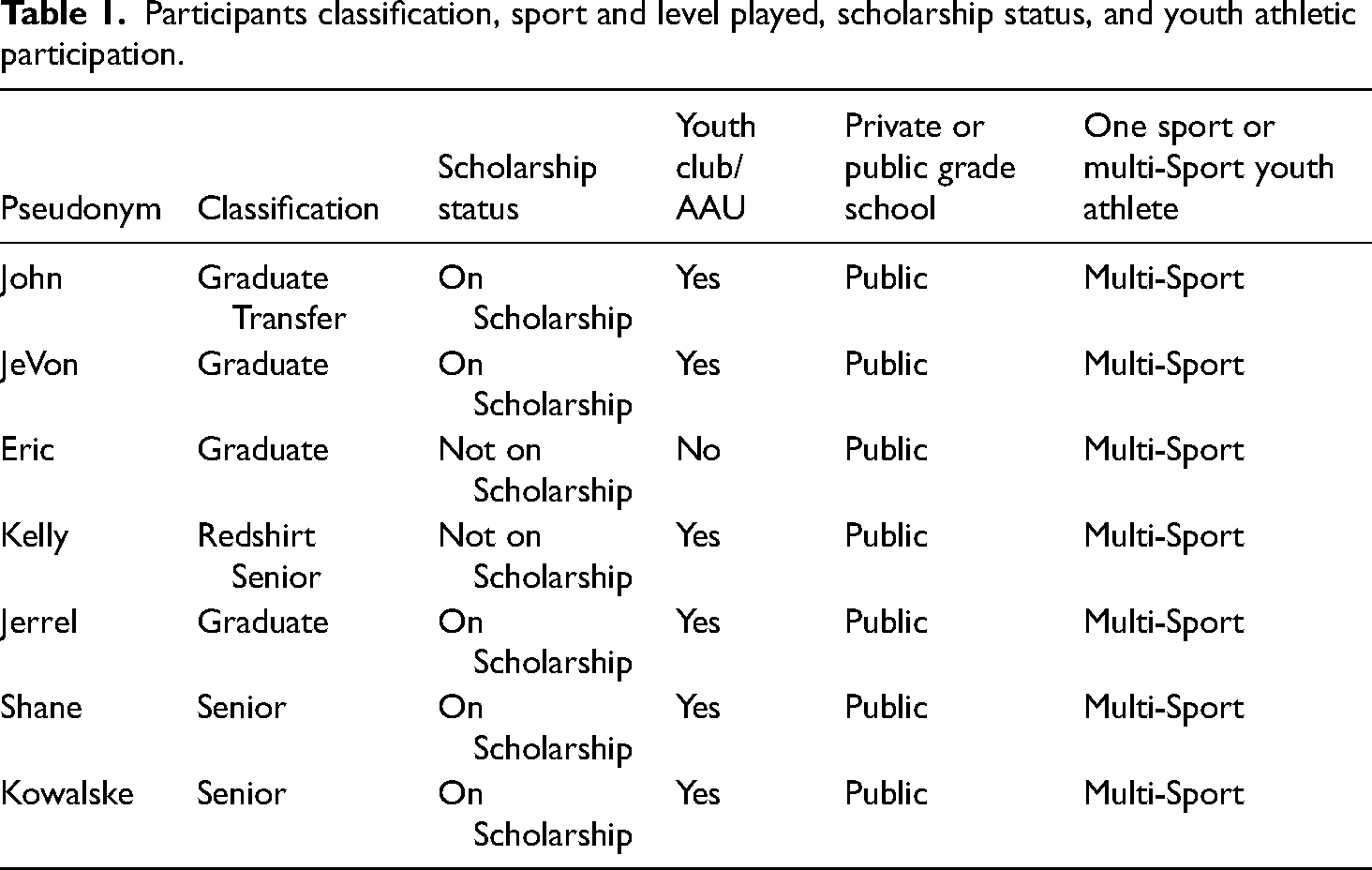
Participants classification, sport and level played, scholarship status, and youth athletic participation.
Participants socioeconomic and parental history.
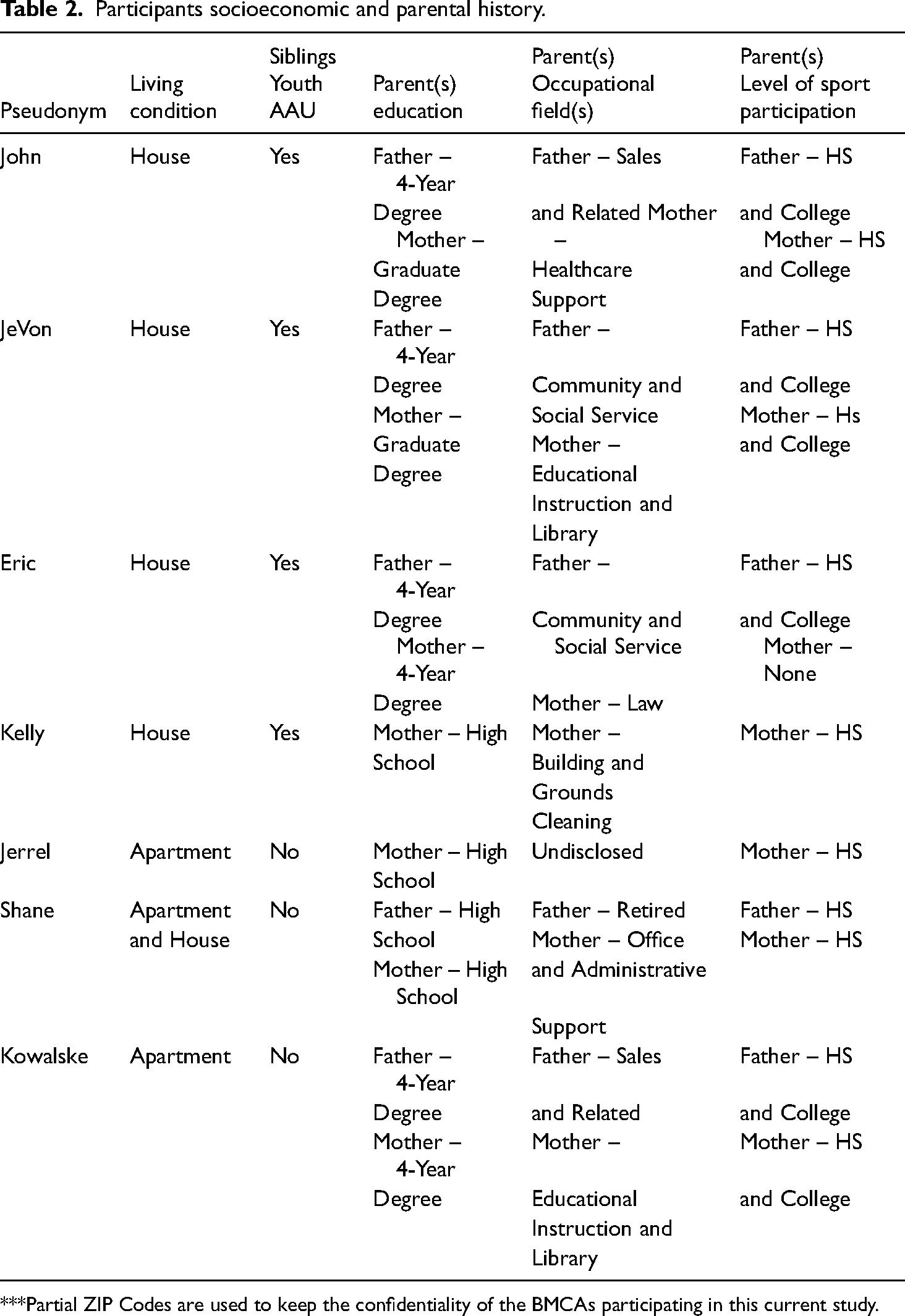
***Partial ZIP Codes are used to keep the confidentiality of the BMCAs participating in this current study.
Literature review
Critical Race Theory has become increasingly salient in the aftermath of the 2020 racial reckoning post-George Floyd murder, particularly within HWCUs (Bonilla-Silva and Peoples, 2022). Scholarship has leveraged CRT via an influx of sport research on athlete activism (Agyemang et al., 2010; Cooper et al., 2019), civil unrest (Keaton and Cooper, 2022; Singer et al., 2019, 2022), and (racialized) exploitation in sport (Beamon, 2008; Kalman-Lamb et al., 2021; Southall et al., 2023). Previous studies have critiqued racially marginalizing educational practices (Singer et al., 2022), interest convergence between Black athletes and HWCUs (Carter-Francique et al., 2017; Donnor, 2005; Harrison et al., 2017), intersectional experiences of Black female (hereinafter referred as women) athletes (Carter-Francique et al., 2018; Cooper et al., 2016), gendered-racist experiences of BMCAs (Bimper et al., 2013; Howe, 2023), and BlackCrit analyses of college athletics (Foster et al., 2022). Additionally, emerging scholarship in the NIL era has examined the identity development of Black college athletes by critically deconstructing the intertwined systems of academic and athletic capitalism that privilege Whiteness while marginalizing Black athletes’ lived experiences and opportunities (Dexter et al., 2021; Howe, 2023; McAulay, 2024).
Black males historically have described the difficulty of reconciling a multidimensional sense of self; Du Bois’ “two-ness” (double consciousness) captures the tension between positive self appraisal and devaluing external judgments (Du Bois, 1903/2016). In HWCU contexts, they mobilize double consciousness as a “coping-strategy”—that is, cognitive assimilation—that safeguarded dignity while sustaining perceived self authenticity in a racial society and functioned as (counter)storytelling against deficit narratives (Okuwobi et al., 2023: 243). These storied athlete identities—Du Bois’ double consciousness and the evolving Black male identity—clarify how navigating HWCUs in the NIL era “impacted the relationship between the psychological states associated with emerging adulthood and well-being” (Baggio et al., 2017: 395). BMCAs occupy liminal roles shifting from dependence to independence (Herman II, 2023; Ibarra and Obodaru, 2016) while matriculating through the AIC (Runstedtler, 2018; Smith, 2007), “oscillating between unstable” adult roles with episodes of regression (Hill and Bosick, 2017: 475) and the infantilized BMCA the NCAA seeks to govern (Southall et al., 2023). Given these dynamics, mental health is paramount, and identity formation remains a central developmental task from adolescence through emerging and young adulthood with direct implications for psychological well-being (Baggio et al., 2017; McLean et al., 2017).
CRP further informs this work, emphasizing academic success, cultural competence, and critical consciousness via student-centered teaching approaches (Ladson-Billings, 1995). CRP fosters counter-spaces where marginalized students challenge stereotypes and affirm identity (Solórzano et al., 2000). In athletics, CRP has been shown to support Black college athletes’ academic self-efficacy and identity development (Carter-Francique, 2013; Mallery Jr., 2020). Despite the NCAA's professed commitment to education, Black athletes continue to experience restricted career mobility, influenced by pre-college conditions, inadequate preparation for life and careers beyond sport, and institutional priorities that privilege athletic eligibility over genuine academic development—dynamics that sustain the systemic power of the AIC (Comeaux and Savage, 2025). Moreover, through mechanisms of hyper-surveillance and the absence of meaningful structural or career development resources, the NCAA further limits BMCAs’ academic engagement and holistic empowerment, particularly within the evolving NIL landscape (Comeaux, 2018). Yet, structural inequities persist in the NCAA, where leadership remains overwhelmingly White, reinforcing color-blind racism and emphasizing commercialization over educational values (Sack and Staurowsky, 1998). Scholars call for race-conscious, culturally relevant leadership to address inequities in athlete development welfare (Cooper, 2016; Harper, 2015). Collectively, CRT and CRP scholarship highlights the need for structural reforms and culturally sustaining approaches that affirm BMCAs’ identities and prepare them for post-athletic transitions.
Theoretical framework
This study draws on CRT, CRP, the Master Narrative Framework (MNF), and narrative identity to analyze how BMCAs at HWCUs construct and contest identity in the NIL era. Together, these frameworks illuminate how racialized structures and dominant cultural scripts shape BMCAs’ self storying, belonging, and agency under social media hypervisibility that commodifies authenticity and heightens mental health risks. Centering (counter)storytelling and culturally responsive supports, the author employ critical, narrative-based lenses to clarify pathways for identity work that sustains well-being across emerging adulthood, enables thoughtful engagement with NIL opportunities, and deepens understanding of lived experiences and holistic development.
Critical race theory
CRT, derived from Critical Legal Studies, examines how race and racism are deeply embedded within dominant ideologies, institutional systems, and cultural narratives (Bell, 1995; Singer et al., 2019). Its five core tenets—(counter)storytelling, permanence of racism, Whiteness as property, interest convergence, and the critique of liberalism – expose how institutions such as the NCAA and athletic departments perpetuate and reproduce racial inequities (Crenshaw, 1995; Delgado, 1989; Haney Lopez, 1994; Harris, 1994). Ladson-Billings and Tate (1995) contend that “(a) race is central to U.S. inequity, (b) property rights undergird U.S. society, and (c) the race-poverty nexus is essential to understanding social inequity” (48)—principles especially salient for BMCAs. Clarifying what counts as CRT, Lynn and Dixson (2021) note that not all race-focused work “qualifies” (36) and that CRT entails viewing “racism as ordinary” (37), explaining change through interest convergence rather than “altruism” (38), recognizing race as a “social construct with no genetic basis” that structures unequal life chances (39), rejecting “essentialism” (40‒41), using storytelling to illuminate “legal principles of racial/social justice” (42), and maintaining “rigor equal to or exceeding other scholarship” (45).
As both an analytical framework and a social justice tool, CRT seeks to explain and challenge the mechanisms through which race and racism shape experiences and power structures, particularly among oppressed groups worldwide (Bell, 1995; Singer et al., 2019). Ray (2022) characterizes CRT as a “body of scholarship that faces America's brutal racial history, recognizes the parts of history that remain unchanged, and works towards changing the rest” (p. xix). Within this study, CRT frames how systemic inequities within the NCAA and HWCUs shape BMCAs’ lived experiences and identity development, while (counter)storytelling captures their resistance to deficit-based narratives (Du Bois, 1903/2016; Woodson, 1933/1990).
Culturally relevant pedagogy
CRP extends CRT by offering a pedagogical praxis that emphasizes academic success, cultural competence, and sociopolitical consciousness (Ladson-Billings, 1995; Laughter, 2013). In athletics, CRP affirms Black athletes’ cultural strengths, fosters identity-affirming counter-spaces, and develops critical awareness of systemic inequities (Carter-Francique, 2013; Mallery Jr., 2020). It validates cultural identities as assets and connects students to broader social psychological strain and cultural dislocation, highlighting the need for identity-affirming approaches rather than assimilation (Laughter, 2013).
Master narrative framework (MNF) and narrative identity
While CRT and CRP expose systemic inequities and educational practices, MNF and narrative identity address how individuals internalize, resist, and reinterpret these forces through personal storytelling. Master narratives – culturally shared stories prescribing how to be a “good members of a culture” – operate through ubiquity, utility, invisibility, rigidity, and compulsory nature principles of identity development (McLean et al., 2017; Syed et al., 2020: 501). Narrative identity conceptualizes the self as an evolving, integrative story linking past experiences, present realities, and “imagined futures” (McAdams and McLean, 2013: 234). This study use narrative inquiry to analyze how BMCAs construct meaning, resist marginalization, and redefine identity at HWCUs in the NIL era (Clandinin, 2006).
Research design
From a larger study, this work adopted a critical constructivist epistemology, blending critical theory and constructivism to examine how BMCAs construct meaning within cultural, social, economic, and psychological contexts (Creswell, 2009; Kincheloe, 2005). Critical constructivism challenges practices that privilege dominant perspectives and promotes reflexivity, dialogue, and critical self reflection; it assumes knowledge is socially constructed and that forms aligned with existing hierarchies are systematically privileged (Kincheloe, 2005). Grounded in narrative inquiry, the author used MNF to interrogate how power, culture, and institutional structures shape NIL era experiences (Clandinin, 2006; Syed et al., 2020). Semi-structured life story interviews generated in-depth narratives of how athletes navigated both college and athletic environments within broader cultural scripts (Atkinson, 1998; McLean et al., 2017; Patton, 2002).
Participants and data collection
Using purposive sampling with maximum variation, the author identified seven BMCAs from four NCAA Division I P4/G6 institutions (Patton, 2002; Suri, 2011) (Tables 1, 2). Criterion included: (a) self-identified Black male, (b) active roster status in football or track, (c) GPA ≥ 3.0, (d) athletic participation on/before Fall 2021, and (e) at least one NIL deal. Given the depth of data derived from the semi-structured interviews, the use of non-probability and maximum variation sampling was essential to capture diverse, in-depth perspectives and achieve a holistic understanding of participants’ lived experiences (Creswell, 2009; Patton, 2002; Suri, 2011). Focusing on Division I reflects where NIL policy changes have the greatest impact and where Black males constitute the largest demographic within men's football and track and field (Cooper, 2016; Southall and Nagel, 2021). This demographic was selected because (a) minority males are overrepresented in these profit-generating sports and face high rates of athletic identity foreclosure (Adler and Adler, 1991), (b) these sports produce the greatest institutional revenue (Southall et al., 2023), and (c) they exemplify ongoing athlete exploitation through debt, low graduation rates, and inadequate post-athletic life preparation (Beamon, 2008; Cooper, 2019). Life story interviews provided a framework for knowledge construction, enabling participants to articulate AIC navigation through open-ended, reflective storytelling (Atkinson, 1998; McAdams, 2001; McLean et al., 2017).
The author triangulated these interviews with ten publicly available interviews – five with NCAA presidents and five with BMCAs – selected for their discussion of NIL implementation amid limited public discourse during the second full NIL season (April 2023) (Adler et al., 2017; Carter et al., 2014; Syed et al., 2020). Participants also completed photo-elicitation tasks by submitting social-media posts on racial profiling, discrimination, and identity negotiation; images were analyzed using CRT's five tenets (Bell, 1995) and interpreted using Denzin's (1989) biographical method to mark life “turning points,” yielding richer, more concrete narratives than interviews alone (69) (Harrison and Lawrence, 2004; Herman II, 2023; McLean et al., 2017). Methodologically, this design links identity work to the NCAA's stratified competition levels – FBS/P4 versus FCS/G6 – where capitalistic market logics concentrate exposure, revenue, and NIL opportunity at the top and constrain agency below; CRT-informed analyses illuminate how these hierarchies commodify visibility and narrow the terms of authentic self presentation in the NIL marketplace.
Interview transcripts were coded in ATLAS.ti, and concept mapping was used to identify patterns across the dataset (Creswell, 2009). Transcription accuracy was checked using Voice Dreamer (Creswell, 2009). Analytic procedures were guided by the MNF and attended to both content and process in order to assess how athletes negotiated, resisted, or internalized cultural narratives (Syed et al., 2020). Additionally, Constant Comparison Inquiry was used as the primary analytic perspective to categorize themes for comparison, integration, delimitation, and documentation in relation to the existing literature (Maykut and Morehouse, 1994). Through this process, categories and their properties were integrated and refined, and concepts were sharpened to ensure clarity and credibility while presenting only the material necessary for comprehension (Breitmayer et al., 1993; Butler-Kisber, 2010).
Positionality statement
The author is a research assistant professor at University of South Carolina; a predominately White institution affiliated with NCAA Division I athletics. His lived experience as a former collegiate athlete significantly informs both his passion for this study and his positionality within it. His positionality is rooted in identifying as a Black, cisgender male of Creole lineage and an emerging academic, which grounds his connection to the shared cultural and experiential background of this study's participants (Berlin, 1996). The author's investment in his athletic identity enabled him to earn both academic and athletic scholarships, ultimately allowing him to letter at a HBCU in football. As a former scholar-athlete, who made the Dean's List during his first year but later struggled with imposter syndrome, depression, illness, and reduced playing time, his lived experience exemplifies his proximity to the research. It highlights the importance of examining the navigational strategies and support systems necessary for the success and well-being of Black male college athletes.
Findings
Theme I: Past—Du Boisian double consciousness
Du Boisian double consciousness
Participants described difficulty grasping multidimensional identities, reflecting Du Bois’ (1903/2016) concept of double consciousness – two-ness shaped by positive self appraisal and negative societal perceptions. Double consciousness functioned as a coping strategy (cognitive assimilation) to navigate HWCUs while maintaining dignity and authenticity in a racialized society (Okuwobi et al., 2023). Conscious of their visibility as Black men, participants recognized the persistent biases tied to their athletic identity. Many employed strategies such as positive mental affirmations, describing “overcoming biases” as essential to successful navigation (John). However, they stressed aspiration beyond survival, seeking holistic development that integrated academic, athletic, and personal growth – though they believed institutions prioritized athletic performance over student-centered advancement (John, Kowalske).
Shane's reflection captured this imbalance: he was reminded by his father to return home “with that degree,” highlighting how growth was framed as individually pursued rather than systematically cultivated. In particular, he determined the HWCU expectations were not indicative of his own ambitions: Bruh, the goals hit different for athletes. Most of us come in focused on what we can do for the team or what the university can do to help us get where we want to go. It takes some guys a while to realize there's more to it, but I caught on early.
Photo elicitation reinforced these dynamics; after reviewing graduation gap data, participants shared images that countered deficit narratives (i.e., personal graduation photos) (Jerrel, Kelly, and Shane) and Jackson State University's recognition for high graduation rates (John) (GoJSUTigers.com, 2023; Wallace et al., 2023a, 2023b). These examples highlighted overrepresentation of Black males on athletic teams alongside underrepresentation in the broader student body – patterns that reveal how HWCUs primarily value this group for athletic labor, fostering otherness and stereotype threat (Foster et al., 2022; Harper, 2015).
Participants managed perceptions and strategically leveraged resources while moving along the AIC's conveyor belt without rocking the boat (Rhoden, 2006; Runstedtler, 2018). Adaptation entailed (a) performing as the lone representation of Blackness and guarding against stereotype threat; (b) crafting self narratives that counter master narratives; and (c) remaining clear-eyed about personal aspirations versus institutional intentions at HWCUs. John reported vigilant self monitoring – staying on his “best behavior” as often the only Black person in the room – to avoid reinforcing stereotypes; Eric highlighted perceptions that Black football players are “dumb” and valued only as entertainment; and JeVon captured both the “blessing” and stigma of being a BMCA, noting their commodification and urging peers to “maximize resources.” Participants described the vigilant self monitoring, contested “dumb athlete” stereotypes, and the commodification of BMCAs while urging peers to maximize resources; collectively, these accounts illustrate strategic responsiveness to interest convergence (Cooper, 2019).
Theme II: Present—Black male storied athlete identity development in a society grounded in anti-Black racism
Participants resisted being siloed as “just athletes,” frequently articulating broader identities (i.e., volunteerism, entrepreneurship, faith traditions). Even upon prompting during questions, participants reverted to self-identifying as student-athletes instead of “scholar athletes.” Several described de-identifying form the athlete label to expand opportunities and align with personal values; legacy building, authenticity, and knowing one's value were central motifs. These reflections emphasize identity work (Black Male Storied Athlete Identity Development in a Society Grounded in Anti-Black Racism) that integrates academic, athletic, and community roles amid NIL era visibility and scrutiny. John displayed his evolved holistic identity by amplifying his graduate transfer student-athlete status: I like to think [of] myself, I'm a lot more than just, an athlete. I take pride in volunteering and extracurriculars, and honestly, I’m more proud of those contributions than my athletic achievements. Like, maybe some [athletes] are just like very one-dimensional.
Additionally, Keshawn in his evolved Black male identity realized capacity was in understanding the nature of him being a student-athlete entrepreneur or athletepreneur: My mindset from being more than just a student-athlete, to being an entrepreneur…you have a different mindset because you know you want to connect with them…you know build that relationship, so you start partnering with those brands you go with every day. (NCAA, 2022, 9:07–9:25)
Finally, Shane's evolved Black male identity involved him de-identifying with the “slash athlete” and the opportunities it avails: Being an athlete will always bring praise, but I’ve come to see it as just one part of me. That “slash athlete,” is not the only part. Sport opened doors for me, giving me leadership, discipline, and a sense of responsibility.
As participants evolved through their college tenures, they recognized the importance of investing in themselves holistically regardless of the messages and/or supports (or lack thereof) they received from their athletic departments. Intentionally dedicating time, energy, and effort in areas beyond athletics was shared by several participants when reflecting on their current status within the NIL policy change era.
In this study, de-identifying as an athlete refers to the process by which participants consciously separate their athletic identity from other dimensions of self and intentionally work to redefine themselves beyond their roles as athletes. Therefore, de-identifying as an athlete required legacy building (Rayquan, Jerrel, Kelly), not caring what people thought of them as BMCAs (Eric and Jerrel), finding authenticity (all), and knowledge of their value (all). BMCAs described this instance of de-identifying as an athlete by overcoming biases (John), being men of faith (Jerrel, JeVon, and Kowalske) and countering stereotypes of ignorance (Kowalske, Eric, Kelly, Jerrel, and JeVon). For example, Eric stated that navigating his HWCU came with being judged based on being a BMCA: I feel like some of the Black athletes are judged by many of the White people. Many people [around campus] assume Black athletes won’t succeed or will get caught up in trouble. It creates a stereotypical environment where we constantly have to prove ourselves.
As part of the photo elicitation exercise, participants reflected on their situated roles in athletics and academics (i.e., perceived self) while challenging dominant ideologies of BMCAs through a critique of liberalism (Crenshaw, 1995; Harris, 1994). They were asked: Can you show me a social media post, following NIL policy implementation, that you consider racially biased or discriminatory as a Black male athlete? Responses varied.
Jerrel shared a YouTube video documenting a social media exchange with local media, which he viewed as damaging to his NIL brand. Throughout this interview, he emphasized pride in representing himself, his family, and his state with integrity; thus, being vilified for defending his university's culture infuriated him, and he chose this incident as emblematic of racial discrimination. Kowalske submitted a diagram illustrating individual racial biases, emphasizing how “power and privilege disparities, cultural narratives, segregated communities, shared stereotypes, and nonverbal messages,” shaped by his navigation of HWCU environments (Skinner-Dorkenoo et al., 2023: 392). John selected an article on NCAA March Madness highlighting discriminatory narratives toward Louisiana State's Black women on their basketball team, described as “dirty debutantes” (Rayford, 2024). As a track and field athlete, he stressed the need for gender-inclusive solutions for Black athletes. Notably, Kelly and Shane did not respond, making this one of only two questions unanswered by all participants.
Theme III: Future: Know your value and lack of access supports
Know your value
Further, participants differentiated between external NIL valuations and self assessed value grounded in campus influence and community contribution. They identified gaps in tailored resources for BMCAs (i.e., time-management, consistent support, brand-building coursework, and access to legal/financial experts). Peer-driven transparency and community engagement emerged as preferred mechanisms for navigating NIL complexity and sustaining holistic identity development. Therefore, realization and understanding of value (Marvin Harrison, Jr.) and how to capitalize on that value was fundamental to BMCAs successful navigation of NIL policy change era on HWCU campuses. Knowledge of value involved three steps: (a) determination of value, (b) assessment of value, and (c) putting yourself in position to capitalize on that value. Specifically, BMCAs were asked what their value in the NIL policy change era of Division-I athletics entailed. Kelly, Jerrel, Eric and Shane stated that On3.com assessments for their value monetarily were “inaccurate.” However, their self-assessed value was overall determined as high. For example, Kowalske described his self-assessment: I feel like people care about things I do. I may not have the biggest name, but my influence on campus is strong. I feel valued here, and I try to use that platform to encourage others.
Additionally, Kowalske maintained his assessment of value by not comparing himself to anyone including peers in sport: “I do good not comparing myself to anybody in terms of NIL money. People, at bigger schools are gonna probably make more money… I kind of look at the guys at the [NFL] combine and see their numbers. See kinda how I would measure up to them.” One of the reasons why I like the student piece [it] is so important to me. The student role matters because of the biases that athletes aren’t smart or focused. I push myself outside of sports to inspire people who look like me and be a good example.
Hence, another example of the BMCAs in this study positively responded to devalued perceptions of their worth within and beyond athletic contexts. The BMCAs in this study possessed a strong sense of self, which was cultivated by their family.
Lack of access supports
Participants consistently emphasized that resources specifically tailored to BMCAs were either limited or non-existent. Most described an institutional landscape devoid of BMCA-focused support, though John and Kowalske noted that the Black Student-Athlete Council (BSAC) provided a sense of community and belonging. Several participants identified pressing needs, including improved time-management resources (Rayquan, John, Eric, and Wingo), greater consistency of support (Shane and JeVon), courses focused on brand-building (Keshawn), and increased access to legal and financial experts who could review NIL contracts (Shane, Eric). John also availed the lack of resources for graduate transfers, noting that networking opportunities on new campuses were particularly insufficient. He linked this to broader sociohistorical contexts, reflecting: I’m just thinking about like the role sports plays, in the Black community. Sport is often seen as a way out – a chance for education when other options feel limited. That narrative shapes why so many pursue athletics.
For John, Eric, and Jerrel, volunteering also became a critical resource for identity formation. Eric, in particular, highlighted his community engagement as central to how he wished to be valued through NIL: Giving back is my strength. Partnering with a high-profile alum to support kids was special. I’d love to use NIL for opportunities like that.
Beyond fulfilling obligatory service hours, participants viewed giving back as mutually beneficial and integral to holistic identity development. These perspectives suggest that athletic departments could learn from BMCAs’ emphasis on community-based engagement when designing holistic programming.
Resources were also tied to navigating the uncertainties of the NIL era, enhancing BMCAs’ confusion about NIL policy and their career outcome implications. Shane articulated the need for financial education: Athletes should be in position to be involved with people that’ll help them. I hope for resources that prepare us for the future – financial advisors, real training on taxes, budgeting, and saving. Many athletes get money without understanding how to manage it. That knowledge is crucial. Like nobody wanna sit in no meetings, but if we sit in a meeting all day. At least let it be a meeting that's gonna allow me to understand what I'm getting myself into.
Meanwhile, Rayquan Smith described transparency as peer-driven: The questions always start with “how?” … I would never charge my teammates for information…I’ll answer, answer the question. Close mouths don’t get fed. (Dosh, 2022, 22:16–22:47)
Collectively, these insights highlight the urgent need for targeted, culturally relevant, and future-oriented supports to help BMCAs navigate both the demands of HWCUs and the evolving NIL landscape.
Discussion and conclusion
Generalizability is constrained by a small, regionally specific sample and a focus on BMCAs in Division I P4/G6 contexts (Hennink and Kaiser, 2022; Queirós et al., 2017). As a qualitative inquiry, broad generalization was not the aim; nevertheless, insights from seven participants yielded meaningful understanding of NIL-era identity challenges and successes (Ladson-Billings, 2024). Absent from this sample are athletes at HBCU and Black women athletes, whose intersectional marginalization warrants dedicated inquiry (Cooper et al., 2016; Runstedtler, 2018). Future research should extend across NCAA divisions and identities (i.e., HBCUs, Division II, women, transfer, and walk-on athletes) to contextualize and refine these findings.
Due to the first two season of NIL implementation unfolded immediately after the 2020 athlete-led protests – which revealed both the mobilization of BMCAs and the paucity of institutional structures for unity and deep meaning-making – the early NIL period has uniquely burdened BMCAs with hypervisible social media self branding that intensifies identity strain and mental health risks (Lee, 2021; Washington, 2020). In HWCUs, holistic development – physical, spiritual, and psychological – is essential as NIL accelerates liminal (i.e., role) transitions and uncertainty, yet chronic time constraints impede exploration and resource use (Brottem, 2019; Dodd, 2024; Jolly et al., 2020). CRT clarifies how racialized structures within the AIC shape access, expectations, and harm, while CRP offers a practice-oriented pedagogy that affirms cultural identity and supports healthy identity development; without structural reform, NCAA approaches risk performative emphasis on individual coping and “cultural sensitivity” (Kroshus et al., 2023: 141).
Guided by CRT and CRP, athletic departments should embed race-conscious, identity-affirming practices across the athlete lifecycle (from recruitment through degree completion) in partnership with cultural centers and social-justice initiatives; pair culturally competent counseling with structural time protections (i.e., in-season course-load adjustments, protected exploration blocks) and sequenced transition programming; and enact governance changes that reduce infantilization and expand genuine adult roles (i.e., athlete representation in policy and NIL decisions); and NIL/social media education should set realistic revenue expectations, emphasize low-burden strategies, prioritize digital well-being, and use disaggregated metrics to evaluate progress (Brottem, 2019; Kunkel et al., 2021; Runstedtler, 2018).
For BMCAs, identity work grounded in CRT/CRP – journaling, (counter)storytelling, purpose alignment – combined with time audits, low-time/high-fit NIL strategies, culturally competent support teams, and adult-role opportunities (leadership, internships, academic projects) supports mental health and expands post-athletic pathways (Du Bois, 1903/2016; Sadberry and Mobley, 2013; Southall et al., 2023). More specifically, BMCAs can join or create advisory councils, build peer and alumni networks – including HBCU and women-athlete linkages – to counter isolation, and use institutional data and supports to craft individualized academic, NIL, and career plans that identify transitions (Cooper, 2019). Taken together, centering CRT and CRP within reformed structures situates BMCAs’ storied identities within the NIL ecology, linking AIC navigation to the “psychological states of emerging adulthood and well-being” (Baggio et al., 2017: 395).
Footnotes
Acknowledgements
This study was funded by a grant from the University of Florida Sport Management Department in the amount of $500 to complete this study. The author extends sincere thanks to the Black male college athletes who participated in this study for their time, transparency, and contributions to advancing this research.
Consent to participate
All participants were informed to consent via written and verbal acknowledgement.
Consent to publication
The author has consent to publish.
Declaration of conflicting interests
The author declared no potential conflicts of interest with respect to the research, authorship, and/or publication of this article.
Ethical considerations
This study includes a detailed presentation of research materials, including the sampling plan, data exclusions, and all measures used. The author followed the International Review for the Sociology of Sport methodological checklist throughout this study. In accordance with IRB approval, the data are not available for sharing beyond the extent to which they are included in this manuscript. Additional syntax files, data, and support materials are available by emailing the corresponding author. For this study, design and analyses were not preregistered.
Funding
The authors disclosed receipt of the following financial support for the research, authorship, and/or publication of this article: This work was supported by the University of Florida Sport Management Department Doctoral Research Grant of $500.
