




Abstract
Drawing on Bourdieu's theory, this study examines the development of safeguarding measures by international sports federations, conceptualised as a case of ‘performative compliance’. Using a multi-step qualitative abductive approach, through a document analysis, it analyses how these organisations address safeguarding. The findings reveal a proliferation of measures introduced in response to external pressures and rising stakeholder expectations. However, federations often tend to privilege initiatives with high symbolic value over comprehensive strategies with lasting impact. This emphasis on appearances suggests that the pressure to demonstrate compliance implicitly drives the adoption of measures that, while contributing to safeguarding, carry a strong symbolic dimension. Building on these insights, the study theorises safeguarding as a process that entails both practical implementation and symbolic positioning within the field and proposes a model to help federations develop more effective safeguarding strategies.
For decades, interpersonal violence 1 (IV) – encompassing the various ways individuals may experience harm, such as physical, psychological, sexual abuse, harassment or neglect, remained a blind spot for sport organisations (SO) (Mountjoy et al., 2016), which too frequently avoided or showed reluctance to address it (Lang and Hartill, 2015). Recently, however, growing concerns about athlete protection have followed the emergence of numerous cases (Constandt et al., 2023; Kerr et al., 2025). Analyses of these cases highlight their systemic nature, deeply embedded within organisational structures, affecting all levels and types of sport (Kerr et al., 2019; Owusu-Sekyere et al., 2021). An emblematic example is the Larry Nassar case – a major instance of sexual abuse, which exposed how institutions fostered environments where reputation, success and winning were prioritised over athlete safety (McPhee and Dowden, 2018) and revealed wider governance failures, notably the lack of adequate safeguarding policies and practices to protect athletes (Harrison and Wolf, 2018).
In this context, the concept of safeguarding has gained prominence, shifting the focus from protection during training and competition to the wider sport ecosystem (Rhind and Owusu-Sekyere, 2018), with the aim of creating environments that prevent abuse (Kerr and Stirling, 2019) and other forms of IV. However, without a clear framework, interpretations of ‘safe sport’ remain uneven among stakeholders, particularly those in positions of power. Gurgis et al. (2022) identify three overarching themes around safe sport: environmental and physical safety, relational safety, and optimising sport. The most recent International Olympic Committee (IOC) consensus statement, published in 2024, defined safeguarding as ‘all proactive measures to both prevent and appropriately respond to concerns related to harassment and abuse in sport as well as the promotion of holistic approaches to athlete welfare’ (Tuakli-Wosornu et al., 2024: 1323).
The growing emphasis on safeguarding, evidenced by the first International Congress on Safe Sport Research in 2025 in Québec, has created shared expectations that sports organisations commit to comprehensive strategies for athlete wellbeing (Lang and Hartill, 2015). Adopting a single policy is no longer sufficient. As Donnelly et al. (2014) emphasise, effective safeguarding depends on making policies publicly accessible, implementing clear and public procedures, and appointing trained personnel, ensuring that safeguarding becomes an integral part of organisational responsibility. Yet researchers have paid limited attention to the role of SO in operationalising safe sport or assessing how safeguarding policies are implemented (Fasting, 2015). This leaves the question of actual practice largely underexplored. Analyses at the level of international federations (IFs) remain scarce, despite their particular relevance. Indeed, as global standard-setters (Chappelet and Mrkonjic, 2019), IFs shape the policies of national federations (NFs), with approaches cascading through countries and disciplines. More, IV in sport tends to occur in environments where other integrity breaches (such as corruption or abuse of power) are also present, as these issues often stem from similar governance failures and organisational culture (Constandt et al., 2023; Kihl, 2022; Robertson and Constandt, 2021). Kihl (2022) documents how weak oversight and accountability mechanisms within sport governing bodies can foster both interpersonal misconduct and other violations, such as financial mismanagement or the concealment of abuse. Understanding IFs approaches is therefore essential to assess progress and to identify structural barriers to meaningful change.
This study addresses the gap by conducting a content analysis of publicly available safeguarding measures adopted by IFs. First, it provides the first overview to date of measures published on IFs English-language websites. To guide this mapping and highlight gaps, we use the “7P” model (Mergaert et al., 2023) originally developed to evaluate institutional responses to gender-based violence in universities and adapted here for international sport. The model captures seven dimensions, which we have adapted to our context. Second, we situate this documentation within a broader sociological perspective, drawing on Bourdieu's theory (1984) and the concept of ‘performative compliance’ (Greener, 2019) in the field of international sport. This theoretical framework helps to explain how IFs adopt safeguarding measures both to manage risks of IV and to demonstrate alignment with emerging standards, thereby signalling commitment to stakeholders – including the IOC, the public, and athletes. While this does not imply that actions are merely symbolic, safeguarding also serves a symbolic function that shapes how these measures operate and are perceived.
Literature review
The evolving understanding of interpersonal violence in sport
Research on IV in sport has developed progressively, with scholars extending inquiries across different forms of violence. Early studies focused on sexual abuse (e.g. Brackenridge, 1994; Brackenridge and Kirby, 1997) and harassment (e.g. Cense and Brackenridge, 2001; Hartill, 2009). Later work broadened the scope to psychological violence and emotional abuse (Gervis et al., 2016; Kerr et al., 2020), physical abuse (McPherson et al., 2016), and neglect (Willson et al., 2022), reflecting a more holistic understanding of IV in sport and recognition of the need to address the full spectrum of IV experienced. Research has also quantified prevalence, mechanisms and consequences. Studies document patterns of IV across forms of violence and actors involved (e.g. Hartill et al., 2023; Marsollier et al., 2021; Parent and Fortier, 2017; Vertommen et al., 2016). National and continental surveys report experiences of sexual abuse ranging from 14% to 38%, physical abuse from 11% to 66%, and psychological abuse and neglect from 37% to 81% (Constandt et al., 2023). Alongside empirical work, scholars have sought broader conceptualisation (Parent and Fortier, 2018). Some use the term gender-based violence (e.g. Mergaert et al., 2016) to highlight power dynamics and gender norms that drive certain forms of violence, while others prefer more neutral terms such as non-accidental violence (Mountjoy et al., 2016). Attempts at classification include Mountjoy et al.'s (2015) distinction between individual, relational and organisational violence.
This conceptual development supported the institutionalisation of safeguarding. The 2024 IOC consensus statement (Tuakli-Wosornu et al., 2024) marked a shift from non-accidental violence to a comprehensive safeguarding framework. It provided, for the first time, a common definition of safeguarding – a notion that SO had rarely formalised. Specifically, it promotes a holistic approach toward athletes’ welfare and explicitly covers the full spectrum of violence facing athletes, their entourage, and SO. As a key normative reference, this statement emphasises the wider sport ecosystem (athletes, entourage, organisations, states, civil society, and researchers) and offers targeted recommendations. IFs, as international non-governmental organisations recognised by the IOC, governing global sport (Chappelet & Mrkonjic, 2019), overseeing NFs and driving change, have a significant role to play.
Organisational and systemic dynamics of interpersonal violence in sport
Building on empirical and conceptual work, scholars have examined the organisational and systemic conditions that foster IV in sport (Roberts et al., 2020; Tuakli-Wosornu et al., 2024). Research has shifted from individual or psychological factors toward broader organisational and cultural dynamics (Owusu-Sekyere et al., 2021). Nite and Nauright (2019), in a comparative study of sexual abuse scandals, show that institutional structures and processes, rather than individual failures, primarily enable violence. Other research points to a deeply entrenched culture of silence and inaction, particularly in paternalistic, male-dominated settings that leave athletes, especially women, vulnerable (Kirby et al., 2002; Parent and Demers, 2011). Roberts et al. (2020) highlight bystander inaction across psychological, physical and sexual violence. Sport's culture of control further normalises violence, especially in its psychological forms (Kerr et al., 2020). For instance, recent empirical research by Schyinck et al. (2024) highlights the relationship between coaching style, club climate and psychological abuse. Practices legitimise IV by normalising it as part of the pursuit of excellence. Emotion abuse can be framed through mottos such as ‘no pain, no gain’ and narratives of sacrifice for success (Gervis et al., 2016). Similarly, adherence to dominant performance values can also foster physical abuse and neglect, such as pressuring athletes to play or train while injured (Roberts et al., 2020; Willson et al., 2022). Donnelly and Kerr (2018), writing on Canada's harassment and abuse policies, describe this as ‘wilful blindness’, where pursuit of performance prevents recognition of IV. Bekker and Posbergh (2021) likewise stress structural and social mechanisms that allow non-accidental violence to be ‘enabled, tolerated, and in some instances, actively encouraged’ (Roberts et al., 2020: 9). Therefore, SO must be seen not as passive settings where IV occurs but as environments that may normalise or conceal it.
Safeguarding in sport organisations: Underexamined frameworks and practices
Building on research on IV and its structural drivers, scholars have also studied how organisations respond institutionally. Because the absence of safeguarding procedures is a major risk factor (Brackenridge, 1997), many organisations adopt policies, codes, reporting mechanisms or safeguarding officers. Evaluating their design and effectiveness has been identified as crucial (Brackenridge, 2010). Pope (1996) argues that meaningful responses require a cross-cutting approach combining policy frameworks, practice and stakeholder engagement. Yet, much research still privileges individual behaviours and prevalence data, leaving organisational responses understudied. National-level studies suggest institutional measures remain fragmented or superficial (e.g. Donnelly et al., 2014; Kim and Connaughton, 2024). Brackenridge and Rhind (2014) note the tension between ‘getting the right people into sport’ and ‘doing sport right’. Others describe a ‘band-aid’ approach (Gardiner et al., 2017), dominated by reactive or symbolic measures (Cléret et al., 2015).
Despite growing research on international sports governance and integrity (Anagnostopoulos and Winand, 2019), safeguarding remains largely unexplored in this context. It is closely intertwined with good governance principles. Transparency ensures that reporting and disciplinary processes are visible and trustworthy. Accountability clarifies who is responsible for enforcing policies. Democracy or inclusiveness broadens participation in decision making, making it more likely that the concerns of underrepresented groups – who are also among those most vulnerable to violence – are heard and addressed. In this sense, strengthening safeguarding mechanisms also means reinforcing governance structures. IFs, central to global governance (Chappelet and Mrkonjic, 2019), carry both legal and moral duties to prevent and respond to non-accidental violence (Mountjoy et al., 2016). Yet, little systematic scrutiny has been given to how IFs implement safeguarding. Integrity research on doping, match-fixing, corruption and abuse points to persistent inconsistencies and accountability gaps in transnational sport governance (Edelman and Pacella, 2019; Verschuuren, 2020), where enforcement is diffuse and accountability is ambiguous. These findings underline the need to examine how IFs design and operationalise safeguarding frameworks.
Some literature adopts a systems view, exploring how organisational integrity is built and sustained in sport governance. Kihl (2021) argues that robust integrity systems require structures – policies, leadership and decision making – that support integrity goals. Scholars also emphasise the influence of cultural norms and informal values, often seen as barriers limiting the effectiveness of structural reforms (Solstad, 2019). Tak et al. (2024) show that building safe sport cultures requires more than upgrading systems to formal standards; it also demands engagement with sociocultural and institutional contexts. Together, these studies highlight the central role of structural reforms in safeguarding. Yet, it remains unclear whether such reforms are being effectively developed and implemented in IFs, leaving a significant gap in our understanding of safeguarding at the international level.
Safeguarding and its performative dimensions in international sport
Building on the gaps identified in the literature, this study conducts a content analysis of the safeguarding policies and procedures adopted by IFs, drawing on documents published on their websites. However, assessing these measures solely from an objectivist perspective risks producing a narrow and incomplete analysis. Such an approach may overlook the symbolic and performative dimensions of organisational behaviour, particularly how compliance is constructed, displayed and made meaningful in relation to external expectations and field-specific norms. With rising demands for accountability, IFs face growing pressure to present themselves as responsible governing bodies. In this context, safeguarding actions serve a dual function: they operate as tools of protection while acting as symbolic gestures that signal alignment with evolving norms within the sports field.
Accordingly, this study examines the structural changes introduced by IFs through safeguarding measures, while systematically comparing federations to identify broader patterns. The article addresses two research questions: (1) To what extent is safeguarding becoming established as a compliance norm within international sport? (2) How do IFs construct this process through safeguarding measures that are at once structural and performative, serving both organisational reform and the signalling of alignment with dominant field expectations? To analyse these dynamics, we draw on Bourdieu's field theory and, informed by our findings, mobilise the concept of ‘performative compliance’, which together provide a robust lens for analysing the material and symbolic logics underpinning IF safeguarding measures.
Safeguarding as an emerging norm of sport
We use Bourdieu's (1984) field theory to analyse how IFs operate within what he conceptualises as a field – a relatively autonomous social space structured by power relations, shared norms and struggles over legitimacy. This perspective enables us to move beyond an analysis of individual organisations and instead examine how safeguarding initiatives are shaped by broader dynamics of conformity and distinction within the field of sport. In this field, dominant actors such as the IOC play a central role in defining what counts as legitimate and responsible practice. Organisations seek to maintain or enhance their position by aligning with these definitions, especially when doing so reinforces credibility and institutional relevance. This process relates to what Bourdieu calls the doxa – a ‘set of fundamental principles and taken-for-granted beliefs’, collective norms, and attitudes about ideal or ‘right’ practice, ‘accepted as self-evident truths and not typically questioned or challenged’ (Bourdieu, 1977: 166). The doxa is not fixed but evolves through social transformations shaped by the historical and social contexts of its time. For instance, Ohl et al. (2021) demonstrate that ‘clean sport’ became a central component of the doxa following doping scandals that shook the sporting world. The promotion of anti-doping norms by the IOC and WADA was both a regulatory imperative and a strategic effort to restore legitimacy. This shows how institutional norms emerge and become embedded through reputational stakes, normative pressures and symbolic positioning.
We ask whether safeguarding is undergoing a similar process, particularly considering abuse and harassment cases that have tarnished the Olympic movement. Schoch and Pape (2024), using a field approach to gender equality, show how the IOC exerts normative influence over IFs by issuing strategic recommendations that shape governance agendas. They show that this influence is particularly pronounced among mid-sized and smaller federations, which tend to adopt IOC guidelines as a way to enhance their legitimacy, maintain institutional relevance and signal alignment with dominant field expectations. We examine whether safeguarding now operates in a comparable way, functioning as a normative space through which IFs position themselves vis-à-vis dominant actors, signalling moral authority and institutional responsibility. Bourdieu's framework enables us to interpret this dynamic not as a simple policy transfer but as a field-driven process of strategic positioning, symbolic struggles, and mimetic dynamics reinforcing the diffusion of emerging norms across sport.
‘Performative compliance’ in international sport
While Bourdieu's field theory offers a valuable framework for understanding how organisational behaviour is shaped by structural power relations and normative pressures, it is less attuned to the symbolic and representational dimensions of action. To capture this, we draw on the concept of ‘performative compliance’, developed in fields such as residential care (Greener, 2019) and teaching (McCarthy et al., 2025). It describes strategies through which organisations or individuals ‘seek to give the illusion that they are conforming with the “agreed” rules of delivery’ (Greener, 2019: 652). It shows how compliance practices may function as strategic performances aimed at satisfying external expectations, complementing a field-theoretical lens by foregrounding the performative nature of alignment with dominant norms – particularly through visible, standardised actions such as publishing and promoting policies, which are subsequently leveraged in institutional communications to signal compliance.
Bringing together Bourdieu's approach and the concept of ‘performative compliance’ provides a framework for analysing safeguarding measures not only as policy outputs but also as performances affirming institutional credibility, conforming to field expectations and reinforcing or contesting the doxa. The performative dimension does not oppose material or regulatory change but highlights the symbolic work involved in shaping perceptions of compliance and commitment. This is not to suggest measures are insincere or superficial, nor that actors lack genuine conviction. Rather, safeguarding actions can be embedded in processes of representation and are inherently performative, aiming to signal symbolic commitment to evolving norms within the sports field. Analysing safeguarding in this way allows us to examine how IFs navigate expectations, manage reputational risks and contribute to the diffusion of new norms through both formal measures and the meanings attached to them. In short, Bourdieu's framework situates safeguarding within the broader logics of the sports field, while performative compliance highlights its symbolic dimension. Together, they allow analysis of both the structural and performative aspects of IF safeguarding practices.
Methods
Data sources and scope of analysis
This study adopts a qualitative design and multiple case study approach (Yin, 2018) to examine how 40 IFs officially recognised by the IOC as of January 2023 address safeguarding in sport. The aim is not to provide a systematic comparison between IFs, but rather to understand how the safeguarding norm is interpreted and operationalised across diverse organisational contexts. The analysis initially focused on the IFs websites and publicly available documents in English, employing an open and exploratory reading to identify emerging themes. In a subsequent phase, we recognised the relevance of the ‘7P’ model as a useful lens to organise and interpret the material. The analytical process thus followed an abductive logic (Timmermans and Tavory, 2012), characterised by continuous interplay between empirical observations and theoretical concepts. This approach allowed patterns to emerge from the data while we iteratively engaged with existing models to refine our understanding, rather than imposing a predefined framework from the outset.
Data were initially collected between November 2022 and January 2023 and updated in February 2024 as several IFs had implemented policies or amended existing ones during this timeframe. The analyses were conducted collaboratively by the two authors, with all stages discussed in the research laboratory, allowing for shared interpretation, peer feedback and methodological rigour.
Data collection and codebook design
First, we mapped each IF to identify safeguarding-related content, familiarising ourselves with website structures, terminology and available documents. We then uploaded all relevant material, including statutes, constitutions, codes, General Assembly minutes, safeguarding communications, strategic plans and policy documents. To enhance completeness, we ran additional keyword searches using terms such as ‘safe’ and ‘safeguard*’ combined with Boolean operators (AND, OR). These logical connectors allowed us to refine and broaden the research, thereby identifying additional materials that were not directly accessible through website navigation.
Second, we manually compiled an inventory of safeguarding measures adopted by IFs to prevent, address and sanction IV. We systematically structured the high volume of data by adapting the ‘7P’ model developed by Mergaert et al. (2023), which evolved from earlier frameworks addressing gender-based violence. These iterations progressively moved beyond a narrow criminal justice lens to a holistic and intersectional approach. The ‘7P’ model evaluates institutional responses across seven dimensions: prevalence, policies, prevention, protection, prosecution and disciplinary measures, provision of services, and partnership. It enables multi-level analysis spanning micro (incidence and effect), meso (organisational responses) and macro (legal and policy frameworks). We adapted it in two ways: by applying it to IFs, building on its prior use in sport (Mergaert et al., 2016); and by focusing specifically on safeguarding rather than gender-based violence. Consequently, we developed a detailed codebook covering each dimension (see Table 1), with terminology adjusted to sport (e.g. ‘athletes’ instead of ‘students’, ‘coach’ instead of ‘supervisor’). To capture nuances beyond the existence of policies, we systematically collected contextual information, including:
Terminology: how IV and protection are described (e.g. ‘harassment and abuse’ and ‘safeguarding’). Level of detail: description of procedures or mechanisms. Date of publication: the year each document was issued where available.
Codebook.
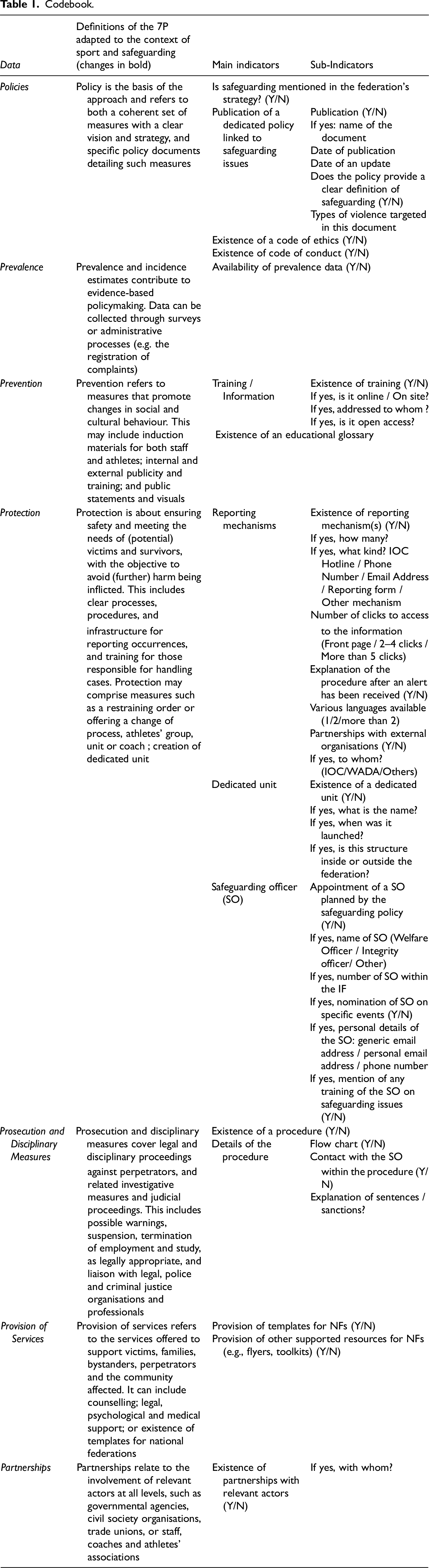
Two methodological challenges emerged. First, terminology varied considerably across federations, requiring careful interpretation and standardisation for consistency (Lang et al., 2023); second, some indicators could plausibly fall under multiple dimensions. To avoid overlap, we classified them by primary focus. By contrast, few indicators were found for certain dimensions reflecting both limited publicly available data and underdeveloped monitoring tools in this area.
Pilot study
The codebook was tested with two IFs selected from the sample: the Fédération Internationale de Football Association (FIFA) and the International Gymnastics Federation (FIG). Both have publicly communicated safeguarding efforts and appear actively engaged, making them suitable for analysing diverse measures. It enabled a critical assessment of the codebook's clarity and relevance, leading to refinement before full-scale application. Additional questions were added on the existence of a code of conduct (beyond codes of ethics), detailed information on safeguarding officers’ responsibilities, and a systematic listing of reporting mechanisms. Improvements continued throughout analysis of the remaining 38 federations, grounding the approach in inductive refinement.
Results
Safeguarding in sport: From a blind spot to a new compliance standard
Safeguarding has emerged as a new standard in international sport, reflected in the proliferation of measures IFs display on their public platforms. Our analysis shows a convergence toward the safeguarding approach promoted by the IOC, suggesting its normative influence and broader field dynamics.
Widespread adoption of safeguarding measures
Of the 40 IFs analysed, 35 have developed safeguarding
Regarding
Type of reporting mechanisms used by 40 IFs.

The widespread adoption of reporting mechanisms and safeguarding officers suggests growing institutionalisation of protection measures, but their scope and depth vary: 17 IFs have at least one reporting mechanism dedicated to safeguarding. By contrast, 20 include safeguarding within broader tools covering corruption, match-fixing, or doping, while two IFs restrict reporting mechanisms to doping, rendering other integrity violations invisible.
Economic and human resources also shape safeguarding practices, yet resources alone do not determine comprehensiveness. Some smaller federations have adopted proactive approaches. For instance, the International Luge Federation, though without a formal policy, has a safeguarding strategy centred on education, awareness and tools for the 2026 Games, alongside two reporting mechanisms and a safeguarding officer. At the other extreme, FIFA has developed extensive training for child safeguarding procedures but lacks a formal policy or designated officer. Its reporting tool addresses all integrity breaches rather than focusing on safeguarding. These cases show that while available resources affect IFs’ ability to implement safeguarding measures, they are not the only factor, and organisational dynamics also play a significant role.
Convergence of strategies among international federations
Safeguarding measures reinforce the idea of a shared norm within the field, aligning across three areas. First, implementation dates reveal increased activity from 2018 onwards. Between 2018 and 2023, 34 IFs published safeguarding policies coinciding with major sexual abuse scandals, the IOC's 2016 Consensus Statement, and 2017 safeguarding Toolkit for IFs. Similarly, 11 of the 13 IFs created integrity units after 2017 (Figure 1). Though varying in form (e.g. units and foundations) and independence – an aspect that is not always clearly explained and raises further questions, these bodies often emerged in response to scandals (Krieger, 2018). For example, the Gymnastics Ethics Foundation was launched in 2019 after the Nassar case, while the Biathlon Integrity Unit followed corruption allegations against officials, including its former president, sentenced in 2024. Their creation reflects both reformist intentions and reputational management, signalling responsiveness within the field. Verschuuren and Ohl (2023) highlight this dual role, showing how World Athletics contained fallout from scandal by creating its Integrity Unit, a strategic move to preserve legitimacy.
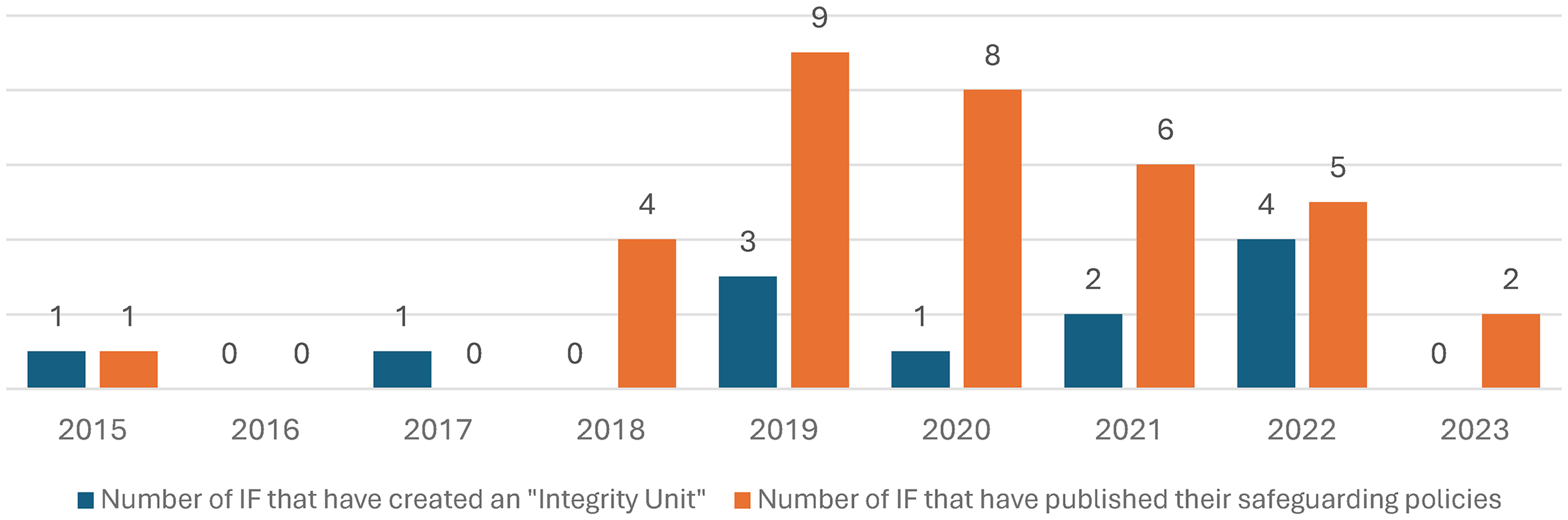
Development of safeguarding policies and ‘integrity units’ within International Federations (2015–2023).
Second, this momentum is accompanied by alignment around ‘safeguarding’ and a shift away from terms such as ‘harassment’ or ‘abuse’. Document titles show that 29 IFs designate them as ‘safeguarding policies’ (Figure 2). This terminology is also reflected in the roles assigned to responsible individuals: 35 IFs have appointed staff under titles such as ‘safeguard* officer’ (n = 24), ‘integrity officer/manager’ (n = 6), ‘lead welfare officer’ (n = 3), ‘medical delegate’ (n = 1) and ‘independent protection officer’ (n = 1).
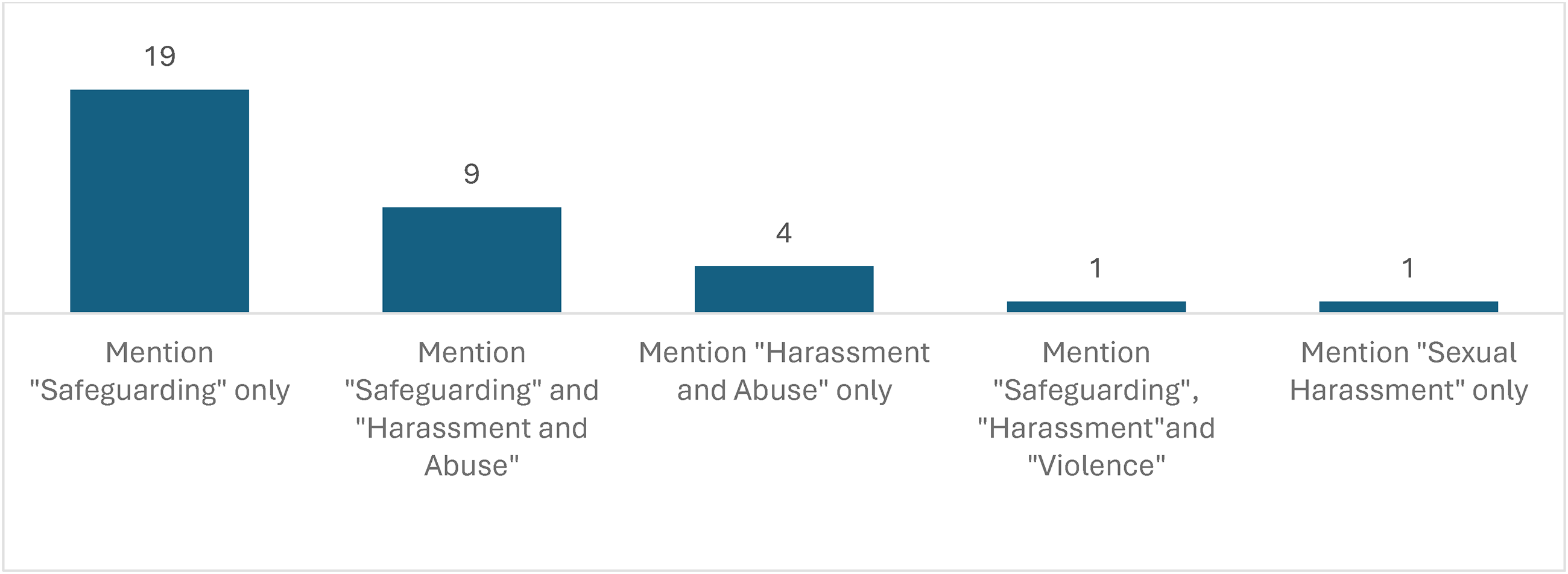
Terminology used in IFs safeguarding policies.
Third, the widespread use of ‘safeguarding’ terminology across documentation indicates a common orientation, positioning it as a central framework for integrity and ethics, broadly consistent with IOC recommendations. In its 2016 consensus statement, the IOC stressed the need for safe sporting environments and urged organisations to implement and monitor safeguarding policies. This was reaffirmed in the IOC Toolkit, which expanded safeguarding beyond children to athletes of all ages. IFs largely adopted this shift: only the International Table Tennis Federation limits safeguarding exclusively to children, while the International Tennis Federation has separate policies for children and adults. The convergence around terminology and scope shows strong alignment with IOC guidance, which federations not only endorse but also operationalise in their frameworks.
Alignment with the IOC also appears explicitly. Nine IFs reference the IOC hotline as a reporting mechanism, with two IFs relying on it exclusively. Although
Overall, data reveal a trend toward standardising safeguarding practices, broadly aligned with IOC recommendations, suggesting a shared normative framework and collective compliance dynamic. Yet this remains partial. While 36 IFs adopt definitions of prohibited behaviours – often drawing on IOC guidelines, the term ‘safeguarding’ itself is loosely defined. Only four IFs define ‘safe sport’ according to the 2016 Consensus Statement, while 12 others offer varied formulations. Such inconsistency produces significant variation in practice, potentially limiting scope and coherence. The 2024 Consensus Statement, which for the first time defines safeguarding, will test whether IFs converge more substantively or continue to diverge.
These findings suggest that safeguarding is increasingly functioning as a compliance norm within the international sports field, reflecting the diffusion of dominant standards promoted by the IOC. This gradual alignment illustrates the mimetic dynamics at play in a hierarchical field, where IFs seek legitimacy by adopting the language and forms of safeguarding endorsed by the field's dominant actor. Yet the persistent of definitional ambiguities and uneven implementation suggests that this alignment may remain largely performative, rather than signalling a full normative consolidation – pointing to an ongoing negotiation over the meaning and value of safeguarding within the field.
Performative compliance and the uneven adoption of safeguarding measures
An analysis of performative compliance dynamics reveals three trends: a fragmented implementation of structural changes; a tendency to develop highly visible and easily communicable actions; and a frequent integration of safeguarding within broader integrity frameworks. While resource and capacity constraints partly explain this, it may also reflect the hierarchical structure of the international sports field, where actors compete for legitimacy through symbolic displays of conformity. In this context, although substantive efforts exist, the visibility and signalling function of measures remains equally important.
Implementation of structural measures in a fragmented manner
Implementation of structural changes across safeguarding domains by the 40 IFs remains uneven and partial. Measures often cover only some of the ‘7P’ dimensions and vary in sophistication, raising questions about comprehensiveness and integration. This suggests that most IFs lack a fully developed strategy addressing all safeguarding dimensions. To illustrate this, the analysis examined three key structural elements: the existence of a safeguarding policy, the identification of a safeguarding officer within that policy, and the establishment of a reporting mechanism. Beyond their mere existence, attention was given to their level of detail and visibility, which reflect varying degrees of institutionalisation. The findings reveal substantial variation in the sophistication of these elements, particularly in terms of their level of detail, clarity and visibility.
First, among the 40 IFs, six have not implemented any of these three structural components, with one federation showing no evidence of safeguarding structures whatsoever. Such limited engagement provides minimal visibility to safeguarding, may discourage reporting, and raises concerns about how safeguarding principles are enacted in practice. Conversely, 34 IFs have adopted the structural elements under consideration, marking notable progress. However, once their content is analysed in greater depth, important discrepancies emerge in their level of sophistication, prompting reflection on how fully these measures capture the range of safeguarding needs and the degree to which they are effectively integrated within each federation. Indeed, seven IFs meet only the three elements, addressing them in a formal yet minimalistic way: they provide no additional information about the safeguarding officer and do not offer a reporting mechanism tailored specifically to safeguarding concerns. Nineteen IFs take a more developed approach by offering supplementary but partial details, such as clearer reporting procedures or more comprehensive information on the designated safeguarding officer (e.g. contact details and training). Although still largely procedural, these provisions indicate a more visible and operational safeguarding architecture. Finally, eight IFs have implemented all three structural elements in a detailed and transparent manner. They provide complete information about safeguarding officers and explicitly state that their reporting systems can be used, or even expressly designed, to address cases of IV. While such measures do not guarantee effectiveness, they perform a dual function: procedurally, they reduce barriers to reporting by clarifying scope and accessibility; symbolically, they reinforce the federation's commitment to safeguarding and enhance its organisational credibility.
Another significant gap lies in initiatives designed to drive change across the field. Implementation of the ‘7P’ model is only partial: some components are inconsistently applied, while others are entirely absent from documentation. The lack of
Regarding
Similarly, regarding
Finally,
In conclusion, the findings indicate that structural changes have been introduced, yet in a fragmented way, with a strong emphasis on Policies and Protection, while the others ‘P’ are addressed more sporadically and less systematically. These steps represent important foundations, but within the logic of the international sports field, they may also reflect efforts to align with dominant compliance models. They are not indicators of cultural transformation within federations (Constandt and Willem, 2021), as their adoption alone does not reveal how safeguarding is embedded in everyday practices or how deeper organisational norms and behaviours evolve.
Noticeable and symbolic actions: An effective communication strategy
There is a tendency among IFs to opt for actions that are both widely accepted and easy to communicate. Often driven by mimetic behaviour within the field, this approach reduces risks while increasing the visibility of initiatives. The creation of dedicated units focused on integrity and safeguarding exemplifies this dynamic. They represent an important step toward safer sport, serving as highly visible institutional signals of commitment that enhance legitimacy through their communicability. Indeed, data show that some IFs are particularly eager to emphasise these structures, highlighting their independence as if this guaranteed both their effectiveness and credibility. The Biathlon federation states that ‘the Integrity Unit is part of the IBU but it's operationally independent’, while the FIG has established an ‘independent and separate Ethics Foundation’. They may also represent decisions with high symbolic value, demonstrating a capacity to respond and comply with emerging norms. These developments show the IFs’ intent to ensure the credibility of their safeguarding initiatives. Despite differences in scope, their promotion aims to present a narrative of transformation and compliance with current expectations.
Navigating safeguarding within broader integrity frameworks
Safeguarding measures adopted by IFs are frequently embedded within broader integrity frameworks. While this integration may be pragmatic – particularly for ‘small/medium’-sized federations with limited resources, it also creates specific challenges. Safeguarding cases differ fundamentally from other integrity issues. Such cases often involve vulnerable individuals and sensitive disclosures, requiring specific training, trauma-informed approaches and a protective environment. In contrast, issues such as corruption or match-fixing demand different expertise and pose fewer risks for those reporting them. When safeguarding is subsumed under broad integrity structures, it risks losing visibility and being handled without the necessary sensitivity. Data show that of the integrity entities established by 13 IFs, 12 address safeguarding concerns. Only two – the Gymnastics Ethics Foundation and the FIBA Safeguarding Council – are dedicated exclusively to safeguarding issues. The others cover a broad range of integrity-related topics, which require distinct expertise and responses. Reporting mechanisms are also instructive: they rarely focus solely on safeguarding and instead address multiple integrity-related matters. Only 17 IFs have developed mechanisms specifically tailored to safeguarding, either as dedicated reporting forms or direct contact with safeguarding officers. This may lower the accessibility and credibility of these channels for potential victims or whistleblowers, thereby limiting their effectiveness.
These observations suggest that IFs may be more inclined to emphasise safeguarding measures that are highly visible and easily communicated, thereby contributing to an image of organisations committed to safeguarding. Yet, such initiatives do not necessarily translate into substantive organisational transformation and may in some cases align more closely with performative compliance. Several shortcomings remain, such as the absence of overarching strategies and measures that sometimes appear underdeveloped or not exclusively focused on safeguarding. Taken together, these elements indicate that the framework remains, at this stage, rather fragmented. Overall, these dynamics reveal that safeguarding has become a terrain where IFs negotiate their legitimacy within a hierarchically structured field. The selective and uneven adoption of measures suggests that safeguarding functions less as a fully internalised norm than as a mechanism of symbolic positioning. Through the visible display of compliance, IFs signal alignment with dominant expectations and seek recognition as responsible organisations. This performative dimension does not necessarily imply insincerity but rather illustrates how conformity operates as a strategy within a competitive field, where legitimacy depends as much on the capacity to be seen as compliant as on the depth of actual organisational change.
Conclusion
This study examined the safeguarding measures and procedures made publicly available by IFs on their official websites. The analysis shows that IFs have developed policies and initiatives signalling alignment with emerging safeguarding expectations, with notable convergence in terminology, timelines and areas of focus closely reflecting IOC recommendations. This indicates that compliance with safeguarding requirements is becoming a normative expectation in the field, leaving less scope for organisations to remain outside this trend. The findings also highlight the importance of structural initiatives, prominence of actions that are visible and easy to communicate, and frequent framing of safeguarding within broader integrity agendas. Simultaneously, the implementation of structural changes remains fragmented, many efforts concentrate on only a subset of measures (notably Policies and Protection), and initiatives often risk being more symbolic than transformative. These dynamics illustrate both the progress achieved and the challenges that remain in embedding safeguarding comprehensively within IFs.
Drawing on Bourdieu's theory and the concept of performative compliance, this study examined how IFs navigate safeguarding expectations through initiatives that emphasise visible alignment with norms. It contributes to the sociology of sport governance by demonstrating how safeguarding operates as both a site of normative diffusion and a marker of symbolic positioning within the international sports field. Further, it extends existing research on organisational compliance (Greener, 2019; McCarthy et al., 2025) and safeguarding (Owusu-Sekyere et al., 2021) by revealing that IFs’ engagement with safeguarding is shaped both by internal processes of transformation and by field dynamics and struggles for legitimacy. Its contribution lies in moving beyond a descriptive account of measures to theorise safeguarding as a process that entails both practical implementation and symbolic positioning within the field.
Practically, this study proposes an adaptation of the ‘7P’ model (Mergaert et al., 2023) to the context of international sport. Beyond its conceptual relevance, this model can serve as a practical roadmap for IFs, guiding them in identifying priority areas for action, structuring safeguarding policies, and monitoring their implementation. By translating general principles into concrete measures, it provides a framework that federations can use to move from ad hoc measures to more systematic and sustainable strategies. Furthermore, the strong similarities between the approaches currently adopted by IFs should be recognised as well as leveraged as they provide an important basis for deeper collaboration, whether through bilateral initiatives or under the coordination of umbrella organisations such as the IOC. Such cooperation could help harmonise standards, pool resources and accelerate the development of effective cultures of protection in international sport.
To further advance research, two avenues can be identified, reflecting both the study's limitations and its potential for future exploration. First, it relies exclusively on English-language documents publicly available on IFs’ websites, which might restrict its comprehensiveness and bias the analysis towards how IFs communicate safeguarding to English-speaking audience stakeholders. Thus, the findings should be understood as reflecting this language-specific representation rather than providing an exhaustive account of safeguarding work and engagement. Nevertheless, several IFs also publish safeguarding materials in other languages which may broaden the scope of their communication. Future research could build on this by including multilingual sources to broaden the linguistic scope of the analysis, and by engaging with internal materials and assessing the independence of safeguarding units or officers to gain deeper insights into the organisational dimensions of safeguarding within IFs. Second, to move beyond structural dimensions, future work could explore cultural processes through in-depth interviews with stakeholders. This could provide deeper insight into how safeguarding norms are negotiated, internalised and enacted within federations, and offer a stronger understanding of IFs’ commitment to building a sustainable and transformative safeguarding culture within sport organisations.
Footnotes
Data availability
The data used for the study comes from the websites of the 40 federations recognised by the IOC in January 2023.
Declaration of conflicting interest
The authors declared no potential conflicts of interest with respect to the research, authorship, and/or publication of this article.
Funding
The authors received no financial support for the research, authorship, and/or publication of this article.
