




Abstract
How can state politics reconstruct unhealthy, undemocratic and unsound sports as a common good? This study explores the convergence of state and sport politics. Using cultural sociology, I unearth how the Nordic welfare state reconstructs children's sport and embeds it in its broader purview of civil society. Through document-ethnography of white papers from the Ministry of Health and Care Services, Ministry of Culture, and Ministry of Childhood and Families, I clarify how the Norwegian welfare state criticizes and “repairs” children's sports by classifying its good and bad practices. The paper then reveals how this meaning-making process justifies and shapes the state's use of sport as an integration arena in civil society. The result reveals that the domain-specific politics of public health, volunteerism, and childhood and family hold three empirically interrelated yet analytically distinguishable codes. These binary codes transcend their domains to instantiate a coherent sport model that shapes how democratic integration and social criticism should be carried out in sports. Consequently, state politics can, in a culturally contingent way, (re)form sport organizations that do not have health promotion, representative democracy and “the child's best interest” as their primary functional tasks. In Norway, the state endlessly works to reshape “bad sports” to reintegrate into its horizon of civil society. The civil repair of unhealthy, undemocratic and unsafe children's sports allows the state to use sports as a formative institution. From the perspective of the state, sport actors do not always solve all social issues, but they can learn, if principally committed, how to engage with a dynamic landscape of social problems.
Keywords
Introduction
How can state politics reconstruct unhealthy, undemocratic and unsound sports as a common good? In line with the cultural politics of sport literature (Hartmann, 2024; Skille et al., 2023)—studying how changing social issues shape the meaning of sport (Broch and Skille, 2018; Manning et al., 2021; Slater and Moustakas, 2024; West, 2022)—I reveal the Norwegian sport model as an emergent property of the welfare-state. Theorizing state politics on sport as a discursive field reveals how policy on the third sector, childhood and health fuse to make children's sport a common good in constant need of recreation and repair.
In Norway, children's sport is included in the broader cultural purview of the welfare state. As the largest volunteer-run children organization in the country of 5.5 million citizens, the two-million-member Norwegian Olympic Committee and Confederation of Sport (NIF) is politically significant in terms of its participation rates and as a representation of Norwegian state culture. The welfare state thus views children's sports as part of a normative childhood, as facilitating public health, democratic participation in civil society, and a safe upbringing. Since the 1970s, sports have been part of Norwegian cultural politics in a civic sector, reifying dominant values, allowing networking and individuals’ experiences of mastery and belonging. In 2024, about 330 million US dollars of government funds were spent on sports so “children and youth have the opportunity to play sports regardless of where they live or their parents' economic situation” (Regjering, 2024). NIF semi-autonomously controls its funds at “an arm's length distance” yet under the supervision of the welfare state and Cultural Ministry.
While most scholars agree that sport politics are shaped by state politics, many delimit their attention to the field of sport politics. Nordic scholars have studied sport political texts, contexts, and highlighted its conventional forms of high participation levels, its voluntary organization, and efforts to dismantle sporting and social hierarchies and barriers to participation (Bergsgard and Norberg, 2010; Green et al., 2019; Støckel et al., 2010) but they have not shown how these values, categories and other cultural elements work to shape the whole political symbol system (Thorildsson and Halldorsson, 2020). In this paper, I show how sport politics are shaped by the larger discursive field of the Norwegian welfare state and how this broader field structures the meaningful organizing of children's sports.
To expound how Norwegian government policies code children's sports as a “common good,” I draw on cultural sociologists who explore how symbolic structures shape social life (Spillman, 2020). These scholars have defined the Nordic states as pro-civil in implementing “power on behalf of civil values and institutions” (Alexander et al., 2019: 4). The Nordic states use a code of civility—a universalizing code of solidarity—to recreate institutions (that are not necessarily concerned with democratic integration) in ways making them principally committed to the common good. Alexander (2006) names this code of civility: The civil sphere. He argues that its symbolic structure is used to negotiate the boundaries between civil society and non-civil institutions, like the state, market, and family. In this paper, I argue that to retain its vision of democracy, the Nordic state draws on the civil sphere to monitor, demand reform, and repair sports’ potential input to “a common good” and social justice. With Alexander (2024), I show how this process is traceable as the state carries out a civil repair: reconstructing unhealthy, undemocratic and unsound sport as an institution that can instantiate the welfare state's conception of good health, a sturdy democracy and a sound upbringing for children.
Methodologically, this project started out with the Norwegian Ministry of Culture's (Stmeld.26. (2011–2012–2012) white paper The Norwegian Sports Model's defining children's (under 12 years old) and youth (13 to 19 years old) sport as a common good. The familiar key themes of health, volunteerism, and a safe childhood are used here to legitimize and question the success of children's sports as an extension of the welfare state. However, I wanted to know why these themes reappear and how they shape the welfare state's reconstruction of sports (Reed, 2011). From the view of sport politics, these themes, in common rhetorical jargon, might legitimize and justify the state's current operations on sport. However, from the view of the welfare state, these themes signify emphasis and the need for reform in light of changing social issues. We therefore need to know more about the deep symbolic grammar of the welfare state that structures its legitimizing rhetoric of a civil repair of sports. This led to a search for white papers from Ministries that could represent these themes and, possibly, provide new data on the hows and whys of their significance in reconstructing sport. Despite variation between the Ministry of Health and Care Services, Ministry of Culture and Equality, and Ministry of Children and Families, their match with the themes of the Norwegian Sports Model and their mutual aspect of meaning-making about sports, allowed me to include them in one dataset (Tavory and Timmermans, 2014). Moreover, this allowed me to put forth a set of causal explanations that are traceable in a systematic and empirical reconstruction of the Norwegian state's three interconnected codes on how children's sports facilitate or threaten the health, democratic participation and safe upbringing of children.
This article starts with a literature review of the cultural formation of sport politics, then outlines a cultural sociological perspective and civil sphere theory that emphasizes the processual formation of the Norwegian Sports model. It unearths how children's sport is part of a discursive field allowing the Norwegian welfare-state to specify forms of social criticism and democratic integration in civil society. The methodology section next clarifies a document analysis of white papers “outside sports” and my reading them “against the grain” to uncover deep meanings about sports (Egholm, 2019; Rowlinson et al., 2014). The analysis shows how the civil repair of children's sport is part of the Norwegian government's ongoing assessment of political climates and social issues.
Literature review: Sport politics and the Norwegian sports model
The study of sport politics reveals how changing ideological currents are addressed in sports (Hartmann, 2024; Skille et al., 2023). While sport has often been viewed as conservative, a growing literature also tries to understand sport's progressive aspects (Broch and Skille, 2018; Hartmann et al., 2022; Kaufman and Wolff, 2010; Manning et al., 2021). Inarguably, sport can hold and contest multiple political perspectives (Broch, 2023; West, 2022; Yang et al., 2025) as it responds to burgeoning social issues, maintains or changes its operations (Sam and Ronglan, 2016; Slater and Moustakas, 2024; Skille and Broch, 2019; Stenling et al., 2023). In this paper, I show how the Norwegian state, —through conservative, progressive and culturally contingent government and policies, transforms children's sports to address and manage social issues.
Scholarship on the Nordic sport models often cites Esping-Andersen's (1990) work on the social democratic welfare state (Bergsgard and Nordberg, 2010; Skille et al., 2022; Tin et al., 2020). With this backdrop, their studies on mass sports (mainly children's and youth sport) highlight the elements of high participation numbers, voluntarism, and the egalitarian and organizational moderating of competition hierarchies (Giulianotti et al., 2019; Green et al., 2019; Støckel et al., 2010). They do speculate whether social democratic ideals have shaped sport or “if social democracy itself was facilitated by specifically Nordic values which have also been largely instrumental in propagating particular attitudes towards sports” (Bairner, 2010: 736). However, the promotion of civic involvement and health through sports is not exclusive to Scandinavia (Bergsgard and Norberg, 2010; Moustakes, 2023). Therefore, it is limited utility in celebrating various sport models if our aim is to explain how their elements are shaped by and shape larger symbolic systems (Thorildsson and Halldorsson, 2020).
There is also a vast scholarship criticizing sport's misuse of welfare-state rhetoric (Ronglan, 2015; Stenling et al., 2023), its inescapable sport-competition hierarchies (Balduck et al. 2015; Helle-Valle, 2008) and the reproduction of social and economic inequality through sports (Bairner, 2007; Moustakes, 2023). Coexisting alongside this critique, are scholars who explore how sports, as voluntaristic, can possibly lessen internal competition hierarchies and fend off external market pressures (Enjolras, 2002; Ibsen et al., 2019; Jarvie, 2003; Seippel, 2005). In contrast to free-market states emphasizing elite sport, Norwegian sport is committed in principle to a mass sport for all, but the many tensions between the state, markets, civil society and sport make it hard to conclude that sport is a common good (Harris et al., 2009; Skille et al., 2024; Giulianotti et al., 2019). At the best, Norwegian children's sports are politically contentious. Their emblematic elements of voluntarism, egalitarianism and social networks are important but not enough to explain why and when sports facilitate the common good. We know little about how and why the welfare state reconstructs sport as a “common good.”
The Norwegian state understands that sports’ primary goals and outputs are, amongst others, hierarchizing and exclusionary competitions. It knows that sport competitions can threaten democratic integration and that barriers to participation often reproduce social inequalities. Thus, the pro-civil Norwegian state monitors sport “making sure” it practices a principle commitment to welfare-state ideals, reform if not, or lose its funds (Broch and Skille, 2018). To honor this promise, sport must be conceptualized as returning facilitating inputs to the welfare state. Sport must mediate individualism and egalitarianism, the market and family, hierarchy and solidarity in ways that contribute to a broader welfare scheme. By theorizing the Norwegian model as a discursive field, we can empirically uncover the code with which the pro-civil state critically engages in a perpetual reconstruction of children's sports.
Methodology
This study uses an open ended, theory-driven hermeneutic reconstruction of text fragments and deep meanings to reveal broader, more robust meaning patterns (Feldt and Petersen, 2021; Reed, 2011). While it is rather unsurprising that sport politics are not only confined to white papers on sports, or simply in the documents of sport federations, few have studied how sports are represented in white papers from diverse Ministries. In this study, documents from “outside sports,” white papers on health, the culture sector, volunteerism, and childhood, were sought out and read “against the grain” (Egholm, 2019; Rowlinson et al., 2014) to show how public culture instantiates (Alexander and Tognato, 2018) in sport organizations. While the Ministry of Culture's (2011–2012) The Norwegian Sports Model, represents the themes of public health, volunteerism, and a safe childhood, its pages are insufficient to empirically explain how and why these themes are vital to the welfare state's broader scheme. In line with trends in the study of symbolic forms (Spillman, 2020), this study therefore carried out an empirical search for sport in sources that deal with other political themes than solely sports.
The document analysis was ethnographic in nature. Ethnography is a perspective as much as a method used to read documents (Rowlinson et al., 2014). I sought out sources that researchers concerned with historical chronology and periodization, or intra-organizational concepts and processes might find distracting (Rowlinson et al., 2014). The search engine of the Norwegian government (Government.no) was used to search websites of the Ministry of Health and Care Services, Ministry of Culture and Equality, and Ministry of Children and Families. Within the ministries’ websites, keywords inspired by previous research were used: “sports” [idrett], “health” [helse], “childhood” [barndom], and “volunteerism” [frivillighet]. Additionally, keywords derived from The Norwegian Sports model (“democracy and sports,” “safe childhood and sport,” and “sport and mastery” were searched. This provided links to white papers where text fragments from keyword searches in the texts were read as part of their corresponding paragraphs and broader “document-section” in which they appeared.
The analytic procedure was not inductive or deductive, but abductive (Tavory and Timmermans, 2014). As a theoretically informed document analysis (Rowlinson et al., 2014; Spillman, 2012)—working with the presupposition that symbolic codes order and generate meaning making, I hermeneutically reconstructed three binary codes on how the state views sport as facilitating or threatening the common good and the welfare state's cultural purview. This interpretive method involved a close reading of empirical sequences on sports in white papers on public health, voluntarism and childhood. Then I used iterative text fragments on sports from these three Ministries to reconstruct three culture structures: three binary codes. The codes are analytically seperate but empirically part of “a cultural whole” (Geertz, 1973) where the theoretical logic of cultural sociology (Alexander and Smith, 1993; Spillman, 2020) allowed me to establish a causal link between the codes and the Norwegian sports model. The result is an empirically informed theory on why and how the vitality of health, voluntarism and childhood are regenerated to reshape Norwegian sport and welfare-state politics.
Theory: Discursive fields, binary codes and civil repair
To understand how government policy shape sports as a common good, theories on the macro formation of cultural patterns and the Nordic civil sphere are helpful. They allow a study of claims-making and criticisms on sports across multiple political fields. A discursive field, “a symbolic space or structure” (Wuthnow, 1989: 13), can expose, anchor, and define a field in which discourse convergences (Spillman, 1995, 2020) are framed: Discursive fields establish “limits of discussion” and define “the range of problems which can be addressed.” They delineate the meaningful and valuable from a large range of potential meanings and values available (Spillman, 1997: 10).
Sports and welfare state politics—dealing with various forms of social exclusion—converge in a discursive field that shapes the welfare state's articulation and sense-making around sports as a common good. Here, different fields articulate with one another, and field-specific culture-structures fuse to form a sphere of action transcending “the dynamics of any given field” (Hall, 2016: 35). As an extension of the pro-civil state, codes, narratives, and myths about sport as a common good must make sense across social domains. These same elements must recur “in the same relations at different levels of analysis and in different settings” (Spillman, 2012: 362). The Norwegian sports model can be considered an institutional structure and platform for fostering children's physical and mental health. It is also a form of grammar that generates certain ways to understand and conduct sports. Thus, although seemingly rational and practical, it is an arbitrary symbolic structure (Sahlins, 1976) that defines and anchors a deeply emotional way to discuss, criticize, and reform Norwegian children's sports. The notion of discursive fields limits and opens new ways to answer how and why claims-making about sports and the pro-civil state makes contextual sense. The theory guides a “structural hermeneutics” allowing “the possibility for generalizing from and between specific localities and historical contexts” (Alexander and Smith, 1993: 196).
Exemplifying that line of thinking, Alexander and Smith (1993) show how American social and political history is shaped by the discursive field, later conceptualized as the civil sphere, a transcendent set of binary codes specifying socially good and evil institutions and actors (Alexander, 2006). The civil sphere, in other words, exists as “a relatively independent social world structured by a critical utopian discourse about the good society” (Alexander, 2024: 1). It is a normative and empirically verifiable concept in which individual rights and collective responsibility are coded and narrated as pure and impure. Crucial to this study, the civil sphere is a socially established consciousness and subjective dimension of the civil society that can be instantiated in various institutions and interactions (Alexander, 2006).
In the Nordic states that implement “power on behalf of civil values and institutions” (Alexander et al., 2019: 4), welfare schemes often converge with the civil sphere. As these pro-civil states extend their ideals and commitments, they (re)construct institutional practices through coded praise and criticism of their pure and impure aspects. In children's sports in Norway, this instantiation entails an “interpretive recipe” of codes concerning the purification of sport and the monitoring of its input to the welfare state's conception of the common good. The key to this theorizing and empirical finding is the notion of civil repair, that is, the use of the civil sphere to articulate and reconstruct uncivil institutions and actions (Alexander, 2024). When certain institutions or power holders are deemed to endanger the common good and the pro-civil state, they trigger public outrage and demands for civil repair. Although civil repair efforts often fail, they are part of everyday democratic meaning-making (Alexander, 2006).
Norwegian sports modeling
The Norwegian sports model states that “All who wants to shall have the opportunity to participate in sports” (Stmeld.26, 2011–2012–2012). In various ways, this ideology of a “sports for all” is paraphrased, condensed and elaborated by different ministries of the state. The analysis starts by reconstructing how the Ministry of Health and Care Services stresses the promotion of physical and mental health through the social life of volunteer associations, with sports as a prime example (Stmeld.15, 2022–2023–2023: 40). I move on to a Ministry of Culture underlining the civil sociality of sport: an arena for making friends, networking, and learning democratic skills (Stmeld.18, 2020–2021–2021: 18). Lastly, the Ministry of Children and Families is visited to unearth its emphasizing that children need to play, participate, and have their voices and wishes heard. Sport is an important arena in which children experience a safe and sound upbringing (St meld.39, 2001–2002–2002: 91). These white papers show that Norwegian politics on sports is polyvalent in its emphasis on health, democracy and childhood. Sport is “an important part in the lives of many Norwegians,” and a “social movement” [folkebevegelse] rooted in culturally distinct moralities about a whole way of life that the Norwegian sports model elaborates and condenses in its “sports for all” slogan (Stmeld.26, 2011–2012–2012: 7).
Health as perspective
The Ministry of Health states that “we need a just [geographical] distribution and [affordable] access” to the common good, that is, healthy activities (Stmeld.34, 2012–2013–2013: 8). Long-lived cooperation between the state and civic sector (Stmeld.19, 2014–2015–2015) makes sports—as well as frilufsliv [outdoor life], humanitarian and ideal organizations, arts, patient and user organizations—and civic arenas open to all. They are common goods valued for their health promotion and intrinsic value. [Voluntary] organizations have intrinsic value as venues for sociality, and through the activities and accommodations they offer; but also, in developing non-smoking and alcohol-free arenas and possibilities for exercise … (Stmeld.34, 2012–2013–2013: 10).
As health-promoting arenas, sports and voluntary associations draw moral boundaries between purity and dangers in health (Douglas, 1966). In Norway, sports occur in health-promoting, alcohol-free, and non-smoking arenas, especially in the context of increasing sedentary lifestyles. Today, children go about their lives with “minimal physical exertion” and adults drink more often than before (Stmeld.34, 2012–2013–2013: 74). Contrarily, sport exhibits proficiency in illness prevention and health promotion through physical activity (Stmeld.19, 2014–2015–2015). Thus, public health is smart social economics, and sport becomes a valuable part of the seemingly rational welfare-state narrative on health promotion vs. health impediments.
Children's sports are part of the so-called early or upstream efforts to prevent and promote public health (Stmeld.19, 2018–2019–2019; Stmeld.15, 2022–2023–2023). Those who participate in the voluntary organized culture-sector “experience better health, are more likely to be satisfied with their life, and experience less anxieties and depression than the rest of the population” (Stmeld.34, 2012–2013–2013: 59). But this welfare scheme on life-style diseases, mental health, and noncommunicable diseases (Helsedirektoratet, 2022a; Stmeld.15, 2022–2023–2023: 42) faces the barriers of social inequality (Dahl et al., 2014; Stmeld.15, 2022–2023–2023). Paradoxically, sport is both an opportunity “for all” to be physically and socially active, but also an activity that is “more common among children from families with higher levels of education and income” (Stmeld.34, 2012–2013–2013: 34). Therefore, good public health relies on a large civic sector with access and opportunities for all to participate (Stmeld.34, 2012–2013–2013). Fusing economic sense-making and moral absolutism, the public health sciences make the purity and dangers of physical (in)activity both proof and remedy of social inequalities in health (Dew, 2012). Fusing moral obligations with the sacred practices of physical activity forms “the good life” in which sport, paradoxically, recreates a health-related class-society.
As arenas for intrinsic value, sport venues are interpreted “as decisive in children and youth's upbringing” (Stmeld.34, 2012–2013–2013: 61). The Health Ministry stresses that the welfare states’ main targets in sports are children (6–12), youth (13–19) and disabled persons (Stmeld.15, 2022–2023–2023; Stmeld.19, 2014–2015–2015). Daily participation in adult-organized sports is vital for developing motor skills, as well as mental and social health in safe places. Adult organized sports provide safe and sound lives (Stmeld.34, 2012–2013–2013: 34) in the local communities where kids grow up (Stmeld.19, 2018–2019–2019). Thus, sport participation is synonymous with social inclusion, development of trust, and mastery of skillsets that are not taught at school. Sports allow a “life unfoldment” that opposes unhealthy choices (Stmeld.19, 2014–2015–2015: 56). Crucially, the experience of mastery is threatened by socioeconomic and cultural barriers to participation (Stmeld.19, 2014–2015–2015: 58; Stmeld.34, 2012–2013–2013: 170) and while 85% of children play sports, youth participation rates drops to 40%. For the welfare state, this is a problem caused by the rising costs of youth sports, social ills like doping, as well as injuries and a hardened sport competition (Stmeld.19, 2014–2015–2015, 2018–2019–2019): a lack of mastery. Sports for all is not only a naïve slogan. It also implies the potentially dreadful aspect of not joining in and mastering this normative pastime: The “increasing costs [and risk] of being left behind” (Stmeld.25, 2020–2021–2021: 57). Children and youth sports promote “social belonging and prevent loneliness” (Stmeld.19, 2018–2019–2019: 45) and are, therefore, among “civil society's most vital contribution to the safe and sound upbringing” of Norwegian children (Stmeld.19, 2014–2015–2015: 58).
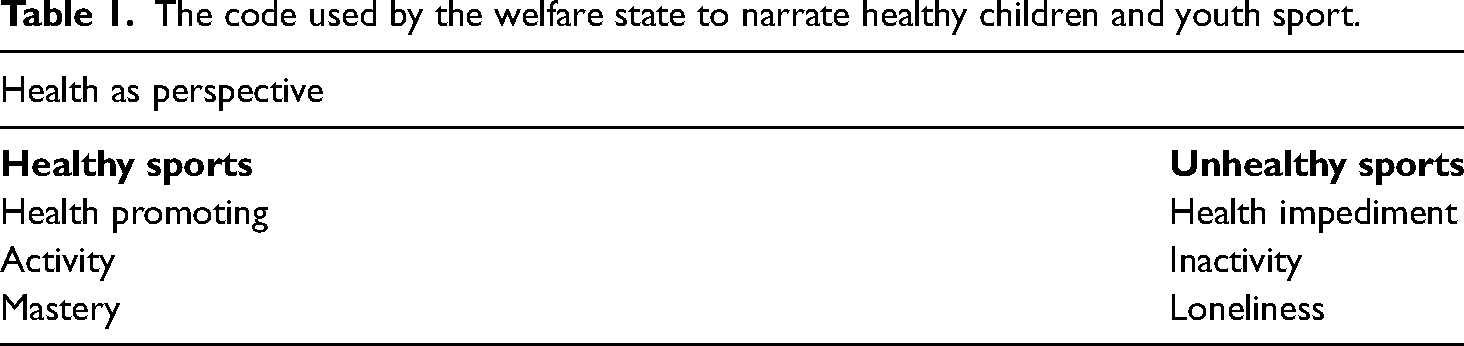
Theorizing how public health meshes with the welfare state, the notion of discursive fields exposes how the Norwegian model positions sports to reveal and remedy the “healthy side-effect” of organized physical activity. Sports are healthy because they provide arenas for physical and social activities, where participants of diverse cultural and social categories can possibly experience mastery. However, sports become unhealthy when they do not stay committed to this code. It also stops being a common good available to all. If children are excluded from sports (or other leisure activities), the welfare state fears that they will become physically and socially inactive and unhealthy; they may grow up experiencing a lack of abilities. Additionally, the code is guided by a pro-civil narrative that makes universality and local availability a means to lessen the impact of social inequality on health and prevent stigmas about abilities through shared sport experiences and mastery (Stmeld.25, 2020–2021–2021). Therefore, the welfare state's health-narrative on children and youth sports can be understood as a simultaneous coding of boundaries between individual and social health: a social democratic shaping of (in)activity and (in)ability as personal experiences formed through, civic participation, or lack thereof (Table 1).
The code used by the welfare state to narrate healthy children and youth sport.
Voluntarism as a perspective
The Norwegian cultural sector developed during the interwar worker movement. As an alternative to bourgeois culture, it was a folksy vernacular [folkelig] democratizing cultural diversity and diversifying democratic knowledge (St meld.10, 2011–2012–2012). A diversity of organizations and actions makes voluntarism a cultural force. “Sports, culture, religion, outdoor life, social work, humanitarian aid, local efforts and political rallying” is unified by shared civic values, “dedication and unpaid labor, creativity and perseverance” (The Ministry of Culture, 2015: 1): For individuals, volunteering develops competence, life experience, belonging, and mastery. Simultaneously, volunteerism contributes to the life quality of the many, and to social development by challenging and setting the social agenda…
Sports help sustain diversity, or “broad and qualitatively sound diversity of activities” and are critical parts of the democratic vernacular and a people's movement [folkebevegelse] itself (Stmeld.39, 2006–2007–2007: 120). When sports “mobilize across entrenched [social] structures and cultural barriers” it diversifies voluntary actions (Stmeld.41, 1991–1992–1992: 10) by countering social class and restraining capitalism. Voluntary organizations question and answer “fundamental issues about who we are and should be, about who we belong with and what opportunities we have” (Stmeld.41, 1991–1992–1992: 11). The third sector answers this question with a diversity that “facilitates a democratic distribution and cultural expression that do not have to compete on a market” (Stmeld.10, 2011–2012–2012: 12) where only the economically strong survive. The welfare state concretizes these questions in conflicts between voluntarism and professionalism, and between collectivities and commercial interests with its “individualizing and differentiating characteristics” (Stmeld.41, 1991–1992–1992: 10). The threat of commercial health actors and self-proclaimed health experts (Stmeld.19, 2014–2015–2015), commercial leisure activities (Stmeld.39, 2006–2007–2007), pacifying information technologies (Helsedirektoratet, 2022b; Stmeld.18, 2020–2021–2021; Stmeld.26, 2011–2012–2012), and the inescapable partnership of the state, private, and civic sectors (St meld.15, 2022–2023–2023; Stmeld.34, 2012–2013–2013) is strong. Crucially, these contradictions are not resolved by voluntarism or the state. In the civic sector, contradiction is experienced and handled in ways that create insights and knowledge about current social issues, politics, and management (Stmeld.39, 2006–2007–2007: 52). For the good of the individual and public, these political life-experiences can inform welfare reforms and civil repair.
The Ministry of Culture aims to sustain a diverse third sector which teaches us about “ourselves and the outside world” (Stmeld.8, 2018–2019–2019: 9). Voluntarism is problem-solving and therefore democratic in being and doing. The civil society preserves “trust by providing arenas for [democratic] interaction, deliberation, learning, and action” (Stmeld.10, 2018–2019–2019). While it is recognized that participation in sports is “driven by movement, [skill] mastery, restitution [overskudd] and social community,” these motivations are storied as fundamentally social in their relation to “norms and values” (Stmeld.41, 1991–1992–1992: 11). Volunteer organizations share a common purpose “to create a good society where citizens can be active and exercise influence” (Stmeld.39, 2006–2007–2007: 204) through participation. Sport volunteers, often adults, are vital “cultural architects [miljøskapere] that help create shared identities and local belonging” (Stmeld.39, 2006–2007–2007: 47). The welfare state views civic organizations as “schools in democracy.” Sport and civic actors are storied as democratic through the “work they carry out” and as passionate “carriers of their members’ views and interests” (Stmeld.39, 2006–2007–2007: 51). Democratic participation cannot be socially or culturally indifferent, and should represent the ethnic, classed, and gendered diversity of Norway (Stmeld.8, 2018–2019–2019; Stmeld.10, 2011–2012–2012; Stmeld.26, 2011–2012–2012), counter intolerance through cross-cultural interaction (Stmeld.39, 2006–2007–2007) and welcome minority-ethnic Norwegians “unfamiliar” with the majority culture (Stmeld.10, 2011–2012–2012; Stmeld.39, 2006–2007–2007).
To the Culture Ministry, sports facilitate intergenerational dialogue, cross-cultural interactions, and is a key carrier of Norwegian children and youth culture: “culture for, with and by children and youth” (Stmeld.18, 2020–2021–2021: 33). Through sports, adults principally commit to facilitate intergenerational and cross-cultural interest in the local community and a concern for citizens’ wellbeing. Democracy, as project and hope (Alexander, 2006), underlines that voluntarism “gathers us in common cause” not conflict, in “disputes empowering citizens as political beings” as “local communities are built in building trust and solidarity” (Stmeld.10, 2018–2019–2019: 20; see also Stmeld.18, 2020–2021–2021: 55). The welfare state is functionalist and goes far in instrumentalizing this cultural code through the concept of “sports’ use-value [nytteverdi]” and a substantial “accommodation” to universalize sports as a “source of experience and meaning” (Stmeld.41, 1991–1992–1992: 12) that combats prejudice.
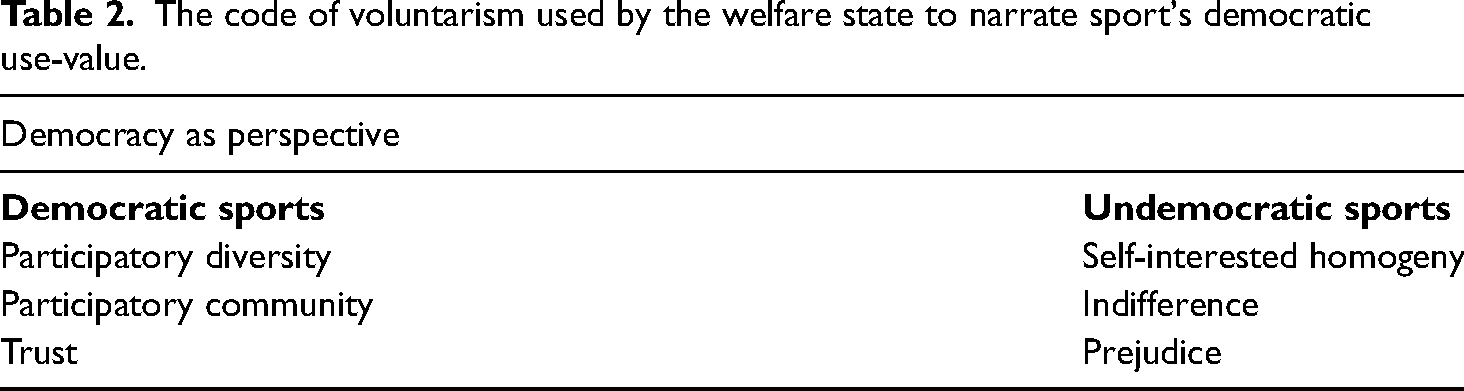
When the Norwegian model of voluntarism frames sports, it fuses individual enrichment with the maintenance of an egalitarian society. Welfare-state funds directed at children and youth sports do not aim to facilitate talent development or competition, but to assist the civic worker's principal commitment to promote local activities and increased participation: To counter social and cultural biases through diversity. In small countries like Norway, market competition cannot sustain the diversity of volunteer organizations (Stmeld.10, 2011–2012–2012) that is fundamental to the pro-civil modeling of democratic incorporation. Thus, sports have become instrumental in democratizing diversity and facilitating high civic participation rates. Sports are vital to the welfare state as they are storied as “creating trust and lessening prejudice” through a “social diversity of values, cultures and interests (Stmeld.39, 2006–2007–2007: 51). For youth and children, sports are arenas for making “friendships” and for “developing social skills” in a diverse landscape of activities “where they live” (Stmeld.18, 2020–2021–2021: 21). The Norwegian model stories the sport democracy by a code marking how the socially diverse community participation creates trust and democratic integration (Table 2).
The code of voluntarism used by the welfare state to narrate sport's democratic use-value.
Childhood as perspective
The civic organization is “key to ensuring good politics on children and youth” (Stmeld.39, 2001–2002–2002: 86). The Ministry of Children and Families underlines how the civic sector provides safe adult-organized environments (Stmeld.32, 1996–1997–1997) that can facilitate children's participation in social life (Stmeld.32, 1996–1997–1997). Voluntary organizations are important arenas for same-age togetherness, for establishing and developing friendships among the young. But the organizations are not only valuable meeting places for children and youth; they also provide room for learning and being together across age and generational divides, and for making contact with adult leaders and engaged parents (Stmeld.39, 2001–2002–2002: 140).
The Ministry of childhood stories civic associations as full-fledged communities that carry out the “valuable work of supporting the family” (Stmeld.24, 2015–2016–2016: 37). They are “meeting grounds” where children experience “positive contact with adults” by sharing common interests (Stmeld.39, 2001–2002–2002: 86). In this story, “children have an innate need for safety and care. They need adults who are motivated to spend time with and talk to them, who share experiences and convey [the right] values” (Stmeld.40, 2001–2002–2002: 59). In civic associations, children and youth encounter adults who, by principle, are bound to meet them on equal terms as they, together, form actions (Stmeld.32, 1996–1997–1997). Locally accessible leisure arenas are key to the Norwegian welfare state. Here parent volunteers make out “coaches, kiosk managers, flea market and lottery salesmen, and as transporters” to and from activities (Stmeld.24, 2015–2016–2016: 38): the parent-volunteer (Stmeld.10, 2018–2019–2019: 25).
The metaphoric family of voluntary sports signifies a safe environment and normative upbringing where the cost of “dropping out” is critical (Stmeld.25, 2020–2021–2021). “Children, more so than adults, are at the mercy of their surroundings: they are extra vulnerable” (Stmeld.24, 2015–2016–2016: 23). Outside civic clubs, “problems like violence and bullying, crime, drugs and racism threaten children and youth” (Stmeld.40, 2001–2002–2002: 3). Youth dropping out of school and “traditional leisure activities tend to withdraw from adults as well” and gravitate towards “city centers where they meet negative milieus characterized by drugs, violence and crime” (Stmeld.39, 2001–2002–2002: 211). Inside organized leisure, “violence, sexual assault and neglect are serious threats” (Stmeld.24, 2015–2016–2016: 23). Thus, white papers on childhood talk at length about preventing sexual harassment and abuse (Stmeld.26, 2011–2012–2012; Stmeld.44, 2012–2013–2013), ableism (Stmeld.25, 2020–2021–2021; Stmeld.45, 2012–2013–2013), and cultural and economic barriers to participation (Stmeld.6, 2012–2013–2013; Stmeld.7, 2015–2016–2016; Stmeld.39, 2001–2002–2002). Committed in principle and bound by the UN conventions of the child, “children and youth have a right to a safe and sound upbringing” (Stmeld.40, 2001–2002–2002: 3). The welfare state “invests in safe” leisure arenas to promote children's rights and equality, to prevent bullying, abuse, harassment (Stmeld.7, 2015–2016–2016: 80) and to reduce commercial pressures on children and families (Stmeld.39, 2001–2002–2002). Therefore, the story goes, the civic sector is vital in allowing children to “make contact with adults” and to “test values and attitudes” in the safe spaces (Stmeld.39, 2001–2002–2002: 211) that also incorporate vulnerable children and youth into the normative pastime of sports (Stmeld.25, 2020–2021–2021).
“Safe, active and responsible youth are crucial to maintain and develop the welfare society” (Stmeld.32, 1996–1997–1997: 10). The Ministry of Childhood depicts leisure activities as formative arenas brimmed with tools that children and youth can use as they seek out, learn about, and participate in society (Stmeld.32, 1996–1997–1997). Children who participate in these “incorporating environments … acquire competencies and abilities to master challenges in ways that will have positive effects on their education and later work life” (The Ministry of Culture, 2024: 20; Stmeld.7, 2015–2016–2016: 33). Given the diversity of volunteer activities, these skills are seldom made explicit but reverberate with the community, identity, and mastery of the civic sector's school in democracy and diversity. Norwegian children's sports are law-bound and principally committed to the Sports Federation's Children's rights in sports (NIF, 2007/2019) (NIF, 2007/2019), which the welfare state views as exemplary. These rights “promote children's physical, psychological, and social development through the introduction to and training in multiple sports” (Stmeld.39, 2001–2002–2002: 146, emphasis added). “Learning” by engaging in several sports entails cultural, social, and democratic lessons in diversity, with the side effects of being healthy and communal. “Competition is firmly toned down” and “[athletic] achievement should not displace learning and recruitment to” children's sports (Stmeld.39, 2001–2002–2002: 146). Children and youth change interests and leisure activities often, it is said, and these changes allow them to try out and acquire diverse “expressions” as they “meet diverse values and attitudes” (Stmeld.39, 2001–2002–2002: 141).
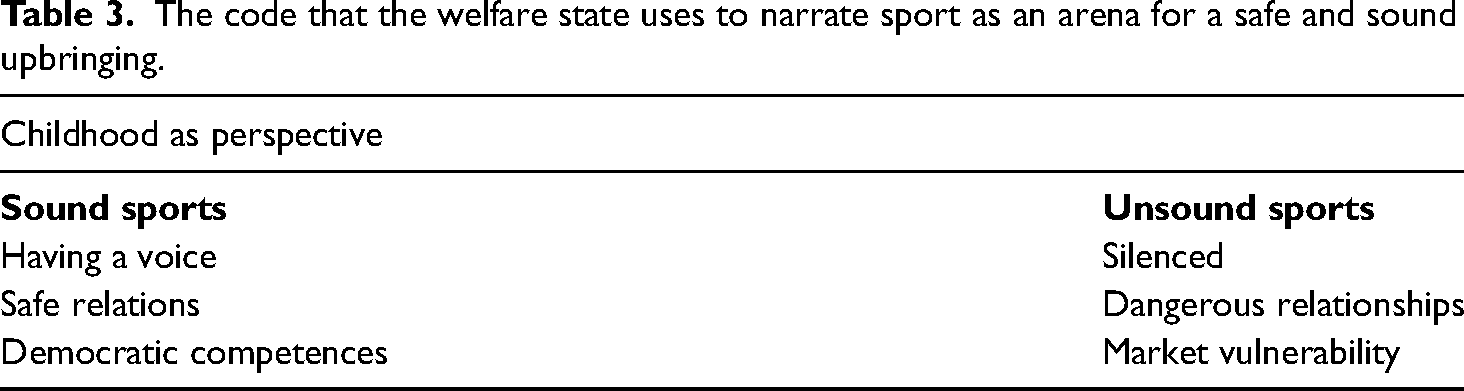
“Without care,” the welfare state argues, “society seizes to function” (Stmeld.7, 2015–2016–2016: 8). This myth is instantiated in voluntarily organized sports and leisure activities, where adults arrange activities for children and youth. In these local pockets, "healthy interests" are shared in ways that are thought to keep young people away from crime, drugs, and danger. Therefore, it is especially troublesome when supposedly safe sports hold adults who discriminate, harass, or are unable to model the anti-racist and healthy behaviors that pro-civil states consider important tools and competencies for future wage earners. Thus, learning by practicing democratic incorporation into civic sports must counter social inequalities and soothe sports competition. At the heart of this myth, sports, as a participatory democracy, is principally committed to giving children's and youth perspectives considerable weight. While the actual voices of children might be quiet, the code stories a child-centered agency and involvement that gives voice to egalitarian individualism exercised through choice-making in a safe local community brimmed with a diversity of adult-organized sports (Table 3).
The code that the welfare state uses to narrate sport as an arena for a safe and sound upbringing.
Conclusion: The civil repair of sports
In this article I asked how state politics can reconstruct unhealthy, undemocratic and unsound sports as a common good. Research on the cultural politics of sports (Hartmann, 2024; Stenling et al., 2023) has uncovered its conservative and progressive (Broch and Skille, 2018; Hartmann et al., 2022; Kaufman and Wolff, 2010; Manning et al., 2021), civil and uncivil (Broch, 2023; West, 2022; Yang et al., 2025) strategic and universalist sides (Sam and Ronglan, 2016; Slater and Moustakas, 2024) but seldom stress how states assess and mediate these paradoxes. Moreover, research shows that sports reproduce social inequalities, erect social barriers and competition hierarchies (Bairner, 2007; Balduck et al., 2015; Helle-Valle, 2008; Moustakes, 2023) and that sports are voluntaristic, with actors who work to lessen competition hierarchies and fend off market pressures (Enjolras, 2002; Ibsen et al., 2019; Jarvie, 2003; Seippel, 2005). How can we theorize this two-sidedness of sports?
The Norwegian state recognizes sport's many contradictions. It knows that children's sport can both facilitate and threaten the common good. Accordingly, sport becomes a never fully realizable repair project. The welfare state uses children's sports to address a landscape of dynamically changing social issues and, at the same time, reconstructs its practices with the aim of reintegrating sports into its broader cultural purview. Through an ongoing civil repair, the Norwegian state perpetually strives to reconstruct sport as a civil, healthy, democratic and sound context for children's upbringing. This finding shows that speculations on the impact of social democracy and Nordic values on sports (Bairner, 2010; Giulianotti et al., 2019; Green et al., 2019) can be clarified through a cultural sociology that takes the view of the state and conceptualizes sport politics as a deeply cultural matter. In Norway, the state draws on culturally contingent codes that define how and what forms of social criticism are understandable and important in the ongoing construction of a mass sport for all. This process of binarism simultaneously marks good and bad sports with the aim of integrating marginalized social groups into civil society through sports. With Alexander's (2006; 2024) theory of the civil sphere, this process is unearthed as a democratic hope to assess and adapt to changing social issues and problems that exclude marginalized groups from the common good. The cultural politics of sport involves this contested and ideologically heated assessment and transformation of sport. It is a meaning-making process aiming to imbue sports in the dynamic recreation of broader cultural landscapes. This process involves active, contested and dynamic meaning-making.
At the center of the Norwegian sports model is a social democratic story on how a healthy local diversity of incorporating measures can moderate the unhealthy homogenizing effects of the market. Sports are not about health, democracy and a safe childhood. Sports are about competition. Therefore, the Norwegian model reconstructs sports as healthy only when distinction-making competitions are downplayed and all children and youth who participate are allowed to experience mastery and inclusion in a health-promoting setting. Local access and universality are antagonistic to the social inequalities, cultural barriers and stigmas that lead to individuals’ unhealthy withdrawal from social life. Diversity in voluntarism and debate maintains trust by building a common frame of experience for participants. This civil society writ large in the White papers explored in this paper, stories how civic actors are threatened by self-interested market actors who are indifferent to the democratizing of cultural diversity and the diversifying of democratic knowledge. Importantly, this social democratic story on sports is recurrently threatened by the pressures of social inequalities and the professionalization and commercialization of children and youth sports (Dahl et al., 2014; Skille et al., 2024), but it remains vibrant in the deep cultural grammar uncovered in this paper. Herein, adults are the protagonists motivated to see, hear, and help the sacralized child to participate, and to protect them from dangerous social relations lurking outside the family, school, and organized leisure. As an instantiation of the welfare state, the Norwegian sports model exposes and counters the market vulnerability of children and youth by ascribing their welfare to the collective.
Theorizing the Norwegian sports model as a discursive field shows how government policy on sports transcends health, voluntarism and childhood-specific policy-domains. While I have shown that these domains hold distinct perspectives, they are part of a broader welfare scheme that reconstructs sports as a common good. Viewing the cultural politics of sports as a democratic project and identity (Alexander et al., 2019), also allows us to conceptualize civic sport organizations and actors within a context of contradiction and ambivalence. Norwegian sport spans across multiple symbolic domains as a “meaningful recipe” and typification of how health, voluntarism and a sound childhood are all contested parts of a well-being vernacular. These domain-specific codes, in varied ways, aim to repair children's sport in ways that facilitate health promotion, democratic communities, intergenerational and cross-cultural interactions. The welfare state does not expect actors to solve all social issues and problems, but to be principally committed to their repair project and, therefore, learn the many pragmatic lessons found in trying to build trust and soothing social inequalities, cultural barriers, and competition-crazed sports.
Footnotes
Acknowledgements
The paper was presented and received helpful comments at the Civil Sphere Theory Working Group meeting in 2023, and the author is grateful for the support and feedback from Jeffrey C. Alexander and Jakob Egholm Feldt at a later stage. I would also like to thank Editage ( ) for English language editing. Finally, many thanks to the editor and two referees for their very helpful and constructive comments and criticism.
Author contribution
Declaration of conflicting interests
The author declared no potential conflicts of interest with respect to the research, authorship, and/or publication of this article.
Funding
The author received the following financial support for the research, authorship and/or publication of this article: This article was supported by the University of Inland Norway.