




Abstract
Data show that sport remains a heterosexual domain, even as sexual minority youth participation in sport sees modest gains.
In 2014, Michael Sam became the first openly gay American football player drafted to a team in the National Football League (NFL). At the time, many were inspired by Sam’s courage in coming out during his senior year at the University of Missouri and beginning his career as an openly gay man in the NFL. Unfortunately, Sam’s time in the NFL was short-lived. He was cut from the St. Louis Rams before the start of the 2014 season and, later that season, waived from the Dallas Cowboys’ practice squad. Sam landed a defensive position for the Montreal Alouettes, a Canadian Football League (CFL) team, in 2015, but left due to mental health issues.
The already high-pressure arena of competitive athletics is a particularly stressful environment for LGBT athletes, which can have long-term consequences in mental health and substance use behaviors.
The media was quick to report that Sam’s decision to come out may have cost him a long-term career in the NFL. Some sport media narratives speculated that NFL teams did not want to deal with the potential distraction of having a gay player. Other outlets cynically guessed that Sam had only made the move to come out so that he would have a better chance of getting drafted; some football analysts thought Michael Sam was sub-par for an NFL hopeful, but wagered that his sexuality might generate media attention and make him a draft prospect. Regardless of the storyline, media outlets seemingly agreed that, ultimately, Sam’s failure was no one’s fault but his own.
As a male who has played and followed sports for nearly 40 years, I found Michael Sam’s story worrisome for aspiring athletes (particularly for boys). The social context of sport is still a heterosexual domain. LGBT athletes, regardless of talent level, face various repercussions for actively claiming a sexual minority identity. They may feel pressure to conform to heterosexual norms in order to maintain the intimate relationships with their teammates and coaches—the kinds of bonding ties that are seen as crucial for team success. Consequently, the already high-pressure arena of competitive athletics is a particularly stressful environment for LGBT athletes, which can have long-term consequences on mental health and substance use behaviors.
Though research has shown greater acceptance of LGBT athletes in American sports in the past several decades, there is still a stigma attached to identification as a sexual minority. Unfortunately, very little research has gone beyond the surface to study this subpopulation of athletes. In particular, nothing is known regarding the percent of youth athletes who identify as LGBT in the U.S. or whether this subpopulation has increased or declined in recent years. Remarkably, however, the Youth Risk Behavior Survey’s large urban district sample (YRBS) has asked about sexual orientation and athletic participation for several decades. By using the YRBS data set, we can roughly determine the percent of LGBT youth athletes in the U.S. over the past 16 years to consider changes in the population against changes in public perceptions of LGBT athletes.
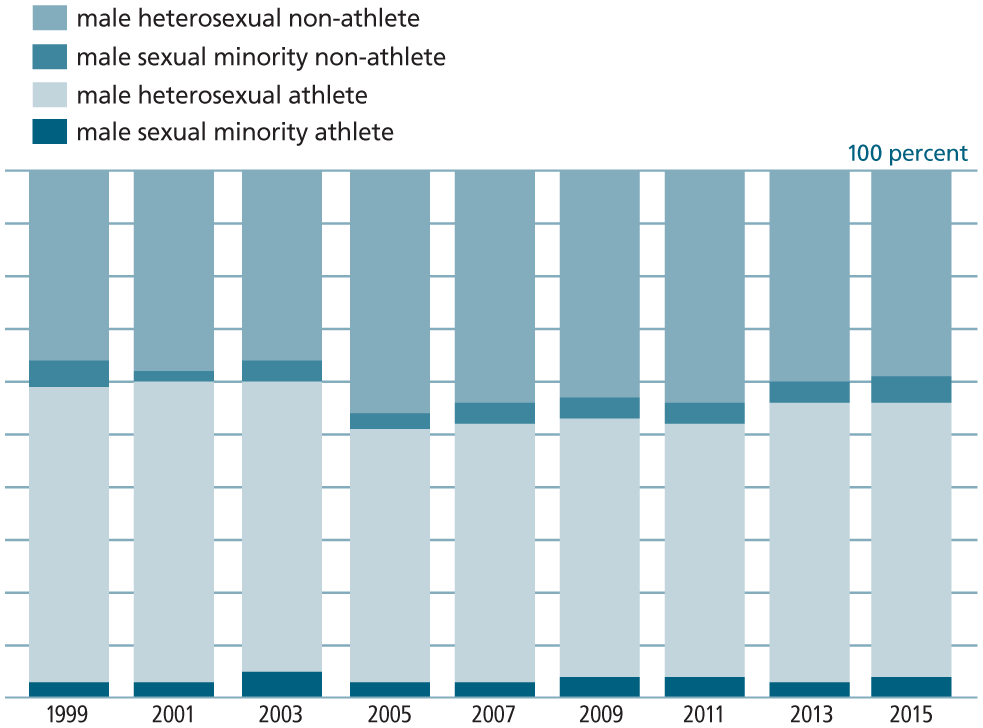
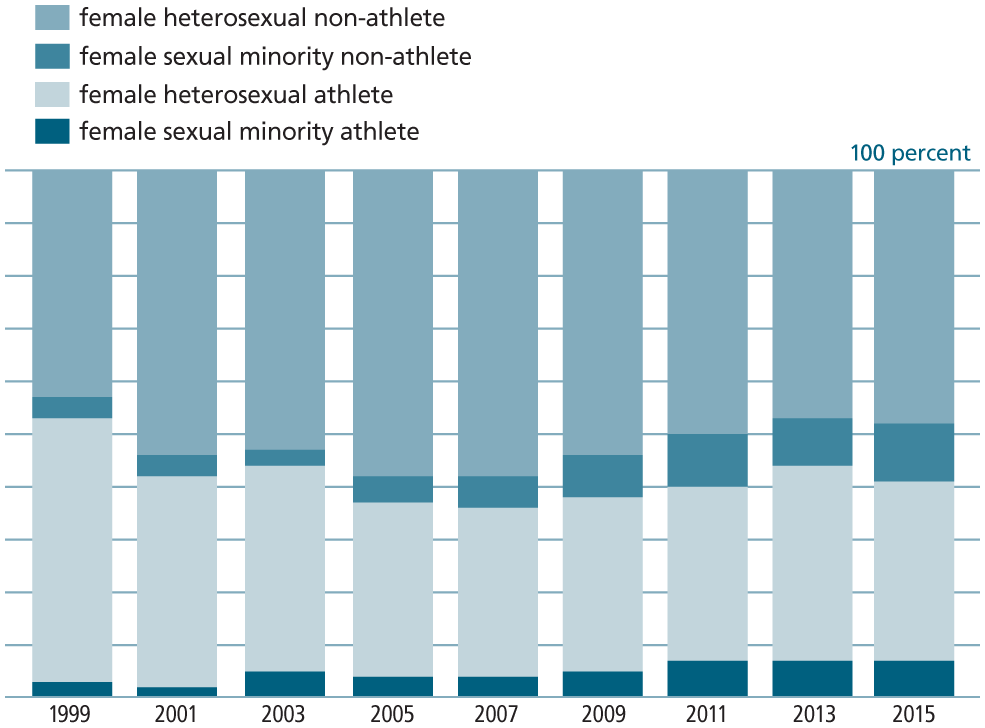
The YRBS asks 9th through 12th graders a range of questions on substance use, sexual victimization, and health-related behaviors. In doing so, the study also asks youth about sexual orientation and past-year athletic participation. I have analyzed the answers to these two questions among males and females between 1999 and 2015, treating gay, lesbian, bisexual, and “not sure” as the sexual minority group.
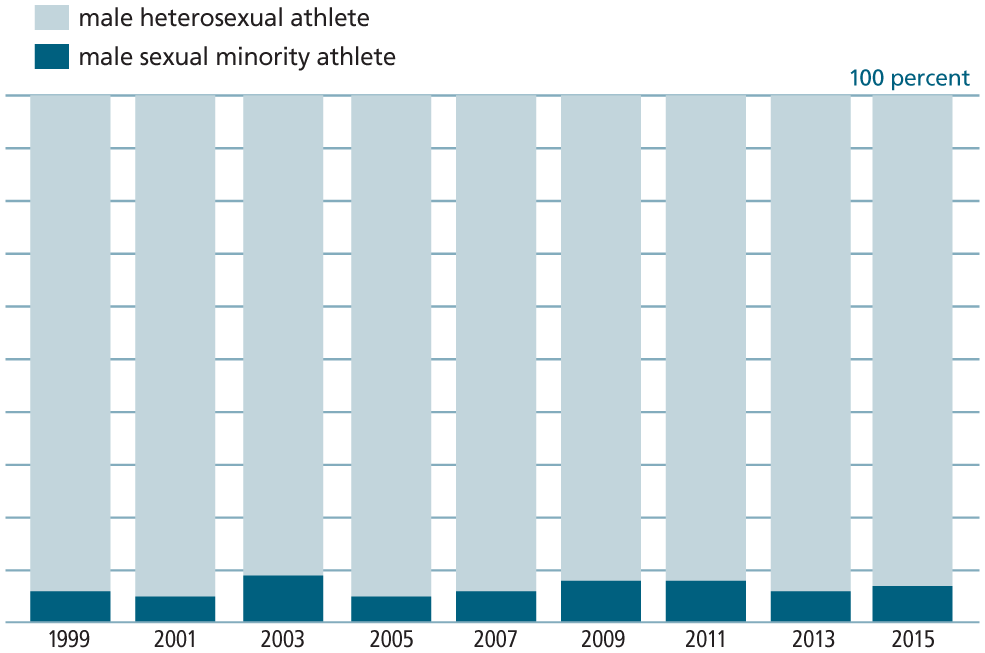
The graphics show that, among all youth in 2015, roughly 4% of male youth were sexual minority athletes and roughly 7% of female youth were sexual minority athletes (see below, top row). In the same year, among only youth athletes, roughly 7% of male athletes and 16% of female athletes were considered sexual minorities (see below, bottom row).
The trends since 1999 suggest that percent of female sexual minority athletes has increased substantially, from 6% in 1999 to roughly 16% in 2015. The numbers for males remained relatively stable, at about 6% male sexual minority youth athletes (See bottom, page 73).
Male Youth Sexuality and Participation in Sport
Source: Youth Risk Behavior Survey
Female Youth Sexuality and Participation in Sport
Source: Youth Risk Behavior Survey
Male Youth Sexual Minority Participation in Sport
Source: Youth Risk Behavior Survey
Female Youth Sexual Minority Participation in Sport
Source: Youth Risk Behavior Survey
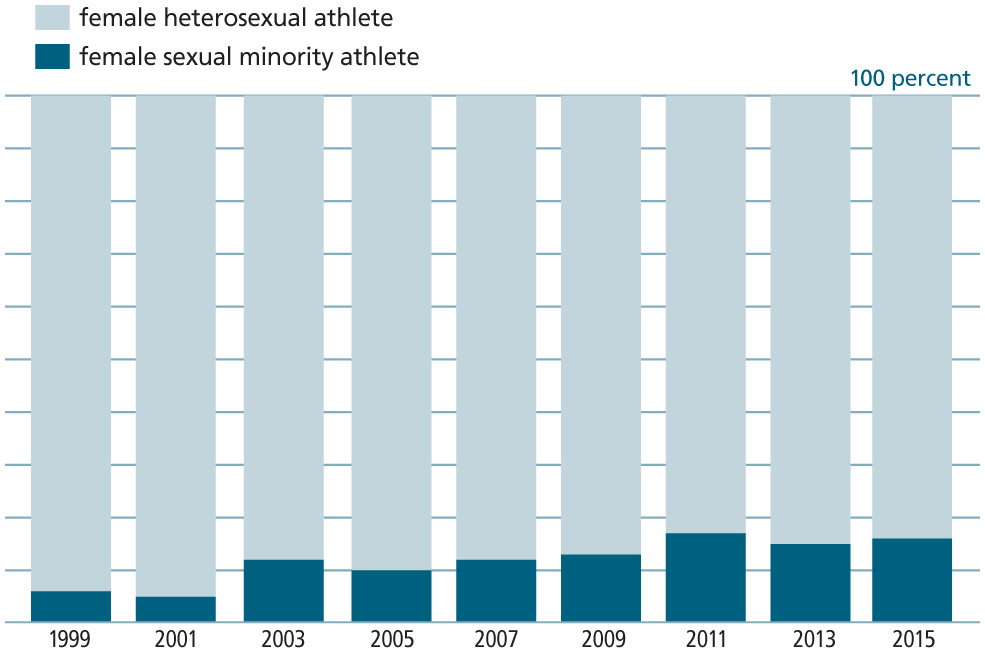
Although there is growing acceptance of sexual minorities both within the U.S. and the larger social arena of sport, data from the YRBS only indicate an increase in the percentage of female sexual minority athletes within youth sport over the past 16 years. Of course, that increase could be the result of these activities providing a more inclusive space; women’s sport tends to challenge heteronormative ideals of femininity by providing a physical outlet in which females are encouraged to be aggressive and competitive. Moreover, positive media representation of sexual minority female athletes is much more common today than in years past. For instance, the 2015 Women’s World Cup soccer tournament featured several openly gay or bisexual athletes, including big names Megan Rapinoe and Abby Wambach. These women were lauded for their physical ability and skill, and not criticized about whether their sexual orientation might become a potential determent to the team’s focus or to their own potential career opportunities.
Women’s sport may be a more inclusive space, long-since challenging heteronormative ideals of femininity by encouraging female athletes to be physical, aggressive, and competitive.
Men’s sport, conversely, still firmly rests on an ethic based on heterosexual norms of masculinity where you still regularly hear exhortations to “play through pain” or gendered denigrations like “you throw like a girl”. Male sexual minority athletes are embedded in a heteronormative social environment in which many coaches, teammates, and spectators expect authentic, “manly” athletic performances. This means that untold numbers of male athletes may still be hiding their true sexual identity in order to maintain important relationships or potential career opportunities within sport.
In other words, the relatively consistent percent of male LGBT athletes in youth sport may be reflective of how little the norms within men’s sports have changed. Unfortunately, Michael Sam’s story may represent a scary prospect, implicitly telling men that if they openly identify as something other than an exclusively heterosexual male within sport, their abilities as men and as athletes are up for debate. The repercussions may very well be too much to gamble, especially where sporting prowess serves as primary identity, social network, and measure of self-worth.