




Abstract
Despite a burgeoning literature on athlete activism and advocacy related to a range of social issues, research on athletes’ environmental engagement is still scarce—a surprising gap considering the rise of environmental movements around the globe and pressing concerns related to climate change in particular. Through interviews with 10 professional football players engaged in environmental activism and advocacy, this article helps fill this gap by exploring 1) how professional football players engage in environmental advocacy and activism, 2) ways the players perceive their role in supporting pro-environmental changes, and 3) paradoxes related to their engagement. Our analysis illustrates that although the players’ modes of engaging varied to some extent, they identified some common contradictions and tensions related to social, structural and categorical facets of their engagement. Players often negotiated a liminal position between, on one hand, their aspirations to do pro-environment work, and, on the other, their focus on athletic performance and the need to maneuver economic sustainability incentives that drive clubs, federations and the football industry. Grounded in Giulianotti et al.'s ( 2021) analytical framework on “liminal antinomies,” these negotiations are explored in depth, along with the modes of environmental engagement by players and their self-reflections. The liminal antinomies we identified are further discussed in relation to the literature on activism and social change through sports.
Introduction
This paper, and the study reported herein, were designed with the aim of contributing to the body of sociological work on athlete activism and advocacy by engaging with an area of research that has been largely overlooked in existing literature on the topic. This area is professional athletes’ engagement with environmental issues through sport activism and advocacy.
There are several reasons we see a need for additional research in this area. The first reason is that athletes are becoming more aware of the relationship between sport and the environmental crisis (Knowles et al., 2023) and, in turn, more elite athletes than ever before are utilizing their platforms and positioning as role models to promote environmentalism (Edgar, 2021). Despite these developments, there are few studies on athletes’ engagement in environmental activism and advocacy, besides a few notable exceptions (Beames and Reed, 2023; Knowles et al., 2023; Orr, 2024; Wheaton, 2007).
More research is also needed that considers the recognized role of sports in relation to transitions towards more socially and environmentally sustainable futures (Millington and Darnell, 2019; Wilson and Millington, 2020). Examples of this recognition of sports can be seen in the “Sports for Climate Action Framework”—a framework developed in support of the Sustainable Development Goals that highlights how sports can be effective as a “unifying tool to federate and create solidarity among global citizens for climate action”(UN, 2024; see also Swatuk, 2020). This “sport as a unifying tool” narrative has also been adopted by international football federations like FIFA (Wågan, 2024), among others (see Edgar, 2021; Kaufman and Wolff, 2010).
Moreover, due to the popularity of football, especially on a global scale, engaging over 3.5 billion people globally, professional football players, the focus of the study reported in this paper, would seem to have immense potential influence (Francis et al., 2016).
In fact, the global possibilities and aims for activism through football and football players might be seen in contrast to other types of social issue activism that often play out on a more local scale—both in terms of what social issues are addressed, and the reach of the efforts that are being made (e.g. Kluch, 2021; Valiente, 2021; Wilson et al., 2015). In terms of the influence of football players in particular, researchers at the Massachusetts Institute of Technology examined the occupations of the most well-known historical figures over various time periods and found that in the time period from 1950 to the early 2000s professional football players had the “biggest reach” in terms of their overall media exposure—with a rank higher in this regard than scientists and politicians (MIT Media Lab, 2019).
With this kind of research in mind, and recognizing that athletes at different levels of sport (and across various sports) can be highly influential, it is also common to see professional athletes and players referred to as prominent ambassadors regarding social causes in sports (see also Dubuy et al., 2014; Leng and Phua, 2022; Smismans et al., 2023; Teigen et al., 2000). Based on these insights, we argue that it is interesting and worthwhile to explore how professional athletes who are engaging in pro-environment work understand their experiences working towards social and environmental change, the processes underlying their work, and the responses they have observed to their engagements in this realm. Exploring athlete experiences in this area is especially important in light of existing research by Hartmann (2024) that shows how athlete engagement often comes with a backlash in terms of tensions and conflicts with other sports stakeholders, and works by Schmidt (2021) that notes the potential financial and career disadvantages associated with such engagements.
Following these and other calls for investigations into athletes’ social (Lee and Cunningham, 2019) and environmental (Edgar, 2021) advocacy and activist activity, this interview-driven qualitative study aims to expand current knowledge about how professional players engage in environmental advocacy and activism, and how they reflect upon their own engagements. Pursuing this aim, we were guided by the following two research questions:
How are professional football players engaging in environmental issues through advocacy and activism? What paradoxes, contradictions and/or tensions do these players experience in their dual role as a professional athlete and an environmental advocate?
Differing from recent and related literature in the field that considered “if and how” groups of professional athletes may consider engaging in climate activism (Knowles et al., 2023), this study explores the perspectives of professional athletes that have already engaged in environmental advocacy or activism.
By considering the players’ reflections on how they make sense of their own engagement and their position in wider societal systems—both in and outside of sports/football—much can also be learned about relationships between different stakeholders, and the social systems that they operate within. This includes how collaborations between various stakeholders and institutions might be better facilitated into the future (Enjolras and Eimhjellen, 2018).
In this paper, we report on and contextualize the study we carried out on these topics in the following parts. First, we outline the theoretical perspectives that informed our analysis. This is followed by a review of relevant literature focused on sport, social change and athlete activism and advocacy. The review includes a particular focus on research concerning environmentalism in and through professional football, as a way of helping to contextualize our interpretations of the empirical data in relation to this similar literature. Next, we outline the results of our research and discuss the interviewed players’ experiences and reflections in relation to the previously presented theory and research. To conclude we highlight the implications of this research and note some knowledge gaps to be filled in future research on the topic.
Theoretical framework
The main theoretical construct that guided our research is “liminal antinomies.” The concept of liminality refers to “the ambiguous and complex condition of occupying a space between a network of social classifications within a given cultural system” (Turner, 1969, in Giulianotti et al. 2021: 955). Antinomy refers to “a tension, contradiction or opposition between ‘two apparently indubitable propositions’, rules, principles, or standpoints” (Giulianotti et al., 2021: 955). The concept of liminal antinomies then, as introduced by Giulianotti et al. (2021), was described as a “unique combination of the concepts of antinomy and liminality”—and was used in their study to aid an analysis of “the ‘in-between’ positions, roles, and experiences of SDP volunteers.”
This framework was a helpful guide through our attempts to conceptualize how the athletes in our study who did activist and advocacy work negotiated the different social and cultural spaces they inhabit, and especially how they responded personally and professionally to the complexities and tensions identified and experienced in these spaces. The framework also supported our attempts to consider the athletes' experiences in relation to the relevant contextual factors that impacted and framed these experiences, within the “cultural system” that Turner (1969) and Giulianotti et al. (2021) are interested in. Specifically, we found the particular concepts associated with the frame (i.e. the antimonies) to allow for an especially nuanced analysis of the complex negotiations described by interviewees.
With this background, we found the three different sets of antinomies Giulianotti et al. (2021) identified to be especially useful reference points. These are categorical antinomies, structural antinomies and social antinomies for volunteering. Categorical antinomies refer to the in-between positioning of volunteers regarding their status within NGOs, their socio-demographical characteristics, and their standing between NGOs and communities. Structural antinomies relate to “the empowering/disempowering aspects of development, positioning between the international development and national public sectors, and their standing between civil society and the private sector.” The social antinomies of volunteering refer to “their relations with the development NGO, links to donors, and volunteer positions in regard to program sustainability.” (Giulianotti et al., 2021: 962).
Akin to the volunteers engaging in forms of advocacy and social activism in Giulianotti et al.'s (2021) research, the players interviewed for the study we carried out for this paper engaged with environmental issues on a voluntary basis, while at the same time doing their professional work as a football player. In this way, the athletes can be seen to be operating in liminal spaces between clearly defined positions and standpoints. One position and standpoint is associated with being a volunteer environmental activist or advocate, and another is associated with being a professional footballer (Turner, 1969). Key here is the idea that there are frequent personal and professional negotiations taking place across these sometimes conflicting roles, and across the spaces they inhabit while operating in these roles. For our study, categorical antinomies relate to the in-between position the players occupy within their club—and in the international football sphere—and the in-between position they occupy as both a professional player and an advocate for the environment.
In applying the concept of liminal antinomies, we made some minor adjustments in how we applied the different sets of antinomies as compared to Giulianotti et al. (2021). This will become evident through the document, as we note in some places the relevance of particular antimonies to particular aspects of environmental advocacy and activism in football and distinguish our usage of the terms from how it may have been used by Giulianotti et al. (2021) for their study of volunteer work in SDP organizations. For example, the kinds of tensions encountered by professional footballers (that correspond to strands of the liminal antimonies concept) would at times have unique features. In this way, we hoped to highlight not only the nuances of the liminal antimonies concept as an analytic tool, but also to contribute to thinking about the potential broader applicability of liminal antinomies for sociological studies of sport carried out in different contexts.
Key literature on social and environmental change through sport activism and advocacy
Our study is positioned in an emerging literature focused on how sports (may) work as a platform for social and political change (Hartmann, 2024), with a particular focus on how athletes’ activism and advocacy contribute to this. We begin this review by highlighting one commonly referred to mechanism thought to underpin the positive impacts of sports, which is “role modelling” and advocacy by professional athletes (Leng and Phua, 2022). Exploring this line of thought, Smismans et al. (2023) analyzed various educational initiatives and campaigns fronted by professional athletes and players across Europe in order to identify “what makes effective inspirational practices.” Although the initiatives they identified were aimed at a range of different social issues, the most successful initiatives shared two common characteristics. First, they were initiated and led by an athlete who was fronting the campaign. Second, they had substantial support from national or local authorities, like sports governing bodies.
Other research, like that conducted by Hartmann (2024) and many others, focused less on particular athletes (although athletes are key to this process) and more generally on the potential of particular sports, or venues where sport is receiving a great deal of attention, to drive positive societal changes. Hartmann (2024) foregrounded the idea of sport as a potential “agenda setter” and “attention attractor,” and highlighted instances where sport acted as a forum for putting issues like racism on the agenda—noting the many examples over the decades where this has been done (e.g. Tommie Smith and John Carlos on the medal podium at the 1968 Olympics, and Colin Kaepernick kneeling during the US national anthem in the mid-2010s).
Of particular relevance to the topic of this paper—activism, sport and environmental issues—is a compelling interview-based study by Amann and Doidges (2023), which focused on football fan experiences with a football fan engagement campaign (Pledgeball) focused on creating engagement with climate change. They found that football fans themselves were most likely to be inspired by campaigns for climate and translate these feelings into engagements in some collective action on this if the campaigns align with the identity and worldview of the fans, as well as the broader culture of football. (Amann and Doidge, 2023; see also Gionfriddo et al., 2023 for similar findings).
While engaging with fans through sport more generally is relevant here, the role of the athlete, as noted earlier, is often key to the success of activist efforts (Wilson et al., 2015). With this in mind—and supplementing our core theoretical approach outlined earlier—we sought to build on powerful conceptualizations of athlete activism by scholars like Cooper et al. (2019) and Jolly et al. (2021). Influenced by their work, we thus conceptualize sports activism as sport participants using their platforms to intentionally challenge hegemonic structures or oppressive systems to create change. Activism in this case is substantially different from advocacy, which refers to “working within the system” to publicly support or promote an issue, but not necessarily challenging existing power relations and hegemonic structures (Saunders, 2013; Van den Bulck, 2018). Advocacy refers here also to intentional, but often reactive, actions by individuals or groups who use their privilege or position to generate awareness about social issues and empower oppressed groups (Jolly et al., 2021; Lee and Cunningham, 2019).
In sports, activism may take many forms, including boycotts, demonstrations and media stunts, while advocacy efforts include (again, more reactive) actions like fundraising or sharing social media posts about the issue. Cooper et al. (2019) developed a typology of African American sports activism that summarizes some different forms sports activism might take—forms that are also relevant for studies examining athlete activism focused on other issues. They describe five categories of activism that athletes, sport scholar activists, and sport institutions might engage in. These are symbolic activism (i.e. “deliberate actions designed to draw attention to social injustices and inspire positive change” (p. 167); scholarly activism (i.e. “transmission of ideas by individuals and groups that enhance a person's understanding of oppressive systems” (p. 168); grassroots activism (i.e. counter-hegemonic actions, including global and national efforts within and beyond sport); sport-based activism (i.e. actions taken by stakeholders in sports aimed to “alter and mitigate the hegemonic nature of structural arrangements, rules/policies/bylaws, and practices through sport organizations” (p. 172), and; economic activism (i.e. efforts provided to financially empower less privileged groups). Cooper et al. (2019) highlight how the most effective forms of activism are efforts that combine the different types of activism in what they call “hybrid forms or activism.”
Along with the various forms of sport activism described by Cooper et al. (2019), it is important here to acknowledge that the acceleration of the development of and engagement with social and digital media platforms of various kinds has led to new opportunities for athletes to engage in activism and advocacy—and with a global reach that was uncommon in previous eras (Wilson, 2007). Recent studies in this realm point to how athletes have used social media to advance alternative discourses on social issues and challenge dominant discourses (Cleland and MacDonald, 2022; Hartmann, 2024).
A related form of athlete activism that has emerged is athlete brand activism (Brown et al., 2022). This implies that an individual athlete, who has established their own symbolic meaning and value in the market by using their name and position in sport—uses their platform to promote social change (Brown et al., 2022). As we mentioned in the introduction, taking a position can have various kinds of negative consequences for the athlete (Hartmann, 2024; Kaufman 2008; Schmidt, 2021). We might consider the idea of the “athlete brand” in this context since some forms of activism might have negative financial consequences, like being less attractive to sponsors (Schmidt, 2021).
Athlete activism, advocacy and environmental issues
The climate crisis, and environmental issues more generally, have received less attention for their relevance to activism and advocacy as compared to other justice-related issues (Hartmann, 2024), with notable exceptions. Wheaton's (2007) study on surfers’ engagement in the environmental group “Surfers Against Sewage” (SAS) is one of the notable and (relatively speaking) early examples of studies that investigated environmental activism by athletes. Looking into surfers’ parallel engagement in surfing and environmental organizations like SAS, Wheaton concluded that despite the limitations of organizations like SAS when it comes to political influence, promoting more sustainable consumption practices through water sports like surfing may play a role in expanding pro-environment discourses. In a more recent study, Knowles et al. (2023) explored if and how winter athletes engage in climate activism and advocacy, finding that a common view among the athletes was that activism among athletes is necessary if sport is to be effectively leveraged for change on climate issues. Despite this, and a high awareness of how environmental issues may impact their sport—and a perceived responsibility to act among the athletes—many of the athletes chose engage in activism or advocacy. The main reason for this was reported to be uncertainty and lack of knowledge about the correct actions to take personally, or the kinds of messages to communicate to their audiences (Knowles et al., 2023).
In terms of climate activism in football, a recent example includes an open letter sent from professional football players to FIFA to question FIFA's claim that the FIFA Qatar World Cup was climate-neutral. Although the letter did not lead to substantial changes in FIFA's environmental practices (in the short term at least), it attracted substantial attention in popular media and inspired public debates on environmental practices at the World Cup in the aftermath of the event (Lockwood and Warwick, 2022)—thus putting at least some pressure on governing bodies to improve their practices for the next World Cup.
In research on activism and advocacy in football, most studies focused on activism from fans’ perspectives rather than from the perspectives of players. When studies have focused on athletes in football, the emphasis has been on advocacy and activist efforts pertaining to social issues, or internal sport-specific issues, with less research on environmental issues (e.g. Numerato, 2018). Insights from our study on professional football players who are engaging in environmental advocacy and activism can thus add valuable perspectives to this growing body of research.
Method
As noted earlier, our study is guided by the analytical framework known as “liminal antinomies.” At the same time, and recognizing that as we are engaging with features of this framework with attention to the social, political, cultural contexts that athletes’ experiences and negotiations take place within—we also attended to principles that underlie what is sometimes called “contextual analysis,” an approach drawn from cultural studies (e.g. Andrews and Giardina, 2008) that aligns with a critical interpretivist epistemology and a social constructivist worldview.
Those working with this cultural studies influenced sensibility, as we are, tend to operate with the assumption that knowledge and related social and cultural practices emerge from social interactions—and that “context matters” when it comes to structuring experiences and for explaining how inequities and systems of power relations are reflected in, reinforced through, and can be challenged on cultural terrains, like those of sport (Charmaz, 2008; King, 2005). Working in this way enabled our attempt to provide an especially nuanced exploration of athletes’ engagement in environmental activism through structured semi-structured interviews concerning the athletes’ lived experiences and their meaning-making processes (Creswell and Poth, 2016)—with ongoing attention to how their responses might be understood in relation to the broader contexts they are a part of (i.e. the social, political and economic contexts of European football in relation to the countries where interviewees played—namely, Norway, Sweden, the UK, Italy, Netherlands, Germany and France).
Following Creswell and Poth's (2016) recommendations for purposeful sampling, participants were recruited with the aims of (1) ensuring representation in terms of the types of environmental advocacy and activism engaged in; (2) capturing the diversity of players engaged in advocacy and activism by including players from a variety of nations and professional leagues; (3) examining cases critical for understanding environmental sustainability logics in international football; and (4) establishing comparisons to highlight differences between leagues and contexts. Players already engaged in environmental issues were chosen because they were considered to be well-positioned to reflect upon how their understandings of environmental sustainability and their own position in football have influenced their attempts to promote awareness around environmental issues and support pro-environment change.
In total, 10 professional football players who are engaged in environmental issues on a voluntary basis in and outside football through the environmental player initiative “We Play Green” were interviewed for this study. All players invited to participate in the study agreed to participate in the study. We Play Green (WPG) is a player-led non-profit organization started by the professional footballer Morten Thorsby. It is made up of professional footballers who use their voice and social influence to bring awareness to, and create engagement around, environmental issues and climate change, while also taking leadership in the promotion of “green initiatives” aimed at clubs and teams. Because this is one of the few environmental initiatives founded and operated by players themselves, we argue that it is a particularly compelling case to study. Those working with the initiative are also known to use some of the “best practices” identified regarding the use of sports and athletes as “tools” to provide positive societal change, which is relevant to the aims of our research as well (Smismans et al., 2023). The relatively small sample size for this study can be explained by the fact that there are, currently, only a few professional players engaging in environmental advocacy openly and on a regular basis on both a local and a global scale.
All players were between 20 and 35 years of age during the interviews and played in levels ranging from the top international level to the top league national level (see Table 1) in seven different countries, with some playing for both their national team and a club in another country. Six of the players identified as women, while four identified as men, and seven out of ten players also had relevant university education, which may have informed their understanding of environmental issues and aspects of social and political change. Yet, all interviewees are now (at the time of carrying out the study) fully professional players, and only engage in activism and advocacy outside football on a voluntary basis. Gender, educational background, and level of play were each considered and noted in relation to the reflections and experiences of the interviewees.
Sample characteristics.
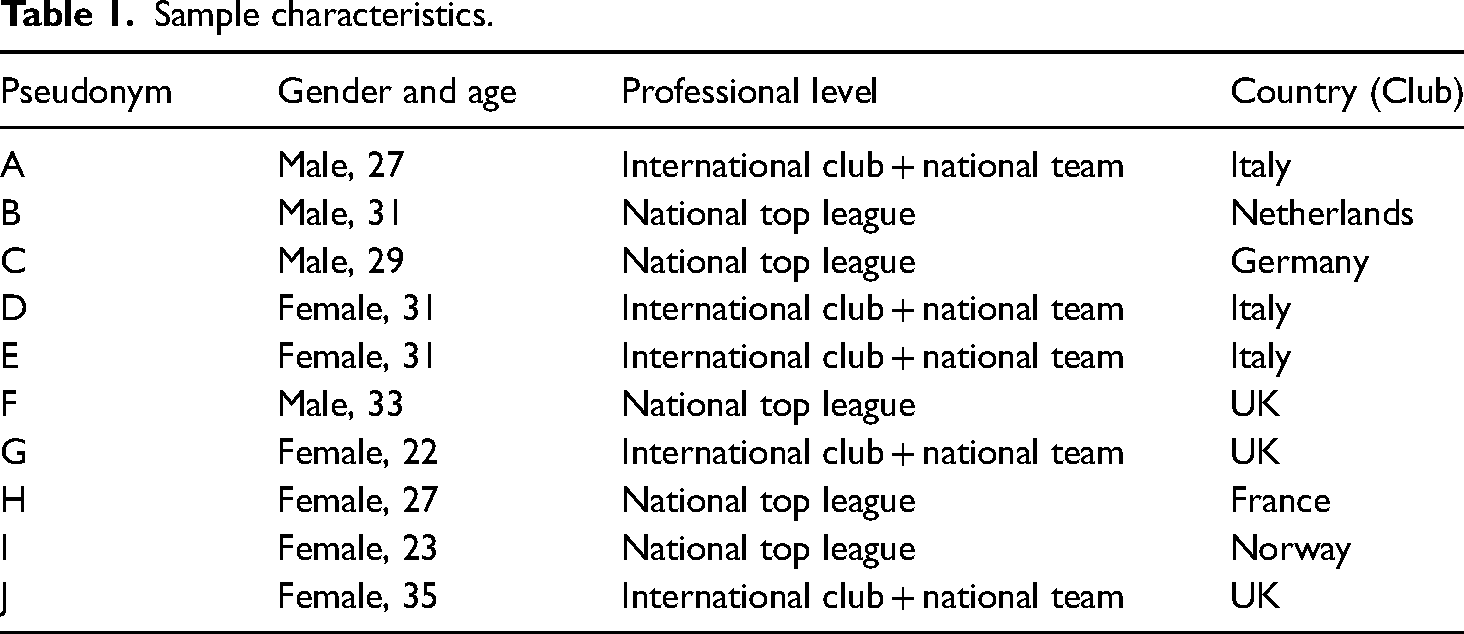
An interview guide in line with the research questions was developed in advance. This focused on how the players engaged with environmental issues (e.g. types and intensity of engagements and initiatives) and on their experiences engaging with these issues. As a part of the more flexible semi-structured approach to interviewing, there was also room for alternative topics to be brought up by the players and pursued by the interviewer during the interviews. All interviews took place between April and December 2023 and lasted for approximately 1 h each. Given the locations and related travel costs, Zoom interviews were deemed a reasonable research tool. Seven of the interviews were thus done by video call on Zoom, while the remaining three interviews were done face-to-face at different locations.
The first author of this paper conducted and transcribed all interviews. In this process, pseudonyms were developed and used in the final analysis to maintain the anonymity of the participants. Additionally, all players received information about the project and data management in the aftermath of the interviews to ensure their confidentiality. The project and the data management plan for the information gathered in the interviews were approved by Sikt.no—the Norwegian organization to secure high-quality research.
Data analysis
To analyze the interview data, Braun and Clarke's (2006) six-step thematic analysis was used. In the coding process, we were guided by our aim to explore how the interviewed professional footballers engaged in environmental advocacy and activism, their reflections on their own engagement in advocacy and activism, and their perceived ability and position to facilitate a green shift both within and outside sport.
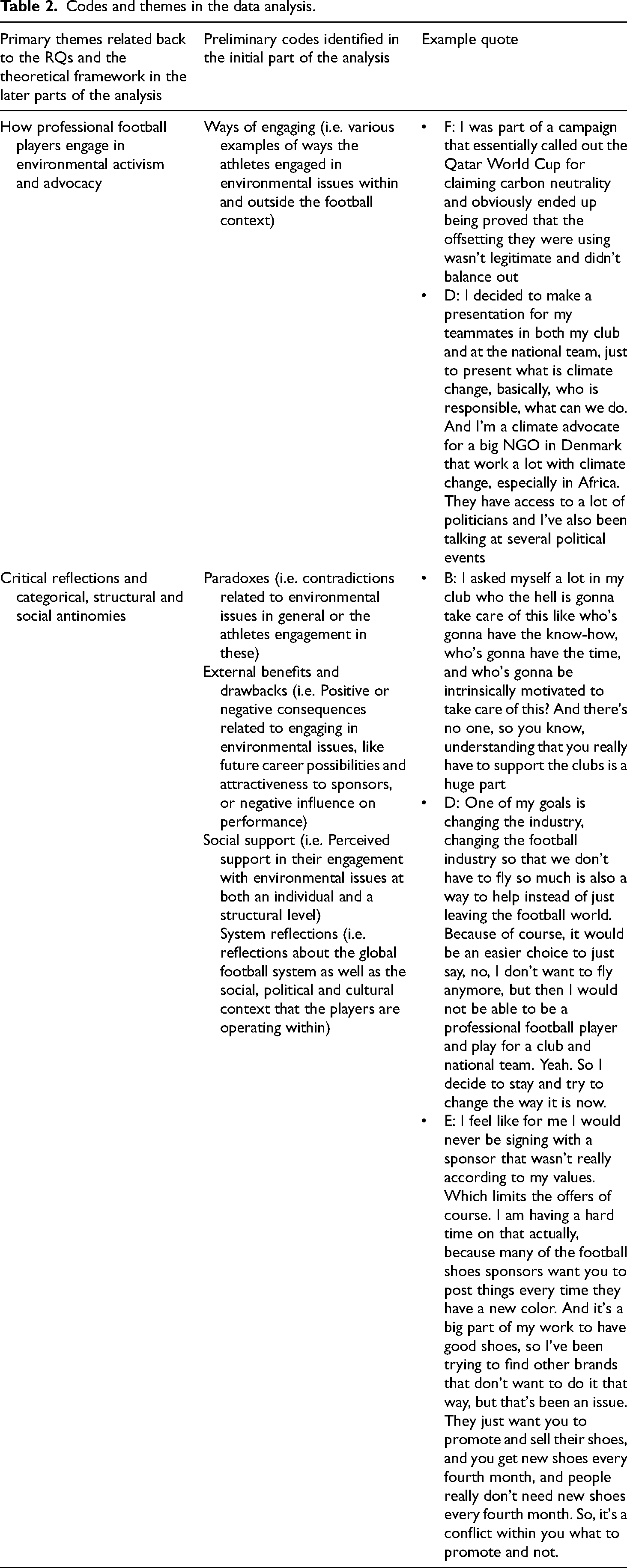
In step one of the analysis, the transcripts were read through, and tags were placed on the content that made meaningful indications of athletes’ reflections and experiences. Secondly, recurring patterns were clustered into preliminary codes before these codes were merged into subthemes in step three. These three initial steps were carried out by the first author (who was also the interviewer). In the fourth step, transcripts were read through a third time, and recurring subthemes were explored. In this process, overarching themes were identified across the interviews, and from here all initial codes were discussed and sorted collectively by both authors, as a step towards naming and defining themes, and relating them back to the research questions and literature. This was all part of ultimately producing a final report of the analysis (see Table 2). We carried out the final parts of the analysis (steps 5 and 6 in Braun and Clarke's (2006) framework) following a deductive logic, inspired by the two research questions, and the theoretical framework presented earlier. Step 4, the writing of the final report of the research, and the last two steps in the analysis (5 and 6), were done collaboratively, by both authors.
Codes and themes in the data analysis.
Results
We begin this section by offering an overview of the various initiatives and efforts the player-interviewees engage in, and then considering these engagements in relation to the players’ understanding of how sport (and football in particular) may act as a platform for social change. This is done in an attempt to answer RQ1 (How are professional football players engaging in environmental issues through advocacy and activism?) and to provide some context for the main part of the analysis—where we delve into the players’ reflections on their own engagement in environmental issues in and through football, and the liminal antinomies we identified in relation to their engagement (RQ2).
How are professional football players engaging in environmental issues through advocacy and activism?
The interviewed players mentioned a range of ways that they had engaged in initiatives focused on environmental sustainability. These measures mainly included awareness-raising efforts targeting the public, such as posting information about climate and nature in their social media channels and sharing knowledge about these topics in public forums through media interviews or at events. The athletes also referred to instances where they engaged with their clubs, with football's governing bodies, and with national governments (i.e. UEFA, EU) on issues concerning the environment. For instance, two players talked about how their efforts led to local results and practical results, with club managers installing solar panels, reducing the use of single-use plastics, and recycling or reusing gear and uniforms.
Some of the efforts that the players engaged in can be seen to align with common definitions of “activism.” That is to say, the athletes used their platforms to intentionally challenge dominant structures or systems as part of their efforts to respond to environmental issues, and did so in ways that at times challenged aspects of the capitalist logics that underlie much of the sport sector (Miller, 2016). D describes an example of this: D: for many years, it's been a dream for me to affect the flights, to have maybe some rules in each country and like for a way of how much are you allowed to fly as a team. Because I think teams will not choose another way of transportation if flight is easier and more comfortable. The other dream is to make UEFA spend more of their money for the green transition, both in the football industry, but I think with all the money we have in the football industry, it's also a responsibility to help the green transition in general.
Still, and because of their focus on generating awareness about environmental issues, many of the interviewees’ efforts played out as “advocacy” rather than activism (Jolly et al., 2021). More specifically, the players engaged in what various studies on athlete activism and advocacy refer to as “sports advocacy” (Lee and Cunningham, 2019). In the case of the players, we interviewed, this included combining grassroots efforts and communications (e.g. through social media platforms; at political and public events in- and outside football) and celebrity engagements (e.g. implementing initiatives aimed at the reuse and recycling of used football equipment and clothing) targeting multiple levels—including individuals, clubs and governing bodies. This strategy also therefore aligns with a multi-level approach to social (and of course environmental) justice issues, like the climate crisis—an approach that has been recommended in literature on sustainable transitions more generally (e.g. O’Brien et al., 2019).
When situating the athletes’ efforts in the sociopolitical context of professional football, it can be argued that the athletes’ chosen ways of engaging with environmental issues align with common strategies for public engagement in recent times—efforts known to be more individualized and mediated than ever before (Enjolras and Eimhjellen, 2018). Although these new forms of public engagement are thought to help democratize public engagement, there are also some paradoxes related to them (Enjolras and Eimhjellen 2018). These paradoxes were identified by some of the players we interviewed. We return to this point when reflecting on “liminal antinomies” in relation to our findings in the next section.
Critical reflections by players on (their) environmental activism and advocacy: Categorical, structural and social antinomies
Based on the paradoxes, contradictions and/or tensions the players reported when reflecting on experiences in their dual role as a professional athlete and an environmental advocate—and in line with Giulianotti et al.'s (2021) analytical framework—we identified three sets of liminal antinomies that related to the experiences of the players we interviewed: categorical, structural and social antinomies. We elaborate on these below, in relation to interviewee responses.
Categorical antinomies
For our study, we used the categorical antinomies concept to help us identify and describe the “in-between” positions the interviewed players occupy. We are referring here to the interviewees’ positioning between, on one hand, their roles as professional players, as members of their club, and as part of the international football sphere, and, on the other, as advocates for the environment. In this context, it became clear that these players are often in a liminal position, as they aspire to create pro-environmental change, while at the same time operating in the best interests of their club, and with their football career goals in mind. This is not to say that professional football clubs or national and international football federations work against issues related to environmental sustainability, but rather that the players prioritized these issues to a greater extent—while clubs and federations tend to follow a narrower incentive system that would seem to align most often with economic and performance goals (Wågan, 2024).
The main categorical antinomy we identified was associated with the players’ efforts to put environmental issues higher on the agenda in their respective clubs. As noted in the section above, most of these efforts are best described as “advocating for the environment.”Still, some of the players' efforts to alter and mitigate hegemonic logics and priorities in football organizations could be considered as activism, as we will discuss later. Even though all interviewees reported being “taken seriously” when they raised environmental issues, they also felt they had limited power to contribute to more substantial changes,especially when it came to influencing the sport governing bodies they operated within: G: We were lucky to have a visit from UEFA at a meeting, and it was exciting to hear what they think, and how they see the problems we are facing. I also think that it was very positive that they took the time to join. It's like showing that they think that what we do is a positive commitment. At the same time, perhaps the outcome was not quite what one could hope for from such meetings, because they do not give the answers we want. It is very much about economics and who has the power to create change. Among other things, we got into the matter of flying to matches, transporting supporters and things like that. And there, of course, there is a limit to what we as players can do, because there, again, it's only about money and optimizing performance. It's a bit of a shame that there are some powers that are very difficult to do anything about. I: Yes, I feel that I am taken seriously. But amongst men in suits you can quickly feel quite small, or that you are only invited because the players’ perspective ‘must’ be respected or incorporated in this in some way. That it's a bit pragmatic, and that they can't push us away because it looks bad from the outside. But you sit there and think, what will my input actually be used for?
Evident from the quotes from I and G is that the athletes felt that they had the power to put environmental issues on the agenda, but lacked the power to influence subsequent efforts to make more impactful and ongoing changes. This dynamic relates to what Rajkobal (2014) refer to as “post politics,” which in this case refers to the process whereby civil society organizations are asked for their opinion when environmental issues are being discussed—but are not given meaningful input on the most contentious and impactful decisions (e.g. civil society actors might be asked how to carry out an event or build a sport venue in an environmentally friendly way, but are not asked whether the event or venue-building should have taken place in the first place—see Kim and Chung, 2018).
Although several players outlined their experiences having limited power to affect priorities and decisions in national and international governing bodies in football, this was not necessarily the case in the context of their respective clubs—where a majority of interviewees elaborated on various initiatives they have initiated in their clubs (see first section of the analysis). Despite this, some players offered some critical reflections on this. For example, for some interviewees, the fact that they do not have much power to change technical solutions for reducing negative environmental impacts may, in some cases, lead to advocacy for changes that are more symbolic than practically useful. This point was nicely articulated by “I” with respect to the recycling of clothing and football uniforms: I: when I had just arrived in my new club, we were to get new training clothes, and the materials manager said that we should save what we wanted, but put the rest here, and then we throw it away. There were of course many people who saved on things, but I also collected a lot of training clothes with the green bags, and looked at what could be used further. The funny thing is that we don't have that many solutions for recycling textiles in place yet, on how to recover, recycle or reuse. So even though it is a good thing to collect, there are no real solutions to this yet, and I end up storing them at WPG until there are solutions.
As I's quote illustrates, the categorical antinomies related to the players’ position in their clubs and in the international football sphere meant that although they are in a position to put environmental concerns on the agenda, the practical consequences of these efforts on a larger scale appear to be limited, at least for now. As such, the categorical antinomies seemed to limit intended activist efforts. For example, an activist effort, like challenging current capitalistic consumption models of football merchandise, was limited in this case to influence individual consumption practices, which is more of an advocacy-oriented activity. While such forms of advocacy can be seen as worthwhile and well-meaning, they do not notably challenge extant systems of environment-impacting consumption.
This finding aligns with other research on athlete activism (Hartmann et al., 2022) and on environmental activism in leisure (Knowles et al., 2023; Wheaton, 2007)—which shows both important changes that have in some way resulted from athlete-driven environmentalist work, and some limits. Hartmann et al. (2022) note this ambiguity when they asserted that “political dramas initiated by athlete activists do not necessarily change anyone's minds; however, they do focus attention on issues and social dynamics public audiences might otherwise minimize or miss altogether.” (Hartmann et al., 2022: 561).
Following this point, we also assert, based on our findings, that there is a need to avoid overly romanticizing sport-based activism and advocacy because, firstly, it is often difficult to translate activist and advocacy efforts to institutional reform or broader structural transformation. Secondly, it is important to keep in mind that activist and advocacy efforts are often as likely to provoke backlash and opposition as they are to gain sympathy among sport stakeholders (policy makers, political leaders, opinion leaders) and members of the general public (Hartmann et al., 2022). Of course, provoking backlash and opposition is certainly a necessary part of the path to change in many cases, and courageous efforts across (sport's) history demonstrate the crucial need for these efforts. Still, it is important to note, as a more subtle point, that many forms of activism and advocacy might not have their intended impacts (what Wilson and Hayhurst (2009) have termed “ironic activism”)—and, as our findings suggest, this should be taken seriously when assessing the environmentalist efforts of contemporary athletes.
Structural antinomies
For the current study, we saw the structural antinomies concept as relating to the empowering and disempowering aspects of driving change towards more environmentally sustainable practices and futures—and especially to the tensions associated with negotiating activities with and on behalf of for-profit and private organizations/entities while also working with and on behalf of non-profit (and often-oriented) volunteer organizations.
When reflecting on the structures in football more generally, all of the players we interviewed offered perspectives that would seem to be critical of the current environmental practices in football. When these perspectives were offered publicly and as an effort to inspire change, these offerings would be viewed as a form of activism, in keeping with the definition of the term outlined earlier. Some of the players were also outspoken and specific about what goals they felt they should be pursued to address problems with environmental practices in football, which might be seen as evidence of the intentional character of activism in these cases (Cooper et al., 2019). We can see in the following comment how “D” articulated the aim of negotiating new pro-environment practices by challenging current structures and systems in football and beyond: D: One of my goals is changing the industry, changing the football industry so that we don't have to fly so much is also a way to help instead of just leaving the football world. Because of course, it would be an easier choice to just say, no, I don't want to fly anymore, but then I would not be able to be a professional football player and play for a club and national team. Yeah. So I decide to stay and try to change the way it is now.
The above example, from D, is illustrative of one structural antinomy—and the empowering and disempowering aspects of engaging in environmental advocacy. D shows in this instance how suggested efforts are often woven into the “sustainability-approach” that dominates the sports industry, despite efforts to challenge aspects of the logic of sustainability (i.e. that often leans toward emphasizing economic sustainability over environmental sustainability) and negotiate new practices. As A further emphasizes in the quote below, it is difficult to negotiate a more environmentally sustainable lifestyle when it is seemingly not compatible with the current logics of a modern lifestyle: A: There are all these small choices you make all the time, and when you become aware of it, there are many things that make it a bit difficult to live sustainably in today's society, like the expectations tied to the lives of young people today.
It is here where the desire for and acknowledged need for structural changes and, at the same time, the acknowledged issue of living in a society dominated by individualist (neoliberal) ideologies come into tension. Demonstrated here again is the point made above regarding limitations on more activist efforts—and how more oppositional and structural change-oriented work might be “toned down” in the contemporary context, and how more industry and consumption-friendly efforts might be privileged.
In our findings, we can see this tension again as the expressed need for structural changes was balanced with numerous player comments about how individual lifestyle and consumption choices could make a big difference too. Still, this tension is something that interviewees were aware of, with some athletes offering critical reflections on how individual efforts are often limited by the social structures and systems which individuals act: E: to take initiatives on your own. It's hard…. It's better to just join an organization that can help you out than to start doing it by yourself…. I want to do more things within my own club. But that takes energy and social skills to talk to people in a way that makes them want to do things, and do things differently on a bigger scale than just by themselves.
Another structural antinomy we identified related to the players’ collaborations and campaigns with a range of actors—actors that follow sometimes different incentive systems and have a range of sometimes different priorities concerning environmental issues. This includes for-profit, non-profit and political organizations, as well as national and international governing bodies in football. As foreshadowed above, many interviewees perceived challenges in their work across these different organizations. Some illustrative examples of this were offered by J and G, who described experiences with collaborations with their national federations: J: I was at this seminar with the national football federation, with a whole bunch of top leaders of various kinds who are just there to network. It is of course super important to be represented there, but I felt completely out of place. It feels a little meaningless to talk about it [environmental issues] up there, with people who I feel are more concerned with their careers than the climate issue, and who have it as one of many things they should be interested in… I think it's cooler to be with clubs and people and talk about it and talk about solutions and actions we can actually implement. G: what is a bit difficult, especially with the national federation, is that they like to contact you as an individual player and want to use you only, and that it can sometimes come into conflict with the long-term vision me and We Play Green have, because the federation would like someone to front something, which may initially be good, but which is not in line with these lasting change we vision. And the fact that something should be fronted in the short term just so that they will have a face and something they can connect to a player feels a bit wrong.
Furthermore, most of the players described how they felt being “in a squeeze” between the commercialized sport market (as a commodified professional player) that strives for growth, and wanting to stimulate reductions in consumptive behavior: E: I feel like for me I would never be signing with a sponsor that wasn't really according to my values. Which limits the offers of course, because many of the football shoes sponsors want you to post things every time they have a new color. And it's a big part of my work to have good shoes, so I've been trying to find other brands that don't want to do it that way, but that's been an issue. They just want you to promote and sell their shoes, and you get new shoes every fourth month, and people really don't need new shoes every fourth month. So, it's a conflict within you what to promote and not. D: I have turned down, I wouldn't say a lot of offers, but some offers for sponsorships and stuff, because I haven't felt that it's something I want to stand for, even though the products might not be very bad. It's not like oil companies and stuff, but still I don't want to use my platform to promote consumerism either.
The structural antinomies and the “in between positions” created by competing logics and ideologies, as mentioned by the players above, highlight a need for tools to negotiate such tensions. In line with this, one player explicitly suggested that being aware of the competing logics was one “tool” to navigate the football context and thus advocate for environmental sustainability in an effective manner: C: there's two sides of being effective in this in this area. One is you have to have the know-how, the right stuff about sustainability, and the levers you can kind of play with to have an impact. I think trying to understand the clubs is just as important as understanding the theme sustainability all right. I would make it bigger than just understanding the clubs, but understanding the football world, for example understanding the fans the sponsorships the clubs the players, the ecosystem and so on.
Other players experienced difficulties navigating such tensions and saw competing logics as a barrier to engagement in social issues: G: Like, no matter what you take a stand against, someone will have an opinion about it. I think that's partly why many people don't take a stand, because they are afraid that it will come into conflict with something else.
Such conflicting opinions or associations have also been shown to limit the impact of positive engagements with environmental issues, and in the worst case lead to accusations of greenwashing (Miller, 2016). Because of this, Kaufman and Wolff (2010) question the possible effects of (elite) athlete activism due to the capitalistic market forces driving modern sports. In the same manner, Edgar (2021) questions the effects of athletes’ environmental activism if sports organizations are unable, due to their performance and growth-oriented incentive system, to “walk the walk” when it comes to reducing their own environmental footprints in a substantial way. An illustrative example of this is the fear of hypocrisy (and fear of being accused of greenwashing) noted by winter athletes in other studies, who are aware of the tensions around their environmentalist stance and their simultaneous connections to carbon-intensive sponsors of their teams, organizations and events (Knowles et al., 2023).
The experiences of being in an “in-between position” between commercial sponsors, for-profit organizations like their clubs, and non-profit organizations reported by the players in our study are all examples of structural antinomies and evidence of tensions and contradictions concerning athlete activism in sport structures that unwaveringly operate within capitalistic and neoliberal logics.
Social antinomies
All of the players expressed a strong belief in football's importance and potential as a platform to initiate and carry out change. At the same time, interviewees found a lack of commitment to addressing environmental problems among many they partnered with. This again led to certain social antinomies related to competing expectations and the players’ attempts to challenge contemporary capitalist systems and priorities in football. As G highlights, environmental issues are rarely (if ever) placed above other priorities, like economic concerns in the world of football, although there is general agreement (at least in public relations statements from major organizations) that it is important to address environmental issues: G: I thought about it now during the climate meeting (COP28), when we see that Norway is not quite where we should have been, that things are going too slowly. And especially in football, which is such a big sport, how much finance and such is involved, and that it is run by people with power and money. And the same for politics in general, and that's why it's going too slowly, that everything is really just about money.
These concerns about a lack of commitment to environmental problems in football led many players to express that they feel a pressing responsibility to advocate for these issues through their (digital) platforms—and to hold people and organizations accountable in terms of implementing initiatives to reduce their environmental footprint. In this way, we might see these athletes engaging in what Cooper et al. (2019) would refer to as “sports-based activism” (i.e. attempting to alter and mitigate the hegemonic nature of structural arrangements, rules/policies/bylaws, and practices through sport organizations). Despite their felt responsibility to advocate for environmental issues, half of the interviewed players also experienced discomfort with the idea of speaking up, or “taking an activist role”: B: I've always been a little bit uncomfortable with taking this activist role, so I consider myself more as someone that likes to inform himself and try to do better. And I'm still struggling with my position in this issue because I don't want to step up that much and put a spotlight on me. And on the other hand, I feel like it's important to have people that are in the spotlight to speak out.
Other studies on athletes’ perspectives on environmental engagement in sports have shown similar calls for more commitment to issues related to climate and nature in sports organizations. More specifically, the winter sport athletes and coaches interviewed by Knowles et al. (2023) stressed that international and national governing bodies are most responsible for taking leadership on sustainability issues and need to lead the way for other stakeholders in sport to take more action.
The feeling that “nobody really takes responsibility” has, according to interviewees, created a situation where environmental efforts are overly reliant on the players’ involvement and leadership, and not enough on the organizations (or regulating governments). This has consequences for the sustainability of the initiatives and efforts they engaged in, and speaks to the social antinomies that underscore the voluntary status of athlete engagements. The following quote from I encapsulates this point: I: With the club it's a bit difficult, because they have no sustainability officer, so it's a responsibility that falls between several chairs, and then it's easy for you to feel alone with the responsibility for what you propose. Everyone is supportive, but refers to each other, and then it may happen that things run a little out in the sand. I sometimes feel that I am the one who has to be the implementing force, for something to happen. Although there is no opposition to it, there is only someone who has to be responsible for it.
Another social antinomy related to the athlete-activists’ role as a professional player and their performance level on the pitch. Contrary to the players’ ambitions as professional players—to reach the highest possible performance level internationally—five of the players mentioned explicitly how it was easier for players in clubs at lower levels to get support for environmental initiatives at their clubs. E explained this experience, having moved from a big international club to a smaller national club: E: I know a lot of people within the club already. I know who to talk to about different issues and initiatives. I feel like they will listen to me in a different way than in my last (bigger) club. There are so many steps in a bigger club. It's like a network and then you have to work your way up. It's easier if there's a flat structure or you have some relations. I think that's maybe a problem for many players in these big clubs and internationally. But on the other hand it's also an even bigger effect if you can get the big clubs to make these decisions.
As E notes, this is a particular issue in the sense that changes in bigger clubs would likely have more positive environmental impacts; however, it is more difficult to successfully lobby for changes with these clubs. Related to this was the fact that many players felt that they had a stronger voice and greater influence with their environmental work (i.e. their platform as a footballer is enhanced) if they were higher status on their team—a status that is directly related to their on-field performance: C: I know that I have to keep playing and getting better, even though sometimes it feels so unimportant, because it gives, it gives me a voice. And you can have such a, such a big impact in comparison to an everyday person. But you know, if on the field, you don't play an important role, the club is less likely to be open to your other ideas. So you're constantly in like this battle of having to confirm your position on the field and running your (environmental) projects.
Furthermore, some players reflected on how their environmentalist work might have a negative impact on their popularity among fans and club managers, especially if they took a strong stand and openly engaged in environmental sustainability issues: A: That's why many players don't bother to get involved in societal issues, because they feel the pressure to perform, and they know that there will be bad periods where they also have their commitment and speak publicly about it, and thus will be more prone to ugly comments.
This pressure to put performance above all, like A mentions, is also evident in other studies on athletes’ engagement with climate issues. For instance, the winter athletes in Knowles et al.'s (2023) study perceived time, distraction from performance, and fear of being called out as a hypocrite by fans as barriers to engagement in environmentalist work. Their suggested solution was to have more flexible forms of engagement, including engaging mainly during their off-season, and for sports organizations and governing bodies to facilitate and support athletes’ engagement to a greater extent (so it is not “all on the athlete”).
Conclusion
Although the interviewed players engage in pro-environment initiatives and activities that might be seen to challenge some of the current approaches to addressing environmental problems in and around football, the players’ indicated that their endeavors to offer a more critical voice and propose more radical transformations have not (yet) led to notable pro-environment changes in environmental policies or practices either inside or outside football. Still, it seems that the pressure players are putting on governing bodies has at least helped put environmental issues—including topics like unsustainable consumption, fossil fuel sponsorships and extensive flying on the agenda—on the agenda, when these issues might not have been otherwise (Rampling, 2024). The best example of this is UEFAs “circular economy guidelines,” where members of WPG (the environmental organization that those in this study were a part of) were invited in, to share their opinion on the process of developing guidelines—at least in part (according to interviewees) because of the athletes’ platforms for publicizing the guidelines and because of their expertise on the topic (derived from their own work on related initiatives). In this case, an athlete-activist footballer was invited to a UEFA panel discussion at the launch of these guidelines to discuss the implementation of the guidelines in UEFA, while another athlete participated in the process of developing these guidelines.
Despite this example, revealed in the experiences of the athletes we interviewed, there were several “liminal antinomies” connected to the athletes’ position in the football system, and evidence that the identified tensions and barriers associated with these likely limited the impact of the athletes’ pro-environment engagements. Our analysis illustrates how the identified liminal antinomies—especially the categorical and structural antinomies—seemed to limit activist efforts intended to alter the hegemonic capitalist logics and priorities. In many cases, it seemed that such efforts were ultimately transformed into standard “within-system” advocacies by players for pro-environmental awareness at an individual level. This is not to suggest that the athletes were unable to advance environmental issues. As above, the athletes were clear about their ability to initiate and drive environmental measures in their respective clubs, especially, and also to put issues on the agenda of governing bodies that were not there before. Still, in order to have more effective environmental initiatives in football, it would seem from the players' experiences that these efforts need to be complemented by additional and extensive pressure “from above” (governments) to mandate clubs, and the governing bodies too, to make tangible pro-environment changes. If this were the case, these player-activists would be better positioned to support change without feeling like they need to work against the grain to do so.
We conclude by acknowledging here the strengths and limits of focusing on players’ perceptions in this research, while also recognizing differences between the perceived impacts of activism and advocacy, and actual impacts. A key learning from this approach pertains to how players experience and make sense of their environmental engagement in relation to the contexts they operate within and their status in these situations. For future research, we therefore see value in extending the insights from the players we interviewed to a focus on the perspectives of decision-makers in their clubs and football's governing bodies, as well as to the fans of football who are exposed to these messages. Studies along these lines would be useful for offering a clearer assessment of the ways in which the athletes’ roles were understood by others and how their efforts are perceived at local and global levels of the football sphere. Additionally, it may give stronger indications of the social and practical impacts of the players’ engagement, beyond what the players themself perceive to be the effects of their actions.
Footnotes
Declaration of conflicting interests
The author(s) declared no potential conflicts of interest with respect to the research, authorship, and/or publication of this article.
Funding
The author(s) received no financial support for the research, authorship, and/or publication of this article.
