



Abstract
Thousands of youths play in amateur and semi-professional clubs in Nigeria with the hope of achieving a professional contract or transnational migration through football. For the majority, however, the social and spatial mobility that is hoped for is never realised. This means that they would have to terminate their pursuit and transition into alternative adulthood pathways. Through semi-structured interviews with former players, this study explored how athletes in amateur and semi-professional football in Nigeria experience and navigate the termination process and transition out of the game. The findings revealed that career termination may develop in a non-linear trajectory as athletes consider their chances of a professional career, age and the obligations of adulthood and intergenerational care. Generally, the athletes navigated the process without significant support from their clubs or other institutions. However, they made use of the social capital and relationships built from their involvement in football (e.g. going into coaching) or leveraged familial ties to secure alternative livelihood opportunities. While participants in this study showed a proactive quest narrative to rebuild their lives away from football, some reported experiences of a chaos narrative among former colleagues, especially manifesting in alcoholism. The findings of this study underscored the need for frameworks for dual career planning for athletes alongside their athletic education and making provisions for psychosocial support for players transitioning out of the game.
Keywords
Since the 1990s, European football clubs have increasingly extended their search for cheap talent to the hinterlands of the African continent (Darby et al., 2007; Poli, 2010). At the same time, because of declining economic opportunities, many youths have looked towards a prospective career in professional football in a bid to navigate very difficult transitions to adulthood (Besnier et al., 2018; Darby et al., 2022; Esson, 2013; 2015a; Ungruhe and Esson, 2017). This convergence is creating a pool of youths seeking opportunities for athletic training and avenues for migration to Europe through football, and the growth of talent development and scouting economy seeking to extract value from the trade of footballers (Darby et al., 2022). This talent economy involves several institutions, including youth football academies, amateur and semi-professional clubs and thousands of aspiring athletes (Darby et al., 2007; Darby et al., 2022; Dubinsky, 2022; Onwumechili and Perry, 2019). For instance, in Ghana's amateur youth league in 2011, Esson reported that there were about 700 amateur youth clubs in 12 regional zones, with about 25,000 athletes registered in 240 clubs in the Accra districts alone (Esson, 2015b). Nigeria has not been left out of this growing football economy (Okwechime and Adetiloye, 2019; Onwumechili and Perry, 2019).
For these aspiring athletes, their pursuit is usually imagined as a social and spatial mobility project, one particularly oriented towards a move to the European football leagues (Ejekwumadu, 2023). For the majority, however, the social and spatial mobility that is hoped for through football is seldom realised (Ungruhe and Esson, 2017; Van der Meij et al., 2017). This situation leads to ‘involuntary immobility’, a disconnection between the desire for and the opportunity to achieve social and spatial mobility (Carling, 2002; Darby et al., 2022). Athletes who are unable to translate their training to a professional contract or transnational migration may experience deselection or career termination (Brown and Potrac, 2009; Van der Meij et al., 2017), voluntarily or involuntarily. At this point, they may have to transit into alternative adulthood pathways.
Although despite that deselection and career termination is a very significant and defining experience in the lives of thousands of aspiring footballers across West Africa, it has not attracted sufficient research attention. Existing literature (Darby et al., 2022; Van der Meij et al., 2017) focuses mostly on the ‘nonmigration’ of youth athletes (aged 18 and below) who are ‘sacked’(deselected) in football academies in Ghana and who in most cases, may still continue their aspirations at local professional clubs. For those in the less structured amateur and semi-professional clubs, who end their quest for a career in professional football at a much later age, there is little known about how the decision to terminate their pursuit happens or how they navigate that crucial period of transition. This is made more important given that for years these athletes invested their lives in the pursuit of a professional career and are at an age where they are required to fulfil obligations of intergenerational care (Darby et al., 2022; Van der Meij et al., 2017). Besides, deselection or career termination at the pre-professional stage is laden with social and psychological difficulties (Brown and Potrac, 2009; Van der Meij et al., 2017).
Through the accounts of former athletes, this paper examined the experience of career termination in pre-professional football in Nigeria. It focused on Nigeria given its importance in West Africa as a leading exporter of football talent (Poli et al., 2021; 2016). It has a large amateur and semi-professional level where aspirations of a professional career and transnational mobility through football are incubated. This paper, therefore, investigated the following question: How do athletes in amateur and semi-professional football in Nigeria experience and navigate the process of career termination? The objective was to understand (a) how the decision to terminate a career develops and is experienced and (b) the behaviours and resources through which athletes may navigate the transition following career termination. In this study, deselection or career termination is theoretically framed as a biographical disruption (Bury, 1982) of the imagined football career, and athletes’ effort to restore coherence to the altered imagined developmental sequence, as a biographical repair (Frank, 1993).
Deselection and career termination as a process of biographical disruption and repair
Biographical disruptions are significant events that alter the individual's life path, usually with negative consequences, such as limited or loss of physical and mental functioning, loss of meaning and identity, dislocation and isolation from familiar social groups, loss of opportunities for education and work, increased dependency on others and uncertainty about the future (Bury, 1982; Hart, 2022). Deselection or failure to achieve a professional status represents a major disruption to the life narrative and imagined biographical sequence of pre-professional athletes, which raises uncertainty about the future and may have significant consequences for immediate and future life courses (Brown and Potrac, 2009). The concept of biographical disruption originated from Bury's (1982) work on chronic illness and the disruptive consequences on the patient's ‘taken for granted assumptions’ about the self, behaviours and identity.
In sports research, it has mostly been applied to the study of the experience of injury (e.g. Malcolm and Pullen, 2020). I find it applicable in this study, since a pre-professional athlete's career termination fits such events that may disrupt the imagined biographical sequence, from an amateur to a professional, leading to the loss of the established self-concept of an athlete (Brown and Potrac, 2009). Having been immersed in the world of sports, athletes tend to depend on their athletic identity for a sense of meaning and to maintain a sense of security and emotional balance (Danish, 1983). Career termination, therefore, may negatively affect athletes’ psychosocial and mental well-being (Brown and Potrac, 2009). It may also undermine their ability to fit into new roles and develop relationships outside of sports, since their self-concept has been steeped in their involvement in sport and their experiences mostly narrowly confined to their sporting network (Price, 2007). Pre-professional athletes remain vulnerable to threats of identity loss that accompany deselection or career termination given that their central notion of self is founded on athletic success (Beamon and Bell, 2011; Danish, 1983; Sparkes, 1998).
Pre-professional career termination as a biographical disruption is usually followed by attempts at ‘biographical repair’ (Frank, 1993). This involves efforts made by an individual to develop capacities to cope with and manage the challenges of an altered life world (Hart, 2022). Biographical repair entails a ‘fundamental re-thinking of the person's biography and self-concept’ and the ‘mobilisation of resources, in facing an altered situation’ (Bury, 1982, pp. 169–170). Such resources may either be internal (e.g. education, skills and positive attitude) or external (e.g. social support), and the outcomes of repair may depend on the sum of resources available to and the strategies or narratives adopted by the individual to articulate the disruption (Hart, 2022: 3). Referencing Frank, Hart (2022) outlines three narratives, namely, chaos narrative, restitution and quest. Chaos narrative is defeatist and marked by expressions of hopelessness and despair; restitution pursues recovery or cure; while quest is pragmatic and positively aims at personal change and growth (Hart, 2022). For athletes, repair following career termination starts with reimagining a new beginning away from professional athletic pursuit and developing the required skills and psychosocial capabilities for gainful employment, meaningful social relationships and emotional balance, using available resources (Brown and Potrac, 2009; Menke and Germany, 2018).
Methodology
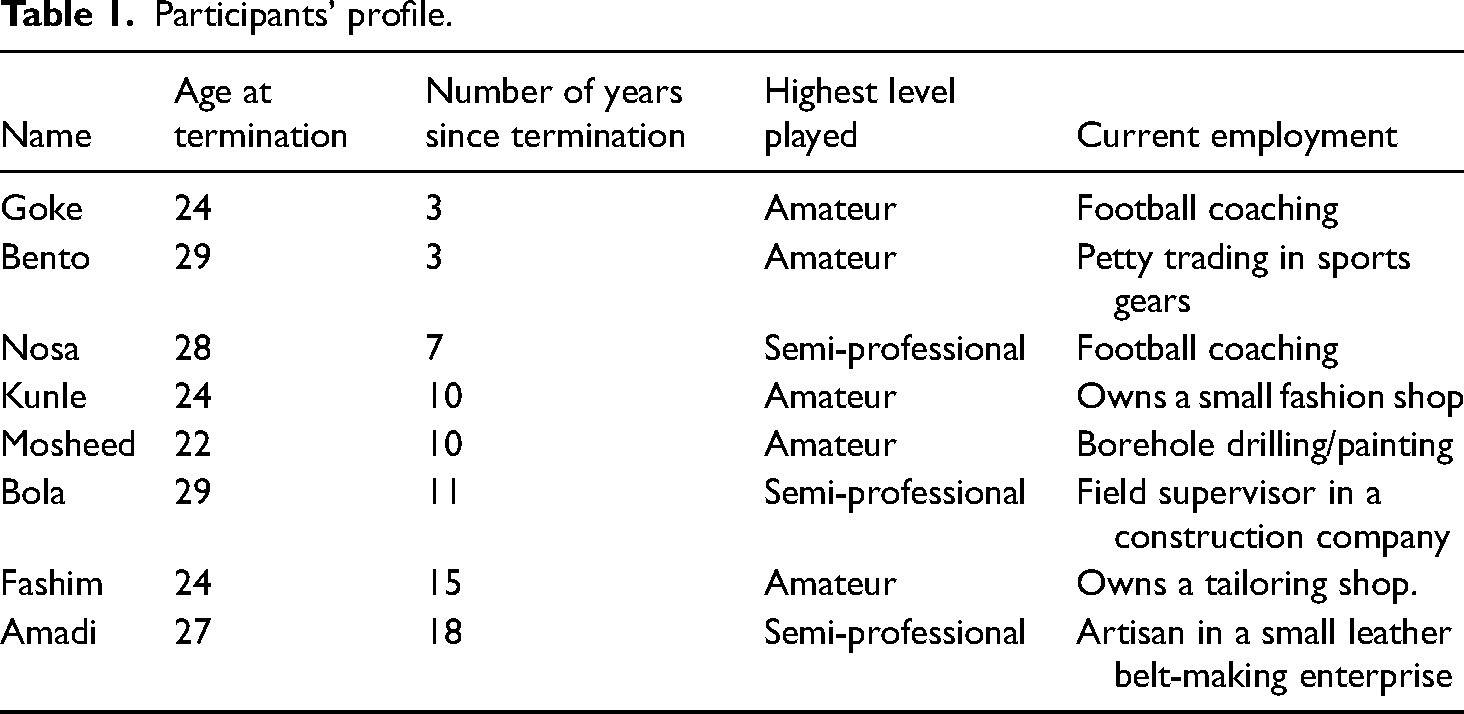
Interpretive methods are very useful for examining personal and narrated lived experience (Smith, 2016) and are recommended for ‘exploring dynamic processes and times of change within people's lives’ (Spiers and Smith, 2019: 2), such as career termination. Interpretive approaches use qualitative methods of data collection (Smith, 2016). The participants in this study comprised eight former pre-professional male athletes, all of whom had stopped actively pursuing a professional football career. The participants were approached and purposively selected through contacts in grassroots football known to the author from the northern, south-western and south-eastern geopolitical regions of the country, representing a diversity of social and biographical backgrounds and experiences (Table 1).
Participants’ profile.
As part of a research project that examined the lives of former pre-professional athletes who were unsuccessful in their effort to realise a career in professional football or transnational migration through football, data were collected through semi-structured face-to-face interviews and field visits to participants’ work places between March and May 2023. Interviews were conducted by the author in English, except for one respondent where a research assistant conducted the interview in Yoruba. The data collection followed strict ethical guidelines (approved by the Faculty of Economics and Social Sciences of the University of Tuebingen). The participants were asked open-ended questions, which helped to spur discussion and gave them the opportunity to tell their stories in rich detail. For the part of the study that explored career termination, the respondents were asked questions such as, ‘When did the thought of quitting football come up for the first time in your career?’; ‘Who and what played a role in reaching that decision?’; and ‘What helped you to deal with the outcome of that decision?’, etc.
To process and analyse the data, after listening to the interview recordings, they were transcribed to text using the naturalized/intelligent verbatim method (McMullin, 2021). The research assistant translated and transcribed the interview conducted in Yoruba. The author conducted the analysis through an interpretive analytical process (Sheard, 2022). It is a ‘creative’ and iterative process that prioritises meaning over description. The position of the researcher is important in this process given that ‘facts are inseparable from the observer’ (Maton, 2003: 54). The researcher draws from own knowledge and experiences, and literature and theory, while reflexively interacting with the research data to arrive at meaningful interpretations of the respondents’ narrative (Sheard, 2022). Interpretive analysis goes beyond merely summarising the respondent's narrative but seeks to make them meaningful. In conducting the analysis, attention was paid to what was said, what it meant (to the respondent and to the researcher) and how it was connected to meanings within the individual and overall data and to the research objectives and the relationship to literature and theory. The findings were organised under the two research objectives.
Analysis and discussion
The decision and experience of career termination
Career termination represented a key experience in the journeys of the former players, which occurred after a period of reflection or a significant event that made continuation difficult. Key reasons for termination that were common in the narratives of the participants include advancing age, perceived diminishing probabilities of a future professional career, the responsibilities of adulthood and intergenerational obligations and injury. The decision to terminate a career, in many cases, was voluntarily made by the players, rather than their clubs: You know, it's the players [deciding to terminate career] mostly here. Sometimes the clubs don't care about the players. Because, one, they don't have anything to offer the players. (Goke)
The experience of voluntary termination expressed by Goke contrasts with involuntary ‘sacking’ (Darby et al., 2022; Van der Meij et al., 2017), where the decision to deselect was primarily made by football academies, rather than the players. One factor that may explain this is the operational context of the football academies, which vary from those of the amateur and semi-professional clubs. While the academies mostly operate primarily as a nursery where young teenage players are groomed, sorted and exported, they take up significant costs to maintain their players, from housing, feeding, healthcare to education, etc. (Van der Meij et al., 2017). On the other hand, the amateur and semi-professional clubs, as Goke expressed, are far less resourced and only marginally cover costs for the players’ subsistence. In this regard, academies make quick decisions about player deselection given the enormous cost of keeping players who fail to make the grade and the reduced chances of exporting players beyond a certain age. In many cases, players deselected at well-resourced academies may even continue their pursuit at amateur and semi-professional clubs long into adulthood (Darby et al., 2022; Van der Meij et al., 2017).
Voluntary termination brings back the question of agency in African players’ pursuit of social and spatial mobility through football. Esson (2015c) and Darby et al. (2022) write that by mobilizing their bodily capital to chase their dreams of social and spatial mobility, African players become ‘entrepreneurs of self’, expressing their agency within the structures that enable or constrain entry into professional football and transnational migration. If ‘sacking’ lays bare the structural limits of the players' agency, voluntary termination demonstrates the ambivalence of agency expressed in African pre-professional players’ aspirations. By reflecting on one's chances of attaining a professional status and on the larger context of life circumstances, players who voluntarily terminate, demonstrate the agency that is embedded in the ‘entrepreneur of self’ (Darby et al., 2022) as rational actors with a choice of action. On the other hand, voluntary termination in itself is a form of ‘involuntary immobility’ (Darby et al., 2022: 113), since it is a disruption to the originally imagined biographical sequence of progressing from amateur and semi-professional to professional football.
Career termination in amateur and semi-professional football in Nigeria may develop in a non-linear process (and marked by tentative optimism - conceptualised under ‘navigating transition’ below), influenced by personal considerations, family and structural contexts in which the aspired career is enacted. Goke aptly shows how termination may be such a non-linear process. Having taken up a coaching job at a football academy, and was no longer making any serious effort at securing a professional playing contract, when asked why he decided to quit, he was quick to note that he still harboured the hope that he may still play at a professional level should an opportunity open for him: It [the dream of playing professionally] is still on. I have not ended it. No. Like I said, I can still play very well. You can see, I keep fit every time. If I had stopped playing, if I stop thinking of playing, I won't be this fit. I won't be keeping myself fit. You understand it? Not some coaches, just barely one or three years you start seeing them getting fat. I've not changed my lifestyle. I don't drink, I don't smoke. I always keep in shape. Occasionally, maybe one or two times, maybe one, maybe once in four months. Okay, alcohol once. Finish. But I don't over drink. Just wine, possibly. Finish. Still, the dream is still very much open. So, it is not something I can close. If Ronaldo at the age of 37 or 38 can still be playing, so me at 27, will I give up now? No. (Goke)
Nosa provides further evidence of the non-linear nature of the career termination process and of the various parties who may be involved in the decision-making. At age 20, while playing for an amateur side, Nosa attended a series of difficult and unsuccessful trials in Abuja to secure a contract in the local professional league. Frustrated, he returned to his family in his hometown and quit football for over a year: I was in Benin. I was just there, just to relax, to cool my head, because it [the selection trial] was frustrating and discouraging for me. The experience I had there [the selection trial], and then, I was so angry. I didn't want to have anything to do with football and all that. (Nosa)
Following the persuasion and encouragement of his ‘brother, aunty and her husband’ that ‘it is not over’, Nosa returned to continue the pursuit of his dream of becoming a professional footballer. ‘Making a future’ in Africa, Pelican and Heiss (2014) maintain, is not a process that lies solely in the hands of the individual, but ‘actors are always nodes in a network… embedded in social relations with kin, friends, neighbours, associates, etc. (Pelican and Heiss, 2014: 16).’ To this end, individuals ‘act as part of a community, they play social roles, share the same values and beliefs, pursue collective interests and execute communal decisions’ (Pelican and Heiss, 2014: 16). Social becoming in most of Africa is, therefore, bound by a social contract of reciprocity of collective and intergenerational care: ‘The young people who are receivers today wish to become givers in the future’ and ‘to be able to support their relatives and families’ (Martin et al., 2016: 9). Thus, ‘making a future is always making a future for the community’ (Pelican and Heiss, 2014: 16). Ejekwumadu (2024) has elucidated the various prosocial activities that elite transnational African footballers perform in their communities of origin as part of the general norm of reciprocity. Darby et al. (2022) and Van der Meij et al. (2017) have explained that the pursuit of a professional football career among West African youths is a ‘household livelihood strategy’ steeped in the practice of inter-generational care and the expectation that the athlete's success would translate to material benefits for the household. Onwumechili and Akpan (2019) highlighted that the livelihood ‘responsibilities’ of immediate and extended family members are central concerns and motivations of football players in domestic football in Nigeria. Extended and immediate family, therefore, may have a significant influence on a player's career termination decision-making and experience (Van der Meij et al., 2017).
A further 6 years spent playing with a club in the semi-professional league, the frustrations that made Nosa previously quit the game would return: ‘I had to take a stand and talk to myself’ that ‘boy, you're not getting younger anymore’. Here, Nosa further underscored the expectations that come with masculinity and age in West Africa, where young men are expected to assume responsibility for self and for others (Esson, 2013; Kovač, 2021; Ungruhe and Esson, 2017), and how such influences important decisions at vital junctures of the life course. Frustrated by his inability to engineer the social and or spatial mobility that he had hoped for, and the general despondency of his life context, Nosa made a decision about his future: We were playing our match, then Niger Tornadoes [a professional Nigerian Premier League club] were [to be] in that same stadium to play another team in the Premier League. I was so keen to play very well that day, just for them to see me. But along the line, they couldn't come because of the rain. Ideally, we were not supposed to go home, because it was still raining. With our wet clothes and all that, we were supposed to stay in a hotel. We understood with the owner of the team, because no one was supporting him. He is a civil servant, so he was just doing it alone. We had to immediately move with our boss and started going back to Abuja. You can imagine the risk and all that. Inside the bus, I was like, this is not it; this is not what I want; this is not how I planned it. I was just talking to myself. I was angry. We were all in the bus. We were all wet and all that. It was crazy and it was the last game of the season. I just had to speak to myself that it's about time for you, you know, for you to do something else, because [breathes out, while sounding emotional], time waits for nobody. So, I just made up my mind and I quit playing. (Nosa).
In stating that ‘this is not how I planned it’, Nosa showed that his eventual decision to terminate his football dreams represented a disruption to his imagined biographical narrative – a loss of his central concept of self-built on athletic success (Danish, 1983; Sparkes, 1998; Beamon and Bell, 2011). Like Nosa, having failed to secure a professional status, the pressures of the expectations of adulthood was becoming intense for Goke. He increasingly felt that he was running out of time to make a career in professional football and needed to secure an alternative pathway to adulthood: So, I know I'm ageing, and you know in football, there's an age you know that you can be active and we are getting to a certain age. I still can play professionally this way. I'm still very active, like, very strong. I know I can play. At least, I can play more than five years still now, but I'm not channelling my energy into wanting to play professionally anymore. (Goke).
Goke further highlighted the burdens of age-related expectations of adulthood and of intergenerational care and their role in the career termination process. He noted that at a certain age, some responsibilities and expectations emerge for the player: ‘you have family; you have to work; responsibilities already setting in; so, he's thinking a lot’. In explaining his decision to quit, the pressures of the responsibilities of adulthood were similarly expressed by Kunle, who needed to ‘hustle’, a colloquial term used by urban youth in Nigeria to explain struggles to earn a living, usually through various activities in the informal (or even clandestine) economy (Chukwuemeka, 2022; Egielewa, 2022). As Chukwuemeka (2022: 24) explained, that the ‘hustler’ youth ‘seeks self-extrication from postcolonial marginality and to monetize his masculinity’, so as ‘to be able to shoulder pecuniary responsibilities’ of adulthood and intergenerational obligations. Players who no longer see a path to their imagined biographies through football may quit in order to find other ways to achieve social becoming. Mosheed, quit because ‘you just have to grow and stop wasting your time’ on ‘something that is not earning me anything’, which expresses similar concerns pertaining to the need to fulfil the responsibilities of masculinity and adulthood.
In some other cases, severe injuries forced the respondents to quit. This was the situation in the cases of Bola, Amadi and Bento, who could not continue due to injury. After a serious injury to his eye that was poorly treated, with little to no support from his club, Bola decided to quit because of the risk posed to his health: ‘I needed to find something [else] to do because it [playing] was dangerous for me or else, if I just wanted to become blind’. Injury has been noted as a significant career transition event and one of the major reasons for involuntary career termination in football (Gordon and Lavallee, 2012). It is even more so in amateur and semi-professional football in Nigeria given that most clubs lack the knowledge and resources to adequately manage injuries (Owoeye et al., 2013). Such forced decisions that disrupt the imagined biographical sequence of the athlete may become the source of significant physical and psychological post-career challenges. Bola noted that watching a professional player in the position he played evoked feelings of sadness about what could have been for him if he had not got injured: ‘Anytime that I see a striker waste chances, I am really sad that if I had been in this position’. Brown and Potrac (2009: 143) argued that players forced to deselect may experience ‘psychological difficulties such as low self-respect, low self-confidence, and feelings of anger, anxiety and depression’.
Navigating the transition
Given the non-linear nature of career termination, except for significant events such as injury, the process of navigating career termination usually started before the players eventually quit the game, as already observed in some of the narratives in the preceding findings. This developed through what I refer to as tentative optimism. It is a construct that may be used for understanding human behaviour in situations of hope, but increasing uncertainty. It may happen when an individual has been highly optimistic about his chances but has not been able to materialise such high hopes into concrete positive outcomes, despite sustained effort. In this situation, certainty is replaced with doubt, albeit, hope is sustained that the desired outcome may still be possible. Tentative optimism may draw conceptual similarities with ‘judicious opportunism’ (Johnson-Hanks, 2005) previously employed by researchers to articulate how African players navigate their pursuit of spatial and social mobility (Darby et al., 2022; Ungruhe and Esson, 2017). Judicious opportunism describes opportunistic behaviour driven by social contexts where social structures and systems do not enable individuals to make long-term plans and act in calculated rational ways (Johnson-Hanks, 2005). Darby et al. (2022) and (Ungruhe and Esson, 2017) argue that aspiring African players express judicious opportunism in their struggle for social becoming by hanging on to hope, while exploiting crevices of opportunity that may open up along their journeys.
While tentative optimism may share certain elements of judicious opportunism, it differs in given ways from the latter in the way Johnson-Hanks (2005) originally conceived it. In terms of similarity, both concepts involve behaviour under conditions of uncertain outcome. However, the difference can be explained by the actors’ perception of, orientation to and reaction towards uncertainty. The actors’ starting point of uncertainty is somewhat more nuanced in tentative optimism. With judicious opportunism, actors, from the outset, conceive the social context of action as unpredictable and outcome as very uncertain, whereas in tentative optimism, actors show initially high levels of optimism about positive outcomes, even if the outcome is objectively very uncertain. That is to say, a starting point marked by the ‘euphoria of imagined success’ (Christiaens, 2020: 496; McRobbie, 2016: 4). In the neoliberal age, ‘the future appears as a hazy mist of uncertainty’, argues Christiaens (2020: 496), ‘but the young creatives are confident that, if they diligently cultivate their virtuosity, they are destined for extraordinary achievements’. Similarly, Roderick (2006: 4) notes that ‘when players start out, they may think that, as young professionals, their destinies are in their own hands’. In judicious opportunism-, actors have a more scattergun and opportunistic approach, seizing occasions as they emerge, perhaps, given their perception of uncertainty. In tentative optimism, while chance opportunities may be seized, actors are a lot more calculated and longterm, focused on more narrowly defined and targeted goals, albeit, diversifying goals and action when the uncertainty of outcome becomes subjectively manifest. Tentative optimism, in addition, more specifically conceptualises behaviour in a period of transition in the individual's life, whereas judicious opportunism captures a more general way of behaving and state of existence in social contexts of enduring uncertainty.
The narratives of a number of the respondents revealed how tentative optimism develops in the career termination experience. At the beginning of their pursuit of a career in professional football, they were very optimistic and effusive about their chances of success. Ungruhe and Esson (2017: 34) have previously noted the widespread belief among aspiring African youth players of ‘a relationship between black bodily capital and success in sport’. This optimism among the participants was demonstrated in the centralisation of the athletic self above every other identity and the foreclosure of their life towards achieving athletic success (Adler and Adler, 1991). The athletic identity refers to the athlete’s role as the central concept of self (Brewer et al., 1993: 237). The development of an exclusive athletic identity (Petitpas, 1978) was aptly demonstrated by Mosheed, who noted that ‘I wanted to focus on football and that is why I never pursued admission [to a higher institution]’. He continued: ‘I saw it as a career; I saw it as a pathway’ and ‘this is what I want to do. I'm not going to any school’. This bullish attitude towards their chances of making it into professional football was common across the narratives of all the players in this study. Media mediated success stories of elite African players in Europe fuel optimism in soccer careers among African youth, the pursuit of which ‘may involve the renunciation of other possibilities and trajectories’ thereby exposing them to uncertain futures (Agergaard and Ungruhe, 2016: 70). Even for many that achieve migration to Europe, the limited football-focused skills undermine their post-career planning and ability to transit into other livelihood pathways (Agergaard and Ungruhe, 2016; Ungruhe and Agergaard, 2020).
With the desired professional career not progressing as imagined over time, the initial optimism was gradually replaced with doubt. While the players started thinking about other ways that they may secure a future adulthood pathway, they however still retained hope in the pursuit of their football ambitions. Nosas’ case shows how tentative optimism may develop in the pursuit of a football career. At first, ‘I went into phone repairs. So, I didn't finish learning that because of football. I was so distracted with football’. Then, ‘I went into CCNA with networking, but I couldn't finish that because of football’. Already in his mid-20s, the desired football career had not yet taken off, but the responsibilities of adulthood were building up: ‘You're already old enough to start taking care of yourself, you know, start deciding what to do’, he said. At this stage, tentative optimism became firmer. ‘Along with football’, he took up a job as a salesperson, which he is ‘gifted’ in.
While some of the respondents tried getting a job or learning a skill, others looked towards gaining further education through a degree or diploma programme at a higher educational institution. Over time, and without yet achieving the success, that he had been very optimistic about, Mosheed said ‘I just had to go back to school’. This was similar to Bento, who narrated that ‘I intentionally used these three years to pursue football, but when I saw that it was not working, I decided to go back to school’. Going back to school was an attempt to create an alternative pathway to adulthood in the event of failing to attain the desired professional career. It may also serve as a clear break from football itself. However, beyond providing an alternative career pathway to football, schooling provided a new anchor of meaning and played the function of replacing a lost identity. This is well captured by Mosheed: Then, you know someone that has spent majority of his time on football and wanting to like go back to school [higher education]. I was like, let me just go to school for certificates… Like, seriously, I didn't even Know what it took to even go to school, because I never had the intention of. I never planned for it. Just like, let me just go to school. Then, I didn't even know the course I wanted to study. I had to call a friend of mine; ‘Yeah, I was in commercial when I was in secondary school, which courses can I do that will be less calculative? Okay, we can put in for this business admin’. And I choose it that way. I didn't even Know what it took, because I never planned for it. (Mosheed).
Athletes who experience a premature career termination or deselection may suffer a feeling of loss of self and identity (Sparkes, 2000; 1998; Brown and Potrac, 2009) because their central framework of self and life have been founded on athletic activity and success (Sparkes, 2000; Sparkes, 1998). In this regard, following deselection or career termination, athletes may need to reimagine and reconstitute the self into new identities. Ejekwumadu and Thiel (2024) have explained that one of the ways African players cope with and adapt to career transitions is to reconstitute their concept of the self to accommodate or fit into new identities or roles. Mosheed's narrative indicated the fear of the loss of status following career termination and suggests that going back to school was more about replacing an identity and status than careful planning of an alternative career path.
Mosheed further confirmed the need for a new status that motivated his recourse to schooling, when he remarked that his thinking was ‘let me push for the certificate, at least, it won’t be like I’m an illiterate, I didn't go to school’. In Nigeria, there is a colloquial use of the adjective, ‘illiterate’, to refer to one who has no educational qualification beyond secondary education, especially if such a person may not demonstrate success or high achievement in an alternative walk of life. Going back to school, therefore, replaced the status of an athlete with the highly valued status of a student. In addition, this status replacement may save the athlete from the ‘negative social evaluation’ of peers, family and community and the ‘shame’ that may accompany career termination, having failed to live up to the expected goal of a professional career and or transnational migration through football (Van der Meij et al., 2017).
As Bury argued, repairing a disrupted biography requires a ‘fundamental re-thinking of the person's biography and self-concept’ (1982: 169). Taking up a part-time job, learning a skill or going back to school (whether as an alternative career plan or to replace the loss of identity), represented a quest narrative (Hart, 2022) to take charge of and repair their disrupted imagined biographical narrative. Bury also noted that such a process requires the ‘mobilisation of resources, in facing an altered situation’ (1982: 170). Besides internal resources, such as education and skills training mentioned earlier, the former athletes mobilised other forms of external resources in their quest to chart a new narrative of life following career termination. In most cases, the former players leveraged relationships and networks built from their engagement in football to either earn a job or to start an enterprise. This is similar to what Ungruhe and Agergaard (2021) observed among migrant African players who try to secure future jobs by utilising social relations built through football. In other cases, some of the former players relied on resources and skills acquired through family and kinship networks to start a trade.
A number of the players tried to use their social capital and network to remain in the game and find jobs within football or to provide associated services to the sector. Transiting into youth football coaching presented one of the choice pathways. Goke, while once again showing the non-linear nature of the career termination experience, described his entry into coaching. The practice of tentative optimism was evident in his narrative as he still harboured a faint hope that he may still earn a professional playing opportunity and transnational migration: Right now, I cannot see me going to play for an academy, and the league here is not good enough. So, why waste my time when I can still be a coach? And I can coach better. I can develop myself now at this age. If there is any deal for me now, I'll play football. I'm a very good footballer, no doubt, but now, I see me building myself as a coach. I just believe I've developed that zeal of encouraging young athletes because I've been through a lot. So, I don't want them to be frustrated like I was. That was why I decided, okay, let me just be a coach. Being a coach at a very young age is not bad. (Goke)
During the COVID-19 lockdown, Goke invested his time in developing his coaching credentials: ‘That was 2020, the year of COVID, when everyone was at home. So, during this period, I was able to do a lot of courses, even under the English FA. I did on Coursera, a lot of coaching courses, like the art of training young athletes’. With this training, he was able to approach and do an internship with a coach in the national youth team setup, whom he had known from his church: ‘Barely one month, this same manager recommended me for an academy job. So, that was where I started my coaching, from last year’. In a similar way, Nosa whose night sales job at an eatery allowed him time to train during the day, started supporting football and physical activity training for children of some expatriates, who were a introduced to him by his boss. Through the same connection, he got a job as an assistant physical education trainer at an international school owned by community of expatriates. With this line of activity appearing to hold promise, he narrated: ‘I began to build myself in the coaching part, and beginning to grow myself, doing research, going into studies and studying so many things, coaching methodologies and all that’. Less than a year later, he got a job as a coach at a football academy on the recommendation of his boss.
In trying to find a way to be meaningfully and gainfully connected with the game, Bento leveraged the network of friends, colleagues and supporters he built during his playing time to set up a petty trade in sports gear and equipment, including jerseys, soccer boots and balls. He not only got a loan from a fan of his, but he also sold his goods to his football network. He feels that despite his inability to go professional, his involvement in football has been beneficial: Football has really helped me a lot. What I'm doing now, the man that gave me the loan to start the business, knew me only from football. So, I cannot say that, maybe, football has delayed me. I may not make it as a professional footballer, but I'm still gaining something from it. I am still making money from it. (Bento)
In their study, Williams and MacNamara (2020) explained that ‘early experiences in a formalized talent pathway’ enabled the athletes ‘to develop a toolbox of psychobehavioral skills’, such as determination, motivation, goal setting, personal responsibility, etc., that ‘supported their transitions to new environments following deselection’. The preponderance of a quest narrative (Hart, 2022) among the participants in this study supports the claims made by Williams and MacNamara. For the participants who found employment within football, remaining in the game provided them a sense of continuity with the enduring concept of the self built on their athletic identity (Brown and Potrac, 2009), which helped the players maintain a sense of meaning, stability and even accomplishment.
Nosa derives a sense of fulfilment that he is still able to perform the obligations of adulthood and of intergenerational care (Darby et al., 2022) through his continued involvement in football: ‘I might not go further than what I wanted, but football still pays my bills; football still puts food on my table; football still provides for my family; through football, I still take care of my mom’. On the other hand, though the athletes in this study, who have found new roles within football, appear to be having an encouraging transition, in some situations, trying to remain connected to football after quitting may be detrimental to repairing the disrupted biography. Brown and Potrac (2009: 154) argue that such a mindset may indicate that the former athlete is ‘wedded to a self-conception situated in the past’, which ‘could lead to an individual's sense of self remaining fragmented and his or her life being put on hold’. This was observed in the cases of Goke and Bento, who despite having transited into coaching and petty trading of sporting gear respectively, still insisted that they may still get a chance and remain open to playing professionally.
Amadi, Fashim and Bola relied on familial relationships to chart new pathways to adulthood away from football. A kinsman offered Amadi a job in his small enterprise where he produces leather belts, while another kinsman brought Bola to join his construction firm. Having quit after suffering a serious injury, Bola narrated: ‘After the surgery, he took me back to construction, that I can't stay at home and that I needed to do something. He invited me to come and learn about their operations in road construction, from the asphalting, bridges, drainage and boreholes to solar lights’. For Fashim, his father's old trade provided an opportunity. He went back to learn his father's trade in tailoring and took over his shop.
While all the respondents in this study demonstrated a quest narrative by proactively attempting to rebuild their biographies through gaining trade skills or educational qualifications or by getting a job, some reported having experienced former colleagues who rather followed a chaos narrative (Hart, 2022). Brown and Potrac (2009: 151) contended that failing to translate their training into a professional career, former youth players may experience considerable emotional and psychological disturbance, including ‘anxiety, humiliation, anger and despair’. Falling into substance abuse appeared to be a common experience among such former players. Nosa narrated that ‘some of my friends, so many of them, were not lucky’ since ‘they couldn't take the bold step’. They became ‘frustrated’, turned themselves in that to a ‘drunkard’ and became ‘a subject of ridicule’. In a similar way, Amadi recounted how many others were not as lucky as he was and lacked the social capital helped him to navigate his own transition: I joined my brother's [kinsman] business. At least, I can be proud of that. I can start this now on my own, but some of them don't have somebody to help them or somebody to support them, to bring them in and say, come and join me. They don't have it. So, from this beer parlour, to this beer parlour. That's even when they see the money. When, they see one of us that has one naira, they say, come and buy me beer, let me drink. When you start drinking from this to this, you are frustrated in life and some of them don’t have families. (Amadi)
In nearly all of the cases in this study, navigating career termination was marked by a general absence of support from clubs. In their own study of the deselection experience of former elite youth players, Brown and Potrac (2009) found that at the athletes perceived ‘little meaningful support’ from their clubs, similar to the findings in this study. Decrying how players may exit the amateur level without even being noticed, Mosheed said that he did not ‘expect anything from the club’ and that ‘grassroots football is like a market, when someone steps out, another one comes in’. The lonely path following career termination and the absence of psychosocial support from the clubs emerged quite strongly from Bola, who was forced to quit football following an injury that left him partially visually impaired. Not only did he receive little to no support for his medical treatment, but he also lacked psychosocial support from his club or any other institutions within football. Disclosing how much relieving and supportive the interview with me was, he said: I'm really happy about it [our interview], because you know, if you have something to say and you don't see anybody that you can just express your feelings to, it would be like you are in a bondage, but today, I have expressed myself. It is the first time for me. Nobody knows what I passed through in my football career. You know that I played football and at the end of it, injury, but there are a lot of things that I passed through about how football is; about the travelling; about the sufferings; about everything, but unfortunately, the thing did not work as I wanted it. So, at times, I will just say to myself, who will I just call now that would hear me? Who wanted to hear my exclamation? So, I'm just happy that I can just express my feelings about my career. (Bola).
The absence of psychosocial support may contribute to the experiences of emotional and psychological trauma that may follow deselection or career termination (Brown and Potrac, 2009), which may lead athletes to follow a chaos narrative (Hart, 2022), such as reported by Nosa and Amadi regarding former colleagues who fell into alcoholism.
Conclusion
The objective of this study was to explore how athletes in amateur and semi-professional football in Nigeria experience and navigate the process of career termination. The findings revealed career termination to be an important transition in the lives of pre-professional footballers in Nigeria. While mostly a voluntary experience, injury may also force others to quit. It also showed that career termination may develop in a non-linear trajectory as athletes consider their chances of a professional career, age and the obligations of adulthood and intergenerational care. While participants in this study showed a proactive quest narrative in rebuilding their lives away from football, some reported that colleagues may follow a chaos narrative. Charting a new narrative of life usually involved making use of the social capital and relationships built from involvement in football (e.g. going into coaching) or leveraging familial ties to secure a job. The study also found that most of the athletes navigated the process without significant support from their former clubs or other institutions, relying on their own resources and network, mostly built through their involvement in football, to restore coherence to their disrupted biographical narratives. Those who find a new way of making a living through the game (e.g. coaching) bring some nuanced perspective to the binary between success and failure in youth and pre-professional sports.
The findings of this study provide a further understanding of the experience of career termination and deselection in pre-professional football in West Africa. For instance, while Darby et al. (2022) and Van der Meij et al. (2017) explained involuntary deselection (sacking) in the context of football academies in Ghana, this study brings the contrasting experience of voluntary career termination from the context of amateur and semi-professional football in Nigeria. A novel contribution of the current study is the articulation of the concept of tentative optimism, which explains how pre-professional athletes may approach the crucial transitional phase away from their aspired career in professional football, as optimism fades into uncertainty. Tentative optimism offers additional and alternative theoretical and conceptual lenses for understanding how African youth behave under contexts of uncertainty, not just in the area of football careers, but also in other livelihood endeavours. In addition, this current paper makes another novel contribution by revealing that the choice of self-development pathway following career termination, such as going back to school, may mean more than a plan towards an alternative career pathway, but may also represent a strategy for constituting a new sense of self, and more importantly, to replace a lost identity and avoid negative social evaluation.
The findings of this study raise a few issues of concern that require attention. Firstly, the context of amateur and semi-professional football in Nigeria needs a dual career planning programme for the athletes. This is evident in the individual journeys of the former players to alternative career pathways following career termination. Since amateur and semi-professional clubs may lack the capacity and organisational objective to provide such a framework, it may be necessary for the governing bodies to develop and mandate the implementation of such frameworks. This would help athletes to better plan and prepare for life after football. Secondly, the general absence of psychosocial support in the experience of transition is a major problem that requires attention. Clubs, administrative bodies and non-profits working in the area of sports may consider creating channels through which pre-professional athletes transiting out of the game may seek and receive psychosocial support.
Despite the valuable knowledge contributions of this study, there is a limitation that is worth stating. The time gap since quitting and this study, for some of the respondents, may affect retrospective recall and the recounting of experiences. On the other hand, however, such a time gap may be useful for the full evolution and experience of the post-termination process. Important areas that further studies may explore are the lived mental health experiences following career termination and the frameworks for dual career planning in amateur and semi-professional football in Nigeria.
Footnotes
Declaration of conflicting interests
The author declared no potential conflicts of interest with respect to the research, authorship, and/or publication of this article.
Funding
The author disclosed receipt of the following financial support for the research, authorship, and/or publication of this article: This work was supported by the Fritz Thyssen Stiftung (grant number 40.22.0.023SO).
