




Abstract
Pre-professional career termination has attracted considerable interest in football research. Research attention has mostly been on the difficulties that players may face in navigating the transition to a post-football life. However, “the excessive focus on the pathologies” may obscure the many different ways that the aspired career may contribute to the athlete's post-football well-being. Through a positive psychology approach, this paper explored the narrative frames through which former amateur and semi-professional players in Nigeria articulate a positive experience of their pursuit of a professional career, irrespective of the unrealized objective of becoming professional footballers. The findings reveal three positive narrative frames arising from connections that study participants made between their football pursuits and their post-football well-being. These include the narrative of livelihood, the narrative of purpose and the narrative of recognition. The implication of the findings is that amateur and semi-professional clubs need to be more deliberate in providing players with a range of experiences that may support a more positive post-football life narrative.
Introduction
The goal of majority of youth footballers is to sign professional contracts with elite football clubs (Darby et al., 2022). In West Africa, a further goal of such players is to achieve transnational migration through football, especially to the European football leagues (Ejekwumadu, 2023; Esson, 2015). However, research has shown that only a small percentage of youths in the amateur and semi-professional divisions make it to full professional level. Revealing how difficult it is for youth players to reach the professional level, Calvin (2017) explains that only about 0.012% of about 1.5 million boys who play organized football in England will go on to sign a professional contract with a Premier League club. In addition, only about 2% of youth players aged 16 awarded academy scholarships at clubs in England still play in the top five levels of English football by the age of 18 (Calvin, 2017). This situation is common across the world, pointing to the inevitability of deselection or voluntary career termination (which may also be injury-induced) for majority of pre-professional footballers, and especially so for aspiring footballers in West Africa (Darby et al., 2022; Ejekwumadu 2024a, 2024b; Van der Meij et al., 2017).
In Nigeria, weak economic prospects in the last couple of decades have made it difficult for many youths to find employment or earn a meaningful livelihood (Olubusoye et al., 2023). At the same time, these youths are increasingly confronted with the difficulties of performing the responsibilities of masculinity and intergenerational care, and face the pressures of living up to the expectations of respectable adulthood (Smith, 2020, 2017). Faced with such difficult situations, many among them who are gifted in activities that are heavily dependent on natural talent, such as music and creative media content, have tried to engineer social mobility through their talent (Serres, 2023). Others have looked toward a career in and migration through football as viable options for achieving social becoming (Darby et al., 2022; Ejekwumadu 2024a, 2024b). However, despite the time and effort committed to their aspirations, for the majority of these aspiring footballers, success is seldom achieved given limited opportunities for a professional contract at local clubs, stiff competition for selection, and the difficulties of transnational migration (Ejekwumadu, 2024a).
Considering the inevitability for many aspiring footballers, deselection and career termination have attracted a fair amount of interest from sport sociologists and psychologists. In most cases, attention on the deselection and career termination of youth footballers has been focused on the difficulties that the players may face in navigating the transition to a post-football life (e.g., Brown & Potrac, 2009; Van der Meij et al., 2017). This is mostly based on the understanding that youth and pre-professional athletes develop a dominant athletic identity (Brewer et al., 1993; Sparkes, 1998), a concept of the self primarily built around participation in sport, of which deselection or career termination represent a major disruption, not only to that identity but also to the hoped-for progression to a professional athlete (Blakelock et al., 2016). Researchers have especially emphasized the attendant psychosocial and mental health challenges that usually follow deselection and career termination. For instance, Brown and Potrac (2009) highlighted the emotional and psychological challenges that youth players face following deselection, including feelings of anxiety, fear, depression, anger, and humiliation. Blakelock et al. (2016) similarly observed that the risk of developing clinical levels of psychological distress is high among players who have been deselected. For aspiring youth and amateur players in West Africa deselected at football academies, Darby et al. (2022) and Van der Meij et al. (2017) reveal that deselection may bring “shame” and “guilt” arising from “negative social evaluation” from family and peers.
Beyond the psychosocial and mental health experiences, the challenges of reinventing self and charting an alternative pathway to independent livelihood and employment for deselected players have also attracted attention. Literature shows that the dominance of the athletic identity may lead to identity foreclosure, a forfeiture of the opportunities for exploring other possible pathways to adult and independent life (Beamon, 2012; Brewer & Petitpas, 2017; Miller & Kerr, 2003; Petitpas, 1978). At deselection or termination, players may find it difficult to access employment outside of football since their overall skill set may be limited to their athletic competencies (Brown & Potrac, 2009). For African players, Ejekwumadu (2024a) highlights how the practices of amateur and semi-professional football in Nigeria produce precarity for the players, which undermine their transition into other livelihood activities at the end of their pre-professional careers (Ejekwumadu 2024b).
However, the “exclusive focus on pathology,” Seligman and Csikszentmihalyi (2014) caution, “results in a model of the human being lacking the positive features that make life worth living” and “neglects the fulfilled individual” (p. 279, 280). Consequently, “hope, wisdom, creativity, future mindedness, courage, spirituality, responsibility, and perseverance are ignored” (Seligman & Csikszentmihalyi, 2014, p. 280). In a study that explored the biographies of former amateur and semi-professional footballers in Nigeria, my initial papers laid bare the precarity of the unfulfilled aspired football career in Nigeria and the attendant challenges for the athletes’ well-being and livelihood (Ejekwumadu 2024a, 2024b). Nevertheless, narratives about an experience may be multi-layered, simultaneously comprising negative and positive experiences. Besides, as Seligman and Csikszentmihalyi (2014) note, a positive perspective of experience, optimism, and hope may enhance well-being and enable the individual to thrive. In this regard, based on the same cohort of players and research data, the current study explored their more positive narratives amidst the negative experience of an unrealized professional pursuit. It explored the following question: What are the narratives through which former amateur and semi-professional players articulate a positive experience of their pursuit of a professional career, irrespective of the less than desirable outcome? The objective was to (a) identify the culturally situated narrative frames of meaning making through which former pre-professional players make a positive sense of their experience after career termination; and (b) to explore the performative importance of such positive narrative frames in the present and in the construction of a future self. As Smith (2015) notes, the changing interpretation of past experience may shape an understanding of the present and the approach to the future. Studying the positive narratives, emerging from a rather generally disappointing outcome, opens up the opportunity for learning about aspects of subjective negative experience that may contribute to recovery and future well-being.
Positive Psychology: Making Lemonade out of Lemons
Positive psychology provides a very useful framework for exploring how individuals may construct a positive narrative of subjective negative experience. Tellis-James and Fox (2016) write that positive psychology places emphasis on “the future, strengths, resources and potential, and suggests that negative experiences can build positive qualities” (p. 327). Seligman and Csikszentmihalyi (2014, p. 280) explain that it is “about valued subjective experiences: well-being, contentment, and satisfaction (in the past); hope and optimism (for the future); and flow and happiness (in the present).” It “focuses on aspects of the human condition that lead to happiness, fulfilment, and flourishing” (Linley et al., 2006, p. 5). The individual is not just a “passive foci” of stimuli, but human beings are “self-organizing, self-directed, adaptive entities” with the tendency of reproducing “optimal experiences” (Seligman & Csikszentmihalyi, 2014, p. 286, 287). Positive psychology can help to nurture well-being, by finding and amplifying the very aspects of experience that generate and foster optimism, hope, growth, and fulfilment (Seligman & Csikszentmihalyi, 2014). Positive psychology is, therefore, about the recognition of human agency and the individual's capacity to express strength and resilience from positions of challenging personal experience.
Positive mental states in the face of adversity may help individuals “confront reality more objectively,” “practice habits that enhance health and to enlist social support” (Seligman & Csikszentmihalyi, 2014, p. 290). Young people, Tellis-James and Fox write, may develop a “range of strengths and resources” from earlier negative experiences. Finding the positive narratives of an individual's generally negative experience comes from focusing on “where they were going, rather than where they had been” (2016, p. 327). This underscores the “importance of focusing on the future; in particular, the importance of exploring how young people conceptualize the possibilities that lie ahead of them” (Tellis-James & Fox, 2016, p. 327, 329). To achieve this involves taking a “developmental perspective” that considers how “individual strengths unfold” over the life course (Seligman & Csikszentmihalyi, 2014, p. 286). In addition, Seligman and Csikszentmihalyi maintain that understanding the social context of experience is important to a positive psychology, the “positive communities and positive institutions,” including the milieu, social relationships, activities and cultural norms that structure positive experience (2014, p. 286).
Although research on pre-professional players’ deselection and career termination has been predominantly focused on the ways it may undermine athletes’ post-football psychosocial well-being and livelihood opportunities, Williams and MacNamara (2020) take a positive approach to exploring the experience of deselection and career termination by focusing on the former youth players’ positive reconstruction of their experience, especially as it impinges on their life course. In their study, the participants maintained that personality and character traits such as determination, motivation, goal setting, and personal responsibility, which were nurtured through involvement in the talent development pathway, proved helpful in their transition from football and success in other walks of life. This shows how important it is for us to explore the subjective narratives of players who have been deselected or who have terminated their careers at the pre-professional stage. It enables us to better understand the experiences that they have along the career pathway that may be interpreted in ways that may contribute to a positive transition experience or support post-football well-being.
Methodology
Social Constructionism and Narrative
In this study, reality is understood as multiple, socially constructed, and dynamic. Individuals construct reality through their interaction with the social and natural world (Burr, 2019). Reality, therefore, is not autonomous of the individual nor does it exist with unchanging properties. The social construction of reality is achieved through narratives (Smith, 2015). These are the resources of meaning making through which individuals make sense of their experiences (Bruner, 1990; Smith, 2015). While individuals tell personal stories about their experiences, these are organized as narratives embedded within social structures and culturally shared meanings (Bruner, 1990; Smith, 2015). Therefore, the stories that individuals tell about their experiences can only be understood in relation to their culturally situated positions. In addition, narratives are not just mere stories, they are performative, influencing action and behavior as well as charting the course of a future self (Bruner, 1987; Smith, 2015). Human beings, notes Smith (2015), are “meaning makers who use narratives to interpret, direct and communicate life” (p. 204).
In this regard, the structures of experience, the reflexivity of individuals and the cultural and linguistic resources through which they make sense of their world are important in the process of knowing. This position aligns with the views expressed in Seligman and Csikszentmihalyi (2014, p. 286) about positive psychology, which contends that “people and experiences are embedded in a social context” of culturally shared meanings, social relationships, and ways of story telling. The reality of the respondents in this study is understood as subjectively constituted within the context of a football career pursuit and the culture and social relationships that have shaped their narrated lives.
Participants
The current paper is based on qualitative data collected for a research project that examined the lived experiences of former pre-professional male athletes in Nigeria who were unsuccessful in their effort to realize a career in professional football or transnational migration through football. The participants comprised of eight former athletes (Table 1), purposively selected through the author's contacts in grassroots football in Nigeria. The respondents all nursed the dream of playing professionally and moving abroad but terminated their pursuits either because of injury or lack of opportunities for realizing their ambitions. By focusing on the future (Tellis-James & Fox, 2016) and taking a developmental perspective (Seligman & Csikszentmihalyi, 2014), the study sampled a cohort of former players who had terminated their pursuit over a considerable period, enabling their narratives to develop beyond the immediate disappointment of an unrealized dream and a more nuanced evaluation of their experiences.
Participants’ Profile.
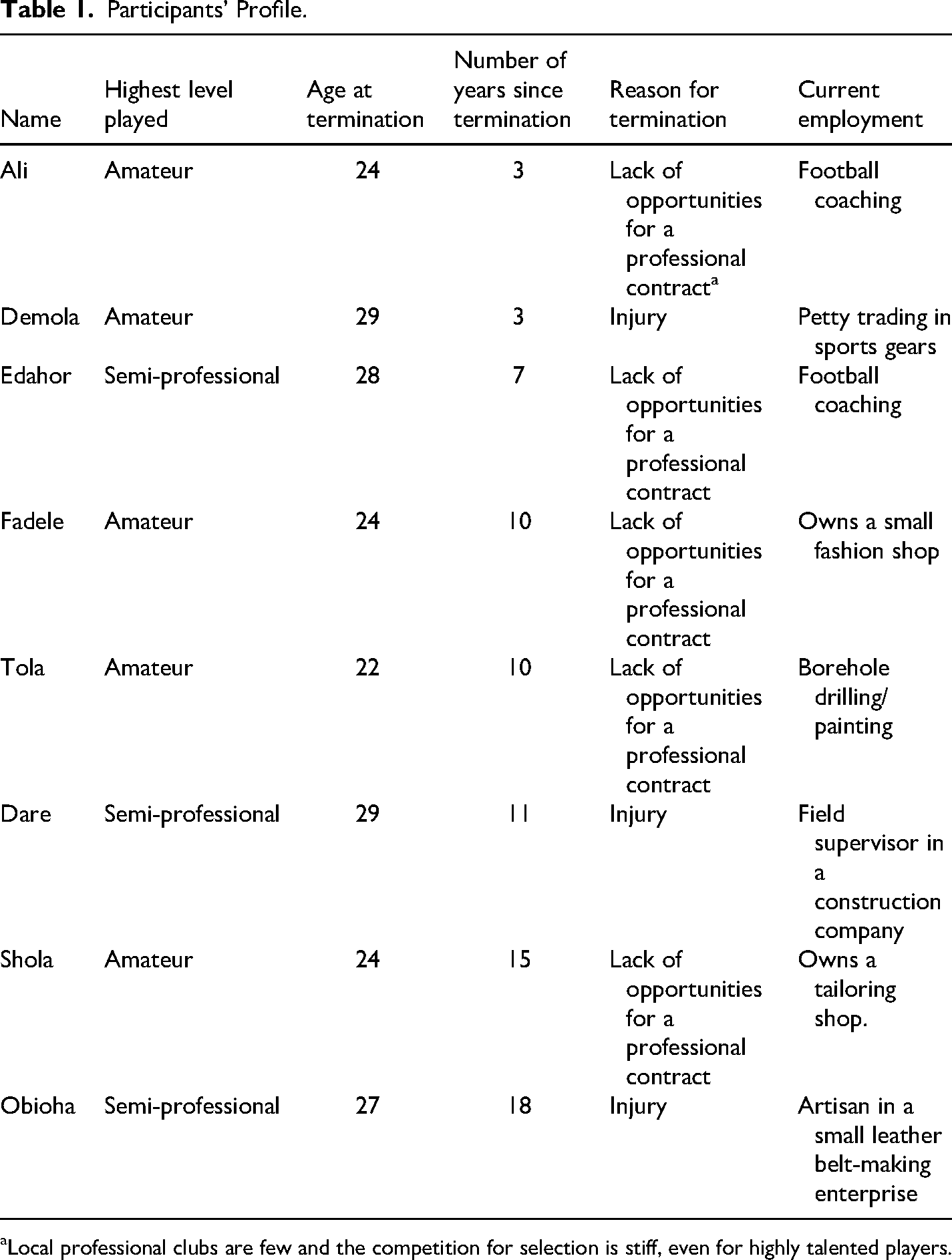
Local professional clubs are few and the competition for selection is stiff, even for highly talented players.
Interviews
Prior to data collection, approval for the study was obtained from the Ethics Committee of the Faculty of Economics and Social Sciences, University of Tuebingen (A 2.5.4 – 267_bi). All protocols, including informed written consent and other participant rights were observed. Data were collected through semi-structured face-to-face life narrative interviews between March and May 2023. Except for one interview conducted in Yoruba by a field assistant, I conducted all the interviews in English. All the participants who spoke in English understand the language at a very good level and the participant who spoke in Yoruba felt more comfortable communicating in his native language. To create a balance of power between the researcher and participants, they were given the freedom to choose a venue without much intrusion and where they felt comfortable to speak freely. The semi-structured interview enabled me to keep the discussion within the study aims, while at the same time giving the respondents sufficient freedom to narrate their stories in rich depth. The discussions were sequenced to produce a progressive and coherent narrative, beginning from early life to the present and the future. The interviews explored the start of their football journeys, the goals they set out to achieve, their experiences and transition from football, and how they felt about not achieving a professional career or transnational migration through football, their present lived world and hopes for the future. This enabled the respondents to properly reflect on and evaluate their experiences.
Narrative Analysis
The interview records were transcribed to text prior to analysis. Data analysis followed narrative analysis (Smith, 2015), which places attention on the evolving story of the individual along a past, the present, and articulated future and how the narrated experience is situated within a social context of meanings, social norms, and social relations (Smith, 2015). Specifically, a dialogical narrative analysis approach was adopted (Smith, 2015). This approach focuses on what is told in the story (the content), how it is told (the narrative resources) and what happens as a result of its telling (the effects) (Smith, 2015). The first stage, “getting to grips” with the story, involved four steps (Smith, 2015). In the first step, indwelling, I comprehensively read and re-read the transcripts and listened to the audio records in order to familiarize with the story, while making further notes (in addition to initial notes made during transcription). In the second step, I identified self-contained stories, which show the beginning or end of a narrated experience. For instance, career termination narrated when the athletes started thinking about quitting football to when they finally left the game. In the third step, I identified narrative themes’ and how they are related. Given the research aims, this focused on identifying how experiences within each story and the overall narrative are evaluated and framed. The fourth step was to identify the structure of the story telling, involving how the story unfolds temporally and in events, experiences, and evaluation. For instance, while in some cases the evaluation of specific experiences became more negative as the story progressed, the overall life outlook became more positive or optimistic in relation to the present or the future.
The second stage involved taking a deeper interpretive lens to examine the narrative resources that the respondents drew from to frame the subjectivities of their experiences. Besides, here, I sought to understand who is involved in the stories told (e.g., family); what sense of meanings that the stories build; what emotions they are communicated with; and what the narrator became as a result of the stories told. The process of analysis did not proceed in a linear direction, but iteratively, going back and forth and making connections between thematic frames, the resources used in narrating them and the meanings, and the social relations and norms of social life implicated in the stories and their evolution.
Findings and Discussion
Although the participants still deal with the feelings of disappointment and of what could have been, three narrative frames emerged from the stories of four participants through which they gave a positive framing and meaning to their unrealized professional football career pursuit. Namely: narrative of livelihood (Demola, Edahor, and Obioha); narrative of purpose (Ali, Edahor, and Demola); and narrative of recognition (Obioha and Demola). Each narrative frame conveys a unique interpretive lens of experience, reflecting the cultural, social, and temporal contexts of life of the narrators.
Narrative of Livelihood
The narrative of livelihood was the most common narrative frame employed to give a positive meaning and interpretation to the overall outcome of the football pursuit, featuring in the narratives of Demola, Edahor, and Obioha. This narrative emphasizes the role football has played in the lives of the former players with regard to finding employment or earning a living. Demola, who ended his football career pursuit due to a serious eye injury, frequently employed this narrative framing throughout his story. Early in his story, when asked about what he considers the most important thing in his life, he mobilized the narrative of livelihood to give positive meaning to his experiences in football: Many things, but I can say football because until now, I am still eating from it. From my primary school to now, I am still living in football. Till today that I am talking, I am still doing football. So, I may not make it as a professional player, but I'm still making it through football. So, football has really helped me a lot. What I am doing now, the man that gave me the loan that I used to start the business knew me only from football. So, I cannot say that, maybe, football has delayed me. So, I may not make it as a professional footballer, but I am still gaining something from it. I am still making money from it. … I just refunded the money back to the guy that gave me the loan. But I'm okay, in as much as I'm able to cater for my family and cater for my needs (Demola). Some of my colleagues that I met in camp, I do send my goods to them and they pay me. What brought us all together? Football. I tell my colleagues that play in the [Nigeria] Premier League that you are making your money through football and I am also making mine. It may not be up to yours, but I am making my own silently… But nobody will know the profit I am making each day. I have made a lot of profit this morning through football. Maybe, if I was not a footballer before, it would not have come to my mind to retail sports materials. Maybe, I will be engaged in fraud or other things (Demola). Well, I am happy for them, those that made it [colleagues who became professionals]. I and Omeruoh [Nigeria international] played together. Was in the past. I am happy, but the most important thing is this, like I used to say, football has a different way of blessing you. Football has a different way of treating you. I might not go further than what I wanted, but football still pays my bills. Football still puts food on my table. Football still provides for my family. Through football, I still take care of my mom. So, it is paying me in a different level. Though it is not much, but I know with time, as I grow up, it will get bigger and better (Edahor).
As Seligman and Csikszentmihalyi (2014) noted, the social relationships and cultural norms that structure positive experience are very central to positive psychology. This is evidenced by the predominance of the narrative of livelihood that permeates the stories of Demola, Edahor and Obioha. Their stories drew resources from the narratives of respectable adulthood and intergenerational care prevalent in the cultures of West African societies (Darby et al., 2022). The narrative of livelihood is very directly linked to the ability to live up to the expectations of independent adulthood and the performance of the obligations of intergeneration care, such as providing for one's family and parents. Edahor highlights this by emphasizing that football provides his subsistence, while Demola notes that he is fine in so far as through football, he is able to take care of his family and his needs. Being able to meet your financial obligations is a rite of passage, where the peak of adulthood is achieved by economic independence. In addition, Darby et al. (2022, p. 23) maintain that “in return for the support of parents, older siblings or relatives, youth are expected to conform to culturally produced obligations to support the family” and that “achieving the means to meet them is a vital part of the journey towards adult respectability.” Edahor fully draws from this narrative resource to make a positive sense of his experience, since his involvement in football still made it possible for him to take care of his mother, whom he narrated raised him alone. Furthermore, besides the material dimensions of respectable adulthood, maintaining a moral persona is also part of respectability (Kovač, 2022, 2021). In this sense, earning a livelihood through football made it possible for Demola to maintain his respectability as a moral subject, especially within the context of cyber scams among sections of urban youth in Nigeria as a means to “monetize masculinity” and to fulfil increasingly difficult obligations of intergenerational care (Chukwuemeka, 2022). By earning a living through football, Demola is able to avoid this moral dilemma and maintain his social and moral respectability.
Narrative of Purpose
The narrative of purpose features significantly as the central frame of positive meaning making in the narratives of Ali, Edahor, and Demola. Through this narrative frame, the former players emphasize the role that their professional football career pursuit has played in giving them a sense of purpose, meaning, and future direction. Following a few years of unsuccessful attempts to earn a contract in the local professional league and a number of rejected visa applications for trials in Europe, Ali began to transition away from his dream of becoming a professional footballer into coaching in youth football. As Ali's story developed, his narrative evolved from one of disappointment to one of a sense of mission and optimism in the future, made possible by his experiences in football. Rather than dwell on the less than desirable outcome, he pivoted his narrative toward the agency and purpose enabled by his past football experience: So, I have sometimes when you think of these things, you will be like, so, will I not play for Chelsea anymore? Will I not do this anymore? Will I not do that anymore? But still, when I am thinking that, I am still thinking that, but at least, if I did not achieve this, I am a coach today. And, I am still like, okay, maybe, God did not want me to play. He wanted me to have the experience because my playing experience is actually paying off. When I am coaching, because as a coach and as a footballer, I can show my kids how to play. There are a lot of coaches that can only give information, they cannot display… But now, I have the techniques of showing my kids what they need to do. How to do it right. So, I believe the training to become a professional [footballer] has really helped me by making my coaching work easy. Very easy for me (Ali). I just believe I have developed that zeal of, you know, encouraging young athletes. Because I have been through a lot, so, I do not want them to be frustrated like I was. That was why I decided, okay, let me just be a coach. Being a coach at a very young age is not bad. Maybe, God does not want me to play. He wanted me to be a coach, and things are working out. It is a slow process. I believe I am not where I was yesterday. Here in this country, the economy is not good, coaches are underpaid, but at least, I know that I have joy in what I am doing right now. Something I love doing. So, I am satisfied (Ali). There is a saying that what does not kill you makes you stronger. You know, it is when you give up that is the end. You know it's not over, if it is not the end. So, one thing with my life is I do not dwell in regrets… Yeah, I’m a positive minded person… And I take it as it prepared me for the future as a coach. I just concluded it that way. It is like that to me because I have a story, an impact to give to the younger generation of which I'm already doing. I am superbly happy to be doing this, because it is still football and I love being around the kids. Training kids. You know, developing kids through football. Like, whenever I am on the pitch, I am happy. Like, I forget everything outside. Whether I have money, whether I am eating or not, whether I am unable to pay my daughter's school fee and all that, I keep it aside and focus on it, because it makes me happy (Edahor). If I can get some money in the future, I have plans to go for coaching school, but not here in Nigeria, maybe, abroad, so that when I come back to Nigeria, I will start my Academy… Yes. I will start my own Academy, just like to be scouting players, because that is what we lacked then. If we had that during our own time, many of us would have made it because God blessed us with a lot of people with a lot of skills here (Demola).
Narrative of Recognition
The narrative of recognition is the third frame of meaning making through which the former players articulated their experiences in a more positive light, featuring in the narratives of Obioha and Demola. This narrative frame focuses on the ways through which their professional football career pursuit has brought them a sense of achievement and social recognition. Through this narrative, the participants were able to build a sense of self-worth, identifying football as one thing for which the society recognizes them and which they can take pride in as their contribution to society. While Obioha felt “sad” that his dream of becoming a professional footballer was “cut short” by injury, he mobilizes the narrative of recognition to dismiss any sense of regret for pursuing a career in football: There is nothing like that [regrets about his football pursuit]. Football really gave me exposure. So much exposure. When I was playing football, my nickname name was Ranchers, here in [name of city]. There is no street or no place you go to, even up till now, they say, yes, I know him, yes, I know him. Are you with me? So, I am not regretting. Football gave me a lot of exposure. I am not getting much because now, I have a family which I am catering for. So, as far as there is life, that is good. So, I am still managing myself (Obioha). It was football that changed my name from [Demola] to Olaball. It is only football. So, football has really helped me a lot (Demola).
Further to materiality, social recognition is a very important component of socially acceptable masculinity and respectable adulthood, and a motivation for youth in West Africa who aspire for professional careers in and transnational migration through football (Ungruhe & Esson, 2017). In this regard, “accumulating social standing by achieving a recognized notion of adulthood, and thus becoming a somebody, is of crucial importance to the young generation more generally, and young men particularly” (Ungruhe & Esson, 2017, p. 23). Social recognition gained from football gives Obioha and Demola a sense of achievement and self-worth as “a somebody.” By employing the narrative of recognition, both are able to find intangible benefits which they can credit to their football career pursuits, thereby bringing further positive meaning to an endeavor that did not achieve its primary objective. Through this narrative, Obioha and Demola are able to put their disappointment behind, rather focussing on the aspects of experience that “lead to happiness, fulfilment, and flourishing” (Linley et al., 2006, p. 5). This frame of meaning making promotes psychosocial well-being (Seligman & Csikszentmihalyi, 2014) in spite of ongoing financial and other difficulties which the respondents still deal with, thereby contributing to the stability of mind required for navigating their post-football lives.
Further Thoughts and Conclusion
In this paper, I explored the narratives through which former amateur and semi-professional players, who were unable to realize their dreams, articulate a positive experience of their pursuit of a professional career, repositioning their lives for satisfaction in the present and growth in the future. While the participants in this study all harbored varying degree of disappointment, some have been able to articulate positive narrative frames of their experiences, which have not only contributed to their psychosocial well-being, but also to forging new futures. Three positive narrative frames were identified in the stories of four participants. The narrative of livelihood focuses on how football provided opportunities for employment and earning a living. The narrative of purpose emphasizes how past experience has contributed to a sense of purpose, meaning, and direction. The narrative of recognition derives from the satisfaction in a sense of achievement and social acknowledgment enabled by football. These findings support the tenets of positive psychology, which holds that individuals are capable of making a positive sense of generally negative experience (Linley et al., 2006; Seligman & Csikszentmihalyi, 2014; Tellis-James & Fox, 2016).
The participants in whose stories the three positive narrative frames were identified had a few things in common. Firstly, all four were able to directly or indirectly connect their past football pursuits to their post-football employment. Secondly, three of the four respondents (Edahor, Ali & Demola) work directly in football or provide associated goods to the sector. This indicates that former players who are able to find further use of the skills that they built in the game or meaningfully use the social networks and relationships that they developed through the game are more likely to construct positive narratives about their experiences. While the predominance of working in football may suggest being wedded to the athletic identity and an inability to leave the past behind (Brown & Potrac, 2009), nevertheless, the useful skills that the experience may provide need not be only applicable in football or sports (Williams & MacNamara, 2020).
On the other hand, for the other four players in the study (Fadele, Tola, Dare, and Shola), the inability to make any meaningful positive connections between their football pursuits and their post-football lives may explain the lack of positive frames in their narratives. For instance, the most negative narrative among the respondents was observed in Dare, whose post-career life has been primarily dominated by his struggle with an eye injury that ended his career and left him partially visually impaired. Besides, the narrative of his current life or future goals was unable to connect in any meaningful positive way to his past experience in football. His inability to find such positive continuities has undermined his psychosocial well-being as he continues to harbor deep regrets, not only as a result of his health struggles, but also because of his inability to satisfactorily reciprocate the obligations of intergenerational care to his mother, who spent her savings in supporting his dreams.
The central thesis this paper makes is that the presence of positive narrative frames of experience in the post-football life of former pre-professional players is related to the possibility of generating a meaningful positive link between past football pursuits and present or future purpose, well-being or fulfilment, irrespective of the outcome of the primary goal of becoming a professional athlete. The implication is that amateur and semi-professional clubs need to be very deliberate about the range of skills-building and personality-developing experiences, sporting and otherwise, that athletes may be exposed to in the course of their pursuit. Life after football and dual career program are crucial in this regard. Of importance is the training of the whole person and not just the athlete. Clubs may partner with both formal and informal trade centers to provide players with alternative training in skills relevant in the local economy. Personality development is also very important in building the character traits such as discipline, motivation, commitment, hard work, confidence and professionalism that may facilitate success in life more generally (Williams & MacNamara, 2020). Such empowerment will provide more opportunities for players to develop skills and the personality that may aid post-football transition to employment in the event that the dreams of a professional career fail to materialize and which players may connect back to their football pursuits, thereby making a positive meaning out of their football involvement and experience.
This study has a few limitations. The positive narratives in the findings have emerged from only four of the eight participants. Insight from more participants could have further enriched the range of positive narratives frames observed. However, while the other four participants may not have revealed any positive narrative frames as sought in this paper, their lack of such contributed to meaning making and interpretation as elaborated above with the example of Dare. Besides, the lack of previous research on the topic, as well as the richness of data from the four and the depth of analysis and interpretation, means that this study has contributed to pushing research forward on the subject of deselection and career termination in football, and sport more generally. It offers valuable insight that may be transferable to other locations and sports. On a final note, future studies may explore the different and specific forms of experiences within amateur and semi-professional clubs that may enhance positive post-football narrative frames of meaning making in former athletes. Besides, the management and organizational cultures that support such experiences need to be properly understood and articulated, so that they may be promoted and institutionalized.
Footnotes
Acknowledgments
I would like to thank the respondents who participated in this study. I reserve special thanks for Yusuf Sikiru Abiona and Bem Jeffrey Buter for their invaluable assistance in the field.
Data Availability
Due to the nature of the research and the narratives of the respondents in the overall dataset from which this paper was written, the risk of identification of participants is high. Therefore, the supporting data may not be available.
Declaration of Conflicting Interests
The author declared no potential conflicts of interest with respect to the research, authorship, and/or publication of this article.
Ethical Approval and Informed Consent
This study was approved by the Ethics Committee of the Faculty of Economics and Social Sciences, University of Tuebingen (number: A 2.5.4–267_bi). Participation was based on informed written consent. Participants have also consented to publishing the findings with full anonymity and in a way that they may not be identified.
Funding
The author disclosed receipt of the following financial support for the research, authorship, and/or publication of this article: This study was funded by the postdoctoral fellowship of the Fritz Thyssen Foundation [40.22.0.023SO].
