




Abstract
The concern for athlete maltreatment in elite sport emerged in response to a wide range of high-profile cases. While diverse theories and concepts have been used to explore the subject, there is a need for non-Western analyses that can attend to the cultures, practices and narratives of Asian states. Drawing on the case of South Korea's elite sport system, this paper scrutinises the mix of institutional practices and narratives that may variously converge to enable maltreatment or diverge, to prompt calls for systemic change. Grounded in ‘new institutionalism’ and a qualitative approach that incorporates document analysis and semi-structured interviews, this research examines maltreatment within a unique Korean Confucian hierarchical socio-cultural context. The results indicate that complementary practices and narratives enable maltreatment and facilitate the continuation of the system. Conversely, this study also investigated instances of divergence highlighting the impetus for change. However, there is some evidence to suggest that accommodating reforms, which remain essentially shaped by existing practices and narratives, often lead to resistance against substantial change. In sum, the combination of convergent and divergent practices and narratives, within the complex and unique cultural and structural context of Korea, signals that while policy changes to address athlete maltreatment are emerging, barriers to fundamental, sustained change remain.
Keywords
Introduction
As Kerr et al. (2019: 237) note, athlete maltreatment in elite sport has received ‘critical attention by the public at large and stakeholders’ worldwide. Consequently, the historical incidents of sexual harassment and abuse that came to prominence in the 1990s have prompted calls for focused research on sport-related maltreatment (Bisgaard and Støckel, 2019; Brackenridge, 2001; Johnson et al., 2020; Mountjoy, 2020; Stirling and Kerr, 2016; Vella, 2019). This heightened awareness follows the formulation of the 2007 International Olympic Committee (IOC) Consensus Statement which established comprehensive guidelines to protect athletes from sexual harassment and abuse (Mountjoy et al., 2016). The mid-2010s witnessed a shift towards a more holistic approach grounded in human rights principles globally, championed by international and national sports organisations as well as scholars committed to safeguarding athletes from various types of maltreatment (Lang, 2020). Notably, an updated consensus statement on several types of maltreatment in sport was produced by Mountjoy et al. (2016) highlighting organisational level threats in elite sporting environments (Bekker and Posbergh, 2022). In particular, the consensus statement provided a more comprehensive conceptualisation of maltreatment in sport to encompass: physical abuse, sexual abuse, psychological abuse and neglect (Kerr et al., 2019; Parent and Fortier, 2018; Park et al., 2024). The 2020 Olympic Charter reinforces this commitment, underlining the mission and role of the IOC in order to ‘promote safe sport and the protection of athletes from all forms of harassment and abuse’ (International Olympic Committee, 2020: 17).
However, despite concerted efforts, athlete maltreatment remains a high-profile and increasingly global concern. Mounting evidence confirms that athlete maltreatment occurs inside and outside of sport across numerous countries. Consider the following recent examples: (1) the 2020 American documentary film titled ‘Athlete A’ exposed the sexual abuse of young female gymnasts by the USA gymnastics team physician, Dr Larry Nassar (Kerr et al., 2019); (2) Former Australian Olympic and Commonwealth Games gymnasts went public about physical and emotional abuse they experienced during their career (James, 2020); and (3) Barry Bennell, a youth football coach and scout in the United Kingdom, was convicted of sexual abuse towards young boys (Kerr and Kerr, 2020).
To comprehensively analyse and understand maltreatment in elite sport, a number of theories and concepts have been applied. For example, Kerr et al. (2019) utilised Bronfenbrenner's ecological-systems theory to interpret the Nassar case attributing the cause of maltreatment to interpersonal relationships amongst athletes, teammates and coaches, as well as the sport culture itself (e.g. self-regulation without an appropriate regulatory system and a performance-driven culture). Furthermore, Adams and Kavanagh (2020) employed the capability approach to assess the human rights of athletes who make sacrifices for their careers and endure normalised or coerced training practices within institutionalised elite sport systems. These practices are culturally embedded and sustained within elite sport systems, often diverging from the norms of broader society.
While these approaches acknowledge the importance of context, these studies are predominantly Western based potentially overlooking broader socio-cultural characteristics shaping the culture of elite sport systems. They also may not fully address the causes of maltreatment rooted in institutions and environments within broader society, as they primarily concentrate on elite sporting contexts. Given the global nature of this issue, there is a need for a deeper understanding of how agent practices and narratives originating from different spheres (e.g. societal systems and traditional cultures) can contribute to, and possibly sustain the problem. In essence, a comprehensive approach demands a more inclusive examination of the diverse socio-cultural factors influencing athlete maltreatment globally.
One way to address this gap is to examine the mix of entrenched ‘informal institutions’ encompassing practices and narratives that connect the elite sport system with wider society. This mix is important because, according to sociological institutionalist perspectives, individuals behave according to particular logics and acquire standardised behaviour through processes of socialisation (March and Olsen, 1996). Observable ‘practices’ are thus the resultant manifestations of these social contexts (Lowndes and Roberts, 2013; Scott, 2013). Likewise in this perspective, agent behaviour is enabled and constrained by ‘narratives’ – that is, the collection of shared, embedded stories that shape individual values, roles and ideas in society (Feldman et al., 2004; Lowndes and Roberts, 2013). Institutional practices and narratives are thus intertwined, each influencing and shaping the other. In this view, practices provide concrete examples of how existing narratives are enacted in everyday life. At the same time, narratives can serve as a framework for interpreting and legitimising practices, giving them a sense of purpose and meaning. Understanding the ways in which they interact is significant for comprehending how social norms and values are established and maintained in society. Therefore, this research investigates how informal institutions (practices and narratives) may enable maltreatment within the elite sporting environment.
This research has two key objectives. The first objective is to identify and analyse the mix of institutional practices and narratives that together may converge towards enabling maltreatment. The second, related objective is to explain the mix of practices and narratives that may likewise diverge, drawing attention to the need for change. Importantly, there are two significant factors underpinning the conditions in South Korea (hereafter Korea) that contribute to maltreatment being viewed as a serious problem by stakeholders: (1) practices (e.g. norms, conventions and routines) and (2) narratives (e.g. the spoken word and official scripts).
In order to gain a more comprehensive understanding of practices and narratives within this context, it is important to first recognise the hierarchical structure of Korean society. Following the works of Horak and Yang (2019), Lee et al. (2019) and Ryu and Cervero (2011), we maintain that Korea's hierarchical structure is influenced by a unique combination of Confucianism, the cultural practice of seniority and a military-service culture. Additionally, this research explores how the cultural practice of meritocracy characterised by a cultural obsession with achievement, success and fierce competition and a rivalry-oriented culture deeply entrenched in Korean society is the foundation of elite sports. There are a number of features of these cultural practices that highlight their complexity and contradictions. For example, while the Korean system demands obedience towards elders based entirely on age and seniority (irrespective of competence or ranking), Korea also highly values performance and individual ability within the cultural practice of meritocracy. Paradoxically, these seemingly opposing features coexist within elite sports. Hence, the unique combination of these practices and narratives may (on one hand) create the conditions for maltreatment and help to sustain or reproduce the interrelated governing mechanism of the overall Korean sport system. On the other hand, inherent or emerging contradictions between practices and narratives may prompt disruption of the sport system and promote change (Hajer, 1995; Sassen, 2008).
This paper consists of four sections. First, it briefly reviews the concepts of practices and narratives within institutional theory. Second, it examines the hierarchical structure of the state and the contrasting and co-existing cultural practices of seniority and meritocracy that characterise Korean society and which create a range of contradictions and paradoxes within the socio-cultural system. Section three delineates the employed methodologies encompassing data sources and the processes involved in data collection. The final section describes and explains the dominant practices as reported by athletes, officials and administrators, including practices to demonstrate strict obedience and the codified behavioural routines amongst/between athletes. This section also reports the dominant narratives that serve to justify and rationalise these practices.
The concepts of practices and narratives in institutional theory
To scrutinise athlete maltreatment and its potential causes, this study investigates informal institutions. Helmke and Levitsky (2004: 88–89) define informal institutions as ‘socially shared rules, usually unwritten, that are created, communicated and enforced outside of officially sanctioned channels’. In new institutionalism, practices (e.g. strict obedience towards coaches and senior athletes) are viewed as manifestations of cultural norms and values that shape social behaviour and maintain social order over time (Lowndes and Roberts, 2013; Peters, 2019). Thus, individuals obtain knowledge of how to conduct themselves in particular circumstances by observing the recurrent performances of other individuals. They adhere to these practices, because alternative scripts are rendered inconceivable due to the absence of other available options (Scott, 2013). In this sense, informal institutions can be as influential as formal rules (e.g. laws and policies), since the former can define the boundaries of what can be imagined (Schmidt, 2006).
Alongside practices are the narratives that may further institutionalise behaviour. While practices are construed as an embodiment of institutional norms and values through actions, narratives are predominantly encountered through shared symbols or stories amongst individuals in society (Lowndes and Roberts, 2013). The regulation of language is crucial as it transmits ideas about ‘how things are done around here’ and the ‘appropriate’ behaviour to follow (Lowndes and Roberts, 2013). Narratives in elite sport, such as ‘we will not compromise to achieve excellence’ have been shown to have a bearing on the operations of organisations and their personnel (Sam, 2015). In this way, narratives are never a neutral endeavour, but rather an intentional act of performing a specific perspective on how the world operates, with the potential to either reinforce or challenge the beliefs and values embodied by that perspective (Lowndes and Roberts, 2013). Furthermore, Schmidt (2006) suggests that narratives in organisations can create shared understandings and sustain the stability of institutions by guiding a common sense of direction.
Across numerous countries, mounting evidence supports the idea that practices and narratives play an important part in institutionalising the elite sport environment. Kim and Dawson (2022) for example, observe that the authoritarian sporting environment is sustained by coaching practices that have become normalised over time. This mirrors Kerr and Stirling's (2019) study, in which athletes reported that some sport coaching practices such as humiliation, yelling and throwing objects are accepted as punishment for poor performance. Pointing to the importance of narratives, Fisher and Dzikus (2017) suggest that athletes do not interpret many of these coaching practices as maltreatment but rather as a means to enhance their performance. Insofar as shared storylines and practices emerge from multiple stakeholders and wider cultural sources, there is a case to be made around their influence in reinforcing or discouraging athlete maltreatment.
Thus, the use of institutional theory for analysing practices and narratives might provide an alternative and more comprehensive perspective in two key ways. Firstly, an institutional perspective may be able to show how sport-specific practices and narratives are connected to, and maintained by, the broader cultural practices pervasive in Korea. Secondly, institutional theory draws attention to the mix of institutional practices and narratives, and how this mix can lead to either sustaining the system or disrupting it. From this perspective, the mix of practices and narratives potentially creates two outcomes. The first potential outcome is that certain practices and narratives converge to precipitate athlete maltreatment. For example, if a coach uses physical punishment (a practice) and both athletes and parents view such punishment as ‘necessary’ for success (a narrative), this might demonstrate a convergence that enables an escalation to more serious forms of physical punishment. In contrast, practices and/or narratives might diverge, leading to change. For instance (and quite simplistically), if education programmes and new policies are introduced alongside a changing societal narrative suggesting that certain types of maltreatment (e.g. verbal abuse) constitute a health and safety violation, it might prompt calls for improvement or reform in elite sports. The next section investigates the unique socio-cultural characteristics of Korean society to better understand how particular practices and narratives become entrenched within elite sports.
Literature review: Korea's socio-cultural characteristics
The first consideration underpinning both practices and narratives in sport is the traditional culture embedded in contemporary Korean society, where fundamental values are intertwined with primary institutions. Korean Confucian culture penetrates every part of society as the fundamental element for the country's overall system and individuals’ lifestyles. In general, Confucianism is a philosophy or a sophisticated code of social ethics from the ancient Chinese philosopher Confucius (551–479 BCE) that prescribes proper behaviour and thoughts between people as the basic social operating principle (Kim and Park, 2003). Confucianism was pervasive in Korea during the Chosun Dynasty (1392–1910) for approximately 500 years, serving as the official philosophy and the most important source of values that endure to this day.
Confucianism consists of five major virtues (duties) that regulate appropriate manners or attitudes amongst: (1) parents and children; (2) ruler and subject; (3) husband and wife; (4) senior and junior and (5) friends (Ryu and Cervero, 2011). In Korea, Confucianism emphasises the significance of hierarchical order such as ‘superior versus subordinate, the ruler versus the ruled, including gender and age’ (Yang, 2006: 283). Thus, Confucian values reinforce and reproduce paternalistic management, hierarchical structures and centralised authority in every organisation and in all social interactions (Chung et al., 1997; Yang, 2006), including sport.
Confucianism has several detailed prescriptions that influence institutional practices and narratives in society. The loyalty of subordinates to superiors (e.g. parents, authority figures, elders and high-ranking officials) is a clear reflection of this influence, as is the persistence of the hierarchical structure (Yang, 2006). For example, younger individuals of lower status must greet elders and higher-ranking people in family groups and organisations by bowing their heads and using formal speech or honorifics. Addressing seniors by their first names is discouraged and juniors must use honourable titles or positions such as Sir, Professor and Manager etc. (Lee, 2012).
Family members, usually children and wives, are likewise taught to obey the head of the family, usually the father or husband, which reflects a hierarchical and patriarchal social structure. Such hierarchical and authoritarian structures are also replicated in schools, companies and organisations (Paik and Sohn, 1998), where decisions by authority figures and higher-ranking people are accepted without question or challenge (Yang, 2006). As a result of hierarchical structures based on Confucianism, Korea is regarded as ‘a high power distance culture’ emphasising strong respect for higher-ranking individuals like supervisors, while individuals of lower status are expected to demonstrate unwavering loyalty to their supervisors (Hong et al., 2016: 9). Therefore, Confucian culture, including its hierarchical structure and the strict communication order, serves as a common value reference or norm for individual and organisational practices.
Indeed, the seniority system can thus be understood as a pervasive sociocultural practice under which an individual's standing is primarily determined by age difference rather than one's performance and technical skills (Horak and Yang, 2019). Despite the adoption of a merit-based system following the 1997 International Monetary Fund (IMF) crisis, Korean companies still rely on the cultural practice of seniority for promotions, thereby preserving the existing hierarchy (Kang and Jeon, 2013). While seniority perpetuates the hierarchical structure, so too does Korea's military culture, which equally places a high value on traits such as order and discipline (Adelman, 2003).
Before graduating from university or beginning their careers, all young men in their early 20s are required to serve in the military for approximately two years. This mandatory service has been in place since the split of North and South Korea in 1945, and significantly impacts men's sense of masculinity (Chung, 2008; Lee et al., 2019). It is later reinforced and reactivated in the workplace, where individuals are expected to exhibit hegemonic masculinity as a valuable attribute (Lee et al., 2019). Militarism thus upholds a strict hierarchical culture both in the national and organisational contexts including ‘corporate sectors, athletic fields and even academia’ (Gwon and Lee, 2011; Lee et al., 2019: 1471). As Chang et al. (2017: 341) observe, this military culture is expedient in fostering ‘a result-oriented can-do spirit and aggressive competition’. Hence, the broad cultural context of Confucianism, the cultural practice of seniority, and military-based behaviours collectively enable and reinforce a unique set of practices. These contexts are both striking and paradoxical given that Korean society also values meritocracy.
Meritocratic practices reinforce the essential elements of ‘impartial competition and equality of opportunity’, rejecting patronage and nepotism (Kim and Choi, 2017: 116; Poocharoen and Brillantes, 2013). According to Kim and Choi (2017), meritocracy has become a ‘governing principle’ advanced towards national and organisational efficiency, by promoting constructive competition among individuals. Grounded in the principles of capitalism and liberalism, meritocracy is thus widely regarded as a fair means of resource distribution (Park, 2019).
Pertinent to this study, meritocracy has fostered a highly competitive society, compelling students to dedicate significant time and effort to their studies, while encouraging parents to allocate more resources towards their children's education with the expectation of gaining admission to prestigious universities (Garrison et al., 2017). Driven by Korea's rapid economic growth, a prestigious university education has served as a means of upward mobility and success for many over a relatively short time period (Garrison et al., 2017; Lee and Shouse, 2011). From this educational meritocracy, a unique Korean culture known as Hakbeol, has resulted in the formation of ‘a degree-caste ethos’ in which an individual's social status and success are significantly influenced by their undergraduate background (Garrison et al., 2017; Kim, 2011).
Within this meritocratic framework, however, a critical paradox emerges as non-meritocratic factors such as family wealth, background and social networks generate ‘different starting points’ (Kim and Choi, 2017: 118). Indeed, parental occupation, income and economic status are associated with a greater likelihood of children entering prestigious universities (Son Hing et al., 2011) 1 . In this respect, meritocracy can be understood as a manifestation of hegemony that, while promoting competition and performance, reinforces the preservation and legitimisation of social inequality (Son Hing et al., 2011). In this light, Korea's ‘SKY’ universities contribute to the paradox of meritocracy, where an individual's social class and network function as an extended familial network, and possibly superseding one's abilities or skills. Elements of this paradox around meritocracy have also been evident in sport. For example, to counter the SKY meritocracy and achieve success as hosts of the 2002 FIFA World Cup, Dutch coach Guus Hiddink was hired in an attempt to abolish the traditional selection policies based on ‘school ties, family ties and regionalism’ and instead prioritise criteria such as ‘merit, skill and team system needs’ (Lee et al., 2007: 293 and 295).
Today, modern Korean society has created unique cultures of academic elitism and performance-based competitiveness based on the meritocracy ethos that is essential for individuals to thrive in highly competitive environments. These cultures are deeply entrenched in all areas of society including elite sports, emphasising and rewarding winning and outstanding achievements. Therefore, while merit-based practices may appear at odds with the practices around seniority (status based on age or rank), the two have perhaps converged towards generating a highly competitive society and culture of achievement/success in Korea.
Methods
This paper draws upon two primary data collection methods: document analysis and semi-structured interviews (Hammarberg et al., 2016; Harper, 2011). Documents were employed to elucidate the distinctive socio-cultural characteristics of Korean society (e.g. Confucianism, Seniority, a Military-service Culture and Meritocracy). These documents also served to expound upon the practices and narratives of stakeholders, which are deeply rooted in these cultural attributes. In doing so, this research drew from a diverse array of official documents, including annual reports and strategy documents from the government and governmental organisations (i.e. MCST, MoE, KSOC, etc.). Furthermore, media releases supported a contextual understanding of these practices and narratives.
Semi-structured interview were deemed an appropriate method for extracting the viewpoints and opinions of participants regarding intricate or delicate subjects (Kallio et al., 2016). In 2022, interview data were gathered from individuals representing pivotal organisations that encompassed the Ministry of Culture, Sports and Tourism (MCST), the Ministry of Education (MoE), the Korean Sport and Olympic Committee (KSOC) 2 , as well as two handpicked National Sports Federations (NSFs) 3 . The participants were selected from two distinct groups: (1) officials and staff members employed within the elite sport system (hereafter the system) and (2) adult elite athletes capable of offering insights into maltreatment and the specifics of these cultural factors. Due to the sensitive nature of the study, preserving participant anonymity and their overall well-being took precedence.
The research interviewees were recruited using a mixed approach involving purposive and snowball sampling methods. Contact details were obtained from sport organisation directories. Subsequently, participants were reached through a combination of telephone and email communication, during which they were apprised of the research objectives and ethical consent was obtained. A total of 18 interviews were conducted between January and December 2022, involving participants such as one MCST staff member, one MCST official, two MoE officials, two KSOC managers, two NSFs directors, two NSFs staff members and eight athletes. General questions posed to all interviewees sought to understand their perceptions and experiences within the system and its potential impact on athlete maltreatment. Additionally, detailed questions were presented to each participant to delve into the specific practices and narratives stemming from societal systems and traditional cultures.
Each interview was conducted in Korean, lasted between one and two hours and was audio recorded. Recordings were transcribed and then translated into English with transcripts retained in both Korean and English. During this phase, the authors cross-verified quotations to ensure a consensus on the intended meanings of the interviewees, considering possible linguistic and grammatical variations as well as nuances of expression. The interview data was first coded and analysed in line with key concepts from institutional theory that were relevant to the research questions including cultural norms, routines and practices. Thus, a norm already found in the literature, such as obedience to coaches, could be confirmed and further refined from interview prompts such as: (1) do athletes perceive their future career opportunities to be at risk if they do not comply?; and (2) is obedience the same between juniors and seniors in sports teams and if so, why? From these broader codes, themes were constructed that could connect these norms and practices to each other and, that might plausibly account for maltreatment. This synthesis could then point to norms having a complementary effect such as an acceptance of ‘power distance’ aligned with learned military norms around obedience. Subsequently, interview data pertaining to informal institutions encompassing practices and narratives as well as incidents of maltreatment were systematically classified into thematic categories: convergence towards maltreatment (addressing RQ1) and divergence for change (addressing RQ2). The following section outlines the practices and narratives embedded within the elite sport system, elucidating the presence of both convergent and divergent elements.
Analysis: Practices and narratives in the elite sport system
In combination, Korea's unique socio-cultural characteristics provide insight into the complexity of a society characterised by fierce competition, a rigid social structure and a very closed organisational culture. This section examines how the mix of institutional practices and narratives shaped by these characteristics converge (or diverge), giving rise to a range of sport-specific manifestations, interactions and contradictions. The first notable feature is how stakeholders (e.g. officials, staff members, athletes and coaches) in the system embrace and perpetuate dominant institutional practices, such as those demanding strict obedience towards elders, along with the codified behavioural routines amongst/between coaches and athletes. The second feature involves the important role played by stakeholders through their prominent and contrasting narratives that justify, rationalise or oppose these practices. Understood together, these practices and narratives may help establish how they might reinforce or disrupt the system, potentially promoting social change.
Convergence of practices and narratives enabling maltreatment
Confucian culture's substantial influence, with emphasis on the significance of hierarchical order, spans from the daily lives of individuals to the social and political fabric of the state (Jeon et al., 2023; Ryu and Cervero, 2011). Within the established cultural order, the system's hierarchical structure enables sport organisations to exert control over coaches and athletes. In turn, coaches and senior athletes’ giving orders to junior athletes is considered a normal practice, reinforcing hierarchical power relationships through deference to authority (Park et al., 2012). The Korean media recently reported that current coaches (aged 40–60) who were former elite athletes, learned to obey their coaches and senior athletes and had themselves experienced various types of maltreatment (Cheon, 2021). Obedience thus persists as a prevailing practice in the elite sport system. Lee et al. (2022) emphasise that within this environment, athletes positioned as subordinates in Confucian hierarchical relationships are rendered more vulnerable, thereby increasing their susceptibility to potential maltreatment.
Likewise, the hierarchical relationship within school sport teams under the Specialist Athlete System (SAS)
4
is highly valued. This is because vertical hierarchies are closely linked to the basic ‘etiquette’ that student-athletes are expected to adhere to, and thus, the instructions provided by coaches are regarded as ‘unbreakable laws’ (Yim and Hong, 2021: 65). Consider the comments of MoE official B, manager of the SAS, who describes why athletes with certain backgrounds are subject to maltreatment: You should know that the Confucian culture affects maltreatment within every area such as schools, society, sport and the military service. But sport is slower than others for making reforms. That's the reason why athletes experience all types of abuse. (January 26, 2022) Confucian culture creates an illusion like gaslighting (a form of psychological manipulation) that coaches take care of their athletes. In general, athletes are much purer than ordinary students because they only train, and they don’t think about rebelling against their coaches. (Athlete B, June 1, 2022) In the semi-professional team, it is essential for me to maintain a respectful demeanour and adhere to the guidance of both the coach and seniors. I think the Confucian culture cannot disappear in elite sports. (Athlete G, June 12, 2022)
From the perspective of informants, the influence of Confucian values exists in social relationships and is integrated into organisational culture. Within such an environment, ‘punishments and physical abuse’ were reported as ‘natural’ (Athlete F, June 12, 2022), legitimate and culturally or cognitively permitted. One informant expressed it this way: I think athletes could maintain their athletic careers by abusing their peers in order to win. Coaches still use verbal abuse and punishments to enhance their power and to get good outcomes from athletes. (NSF Director B, June 20, 2022)
Arguably, a key factor is the significant ‘power distance’ (Hofstede, 2011) between coaches and athletes and between senior athletes and juniors within the hierarchical structure. Power distance is a fundamental characteristic of any society and is the extent to which: ‘the less powerful members of organizations and institutions (like the family) accept and expect that power is distributed unequally’ (Hofstede, 2011: 9). According to Hofstede (2011: 9), this power differential is transmitted in several ways: ‘(a) parents teach children obedience; (b) older people are both respected and feared; (c) hierarchy means existential inequality; and (d) subordinates expect to be told what to do’. According to MoE ‘Official B’, the logic of power distance is translated into the informal practices of coaches that foundationally contribute to maltreatment: Coaches can identify any athlete across teams because coaches know a lot. They share information about athletes. Coaches have absolute authority such as the right to select top players and the right to decide about athletes’ transfer rewards to progress from schools to universities. So, athletes comply with coaches for their future career opportunities. (January 26, 2022)
Although power distance amongst individuals functions as an important factor in maintaining a hierarchical society, the cultural practice of obeying seniors specifically emphasises ‘age gaps’ in formal and informal hierarchical organisations (Horak and Yang, 2019). A person's age thus determines their status within the Korean sport system which, in turn, is connected to the collective training camps that serve to maintain the existing hierarchical structure. The development of Korean adult athletes and student-athletes is intricately linked to the operation of three fundamental policy instruments. The NSF director ‘A’ explains compliance based on an individual's age in these instruments: Athletes in schools and semi-professional teams still comply with their seniors. Juniors will especially obey seniors like a God [and], the phenomenon is particularly evident in ball games [football, basketball and baseball]. They live in the training camps and train in a big group so it is a structural problem. If a junior athlete has a good outcome in a competition, most seniors abuse and bully the junior. Thus, juniors comply with seniors to maintain their careers. (April 30, 2022)
As Lee et al. (2019) note, while most Korean young men encounter strict hierarchical structures during their military service (and follow superiors’ orders accordingly), they progressively internalise compliance as a means of constructing hegemonic masculinity. The masculinised culture is established through two ways: formal activities (e.g. training and planning for war) and informal discipline (e.g. norms and culture) within a hierarchical system that emphasises deference to authority, embodying values such as ‘obedience, conformity and fraternity’ (Wadham and Connor, 2023: 3). Subsequently, upon completing their military service, individuals demonstrate their newly acquired hegemonic masculinity in their interactions with younger students (juniors) at the university, while also fostering a military culture within the workplace (Lee et al., 2019). In this light, student-athletes tend to assimilate and embrace military culture as an inherent aspect within specialist Physical Education Middle and High Schools as well as within the training camps (Jeon et al., 2023). Two interviewees describe the environments: When I was in the … Physical Education Middle and High School, seniors enforced the school's culture by using the Korean military service's way of speaking and demanding the memorisation of school songs by freshmen. It was very much like the military service's culture. Juniors must obey seniors within the environment. (Athlete F, June 10, 2022) The collective in-camp training culture is very similar to the military service culture where the closed culture contributes to maltreatment. Athletes in the training camps live and learn within an unusual cultural setting which consists only of their coaches and colleagues. So they cannot mingle with general students because athletes always focus on their training without studying. (MCST official A, February 26, 2022)
Corroborating the presence of ‘informal rules’ within PE schools, the NSF director B (a former athlete) reported: … I learned informal rules for community life in the PE schools when I was a student-athlete. There was a unique culture where juniors had to politely bow to seniors whenever they met them. The culture still exists in the schools. If an athlete doesn’t bow to seniors the athlete can be stigmatised. Therefore, the culture leads to maltreatment… (June 20, 2022)
Likewise, the training camps were reported to be so culturally insular that abuse could become normalised over time. According to Athlete E: The training camps lead to a unique culture that is called ‘island culture’ amongst our colleagues. Most athletes learn good and bad practices or culture in the camps over a long period of time. But they cannot judge what behaviour is right or wrong by learning while living within the island culture and being isolated from society from an early age. As a result, they naturally learn maltreatment and bad practices. (January 20, 2022)
In sum, Confucian culture, the cultural practice of obedience and the military service culture not only perpetuate and strengthen strict hierarchical structures but also contribute to maltreatment within elite sports. While athletes face maltreatment within these cultural contexts, they often feel compelled to endure such challenges to pursue success and achieve their goals.
In this light, it is worth noting that the prevailing meritocratic ethos in the state places an excessive emphasis on intense competition within both general society and the realm of elite sports. According to Chang et al. (2017: 338), a significant proportion of Koreans experience extreme pressure to attain the status of ‘number one’ in a highly competitive societal landscape that lacks sufficient rules and regulations to endorse equitable and just competition. Illustrating the fierce (and at times, unjust) competition in the country and in a particular elite sport, consider Athlete F's account: In a 2020 international event, Korean athletes engaged in intense competition to secure higher wages within semi-professional teams. During a swimming event, certain athletes who held lower rankings targeted a male athlete who held the top rank in Korea, attempting to attack him underwater to reduce his ranking. As a result of this attack, the male athlete's performance suffered. (June 10, 2022)
In such a ruthless environment, performance is highly valued however, it is also understood that merit is not the only way to get to the top. Indeed, a number of scholars have suggested that the acquisition of a robust social network in Korea is critical for attaining advantageous positions within most organisations including the sport system (Garrison et al., 2017; Kim and Choi, 2017; Lee et al., 2007). This study's evidence suggests that social networks characterised by relationships and personality traits play a significant role in both sustaining the careers of semi-professional athletes and facilitating opportunities for future employment. Here, two athletes highlight the importance of social networks in the Semi-Professional Team System (SPTS): The head coaches have a lot of power with regard to renewing athletes’ contracts. My colleague has a better relationship with the head coach than I. The relationship between the head coach and athletes is the most important factor when renewing athletes’ contracts, rather than the results of the National Sports Festival. (Athlete H, July 25, 2022) We cannot predict the future after retirement. If I require references from coaches and colleagues for a coaching or training position, their evaluations of me would hold great significance. Many coaches and former athletes believe that an athlete's personality is the most important factor for athletes, but within the system, personality is often perceived as a reflection of how well athletes follow the guidance of coaches and seniors. (Athlete E, January 20, 2022)
Building on this idea, it is essential to recognise that the significance of interpersonal interactions goes beyond individual benefits. According to Yang and Horak (2019), social networks serve as a vital mechanism for establishing and maintaining interpersonal communication and relationships, which, in turn, contribute to Asian collectivism and Confucian culture. Thus, despite the importance of medals, achievement and rankings, ‘networking’ or ingratiating oneself to seniors, may be equally important in the long term. Put another way, social networks in Korea may lead to unequal competition and evaluation in the pursuit of exceptional performance and may thus contribute to maltreatment because athletes must adhere to the established practices around obedience. Nevertheless, there are elements of potential divergence within the spectrum of institutional practices and narratives, which may ultimately result in contradictions and bring about change. The ensuing discussion section is primarily shaped by the concept of divergence as there is relatively less data/evidence available related to divergence when compared to convergence.
Discussion
In the context of athlete maltreatment, extensive research has investigated its various institutional and environmental causes however, the links and interplay between these causes remain unclear. The analysis above helps explain the connection between the socio-cultural characteristics of Korea and the unique practices and narratives within the elite sport system. Hence, there is a need to understand how the interaction between practices and narratives within the system can either converge or diverge. As shown in Figure 1, the mix of institutional practices and narratives are intricately interconnected and it is these elements that serve to uphold and legitimise the system.
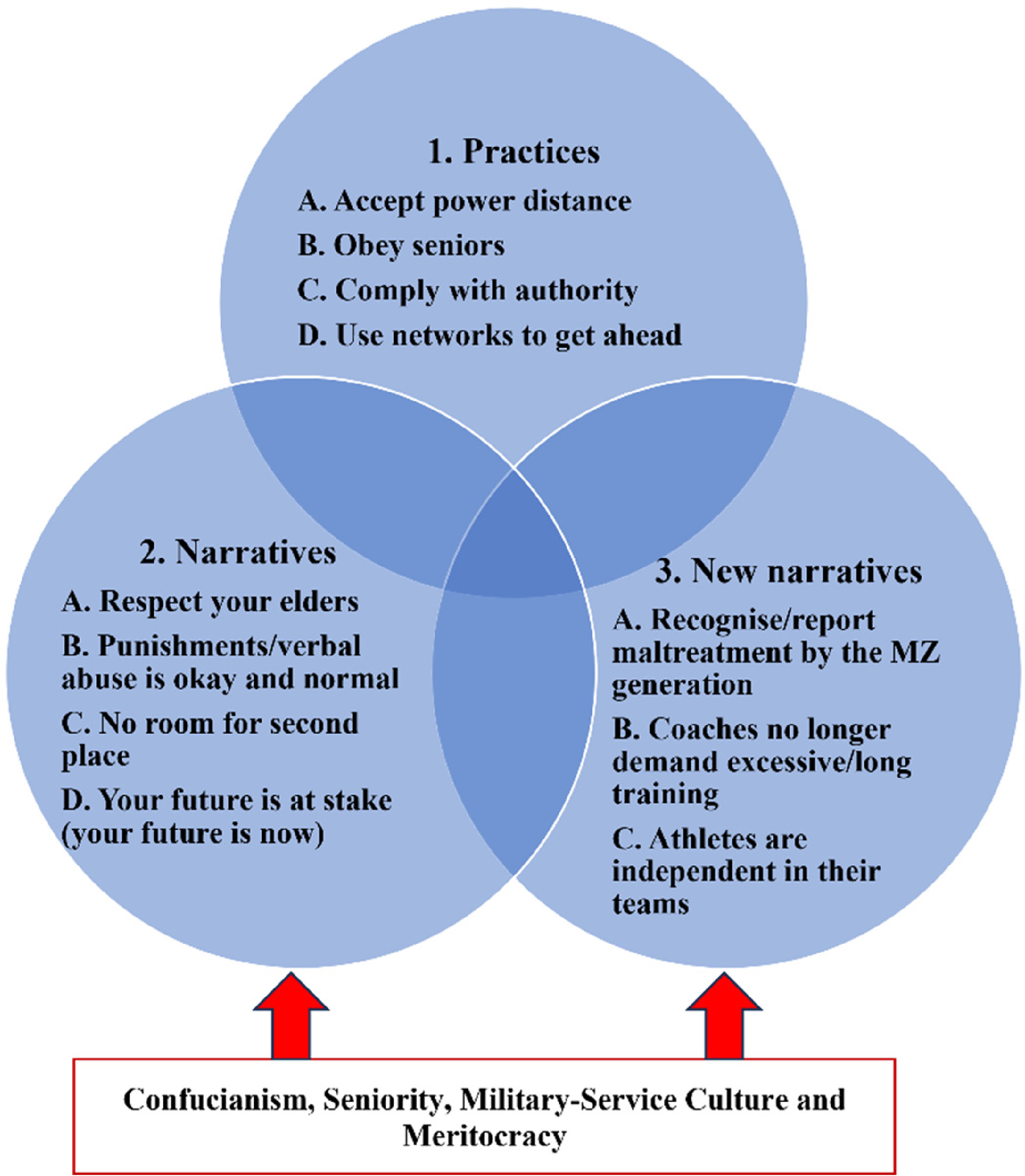
Relationships between practices and narratives within elite sport.
The data demonstrates that Confucian culture is practised in the system as ‘obedience towards seniors’, reinforcing and accepting unequal power relationships. As highlighted by Lee et al. (2022), these hierarchical and unequal power relationships are evident between seniors and juniors as well as between coaches and athletes within the system. For example, athletes saluting their coaches and seniors is informally considered a compulsory practice to secure their job and career stability. This obedience is necessary so as not to be abused, but paradoxically could lead to athlete maltreatment. Within this hierarchical sport system, interviewees indicate that practices such as verbal abuse and punishments intended to enhance athletes’ performances remain common and culturally accepted, particularly at the elite sport level, where athletes are expected to comply with their coaches and other staff. Likewise, the cultural practice of age-based seniority and the influence of military culture further amplify expectations of ‘obedience and compliance towards seniors’.
It is noteworthy that while new narratives challenging the deeply ingrained societal practices are taking hold, contradictions still exist. The findings indicate that athletes, particularly those aged from 10 to late-20s, have begun to recognise various types of abuse and have reported instances of maltreatment to the appropriate authorities. One of these changes is a shift in the perception of athletes, as reflected in the account of one informant: These days, when coaches curse at student-athletes and adult athletes or physically mistreat them, athletes either argue with coaches or report the incidents to schools and police stations. As a result, the MZ generation [comprising Millennials born between 1981 and 1995, and Generation Z born between 1996 and 2005] is more vocal about their objections to unreasonable behaviour. (NSF Director A, April 30, 2022)
In a similar vein, following the 2019 #MeToo movement in Korean sport, some modest, positive changes were observed. Immediately, the Korean government appointed a Sport Reform Committee to evaluate the overall sport system and identify the factors contributing to athlete maltreatment (Hong, 2020; Kim and Jang, 2022). The extensive reports comprising around 300 pages concluded with seven recommendations that led to incremental enhancements in elite sport (An and Jeoung, 2020; Hong, 2020). One athlete described the new environment: ‘Since the 2019 movement, coaches no longer demand excessive and prolonged training from athletes’ (Athlete A, May 31, 2022). Many attributed this change to coaches’ fear of facing severe punishments if accused of maltreatment. As Athlete H observes: After the #MeToo movement, athletes can easily make abuse claims against their coaches, even without evidence… Currently, the elite sport environment in Korea is characterised by a scenario where the Korea Sport Ethics Centre (KSEC) and sport organisations predominantly rely on athletes’ testimonies. This has resulted in coaches facing unfair damage and defamation. Therefore, they are now cautions and refrain from imposing excessive training on athletes to prevent any accusations of maltreatment. (July 25, 2022)
Moreover, following the tragic suicide of a female triathlete in 2020, several Korean triathletes in semi-professional teams reported changes in their sporting environments including: (1) increased mutual respect amongst individuals; (2) a decline in the oppressive nature of training environments; and (3) more athletes reporting their experiences of maltreatment to relevant organisations (Kim and Chang, 2022). Consequently, the perspectives of coaches and athletes concerning maltreatment have shown positive progress towards shaping a new sport environment.
In that sense, some athletes particularly those belonging to the MZ generation might not consider the practices described above (i.e. obedience and acceptance of power distance) as significant determinants of their contracts and careers. This outlook can be attributed to the prioritisation of satisfaction and happiness amongst the MZ generation, often referred to as the ‘digital generation’ (Lee and Kwon, 2022: 3209), which is characterised as focusing on achieving a balance between work and life and expressing opinions and values distinct from previous generations (Kang and Kim, 2022). This shift in perspective is closely linked to an increasing trend towards individualism, a concept that assumes ‘individuals are independent of one another’, even within cohesive groups (Oyserman et al., 2002: 4). In essence, individualism underscores the expectation for individuals to prioritise self-care, thereby highlighting the loose connections between people (Hofstede, 2011). As a result, individuals tend to pursue their personal interests when making decisions rather than prioritising the goals of groups or organisations (Kim et al., 2021). Notably, Horak and Yang (2019) point to the impact of individualism on the devaluation of the cultural practice of seniority. Thus, in the context of the sport system, individualism may prompt favourable transformations concerning maltreatment.
However, a substantial gap still exists between athletes and recent research findings regarding positive changes in maltreatment. Jeon et al. (2023) argue that perpetrators have become more subtle, often resorting to verbal abuse rather than physical aggression as sports organisations and stakeholders generally normalise verbal abuse as part of the sport culture. This concern is highlighted by the MoE official B: Nowadays, student-athletes have learnt about verbal abuse and physical abuse through numerous educational programmes. But some coaches still view maltreatment [verbal abuse] as a normal part of sport culture or a necessary tool for improving athletes’ performance. You know, student-athletes may not recognise punishments and compulsory orders as maltreatment during training, even after participating in these educational programmes. (January 26, 2022)
Therefore, despite a changing narrative, the perspectives of coaches and athletes may not align with the changes occurring in sport. Indeed, despite new reforms, existing structural barriers and power imbalances endure as reflected in the comments of the NSF director A: Coaches often prioritise financial incentives and job security, which can lead to the use of various types of maltreatment against athletes to drive them to achieve medal-winning performances. Also, maltreatment amongst athletes persists due to the intense competition. This competition is further exacerbated by the fear that losing a medal could jeopardise their positions, particularly in semi-professional teams. (April 30, 2022)
In sum, while the mix of institutional practices and narratives within the elite sport system has demonstrated some divergence, various types of maltreatment continue to persist.
How then do we explain the fact that both convergences and divergences may enable and/or constrain maltreatment in Korean sport? There are a number of possible explanations. As an initial consideration, Koreans live in a society characterised by strong in-groups, cohesive bonds and collectivism that integrate individuals from birth onwards. However, while this collectivism is apparent in elite sports, so too are the cultural practices associated with meritocracy. Importantly, because meritocracy places importance on individual achievement, it is arguably at odds with the hierarchical, in-group collectivist nature of the system. Indeed, merit and a performance-based achievement orientation lie in tension within a hierarchical system based on age/seniority and rank. As Jeon et al. (2023) and Yang and Horak (2019) suggest, this tension underscores the importance of a social network as an essential facet of Korean society for individuals to achieve their goals. As the data above demonstrates, relationships that exist outside the hierarchical structures are essential for athletes when it comes to renewing contracts and considering potential future opportunities.
In this way, the power distance (Hofstede, 2011) between coaches and athletes remains an important contributing factor to maltreatment. This is due, in part, to power differentials and reinforced by vertical stratification, which in turn, have a negative impact on relationships (Kim and Kim, 2010). According to Yang and Horak (2019), the high power distance effectively underpins Korea's strict hierarchical culture characterised by top-down authoritarian decision-making. Similarly, the cultural practice of obedience, which is grounded in age disparities and seniority, reinforces the prevalent hierarchical structure rooted in Confucianism and endures within all organisations (Horak and Yang, 2019).
Lastly, in line with prevailing cultural norms, masculine culture in Korea is generally illustrated by assertiveness, toughness and an emphasis on material success (Hofstede, 2011). From this perspective, the prevalence of heightened masculinity within the system can be attributed, in part, to the impact of military culture and its intensive training. Kim et al. (2020), for example, note that military governments from 1961 to 1993 established an authoritative sporting environment rooted in military culture to develop young talented athletes. Moreover, coaches’ personal experiences as former elite athletes under these military governments may further reinforce this cultural aspect. In combination, these interrelated factors would not support the causal explanation of maltreatment as a matter of individual deviance, but rather ascribe the problem to a converging mix of practices and narratives shaped by a unique cultural context.
Based on the data, it is evident that the combination of institutional practices and narratives manifests a dual nature, that is, one characterised by both convergence and divergence. The first outcome is that the mix of practices and narratives converge to precipitate and perhaps even exacerbate various forms of maltreatment. When these practices and narratives interact with the various instruments (e.g. the SPTS, the SAS and the training camps) (Helmke and Levitsky, 2004), they foster convergent outcomes and the evolution of complementary practices and narratives (Lauth, 2000). According to Helmke and Levitsky (2004), these complementary practices and narratives (informal institutions) play a crucial role in reinforcing incentives for these instruments (formal institutions). For example, shared beliefs, norms of social obligation and expectations amongst stakeholders maximise the effectiveness of these instruments that leverage scholarships and salary negotiation to drive the achievement of medals. Consequently, in this context, practices and narratives become intrinsic to these instruments, serving to justify or strengthen institutional permanence.
The second outcome arises from the divergence within the mix of practices and narratives, which, subsequently, serves as a catalyst for instigating changes aimed at addressing maltreatment. Unlike convergence, where practices and narratives may serve to maintain the status quo, this divergence initiates a wave of social changes. However, Helmke and Levitsky (2004) insist that accommodating practices and narratives tend to resist change and, instead, contribute to the stability of instruments by reducing demands for reform. Therefore, it is imperative to conduct a comprehensive analysis of the mix of practices and narratives in order to identify the underlying causes of maltreatment and develop effective solutions to address the issue.
Conclusion
Drawing from political variants of new institutionalism, this research attempted to identify the mix of informal institutions surrounding elite sport that potentially contribute to athlete maltreatment. In pursuit of this objective, this paper explored the socio-cultural characteristics of Korea through which the mix of entrenched institutionalised sporting practices and narratives takes place. The results reveal that athlete maltreatment is potentially intensified by these practices and narratives in several ways. First, Korean Confucian culture reinforces hierarchical relationships and obedience between coaches and athletes, as well as between senior and junior athletes. Athletes thus embrace hierarchies because they have learned to accept them across various contexts including homes, schools and sports teams. Second, the cultural practice of obedience towards seniors (by age) solidifies the prevailing hierarchical structure within the elite sport system. Third, in the context of the hierarchical military culture stemming from compulsory service, athletes demonstrate a proficient integration of obedience. Fourth, while the ethos of Korean meritocracy, which strives for excellence and being ‘number one’ (Chang et al., 2017: 338), fosters a highly competitive society and a culture of individual achievement and success, athletes still require strong social networks to support and sustain their careers and attain success.
Interestingly, the consequences of this drive for excellence do not only make maltreatment a risk for the young and the lower ranked, as illustrated by recent tragedies within the educational sector. In 2023, there were several cases of Korean school teachers accused of severe maltreatment from a student's parents that ultimately led not only to their dismissal from the profession but in at least one instance, suicide. This maltreatment was characterised by a culture of ‘malicious complaints’ against teachers in the ‘competitive school environment’ (Kim, 2023; Mackenzie, 2023). Notably, media reports highlighted the link between this culture of maltreatment by parents and the overarching ‘hyper-competitive society’ in the country, attributing it to the pursuit of academic achievement as a path to success (Mackenzie, 2023).
By identifying Korea's unique cultural characteristics, this research first aimed to examine the convergence of institutional practices and narratives that accelerate the intensification of maltreatment in elite sports. The results suggest that complementary practices and narratives enable maltreatment and facilitate the continuation of the elite sport system. Conversely, this study also investigated instances of divergence highlighting the impetus for change. However, there is some evidence to suggest that accommodating reforms, which remain essentially shaped by existing practices and narratives, often lead to resistance against substantial change. To sum up, the combination of convergent and divergent practices and narratives, within the complex and unique cultural and structural context of Korea, signals that while policy changes to address athlete maltreatment are emerging, barriers to fundamental, sustained change remain.
Our utilisation of informal institutions such as practices and narratives (Lowndes and Roberts, 2013; Peters, 2019), represents a step towards addressing the issue. Additionally, gaining insights from formal institutions (e.g. the Semi-Professional Team System, the Specialist Athlete System and the National Sports Festival) is crucial for achieving a comprehensive understanding of both the Korean elite sport system and the underlying causes of maltreatment (Park et al., 2024). Future research could extend our understanding of maltreatment in sport by exploring how policies and practices within other cultural contexts (Asia, Africa and South America) are discussed, debated and negotiated.
Footnotes
Declaration of conflicting interests
The authors declared no potential conflicts of interest with respect to the research, authorship and/or publication of this article.
Funding
The authors received no financial support for the research, authorship and/or publication of this article.
