



Abstract
Scholars emphasise the need to understand how contested concepts, like social inclusion and legacy, are interpreted within specific contexts. However, there are a lack of critical studies on social legacies of sports mega-events. This study aims to analyse how social inclusion of marginalised groups is constructed in the legacy-shaping process of and bidding for the Olympic Games. Three cases were chosen in which the inclusion of Indigenous Peoples was stated as one of the goals of the bidding and organising committees: Sydney 2000, Vancouver 2010 and Tromsø 2014, 2018 bids. Translation theory and critical discourse analysis were used to understand how inclusion and legacy efforts are taken into action. The cases spread across space, time and bidding stage did not provide unique approaches to the formulations of legacies and inclusion. Despite the highlighted celebration of culture and diversity of communities in the documents, we interpret the inclusion discourse as a symbolic appreciation of Indigenous Peoples with attempts to address and solve the challenges connected to social exclusion. However, these attempts are characterised by postcolonial and assimilation thinking. A broader commitment is needed to create lasting social change through long-term initiatives created with and led by Indigenous Peoples.
The concepts of sports mega-events’ social legacy and social inclusion are challenging to define and open to interpretation (Koenigstorfer et al., 2019; Leopkey et al., 2021; Preuss, 2007, 2019; Thomson et al., 2019), and have been examined from economic, political and social development perspectives nationally and internationally (Leopkey and Parent, 2012). As these concepts are broad and can be understood and interpreted differently, there is a contradiction in whether and how legacies benefit the host country and its population. Often, legacy is spoken about positively and is used as one of the main arguments by cities to justify bidding and hosting (Chalip, 2006). Despite a large body of research emphasising the significance of social and community-related legacies (Koenigstorfer et al., 2019), marginalised groups are often overlooked and do not get access to the alleged benefits created by the Games, even when targeted specifically (Minnaert, 2012; Thomson et al., 2020). Additionally, multiple social injustice cases among marginalised people connected to sports mega-events like Sochi 2014, Rio 2016, Beijing 2022 and the FIFA World Cup 2022, still arise (Talbot, 2023). To widen the understanding of alleged positive legacies from sports events, we aim to analyse how social inclusion of marginalised groups, specifically Indigenous Peoples, is constructed in the legacy-shaping process.
Existing literature on Indigenous Peoples in the sociology of sports addresses their displacement (Horne, 1998), sports participation (Rathwell et al., 2021), the role of sports and sporting culture, reconciliation (Holmes et al., 2024), sports policy and governance structures (Lehtonen et al., 2023; Skille et al., 2023; Te Hiwi, 2014). According to this literature, Indigenous Peoples face challenges in preserving their culture and identity versus adapting to the modern sporting world, commercialising their traditional sports and culture, and balancing respect for their cultural values with the demands of sports events. Without the ability to balance this, sport may work in colonial ways as suggested by Skille et al. (2022) (see also Forsyth, 2007; Forsyth and Wamsley, 2006). Concerning Olympic Games, studies on Indigenous Peoples have examined inclusion in terms of design, delivery and legacy (Dickson et al., 2022), hosting the Games on Indigenous Lands (O’Bonsawin, 2023), athlete identity (O’Bonsawin, 2015), motivations for inclusion such as avoiding protest, promoting diverse national culture, reconciliation efforts (Elder et al., 2006) and ethnicised discourses of national identity (Hogan, 2003).
We extend the existing literature by focusing on how inclusion and sport event legacy are processed. The research question is: How is social inclusion constructed within the legacy-shaping process of the Olympic Games for Indigenous Peoples? Three cases are chosen in which the inclusion of Indigenous Peoples was stated as one of the bidding goals: Sydney 2000, Vancouver 2010 and Tromsø 2014, 2018 bids. We apply translation theory (Czarniawska and Joerges, 1996; Røvik, 2016) and critical discourse analysis (CDA) (Fairclough, 2013) as a conceptual framework to analyse the ideas and discourses of inclusion regarding Olympic legacy. CDA is employed to identify and critically discuss the dominant discourses and social order around formulations of inclusion ideas translated into practice. As there is a lack of research regarding the planning and interpretation of legacy and inclusion within a specific context (Thomson et al., 2019; Thomson et al., 2020), translation theory is chosen to unravel how these ideas ‘travel’ and are translated in different contexts and time.
Conceptual framework
Social inclusion is a contested concept often defined by the opposite, social exclusion (Kelly, 2011). Inclusion is about improving the conditions in which individuals and groups take part in society in connection to their identity. Meaningful inclusion has therefore to be constructed in its context. By combining CDA (Fairclough, 2013) and the three modes of translation: radical, reproducing and modifying (Røvik, 2016), we address the construction of inclusion of Indigenous Peoples.
Critical discourse analysis and social inclusion
CDA is concerned with social problems and views discourse – language use in speech and writing – as a social practice (Fairclough, 2013). CDA focuses on the notions of ideology, power and hierarchy when interpreting text and is a flexible research tradition with no specific theory or methodology (Martin and Wodak, 2003). Discourse analysis has been used in only a few studies concerning social legacy (Thomson et al., 2020). For example, discursive content analysis was used to investigate the concept of sustainability of the Rio 2016 Bid Books (Gaffney, 2013) alongside disability and personal narratives of athletes concerning Paralympic legacy (Bush et al., 2013), a critical and semantic exploration of legacy discourse within the IOC system (MacAloon, 2008) and an examination of how media frame legacies (Misener, 2013). Regarding Indigenous questions, the use of CDA focused on media and athletes (Coram, 2007), Indigenous and ethnic minority issues related to inclusion in sport policy (Dowling, 2024) uncovering the interplay between discourses, ideology and power. Social inclusion can be constructed in the text by drawing on common sense, research and ideologies (Fairclough, 2013) or by selecting views represented in quotes from documents written by different actors participating in Olympic bid processes.
From a pragmatic perspective, actors who write the text try to avoid conflict, build enthusiasm for the Games and create a coalition behind the bid, as there might be problems with different reactions (Waitt, 2001). Thus, the link between social inclusion problems and solutions might be disconnected or narrowed in the text (Cohen et al., 1972).
CDA has several approaches, but all focus on how text uses structure, words and narratives to reproduce social dominance (Fairclough, 1992; Wodak, 2001). This paper employs four stages of CDA (Fairclough, 2013) as a theoretical lens: (1) Focus upon a social wrong, in its semiotic aspects: we focus on the construction of Indigenous Peoples’ inclusion, which has been largely characterised by contested postcolonial perspectives (Dowling, 2024; Forsyth, 2016); (2) Identify obstacles to addressing the social wrong: we examine what aspects of inclusion and legacy are prioritised, their interrelationship within and across texts and unaddressed discourses. Our analysis is situated within the international and national legacy and inclusion discourses; (3) Consider whether the social order ‘needs’ the social wrong – if the social order is shown to cause significant social wrongs, it may require change: we analyse how the Olympic framework has evolved and how legacy and inclusion discourses are addressed in cases’ bidding processes, demonstrating the system's development; (4) Identify possible ways past the obstacles: in discussion and concluding comments, we identify possible ways past the obstacles.
Widdowson (1996) agreed with Fairclough's views, but criticised the lack of consideration for agency which is important when studying social inclusion in texts that aim to influence actors at different local and international levels. The text represents a microcosm of various discourses and how they handle tensions in such contexts. Widdowson (1996) emphasised the agency-structure dialectic that governs how a text is recontextualised from one context to another, where translation theory comes into play.
Translation of social inclusion ideas
Ideas in translation theory are viewed as immaterial accounts that are transformed while travelling in time and space and adapted to the local context (Czarniawska and Joerges, 1996). Further, translation theory (Czarniawska and Joerges, 1996; Røvik, 2016) provides insight into how stakeholders change ideas for their own use, which helps identify possible trajectories to implement legacy and social inclusion ideas in different contexts. It enables us to examine how formulations around social inclusion ideas might be copied from another context, superficially translated through new word usage, modified or radicalised to varying degrees (Røvik, 2016). Røvik (2016) defined three translation modes and particular rules (in parentheses): reproducing (copying), modifying (addition, omission) and radical (alteration), which help us to analyse where inclusion ideas travel from and how they are translated within legacy-shaping processes. Copying from other contexts may be one solution to create local innovations enabling social inclusion. However, ideas can often be modified or omitted (Røvik, 2016) to have a (lasting) effect on the target group and fit into the dominant discourses that can potentially collide with the inclusion ideas. Thus, each host city's interpretation of inclusion can diverge from the ‘original’ idea. By ‘original’ idea, we mean the International Olympic Committee (IOC) rules and guidelines and United Nations (UN)-related documents supported by the countries regarding legacy and social inclusion of Indigenous Peoples. We employ alteration to examine the novelty of the ideas.
The combination of CDA and translation theory as a conceptual framework in our study enables us to better understand the inclusion idea in different national contexts. It enables us to reveal ideas connected to social inclusion more explicitly and understand the meaning of ideas through discourses.
Indigenous Peoples in Australia, Canada and Norway
Here we provide a brief history and current situation of Indigenous Peoples in Australia, Canada and Norway. There are many Indigenous cultures around the world, and in this paper, we do not intend to talk about, assume or generalise the experiences of Indigenous Peoples. Within the chosen countries, there are many Indigenous groups, we focus on those that were involved, included or prominent in the bidding documents – Aboriginal and Torres Strait Islanders (Australia), Four Host First Nations: Squamish, Tsleil Waututh, Musqueam and Lil’Wat (Canada), Sámi (Norway). ‘Indigenous’, ‘Native’, and ‘Aboriginal’ are used respectfully and interchangeably with the terms Aboriginal and Torres Strait Islander, Sámi people, Squamish, Tsleil Waututh, Musqueam and Lil’Wat. The capitalisation of the words ‘Indigenous’ and ‘Aboriginal’ promotes solidarity among Indigenous nations in advancing their interests. Since Indigenous Peoples are diverse, there is no official definition, but the UN acknowledged a set of statements recognising a strong link to territories and surrounding natural resources, unique social, economic or political systems, culture and beliefs and self-identification at the individual level (UN, n.d.-a). The analysis is based on shared features of the chosen countries, including postcolonialism, assimilation practices, cultural colonisation, marginalisation and ethnic discrimination of Indigenous Peoples. These factors have resulted in negative impacts, including lack of political representation and participation, economic marginalisation and poverty, inaccessibility to social services and discrimination, inability to maintain Oral Traditions and languages, health, social and emotional well-being problems and overrepresentation in the criminal justice system (Cesaroni et al., 2019; Hansen, 2022; Menzies, 2019).
The United Nations Declaration on the Rights of Indigenous Peoples (UNDRIP) was adopted on September 13, 2007 (UN, n.d.-b), marking a crucial document for Indigenous Rights in the international discourse. Although the UN formally adopted the UNDRIP after Sydney 2000, the negotiations and collaboration in designing the Declaration took almost 25 years, with Australia and Canada actively involved (UN, n.d.-b), which indicates that the idea travelled from the national into the international contexts, and back into the national discourses. Norway voted for UNDRIP in 2007; Canada endorsed it only in November 2010 and fully supported it in May 2016, while Australia endorsed it in 2009 but considered it only aspirational (UN, n.d.-b). In 2017, the Uluru Statement from the Heart initiated a process towards constitutional recognition and establishment of the First Nations Voice to Parliament (Hobbs, 2020), instead of, the Referendum on October 14 2023, did not pass (Commission, 2023). Norway ratified Indigenous and Tribal Peoples Convention (no. 169) in 1990 (ILO, n.d.). It is the only country, among our cases, to have done so. Even though Norway ratified the Convention, there is no full compliance with it. For example, recent scandals about culling of reindeer herds and development of wind turbines on Sámi land show that Sámi rights are often not prioritised (Ravna, 2021). Despite more established self-government, Sámis in Norway still experience higher levels of discrimination and prejudice than most of the population (Hansen, 2022; Skille, 2022). On another note, adding Sami names to sports arenas has been implemented more easily in recent years. Canada's and Australia's arguments for not ratifying ILO Convention 169 are the mismatch with the national laws and a potential problem arising from a sub-group having veto rights that other groups do not have (Barelli, 2012).
Methods
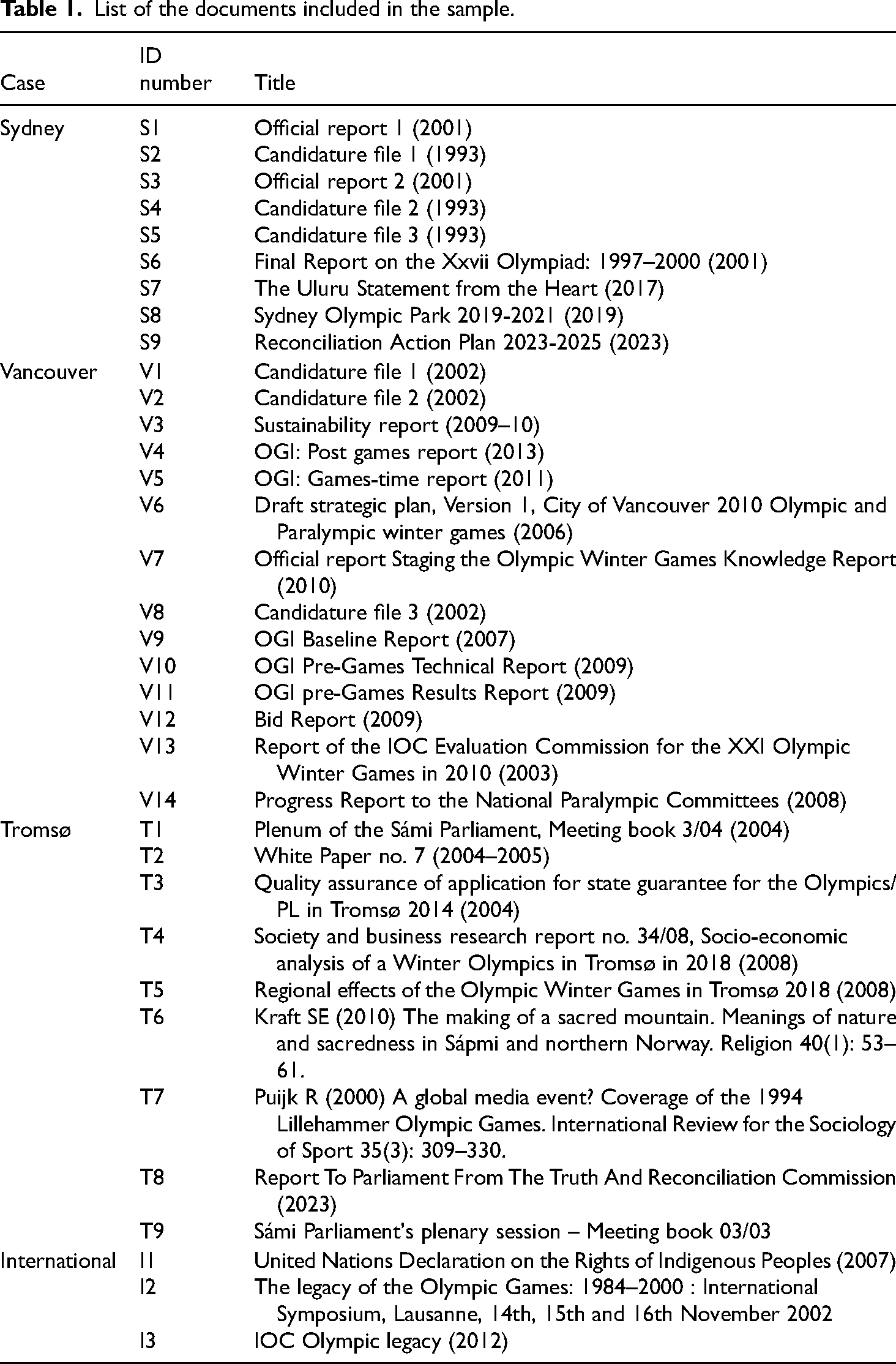
A purposeful sample of academic and official documents was selected. This includes documents produced by Sydney's and Vancouver's organising committees, the documents produced by the Norwegian government regarding the 2014, and 2018 Tromsø bids, national documents related to Indigenous Rights and international documents that played an important role in developing the international discourse of legacy and Indigenous Rights. The data were collected from publicly available sources, which provides reliable, repeatable, accessible, and affordable data (Asdal et al., 2022). Inclusion criteria focused on documents with text passages about legacy, inclusion, social sustainability, diversity, novelty and topics related to Indigenous Peoples: culture, legacy initiatives and reconciliation. Hence, bid documents, strategy documents, reports and state guarantees (see Table 1) were included. The number and type of documents vary across cases: the Tromsø bid documents were not sent to the IOC; Vancouver has additional documents – Olympic Games Impact (OGI) Study reports – that the IOC introduced in 2000 with Vancouver being the first host city to incorporate them (Vanwynsberghe, 2015). We consider documents created in connection with the Games not as standalone but as part of the international discourse, which, in turn, is reflected in the national socio-political discourses (Fairclough, 2013). Overall, 35 documents were located and selected through keywords on the search engine, the Olympic World Library, and the Norwegian government's website: Sydney: 9, Vancouver: 14, Tromsø: 9 and 3 international documents. Only 22 documents were coded and subjected to our conceptual framework, while the remaining helped us understand the international and national discourses.
List of the documents included in the sample.
The documents were analysed based on the conceptual framework, including CDA and translation theory (Fairclough, 2013; Røvik, 2016) with the following analytical questions:
What discourses related to social legacy, inclusion and Indigenous Peoples are used within and across texts? How are the key concepts translated in context? How are Indigenous Peoples framed? In what ways are the inclusion discourses related to legacy discourses? Which (new) ideas do the inclusion discourses build on and/or lead to? How are postcolonial perspectives shaping formulations and translations of ideas connected to legacy of inclusion? How is social order changed and/or reproduced through discourses and translations of legacies?
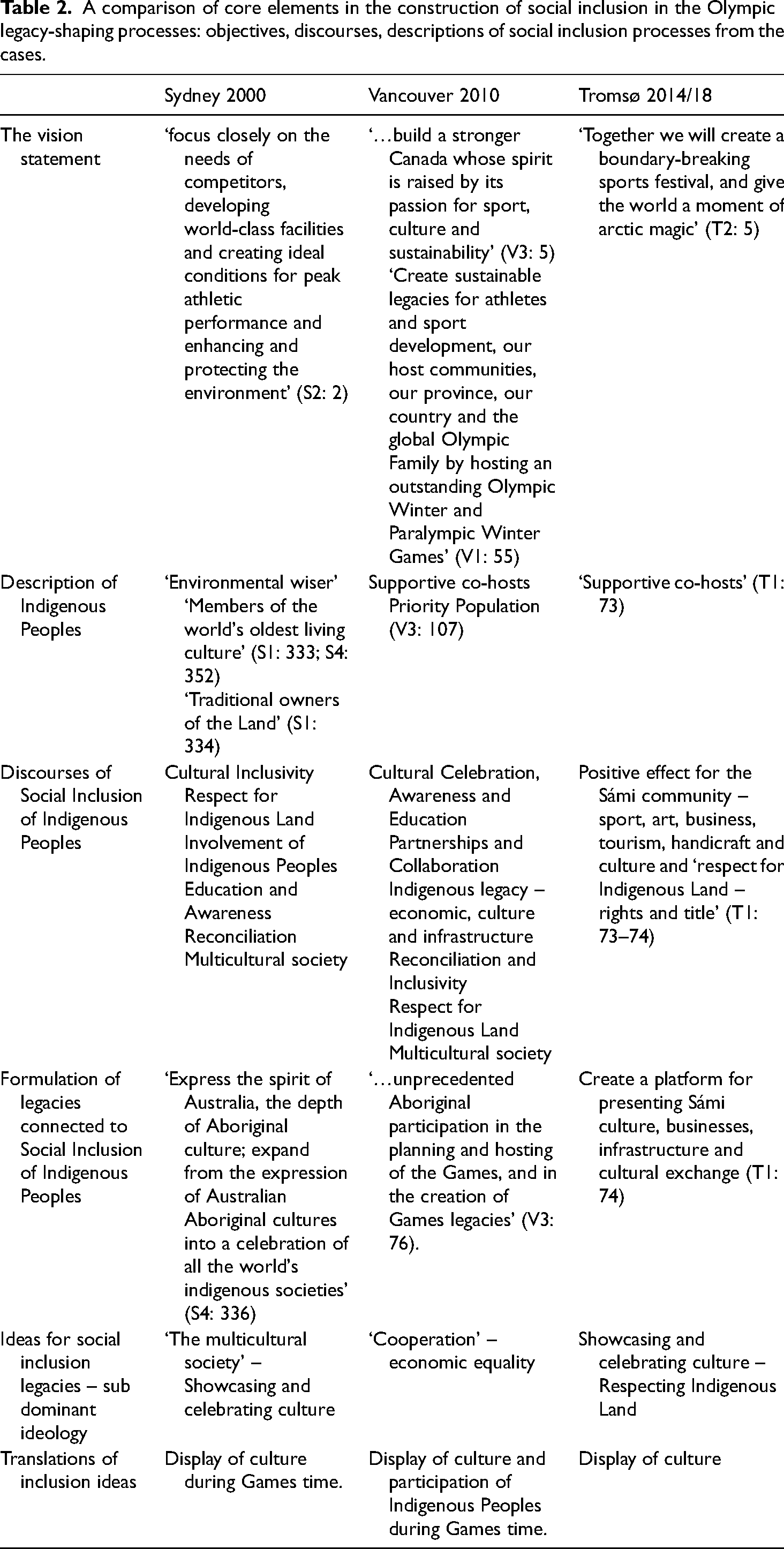
As the data differed across cases, we ensured inter-coder reliability by developing an inductive and deductive coding sheet manual. Thus, data followed the two-phase strategy suggested by Miles and Huberman (1994). In the inductive phase, codes were established after derivation from data, such as inclusion, legacy and descriptions of Indigenous Peoples. In the next phase, codes were analysed against and bundled into theory-informed themes, such as translation of Olympic legacy initiatives, representational aspects connected to legacy, reproduction of social order, Indigenous culture as legacy and origins of translation ideas. Further, we bundled the themes to what we identified as the core elements in the construction of social inclusion of Indigenous Peoples in the Olympic legacy-shaping processes: namely descriptions, discourses and formulations of Indigenous Peoples, ideas and processes connected to inclusion and legacy of the Games (see Table 2).
A comparison of core elements in the construction of social inclusion in the Olympic legacy-shaping processes: objectives, discourses, descriptions of social inclusion processes from the cases.
All authors independently coded the assigned case documents, ensuring consistency by familiarising ourselves with the coding sheet and the theoretical and methodological reasonings of the study. We compared and discussed ideas throughout the process (Asdal et al., 2022).
The native Norwegian author provided the best interpretation of the linguistic aspects of Tromsø documents. In Vancouver's case, only English documents were analysed, as per their statement that English prevails over French in interpretation (V1: 41).
Findings and discussion
To answer our research question on how social inclusion for Indigenous Peoples is constructed within the legacy-shaping process of the Olympic Games, we present and discuss our findings in the following order. First, we compare key discourses on the ideologies and formulations related to inclusion of Indigenous Peoples in each case. Second, we discuss different forms of formulation of legacies and translation efforts connected to the respective formulations. Third, we provide insights and critically reflect on the timing of translations within the legacy-shaping process.
Table 2 compares the cases regarding discourses, descriptions, ideas and formulations of social inclusion and legacies identified within and across the documents.
Framing of Indigenous Peoples in connection with Olympic legacy
In all cases, Indigenous Peoples are framed as marginalised groups and portrayed as the hosts’ cultural heritage. As Table 2 shows, e.g. in Vancouver, they are considered a Priority Population along with individuals with disabilities and new immigrants (V3) and at the same time as the ones that have the right to the land. Documents emphasise the Indigenous Peoples’ Rights and title to their Traditional Territories, specifically the Four Host First Nations’ (FHFN) Traditional and shared Territories (V1; V3). In Sydney, Indigenous Peoples were called ‘environmental-wise managers of land’ (Gold and Gold, 2017: 7). The Tromsø case draws upon the positive legacy of Lillehammer 1994 where Indigenous culture was displayed at the opening ceremony and other events during the Games (see also Table 2) where ideas of Indigenous context was modified into the Olympic context. Indigenous People are claimed as co-hosts in Tromsø and Vancouver. In all cases, there was an emphasis on the cooperation of the organising committee and the Indigenous Peoples.
The discourses in the three cases are similar but have different ideological orientations. In Sydney, the dominant ideas are multiculturalism and inclusiveness of Indigenous Peoples, with a sub-ideology of showcasing and celebrating culture. Vancouver is characterised by cooperation (dominant) and economic equality (sub-ideology). In Tromsø, showcasing and celebrating culture is the main idea of inclusion, with respect for Indigenous Lands gaining importance later in the process. These findings suggest that the inclusion idea has been recontextualised over time with an attempt to operationalise the inclusion discourse (Fairclough, 2013) through reproduction and modification (Røvik, 2016) of the inclusion of Indigenous ideas into the Olympic context.
Formulations of legacy and legacy translations
Four distinct but interrelating legacy formulations in connection to social inclusion of Indigenous Peoples were identified: (a) inclusion and representation of Indigenous Peoples; (b) the promotion of Indigenous culture through ceremonial connections and festivities; (c) reconciliation; (d) employment and education. In the following, we explain the formulations and discuss how ideas connected to these legacies were (not) translated into action.
Inclusion and representation of Indigenous Peoples as legacy
Commonly, for all three cases, inclusion is one major objective stated and connected to the legacy of the Games. The Vancouver bidding committee ‘developed the 2010 Winter Games Inner City Inclusivity Commitment Statement’ highlighting the Games’ inclusivity (V6). This document emphasises programmes and policies developed during the organising phase to ‘ensure incorporation of the interests of different groups, such as aboriginal people, women, youth, people with disabilities, people of colour, immigrants and other groups’ (V6: 70). While all cases address the inequality between Indigenous and non-Indigenous populations, representation of Indigenous Voices in the organisation and implementation of the Games was a major concern. In Australia, the lack of Aboriginal representation was aimed to be one focus of organising the Games and was intended to promote Australian Aboriginal heritage (Haynes, 2001).
In Norway, the Sámi Parliament was a consultation body (T1) and the Sámi, saw themselves as co-host of a potential Game (T1: 73). However, this was not explicitly mentioned in the official White Paper (T2). Another concern connected to the bid was protecting the Land. Tromsdalstind (a spectacular mountain on Sámi Land) was planned to become the downhill arena, a suggestion that fused opposition from the Sámi. Two competing discourses emerged (T6). One is about selling the Olympic Games as a spectacular game, and another is opposing the same event using legal sanctity criteria for respecting the past and Sámi Land. The spectacular game discourse portrays man as almost unlimited and almighty, someone who does the impossible, manipulates their surroundings and creates a better future (T6). The opposing discourse emphasised ethnic diversity, closeness to nature and respect for the past articulated by older Sámi voices (T6). This conflict became the reason for the Sámi Parliament to document that Tromsdalstind is a sacred mountain (T6) and for the Tromsø organising committee to finally give up their plans to use that mountain as a downhill location. Sámi protests helped create a lasting legacy by preserving Tromsdalstind (T6). This illustrates the tension between two discourses in the current social order: the importance of Indigenous Land and a dominant market-oriented, striving to create fantastic games for the viewers (T7). However, this came to life through protests, demonstrating the importance of including Indigenous Peoples in the decision-making processes during the planning stage.
The Canadian Constitution recognises three groups of Aboriginal peoples: Indians (more commonly referred to as First Nations), Inuit and Métis; these are three distinct peoples with unique histories, languages, cultural practices and spiritual beliefs (Canada, 2022). Even though Inuit and Métis are recognised, little evidence suggests their inclusion in the Vancouver 2010 Games. Vancouver differs from the others by promoting the participation of Indigenous Peoples in the decision-making processes. The main idea of involvement and ‘innovation’ that we have uncovered in our analysis is the phrase, ‘unprecedented Aboriginal participation in the planning and hosting of the Games, and in the creation of Games legacies’, found in multiple documents (V3: 10, 76; V7: 6, 9; V9: 7; V1: 63). In addition, a full section of the V3 is devoted to Aboriginal participation and collaboration. This can be interpreted as the organising committee attempting to change the inclusion discourse and bring attention to Indigenous Peoples’ involvement through the use of ‘unprecedented’ words. Thereby, the discourse is enacted as a new way of interacting with Indigenous Peoples and attempts to modify the inclusion idea. However, translation efforts towards real inclusion in that, e.g. by securing quota spots (Stenling et al., 2023) in decision-making bodies was not documented. In addition, Forsyth (2016: 24) argues that Indigenous involvement was unprecedented only in ‘mobilising Indigenous bodies, land and insignia’. The idea of co-hosting had potential to create the involvement legacy of Indigenous Peoples, which was missed witnessing over an actual non-prioritisation and reproduction of social dominance (Fairclough, 1992) by non-Indigenous people and the uphold of hierarchies (Martin and Wodak, 2003) when it comes to the organisation and governance of Olympic Games.
Promotion of Indigenous culture as legacy
The importance of culture as legacy for social inclusion of Indigenous Peoples was emphasised and displayed in all cases (see Table 2). Indigenous cultural imagery is prominent and visible in the Games’ ceremonies and festivals. One of the reasons for the Norwegian government's support of the Tromsø Bid was to promote Sámi culture and architecture (T3). The Sámi Parliament also stated that the Olympic Games in Tromsø would positively affect the Sámi community in many areas: ‘profile modern Sámi cultural and sporting life, contribute to Sámi tourism, stimulate Sámi art and duodji environments, add valuable expertise to organisations, event environments, provide missions and marketing channels for Sámi businesses’ (T1: 73–74). One of the positive legacy goals might be raising national and global Sámi awareness. However, ‘these ambitions were not detailed enough’ (T3: 149) and ‘strengthening Sámi culture and life development in the light of mega event can be counterproductive with little socio-economic impact’ (V3: 125). This illustrates that despite Indigenous Peoples’ involvement and legacy ideas being formulated, these were not translated into action. Additionally, this highlights the importance of the development of specific initiatives for the target group (Minnaert, 2012).
Although the bids emphasise environmental sustainability and recognise Indigenous sustainable practices, these are not included in Sydney's environmental discourse. In our data, we found that infrastructural and environmental sustainability prevailed over social inclusion. In the documents, Indigenous Peoples are acknowledged as the ones who have been living sustainably and in harmony with the land (see Table 2). However, they are not included in this discourse on are how the Games can be more sustainable. The discourse uncovers that their consultations and advice only connected to Indigenous Territories and the questions that are directly impacting them. This can be interpreted as superficial inclusion that was not incorporated throughout the documents and could be one of the possible ways of securing inclusion, as Fairclough's (2013) stage four represents. Vancouver's and Tromsø's translations of inclusion ideas have similar character. Even though the mentioning of Indigenous Peoples can be found in different sections of the documents, e.g. infrastructural legacies, those are questions of the land and the infrastructural legacy in terms of housing for Indigenous Peoples. Incorporating Indigenous Knowledge in matters of environmental sustainability is neglected, even though it could have been another possible way for inclusion (CDA – stage 4). However, the documents mainly emphasise Indigenous culture and handicraft. This can be interpreted as a one-sided cultural approach highlighting the power dynamic between environmental and social discourses, where the former has more focus, and Indigenous Peoples are only included in matters that would concern themselves, not the Games and its legacy in general.
It is claimed that the Vancouver cultural programmes are founded on Olympic Values that ‘will ensure Olympic legacy for our community and future generations’ (V8: 3). The Organising Committee planned various cultural activities to represent the country's multicultural pride. Aboriginal culture and art were showcased in medal designs, the opening ceremony and torch relay. A licensing and merchandising programme involving FHFN allowed merchandise marketing with Aboriginal themes; art was installed in different venues. The official emblem/logo of Vancouver 2010 was an Inuit inukshuk. However, no other Inuit inclusion was evident, possibly due to the Games taking place on First Nations’ Territories.
Also, several ceremonial highlights of the Games were connected to Indigenous Peoples. For example, in Syndey, Australia's first Aboriginal Olympic gold medalist, Nova Peris-Kneebone, started a torch relay at Uluru (spiritual centre for Aboriginal Australians) with the permission of ‘Aboriginal and Torres Strait Islander elders’ (S1: 335). Aboriginal athlete Cathy Freeman ended the relay and lit the cauldron. At the Opening ceremony in Sydney, the encounter between Aboriginal and white Australians was enacted to highlight the antiquity of Indigenous culture, including its myths, legend, spirituality and diversity (Gold and Gold, 2017). Several of Sydney's 2000 festivals were themed around Aboriginal people of Australia and Indigenous Peoples around the world (S4), which can be considered an attempt to create a symbolic appreciation and recognition of Indigenous Peoples worldwide. Sydney created a special focus on the festivals – ‘The Festival of the Dreaming was an affirmation of indigenous identity and culture’ (S3: 304). All of these initiatives can be considered a cultural platform for Indigenous Peoples.
In all cases, the idea of social inclusion was translated as cultural showcasing. This approach fits the ideology of Games providing fantastic TV images and increasing market value. Showcasing Indigenous culture is also an opportunity to show the ‘best’ qualities of the host country, but it might hamper the translation of legacy efforts. Although Indigenous symbols were incorporated, it does not represent Indigenous ideas, but rather a non-Indigenous translation of the inclusion idea (see also Elder et al., 2006; Holmes et al., 2024). Showcasing and celebrating culture are essential to staging the Games, so our critique is that showcasing was considered enough to call inclusion.
While Czarniawska and Joerges (1996) emphasise the innovative nature of translation, Røvik (2016) argues that translations can be imitative. Our findings show that the inclusion of Indigenous Peoples is more imitative than innovative. All three cases promote showcasing through cultural celebration, inclusion programmes lacking long-term aspects, and presenting the Indigenous Peoples as co-hosts for the Games. However, a legacy from actual co-hosting is not observable. Cultural celebration and inclusivity are prominent themes that balance showcasing/commercialising and creating a cultural platform for Indigenous Peoples. The lack of effective idea translations for inclusion and real changes can be seen as an attempt to avoid conflicts and negative reactions towards the Games (Cohen et al., 1972). The display of Indigenous culture is more decoration than real change. The showcasing of Indigenous Peoples creates enthusiasm for the Games at the national and international levels, but to a lesser extent creates a long-lasting legacy. As our cases suggest, it also portrays the Indigenous Peoples within a national identity that might enhance an existing social order of postcolonial thinking (Fairclough, 1992).
Reconciliation as legacy
Reconciliation is another focus in the discourses and formulation of legacy in the cases of Sydney and Tromsø. In Sydney, the city conducted a series of reconciliation efforts, initiating a process with the passage of the Council for Aboriginal Reconciliation Act in 1991, which culminated in a formal apology to Aboriginal Peoples from Australia's Prime Minister in 2008 (Australia, 2021). ‘Most notably, 250,000 people marched across the Sydney Harbour Bridge in a show of support for and recognition of the plight of indigenous Australians, while the word “Sorry” was repeatedly written in the sky’ (IOC, 2020). Therefore, there is a clash between addressing and attempting to solve the issues by using the Games as a catalyst for change and, thus, successful translation of ideas (Røvik, 2016), applicable to all three cases. The ceremonial connections and festivals have the potential to become an attempt to reconcile. However, we identified some missed opportunities. For example, in Sydney, the cultural festival ‘Harbour of Life will thus explore the achievement of the Olympic ideal: the possibility of enduring human happiness and cooperation in a world historically plagued by strife and war’ (S4: 338). This can be interpreted as the Games being supposed to create a positive change in the society, however without change of the social order (Fairclough, 2013) in the long run and as actual lasting legacy. Even though, several efforts towards reconciliation and inclusion, like S8 and S9, were implemented, Aboriginal and Torres Strait Islander peoples are still not recognised in the Australian Constitution. The Referendum held on October 14 2023, with the agenda to establish an Indigenous Voice to Parliament failed (Comission AHR, no date). This demonstrates the power of the current discourse over the social wrong, even if it is addressed within the social order (Fairclough, 1992; Martin and Wodak, 2003).
In the case of Tromsø, reconciliation was absent in the documents. One reason we suggest is that the Norwegian King apologised in a speech to the Sámi Parliament in 1997 for mistreating the Sámi people (OSCE, 2020). However, the Truth and Reconciliation Commission's June 2023 report revealed that Sámi continue to experience discrimination (T8). Although the ‘Norwegianisation policy’ was discontinued, several patterns of behaviour, mindsets, and social structures that the policy had previously fostered endured (T8).The documents can be interpreted that the bid and organising committees used the reconciliation idea for their legacy shaping and implementation of social inclusion of Indigenous Peoples in the context of the Olympic Games. However, another theme identified is an unaddressed discourse, the events and happenings not included in the document, even though they directly link to Indigenous issues and inclusion/exclusion problems. Australia's bicentenary celebrations are mentioned as ‘a high point in the history of Australia since European settlement. One million people thronged the shores of Sydney Harbour in an unprecedented expression of national feeling’ (S2: 32). The peaceful protests of 100,000 Indigenous and non-Indigenous people raised awareness of Indigenous issues not mentioned in the document. Australia Day is still a contested day considered as ‘Invasion Day’ or ‘Survival Day’ from an Indigenous perspective (Australia, 1988), which could have been one of the ways of including Indigenous Peoples in the bid from a reconciliation perspective. However, our findings show the social inclusion of Indigenous Peoples in the legacy-shaping processes of Olympic Games is mainly characterised by non-Indigenous people translating Indigenous symbols and ideas of inclusion. While reconciliation is a key focus in legacy discussions, the term lacks clear definition and direction, as noted by Tatz (1998). This can result in reconciliation efforts reinforcing dominant non-Indigenous perspectives without promoting genuine recognition and understanding. Our findings suggest that several opportunities for reconciliation have been missed. Therefore, reconciliation may inadvertently lead to neglecting past issues without proper resolution (Tatz, 1998). The translation of reconciliation ideas might get complicated due to unique and yet shared experiences of Indigenous Peoples. Therefore, long-term planning and cooperation are essential for both reconciliation idea translation from the source to the recipient and the development of inclusion discourse as a whole.
Employment and education as legacy
Other translation efforts for social inclusion of Indigenous Peoples in connection with the Olympic Games targeted workforce and education, especially in Vancouver; for example, the Aboriginal Recruitment Strategy – ‘A VANOC (Vancouver Organizing Committee) strategy that focuses on building relationships within the Aboriginal community to increase awareness of Games-related employment opportunities and how Aboriginal peoples can access them’ (V3: 104). Other initiatives targeted educational and promotional programmes: ‘13 programs related to minorities and indigenous populations aimed at the general public were implemented through VANOC (9 programmes) and 2010 Legacies Now (4 programmes)’ (V4: 171). However, the effectiveness of these programmes ‘remains largely unevaluated’ (V4: 171). There is a difference between the programmes aimed at the general public and those aimed at marginalised groups. The former usually have educational and promotional characteristics for raising awareness; however, it is also a question of whether the former interprets inclusion as assimilation or multiculturalism. In the document, there is no division between the programmes’ recipients. The only programmes aimed at Indigenous Peoples are those that enhance the skills of minorities.
Timing of translating legacy-shaping initiatives
Looking at the cases it becomes clear that the timing of translating initiatives plays an important role in the legacy-shaping processes.
In Vancouver, ‘post-Games use’ refers to venues and facilities, indicating the importance of infrastructure discourse in the legacy-shaping process. When it comes to cultural and sports-related use, most of these can be considered as the Games-time initiative (V3). For example, during the 2009–10 reporting year, VANOC stated that it ‘continued working with First Nations, Inuit and Métis organisations to identify and maximise opportunities for Canada-wide Aboriginal participation in the Games’ (V3: 11). In Australia, Indigenous issues played a large role in the lead-up to hosting (Haynes, 2001). Based on the experiences from the Lillehammer Olympics, in 2004 the Sámi Parliament chose to allocate money for planning the Tromsø Olympics in 2014. The experiences from Lillehammer led the Sámi community to value early involvement as they arrived so late in 1994, which resulted in Sámi people being not more than an extra decoration. A key lesson is that Indigenous Peoples’ representatives must participate from the start in the legacy-shaping process to influence the idea of the Games and have agency on the translation of the ideas.
On a broader view, the ideas of framing Indigenous Peoples, social inclusion and legacy have been changing over time on the national and international levels, as with the United Nations Declaration on the Rights of Indigenous Peoples (UNDRIP) in 2007, which represents idea travel (Røvik, 2016). The development of the inclusion and reconciliation discourses over time and across different contexts demonstrates that the attempts to change the social order were insufficient. Missed opportunities for reconciliation, cultural showcasing, and, in particular, the role of timing tell us that the solution ideas to inclusion arise before the problem is properly defined (Cohen et al., 1972), and consequently, the problem of inclusion of Indigenous Peoples is therefore not properly addressed in the legacy-shaping processes. It is utterly necessary to incorporate Indigenous perspectives early in the legacy-shaping process, and translating plans into concrete initiatives to enhance inclusion efforts. Despite the emphasis on multiculturalism and diversity in the documents, the ongoing challenges faced by Indigenous Peoples were not addressed.
Conclusion
The idea of Indigenous Peoples’ social inclusion is not yet a central focus in Olympic legacy (bidding) documents, but Sydney 2000, Vancouver 2010 and Tromsø 2014/18 offer insights into how inclusion is constructed. Our study revealed that even though there is emphasis on the involvement of Indigenous culture, acknowledgement of Lands’ Rights and cooperation, non-Indigenous understandings and translations of Indigenous culture are still dominant. The situation of Indigenous Peoples in all three cases shows that the legacies and inclusion formulations were insufficient to create positive change. Given the uniqueness of the cases in space, time and the type/stage of the Games – winter, summer and unrealised bids, the approaches to planning inclusion and national multicultural discourse do not vary much. They are characterised by postcolonialism and assimilation thinking.
The findings show that the problems that Indigenous Peoples face in these cases are a lack of emphasis on long-term initiatives for inclusion and the tendency to include Indigenous Peoples in the national identity of the respective countries. Therefore, a broader commitment is needed to create lasting social change through legacy-shaping processes created with and led by the Indigenous Peoples.
We developed an understanding of the inclusion phenomenon by combining critical and pragmatic perspectives. The postcolonial view of Indigenous Peoples is evident, and the pragmatic perspective helps us better understand translation in legacy-shaping processes. Thus, it becomes easier to point to concrete measures to promote inclusion, such as the involvement of Indigenous Peoples in initiation and legacy planning processes and support of the Indigenous-led bid. However, bidding procedures must also be seen as critical as they are strongly characterised by legitimisation acts where the main goal is first and foremost to win the bid (Strittmatter, 2016; Strittmatter et al., 2018). In any circumstance, we suggest that inclusion must become a central part of a new ongoing dialogue between the applicant and the IOC. The IOC's proposed softening of requirements for new applicants in 2023, in which local and national interests are leading the way to a greater extent, presents an opportunity to redefine the social order and promote radical innovation in legacy planning. The fact that the individual country is to a greater extent setting the conditions for the Games can paradoxically mean that the majority does not prioritise the minority, which will reinforce the current order. By challenging Western narratives that view nature as a purely human gain, it may be possible to empower Indigenous Peoples. This study is not meant for generalisation. Future research should investigate the construction of legacy and inclusion translations across host communities.
Footnotes
Acknowledgements
The authors would like to thank the anonymous reviewers for their constructive and helpful comments.
Declaration of conflicting interests
The authors declared no potential conflicts of interest with respect to the research, authorship, and/or publication of this article.
Funding
The authors received no financial support for the research, authorship, and/or publication of this article.
