



Abstract
For the last 20 years, Putnam's conceptualisations of bonding and bridging social capital have become a common reference for policies and programmes that seek to promote integration in and through sports. However, few researchers have looked beyond face-to-face interactions to how sports may develop migrants’ relations to formal associations, institutions, and agencies in civil society. In this article, we aim to explore how young refugees accumulate diverse forms of social capital through participation in sports clubs and informal sports. Drawing on Lewandowski's conceptualisations of horizontal and vertical social capital, we analyse 10 young refugees’ experiences with sports participation in Norway. The results show that informants found it challenging to participate in sports clubs due to conflicting views on how to ‘do sports’ as well as processes of ‘othering’. As a result, their opportunities for accumulating vertical social capital (social connections and resources across vertical power differentials) were limited and only identified for the most highly skilled informants. Consequently, the informants dropped out of sports clubs and instead joined informal sports to experience a sense of community and belonging with peers similar to themselves. By doing so, the informants were able to accumulate horizontal social capital (resources within a specific socioeconomic or cultural stratum) as well as negotiating specific types of vertical social capital. Overall, our findings illustrate some of the challenges and limitations of Norwegian sports policy and clubs in facilitating social capital and, thus, social mobility for young refugees.
With the publication of his critically acclaimed book, ‘Bowling Alone’, Robert Putnam's (2000) concept of social capital gained substantial attention amongst both academics and practitioners and has since had a considerable impact on (sports) policy worldwide (Tacon, 2021). Due to his emphasis on the benefits derived from social networks, trust, and reciprocal norms within voluntary organisations, and particularly membership associations in which people regularly interact face-to-face, voluntary sports clubs were quickly identified as important institutions in enabling the development and maintenance of social capital within and across societies. This aligned with well-documented historical traditions of politicians ascribing a series of personal and social benefits to sport (Vermeulen and Verweel, 2009).
A particular area of focus in the relationship between social capital and sport has been inclusion and integration among migrants. That is, there seems to be a strong political belief that supporting migrants in participating in voluntary sports clubs will enhance social capital and facilitate social inclusion and integration (Spracklen et al., 2015). A prevailing notion among policymakers on sports and integration seems to be that migrants should participate in ethnically mixed sports clubs rather than ethnic minority clubs (i.e. mono-ethnic; Tacon, 2021). This is based upon the assumption that bridging across ethnic groups encourages greater integration into the host community compared to participation in ethnically separate clubs. Thus, for these reasons, a narrative has developed that has positioned ethnically mixed clubs as more valuable and desirable in efforts to integrate refugees into local communities (Tacon, 2021). However, studies that have compared and contrasted the accumulation of social capital in separate and mixed clubs have presented a more nuanced picture, showing how in-group bonding and out-group bridging seem to occur in both settings (Spaaij, 2012; Theeboom et al., 2012; Verhagen and Boonstra, 2014; Vermeulen and Verweel, 2009). Thus, the reality of negotiating social capital appears more complex and non-linear than often presented in theory and policy.
The importance and relevance of social bonding and social bridging are well explored in the body of research on sport and integration (Ager and Strang, 2004; Spaaij, 2012). However, there seems to be a lack of research on how migrants develop relations with formal associations and institutions inside and outside civil society through sports participation. Two exceptions are Spaaij's (2012) and Block and Gibbs’ (2017) studies on the social integration of refugees in Australia, which discuss the importance of linking individuals with societal institutions. Both studies show how refugees experience an absence or scarcity of resources like education and language proficiency that foster social mobility, participation in associations, and shared cooperative actions up and down the socioeconomic and cultural ladder in their new home country. This lack of social capital is conceptualised by Lewandowski (2008) as ‘social poverty’, which is problematic as it promotes antagonistic class divisions as well as the stratification of human capabilities. Following these studies and challenges of social poverty amongst refugees, we believe that Lewandowski's (2008) concepts of horizontal and vertical social capital can aid exploration of the extent to which sport participation facilitates newcomers’ accumulation of resources and knowledge that help in accessing important formal societal domains such as employment, housing, education, and health care.
The aim of this article is, therefore, to explore how young refugees experience the processes of accumulating horizontal and vertical social capital through participation in sports clubs and/or informal sports. Following Jeanes et al. (2019: 79), we define informal sports as ‘[sports] participation that is self-organised and not club based’. We endeavour to contribute to the under-developed body of literature examining how sports may lead to an accumulation of social capital beyond social bonding and bridging. Furthermore, as the data material is based on life-story interviews with young refugees living in Norway, we deliver a novel empirical contribution to research on young refugees’ sports participation in a Scandinavian setting where sports clubs are often seen as key arenas for accumulation of social capital.
Sport for young refugees in Norway
Before presenting the conceptual framework, we will briefly discuss the applied context of this study: the political mandate of integration given to voluntary sports clubs in Norway. This mandate emphasises integration being ‘more than just participation in sports’ (Nesse and Hovden, 2023: 4), as voluntary sports clubs are expected to facilitate structural, social-cultural, and social-affective integration (see Elling et al., 2001). Resultantly, the Norwegian Olympic and Paralympic Committee and Confederation of Sports (NIF) receive considerable state funding to support its inclusion-focused work in promoting ‘enjoyment of sport for all’ and ‘playful, ambitious, honest and inclusive’ sport (NIF, 2019: 5).
However, while sport is often constructed as an essentially good, unifying, pure, and wholesome institution, Dowling (2019: 2) argues that policymakers’ ‘ill-defined policies of sport for integration are difficult to realise and, paradoxically, can lead to a sense of alterity and exclusion’. This is in line with findings from other studies showing how integration is downgraded in favour of competitive sports in Norway (Friberg and Gautun, 2007; Nesse and Hovden, 2023) and the Nordic countries (Bjerregaard et al., 2009; Flensner et al., 2021; Hertting and Karlefors, 2021). Furthermore, whilst Norwegian-based studies show that sports participation is the most popular activity among young refugees (Seland and Lidén, 2011) and is essential in creating safe spaces from the challenges of young refugees’ everyday lives (Nesse, 2023), Dowling (2019) argues that young refugees are subjected to assimilation and othering within voluntary sports clubs.
With this as a backdrop, we place value on understanding how refugees experience developing horizontal and vertical social relationships through both formal and informal sports. This is particularly crucial when research shows that migrants and refugees drop out of voluntary sports clubs in favour of informal sports (Andersen and Bakken, 2015). To support our understanding of how young refugees experience the development of social connections through sports participation and the extent to which they perceive them as a driving force in the process of integration, we will draw upon Lewandowski's (2008, 2018) conceptualisations of horizontal and vertical social capital, and ‘social poverty’.
Conceptual framework: social capital and integration
Social capital and related concepts have proven valuable for policymakers and researchers alike and, within the social sciences, the popularisation of social capital has resulted in its merging into broader ideas of social cohesion and national unity (Agergaard, 2018; Spaaij, 2012). Here, Putnam's (2000; 2002) work in particular has been used to present social capital as the outcome of participation in sports and leisure activities. However, following Blackshaw and Long (2005: 241), Putnam's conceptualisation of social capital is challenging as it offers ‘an imaginary construction [more] than a solution for the pains that it claims to cure’.
Similarly, Lewandowski (2018: 388) states that Putnam's (2000; 2002) ‘sociologically vague methaphors’ of bonding and bridging have proven challenging as they fail to distinguish adequately between different empirical and normative types of social capital. To accommodate this challenge, Lewandowski (2008) introduces the concepts of horizontal and vertical social capital. Here, horizontal social capital refers to resources ‘that are accessible and appropriable within a specific socioeconomic or cultural stratum’ (Lewandowski, 2008: 32), for example, the development of social networks, trust, and a sense of community. Thus, horizontal social capital is a stratified resource for individual and collective actions within a given habitus (to borrow Bourdieu’s, 1977 term). It must, therefore, be considered the most basic and commonplace form of social capital.
In contrast, vertical social capital is referred to as a ‘destratifying resource for individual and collective actions from one habitus to others above and/or below it’ (Lewandowski, 2008: 32). Or, put differently, resources that are obtainable and appropriable between and among various socioeconomic and cultural strata. This aligns with the related concept of linking social capital, which refers to social relations connecting individuals across explicit ‘vertical’ power differentials and accessing public and private services (Lewandowski and Streich, 2007). This includes ties between citizens and civil servants (Barker and Thomson, 2015) or individuals’ access to professional resources (Dahl and Malmberg-Heimonen, 2010). However, a restrictive component of linking capital is the necessity of face-to-face interactions. For example, Szreter and Woolcock (2004: 655) emphasise that linking social capital ‘only can be delivered through on-going face-to-face interactions such as classroom teaching’. This ignores processes of resource accumulation that sit outside of exclusively face-to-face interactions, such as gaining a ‘knowledge of the system’ through involvement in sports clubs as an administrator or player, which seem more dependent on time in the given social field than direct face-to-face interactions (Spaaij, 2012). Similarly, Agergaard (2018) also emphasises how migrants may acquire vertical social capital over time as they get acquainted with societal institutions and develop trust in the laws and administration of the host society.
Within this article, we refer to vertical social capital as an umbrella term for developing social connections and resources that connect individuals across socioeconomic or cultural strata and give access to public and private services. Our understanding of vertical social capital includes Szreter and Woolcock's (2004) definition of linking social capital, whilst avoiding conceptual restrictions that prioritise face-to-face interactions and neglect the importance of time. Following Lewandowski (2008), this conceptualisation of vertical social capital is normatively different from horizontal social capital as it fosters mutual recognition across cultural classes and class divisions and plays an important role in realising institutional change in socially complex and culturally diverse societies. Thus, the utilisation of these concepts of social capital allow the development of a greater understanding of how and why some refugees engaged in sport simultaneously experience a wealth of horizontal social capital alongside a poverty of vertical social capital.
Methodology
The empirical material presented in this article draws from the first author's PhD project on the integration of unaccompanied minor refugees in voluntary sports clubs in Norway. The project utilised in-depth semi-structured interviews inspired by Atkinson’s (1998) ‘lifestory interviews’ as the primary research method. With this approach, the interviews aimed to uncover the individual's narrative as entirely and honestly as possible through conversations with the interviewer. The stories represented in this article are retrieved from ten interviews with young adults (18–23 years old) who arrived in Norway as unaccompanied minor asylum seekers. After having their asylum application approved, all informants lived in different housing arrangements for unaccompanied minors before moving out, living alone, with relatives, or being assigned a Norwegian family. At the time of the interview, the informants’ times of residence in Norway were between three and seven years.
Due to increasingly restrictive immigration and integration policies in Norway, as well as other Western European states (Hernes, 2018), the proportion of unaccompanied minor refugees who have been granted permanent residence in Norway has decreased significantly in the last two decades (Kirkeberg et al., 2022). In 2022, a total number of 510 unaccompanied minor refugees were granted residence (ImdI, 2023). Furthermore, as this group of young refugees has escaped war, persecution, and challenging living conditions whilst lacking their parents’ care, guidance, and protection, they are particularly prone to mental disorders and in need of careful follow-up and individual provision (Svendsen et al., 2018). As such, the Norwegian government highly protects unaccompanied minor refugees, making this group challenging to contact and interview. Thus, to recruit informants, the first author collaborated with the ‘Child and Family Service’ (CFS) in one of the largest municipalities in Norway. From there, an information letter was developed to ensure the municipality and the CFS were familiar with the project's purpose and the possible informants’ legal rights. This letter was later presented to prospective informants.
Initially, we planned to adopt a ‘maximum variation sampling’ strategy (Markula and Silk, 2011) with the following initial selection criteria: (a) the refugees had to arrive in Norway as unaccompanied minor asylum seekers and later be given status as refugees, and (b) they had to have experience with participating in voluntary sports clubs in Norway. However, after taking advice from an advisor at CFS, we added the criterion that informants had to be a minimum of 18 years old due to privacy challenges. These criteria were passed on to a social educator who worked at several housing associations and thus knew and contacted potential informants. As a result, nine refugees showed interest in the project, of which six agreed to be interviewed. These were all men from Afghanistan.
After sampling, the first author constructed an interview guide consisting of three main topics: (a) school and leisure activities, (b) experience with sports in their home country, and (c) experience with voluntary sports clubs in Norway. Due to restrictions related to Covid-19, two interviews were conducted by phone, whilst four were face-to-face. The interviews lasted between 30 and 45 min. Two informants did not allow recording of the interview. Due to relatively few initial informants and a lack of opportunity for snowball sampling, the first author approached the CFS again, expanding the selection criteria to recruit more informants. The new criterion was ‘an interest in participating in voluntary sports clubs in Norway’. This resulted in five new informants, two women from Eritrea and two women and one man from Ethiopia. The first author interviewed all five face-to-face, with the interviews lasting between 40 and 60 min. Following the five interviews, it became apparent that one of the women from Ethiopia had no interest in sports participation in Norway nor her home country. Hence, as she did not meet the selection criteria, she was excluded from the analysis. Thus, the narratives represented in this study are based on the stories of 10 informants, as outlined in Table 1.
The informants and their experience with sports participation
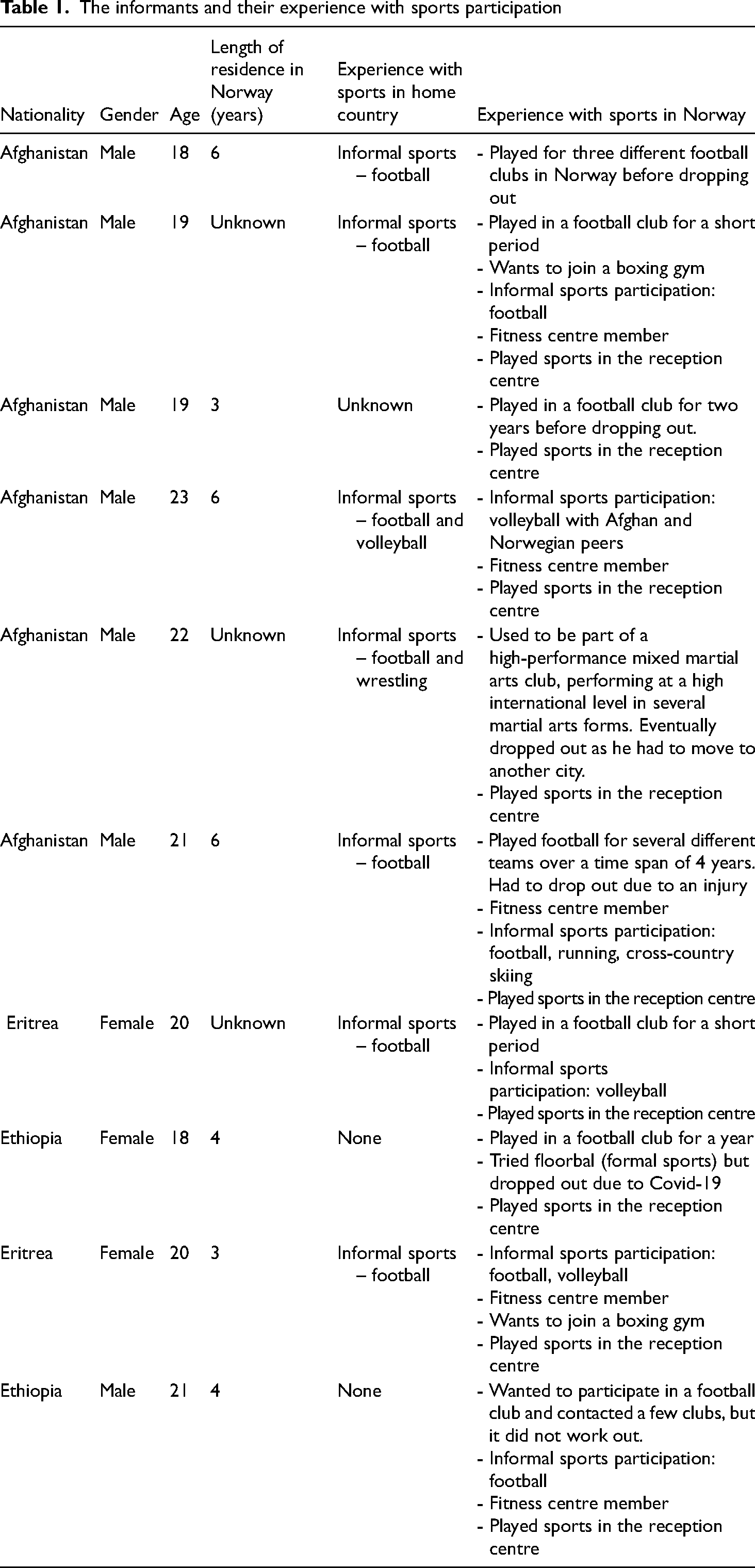
Due to the informants’ limited Norwegian language skills as well as a (natural) hesitancy to talk about sensitive experiences, their storytelling was somewhat fragmented. To accommodate the challenge of interviews mostly consisting of short answers and affirmative nods, the analysis is inspired by what Riessman (2008) refers to as thematic narrative analysis. This approach includes deconstructing the informant's life stories and identifying themes that are not unique to one informant but, in sum, represent a greater narrative (Riessman, 2008; Sandberg, 2022). In doing so, our analysis strategy emphasised an inductive approach in coding and categorising the empirical material. This included an ‘in vivo’ coding process to develop categorisations closely related to the words and phrasings introduced in the interviews.
Following coding and the development, defining, and interpretation of themes, the next phase of our analysis process involved the creation of three narratives. The first narrative, narrative 1, is based on themes encompassing experiences with informal sports in the informant's home country and challenges related to the style of play or lack of the ‘proper’ skillset required for participation in voluntary sports clubs in Norway. Here, the most influential themes are: (a) I used to play sports back home with my friends, (b) in my home country we played with street rules, (c) Norwegian sports are both physically and tactically demanding, and (d) I am expected to adapt to the Norwegian ‘no flair’ style of play. The second narrative, narrative 2, is also based on themes related to experiences with informal sports in the informant's home country. However, it differentiates from the first narrative, combining themes encompassing a successful attempt to participate in voluntary sports clubs. Here, the most influential themes are: (a) I used to train with adults back home, (b) in my home country, we trained seriously, (c) my skillset was highly welcome in Norway, and (d) I have teammates, not friends. Finally, the last narrative, narrative 3, is based on themes describing experiences of not being welcomed in voluntary sports clubs in Norway. Thus, this narrative includes themes related to experiences of rejection or a sense of being unfairly treated by the sports clubs. Here, the most significant themes are: (a) I reached out to sports clubs, but they did not respond, (b) I was put on a team with younger girls, and (c) I find Norwegians uninterested in interacting with us refugees.
The narratives developed aim to showcase three ways the informants have tried participating in voluntary sports clubs in Norway. Furthermore, the narratives also describe a broader story of the barriers and opportunities unaccompanied minor refugees meet in accumulating social capital in formal and informal sports. However, developing such narratives is not free of concern nor power dynamics. Firstly, as specified by Sandberg (2022) and Tjønndal and Hovden (2021), it is important to note that a thematic narrative analysis involves a critical reading of the data material where we, as researchers, deconstruct, interpret, and prioritise events and relationships in the informants’ lives while neglecting others. In doing so, we reconstructed the informants’ stories and gathered them in a ‘typical’ narrative that is ‘richer, more condensed, and coherent than scattered stories across single interviews’ [authors’ translation] (Kvale and Brinkmann, 2015: 251).
Another concern in developing narratives based on stories of refugees is, as addressed by Ratna and Samie (2018) and Mashreghi (2020, 2021), the possibility of such studies being perceived as Eurocentric with the risk of researchers positioning the ‘cultural other’ as fundamentally different and less than their European counterparts. To accommodate this challenge when developing and analysing the narratives, we drew on the work of Nobis and El-Kayed (2022) to acknowledge and address our subjectivities as researchers. In doing so, we critically reflected on ‘possible biases and hegemonic patterns in knowledge production’ that can result in the ‘Othering’ of those with migrant backgrounds (Nobis and El-Kayed, 2022: 2). A particular focus throughout this process was ensuring that we did not place more weight on the informants’ refugee backgrounds than was warranted by the empirical data.
Regarding our ethical considerations, the Norwegian Centre for Research Data (NSD) has approved the study proposal. Participants were informed about the voluntary nature of participation and guaranteed confidentiality. Three necessary measures were taken to ensure the informants’ confidentiality. First, the authors never learned the names of the informants and the first author never asked the informants for their names during the interviews. Second, eight of nine face-to-face interviews were conducted at a refugee centre to ensure a safe environment for the informants and to ensure that the informants were not seen publicly with anyone related to the project. Third, we have adopted a de-identification strategy where we removed all references to their housing arrangements, family, friends, and sports clubs.
Analysis
The informants in this study all share a similar story regarding their sports participation in Norway. Before attempting to take part in Norwegian sports clubs, they all participated in sports in an asylum centre. From there on, all informants eventually favoured informal sports participation with other migrants and refugees over organised sport through their local sports club. We structure the following analyses according to these common journeys by first exploring informants’ experiences and possibilities of accumulating vertical social capital in sports clubs. In the last section, we then explore how the informant's scarcity of vertical social capital in sports clubs has resulted in them turning to informal sports, which were discussed as important arenas of horizontal social capital.
Vertical social capital in Norwegian sports clubs: a matter of skill, performance, and willingness of Norwegian teammates
I escaped from my home country. It sort of just happened; I had to run. After a long time on the run, I ended up in Norway. After a year at an asylum centre, I got status as a refugee and moved into a housing association. I lived there with other refugees and the social educators. We were introduced to school quite early. We played football at the asylum centre, which I liked. So, when the social educators at my house almost immediately mentioned the importance of sports and participation in sports clubs, I was thrilled. Soon after, a refugee organisation introduced me to this event where a lot of different sports were on display so we could try and figure out if we liked it. I have some experience with football from my home country, so I decided to join a football club. (Narrative 1)
The informants’ experiences of being introduced to sports clubs soon after being assigned a housing association serve as an example of the strong political belief within Norway that sports participation will enhance integration. Furthermore, the emphasis by social educators on the importance of participation in sports clubs and not just facilitating sports activities in and between different housing arrangements appears to align with the common belief that club-based sports participation will provide networks that bring together people who are unlike one another, and thus facilitate vertical social capital. Furthermore, most informants were positive about joining a Norwegian sports club and looked forward to meeting Norwegian peers and participating in the club's community. However, some informants found it challenging to get in contact with their local sports clubs and even more so to take part in the community of the club: I was looking forward to participating in a sports club. I had learned a lot from the social educators at my housing arrangements about Norwegian society and was ready to practice what I had learned. We spoke about it, my flatmates and me, that sports could be a great place to meet others, have fun, learn the language and so on. You know, integrate. So, with some assistance from a social educator, we reached out to two or three football clubs nearby and asked if we could come to training. We never heard back from most of them. It was disappointing. Luckily, I eventually found a club that welcomed me. In the beginning, it was a really good experience. I got a jersey and gear, and everyone welcomed me to the club. However, I found it, and still find it, hard to get to know Norwegian youth. In my team, everyone said ‘hello’ and ‘see you later,’ but that was about it. I find Norwegians uninterested in interacting with us refugees. I quickly realised that taking part in a Norwegian sports club would be challenging, and dropped out soon after. (Narrative 3)
In addition to finding it challenging to create and develop social networks with Norwegian peers, informants also discussed how they experienced a continuous comparison between what they refer to as ‘migrants’ or ‘refugees’ on the one hand and ‘Norwegians’ on the other. Such comparisons were particularly prevalent regarding the sporting activities themselves and challenges related to skill, performance, and issues of prejudgement: In my home country, we do sports differently than in Norway. We play by ‘street rules.’ The winner stays on. The fat kid was always the goalie. And we played with flair; it was all about being Cristiano Ronaldo or Lionel Messi. To dribble and score goals. In Norway, however, this is not appreciated. Norwegian teams play in a certain way, very physically and with demanding tactics. I don’t see football like this, so adapting is very hard. Don’t dribble and stuff. I kept being told to ‘play like us.’ Eventually, I dropped out. I only do informal sports with other migrants and refugees. (Narrative 1) After a good welcome to the club, I quickly discovered that I was put in a team for fifteen-year-olds. I was 18 at the time. I think it was because of my level of skills. Or maybe my lack of skills. Of course, they were better than me initially, as I hadn’t played much since I left my home country. The coach helped me a lot and showed me what I needed to improve to get on the team. I eventually got the hang of it, and in my opinion, I was at the level of my teammates after some time. However, I could not play any games as I was too old. I was not allowed. It made me feel, well, not welcome in the club. Why would they put me in a team where I couldn’t play matches? And in a team with girls a lot younger than me? Why couldn’t I play with the girls at my school or at least my age? I dropped out eventually. Today, I do informal sports with other refugees. (Narrative 3)
Where examples of vertical social capital were reported in sports clubs, they were isolated, highly varied, non-linear, and directly related to the skill level of the informants. One example was related to education, where the sports club and the local high school had jointly initiated a ‘dual career’ initiative. Another was club participation leading to the obtaining of a driver's licence and accessing the job market: Being on my former team, one of the most important things I learned was the importance of education. When I was about to start high school, I was unsure if I should drop out and work instead. I didn’t really like to go to school. However, my coach and other teammates told me I could combine sports and education in high school. Many of my teammates either did so already or planned to do so. It made it a lot easier to start high school. Today, I am halfway through nursing studies and work part-time as a substitute nurse. (Narrative 2) I dream of competing on an international stage and becoming a professional fighter. In order to do so, I must train a lot. It was easy when I lived at the housing arrangement as it was close by, but when I moved out, I got an apartment across the city. I had to take the bus and wait out in the rain, and sometimes the bus was late, so I missed out on part of the practice. So, I quickly realised I needed to get my driver's license. Soon after I got my driver's license, I got a job at a food delivery service. This job is vital to my dream of going pro, as it is expensive to compete abroad. (Narrative 2)
Only one example was provided of lasting social relationships across the habitus of refugees and majority youth. Furthermore, this relationship was exclusive to sporting activities as social interactions were limited to the sports context. Notably, this narrative also shows how even high-performing informants struggle to utilise their sporting proficiency to negotiate and accumulate vertical social capital within Norwegian sports clubs: A few years back, I had a few Norwegian friends. Or at least one. His name was Morten. We trained together in one of the disciplines of mixed martial arts for a couple of years and really connected. At the time, we were at a high level, competing for medals at the national championships and had ambitions of competing on the international stage. I learned a lot from him, not just about sports but other things as well. Language skills, in particular. I felt he really looked out for me and all. He used to call me before practice or matches and even came to pick me up. However, as we progressed in different mixed martial arts styles, we don’t train together anymore, and I haven’t seen him for a long time. No one in my current training group seems to care about me as Morten did. We train together, but that's pretty much it. (Narrative 2) I work at a restaurant at the mall. I mostly serve tables. I got this job through the municipality and a refugee organisation. First, I was an intern. Later on, I got the job. I enjoy working there! Here, I have also made a friend. He is a refugee, too. He introduced me to our local fitness centre, and today, we work out two or three times a week. (Narrative 3)
Informal sports: an arena of horizontal social capital
The informants’ lack of opportunities to accumulate vertical social capital in sports clubs illustrates a dark side of Norwegian sports clubs, where refugees can experience marginalisation due to strong in-group loyalty and out-group antagonism from their Norwegian teammates and coaches. This contrasts with the informants’ experiences of informal sports, which was described as an inclusive arena where everyone is welcome and free to do sports the way they like: For the last year, I have played football and volleyball with other refugees. Just for fun! No strict rules or tactical play. I have lived with a few of them at the asylum centre or the housing arrangement. The rest of them I meet on the football field. It is a great way to make new friends! (Narrative 1) Before Covid, I played football with other refugees I met at a refugee centre downtown. I have also played volleyball with some other friends; they are refugees as well. (Narrative 3) One of the things I like the most, besides the activity, of course, is that we can discuss everything. We share the same struggles, you know, as newcomers. It's a lot we don’t know about school or how to get a job. How society works and such. So, when we meet and play football, we also get to talk about these challenges and share our experiences. And maybe a trick or two about how to pick up girls! (Narrative 1)
For the informants, informal sports became an arena where they developed social networks, trust, and a sense of community with other refugees. As such, informal sports seem to be an arena of horizontal social capital. However, as the informants also talked with peers about challenges related to being a newcomer in Norway and interacting with Norwegian youths, we suggest that accumulating horizontal social capital is not merely an outcome of informal sports. Informal sports can also be a facilitator in negotiating access to resources from one habitus to others above and/or below it. Put differently, informal sports can be important arenas in negotiating vertical social capital in the form of ‘knowledge of the system’ (Lewandowski, 2008; Spaaij, 2012). With their more generative and improvisational nature, informal sports seem less stratified along urban geographies’ ethnoracial and socioeconomic lines compared to formalised sports.
From this point of departure, we argue that informal sports provide ethnoracially destratifying potential and thus can create opportunities for ‘undoing racial othering’ that has previously been found to be a challenge for refugees in sports clubs (e.g. Agergaard et al., 2022; Dowling, 2019; Spaaij, 2012). Such, informal sports seem to acknowledge and reincorporate alternative ways of ‘doing sport’, such as different styles of play, which are considered outside the norms of formal sports clubs. Subsequently, the combination of ethnic-mixed participation and more flexible and varied norms within informal sporting spaces contributes to ‘undoing racial othering’ and accumulating social capital amongst ethnic minority refugees. However, as informal sports are separate from mainstream society, they do not seem sufficient alone in counteracting social poverty. This was made evident by the informants discussing other arenas or institutions that provided important channels for accessing vertical social capital. Still, informal sports seem to be an important space in obtaining knowledge of the system that can complement these other avenues for vertical social capital accumulation.
Concluding remarks
Within this study, we aimed to explore how young refugees experience opportunities for accumulating horizontal and vertical social capital through participation in sports clubs and informal sports. We found that informants experienced participation in sports clubs as challenging because it involved conflictual views on how to do sports and processes of ‘othering’, which stand out as the most prevalent barriers to accumulating vertical social capital in sports clubs. Furthermore, only one of the examples of vertical social capital in sports clubs that emerged from the findings was an example of sports clubs actively working as spaces to facilitate the accumulation of such resources. Instead, the informants seemed to develop vertical social capital elsewhere. This, in contrast to common policy narratives, raises questions about the effectiveness of voluntary sports clubs in facilitating social capital and, thus, social mobility. As a result of this scarcity of vertical social capital in sports clubs, in addition to feeling ‘othered’, the informants dropped out of organised sports and instead joined informal sports to experience a sense of community and belonging with peers similar to themselves. By doing so, the informants were able to accumulate horizontal social capital as well as negotiate specific types of vertical social capital, for example, a knowledge of the system.
Furthermore, our findings point to the influence of different structures, requirements, and expectations across formal and informal sports in their ability to facilitate horizontal and vertical social capital. Formal sports are, to a greater extent than informal sports, based upon pre-existing hierarchies, boundaries, and assumptions that reinforce ethnoracial stratification and othering. This made it challenging for the informants to accumulate social capital in these settings. In contrast, informal sports appear to be less stratified along the ethnoracial and socioeconomic lines of urban geographies and thus seem to provide arenas of horizontal social capital in particular. Furthermore, due to their more generative and improvisational nature, informal sports seem to be arenas of undoing othering. Nevertheless, our results align with previous research on social capital and the integration of migrants in that the accumulation of horizontal social capital occurs to different degrees in both ethnically mixed and separate sporting contexts. As few studies have explored newly arrived refugees’ sports participation in the Norwegian context, our findings add new empirical insight in this regard. Furthermore, by examining both horizontal and vertical social capital, this article provides a new conceptual contribution to the study of social capital and sports.
As we have only begun to scratch the surface of how we can understand the development of vertical social capital in sports and the potential that lies therein, we identify promising directions for future research. Firstly, it would be highly relevant to study in-depth how the informants lack a certain ‘feel’ for their new home country and, thus, how the institutions and cultural codes in which they are embedded affect their experience of accumulating social capital. Here, it would be interesting to explore how the young refugees improvise and create opportunities within this embeddedness to develop open-ended arenas to generate vertical social capital with their Norwegian peers. Secondly, as we have identified examples of short-term effects of vertical social capital, we have no data to demonstrate long-term social mobility among refugees. Therefore, longitudinal studies focusing on the long-term potential for vertical social capital accumulation through sports are needed, particularly in the context of the experiences of refugees and migrants.
Thirdly, although an in-depth analysis was beyond the scope of this paper, the narratives indicate differences in gender and opportunities for the accumulation of (vertical) social capital. This notion is highlighted in Spaaijs' (2012) study, where he states that women's experiences of vertical social capital are not always positive and that ‘some women feel they have few opportunities for developing vertical social capital in sports due to their restricted access to high-status positions’ (1534). Thus, future research is needed to pursue a gender perspective and explore how the social structures within sports clubs may specifically affect women's opportunities of developing vertical social capital and, thus, social mobility.
Finally, our results have implications for sports policy and practice. Across different national contexts, the prevailing notion of sport policy is that migrants should participate in ethnically mixed sports clubs to develop bridging social capital and thus integrate into the host community (Tacon, 2021). However, the findings from this study, alongside others (e.g. Ekholm, 2019; Hoye and Nicholson, 2008), suggest that ‘the way from policy-making at the national level to the implementation of the policy at the local level is long and uneasy’ (Skille, 2008: 181). Following Waardenburg and Nagel (2019), this is due to sports policymakers repeatedly assigning a range of delivery roles, including facilitating social capital, without adequately understanding or acknowledging the nature, core purpose, and organisational capacity of voluntary sports clubs. Our findings indicate a lack of awareness, knowledge, and resource amongst sports clubs to promote newcomers’ accumulation of social capital. Instead, integration approaches seem to marginalise in favour of competitive sports and othering (Dowling, 2019). This paper, therefore, adds to critical literature (e.g. Ekholm, 2016; Hertting and Karlefors, 2021; Nesse and Hovden, 2023) questioning the overall capacity of sport to promote civic integration into society.
Footnotes
Declaration of conflicting interests
The authors declared no potential conflicts of interest with respect to the research, authorship, and/or publication of this article.
Funding
The authors received no financial support for the research, authorship, and/or publication of this article.
