



Abstract
Once discouraged or viewed as dangerous, Masters athletes are now seen as exemplars of how people should age. This paper qualitatively examines the sporting pathways, embodied experiences and the moral formation of ageing identities among ‘young-old’ athletes competing in the 16th Australian Masters Games. Held in regional Tasmania (Australia), the Games attracted over 5000 participants competing across 47 sports over an 8-day period. Contributing to a critical body of scholarship on Masters athletes, the paper shows that class and gender inequality shape processes of becoming and being a Masters athlete that are rarely acknowledged in the ‘heroic ageing’ accounts the participants narrate. Further, the paper develops a unique spatial perspective on Masters sport that recognises the potential of the Games to disrupt place-based stigma but also identifies its class dimensions both as a site of middle-class shame and consumer opportunity for affluent sports tourists. We draw upon Allen-Collinson's concept of ‘intense embodiment’ to spotlight the sensory pleasures, pain and injuries of training and competing as an older athlete but also as an important lens for analysing the construction of ageing moral identities that can stigmatise and exclude the inactive old.
Introduction
The rise of Masters athletes represents a significant social and cultural shift in the relationship between sport, ageing and identity. Once discouraged, or even seen as dangerous, Masters athletes are now considered exemplars of ‘successful’ or positive ageing – as models of not only how we can age but how people should age (Gard and Dionigi, 2016; Gard et al., 2017; Dionigi et al., 2011). Masters athletes challenge traditional ideas of ageing as bodily decline and frailty and capture policy initiatives to increase physical activity later in life (Bowness, 2020; Tulle, 2008; Phoenix and Tulle, 2018). Although physical activity and sporting participation declines with age, major multi-sporting events like the Australian and World Masters Games have increased in popularity, and there are more older athletes competing in physically demanding and competitive sports such as running, cycling and tennis (Dionigi and Gard, 2018; Bowness, 2020). There is a need to deepen understanding about the social processes and structures that underpin how people become Masters athletes, their embodied experiences of training and competing and how these experiences influence the moral formation of ageing identities. Masters athletes emerge in a late–modern context where fitness, exercise and the body have become a new ‘virtuous norm’ (Higgs and Gilleard, 2015) for older people, but less is known about how social structures such as gender, class and place shape Masters pathways and experiences, the embodied and sensory dimensions of competing as an older athlete and how the body and the corporeal are implicated in the moral construction of ageing selfhood.
To help answer these questions, this paper draws on qualitative in-depth interviews with mostly late middle-aged or ‘young-old’ (Neugarten, 1974) athletes who competed in the 16th Australian Masters Games (AMG). While the minimum age criteria to enter AMG sports is typically over 30 (each sport sets minimum age requirements), many athletes compete well into older age. The AMG is a mass-participation event and the largest multi-sport participation event in Australia. The 16th AMG returned to Tasmania in 2017 for the first time in 30 years (SportInfo, 2017) with organisers departing from tradition and awarding the event to a regional area rather than an urban or larger city setting. The event was held in the northwest coast region of Tasmania and centred on the deindustrialised cities of Burnie and Devonport and several smaller coastal towns. This resulted in 5858 participants competing in 47 sports over an 8-day period. The northwest region of Tasmania is known for its physical and natural beauty but also place-based stigma, experiencing high levels of social and economic disadvantage and a rapidly ageing population compared to the rest of the state and ‘mainland’ Australia (State Growth Tasmania, 2021). This paper spotlights class, gender and place as central to understanding processes of becoming and being a Masters athlete and argues that the physical–cultural context of Masters sport powerfully shapes morally evaluative practices about their own and others’ ageing identities.
Masters sport pathways and experiences: Class inequality and the ‘double standard of ageing’
Dionigi (2015) maps three pathways to Masters sport: ‘continuers’, ‘rekindlers’ and ‘late bloomers’. The ‘continuer’ has engaged with sport across the life course; the ‘rekindler’ returns following a previous connection; and the ‘late bloomer’ starts in late-life. Dionigi's (2015) model recognises that women may be more likely to be ‘rekindlers’ due to caring responsibilities while the ‘late bloomer’ may capture those who discover sport in later life following a significant social disruption such as divorce, loss of a partner or health concern. Dionigi and colleagues (e.g. Dionigi and Gard, 2018; Son and Dionigi, 2020; Gard et al., 2017) critique the class dimensions of Masters sport, depicting Masters athletes as a privileged and unrepresentative group of older people. For example, Dionigi and Litchfield (2018) challenge ideas that events such as the AMG and the World Masters Games are effective ways to promote physical activity for people in mid to later life as they are economically and socially exclusive. Dionigi's critical sociological oeuvre on Masters sports underlines the need to recognise how class inequality shapes Masters sport experiences and identities. In addition to class, there are also opportunities to extend the gendered aspects of Dionigi's pathways.
While there is a ‘gender blindness’ (Hartmann-Tews, 2015) in much of the research on Masters athletes’ identities and experiences, gender remains an organising – and limiting – factor that often disadvantages older sporting women (Pike, 2011). Pike (2011), for example, captures the conflict older female swimmers experience between gendered norms to carry out domestic and caring responsibilities with desires to swim regularly. Wheaton (2019) in a study on older surfers found that surfing provided opportunities to carve out identities that challenged ideas of bodily decline but perpetuated a youthful and hegemonic masculine culture of aggression that often excluded older women. Similarly, Litchfield and Dionigi (2012) found that middle-aged and older women experienced participating in physically demanding and competitive sports as a vehicle for empowerment, identity and feelings of community but also as violating age and gender norms. As Hartmann-Tews (2015) suggests, drawing on Sontag's (1972) classic expression, women experience a ‘double standard of ageing’ where their sports participation is more geared towards sport as an anti-ageing project and are subject to limiting norms around beauty and sexual attractiveness. Tulle (2007) claims veteran elite men and women runners experience the demands of the sport in similar ways, but women are disadvantaged in terms of entry and exits to the sport.
Other research has focused on gender dynamics within the family context. For example, Dionigi et al. (2012) discovered that while sports participation can be a source of gendered family conflict for older athletes, there was evidence of equitable negotiation between spouses and children, especially when both (heterosexual) parents were athletes. These findings provide evidence for contemporary practices of gender that are less constrained by traditional ideas of masculinity and femininity. Whilst there is evidence that shifting gender roles has resulted in increased physical activity for older groups (Hartmann-Tews, 2015; Higgs and Gilleard, 2015), particularly for women who are generally more inactive than men, there is a need to address the specific gendered pathways and experiences of Masters athletes and how this group may challenge or reproduce traditional patterns of gender inequality. With the 16th AMG held in regional Tasmania, it is also critical to consider how social differences such as class and gender intersect with notions of place to shape participants’ experiences and identity.
Place, regionality and community: A spatial perspective on Masters sport
Spatiality is a neglected area of sociological research on Masters sport. Reflecting a wider ‘metrocentrity’ (Farrugia, 2020) in sociology, masters sport scholarship predominantly focuses on experiences of urban competitors, and the city is the taken-for-granted space of analysis. There is a need for a ‘spatialised’ sociology that recognises how place and regional identity are deeply enmeshed in experiences of sport and ageing. The decision, then, to award the 16th AMG to the northwest coast region of Tasmania – a small island state off mainland Australia with a population of almost less than half a million – rather than a larger city setting offers a unique opportunity to examine the impact of place and regional identity on the Masters experience. Tasmania is known for its spectacular geographical beauty and world-class natural heritage but also has a rapidly ageing population and some of the highest levels of socio-economic disadvantage in Australia, both of which are intensified in the northwest region of Tasmania (State Growth Tasmania, 2021).
Drawing upon Massey (2005:148), we approach place though a relational lens conceptualised as an entity collectively produced and remade by interactions and interrelations. Massey's analytical framework acknowledges the specificity of place but also conceptualises place as unfinished and even chaotic, open to a ‘multiplicity of human and non-human trajectories’ (2005: 131). Passi (2003: 477) evokes these multiple trajectories in sketching regional identities as comprised by diverse narrative elements related to ideas about nature, landscape, economic success, periphery/centre relations, notions of ‘us and them’ and stereotypes of people/communities. Passi (2003: 447) outlines how these elements are used ‘contextually in practices, rituals and discourses to construct narratives of more or less closed, imagined identities’ (Passi, 2003: 447). Following Massey, we reject the notion of closed place identities. We recognise Tasmania and the northwest coast region as possessing a unique ‘regional identity’ (Passi, 2003) historically linked to place-based stigma (Butler-Warke, 2020) and class inequalities but remain open to an ‘imaginative opening up of space’ that is neither closed nor fixed (Massey, 2005: 120).
While Massey's (2005: 9) relational approach underpins how place is constituted through interrelationships and social networks, place is often analytically separated from ideas of community. Most studies highlight how Masters sport promotes aspects of togetherness such as friendships, family and feelings of belonging but overlooks its place dimensions (Dionigi, Baker and Horton, 2011; Lyons and Dionigi, 2007; Geard et al., 2017; Pike, 2011; Son and Dionigi, 2020; Wheaton, 2019). Further, Lyons and Dionigi (2007) found evidence of an ongoing sense of community experienced by AMG participants. Further research is needed to ascertain whether these community formations resemble Bauman's (2005) ‘episodic’ communities and how they might be shaped by place relations. The following section outlines how Masters athletes reproduce and challenge discourses of ageing as bodily decline and theorises the body as implicated in the moral formation of Masters athletes’ ageing identities.
Identity, (anti)ageing and intense embodiment
There is a developed sociological literature that examines the links between identity, embodiment and ageing for competitive older athletes (Bowness, 2020; Dionigi et al., 2013; Dionigi et al., 2011; Phoenix and Tulle, 2018; Pike, 2011; Tulle, 2008; Wheaton, 2019). For example, research on veteran elite runners (Tulle, 2007, 2008), Masters swimmers (Stevenson, 2002; Pike, 2011), older natural bodybuilders (Phoenix, 2010) and surfers (Wheaton, 2019) highlights how physical activity and competitive sport in older age challenge dominant constructions of ageing as biomedical decline (Dionigi, 2013). Scholarship also highlights the embodied pleasures of physicality and competition, which as Phoenix and Tulle (2018) suggest tends to be obscured by an overfocus on health initiatives and outcome measures in older age. Tulle (2008), for example, in her research on elite veteran runners shows how the body has the potential to challenge ‘age habitus’ and provides access to new ageing and bodily identities. Existing sociological research has examined the identity and emotional work involved in elite and non-elite athletes managing the injured athletic body (e.g. Allen-Collinson and Hockey, 2007; Allen-Collinson, 2017), but the meaning and negotiation of injuries for Masters athletes are under-researched.
Masters athletes offer a counternarrative to ageing as decline but also reproduce ageist discourses (Gard et al., 2018; Pike, 2011; Phoenix and Tulle 2018). Dionigi and colleagues’ critical body of work captures the ‘anti-ageing’ dimension to Masters sport in how it glorifies youthfulness, positions ageing as a problem to be rectified and reinforces neoliberal constructs about ‘good’ and ‘bad’ ageing (Dionigi et al., 2013; Gard et al., 2017; Son and Dionigi, 2020). Pike (2011: 506), for example, in her study of Masters swimmers, suggests they provide an inspirational case study of ‘successful’ ageing, but at the same time their experiences are ‘framed within limiting and marginalising stereotypes and negative labelling of those who are unable or unwilling to meet exercise expectations’. Diongi and Gard (2018) and Gard et al. (2017) critique ‘sport for all’ policies as they overlook the social determinants of health and demonise passive leisure and alternative ways of ageing.
Building upon these critical accounts, we theorise the sensory and embodied experience of being a Masters athlete as central to the moral formation of ‘anti-ageing’ identities. The need to attend to the body and sensory has become well established in the sociology of sport (Hartmann-Tews, 2015; Allen-Collinson and Jackman, 2022), yet there is scant recognition of how the bodily and sensuous worlds Masters athletes occupy shape moral constructions about their own and other people's ageing identities. This theoretical approach extends conceptualisations of embodiment from bodily ‘know-how’ to the ‘incarnation of cultural values’ (Allen-Collinson and Jackman, 2022; Shilling, 2022). We draw specifically upon Allen-Collinson and colleagues’ concept of ‘intense embodiment’ to describe the links between sensuous sporting embodiment and moral identity construction (Allen-Collinson and Leledaki, 2015). Intense embodiment is defined as ‘a positively heightened sense of corporeal “aliveness”, of the senses working at an intense level … [a] kind of bodily “high” … where pleasure and pain boundaries blur, and muscles work “to the max”’ (Allen-Collinson and Owton, 2015: 247). ‘Intense embodiment’ provides a theoretical framework to understand the lived and sensory experience of Masters competitors but also the generation of moral identities that resist dominant discourses of ageing and denounce older people who are physically inactive – or even those deemed not intensely physical.
Methods
The study involved a qualitative analysis of 20 semi-structured in-depth interviews with participants in the October 2017 AMG. The interviews formed the second stage of a larger multi-method survey–interview project exploring AMG participants’ understandings and lived experience of sport, ageing and identity. Interviewees were recruited via the stage one survey (N = 271) that had been shared by event organisers to all AMG participants via email and the event website. Upon completing the survey, participants were invited to participate in a follow-up 1-hour interview to deepen knowledge about their experiences and understandings of becoming and being a Masters athlete. The interview guide was developed through a close reading of existing literature related to ageing, sport and identity. The interview guide provided ‘theoretical sensitivity’ (Corbin and Strauss, 1990: 41), allowing for further development of existing concepts and models from the literature that could be adjusted and refined once interviewing began. In the interview, participants were asked about their experiences of training and competing in the Games, the wider role of sport and physical activity in their lives and their understandings and experiences of playing sport as an older person.
Interviews were conducted either in person or via Skype/Zoom and went for approximately 1 hour. The age range was 37–67 with a mean age of 55. Most interviewees were aged in their 60s (N = 8) or 50s (N = 6). Five participants were in their 40s; one participant was in their late 30s. The concentration of participants in their 50s and 60s reflects the wider age distribution of AMG entrants, which was mostly in the 55–64 age group (SportsINFO, 2017). This mostly late middle-aged or ‘young-old’ (Neugarten, 1974) sample is also similar to existing sociological research on Masters sport where participants tend to be aged between 40 and 70 (Lyons and Dionigi, 2007; Bowness, 2020; Dionigi et al., 2018; Dionigi et al., 2012; Tulle, 2007; Pike, 2011). A younger cohort of Masters athletes is also relevant as ageing is a lifelong process and Masters sport is for those considered past the typical age of peak performance for a specific sport (Dionigi et al., 2013). Interviewees were all of Anglo-Australian ethnicity and included eight men and 12 women. All participants were or had been employed in white-collar professions – teachers, doctors, public servants and academics, among others (see Table 1). With the exception of two participants, all had a Bachelors or postgraduate degree. Respondents participated in a range of individual sports including track and field, road cycling, gymnastics, tennis, rowing, dragonboat racing, indoor and beach volleyball, swimming and trail and road running (see Table 1).
Interview participants.
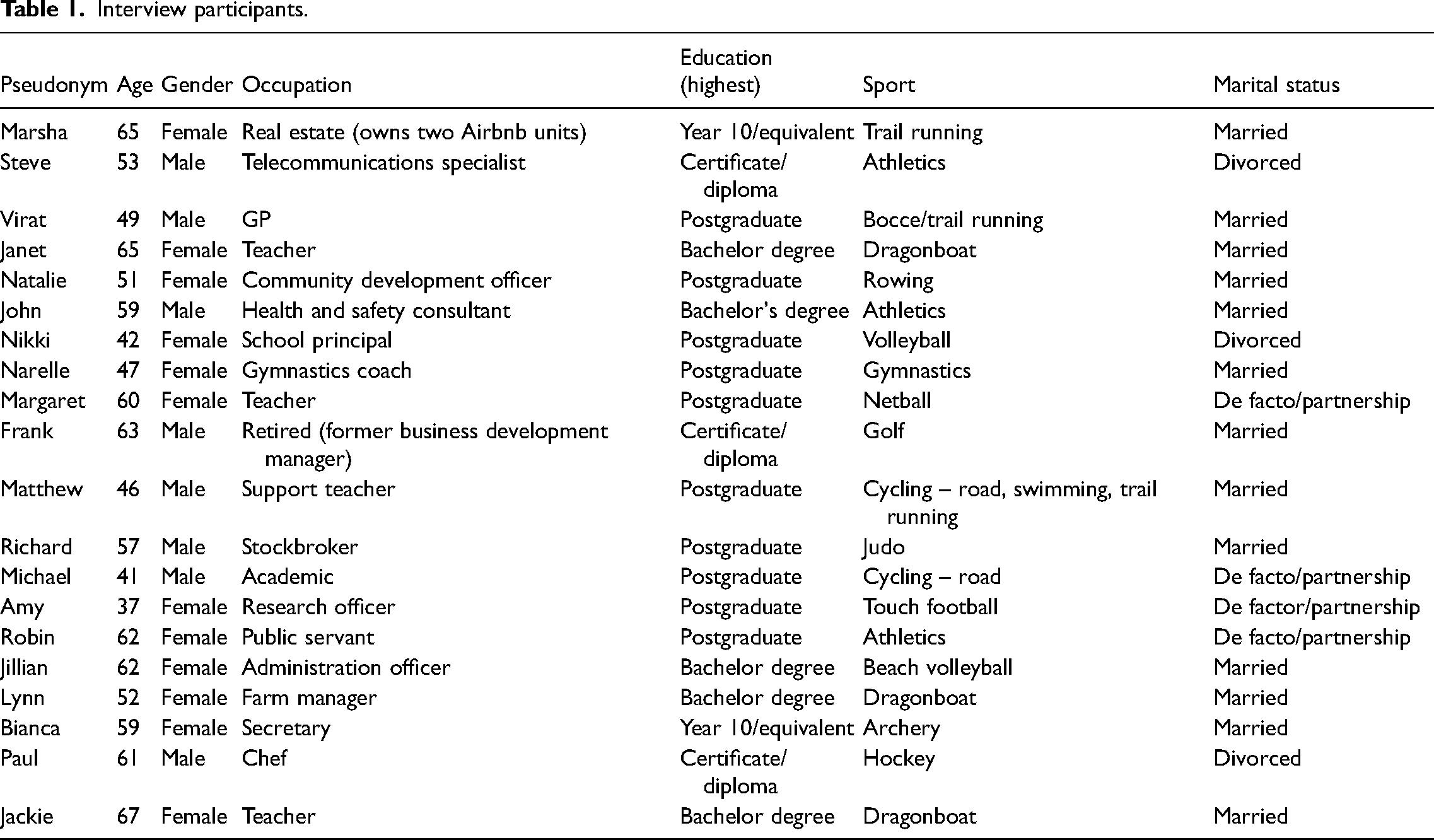
In-depth interviews were digitally recorded and transcribed verbatim. Thematic analysis was conducted to develop themes and patterns related to becoming and being a Masters athlete. Following Braun and Clarke's (2006) six steps to conduct thematic analysis, we (a) read and re-read the transcripts, (b) generated initial codes through analysis within and across cases, (c) developed codes into themes, (d) revised themes in relation to codes, quotes and the whole dataset, (e) refined the themes, and (f) reported results using exemplar cases and quotations. The first and second authors coded and developed the themes and then shared with the research team for further discussion, review and finalisation. Coding was not linear, and all themes developed were continually re-worked and refined throughout the fieldwork component of the study (Minichiello et al., 1995). Codes formed both deductively, based on existing empirical and theoretical literature, and inductively as they emerged from the data (Willis, 2010). This approach enabled us to develop an understanding by identifying patterns and themes within the data itself while paying attention to theoretical insights about sport, ageing and identity (Liamputtong and Ezzy, 2005). To ensure anonymity, pseudonyms are used throughout.
Findings and discussion
‘Switchers’ and ‘downsizers’ and the impacts of class and gender on Masters sporting pathways and experiences
Most participants reported long and positive family histories of involvement in sport and physical activity. Participants described how sport had been core to their family background since childhood and was an established element of their personal identity (Palmer, 2015; Dionigi et al., 2013: 310). While the northwest coast region of Tasmania is marked by high levels of social inequality, the local (and interstate) participants largely came from middle-class backgrounds. Consistent with Dionigi and colleagues’ (e.g. Dionigi, 2015; Dionigi and Litchfield, 2018) research that shows Masters athletes are a privileged social group, most of the interviewees were from middle-class backgrounds, possessing post-compulsory educational qualifications and employed in professional occupations. While participants commonly framed their ongoing involvement in sport due to essentialising notions such as sport being ‘in the genes’ or possessing a ‘sporty nature’, it is difficult to deny the class privileges that underpin their intergenerational family engagement with sport (Hayoz et al., 2019; Palmer, 2015). Despite Masters sporting events such as the AMG being framed by governments, policy-makers and community advocates as vehicles to increase physical activity for older populations, these findings support claims that Masters events are economically and socially exclusive (Dionigi and Litchfield, 2018) and most participants are already physically active.
Diongi's (2015) pathways to becoming a Masters athlete, ‘continuers’, ‘rekindlers’ and ‘latebloomers’, were all evident in the participants’ narratives but also two new trajectories we call ‘switchers’ and ‘downsizers’. These sporting trajectories were distinctly gendered. Most of the male participants could be classified as ‘continuers’ or ‘switchers’. The ‘switcher’ addresses a gap in Diongi's (2015) model, which tends to overlook how people move between different sports over the life course (Bowness, 2020) and how these pathways are explicitly gendered. Matthew, a 46-year-old man, who competed in the cycling, swimming and trail running, illustrates the ‘switcher’ trajectory: I’ve always loved sport. It was mainly rugby league and rugby union in New South Wales. And then I played cricket as well and tennis. So, I tried quite a few things growing up. But when I got married, I had a family and kind of put an end to rugby days, and so that's when I got really passionate about distance running. So, I ran a lot of marathons and things like that.
The prevalence of the ‘rekindler’ and ‘downsizer’ pathways among Masters women and the ‘continuer’ and ‘switcher’ pathways among Masters men captures the leisure ‘burden’ women often experience across the life course due to caring demands and responsibilities (Yerkes et al., 2020). While larger-scale research is required, these findings challenge theories of ‘de-gendering’ in sport for older athletes, with gender inequity impacting sports participation across the life course. These gendered pathways reinforce wider sociological research showing women are less likely to enjoy quality leisure, less likely to feel entitled to leisure and free time and often facilitate men's leisure at costs to their own (Dilley and Scraton, 2010; Lamont et al., 2019).
Further, nearly all the women in the group captured the limiting effects of age and gender norms on their sporting experience. Unlike the men, several of the women framed their involvement in competitive sport as an anti-ageing project: ‘everything starts to drop as you get older’ (Denise); ‘I don’t want to feel like I’m getting older’ (Amy). Other female participants captured the ‘double standard of ageing’ (Hartman-Tews, 2015), policing their bodily expression based on gendered and age-based aesthetic norms. Narelle, for example, said, ‘I’ve often joked that “I feel like a grandma in a mini skirt”’, doing gymnastics. Though reporting that most competitors wore one, she said, ‘I’m way too old for leotard’. Narelle's discomfort wearing a leotard illustrates how age and gendered expectation based on ideals of youthful beauty shape what is seen as appropriate bodily display for older sporting women (Dumas et al., 2005; Energici et al., 2021; Litchfield and Dionigi, 2012). None of the men reported challenges associated with wearing sporting outfits due to age or gender constraints. Other women in the sample were critical of this ‘double standard of ageing’ (Hartman-Tews, 2015). Robin, for instance, felt that while endurance events like running and cycling events have become normalised for older women, an older woman doing an explosive sport like sprinting was still seen as defying age and gender bodily norms. While the women's stories illustrate the constraining effects of age and gender, many of the women – like the men – experienced the Games as an overwhelming positive experience that was individually rewarding, enhanced wellbeing and generated a strong sense of sense of community connection and place-pride.
Family, community and place
Nearly all participants spoke enthusiastically about the social connectedness and sense of community the Games generated. First, the AMG was seen as a unique opportunity to strengthen family bonds, whether it was watching a family member play competitively for the first time or parents reliving memories of watching their child play competitive sport (Dionigi et al., 2012). Second, participants expressed the pleasures of ‘socialising’, ‘mateship’, ‘getting to be with the girls’ and ‘making new friends’. These findings resonate with research that underlines the value of Masters sport in promoting family, friendships and community (Dionigi, Horton and Baker, 2013; Lyons and Dionigi, 2007; Geard et al., 2017; Pike, 2011; Son and Dionigi, 2020; Wheaton, 2019). Further, the Games was understood as supporting ongoing friendships and relationships not just episodic connections (Bauman, 2005). Steve, for example, a 53-year-old runner, said: ‘I have long-term friends in every state of Australia thanks to running’. The emphasis on the Games generating enduring forms of community challenges theoretical ideas that contemporary leisure communities are short-term or fleeting (Lyons and Dionigi, 2007; Bauman, 2005).
Themes of belonging and community were also distinctly ‘spatialised’. For this sample of mostly local and Tasmanian participants, the AMG involved a reimagining of place that loosened place-based stigma (Butler-Warke, 2020). Virat exemplifies how the Games generated novel understandings of Tasmania and the northwest coast region: The thing for me with the Masters Games is that it highlighted what we have to offer in Tasmania…to change that perception that Tasmania doesn’t have a healthy lifestyle – we’re always regarded as the second cousins, I think. We’re always a joke…And I think this is where the Australian Games, for me, has promoted what we’ve got to offer here. And I think that's been great for the northwest coast, and Tasmania generally (Virat, 49, bocce and trail running).
The consumption of place as part of sport tourism was another key thread of AMG place-making. For a handful of interstate competitors, Tasmania constituted a unique sports tourism destination. Participants shared their excitement in experiencing and photographing the unique natural landscapes of Tasmania – ‘the sunsets, darkness, the ocean and the landmark locations’ (Lindley). As Emily said, ‘when we see the next Masters event…we look at the location, and we’re like “oh, yeah, that’ll be really fun to go there”. We actually create a bit of a trip around it now’. The emphasis on place, consumption and fun aligns with Dionigi and Litchfield's (2018) framing of Masters sports events as a ‘mid-life’ consumer market, attracting young-old middle-class groups mostly in their 40s and 50s who have the mobility capital (e.g. financial resources and bodily capacity) to travel for leisure and consumption. The final two themes shift focus to the embodied and sensory dimensions of training and competing and how this is linked to the moral formation of ‘heroic’ ageing identities.
Masters sport as intense embodiment: The bodily lows and highs of injury and competition
Cutting through participant accounts is the embodied pleasures, pains and fears of training and competing. From accounts of ‘working hard’ and ‘testing your body’ to ‘aching bodies’ and ‘managing injuries’, ‘intense embodiment’ experiences were constitutive of being a Masters athlete (Allen-Collinson and Leledaki, 2015). Margaret said: ‘When you’re competing your endorphins are going so you know that you’re going to feel good’. Similarly, Amy commented that ‘as much as we complain about aching bodies, I think we really like it, because we know we’ve worked’, and Steve shared: ‘I’m a runner and all I do is run but it hurts. That pain barrier isn’t comfortable, ok? But I do it because of the rewards’. These findings show how enduring physical (and psychological) discomfort is valorised by this group of Masters athletes and is key to achieving the bodily high and corporeal aliveness that characterise ‘intense embodiment’ (Atkinson, 2008; Allen-Collinson and Leledaki, 2015). While Dionigi and O’Flynn's (2007) earlier research on the AMG highlighted how ideals of performance and competition can contradict age and gender norms for older groups, many participants emphasised the sensory pleasures and thrill of competition. There were no clear gender differences with most men and women emphasising the embodied pleasures of pushing themselves physically, hunting that elusive ‘PB’ and enjoying the thrill of competing (and sometimes winning). These findings resonate with Dionigi et al.'s (2011) and Dionigi et al.'s (2013) research on the World Masters Games in Sydney which found pushing the body to its limits was seen as key benefits of competition and was related to cultural values of competition and youthfulness in Western society.
Expressing technical and bodily mastery was also experienced as a key source of positive intense embodiment (Allen-Collinson and Leledaki 2015). Narelle, who we met earlier, is an exemplary story here. Narelle intimately describes the corporeal pleasure of her body executing complex moves on the balance bars, capturing how she can ‘close my eyes and feel the skills’ and that despite lacking the power of her young body, the ‘body knows what it's doing’. Narelle's story evokes the ‘tactile-kinaesthetic felt and feeling body’ (Sheets-Johnstone, 2017 cited in Allen-Collinson and Jackman, 2022) and its role in generating a ‘heightened awareness of corporeal existence’, providing pleasure and countering feelings of bodily decline. For some participants, like Robin, their very understanding of their sporting body – in this instance, as a ‘fast-twitcher’ – shaped core understandings of their identity: ‘I’m a fast twitcher. It releases endorphins very quickly. I’m very impatient. It's everything to me’.
While participants’ experiences of pain and fatigue were often normalised as part of the pleasures of ‘intense embodiment’, injured and pained bodies lurked as ubiquitous threats to identity and participation (Allen-Collinson, 2017). Detailed accounts of injuries – torn calves, strained hamstrings, surgeries, and injury comebacks – featured prominently in participants’ narratives. As Amy said: ‘You see a lot of tape, you see a lot of ankles and knees. That was my last touch game for a while, because I have to have surgery when I get home’. There was acceptance that injuries were part of sport but also a recognition that injury risk increased with age as bodily structures like tendons and muscles weaken. For some, this created an intensifying fear of injury and a close monitoring of bodily sensations that negatively impacted sporting enjoyment: ‘I’m not getting any younger…I get overly anxious about tearing my calves, which I’ve done multiple times’ (Steve). Allen-Collinson (2017) suggests that the liminality of sports ‘injury time’ severely disrupts the self-body relation and requires significant ‘identity work’. This disruption of self was expressed in participant comments that when injured they ‘felt lost’, ‘go spare’ and are ‘awful to be around’. Whilst fatigue, niggles and pain are a normalised if not valorised feature of Masters’ physical–cultural worlds, serious injury hovered as an existential threat to their identities as committed athletes. The following section addresses how embodied experiences of being a Masters athlete disrupted ideas of ageing as physical decline but were also linked to the production of moral identities that stigmatise the inactive old.
Heroic ageing and the moral failure of the inactive old
Participants described how the Games challenged dominant ideas of ageing as decline. For competitive runners like Steve, getting older was embraced, commenting that male runners, ‘we all get excited when we get the next age as we become fast’. Here, age-gradings enabled older athletes – particularly men – to rearticulate bodily agency and competence through performance and competition (Tulle, 2007; Wheaton, 2019). Further, participants believed the Games contested cultural scripts that sport ‘wasn’t for older people’ (Matthew) or that getting older ‘means you slow down’ (Suren). In Elizabeth's words, the Games demonstrated ‘what an ageing population is able to do’. For some, the Games even challenged their own ageist assumptions, awed, for example, by the 80- and 90-year-olds competing in track and field events. This ‘inspiring’ narrative, however, was contrasted with concerns about excessive AMG media coverage focused on the ‘old-old’. Respondents variously commented that: ‘I get sick of the media talking about and photographing just the older women’ or ‘It's [the media coverage] like “look at this 94-year old”’ and “the focus on the media is on one of the 90-year olds running”. Whilst some interpreted this coverage as ‘inspiring’ or ‘breaking down stereotypes’, others saw it as spectacularising or fetishing ageing, reinforcing messages that competitive sport is not something ‘normally’ performed by older people.
Participants tended to frame their own ageing as ‘heroic’ (Pike, 2011) establishing a moral boundary between their own ‘good’ ageing and other older people's ‘bad’ ageing. Strong moral judgements were directed at older people who do not exercise or play sport – those older people ‘just sitting on their backsides bemoaning they’re getting older’ (Jackie) or ‘who can’t do things like kick a football with their grandkids’ (Richard). Their moral talk was also place-based with multiple participants highlighting the need for increased levels of physical activity in Tasmania and the northwest coast region: ‘you see a lot of people who are not old at all, and they’re just sitting on their arse, particularly in Tasmania…we’re disproportionately endowed with fatties down here’ (Richard). ‘Fatness’ and the ‘couch’ were regularly used as moral markers of ‘bad’ ageing. Being overweight or spending too much time ‘on the couch’ were indices of failure in meeting neoliberal and active ageing mandates of self-discipline and personal responsibility (Gard et al., 2017). Inactive older people – or even less intensely active people – are deemed ‘lazy’ while cultural activities once normalised for older people such as ‘playing bingo’ or ‘watching TV’ are positioned as the opposite of living a worthwhile life (Gard et al., 2017). Janet's comments are indicative: I spoke to a lady who was thinking of giving it [the Masters Games] up. I asked her what her friends did, and she said they played bingo and watched daytime TV. Give me a break! I said: ‘is that really what you want to do?’ She said ‘oh, God no.’ Her vitality was amazing. Because she’d taken control of her health and wellbeing in a way that her friends probably haven’t.
The moral judgement of the ‘failed ageing’ of inactive older people is galvanised by the embodied sensory worlds this group occupy. The neoliberal emphasis on choice and personal responsibility is extended by a set of embodied values generated over a lifetime of playing competitive sport. Allen-Collinson and Jackman (2022: 646) suggest that bodies generate ‘physical–cultural values’ within specific physical–cultural contexts, for example, the cross-country runner who develops values such as the willingness to endure and suffer physical hardship or embrace the elements. The life-worlds of Masters athletes require a priority to be placed on corporeal values of embracing pain, discomfort and suffering. The Masters body is subject to intense regimes of self-discipline, hard work and pushing the body, which are valorised and celebrated. This ‘incarnation of cultural values’ (Shilling, 2022) means that bodily values such as ‘pushing to the limit’, ‘ignoring pain’ and ‘getting the work done’ shape the evaluative judgements of others and the formation of moral selfhood. Through the normative prism of training, competing and extending the body, Masters athletes may become deaf to arguments that highlight structural barriers to sport and physical activity, as they deny these ‘intensely embodied’ values (Allen-Collinson and Jackman, 2022). In this way, the very bodily and fitness cultures that constitute Masters athletes are key to analysing the construction of ageing identities that pivot on claims about ‘good’ and ‘bad’ ageing.
Conclusion
This paper has examined the pathways, embodied experiences and moral identity formation of late middle-aged or ‘young-old’ athletes competing in the 16th AMG. The paper makes three key theoretical contributions. First, it contributes to a critical body of sociological scholarship that shows how structures such as class, gender and place shape Masters pathways and experiences. These findings challenge late-modern accounts which downplay social structures in theorising postmodern ‘fitness’ and ‘new ageing’ (Bauman, 2005; Higgs and Gilleard, 2015). Second, whilst class – and to a less extent gender – has been shown to influence Masters sports participation in the existing literature, this study was unique in developing a spatial perspective that captured how the AMG generated an ‘imaginative opening up of space’ (Massey, 2005: 120) that positively expressed regional identity and challenged place-based stigma (Butler-Warke, 2020). Place-making also had class dimensions with local stigma linked to middle-class ‘shame’ about the region and affluent interstate competitors ‘consuming’ place as sports tourists. Third, the paper argues for the need to attend to the sensory and embodied dimensions of Masters sports lived experience. Drawing upon the concept of ‘intense embodiment’ (Allen-Collinson and Owton, 2015), we argue that the sensory and bodily aspects of Masters sport are not only key to foregrounding the physical pleasures and pains of training and competing – the ‘aching bodies’, the ‘endorphin rush’, and the self-bodily threat of injury – but also the formation of ageing moral identities. We suggest intense embodiment provides a novel way to link physical activity as a ‘new virtuous’ norm (Higgs and Gilleard, 2015) for older people with theoretical approaches that extend embodiment from bodily ‘know-how’ to the ‘incarnation of cultural values’ (Shilling, 2022; Allen-Collinson and Jackman, 2022).
Empirically, the findings add the ‘switcher’ and the ‘downsizer’ to Dionigi's (2015) existing pathways (‘continuer’, ‘rekindler’, and ‘latebloomer’) and underline their classed and gendered nature. Most athletes were from middle-class backgrounds confirming arguments that events like the AMG tend to be the preserve of the privileged (Dionigi, 2015; Dionigi and Litchfield, 2018). Gender inequality shaped participants’ sporting trajectories: men were more likely to report uninterrupted pathways (i.e. ‘continuer’ or ‘switcher’) while women tended to be ‘rekindlers’ or ‘downsizers’. These findings echo wider research that shows that women face a leisure burden where they are less likely to enjoy quality leisure and often facilitate men's leisure at costs to their own (Dilley and Scraton, 2010; Lamont et al., 2019; Dionigi et al., 2012). Women's stories also reflected the ‘double standard of ageing’ (Sontag, 1972 cited in Hartman-Tews, 2015) being more likely to frame their involvement as either an anti-ageing project or impacted by restrictive aesthetic-based gender norms (Energici et al., 2021).
The interviews spotlight social and family connection as a key outcome of the Games that are enduring in quality rather than ephemeral or ‘liquid’ (Son and Dionigi, 2020; Pike, 2011; Geard et al., 2017; Wheaton, 2019; Bauman, 2005). Themes of belonging and community dovetail with the Games as a site for place-making. Place emerged as a space to be consumed by middle-class Masters sports tourists or a way of expressing regional identity that challenged place-based stigma for local participants that articulated with changing place discourses about Tasmania's desirability as a tourist and green-change destination (Booth et al., 2021). The participants’ stories also pinpoint the corporeal and sensuous dimensions of training and competing. From ‘testing your body’, ‘dealing with pain’ and ‘managing injuries’, experiences of intense embodiment (Allen-Collinson and Jackman, 2022) were crucial to understanding the lived experience of the Masters Games. Alongside accounts of bodily competence and acumen that challenge ageing as decline, injuries featured prominently as disruptive threats to athletic identity and underlined fears of the failing ageing body (Allen-Collinson, 2017).
Experiences of intense embodiment (Allen-Collinson and Jackman, 2022) also underpinned expressions of ‘heroic ageing’. Strong ethical judgments were directed at ‘other’ older people who are not physically active using moral categories of ‘fatness’ and the ‘couch’ to condemn those deemed ‘lazy’, ‘irresponsible’ or a ‘burden’. Non-athletic populations were devalued as ‘wasting their life’, and non-active or more passive forms of ageing were understood with moral contempt. Most participants failed to identify how their own economic and social privileges shaped their capacity to participate or simply that some people do not want to play sport. This finding aligns with Gard et al. (2017) and Son and Dionigi (2020: 119) who argue that the increasing normalisation of sport for older athletes can demonise older people who are not active and establish a class divide between ‘those who have the means, ability and desire to play sport and those who do not’. We extend this argument suggesting that physical–cultural values (Allen-Collinson and Jackman, 2022) such as ‘ignoring pain’ or ‘pushing the body’ learnt over a lifetime of playing competitive sport infuse and extend harsh neoliberal moral evaluations of physically inactive older people. Whilst there is no doubting that the Masters Games produced significant social and physical benefits for participants, it is misguided for policy-makers and governments to worship Masters athletes as ‘exemplary’ of how older people should age (Gard et al., 2017). To do so risks ignoring their social privilege, individualising illness as personal responsibility or failure to exercise, and overlooks the value of alternative and diverse ways of ageing (Son and Dionigi (2020: 119; Gard et al., 2017).
Footnotes
Declaration of Conflicting Interests
The author(s) declared no potential conflicts of interest with respect to the research, authorship, and/or publication of this article.
Funding
The author(s) received no financial support for the research, authorship, and/or publication of this article.
