



Abstract
Drawing on Fairclough's critical discourse analysis, this study sheds light on sports nationalism and traces changes in the media's discursive construction of the Korean national football team over time by analyzing news articles from three different World Cups. Korean sports nationalism has evolved in complex ways and has been influenced by a combination of factors, including the colonial experience, initiatives by the former military government, the hosting of mega-sporting events, local professional leagues, and the globalization of athletes on the world stage. Given the multifaceted nature of Korean sports nationalism, this study aims to examine how it has changed in response to social transformations, particularly the impact of neoliberal globalization. The findings reveal that sports nationalism is often manifested in the terms of “fighting spirit” or “sacrifice” as a core national trait. However, it increasingly incorporates and embraces a new neoliberal meritocratic culture and subjectivity that foregrounds individual success on the world stage as a new form of nationalism in an era of accelerating globalized and commodified sports elitism.
The relationship between nationalism and sports has been closely intertwined over time. Sports represent a significant contemporary domain where nationalism is embedded through lived experience, showcasing national identity and fostering a sense of belonging. This interconnectedness has been further enhanced by the development of media technologies (Rowe, 2004). The increasing mediatization of sports has facilitated their commercialization and the proliferation of mega-sporting events. As a result, transnational industries have emerged in the global sports system (Maguire, 1999: 128). In addition, the pervasive impact of neoliberalism has led to significant changes in sports. The globalization of sports has resulted in the labor migration of athletes and market principles being subjected to the rationalities of neoliberalism, turning sporting events into profitable business ventures. Corporate sponsors and media conglomerates invest heavily in sporting mega-events that can transform national identity into a marketable commodity (Silk, 2014). The sense of nationhood has undergone changes in parallel with the rise of neoliberal globalization, which has demonstrated its influence in the realm of sports and consequently changed the subjectivity of the public (Andrews and Silk, 2018).
With this in mind, examining the news discourse produced during mega-media sports events provides insight into how people embody or challenge their sense of nation-ness (Lee and Cho, 2009: 100). South Korea (hereafter Korea) has traversed a complicated historical trajectory marked by colonial occupation by Japanese imperialists, war and ideological rivalry with North Korea, military autocracy, and the implementation of neoliberal sports and cultural policies that have been associated with sports in various ways. Given that the Korean national team has qualified for the World Cup 10 consecutive times from 1986 to 2022, this study postulates that news about the Korean national team over time is a good repository for analyzing the discursive change surrounding sports nationalism. Methodologically, this study applies Fairclough's critical discourse analysis (CDA), which views discourse as socially constitutive and socially conditioned (Chouliaraki and Fairclough, 1999: 4), to examine how discourse on sports nationalism has evolved in relation to social conditions.
Sports, media, and nationalism in neoliberal globalization
In contemporary culture, sports nationalism has gained scholarly attention as nation-ness is increasingly performed through cultural practice (Lee and Cho, 2009). From this perspective, nations are habitually imagined, produced, and sustained rather than a top–down hegemonic ideology. National identity is a social construct that is remembered and practiced in everyday life through a banal form, such as displaying national flags, singing the national anthem, and performing symbolic functions (Billig, 1995: 39). Under these circumstances, media and sports have become increasingly interconnected, with sports providing a site for the expression of banal nationalism and the media serving as a vehicle for the creation of a collective consciousness that functions as a “ritual” (Carey, 2009; Couldry, 2008). Along these lines, many scholars have drawn attention to the link between sports and nationalism. Rowe et al. (1998: 133) shed light on the significance of the “sport–nationalism–media troika” as a crucial realm for constructing and contesting dominant cultural identities.
In addition, Bairner (2001) contends that mega-sporting events have the potential to evoke intense nationalist sentiments, with the media playing a pivotal role in amplifying the relationship between sports and nationalism through their mediatization. In this context, mass sports as a global spectacle have served to fuse social traditions with politics by introducing new expressions of nationalism through the invention of national sports (Hobsbawm and Ranger, 1983: 300). Such phenomena were evident in state propaganda through sports and in global mega-sporting events, such as the 1936 Nazi Olympics, as well as in sporting events during the Cold War, where sports were seen as a symbolic war in which national pride was enhanced through talented athletes. Against this backdrop, state-run elite sports programs were created to train and support top athletes and elevate their victories to national triumphs and sources of pride (Beamish and Ritchie, 2006).
Furthermore, as the relationship between sports and the media has developed, many scholars have pointed to the neoliberal impact in the contemporary sports domain. For example, Miller (2012) suggests that sport is the most spectacular form of neoliberalism. Coakley (2011) argues that sports internalize the value of competition and the logic of reward into the public's beliefs. This connection has been accelerated by the wave of neoliberal globalization that commercializes and commodifies sports. The globalization of sports facilitates the labor migration of athletes and sports mega-events that increasingly serve as the driving force behind corporate sports, exerting a cultural, economic, and even political influence that extends to all components within the complex structure of corporate sports. John and McDonald (2019) illustrate how elite sports in Australia promote a neoliberal culture through government intervention. Gazeres (2022) articulates an alternative sports ecology that challenges neoliberal principles by emphasizing a counter-neoliberal approach that rejects individual competition. In this context, it can be argued that sports play a significant role in contemporary popular culture as a platform through which neoliberal ideals are embraced and accepted by the public (Andrews and Silk, 2018).
The evolving nature of Korean sports nationalism
In terms of national identity, Hobsbawm (1990) proposes that Korea can be classified as an idiosyncratic case because it consists of an almost entirely homogeneous ethnic population with a single language and a coherent linear history. From this perspective, Korean national identity inherently contains strong primordial and perennial aspects of nationalism focused on one ethnicity and blood ties. However, scholars such as Em (1999) have challenged the prevailing primordial approaches by claiming that the Korean “nation” (Minjok) emerged during the colonial period, together with the construction of images about the nation. During the Japanese occupation (1910–1945), sports became a way for Koreans to assert their national identity and symbolically challenge the Japanese imperialists. In particular, football matches against Japan were of great importance as they allowed Koreans to express their national pride and achieve extraordinary feats (Tosa, 2015).
Even after gaining independence, historical upheavals such as the Korean War further solidified Korean identity (Lee et al., 2014). Subsequently, dictatorships leveraged sports nationalism as an ideological tool to legitimize their rule. Rhee Seung-man, the first president of South Korea (1948–1960), used ethnic nationalism and popular sentiment to consolidate his power by emphasizing territorial divisions against North Korea. Park Chung-hee, his successor until 1979, further emphasized nationalism as a core rhetoric to justify his rule and economic development initiatives. During this process, the military regime focused on elite sports that showcased national pride and strengthened sports through three major national policies: the establishment of a national training center, the provision of exemptions and benefits for athletes in the national military service, and the creation of the National Youth Sports Association (Park and Oak, 2022).
The subsequent Chun Doo-hwan regime, which came to power through a military coup, faced legitimacy challenges as democratic aspirations grew. In order to divert attention and suppress resistance, the regime adopted previous sports policies as part of its “3S strategy”—screen, sex, and sport. This strategy aimed to distract citizens, fuel anti-communist sentiments, emphasize security concerns, and promote hostility toward communism (Campbell, 2016). Thus, sports in Korea became deeply entwined with politics through the use of nationalism and served as a tool to legitimize the regime. In this sense, North Korea also strategically used international sports as a stage to showcase “the glory of its dignified system” against South Korea, bolstering sports nationalism in both nations (Merkel, 2014). Under these ideological circumstances, the rivalry between the two Koreas required the presence of exceptionally talented athletes, and under these conditions, elite sports were born.
In terms of the nature of sports nationalism, however, many scholars argue that a significant change has taken place since the 2002 World Cup, a defining moment that ushered in a novel manifestation of performative “banal nationalism” (Lee and Cho, 2009). During this tournament, the everyday use of national flags and nationalist slogans in everyday contexts created a renewed sense of belonging. Cho Han (2004: 11) highlights this emerging nationalism, noting that expressions of victory differed from the earlier narrow, clan-based expressions of nationalist sentiment.
Moreover, scholars have observed changes in the nature of nationalism toward individualized nationalism that emphasizes responsible individuals and legitimate global competition. Cho (2020) identifies two key factors that have led to the dismantling of dominant nationalist narratives. First, during the IMF period, there was a stark contrast between the government's idealized image of the country and the harsh reality people experienced; this fostered a sense of cynicism toward state-led nationalist sentiments. Second, there was a notable disconnect between traditional expressions of nationalism and the globalized nature of professional sports as a commercial commodity. For example, Kim (2018) explores the evolving nature of sports nationalism by analyzing the media representation of another prominent Korean athlete, Ahn Hyun-soo, who won multiple gold medals in short-track skating. After a dispute with the Korean Skating Union, Ahn became a naturalized Russian citizen and a coach of the Russian national team, which competed against the Korean national team. J. Kim asserts that Ahn was depicted as a new kind of cosmopolitan sports celebrity who embodied, to some extent, a rhetoric of meritocracy, despite facing criticism within an earlier nationalist framework. In this context, it can be argued that Korean sports, known for their elitist nature, share similarities with the neoliberal meritocratic sports culture that emphasizes high-performance athletes and their association with monetary value.
Methods
Fairclough's CDA is a useful methodological tool for analyzing sports, as it provides appropriate operational tools for identifying the taken-for-granted discourses at the individual and institutional levels (McGannon, 2016). Because the sports domain is a site of expression for performative banal nationalism (Lee and Cho, 2009), scholars have applied CDA to the analysis of sports discourse. For instance, Vidacs (2011) analyzes the use of sports language in a radio program and argues that it constitutes everyday nationalism. Similarly, one of the main focuses of Michael Billig's (1995) notion of banal nationalism is deixis, which refers to the use of language that assumes the listener's understanding of the circumstances surrounding a spoken statement.
Based on such previous analyses, this study uses CDA to examine how the nationalist discourse on sports has changed by analyzing news articles about the Korean national football team from three different periods (the 1998, 2006, and 2022 World Cups). The rationale for this approach is based on Van Dijk's argument that “news discourse is viewed as the manifestation of a complex process in which knowledge, beliefs, and opinions are matched with existing or incoming information about events, the social contexts of news production, and representations of the reading public” (1983: 28), which lays the foundation for the production and daily expression of an ideology (Van Dijk, 2006).
In order to trace the discursive changes in sports nationalism, this study divided the period into three phases based on previous literature, considering the differences and similarities of the three relevant tournaments among the 10 consecutive World Cups from 1986 to 2022 for which the Korean team qualified. The first criterion to be considered was the 2002 World Cup, as it was claimed to be a turning point for a new, emerging form of banal nationalism through football, in which the Korean national team not only reached the quarterfinals but also provided a novel collective experience for millions of people to cheer in the streets (Lee and Cho, 2009). For this reason, 1998 and 2006 were selected first before and after the 2002 World Cup. The next point of reference considered was the impact of the globalization of Korean athletes on sports nationalism, particularly Park Ji-sung, who played for Manchester United from 2005 to 2012, and Son Heung-min, who has played for Tottenham Hotspur from 2015 to the present. An important consideration in this context was the impact of social media culture, which has allowed athletes to communicate more closely with fans. Son Heung-min opened his Instagram account in November 2015 and gained 5 million followers by August 2021 (Park, 2021). Just before the 2022 Qatar World Cup, he became the first Asian player to win the English Premier League (EPL) Golden Boot by scoring the most goals in 2022. Given the peak of his popularity and the changing media environment, 2022 was selected for this study. Finally, another similarity was taken into account. There were three cases in which key players were injured during the World Cup: Lee Im-Saeng (1998), Park Ji-sung (2006), and Son Heung-min (2022). In this study, it was assumed that a nationalist sentiment was embedded in the portrayal of each player's mentality. In this filtering process, news articles that met all the criteria were selected: those that related to the 1998, 2006, and 2022 FIFA World Cups. Three media outlets were then chosen, including a national public broadcaster KBS and two major newspapers, Chosun Ilbo (right wing) and Kyunghyang Shinmun (left wing), to account for the possibility that a particular political orientation or type of media constructs sports nationalism.
In addition, in this study, keywords such as “World Cup,” “fighting spirit,” “injury,” and “Taegeuk Warriors” (“Taegeuk” refers to the symbolic circle of the Korean flag) were used, as well as names such as “Son Heung-min” and “Park Ji-sung.” The study period was 5 days before and after each World Cup. The data were obtained from the news archive “BIG KINDS,” operated by the Korea Press Foundation, which comprehensively archives Korean news articles from 1990 onward. However, since the database did not provide three datasets (the 1998 and 2006 Chosun Ilbo and the 1998 KBS news), data were collected from the official homepage of each media outlet. Ultimately, this study was based on a review of a total of 886 news articles. Three different analytical filters (textual, discourse practice, and sociocultural analysis) were also applied based on Fairclough's CDA (1995: 97). At the level of textual analysis, lexical choices such as keywords, phrases, sentences, and over-lexicalization were identified. Discourse practices such as genres, styles, and interdiscursivity were analyzed to examine how a text is produced or interpreted that mediate between the texts and the discursive processes. Lastly, this research links such elements to broader social contexts based on Fairclough's perspective that texts never exist in isolation but are embedded in sociocultural practice at multiple levels.
Findings
Text analysis
The 1998 World Cup
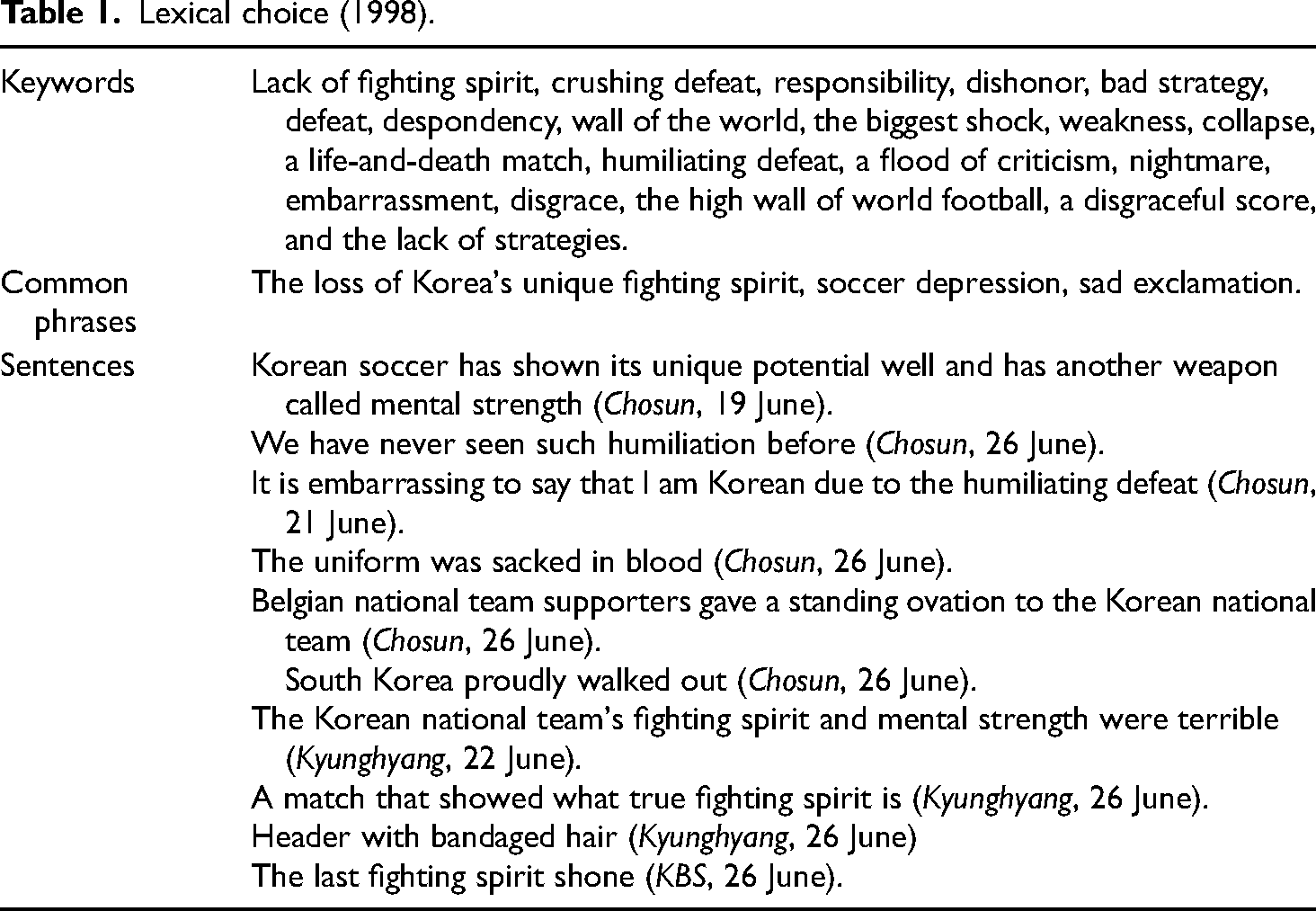
The 1998 World Cup demonstrated two distinctive features of nationalist sentiment at the textual analysis level (see Table 1). First, the underlying tone was an Orientalist sentiment in which European countries were portrayed as nations with an advanced football ecosystem that South Korea needed to catch up with. Therefore, the term “fighting spirit” kept appearing as a way to overcome the gap between “strong” European countries and “weak” Korea, even in a sacrificial way. Following this Orientalist logic, defeat is regarded as a disgrace for Korea. Second, regardless of the political orientation of the media companies under study, news articles from all three directly connected the national team's performance and the nation's reputation in the dichotomous framework of victory or defeat. The national team's defeat was described with several keywords, including “disastrous defeat,” “lack of responsibility,” “resignation,” “disgrace,” “bad decision,” and “lack of fighting spirit,” and Korea's unique temperament was highlighted with the term “fighting spirit.” The news headlines, such as “Where was the Korean fighting spirit?” or “The match was a quintessence of the fighting spirit,” indicate this tendency and emphasize this fighting spirit as the most important criterion for judging the quality of the national team's performance.
Lexical choice (1998).
The 2006 World Cup
Due to the remarkable performance of the South Korean national soccer team in the 2002 FIFA World Cup, talented players such as Park Ji-sung were recruited by European soccer leagues. In this internationalization of Korean footballers, it was observed that the vocabulary in news reports was more focused on individuals in a positive tone, while the Orientalist tone was downplayed by emphasizing that the Korean team is a role model for Asia (see Table 2). For example, Park Ji-sung was over-lexicalized as a world-class, successful sports hero. In order to position Korea as a representative of Asia, the news stories highlighted Park Ji-sung's individual success story, suggesting that his success epitomized Korean social norms and patriarchal values. Some examples were as follows: “Alex Ferguson (the former manager of Manchester United) was someone like a father” (Kyunghyang, 14 July 2006), “Park Ji-sung's case is the development model for Asia” (Chosun, 3 July 2006), and “We (Japanese) envy the Korean fighting spirit” (KBS, 14 June 2006). In this sense, his achievements were constructed as a good example of success not only on the football field but also in the context of everyday life, thereby epitomizing Korean-ness.
Lexical choice (2006).
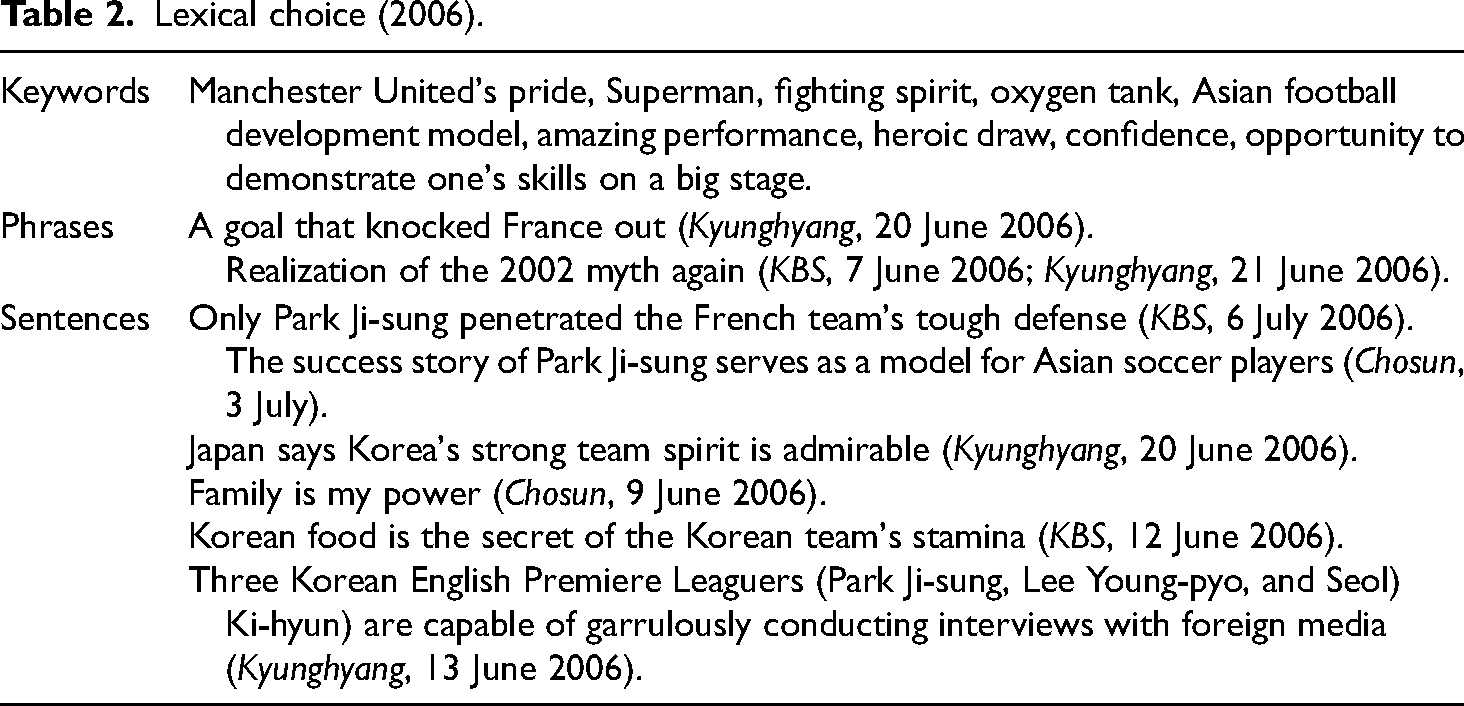
In addition, it is noteworthy that football success was linked to Korea's symbolic value to highlight Korea's excellence, which can be seen in sentences such as “Korean food is the secret of Korean player's stamina,” “Family is my power,” and the term “Taekeuk,” a Korean symbol in the center of the Korean national flag that represents Korean-ness. Similar to the 1998 World Cup, Korea's identity was constructed around the fighting spirit through a repeated emphasis on Korean mental strength, and this rhetoric was reinforced by the overuse of foreign media commentary such as “Korea's strength was due to mental strength and a great fighting spirit.”
The 2022 World Cup
This period was marked by the accelerating globalization of sports spectatorship and increased interaction between athletes and fans. Specifically, it has become commonplace to see Korean soccer players playing abroad, most notably in the case of Son Heung-min in the EPL. Another characteristic of this period is that the players interacted more closely with fans through their personal social media accounts, thus building their fandom. From this perspective, it is understandable that there was a growing tendency for media to use vocabulary describing individual superior characteristics such as “respect,” “hero,” “monsters,” and “national pride” during this time (see Table 3). Despite the presence of words like “fighting spirit” and “hope for Asia,” which echoed earlier rhetoric, another salient lexicalization was “world-class,” which points to Korea's global recognition. This claim is legitimized by some foreign quotes, such as “Brazilian footballer Neymar said Son is a legend” (Chosun, 9 December 2022) and “Uruguayan players greeted Son Heung-min with respect” (Chosun, 25 November 2022).
Lexical choice (2022).
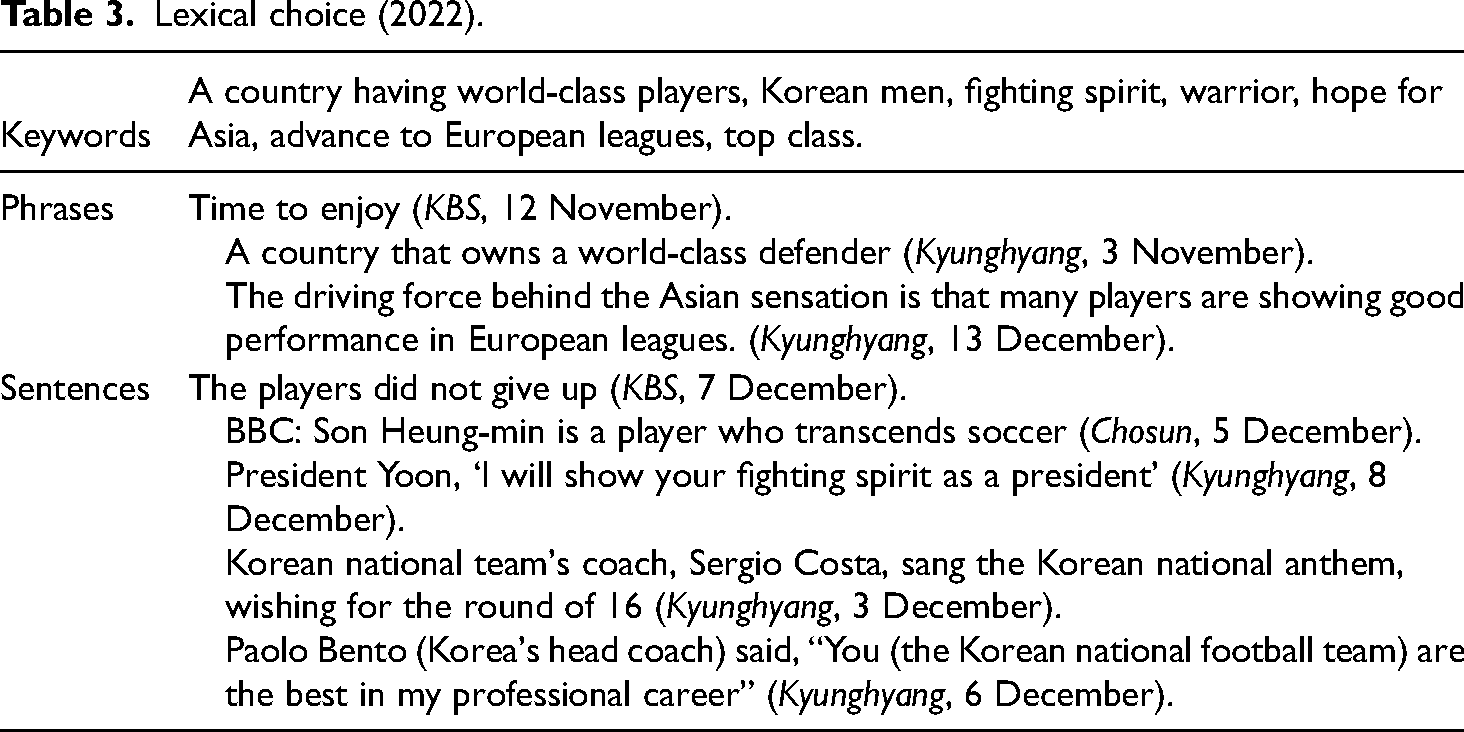
The same rhetoric can be found in the news, citing the BBC news article saying, “Son's participation in the 2022 World Cup was a very heroic and audacious decision with high risk, and this was done for his high spirit of commitment to the national team.” This pattern was repeated in the exaggerated expression of Kyunghyang's news story (23 November 2022), saying, “Son's speed of recovery is also top-class one.” In a similar vein, different from the previous Orientalist tone, a growing number of news stories also underscored the high status of the K-League, as seen in a news story titled “K-football leaguers who shine at the Qatar World Cup” (Kyunghyang, 2 December 2022).
Similarly, global recognition was of overarching importance during this period. For example, one news article featured an interview with a Moroccan footballer who said, “our impressive achievement was below South Korea's achievement in the 2002 World Cup” (Kyunghyang, 18 December 2022). In short, the news in 2022 emphasized individual Korean success narratives, to some extent bridging the binary Orientalism of Western superiority and Korean backwardness. It placed great importance on the global visibility of Korean athletes on the world stage, creating a discourse that attributed their performance to national competence and pride.
Discourse practice
The 1998 World Cup
In terms of discourse construction, interviews were common to all three World Cups. During the 1998 World Cup, interviews predominantly focused on experts and key players, emphasizing the outcomes of victory or defeat. During this time, interviews with foreign experts were often used to enhance the credibility of articles and legitimize arguments. For instance, when coach Cha Bum-geun was dismissed midway through the tournament due to the team's poor performance, one interview included the following commentary: “FIFA says Korea is a remarkably better team now. It is astonishing how the Korean national team rapidly transformed into a formidable force after swiftly replacing five of its national footballers” (Kyunghyang, 10 June 1998). Thus, it was common for all three news outlets to have an Orientalist tone, borrowing opinions and perspectives from Western sources by including foreign correspondents and experts to bolster their arguments, albeit to varying degrees.
The 2006 World Cup
Nationalist sentiments were presented through more diverse discourse practices, and a noticeable change in discourse practice was KBS's extensive coverage of Korean diaspora communities as well as diverse communities, even including prisoners, which resonated with Benedict Anderson's notion of “imagined community” (2006). This pattern emerged during the 2002 World Cup, when major broadcasters remarkably extended their news hours to provide World Cup-related information and fuel football fever. News headlines such as “Red-colored hot place Sangam Plaza” (KBS, 19 June), “Koreans in London shouted, it was a victory-like draw” (KBS, 19 June), and “Great support from prisoners” (KBS, 19 June) all showed how advances in communication technology changed the discourse practices that constructed the imagination about the nation.
Global recognition of Korea also remained important in discourse practice. One prominent pattern was the inclusion of foreigners in the Korean community. For example, some news stories reported that a Kurdish girl treated by the Korean military unit “Zaytun” in Iraq said she would cheer for Korea. News stories from all three media outlets often emphasized the importance of producing more Korean football players who could excel in major European leagues (Kyunghyang, 1 June). This common discourse was often reinforced by including the opinions and perspectives of foreign correspondents and the public. More strikingly, it was also observed that nationalist sentiments were connected to confidence in global competition by quoting foreign media comments such as “the Korean national team was the pride of Asia, and Korea's fighting spirit was the envy of other countries” (Chosun 20 June).
As communication technology and media culture developed, more diverse news formats emerged as a new discourse practice. Although long-standing traditional formats such as interviews with former FIFA vice president Chung Mong-joon and other football experts remained, there was a new tendency to conduct more interviews with individual players and have them comment on their national pride and confidence to win, which partly showed the emergence of a more individualized sports discourse. From this perspective, an important change in the nature of the interviews was that news stories began to focus more on the personal qualities and characters of individual players, such as Park Ji-sung's calm and humble personality. This new trend distanced itself from the previous strict win-or-lose dichotomy by capturing the daily life of an individual player, as can be seen in some gossip-oriented news articles such as “If you choose the best son-in-law among the Taegeuk Warriors” (Kyunghyang, 10 June).
Most importantly, another change to note is the transition to the globalization of sports. For example, the headline “Korea's World Cup addiction” (Chosun, 14 July) introduced a new narrative that Park Ji-sung, who played in the EPL, made it possible for audiences to watch an advanced football match on a daily basis. Thus, the value of the World Cup was that it provided a valuable opportunity to watch the performances of top-class footballers. This article concluded that Koreans also became supporters of the English and Portuguese national teams because Park Ji-sung's teammates, such as Wayne Rooney and Cristiano Ronaldo, played for those teams.
Meanwhile, it is also noteworthy that the Chosun Ilbo, a media outlet that has a conservative political stance, connected the football achievements of the national team to the economic discourse, as seen in a news article titled “Slow and sluggish Korean companies” (Chosun, 19 June). This news story suggested that the Korean team's speed was the key to success and metaphorically criticized the fact that South Korea's economy slowed down due to too many regulations, which would result in foreign companies becoming victorious in global competition. In this sense, it can be said that during this time, the nationalist discourse extended football to a broader social discourse, while individual players were constructed as a new subject, producing national identity and pride.
The 2022 World Cup
A notable aspect of news coverage during the 2022 World Cup was the emergence of diverse styles and a more bottom–up approach to news storytelling. This new style made it possible to more effectively capture the voices of citizens and shed light on the abilities and qualities of individual players, as well as the growing popularity of different players. With an extensive focus on famous Korean footballers, including Son Heung-min and Kim Min-jae, the news conveyed the players’ performance and their respectable temperament, dedication, and warm personalities as human beings. It can be said that the new trend of focusing on individual players in a more intimate format resonates with the emerging online football culture, where athletes maintain their own social media accounts and fans closely follow every aspect of their favorite sports celebrities, leading to a change in the relationship between the athletes and their fans. For instance, Son Heung-min opened his Instagram account in 2015 and uploaded his photos about football and his ordinary life off the pitch. As of 1 July 2023, around 12 million fans follow him. In line with this changing media environment and sports culture, media interviews have become more diverse in terms of content and interviewees. The construction of the nationalist discourse has evolved into a more individualized one, as commercialized global sports have influenced it.
Another prominent pattern of news coverage during this period is that the achievements of the national team and national pride were attributed to the performance and temperament of individual players. For example, Son Heung-min's determination to overcome the pain and challenges for the Korean national team despite a serious eye socket injury positioned him as a superhero figure, regardless of his performance. In contrast to 1998, when athletes’ injuries were taken for granted for the sake of national pride and nationalist vocabulary and clichés about a “fighting spirit” prevailed, as a result, the value of an individual athlete at this time overrode nationalist sentiments in some quarters. In the 2022 World Cup, victory remained Korea's aspiration. However, the media created a discourse suggesting that achieving victory was no longer necessary at the cost of sacrificing the famous Korean footballer in the EPL. One news article evidenced this change: “It's time not to be obsessed with winning or losing, but now it's time to enjoy” (KBS, 12 November 2022). In this context, it can be argued that sports nationalism, once a core value of Korean elite sports and deeply based on a win-or-lose dichotomy, has evolved into a more individualized meritocratic culture, implying that individual success is part of the national pride itself.
Sociocultural context
The 1998 World Cup
On a sociocultural level, South Korea in 1998 had been experiencing a continuous financial crisis since the country declared a moratorium in 1997, which often led to news narratives that metaphorically expressed that a victory in a football match would be equivalent to getting out of a depressed social condition. This study's findings also showed that elite sports, long promoted by the military regime as political propaganda, were still prominent in the socio-political sphere. The IMF had demanded severe structural adjustments from the South Korean government, and people felt powerless (Cho 2008). The news discourse about the Korean national football team reflected such a social mood. In this context, this period can be characterized by the nationalist news narrative that emotionally connected the national team at the World Cup to the recovery from a depressed social and economic condition, while patriotic sentiments were still dominant in the media portrayal of the football match.
The 2006 World Cup
Distinct dimensions can characterize this period. First, there has been a notable upsurge in fervent football enthusiasts following the 2002 World Cup, where individuals collectively experienced moments of triumph, fostering a sense of national superiority and cohesion. Second, the globalization of sports after the World Cup took place as some talented players migrated to European leagues. The exceptional performance of Park Ji-sung in the EPL has altered societal perceptions of sports, as a growing number of football fans enjoyed the commercially driven globalized European professional football. In this transitional time, the nationalist rhetoric was still significantly presented; however, at the same time, the media increasingly shed light on athletes’ individual characteristics. This tendency is omnipresent not only in football but also in other sports fields. For example, Cho (2008) analyzed the media representations of two Korean iconic sports celebrities (golfer Park Se-ri playing in the Ladies Professional Golf Association and pitcher Park Chan-ho in Major League Baseball) and concluded that they represented a new type of athlete vested with the image of a self-governing persona, economic success, and responsibility for the family and nation-state during the IMF crisis.
The 2022 World Cup
During this period, two changes occurred at the macro-sociocultural level. The first is that sports have become more globalized, with athletes moving abroad more commonly. The second was the politicization of sports, which challenged the social integration function of sports. For example, the way politicians attempted to use sports events as political photo opportunities unexpectedly faced a backlash in both politicized and a-politicized ways. In terms of apolitical criticism, an increasing number of fans hoped to keep sports from politics and enjoy them purely as entertainment. More notably, sports fans criticized politicians’ attempts to use sports celebrities for their own interests, and this tendency has become increasingly polarized by political orientation. For example, when a photograph of former left-leaning President Moon consoling defeated crying players in the locker room at the 2018 World Cup appeared in the media, President Moon was condemned by right-wing media outlets and fans who said that he ignored the sad feelings of the players and just tried to use them for political purposes (Lee, 2018).
In contrast, the first lady of the current right-wing government faced criticism from left-wing media and fans when she took a commemorative photo with Cho Gue-sung, a famous K-leaguer, during the national team's return from the 2022 Qatar World Cup (Lee, 2022). In this sense, it can be argued that sports nationalism has been increasingly politicized and fragmented. Rowe et al. (1998: 124) argue that “the media coverage of international sporting events creates a shared national cultural identity; however, it also passes through a complex prism of nation, region, race, class, and gender.” Nevertheless, this does not indicate that politics is divorced from sports. In a time when the incumbent President, Yoon Suk-yeol, suffered from low approval ratings among citizens (Park, 2022), his government followed the traditional pattern of using mega-sporting events as a political opportunity by inviting the national team to his office to promote the government image. President Yoon stated, “Football has unified Koreans as one” and “I will embody your fighting spirit as president” (Chosun, 5 December 2022). At the same time, the Presidential Office also displayed the captain's armband of Son Heung-min and spread pictures of it through social media. However, all the politically involved cases above show that the effect of this kind of publicity is no longer the same as in the past.
Discussion
The rise of global media sports is linked to the sociocultural processes of broader globalization. The contemporary nexus of media, culture, and sports has transformed the ways that sports are produced and consumed (Rowe, 2004). Sports mega-events have functioned as integrated spectacular systems for the production and distribution of sports as commodities in the wave of globalization (Gruneau and Horne, 2016). In the context of Korean sports, the 2002 Korea–Japan World Cup marked a significant transition. At a fundamental level, it can be said that the increasing interconnectedness of media and sports within a capitalist framework led to the promotion of patriotism among the public through mega-sporting events. However, this also positioned them as consumers who treated football as a commodity (Jung and Kim, 2011).
This study's findings empirically demonstrate that the nationalist discourses in media coverage of the World Cup have shifted from a nationalism based on a belief in one ethnicity with a shared culture, language, and history or a governing ideology that prioritizes nation-first thinking to a more individualized, banal form of nationalism that promotes individual achievement on the global stage as a valuable national asset and the legitimacy of global competition and individual responsibility (Cho, 2020). Such a shift is consistent with neoliberal meritocratic culture and subjectivity. Neoliberalism serves as a prevailing political framework that encompasses both state management and the internal dynamics of individuals, and its principles actively shape and encourage individuals to internalize the role of entrepreneurial actors through visceral experiences (Andrews and Silk, 2018). In this sense, neoliberalism operates at both the macro and micro levels. At the macro level, it promotes an unregulated and privatized free market and emphasizes the role of the state. At the micro level, it promotes competitive individualism and subjectivity as fundamental aspects of its ideology (2018: 523).
From this perspective, the nationalist nature of football in Korea—which was once associated with the assertion of national identity as a means of resisting Japanese imperialism or enforcing governing ideology as a tool to control the population during the military dictatorship—has been commodified through professional sports, paralleling the trajectory of neoliberal culture disseminated through the globalization of sports. The globalization of Korean football has accelerated the migration of athletes from Korea to European leagues and expanded the audience of Korean football fans for the leagues in which Korean athletes play. For example, the EPL generates more revenue from international broadcasters than domestic channels in the United Kingdom. Asia is the EPL's largest single market, expected to generate $1.4 billion USD between 2023 and 2025 (Marsh, 2022).
Moreover, at the level of national governance, this trend also aligns with Korean cultural policy and the resulting culture, which actively embraces the wave of neoliberal globalization and seeks to use culture as soft power for both diplomatic and domestic political purposes. After the 2002 World Cup, which reaffirmed confidence and marked the end of the depression caused by the East Asian financial crisis, Korea more visibly introduced a neoliberal cultural policy that viewed culture as the next engine of growth. Meanwhile, the media promoted a positive globalization discourse under the name of the “Korean Wave,” implicitly using it as a means to gain the affective support of the public (Lee, 2019). In this line, sports stars have increasingly been labeled as the “Korean wave” (“Hallyu” in Korean) stars, a phenomenon that is common to all sectors in Korea (Kim, 2021).
This sociocultural shift has created a new culture in which the traditional ethnic–centric sense of nationalism no longer functions in contemporary sports arenas due to the tension between ethnic nationalism as a grand narrative and the neoliberal globalization of sports as an individual meritocratic narrative. This complexity was evident, for example, in the controversy surrounding the formation of the unified North–South Korean ice hockey team at the 2018 Pyeongchang Winter Olympics. The formation of this unified team of the two Koreas, which symbolized peace in the Korean Peninsula, was criticized by many citizens who expressed concerns that a few South Korean players who had tried their best to be selected for the national team lost their valuable opportunities because of politics. This public response differed from previous instances of Korea's two united teams, which once received considerable attention and support (Gregory, 2018). Thus, at the intersection of nationalism and commercially driven neoliberal sports elitism, government efforts and one-ethnic grand narratives that link sporting events to nationalist political discourses are challenged by more neoliberal and mundane forms of nationalism practiced in everyday life that follow a meritocratic logic.
Conclusion
This study empirically demonstrates that the construction of sports nationalism in Korea, once tied to the same blood ties, culture, or governing ideology as a means of controlling the population, has been challenged and transformed into a more commodified and individualized form of nationalism manifested in the media. During the 1998 World Cup, the media constructed a nationalist discourse in an Orientalist tone that assumed a significant gap between the West as advanced and Korea as backward as a whole. It emphasized a patriotic fighting spirit and a self-sacrificing attitude to bridge this gap. In contrast, the 2022 World Cup saw changes in the construction of this nationalist discourse; more light was shed on the characteristics of individual players and their personal achievements in global competition. The 2006 World Cup can be described as a transitional period in which individual achievements were not only seen as belonging to the nation itself but also as a new object of national pride.
In conclusion, this study's findings can be presented in three ways. First, at the level of textual analysis, the lexical choices in the news changed from words that foregrounded the nation (e.g., “fighting spirit,” “sacrifice,” “weakness,” “life-or-death match,” and “crushing defeat”) to more individual-centric words (e.g., “hero” and “world-class”). Second, at the level of discourse practice, a common feature of the news articles from the three selected World Cups was the frequent use of interviews. Over time, there has been a growing tendency for the media to pay more attention to the voices of individual players and fans in a new sports culture driven by communication technology, as well as a new culture that has re-established the relationship between fans and players. Third, the sociocultural practice analysis revealed that Korean sports nationalism may fulfill political functions. Increasingly, however, this nationalism does not take the form of ethnic-based nationalism or state-centered initiatives. Instead, it is often performed in a more everyday form that values the transformation of star players’ high achievements on the world stage as a source of national pride. These types of performances resonate well with the new neoliberal meritocratic culture, which prioritizes individual success and responsibility.
Footnotes
Declaration of conflicting interests
The author declared no potential conflicts of interest with respect to the research, authorship, and/or publication of this article.
Funding
The author received no financial support for the research, authorship, and/or publication of this article.
