




Abstract
Douglas Hartmann, Alex Manning, and Kyle Green on the social significance of global sport.
The 2022 World Cup, hosted by the Arab nation of Qatar (population 2.6 million), seemingly had it all. The level of play was exceptional, producing highlights, upsets, and Cinderella stories fit for a global audience. These included an exhilarating run to the semi-finals for the Moroccan side, the first for an African nation, as well as the final match-up, an instant classic in which Argentina and longtime superstar Lionel Messi edged France in penalty kicks to win the most famous trophy in international sport.
The Cup also “had it all” in far less crowd-pleasing ways. Charges of corruption in the bidding process, the cost and environmental impact of the undertaking, and allegations of mistreatment of migrant workers in the building projects that led up to the event were central storylines of the 2022 World Cup. There were also protests against the Qatari government’s homophobia, gender inequities, and suspect human rights, and important discussions of the appropriate role of authoritarian governments on the world stage, the ongoing legacies of colonialism, and the silencing of athletes by the sport’s organizing authority FIFA.
For sport sociologists, the interest in Qatar’s World Cup went beyond wins and losses and virtuoso performances—it was about to the “cultural politics” of sport.
A brief recap of these issues and events—a sociological post-game analysis, as it were—helps us to not only better understand the social significance of the Qatar World Cup but also to grasp the cultural power of modern, spectacle sport itself as a site for the dramatization of all manner of social concerns and struggles.
The drama of the 2022 Qatar World Cup goes back, at least, to the 2010 decision by FIFA, soccer’s international governing authority, to award Qatar the right to host the event (Russia was awarded the 2018 Cup at the same time). On the one hand, this made Qatar the first Middle Eastern/Arab nation to host one of the premiere mega events in modern global sport. On the other, it invited scrutiny, not only of a possibly corrupt bidding process (allegations that eventually led to the dismissal of a number of FIFA delegates) or of the cost and environmental impacts of building and hosting a massive athletic tournament in the middle of a desert, but of the Qatari regime’s record on democratic and human rights. Global media seized on each of these issues, with Western media largely criticizing Qatar’s government or questioning the excess and ethics of spectacle sport in the new millennium. Commentators in the Middle East and global South, meanwhile, wondered why some Western commentators were so quick to judge and condemn Qatar for practices so common to mega events and sports institutions worldwide.
As Qatar embarked upon building the massive infrastructure required to host the Cup—multiple athletic stadiums and new hotels, roads, and communication networks—new sets of questions and social concerns emerged. For instance, the construction projects reanimated questions about cost and environmental impact, as well as reporting focused on the treatment and safety of the thousands of migrant laborers brought to Qatar to do the actual work. Investigative reports documented poor and dangerous working conditions allegedly resulting in 5,000 or more worker deaths. In addition to being appalled by how government officials dismissed such concerns, reporters, activists, and advocacy organizations were dismayed by the ways in which the event was used to promote Qatar as a vibrant, growing modern nation. Bundled with the recent Sochi and Beijing Olympics, Qatar’s World Cup was framed by many as a quintessential example of “sportswashing”—the process in which political authorities use mega sporting events to promote themselves and their regimes and help paper over public problems, abuses of power, and social injustices. Once the games got underway in November, athletes, their performances, and the games themselves finally came to the fore. For sport sociologists, the interest went beyond wins and losses and virtuoso performances to consider the broader social messages and cultural meanings that comprise the “cultural politics” of sport.
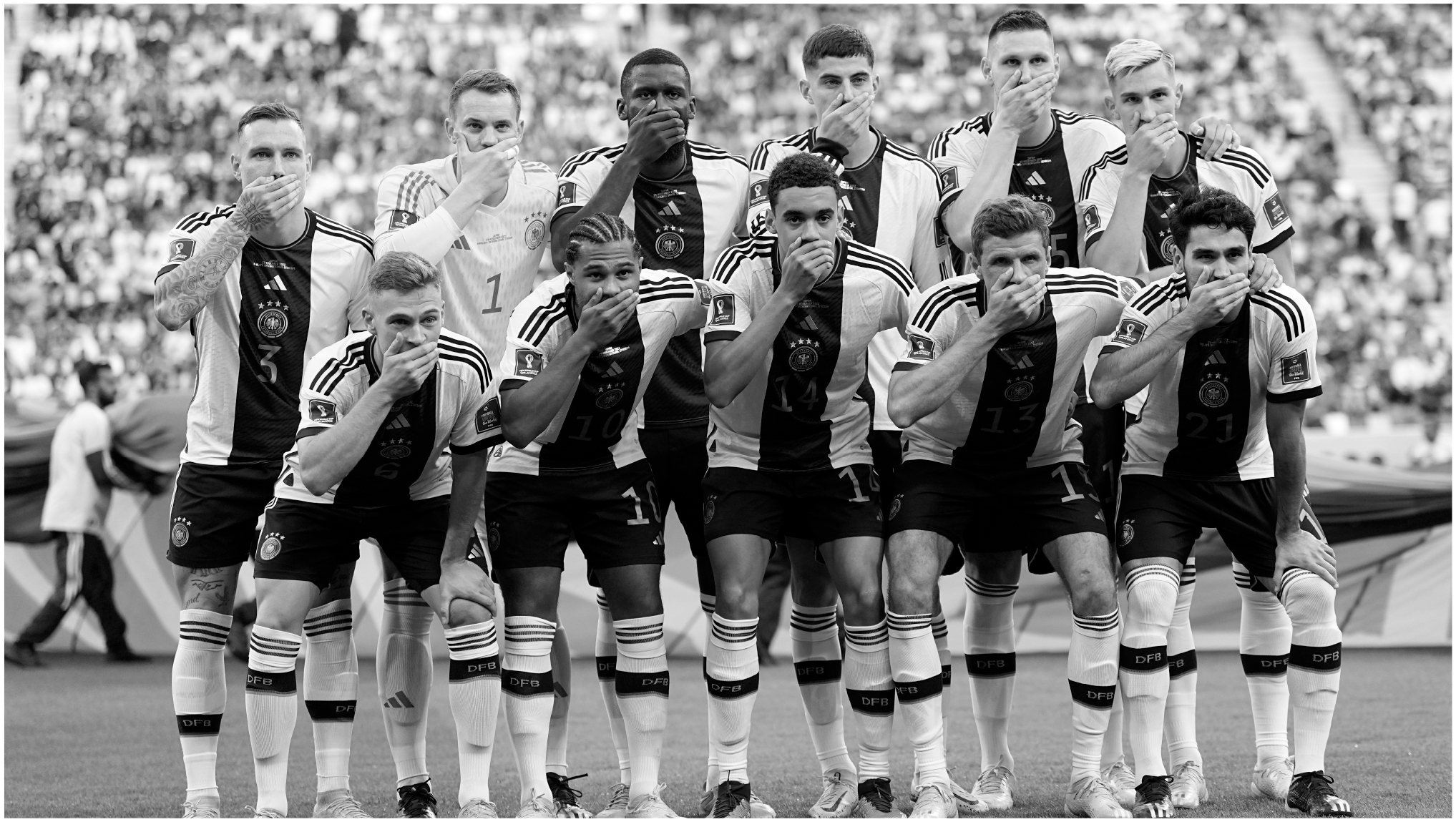
German players protest during team photos before their match with Japan at the FIFA World Cup 2022.
AP Photo/Ebrahim Noroozi
Some of the social meanings of Qatar 2022 were similar to those of other elite, spectacle sport. For example, celebrations of consumerism, global corporations, and wealth were abundant in the media coverage and packaging of the games. And with the playing of anthems, flying of flags, and composition of teams themselves, nationalism and patriotism are essentially baked into the event.
Organizational bodies such as FIFA love to tout the benefits of peace and cross-cultural understanding that can come with international athletic competition, but the 2022 Cup also revealed how fraught such exchanges can be. Certainly, the unique geographical and cultural context of Qatar introduced viewers to nations they didn’t know existed and geopolitical tensions they might not otherwise have been aware of.
At the same time, troubling nationalistic sentiments and cultural stereotypes were reproduced as well, as in commentators’ conflation of the flamboyant style of Brazil’s play with the country’s culture or contrasting of other teams’ defensive play with their countries’ perceived militarism or authoritarianism. And the contestation of social meanings and political implications swirling around Qatar 2022 was more extensive and intense than any recent comparable event. Consider the significance of spectators from Arab nations flying Palestinian flags in the stands while the games were being played and televised worldwide; or how journalists from other parts of the world challenged Western and European dominance in the context of the Cup, such as when Iranian journalists pressed the American team to defend their country’s global power and uneven record on social justice issues.
Other cultural messaging was even more intentional and contentious. One of the most striking developments in both domestic and international sport in the past decade has been the widespread emergence of socially conscious, politically committed athletes—and Qatar 2022 was no exception. With special patches on jerseys, statements at press conferences, and various demonstrations and displays, soccer players from all over the world tried to use the visibility afforded them to contribute to awareness and action on a whole host of injustices in Qatar and around the world. Their actions included Harry Kane and the English team’s plan to wear “One Love” armbands, fans and journalists like the late Grant Wahl sporting Pride flags, and the German team covering their mouths during their first match’s pre-game ceremonies to demonstrate against FIFA’s veto against players wearing pride armbands as well as the exploitation of migrant laborers.
Such advocacy transforms sport from a passive vessel for the legitimation of power and privilege into a tool for resistance in pursuit of social justice and change. However, these struggles are also where the politics of representation and power were played out most blatantly in Qatar. Virtually all talk and plans of player advocacy on social issues was silenced when FIFA threatened penalties and forfeitures against teams that voiced or displayed social messages. This context also helps explain FIFA chief Gianni Infantino’s desperate and bizarre attempt to maintain the moral high ground when he criticized European players and media for “hypocrisy” in his opening press conference: “Today I feel Qatari, today I feel Arab, today I feel African, today I feel gay, today I feel disabled, today I feel a migrant worker.”
In 2022, on the World Cup stage, all of these issues, incidents, controversies, and struggles were played out symbolically for global audiences worldwide.
In recent years, the emergence of large numbers of activist-oriented athletes all over the world has called attention to the power of sport as a platform for protest. Reflecting on Qatar 2022, we want to go further to suggest that global sport is actually a grand stage, presenting social issues, cultural contestations, and enactments of power and privilege to wide swaths of the global public who might not otherwise know or care about any of them. The way in which sport both captures and displays complicated social dynamics is key to its power and social significance in the contemporary world. Mega events like the World Cup offer an unparalleled site for the dramatization of and struggle over social issues because of their scope, the range of participants, the global media coverage and attention, and the passion and emotional intensity that global audiences and fans bring to them.
The way in which sport both captures and displays complicated social dynamics is key to its power and social significance.
The attention and intensity that come with spectacle sporting events doesn’t just reproduce the social status quo, it can, as we argued recently in the American Journal of Cultural Sociology, provide openings for athletes and media members in terms of raising awareness about systems of exploitation both internal and external to sport, subaltern histories and perspectives, and geopolitical conflict. At the same time, the 2022 World Cup offered clear reminders of the political challenges and limitations of the global and hyper-visible sporting platform. First, FIFA, various national soccer federations, and many national governments proved effective in limiting on-the-field protests or alternative viewpoints. Second, since the World Cup is a global event with actors from a wide array of positionalities and histories, viewers (diverse in their preexisting knowledge and interpretations) saw an abundance of issues and critiques but no clear unifying narrative. And third, because sport is, for many, assumed to be about fun and games, escapist emotional joy effectively diluted efforts to raise awareness about social issues including sport’s complicity in reproducing inequality and human suffering.
In his 2022 book Soccer in Mind, sport sociologist Andrew Guest argued for a “thinking fan’s guide” to the beautiful game. This, he wrote, would involve developing a “broad intellectual curiosity and an engaged critical consciousness” which could recognize both the joy that comes with sport as well as all the public issues, social dynamics, and “repulsive behaviors and ideologies” bound up with it. For Guest, this engagement would make our engagement with soccer, and sport more generally, richer and more meaningful.
We agree. In fact, the “post-game analysis” offered here can and should be understood in that vein. However, we offer one important caveat.
We cannot know how global audiences recognized or processed all the social issues, advocacy, and conscious contestation that played out in the 2022 World Cup. We cannot be sure of the extent to which viewers and fans recognized the embedded social meanings and struggles we have described.
What we do know, however, is that most sports fans and sports writers, and indeed everyone who interacts with sport in one way or another, do not typically bring curious, critical eyes, minds, and hearts to their engagement with sport. Too often, they fail to see the social issues and socio-political dramas displayed right in front of them—or, if they do, they want to minimize or dispense with the complications of the “real” world as quickly as possible in favor of getting back to the game. In other words, they fall into a version of what the anthropologist Clifford Geertz long ago called “deep play”—communal activities which are passionately pursued even as their broader social significance is trivialized or dismissed.
This paradoxical orientation, in which social dynamics are both seen and unseen, is part of global, spectacle sport—and may make the social dramas played out on the stage of mega events like the World Cup all the more powerful. Ultimately, to properly apprehend the social power and cultural significance of Qatar 2022, we must think sociologically about it while also understanding that most people in the world do not—at least not yet.