



Abstract
Scholars have increasingly called for the need to problematise and critically examine sport policy for integration/inclusion. This article aims to contribute to this ongoing debate by presenting a Foucauldian-inspired discourse analysis of the languaging of three decades of Norwegian sport policy for integration/inclusion, as well as non-sport policy that seeks to use sport as a policy tool. The analysis demonstrates how ideas and practices about the integration of ethnic minorities in sport are constructed in the shadows of the ‘real business’ of sport. Self-evident ‘Truths’ about inclusion/integration convey simplistic notions of assimilation into existing sport practices, reify notions of homogenous groups both with regard to the majority and the ethnic minority Norwegian population, distributing power unequally across the majority–minority divide, and contribute to construct sport as a racially coded, Eurocentric practice. The pervasive, long-standing idea that sport is inclusive works discursively to marginalise contradictory ideas, such as the complexities of integration that focus upon the need for a transformation of structures and practices, and ‘Truths’ like resourceful ethnic minorities or an adaptable sports organisation remain currently almost unthinkable. The analysis bears witness to scholars’ claims for the need to broaden research methodologies and policies for integration in/through sport, such that inequitable, Eurocentric, assimilated practices can be re-languaged to enable hybrid, transnational sports spaces frequented by resourceful participants.
Introduction
Sport has long been heralded by politicians and stakeholders alike as an excellent arena for the integration of ethnic minorities into host communities. Yet, a growing body of research indicates that there is considerable discrepancy between the political visions of sport for social integration and inclusion, and the lived realities of those targeted in policy. In this article, I aim to enrich the body of knowledge on the complexities and challenges of sport for integration by paying close attention to the languaging of sport policy for the integration of ethnic minorities. The discussion is based on a discourse analysis of three decades of Norwegian sport policy for integration and inclusion, as well as non-sport policy that seeks to use sport as a policy tool. Whilst the case study is inevitably bound to its national context, I contend that the insights gained from problematising the discourses of inclusion/integration from a country often associated with a high degree of social equality can be a useful heuristic or ‘tool to think with’ across international borders. It reveals how the language of sports policy not only frames how resources are distributed, acted upon and who benefits, but significantly also shapes the ways in which we come to learn about the interests, needs and concerns of inclusion/integration (Ball, 1993; Piggin, 2014). It contributes to the body of knowledge that reveals an urgent need for a re-conceptualisation of sport policy for integration/inclusion that recognises the contemporary diversification of migration and methodologies that avoid promoting nationalism (Agergaard, 2018; Agergaard et al., 2023; De Martini Ugolotti and Caudwell, 2022; Spaaij et al., 2022).
Critique of seemingly naive sport policy for integration/inclusion has been voiced for two decades. In 2007, Coalter criticised, for example, the a-theoretical nature of much of the monitoring and evaluation of early initiatives for integration in, and through, sport that measured who gained access to sports and whether participation was sustained. Scholars adhering to the notion that social inclusion/integration is a contested concept have revealed how a sense of feeling included in a voluntary sports club (VSC) is often transitory or ambiguous and depends upon a multitude of factors such as language skills, sports skills, coaches’ and other members’ attitudes (especially (non)racist beliefs) and degree of empathy, as well as the type of VSC (Burrmann et al., 2017; Doherty and Taylor, 2007; Jeanes et al., 2015; Sisjord et al., 2011; Spaaij, 2015; Spracklen et al., 2015). Using the concept of social capital, scholars have attempted to gauge the amount and types of social capital accrued in sport that can be transformed into other social arenas (Coalter, 2015; Haudenhuyse, 2017; Hoye et al., 2010; Spaaij et al., 2014; Walseth, 2008). More often than not, social capital gained in sports contexts tends to have limited exchange value in other spheres of society. Andersson's (2002) post-colonial study of young Norwegian immigrants’ identity work highlighted how macro issues like racism and a more restrictive immigration policy limited ideas of liberal multiculturalism and belonging to the microculture of a given sports club, rather than feeling integrated into society at large. Indeed, with regard to VSCs, a range of international studies (e.g., Bergsgard, 2016; Dowling 2020; Waardenburg, 2016) argue that their preoccupation with competitive sport as an end in itself is a major hindrance to welfare objectives such as social inclusion/integration. In a similar vein, critical sports scholars draw attention to repressive practices in sport including sexism, ableism, homophobia, xenophobia and racism that mean that sports clubs are not necessarily ‘good’ places to be or offer values to be cherished (Coakley, 2011; Spracklen et al., 2015).
Extending this line of thought, researchers have adopted new theoretical lenses to study sport for integration such as intersectionality to illuminate the multiple ways in which ethnic minorities’/migrants’ experiences of sport and leisure can be impacted not only by their status as belonging to a minority group but also by class, gender, sexuality, dis/ability, race and legal status within and beyond sporting contexts (De Martini Ugolotti and Caudwell, 2022; Peers et al., 2023). Agergaard (2018: 25) problematises the way sport policy for integration, most often interpreted as assimilation and a need to adopt nationally revered ideas and practices, fails to acknowledge the transnational ways migrants foster ways of belonging and proposes a reconceptualisation of integration ‘… as multidimensional social relational processes that are bound up in power asymmetries, and evolve as changing trajectories’. Following on from this more complex definition of integration, and extending Andersson's (2002) early work based on post-colonial perspectives, some scholars are also adopting concepts such as mimicry and hybridity to explore the possibilities for resistance and agency amongst ethnic minorities to assimilationist strategies of integration in, and through, sport (Agergaard et al., 2023) or developing participatory action research projects within a decolonial framework to work against dominant narratives of the ‘deficit Other’ who's responsibility is to integrate in the host society (Mashreghi S with Hassan, Yasmin, Mohammad, Ali, 2021). In sum, recent studies are founded upon the need to recognise a rapidly changing context for migration (e.g., unprecedented numbers of people migrating; the plurality of reasons for migration and the super-diversity within ethnic minorities; the superdiversity of many host societies; an international tendency to try to regulate and manage migration flows), as well as the shortcomings of previous research methodologies (Agergaard, 2018; De Martini Ugolotti and Caudwell, 2022; Spaaij et al., 2022). As De Martini Ugolotti and Caudwell (2021) claim much research has unwittingly replicated narrow, stereotypical ideas of migrants and re/produced simplistic binaries between integration and segregation, majority and minority groups and of unfamiliar host societies and longed-for homelands.
Against this backcloth with the premise that sport for integration/inclusion is problematic, rather than automatic, and how definitions of sport and integration/inclusion are fluid rather than fixed, it seems pertinent to examine in greater detail the imaginaries of the inclusion/integration of ethnic minorities in sport as expressed in Norwegian policy texts. The study sought to illuminate: How is the policy ‘problem’ of integration through sport framed, how are ethnic minorities depicted (what possible identities are constructed), how are potential ‘solutions’ to the challenges of integration through sport constructed, who is bestowed with authority and who is marginalised, and how, and why, are (subtle) changes in policy identified? In other words, the discussion traces what ‘truths’ or discourses are being promoted and/or contested, and in whose interests are taken-for-granted ideas about the integration of ethnic minorities through/in sport serving, in given historical circumstances (Foucault, 1977; Markula and Pringle, 2006)? Importantly, the discourse analysis also seeks to reveal possibilities for new ways of knowing and being, acknowledging that policy is a site for resistance (Piggin, 2014).
A Foucauldian-inspired approach to policy discourse analysis
A Foucauldian-inspired approach to discourse analysis rests upon an understanding that policy is not simply a response to existing conditions external to the policy texts, rather policy discourse creates both problems and solutions (Bacchi, 2000). Language in use and discourse sets limits upon what can be said and done; they constrain what can be regarded as ‘true’ and are, therefore, inherently tied up with power. A discourse analysis draws attention to what is left out of policy, as much as paying attention to its content. As Bacchi (2000: 49) writes, Its starting point is a close analysis of items that do make the political agenda to see how the construction and representation of those issues merits what is talked about as possible or desirable, or impossible or undesirable.
Setting the scene: ethnic minorities and sport in Norway
In order to contextualise the analysis, this section will briefly describe who is defined as an ethnic minority in Norway, as well as the organisation of sport. Whilst popular belief depicts a homogenous, White ‘Norwegian’ population, Norway's inhabitants have long since comprised a number of ethnic groups (Gullestad, 2006). Today there are six nationally recognised minority groups (the indigenous Sámi, and the national minorities of Jews, Kvens/Norwegian Finns, Forest Finns, Roma (Gypsies) and Romani people/Tater. Since the 1970s, a steadily increasing number of migrants seeking work, or fleeing from war and displacement, have arrived in Norway, gaining status as ethnic minorities. In 2023, 16% of the population was described as belonging to an ethnic minority group with circa 7% from European, or developed, countries such as US, Australia, Canada and New Zealand, and circa 9% from a range of countries in Asia, Africa and South America. Second-generation immigrants form part of these statistics, but third-generation decedents are officially recognised as being part of the majority population (Statistics Norway).
National policies for integration have waxed and waned between discourses of assimilation, and discourses of multiculturalism and a celebration of difference, though the latter is less evident in current policy (Midtbøen and Lidén, 2016). In their most extreme form, policy for the assimilation of the Sámi people and Kvens/Finns/Roma peoples led to brutal and discriminatory practices from c.1850–1960s, with repercussions well into the 1980s (Sannhets- og forsoningskommisjon 2023). During the past three decades, policy has been written using both the terms of integration and inclusion; hence, the discourse analysis of sport for integration also uses both these terms.
Turning to sport in Norway, akin to other nations, it has been politically legitimated for a range of reasons: instrumental reasons like contributing to a strong military, improved public health, the physical education of young people, entertainment and national identity, as well as being prized in its own right (Goksøyr, 2008). Sports associations have received financial assistance from the State via a lottery fund since 1946, whilst simultaneously enjoying a great deal of organisational autonomy (Bergsgard and Tangen, 2011; Enjolras and Waldahl, 2007). Policy has been directed at securing systems to support national sports associations, regional sports bodies and local VSCs who provide ‘sport for all’; to nurture elite sport development; and not least, the building of, and access to, nationwide sport facilities. Until the early 1990s, sport policy was integral to policy developed by the Department of Education and the Department of Culture, and whilst policy remains under the auspices of the Department of Culture (Kunnskapsdepartementet, KD), 1991–92 saw the first White Paper solely for sport, and subsequent Sports Policy White Papers in 1999 and 2011–2012. Since 1996, the newly amalgamated Norwegian Olympic and Paralympic Committee and Confederation of Sport's (NIF) has published Sport Policy Documents outlining their visions and strategies every four years, coinciding with their ‘Sports Parliament Sessions’. These documents have, therefore, also been included in the discourse analysis in order to analyse the relations between government and NGO policies. Periodically, Select Committees have been established to investigate specific issues in sport culminating in reports that guide policy: of particular interest to this study is a report from a Select Committee appointed to evaluate why girls with ethnic minority backgrounds are underrepresented in VSCs (KD, 2014).
Finally, non-sport policy has in recent years also directed attention to the potential for sport to solve a range of political goals in Norway, including developing social capital and cohesion (e.g., the Ministry of Children and Families [Barne- og familiedepartementet, BFD] and the Ministry of Justice and Public Security [Justis- og beredsskapsdepartementet, JD]), though political strategies have been symbolic and seldom been earmarked with funding, echoing findings from non-sport policy analyses in the UK and Australia (Hoye et al., 2010).
Methodology
A purposeful sample (Markula and Silk, 2011) of key documents was selected from existing sport policy documents (the three existing White Papers of Sport and NIF's Sport Policy Strategy Documents in the period 1991–2020) and relevant non-sport policy sources published between 1991 and 2015 as described above (see Table 1). A total of four White Papers, two Reports from Select Committees and six NIF Strategy Documents were scrutinised with regards to how ideas about ‘sport for integration/inclusion’ and ‘ethnic minorities’ have been constructed in the text. Following Piggin (2014: 31), and Markula and Silk (2011: 131), the following set of questions were adopted in the systematic discourse analysis:
What are the antecedents to the policy, and who wrote it? How are ideas about sport for the integration/ inclusion of ethnic minorities conveyed with particular attention paid to the language in use: firstly, with regards to the style of the communication (including types of metaphors, synecdoche and use of statistics), and secondly, in relation to the forcefulness of any declarations or policy solutions? How are individuals/groups framed, and who is bestowed with authority? How are policy instruments legitimated and what types of evidence are used? Is it persuasive? In what ways are the integration/inclusion discourses linked to discourses that structure the field of sport and/ or broader policy concerning the integration of ethnic minorities into Norwegian society? What effect or practices are produced through the discourses; how are power relations configured? How are discourses constructed within different historical policy contexts?
Sample of sport policy and non-sport policy documents.
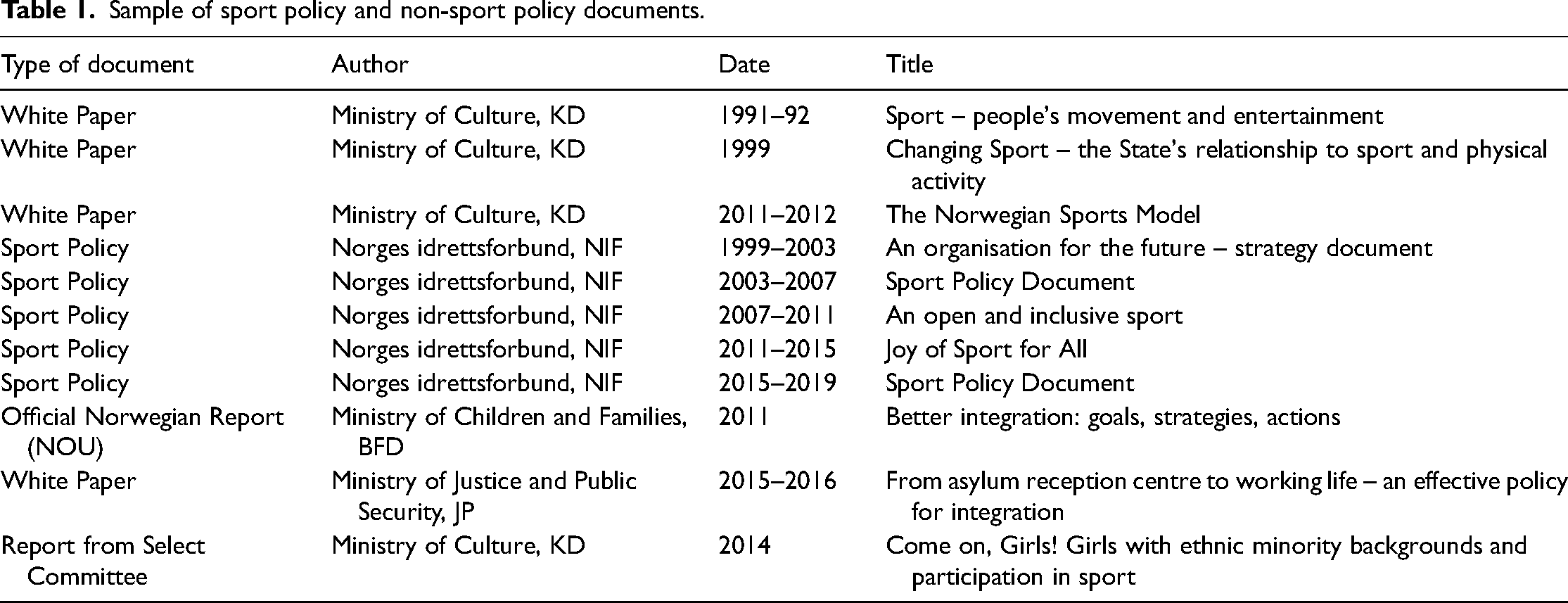
Each document has been closely scrutinised with these questions in mind: How are concepts inscribed? How are concepts brought together into coherent logics? How do they relate to broader fields of knowledge? How is power exercised, and by whom? The findings are presented and discussed below. The time frame is somewhat limited and does not represent a Foucauldian ‘genealogy’, yet it nevertheless offers some significant insights from a shifting political landscape.
Findings
‘Sport for all’
The analysis reveals that sport for the integration/inclusion of ethnic minorities is strongly linked to sport's dominant discourse of ‘sport for all’, which constructs integration/inclusion as almost automatic, and seldom problematic. As mentioned above, politicians’ investment in organised sport reflects a variety of interests. As the first White Paper states, ‘…sport is justified for its intrinsic and instrumental value. Accordingly, sport is both a goal and a strategy’ (KD, 1991-92: 12). Indeed, throughout the last three decades, sport's instrumental value has been associated with the following: a potential to improve individuals’ physical and mental health; children's up-bringing, developing their sense of self and mastery; national identity; its ability to include and create a sense of community; employment opportunities and economic growth; and volunteerism and local democracy. With regards to the latter, organised sport is described as being one of the largest voluntary organisations in the civil sector, albeit dominated by parents who perceive pressure to volunteer on behalf of their physically active children (KD, 1999: 21).
Under the slogan ‘Sport for all’, sport refers to: grassroots competitive sport organised by VSCs; outdoor life activities (‘friluftsliv’); elite sport sponsored by NIF and commercial actors; and what we might call ‘sport-by-association’, that is, by volunteering, or being an interested spectator (either at events or via mediated sporting events). Policy documents contain a multitude of visions and strategies for achieving ‘sport for all’ that range from philosophical assumptions about the goodness of sports participation to the economics, and provision, of sports facilities. In fact, strategies concerning the provision of facilities dominate policy texts, no doubt because there has been an underlying belief that the more facilities are built, the greater the number of participants.
A changing political backcloth, notably the influence of increasing commercialisation in sport, fear of the health consequences of sedentary lifestyles, an increasingly aging and multicultural population, and neo-liberal demands for greater effectivity of public resources, has led to the vision of ‘Sport for all’ morphing into, respectively, ‘Sport and physical activity for all’ (KD, 1999), and ‘Sport and physical activity for all …such that all who wish to take part shall have an opportunity to participate in sport or pursue self-organised physical activity’ (KD, 2011-2012, my italics). These various visions of ‘Sport for all’ are multifaceted: strategies aim to increase the number of members in the sports movement (active and passive members across different social categories such as gender, (dis)ability, social class, age and ethnicity), and not least, to cultivate sporting talents with the long-term vision of gaining international status. Integral to many of these strategies is the underlying belief that ‘sport is inclusive and integrative’, which is central to the on-going discourse analysis.
‘Sport is inclusion’
Indeed, throughout the sample's policy texts, sport is normatively postulated as being valued in Norwegian culture for its special ability to include and integrate people. In the 2011–2012 White Paper, it is stated that, ‘Sport has a broad social recruitment and is one of society's most important arenas for social inclusion’ (KD, 2011-12: 66, my italics). Geographically, ‘…VSCs exist in almost all local communities … and through their activities contribute to a sense of social community… (and) … NIF is the largest voluntary organisation. That gives sport a unique position as an arena for inclusion’ (KD, 2011-12: 97, my italics). Such claims can be traced back to 1991–92: No other activity is able to mobilise and strongly engage people across traditional social and cultural divides. Sport integrates, inspires, and gives pleasure, and contributes to several positive outcomes for individuals and society with regard to health, and social and economic benefits. (KD, 1991-92: 10) ‘ … sport … is concerned with fundamental and basic questions about who we are and ought to be, to whom we belong, and what opportunities we have in relation to our surroundings. … Sport's intrinsic value is to do with identity and belonging, and must be seen in conjunction with basic social and cultural norms and values’ (KD, 1991-92: 11).
Voluntary sports clubs are depicted as ‘the cornerstones of a harmonious society’ and ‘without sports teams (the experiences, the joy and quality of life, friendships and fellowship), society would be a “colder” place’ (KD, 1991-92: 65). The 1999 White Paper boldly claims the following about elite sports’ capacity to unite people: Sport is a universal phenomenon. The most popular sports are played in most countries according to the same set of rules. Sport is widely recognised across national borders and is a cultural phenomenon with a common understanding worldwide. (KD, 1999: 45)
These bold, and periodically emotional, claims about sport being inclusive are also backed up by references to survey data about participation rates using variables such as age, gender, (dis)ability and ethnicity. Higher participation rates are self-evident proof of greater inclusion. In the 2011–2012 White Paper, the notion of ‘social capital’ appears: the idea that taking part in sport allows individuals to build social networks and internalise the (taken-for-granted) democratic processes of the voluntary sector. The shift in rhetoric from statistics to theoretical concepts can partly be linked to a growing research interest in volunteerism in the civic sector, including volunteerism in sport. Yet generally speaking, references to research are sparse, they are used selectively to illustrate the dominant storylines, such as participation rates or perceived barriers to participation, and importantly, critical research studies about the ‘dark sides’ of sport (e.g., social class differences in participation rates, racism, sexism and homophobia) or the potential shortcomings of concepts like ‘social capital’ are significant by their absence. The following quotation illustrates the sentiments expressed in all three of the White Papers on Sport with regards to potential negative aspects of sport: There are some darker sides of sport. The pressure to perform, competitiveness and too much adult control can harm motivation and experiences. Drop-out rates amongst teenagers imply that sport isn’t experienced as positive by everyone … Recruitment to sport may accentuate certain social differences… according to research…but it would however be misleading to accuse sport of being exclusionary. Popular sports like football, handball, ice hockey recruit widely from all social classes. (KD, 1992: 43; 114, my italics)
The 1999 and 2011–2012 White Papers increasingly tie the notion of sport's ability to include and integrate individuals in society more directly to ‘welfare political objectives’ (KD, 2011-2012: 97), which can also be traced in surrounding non-sport policy, such as the Report on Better Integration (BFD, 2011) and the White Paper ‘From asylum reception centre to working life’ (JD, 2015-2016). Both the 1999 and 2011–2012 White Papers on Sport are also laced with neoliberal ideas about the need for ‘value for money’ for public investments (Hammer, 2020), for example, ‘The National Audit is of the opinion that the existing goals and evaluation system is not sufficient to provide information about the use of lottery money and activities in sports organisations’ (KD, 1999: 8). In other words, strategies for inclusion in sport need to be economically effective.
Sport is universal … or is it? Sport and national identity
As mentioned above, a dominant idea in Norwegian sport policy is that of its universal nature. It offers a ‘common language’ via internationally recognised sets of rules, and participants, in the absence of a common spoken language, can communicate together through physical expression. Yet, this is a ‘Truth’ with several caveats and modifications which are of particular interest with regards to the integration of ethnic minorities. Specifically, the notion of sport as a means for providing national identity sits uncomfortably with universal feelings of belonging. Indeed, rather than being constructed as solely universal, Norwegian ‘sport for all’ is discursively linked to English origins (‘English sport emphasising competition, performance and excitement prevails in Norway today’ (KD, 1991-92: 11), as well as comprising activities that are designated ethnic Norwegian qualities. For example: ‘The Norwegian culture for hiking is very strong… Norwegians are socialised into a set of values in which fresh air, walks in the forest and … closeness to nature are crucial for well-being’ (KD, 1991-92: 45). Similarly, this text states, ‘Sport is an important part of many Norwegians' lives’ (KD, 2011-212: 7).
Ideas connecting sport and national identity are also evident in elite sport: in the 1990s, policy stated that international sports success ‘provides a positive image for marketing national interests of different kinds’ and ‘elite sport has increasingly become important in national and ideological struggles’ (KD, 1991-92: 49–52). Two decades later: ‘Elite sport is important for Norwegian cultural identity … it is entertainment, but more importantly it creates identity’ (KD, 2011-2012: 92). These examples all raise the question of whether there are discursive spaces in which ethnic minorities can become integral to the ‘essentialist Norwegian sports identity’, and whether there is, in fact, room for hybrid identities. We might also ask whether indigenous Sámi subjects are discursively defined as potentially belonging and integrated in sport, all the while mainstream/ethnic Norwegian sport is constructed as relationally different from indigenous Sámi sport (KD, 1991-92: 134)? The 2011–2012 White Paper claims, ‘Sport at all levels contributes to positive common experiences for the active, volunteers and spectators’ (KD, 2011-2012: 66), yet, on whose terms?
Integrating/including ethnic minorities in sport
It is against this backcloth that policy relating specifically to the inclusion of ethnic minorities in, or through sport, is woven, and importantly, ethnic minorities/immigrants represent merely one amongst many potential target groups (e.g., girls/women, the disabled, inactive adults). Similar arguments to the ones outlined above are used to justify targeting these potential new members into the ‘inherently inclusive’ folds of sport: for example, sport has its own language (‘… participation in sport does not require high language proficiency’; KD, 2011-2012: 25), and sport is a gateway to Norwegian local communities (‘…participation in sport that often entails cooperation and community conveys the majority population's norms and rules in an inclusive way’; KD, 2011-2012: 26). Further, ‘…participation in local clubs provides access to the local community that is valuable for the individual and society’ (KD, 2011-2012: 67), and hence, ‘… strengthening the local clubs’ funding, by amongst other things giving economic support for the building and development of sports facilities and areas for sport and physical activity, are the most important factors in order to reach the aims of inclusion …’ (KD, 2011-2012: 97). Non-sports policy reinforces the strategies in sports policy. The Report on Integration (BFD, 2011) refers, for example, to the potential for sports participation to contribute to developing ‘social capital’: building social networks and internalising the taken-for-granted democratic processes of the voluntary sector. Similarly, the White Paper on more effective integration (JD, 2015-16: 50) purports that experience from participating in VSCs in the large democratic organisation of sport (either actively in sport or as a volunteer) is vital for integrating ethnic minorities ‘…as a route of entry into local society and for creating trust and an enhanced sense of belonging’.
Typically, the strategies for the inclusion of ethnic minorities entail specific short-term projects, as opposed to being directed at mainstream sports. These have included offering low threshold activities that do not require membership of a VSC (KD, 1991-92: 133; KD, 2011-2012: 99); a series of projects, including the so-called ‘Colourful Sport project’ (in liaison with the Norwegian Directorate of Immigration) that aimed to ‘provide immigrants with sport and in time integrate them in sports clubs’ (KD, 1991-92: 133) and the Urban City project (KD, 1999: 76), as well as a funding programme entitled, ‘Grants for inclusion in sport’ (KD, 2011-12: 99). Yet, it should be noted that neither the latter nor the Urban City project was exclusively directed at ethnic minorities and aimed to recruit a broad range of ‘Others’ (e.g., disabled youth).
A closer inspection of the languaging of ethnic minorities within these various strategies reveals discourses laced with difference and deficits. There has been a range of terms used to denote ethnic minorities from the naming of specific minorities, such as the Sámi people, to generic terms such as ‘immigrants’ and ‘migrants’. In the first White Paper for Sport, policy constructs immigrants as ‘an extremely varied and diverse group… with ideological and ethnic differences’ (KD, 1991-92: 133). Immigrants are in danger of having a poor self-image and sense of insecurity, that participation in specialist activity groups can counteract. Indeed, the second White Paper on Sport also positions immigrants on the fringes of policy: in particular, female immigrants are targeted as potential recruits to low-threshold sports activities via the ‘Urban City Project’ (KD, 1999: 76). ‘Non-pretentious fitness activities’, and a toning down of the competitive aspect of sport, are presented as ways to increase participation in fringe activities (as opposed to mainstream sports), and moreover, project funds can help VSCs that lack access to run-down facilities and struggle to recruit coaches (KD, 1999: 75). Although immigrants are not directly blamed for the lack of regular maintenance of sports buildings or their decline, the policy nevertheless indirectly links urban decline, a need for urban renewal and immigrants together.
In 2011–2012, the policy discourse shifts to describing Norway as a multicultural society and statistics show that immigrants represent 12% of the population, stemming from 216 different countries (KD, 2011-2012: 9). It is argued (or warned) that a more multicultural society will influence prioritising between different groups and how this can be significant for sport (KD, 2011-2012: 9). Ethnic minorities are used to reiterate and emphasise sports’ inherently inclusive nature and its contribution to building social capital: ‘sport is a gateway to Norwegian society for minority groups’ and a place to learn about democracy and democratic organisations (KD, 2011-2012: 97). The inference of the latter is that ethnic minorities are possibly ignorant about, or lack, experiences of democratic ideals. The policy concentrates its attention on children and youth, who are depicted as being good role models for their ‘ignorant’ parents (KD, 2011-2012: 67). In fact, it is not only parents who are constructed as ‘deficit’ or lacking knowledge or the ‘right’ behaviour in sports: youth, too, are contrasted with their majority counterparts as being ‘underrepresented’ or outside of the norm, particularly girls with minority backgrounds (KD, 2011-2012: 98). Indeed, drawing upon a selection of survey data and surrounding non-sport policy (BFD, 2011), immigrants are constructed as deviant for: lacking an understanding about the role of sport; a groundless fear for leaving their offspring in the hands of VSCs’ ‘strangers’; their religious beliefs; and their lack of economic resources (KD 2011-2012: 98–100; KD, 2014). Ethnic minorities’ religion, traditions and culture are depicted as barriers that prevent girls from being able to accrue invaluable social capital by participation in the democratic organisation of sports clubs (KD, 2014: 9). Cultural and religious norms, ‘… whether they are genuine or experienced’, that lead to expectations that girls must avoid showing any naked skin in public, that they must wear head attire, or that they must avoid taking part in mixed sex sports activities impedes some girls from certain sports (KD, 2014: 19). The different policy texts (White Papers, Select Committee Report and the NOU Report) work together to strengthen these ‘truths’ by processes of cross-referencing. With the exception of an acknowledgement that there are no significant differences between participation rates in physical activity for ethnic majority and minority girls (i.e. to say in activities beyond the auspices of NIF), there is an absence of discourse concerning the potential idea that ethnic minorities (or indeed other groups) may actually choose not to enter the arena of organised sports. Indeed, the latter is seemingly undesirable and unthinkable.
Turning to NIFs six policy documents during the period 1996–2019, ideas and strategies for the inclusion/integration of ethnic minorities are less evident than in government policy documents. Generally speaking, mention of immigrants (NIF, 1996-2000; NIF, 2007-2011), ethnic background (NIF, 2003-2007) or ethnic minorities (NIF, 2003-2007; NIF, 2011-2015) is fleeting, and most often linked to a host of other potential target groups within sport, such as girls/women, the disabled, the physically inactive, deviant youth or those with a ‘different’ sexual orientation. Within a liberal equity discourse of ‘sport for all’, sport can offer social networks, well-being and good health, as well as Norwegian cultural traditions (NIF, 1996-2000: 91). The only ‘… precondition for participation in Norwegian organised sport’ is an individual membership that opens up the ‘friendly and inclusive environments’ of sports clubs (NIF, 2011-2015: 5). Sport aims to mirror diversity in the population at large, including its increasing multicultural nature (NIF, 2011-2015: 19). Coupled with the idea of organised sport as an equitable space is the related notion of sport as ‘an arena for combatting discrimination and intolerance’ whether the latter concerns gender inequality, racism, sexism or ableism. The most specific strategy that is mentioned in the course of the two decades of sports policy is in the period 2011–2015, whereby NIF aims to ‘… establish partnerships with immigrant organisations and public bodies working on integration’ and ‘to secure funding of actions aimed at the participation of minorities in sports clubs’ and to ‘contribute to the positive development of newly-established sports’ (NIF, 2011-2015: 19). Lurking in the shadows of the latter is the unspoken ‘truth’ that minorities are less inclined to participate in well-established sports, and thereby, are in some way ‘lacking’. Interestingly, in NIFs sport policy document 2015–2019, there is in fact no mention of multicultural Norway, nor the inclusion of immigrants or ethnic minorities; rather the focus is to generally mirror diversity in society and to work for an open and inclusive sport (NIF, 2015-2019: 6). Ethnic minorities are temporarily, at least, written out of NIFs sport policy. As NIFs 2003–2007 sports policy document candidly states, Norwegian sports’ primary goal is to provide sports experiences for its members and promote sports’ intrinsic value, and instrumental objectives aimed at solving broader societal issues (including integration of ethnic minorities) are secondary in nature (NIF, 2003-2007: 21).
Discussion
In following up the analytical questions posed in the methodology section, the discourse analysis reveals that there are few antecedents to sport policy for integration/inclusion that are specifically related to ethnic minorities. In the 2011–2012 White Paper, there is mention of Norway becoming a multicultural society, and how this might affect the range, and types of sports activities that are deemed attractive (KD 2011-2012: 12). Yet generally speaking, new policy has emerged as a response to concerns such as the increasing commercialisation of sport and threats to volunteerism, a growing belief that public-funded sport is not only an activity with intrinsic value but can also serve as a means for delivering welfare goals, and the importance of elite sport to promote national identity and interests. In other words, dominant discourses from the institution of sport shape ideas about how ethnic minorities may be fabricated into the social order rather than transnational concerns about migration. The White Papers have been written by the senior staff at the Department of Sport within the Department of Culture who have close ties with the leadership of NIF, which some scholars have described as problematic (Bergsgard and Tangen, 2011; Enjolras and Waldahl, 2007; Goksøyr, 2008; Skille et al., 2022), and which may well explain why there is so little dissent. Moreover, there is considerable political consensus across party political divides with regards to sports policy (Seippel and Skille, 2019).
As the presentation of findings illuminates, the ideas expressed in Norwegian sport policy about the integration/social inclusion of ethnic minorities in sport can be characterised as ill-defined similar to international research (Agergaard, 2018; De Martini Ugolotti and Caudwell, 2022; Coalter, 2015; Schaillée et al., 2019). Significantly, I contend that Norwegian sports policy systematically fails to draw upon theoretical understandings of terms like ‘integration’ or ‘inclusion’ in or through sport. Whilst non-sport policy defines integration as enabling ethnic minorities ‘… to live and reside in Norway, find employment, become taxpayers and active citizens’ (JD, 2015-2016: 10), sports policy documents use integration and inclusion interchangeably, and on the whole, equate them with the notion of participation in sport. Following Agergaard (2018), policy glosses over the complexities of integration through sport to spheres like education or the job market. Similarly, terms like ‘multiculturalism’ are used without reference to the complex theoretical definitions that abound (Johansson, 2022). There is little discourse, for example, that links the integration/inclusion of ethnic minorities in sport to ideas about cultural pluralism and diversity. Nor is there recognition of the super-diversity within groups labelled as immigrants or ethnic minorities, and their descendants, that acknowledges the range of socio-cultural, legal, educational and economic differences amongst migrants or the possibility for hybrid-transnational identities (Agergaard, 2018).
Despite some strategically selected statistics concerning participation rates or fleeting references to research on the experiences of ethnic minority girls in organised sport, the ‘policy problem’ of non-participating ethnic minorities in sport (either as physically active or a volunteer) is normatively constructed and integral to the general policy issue of participation. Policy has generally marginalised integration research albeit generated with methodogically blunt, or in some cases, repressive tools (Agergaard, 2018; De Martini Ugolotti and Caudwell, 2022; Spaaij et al., 2022). Sports participation is reified as having an inherent value for everyone, as well as social benefits, such as improved health, social well-being and access to social networks. The emotive language used to describe sports’ inherent value is laced with certainty: for example, ‘there is little doubt’, ‘the significance of sport cannot be overestimated’, ‘sport has brought people together … for hundreds of years’ (KD, 1991-92: 43) and ‘we know … research shows’ (KD, 2011-2012: 9). Sports clubs are constructed as self-evident ‘gateways to’, and ‘cornerstones for’, a ‘harmonious society’ (KD 1991-1992: 65; KD, 2011-2012: 97) that facilitate social cohesion across ideological and ethnic divides. There is almost no room in the texts for the faintest possibility that sport might not be positive for everyone: sport is ‘a central part of Norwegians’ lives’ (p. 66), it ‘contributes to positive common experiences for the active, volunteers and spectators’ (p. 66), and due to its organisational size, it holds a ‘unique’ position for inclusion (KD, 2011-2012: 97).
Similar to Peers et al.'s (2023: 201) findings in Canada, the inclusion of ethnic minorities into the folds of sport represents thus merely one target group on the ‘laundry list’ amongst a whole host of potential recruits that can benefit from sports’ inherent good, including underrepresented gender groups, youth, adults, the elderly, the unemployed, the disabled and drop-outs who hopefully can be wooed back. The general policy issue of participation is also closely linked to the policy issue of elite sport because by increasing the recruitment of youth to sport, including ethnic minority youth, the chances for talent development and international success are enhanced (Bergsgard and Tangen, 2011: 66).
Moving onto a closer inspection of the language of integration/inclusion for ethnic minorities in sport, it repeatedly reaffirms a binary relationship to the ethnic Norwegian majority. It works to uphold the idea of ‘difference’ – we/them, majority/minority, included/excluded and talented/deficit skills – and more importantly, the idea that difference is undesirable. Integration/inclusion is constructed as ‘being like us’, ‘learning our Norwegian sports culture’, ‘becoming a member of our club’, ‘becoming a volunteer’ and ‘learning about our democracy and values’. In other words, the dominant idea about integration/inclusion for ethnic minorities is constructed as being assimilated into the existing structures of (Eurocentric) Norwegian sport. Newcomers are welcomed so long as they respect the rightful owners of the space (Agergaard, 2018; De Martini Ugolotti and Caudwell, 2022; Peers et al., 2023). Social inclusion and exclusion are constructed as diametrically opposed poles (Haudenhuyse, 2017). The idea that ethnic minorities could enrich and renew sport practice is significant by its almost absence. There is a single reference to the positive development of newly established sports (e.g., cricket) in NIF's, 2011-2015 policy document, but otherwise learning is constructed as a one-way process: ethnic minorities can learn about ‘our’ sport culture or acquire new motor skills from the majority population if they are to become ‘successfully included/integrated’. The imaginary that ethnic minorities have knowledge and skills that could enrich Norwegian sport is practically untraceable; their voices remain unheard (Mashreghi S with Hassan, Yasmin, Mohammad, Ali, 2021). Similarly, it is ethnic minorities who must adapt to a changing sports environment, rather than the ethnic majority, by overcoming barriers, misunderstandings or scepticism. The power to define sport resides firmly with the ethnic majority.
Metaphors such as sport is ‘a gateway to society’ or sports clubs are the ‘cornerstones’ of local communities consolidate the logic of the policy problem of integration. Discursively, these can work together to problematise those who remain on the ‘wrong side’ of the gate or beyond the reaches of the indispensable inclusive community within the local sports club, implying they are unlikely to become integrated into civic society nor internalise the democratic processes of large organisations. Accordingly, the discourse analysis illuminates how existing sport policy discourse for integration can inadvertently disempower ethnic minorities and uphold mechanisms that tend to exclude rather than include them into organised sport, not least taking into consideration the countless references to Norwegian sport and an imagined Norwegian national identity. A picture of a monocultural national identity is constructed with little room for competing hybrid or transnational identities (Agergaard, 2018).
Research on the experiences of ethnic minorities in sport in Norway reveals systematic discrimination and racism, particularly for athletes of colour (Dowling 2020; Andersson, 2002, 2008; Massao and Fasting, 2010). Following on from this, it is relevant to ask what discursive work the policy instrument of the so-called ‘Colourful Sport Project’ does to uphold difference, given that its title can infer a strategy that targets the inclusion of people of colour in sport (KD, 1991-92: 133). Whilst it is possible to read the term ‘colourful’ in a figurative sense conveying ‘full of interest, lively and exciting’, it is however equally possible to associate the project with ethnic minorities of colour. In other words, sport policy and strategies for the integration of ethnic minorities can contribute to the idea that ethnic minorities are marked by a darker skin colour, and become racially coded, despite the wide range of countries of origin of migrants (Gullestad, 2006). The existence of a separate sports organisation and policy for the Sámi population also contributes to the discursive racialisation of sport, because even though it importantly acknowledges the rights and culture of the indigenous Sámi, it is nevertheless the ‘Norwegian’ sports model that signifies the normative position (Skille et al., 2022). Akin to other social arenas, sport and its policy for inclusion/integration contribute to a hierarchy of social status amongst ethnic minorities (Midtbøen and Lidén, 2016), and frequently ‘erases race’ off the agenda (Andersson, 2002; Peers et al., 2023).
Generally speaking, the discourse analysis reveals an ad hoc approach to poorly funded strategies for integration with little accountability, which in turn reinforces the peripheral nature of integration/inclusion of ethnic minorities in current sport policy. Policy instruments like the ‘Colourful Sports Project’ and grants for inclusion provide access to additional funding of VSCs that potentially enrich the general running of sports activities and do not exclusively enhance the opportunities for the participation of ethnic minorities (Dowling 2020). Similarly, the focus on funding new sports facilities as a means for inclusion (KD, 2011-2012) is clearly a wide-reaching aim and not a specifically targeted strategy. As Bergsgard and Tangen (2011: 69) observe ‘… the building of sports facilities is the main political instrument in policy’. Ideas about financing new sports facilities as a means for integrating ethnic minorities do, therefore, discursive work to uphold this general policy objective and consolidate the majority population's position in sport. The lack of earmarked funding for strategies for integration in sport as expressed in non-sport policy texts further weakens the significance of any sport policy for integration of ethnic minorities, because without resources policy visions are rarely achieved.
In the wake of the so-called migration crisis in 2015 that brought unprecedented numbers of migrants to Norway, NIF did in fact establish an extraordinary ‘Refugee Fund’ together with economic and administrative assistance from the Norwegian Directorate of Immigration that had no roots in existing sport policy. Voluntary sports clubs could apply for additional funding for the purposes of providing ‘instant, meaningful sports activities’ for young migrants. Whilst the success of local initiatives could be called into question (Dowling 2020), what is remarkable is that the fund ceased to exist a year later, and as mentioned above, NIF's sport policy document (2015–2019) bore no reference to it, nor to the issue of integration in, or through, sport. This silence, or recognition of what is written out of policy, may be interpreted as signifying NIF's desire to distance itself from welfare objectives, or indicative of ‘crisis overload’ and a hardening of public narratives about migration (De Martini Ugolotti and Caudwell, 2022).
Concluding comments
In drawing the discussion to an end, it is important to reiterate that a Foucauldian-inspired discourse analysis does not aim to reveal an essentialist ‘Truth’ about policy for the integration of ethnic minorities in sport. Rather the analysis has endeavoured to reveal the multiple ways in which language and practices in sports policy have constituted ideas about the inclusion/integration of ethnic minorities during a 20-year period, acknowledging the significance of socio-historical contexts in the formation of knowledge, as well as to illuminate possibilities for different ways of knowing. Overall, the discourse analysis demonstrates how ideas about the integration/inclusion of ethnic minorities in sport are constructed in the shadows of the ‘real business’ of sport. Self-evident ideas about inclusion/integration convey simplistic notions of assimilation into existing sport practices, they reify notions of homogenous groups both with regards to the majority and the ethnic minority Norwegian population, distributing power unequally across the majority–minority divide, and construct sport as a monolithic practice. The pervasive, long-standing idea that sport is inclusive works to marginalise contradictory ideas, such as the complexities of integration that focus upon the need for a transformation of structures and practices that can result in experiences of exclusion, the fluid and transnational nature of belonging, or indeed, the notion that existing sport practices are not only necessarily ‘good’ but also harbour ‘darker’ aspects (Agergaard, 2018; De Martini Ugolotti and Caudwell, 2022). Rafoss and Tangen (2017) contend that the level of consensus in Norwegian sport has been so great that it has had detrimental effects: ‘…politicians, bureaucrats and leaders in sport act first and foremost based on a cultural narrative about themselves – the Norwegian sports model. Over time this mindset has more or less blinded actors to the many social changes and challenges that have arisen. The result is a model that is out of step with the times.’ (Rafoss and Tangen, 2017: 154 my translation)
Footnotes
Acknowledgements
The author would like to thank the anonymous reviewers for their constructive comments on an earlier draft of this paper.
Declaration of Conflicting Interests
The author declared no potential conflicts of interest with respect to the research, authorship, and/or publication of this article.
Funding
The author received no financial support for the research, authorship, and/or publication of this article.
