



Abstract
Against the background of the recent European ‘refugee crisis’ and its long-term consequences, this article investigates the research question ‘how do footballers with a refugee background experience the process of accessing top-level football?’, using ethnographic material and interviews with competitive footballers with a refugee background in Italy and Germany from two studies. The material was examined using qualitative content analysis and interpreted through the ecological systems theory. The results show that inclusion to professional football is complex for refugee footballers who are faced with the additional hurdles and consequences of a forced migration. Moreover, refugees build their networks within the process of resettlement, without a clear path for inclusion to elite football. Those who ‘make it’ have relied on key enablers within their microsystem and on mesosystemic interactions, further emphasizing the importance of networks for professional development. In contrast, exosystemic and macrosystemic factors further hinder the possibility of a sport career in football, on top of the existing difficulties of a forced migration. The process of seeking inclusion in competitive football however has been identified as a positive element that can provide direction in resettlement and opportunities for socialisation.
Introduction
Football is one of the most relevant sports in terms of participation, viewership and business turnover around the world (FIFA, 2007). In turn, this enhances the attractiveness of a professional career as an athlete in the sport. On the one hand, ‘making it’ as a footballer is extremely difficult, due to a highly competitive closed system that selects its athletes because of their talent through recurring nodes and networks (Parnell et al., 2021; Darby et al., 2022). On the other hand, a professional football career is depicted as one of the modern means of upward social mobility for –amongst other groups – migrants (Esson, 2015).
Against the current actuality and relevance of ‘refugee crises’, this article examines stories of in/exclusion from elite football told by refugees themselves. At least in its self-description, football stands for openness, diversity and integration like hardly any other sport. In Europe, football traditionally has succeeded in a special way in including people of different ethnic origins (Bradbury, 2011; Sterchele, 2015; Stone, 2018). Yet, a consistent body of sociological literature shows that football is not immune to phenomena of racism, discrimination and exclusion (Adams and Darby, 2020; Esson, 2015; Nobis et al., 2021). Moreover, despite the asylum-migration nexus (Stewart, 2008), there are relevant differences between migrants and refugees.
Besides the obvious legal implications, the refugee label has potentially plenty of psychosocial consequences. This label contributes to undermining individual agency, exerting controlling power and fostering the concept of ‘deservingness’ concerning the extent to which a refugee deserves the help that is given to him/her (Holmes and Castaneda, 2016; Zetter, 2007). Literature on sport and refugees is rooted in a deficit approach, where sport is used to give refugees something they don’t have, whether this is belongingness, inclusion, well-being, or participation (Spaaij et al., 2019). Nevertheless, refugees are not just apolitical recipients of humanitarian interventions, integrative policies or welcoming generosity; they need high adaptability, creativity and agency to deal with the situations they face (Besteman, 2016).
Recent literature reviews show that existing research on this topic focuses mainly on health promotion, social inclusion and sport participation (Michelini, 2020a; Middleton et al., 2020; Spaaij et al., 2019) but not on elite and professional sport. This applies also to the discipline of football despite it being by far the sport most studied in this area (Spaaij et al., 2019). In relation to football, a particular further focus is given to the themes of belonging (Nunn et al., 2022; Stone, 2018) and activism (Doidge, 2018). Yet refugees and football also share a complicated link, with the sport also being a characterizing element of conflict and practices of persecution (Cable, 1969; Armstrong and Rosbrook-Thompson, 2012). Despite the existence of scientific results that partly confirm sport's integrative power, its role in this context can neither be taken for granted nor unequivocally accepted (Krouwel et al., 2006; Smith et al., 2019; Thiel and Seiberth, 2020; Waardenburg et al., 2019). Moreover, the integration of elite athletes in the sport system has similarities to labour market integration. In both cases, specific skills are interconnected to multiple locations and times and need to be adapted and actualised in the new context (Hercog and Cangià, 2021).
Some biographical research on athletes with a refugee background has been recently carried out (Michelini, 2018, 2020b; Thorpe and Wheaton, 2021). However, the whole professional realm and the particularity of refugee elite footballers that have experienced a forced migration to another country have been overlooked. To fill this gap, we examine the careers of ‘refugee footballers’ in Italy and Germany, focusing on multidimensional characterizing factors that affect their professional development. The socio-political context of the stories collected is the so-called European refugee crisis, which is here understood as the migratory wave from Africa and Asia to Europe during 2015 and 2016. The scare quotes indicate that we are well aware and critical of the use of this term (Gutiérrez Rodríguez, 2018), of the term ‘refugee athlete’ (Michelini and Seiberth, 2022) and of the implications beyond the use of this rhetoric in the socio-political discourse. To illuminate both the individual and contextual perspectives, we address the question ‘how do footballers with a refugee background experience the process of accessing top-level football?’, adopting a socioecological approach to the analysis of ‘refugee footballers’ careers, taking account of their shifting environments along migratory journeys.
Theoretical framework
This study is conducted through the application of Bronfenbrenner's (1979, 2005) ecologic system theory (EST) from an interactionist standpoint. EST outlines the relationships and interactions between the individual and the environment and how these shape and are shaped by the development of the individual. The environment comprises five different systems, named microsystem, mesosystem, exosystem, macrosystem and chronosystem. With the individual being at the centre of the environment, each system is represented by key actors that interact both with the individual and differing systems. The individual is influenced by the system they live in but at the same time can influence their surrounding environment. Different systems should be understood as networked rather than nested (Neal and Neal, 2013), meaning that systems overlap and therefore interact with each other through the social interactions of the individuals within. These interlink not only with their proximal system but also across different systems. Figure 1 1 explains the definition of each different system in relation to the individual, here defined ‘refugee footballer’.
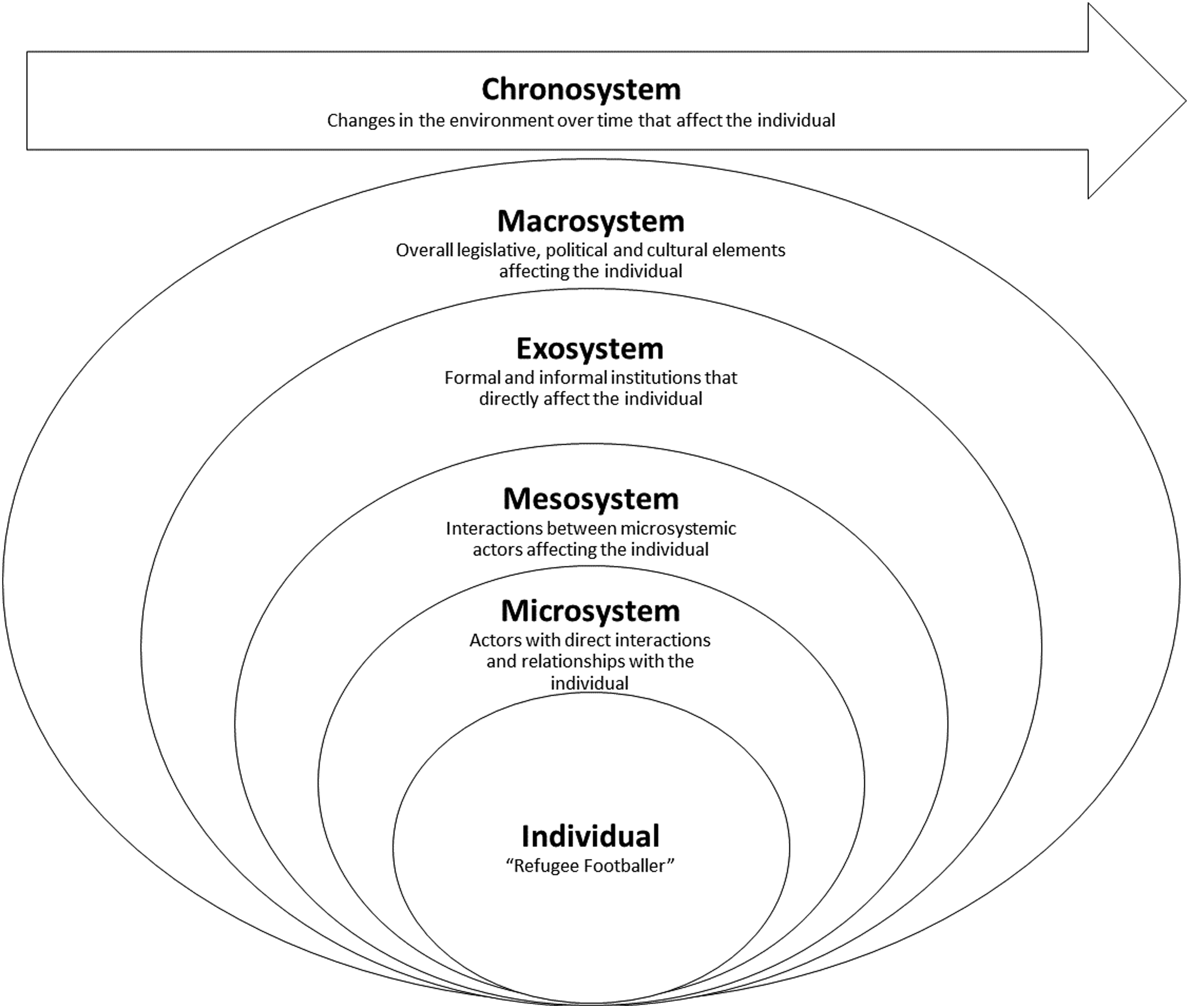
Bronfenbrenner's ecologic system theory applied to ‘refugee footballers’. Adapted from Bronfenbrenner (1979).
Whilst EST is originally used in psychology and child development (Neal and Neal, 2013), the theory has also been applied for studying career development (King and Madsen, 2007; Leong and Tang, 2016; Xie et al., 2019). The focus of EST on human development allows the precise but flexible use of the theory to explore interactions between the environment and the individual in different instances (Neal and Neal, 2013). Relevant examples include explorations of career development barriers for Chinese migrants in the USA (Leong and Tang, 2016), as well as the influence of context in the career development of African American youth (King and Madsen, 2007). The focus on the interactionist element in combination with ecological system theory has also been advocated for the understanding of indigenous worldviews (Ali et al., 2022).
The decision for choosing a human development theory to analyse the professional career of refugees lies in the acknowledgement of the interconnectedness that employment plays within the experiences of forced migration (Ager and Strang, 2008). Career development is a part of the wider development process that occurs upon refugee migration and resettlement (Campion, 2018). Given the experiential focus, the model acknowledges that a refugee career in football is inevitably shaped by the distinguishing elements of the individual (e.g. refugee status and possibly related trauma), and of the environment (e.g. football clubs and governing bodies), necessitating a broader developmental focus that allows the exploration of these intersecting elements.
From a sociological perspective, EST enables our in-depth analysis of the careers of refugee footballers, providing a structure within, and positioning of, the various multidimensional elements influencing resettlement (Arakelyan and Ager, 2020; Ganassin and Young, 2020; Paat, 2013). In the sociology of sport, EST has been used to evaluate sport for development programmes (Burnett, 2015; Robledo et al., 2022), as well as a lens to explore barriers faced in sport (Marshall et al., 2022).
In this study, EST particularly informs interactions between and across systems, providing a balance between structure and flexibility needed for this exploration (Neal and Neal, 2013). The broader theoretical application of the model instead aims to explore and locate interactive processes that guide the experiences of refugees in competitive football upon resettlement. Focusing on interactions across systems, EST can help in understanding the worldviews of participants (Ali et al., 2022).
Although resettlement is considered a major and immediate solution to safeguard refugee communities from dangers occurring in their home country (Esses et al., 2017), the result of resettlement is the sudden change of environment for the individual, with subsequent erosion of existing social capital (Elliott and Yusuf, 2014). As networks play a key role in securing and sustaining a football career (Parnell et al., 2021), this sudden environmental change may mean the disruption of existing networks and the re-creation of new social ties upon resettlement (Lamba and Krahn, 2003). Through the examination of purposeful interaction with the new environment, it is possible to understand the process of resettlement of refugee footballers, as they try to reconstruct their careers in the country of resettlement.
As refugee issues pertain to transformative crises within the ongoing process of globalisation, it is important to recognise macrosystems as interconnected within the global society (Young et al., 2006). Modern football is an expression of globalisation, as well as refugee crises and resettlement (Giulianotti and Robertson, 2012; Zetter, 2007). Therefore, we present the cases of Italy and Germany as chronosystems in relation to football. In understanding and exploring the stories of refugee footballers, EST allows us to analyse comparatively the lived experiences of the group from a micro-, socio-relational level, to a macrosystemic, global dimension.
Methods
This paper is the product of two separate studies conducted in Italy and Germany, with similar foci, objectives, and paradigms. The research project conducted in Italy explores the value of football for the resettlement of refugees, whilst the study conducted in Germany purposefully looked at the careers of footballers with a refugee background. Through ongoing discussions, we realised that the combination of the data between the two studies would provide stronger knowledge and evidence to understand the experiences of refugees in relation to competitive football, a common objective of both studies. Research in Italy has been conducted by Norrito, under the supervision of Giulianotti and Mason, whilst research in Germany was undertaken by Michelini.
This study has been conducted through an interpretivist paradigm, constructing knowledge through the narration of the lived experiences of refugee footballers in Italy and Germany. The two countries are inextricably connected within and beyond sporting dimensions as they are both members of the European Union and have had a primary role in the ‘European refugee crisis’ (Holmes and Castaneda, 2016; Georgiou and Zaborowski, 2017). Comparing these two cases – and the discussions between the two researchers which led the analysis– is fundamental for painting a comprehensive picture and is essential for understanding both of them (Hammersley and Atkinson, 2019). Participants have been purposefully selected, directionally aligning with interpretivist epistemologies, to explore the experiences of refugee footballers in Europe. In total, this paper draws from a total of 17 interviews, with 12 participants in Italy and five participants in Germany. As a vulnerable population group, research on and with refugees automatically raises ethical issues (Smith et al., 2022). Both projects received approval from the ethics committee of the respective universities. Participation in both projects was voluntary. In Germany in order to recruit participants, all footballers whose refugee background is known and who are or were active between the professional and ambitioned amateur leagues were identified through an internet search and contacted via email. Approximately one third of the respondents contacted agreed to participate in an online interview. Access to participants in Italy was gained through the mediation of gatekeepers, who, after initial contact by the researcher, would put interested refugees in contact with the researcher. Gatekeepers were trusted by the participants but did not have a vested interest in the research and were for example player agents, journalists or family members. Their role was also key in confirming the refugee status of participants.
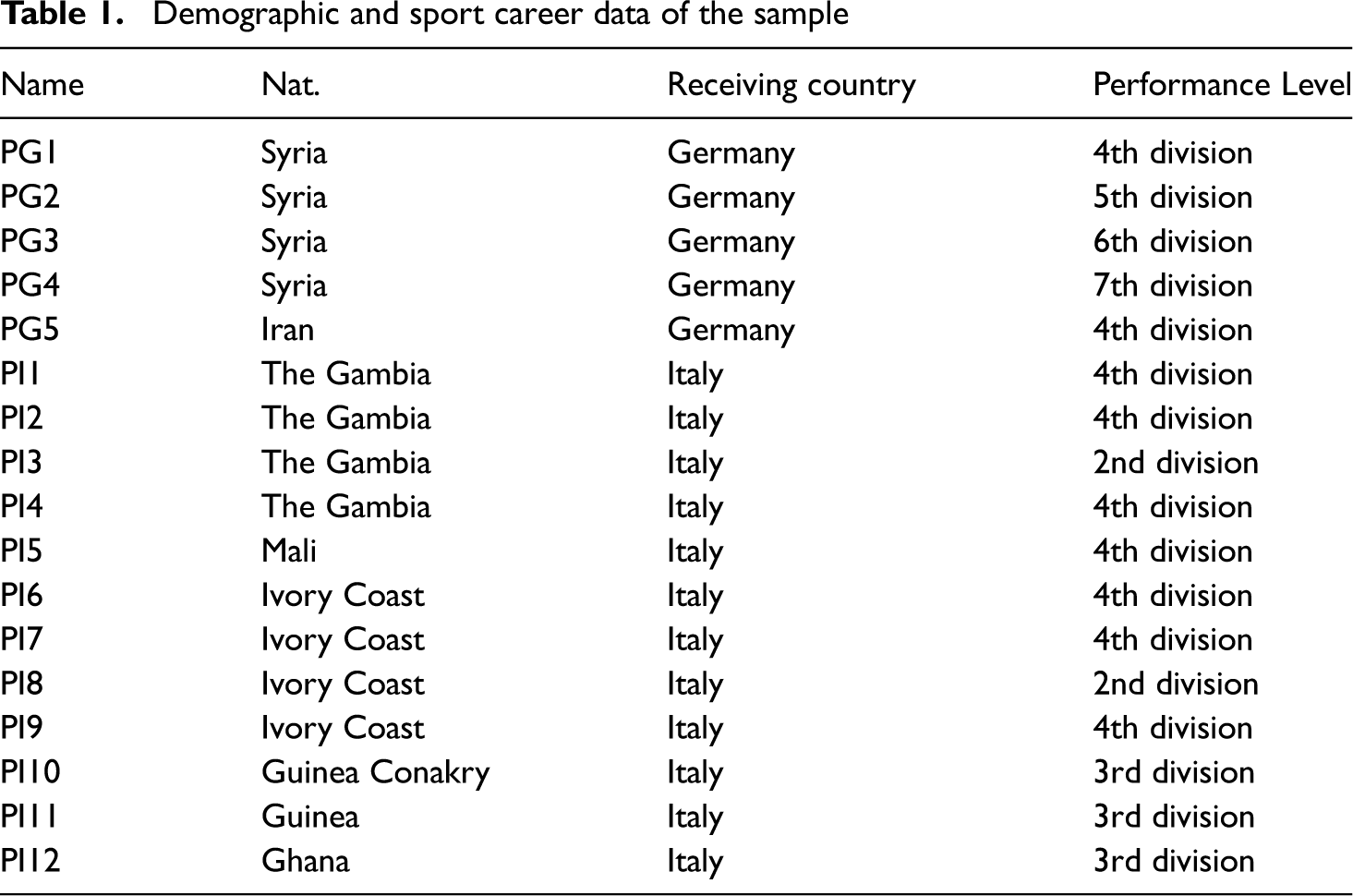
In the case of Italy, data was collected through a pluralist qualitative approach, making use of semi-structured conversational interviews (with a length of between 40 and 70 min) and ethnographic observations. Participants came from The Gambia (n = 4), Mali (n = 1), Ivory Coast (n = 4), Guinea Conakry (n = 1), Guinea (n = 1), and Ghana (n = 1). The Italian sample was younger than the German one (aged 19 to 26 years old), and footballers tended to play in higher divisions, with the highest level of performance reached between the second and fourth divisions of Italian football. Interviews were conducted in person (n = 6) and remotely (n = 6) either in English (n = 8) or in Italian (n = 4). All interviews were conducted by the first author over a period of 8 months, from November 2021 to July 2022. Only two interviews were conducted in the mother tongue of participants, where English was used for PI2 and PI12. The ethnographical observations were conducted over the same period, including visits to football clubs and reception centres (Table 1).
For the German case, online and video-recorded narrative interviews and the collection of complementary sources (mainly from news and social media) were used. These interviews were oriented towards approaches of biographical and expert research (Schütze, 1983) to collect long and deep insights into the topic. Due to the COVID-19 pandemic, all interviews were conducted and recorded (including video) through video telephony (Zoom) within a time frame of 2 months in 2021. The second author of this article conducted the interviews, which lasted between one and 2.5 hours each and in foreign languages (English and German) for both the interviewee and the interviewer. For the German case, four Syrians and one Iranian were considered, who are aged 28 to 31 years old and arrived in Germany as asylum seekers between 2011 and 2018. Whilst information on the status was not explicitly asked, it can be assumed that in all but one case, a permanent residency was granted.
To analyse the data, a qualitative content analysis approach was used, which is based on Mayring's (2014) methodological guidelines for the analysis of interviews. This approach can be classified in the interactive-hermeneutic group and enables an evaluation procedure for qualitative data that is systematic, data-based, and theory-guided (Krippendorff, 2013). The data was coded by a system of categories determined a priori by the research questions and the ecologic system theory (Mayring, 2014: 59). However, the deeper engagement with the material implied discursive and reflective dialectic between the authors, a back and forth between deductive and inductive analysis as well as the development of further categories. Such inductive categories revolved around two major themes on barriers and facilitators that however would have not captured interactions in the same structured way presented by the deductive application of EST. Moreover, EST enables an active involvement of contexts within the analysis, a crucial element for the understanding of barriers and facilitators for refugee and sport contexts. The language level of the participants allowed flowing communication and a good understanding in all cases. Yet, minor communication problems raised methodological issues in the interpretation process. In facing these issues, authors worked collaboratively to interpret more complex elements of the interviews.
Results
The following sections illustrate explanatory factors located across the different systems of the environment. Through a narrative format, selected quotes and cases are included to exemplify and support the results.
Individual
Acknowledging the complexity of identifying the multiple facets and dimensions of the individuals involved in the study, this section focuses on the similarities and differences that characterise the participants in their heterogeneity. This helps us unpack the term ‘refugee footballer’.
First, all participants have forcibly migrated and their common refugee background represents the ‘refugee’ dimension of the individual. Nevertheless, it is important to stress that they have different nationalities and experiences of migration: Italian participants have migrated from Western Africa, crossing the Mediterranean from Northern Africa, and German from Western Asia through the ‘Balkan route’. Second, all the participants are involved in football, contributing to the ‘footballer’ dimension of the individual. Interviewees perceive themselves as competent footballers, who deserve a chance of playing professionally after resettlement. Importantly, all German interviewees played as professionals in their country of origin before moving to Europe, whilst the Italian participants did not have this elite athlete background.
Both dimensions intersect in creating our depiction of the individual. Refugee footballers in Italy and Germany hold stereotypical beliefs of the self as naturally gifted to play football, whilst simultaneously recognizing that their background puts them at a disadvantage with their local competitors. A forced migration adds a further and relevant obstacle to the already precarious trajectory of a ‘normal’ sport career in football. However, their reason for wanting to be involved in football transcends the sportive dimension itself.
For example, PI7, who has contributed to the promotion of his club from the fourth to third divisions, has explained his initial reason for getting involved in football as a way to be understood and normalise his condition in the eyes of others: When you go down on the field, who is Italian and who is not Italian, who is not a foreigner and who is a foreigner … at that moment it no longer exists. The diversity of your color, the language you speak, all these things, you forget. Only one language is spoken on the field, which is everyone's language. The language of football. *, He {refugee interviewee} trains every day more than professional, more than first league. Running 10 km every day and so, but for what? And then, what comes? Nothing comes. Nobody looks at him, nobody.
Overall, the ‘refugee footballer’ is limited in participating in professional football due to personal barriers that emanate from the refugee condition. Yet, the comforting space that football presents in a foreign territory motivates the involvement of the individual, who sees in the sport a strategy to present himself to the community. Such representation relies on football as a mean of communication that highlights the common ground between refugees and the host community. This mean of involvement reflects the desire of the participants who ultimately aspire to achieve a better life condition after seeking asylum.
Microsystem
Actors in the microsystem of refugee footballers within the Italian chronosystem consist of teammates, coaches, family members (if any) and close friends beyond the domain of football. Within microsystems, it is of relevance the dualism between biological and acquired families of refugee footballers. The acquired families of refugees consist of actors within the microsystem that can form a special bond with refugees. Establishing quickly deep relationships in the new context is critical for the refugees’ processes of self-realisation within and beyond football itself. In the case of PI1, a key figure was a woman that saw him training in the streets of the town where his reception centre was located. After she asked him if he would like to play football, she introduced him to several people who could provide the opportunity to play. These introductions were successful not only for the player to find a team but also in establishing important bonds with the receiving community. As he recalls: [talking about an Italian city] was a beautiful time there for me. Because I have so many friends, so many parents, so many families. […] I also found a coach who loves me. Family, like my father and mother. We were winning. You know when it's like that the goalkeeper wastes time, it's like that. Then the fans started saying ‘black black’ as racist things. There is a mother there who got up and said ‘You don’t have to say these things, because football is like that’. Then the fans didn’t say anything, that's it. ‘This is my son’ she told them.
It is therefore noteworthy how the presence of acquired families within the microsystem is fundamental, acting in place of their biological families as a system of guidance and support for the progress of their career.
In the German cases, despite being distant the (extended) biological family in the country of origin of the interviewed played a major role in the decision to leave their home and to continue their sport career. Whilst this constitutes a strong drive for them, it is also a source of pressure and stress, as PG1 argues in explaining his reasons for leaving Syria: At that moment I said, now I want to continue playing football because it doesn’t make sense if you stay there, you work and [my former teammates in the national team], I don’t know where they play, they have a lot of money and I eat from the ground. […] And I’m already better than all the others and I can reach my family and eat and help my family and the other families, my neighbours, all the people. So why should I stay there? I can do 100%, but I told you, now you don’t have time, you don’t have time anymore, because when you have a family it's hard, hard. If you get an offer, for example, from, let's say, Dortmund, near Dortmund, regional league or something. How do you go there?
The interviews show that the teammates and their (extended) network played a crucial role in their social integration and feeling of belongingness. Sometimes, this was even fundamental to find occupation and accommodation.
Mesosystem
Following the concept of families enabling or hindering a level playing field rather than being an advantage themselves, it is through mesosystemic interactions that the key to a refugee footballer's success resides. These interactions, occurring between members of the microsystem, can direct the career of refugee footballers towards opportunities that would otherwise be inaccessible to them. As we have seen for PI1, the connection between members of the community was key to his success in achieving a football contract. However, this is not always the case, as shown by PI4. He notes how a noncohesive receiving community can in turn harm the success of footballers. Indeed, he is the only one amongst his friendship group, who was successful in playing football after resettlement: Lack of support here is a big problem you know. […] Because even in this city you know, in the club, people are not … I don’t know how to say it, they are not together you know, they don’t have each other you know?
In Germany also, social relationships in the host country are allegedly extremely helpful for a new sporting start in organised football. Almost all of the German interviewees came to nearby clubs at various amateur levels through personal contacts, such as friends or coaches. The interviews show that even a trial training at a club at a high amateur level is extremely difficult to obtain without internal contacts. The lack of a social network amongst refugee footballers explains the fact that most of the interviewees, who resettled in Germany, had to start in lower amateur leagues. In contrast, with the help of a personal contact, one interviewee managed to get a trial training at a regional league club. As this was successful, his entry into football immediately took place at the highest amateur level, where he still plays today.
In any case, all private, professional and financial conditions would also have to be in place for a change of residence due to playing football, to consider a change of location. This is generally the exception as in the experience of PG1: And afterward I just thought about football so uh so that I just try to play football, that I try and so maybe it works out for me. And I asked many people here and here and I go everywhere. I just need one, just one trial training, I just need one chance and that was also very difficult in Germany. One, one German told me, if you want to be a professional, you, you need good connections. […] and that was also the worst answer for me, because I don’t know people either, because how … how do you know people in Germany?
Exosystem
Exosystems relate to institutions within the environment that directly affect the individual. Within the Italian and German chronosystems, two relevant institutions in the exosystem interact particularly with refugee footballers: the reception centre and the football club. These institutions function differently, with dissimilar salience on the condition of forced migration of the player.
Reception centres, as the first facility where refugees reside, are crucial for their integration and capacity to succeed in their careers in the immediate time after their migration. Yet, whilst clubs follow a common pattern in their interactions with the refugee population, the conditions of reception centres are extremely variable. A relevant commonality of this setting is that, whilst refugees reside within, they have to sign a declaration every time that they go in or out of the centre, thus being an institution that impacts mobility, an important element to pursue a football career. The capacity to play football within the domain of the centre is therefore variable and depends on the proximity of a pitch, the cooperation with local football clubs, the possibility to regularly practice and the visibility of one's efforts. In turn, prioritizing sport can limit the time and energy, which can be invested in other integration-relevant activities and commitments, like learning the local language. Nonetheless, football interactions also enable language skills can be practiced and nurtured.
The second crucial organisation considered is the football club, acting neutrally towards refugee conditions, with both positive and negative consequences. Pressured by the function that players have within a team and the necessity to win matches, clubs treat footballers based on their contribution on the pitch, effectively creating a relationship between employer and employee. However, in lower leagues, clubs pay players inconsistently or not at all, resulting in a necessity for refugees to have other jobs to make ends meet. As experienced by many other refugees in Italy, the case of PI7 has shown the frequent malpractice of failing to pay the agreed remuneration. In turn, dual-employment deters their chance to be intensively involved in the pitch and therefore hinders progress in their careers. As PI4 explains: If you don’t go to training, even one day, they would start to complain, you know? Why are you late, why you did not come. I tell them you know, only this football cannot help me (financially), I need to find something to do to help myself you know, because only this football is just you know, like, one hour of money for some people.
Access to amateur clubs is often less problematic than competitive clubs. When it comes to accepting refugee footballers the lower the amateur level, the easier it is to accept them into the club. For this reason, three of the interviewees in Germany joined first teams in lower leagues. To present themselves to higher-class clubs, the refugee footballers must first prove their footballing quality through regular participation in training and consistently good performances. If they are successful, they might be contacted by coaches or representatives of higher clubs. This can however take too long for players in their 30s, who have no contacts and are under time pressure. PG2 argues that: The normal teams, especially the professional teams, have their training sessions, their working sessions. It is rare for someone to come and try out in between. There must be a very good reason, because the club has a need for this player. In the lower leagues, I think they’re more flexible, because they’re not so professional that they can get out of their daily routine.
In summary, reception centres can be a facilitating or hindering element for the career of refugee footballers in both Italy and Germany. Proximity and connections with football clubs and the quality of the reception centre vary significantly. This variation ultimately determines the opportunities to both enter in contact with wider parts of the community and to get involved in football. With clubs exclusively looking at the performance advantage that players can bring to the team, players within the traditional nodes of youth academies or already included within the professional systems are generally preferred. Refugee players are welcome only so far as they can strengthen the team without creating extra costs and issues. Therefore, the exosystem of refugee footballers presents significant barriers to their professional development.
Macrosystem
The macrosystem contains overall legislative, cultural and political elements that affect the individual. In the analysis of the macrosystem, the most impactful element of the Italian chronosystem is the necessary documentation to enable refugees to play football competitively. Whilst this point is not discussed by any of the football players in Germany, the bureaucracy of the Italian system effectively negates the right to play to a portion of refugees or delays their possibility of involvement in professionalism. The obstruction of refugee footballers within the Italian system sees differing cascading interactions.
Italy is perceived by the individual as a necessary point of passage in their European journeys, more than a desired destination. Forced migrants that undertake the Central Mediterranean Route, thus migrating from either Libya or Tunisia towards Europe, are likely to arrive in Italy as their first European destination. Whilst some athletes decide to stay to pursue a football career in the country, others think of Italy as a point of passage in their European journeys, effectively rendering the Italian chronosystem a moment of transition.
Alternatively, to surpass the barriers within the Italian macrosystem, refugees decide to move on and migrate once more to seek opportunities within other European countries. PI9 has had a positive resettlement in Italy and felt included in society. However, current regulations prevent him from being transferred into a third-division club from his current fourth-division club. Given the impact of these regulations on his career, he has since then considered leaving Italy for another European country. He had even received a transfer request from a European first-division club that he had to turn down due to the pandemic. As pandemic regulations have relaxed, he is now determined to leave Italy: I always wanted to stay in Italy, but given this law, I think that even today … I’m really thinking about it, it's been two years that I’ve been thinking about it. This year I really decided, if I have a proposal from abroad I go.
Despite the absence of a similar relevant bureaucratic obstacle, the openness of German football towards refugees was questioned by the interviewees. Indeed, none of them is satisfied with their current league level. All five refugee interviewees were active in professional football before their migration and believe that their footballing ability is sufficient to play at least in the regional league. To illustrate their footballing quality, many of the interviewees refer to former teammates from their home country who are still active as professional footballers in other countries.
Despite being considered inferior compared to the competitiveness and popularity of other European football leagues, the interviewed refugees were eager to realise their football dreams in Germany, as PG4 explains: Yes and then after 15 days I told my friend let's go to Germany. Because I love Germany. Germany … that was my dream to go to Germany really … and the German national team is my team and yes maybe Bayern Munich too. Okay – yes, I really wanted to go to Munich but … yes and then all of a sudden we decided and … there, from Turkey you know … maybe to Greece … you know these stories.
Conclusion and discussion
This article explores the question ‘how do footballers with a refugee background experience the process of accessing top-level football?’. Data collected in two distinct studies exploring football and forced migration conducted in Italy and Germany was qualitatively analysed and interpreted through the EST. The following paragraphs bring together the result of the analyses, discussing the possibilities and challenges of refugee footballers in European football and highlighting differences and similarities within the different contexts.
Different time dimensions heavily influence the sporting careers of ‘refugee footballers’. The possibility to invest a large amount of time in sport needs to be commensurable with their daily routines and current priorities (synchronic time). Their biological and athletic age (diachronic time) set the horizon of their current and future performance and of their self- and foreign–perceived potentials. The different steps of their forced migration (chronosystems) constitute a radical change in the environment and are all critical life events decisive for their career development. Through these turns, sport skills are in many cases the only capital the athletes can bring with them, and therefore their lives are deeply entrenched in sport. In most cases, forced migration was a major obstacle to football careers. In Germany, none of the participants regained their professional level prior to resettlement whilst, in Italy, participants have improved their sporting levels compared to their country of origin. Their younger age might be identified as the main explanation for this greater success. In the context of their sport challenges, refugees have identified alternative paths, possibilities and solutions for inclusion in competitive football, showing an immense degree of enterprising and agency. In the case of Germany, presenting an older sample than the Italian case, players have ‘settled’ for the amateur level, with football shifting from a profession to a pastime or part-time occupation. Younger refugees in Italy have hypothesised further migration within Europe, where fewer barriers are perceived. In both cases, refugees are subject to involuntary immobility within football, a common experience of migrant footballers (Adams and Darby, 2020; Esson, 2015).
Similarly as in other studied cases (Thorpe and Wheaton, 2021; Michelini, 2023), refugees in Italy and Germany have used their existing sporting skills and network as a tool to seek refuge. However, they have recognised a professional disadvantage related to their status and the relative process of forcibly migrating. In both Italy and Germany, the time consumed through migration represented a career-hindering factor. A significant challenge for refugees to succeed in football lies also in the disintegration of existing social networks and the consequent necessity of rebuilding social capital. Rapidly building professional social networks after resettlement is a key element for the professional success of refugees (Ganassin and Young, 2020). Recent research has also shown how strong ties within networks are fundamental for the recruitment of players in elite football (Parnell et al., 2021). When refugees arrive with limited contextual knowledge of their place of resettlement, micro- and mesosystemic networks are therefore fundamental for career development, as shown by the results. However, upon resettlement, refugees are excluded from key nodes of professional football, such as academies, where these networks could be constructed and their talent showcased (Darby et al., 2022). Indeed, the processual system lets them undergo through reception centres, constraining their mobility and capacity to interact outside of refugee domains (Waardenburg et al., 2019; Michelini, 2020b). The results have also shown that such bureaucratical ties can delay the re-inclusion of refugees in competitive football. It can therefore be argued that the labelisation and contextual treatment of refugees hinder their professional inclusion in the football system (Zetter, 2007). The highly networked dimension for player recruitment, paired with the precluding nature of the asylum system, hinders refugee players, who remain excluded from outside of these nodes and networks. Similarly to labour market integration, the continuation of a sport career depends highly on personal social networks and (the openness of) sport infrastructures (Udayar et al., 2020).
Their prolonged involvement in football however goes beyond the sole professional dimension, as players have identified a positive role in football towards inclusion and socialisation in the context of resettlement. Whilst sport clubs as institutions are considered distant and apathetic, refugees were able to form important bonds and strong tie networks within the club (Bradbury, 2011; Marshall et al., 2019; Stone, 2018). These strong ties are the main reason why players have continued their involvement in football, albeit unprofessionally, motivated by a strong sense of cultural belonging within the sport (Nobis et al., 2021; Nunn et al., 2022; Spaaij et al., 2019). The transnational nature of belonging to football validates ecosystems as expressions of a global society (Young et al., 2006). Taking this direction, sport clubs can be spaces for positive encounters to foster development within resettlement (Seiberth et al., 2018). These structures should, however, be aware that positive outcomes are context-dependent and integrative results are not granted (Krouwel et al., 2006; Smith et al., 2019; Thiel and Seiberth, 2020), particularly when the user group, in this case refugees, has a high interest in the competitive dimension of sport (Sterchele, 2015; Stone, 2018). Yet, even when their professional ambitions had subsided, refugees wanted to retain their involvement in competitive football due to their perceived associated benefit. Nonetheless, caution should be exerted in assuming the association between football and positive outcomes for refugee athletes because it could be also associated with a sunk cost bias. This common psychological bias is here a distorted perception of their own situation characterised by the overestimation of their chances in football and an underestimation of their chances outside football, against the background of their already huge investments in sport. The experience of forced migration reduces further their probability of success; they still ‘struggle to become the kinds of neoliberal subjects that the global sport industries require: hard working despite the uncertainty about the results of hard work; self-improving even though improvement guarantees nothing; and being responsible for one's destiny, including both successes and failures’ (Besnier et al., 2018: 865).
Overall, the use of EST as a theoretical lens for this study has helped structure our analysis in a precise yet flexible manner (Neal and Neal, 2013), which allowed us to construct a structured exploration of the many multidimensional interactions that occur within a sportive environment. Nonetheless, the model goes beyond providing structure, as it allows for the flexible analysis of interactions in relation to their career development. Such flexibility has allowed us to identify ‘structured’ elements, such as barriers and facilitators, as well as better understand processes of skill enactment, knowledge generation and transnational connectedness through football that come into effect for refugee experiences in the new environment. This being said, the lens of other theories could be applied to improve understanding of the refugee condition beyond the centrality of the individual, such as liminality theory, or to understand power dynamics between the football system and refugees, such as Foucault's critical theory.
Further critically delimitating the contribution to knowledge of this paper, two elements must be taken into consideration. First, the sample exclusively comprises male participants. Further studies should therefore understand refugee inclusion from the perspective of female professional athletes (Culvin, 2021). Second, this article considers a posteriori data collected through different methods and assessing different foci. Whilst the comparative analysis of the cases generated new knowledge, not all data was commensurable. Future projects could benefit from a planned and coordinated cooperation, which shares methods and goals. Such a project with longitudinal and transnational range would fill the current research gap under methodological and content aspects, which is indicated by Spaaij et al. (2019) and that this article could only partially compensate.
Demographic and sport career data of the sample
Footnotes
Acknowledgements
We would like to thank all the participants involved and all the clubs, organisations and individuals that have made this journal article possible. We would also thank the reviewers and editors of IRSS for the precious feedback on this paper.
Declaration of Conflicting Interests
The author(s) declared no potential conflicts of interest with respect to the research, authorship, and/or publication of this article.
Funding
The author(s) disclosed receipt of the following financial support for the research, authorship and/or publication of this article: The work was partially supported by the DFB Foundation Egidius Braun.

Notes
Correction (July 2023):
This article has been updated to correct the author order since its original publication.