




Abstract
How do states avoid hosting refugees? Whereas scholars have documented at length the strategies that rich democracies use to avoid hosting refugees, conventional wisdom holds that states in the Global South have no choice but to host refugees. This article presents a novel typology of state strategies to evade asylum obligations, demonstrating that just as rich democracies can feign compliance with the letter of international law without upholding the spirit, states in the Global South can manipulate liberal asylum policies towards illiberal ends. Identifying how they do so, however, requires looking to the governance of refugee return. Using a descriptive typology and inductive case study, the article identifies and describes a common but under-recognized tactic that states use to avoid asylum responsibilities. I call this strategy “return-without-refoulement” because states seek to coerce refugees to return without technically violating non-refoulement, the international legal prohibition against states returning refugees to dangerous places. Conceptualizing return-without-refoulement alongside other well-studied state responses to asylum-seeking evinces the continued strength of non-refoulement in shaping state behavior—just to perverse ends. In so doing, the article advances both the research agendas on state responses to displacement and international norm compliance.
Introduction
State attempts to return refugees are increasingly visible. Pakistan has repeatedly coerced the mass return of Afghan refugees living on their territory. Turkey justified its 2019 military incursion into Syria in part to create “safe-zones” to which they could return Syrians refugees living on their territory. Kenya has worked with The UN Refugee Agency (UNHCR) to pay refugees to return to Somalia. At the same time, returning refugees to places where their lives or liberty are in danger is prohibited under international law. This prohibition known as “non-refoulement” is regarded as customary international law, meaning that it is a standard of legitimate behavior that all states are responsible for upholding regardless of whether they are party to the legal instruments in which non-refoulement is codified. 1 The United Nations goes further to classify non-refoulement as having jus cogens status, meaning that it is a preemptory norm of international law from which no derogation is permitted. How then, are we seeing so many instances of states returning refugees, seemingly without paying reputation costs?
These instances of refugee return are more puzzling considering that conventional wisdom holds that the ability to avoid hosting refugees without violating international law is largely the purview of rich democracies. Scholars have long established how rich democracies prevent refugees from reaching their territory to avoid triggering non-refoulement protections, fortifying themselves against having to provide asylum unless they wish to do so (FitzGerald 2019; Gammeltoft-Hansen and Hathaway 2015; Gammeltoft-Hansen 2011; Orchard 2014). States in the Global South on the other hand are thought to have “no choice” but to host refugees (Aleinikoff and Owen 2022; Betts 2011). This is because whereas most rich democracies are geographically distant from refugee sending states, states in the Global South tend to share borders with refugee-sending states, making it more difficult to use similar tactics to prevent non-refoulement protections from being invoked—once a refugee approaches the border, a neighboring host state would be prohibited from turning these refugees away. Moreover, because refugee situations in the Global South tend to occur in mass, rapid population movements, states in the Global South are assumed to not have the capacity to deny refugee status through a strict review of individual cases.
I argue that just as rich democracies can feign compliance with the letter of international law without upholding the spirit, states in the Global South can manipulate liberal asylum policies towards illiberal ends; they just must look to the governance of refugee return to do so. To this end, this article presents a novel typology of state strategies to avoid asylum obligations. Whereas previous studies focus on how states preclude refugees from being recognized to evade their non-refoulement obligations (Orchard 2014; Ghezelbash 2018; Gammeltoft-Hansen and Hathaway 2015; FitzGerald 2019), or avoid recognizing refugees on their territory (Hamlin 2021; Norman 2020; Zetter 2007), I argue that looking at how states govern refugee return reveals a third, previously unrecognized strategy that I call “return-without-refoulement,” so-called because states employ tactics to coerce refugees to return without being seen as violating non-refoulement.
In so doing, the article makes three primary contributions. First, without conceptualizing this strategy, we fail to observe how, just like rich democracies, states in the Global South can and do legally evade asylum norms. Rather than mimicking the strategies of Global North, however, they do so through the governance of refugee return. This descriptive contribution carries important implications. Without identifying return-without-refoulement as a strategy states use to evade asylum obligations, and describing its constituent tactics, research on the nature of state responses to displacement in the Global South—where the majority of refugees live—may suffer from systematic measurement error. Identifying return-without-refoulement as a state strategy also suggests a need for greater research how state behavior shapes refugees’ choices whether to return.
Second, the concept and typology have important implications for the research agenda on human rights compliance. Some scholars argue that the widespread norm evasion described above is evidence that asylum norms are weakening (Benhabib 2020; Ghezelbash 2018; Nyabola 2019). However, the typology reveals that the common characteristic uniting return-without-refoulement with related strategies rich democracies use is an effort to technically comply with international law. Not only does this provide further evidence of the need analytically separate compliance and norm strength (Cronin-Furman 2022; Búzás 2021; Ben-Josef Hirsch and Dixon 2021; Subotíc 2010), it also suggests important avenues for future research on human rights regime complexes, namely how to account for the observation that the fundamental pillar of a normative regime can remain strong, but the actual provision of rights eroded.
Finally, describing how the return-without-refoulement strategy functions suggests a need to re-diagnose the central pathologies of the global asylum and refugee protection regime. Identifying return-without-refoulement evinces the ways in which states take advantage of the focus on compliance with non-refoulement over all other standards in the refugee governance regime, leading to perverse consequences. Moreover, the description of return-without-refoulement's constituent tactics reveals how that is facilitated in large part by prior prima facie recognition, a type of refugee status determination (RSD) that expedites recognition in cases of mass displacement whereby members of a specific group are recognized as refugees based on readily apparent conditions in their country-of-origin. Taken together, these findings suggest a need to consider how to improve standards of protection within host countries for refugees recognized prima facie—the majority of refugees worldwide.
The rest of this article proceeds as follows: The Non-refoulement & Avoiding Hosting Refugees section provides an overview of existing research on how states avoid hosting refugees and human rights norm compliance. The Methodology section discusses the inferential function of description, typolgy and concept development and details the article's emprical approach. The following section present a novel typology of state strategies to avoid providing asylum. I use synthetic and typological arguments to demonstrate that a set of diverse state behaviors revolve around a central theme, technical compliance with non-refoulement. I then conceptualize return-without-refoulement using illustrative examples of the strategy's constituent tactics. The Case Study: Coercing Voluntary Return from Tanzania to Burundi (2017–2024) section presents an inductive case study as proof-of-concept of Tanzania's use of return-without-refoulement from 2017 through 2024. Finally, the Conclusion considers the implications for research and policy agendas on forced migration governance and international human rights norms.
Non-Refoulement & Avoiding Hosting Refugees
How do states avoid hosting refugees? Migration scholars have documented at length the strategies that rich democracies use to avoid hosting refugees, such as interdiction at sea, paying neighboring governments to clamp down on outward migration, or extra-territorialization of asylum processing (Orchard 2014; Ghezelbash 2018; Gammeltoft-Hansen and Hathaway 2015; FitzGerald 2019). Such tactics are so widespread and institutionalized in the Global North that rich democracies have largely insulated themselves from having to host unwanted refugees (FitzGerald 2019). At the same time, however, non-entrée tactics are explicitly designed to avoid violating non-refoulement, they simply prevent it from being invoked.
Scholars tend to view these asylum norm-evasion strategies as the exclusive purview of the Global North, to the degree that it exacerbates the already disproportionate responsibility the Global South undertakes hosting refugees (Betts 2011; Aleinikoff and Owen 2022). Studies of asylum norm evasion, however, largely focus on ways that states can avoid recognizing refugees who enter their territory, with the implicit assumption that non-refoulement prevents states from returning recognized refugees on their territory.
Relatedly, recent studies have found that whereas rich democracies’ asylum policies have become more restrictive over time, formal asylum policies in the Global South has become more liberal, and these liberal policies attract more refugees (Blair, Grossman and Weinstein 2021). However, there is an implicit assumption in this finding that codifying liberal policies lessens restrictions on asylum access, even though we know states in Global North find ways to manipulate the same rules towards restrictive ends. And despite their disproportionate hosting of refugees worldwide, many states in the Global South are averse to providing asylum (Nyabola 2019).
While it may be more difficult for states in the Global South to use non-entrée tactics to reduce their refugee hosting due to their proximity to and/or shared land borders with many refugee-sending countries, if we recognize that the process of seeking refuge in the Global South functions differently, we can also expect the tactics these states use to avoid hosting refugees to be different. Indeed, scholars have identified several alternative tactics states in the Global South use to avoid recognizing refugees, such as delegating refugee recognition processes and humanitarian provision to the UN Refugee Agency (UNHCR), remaining strategically indifferent to the displaced persons on their territory, or deliberately creating ambiguity in refugee policies to avoid the full responsibilities of hosting refugees (Norman 2020; Abdelaaty 2021; Stel 2021; Natter 2021).
Building on these studies, I argue that two overlooked factors are essential for accurately interpreting the increasingly visible attempts to orchestrate refugee return in the Global South. First is that the processes of gaining and maintaining refuge in the Global South are different than in the Global North. In rich democracies, most refugees go through a process of asylum-seeking during which their claims for international protection are evaluated on a case-by-case basis, a process known as individual refugee status determination (RSD). Though it varies by state, individual RSD takes months, even years to complete. Most refugees recognized through individual RSD in the Global North are set on a path towards permanent legal residence regardless of whether the conditions they fled eventually change (Arar 2017). However, most refugees live in the Global South and are recognized prima facie (UNHCR 2022). Prima Facie recognition, sometimes called group recognition, expedites refugee status recognition in cases of mass, cross-border displacement by designating that members of a given group qualify for refugee status based on the conditions in their country-of-origin. 2 Unlike in the Global North, refugees whose status is recognized prima facie are not set on a path to permanent settlement, instead they often live for years or even decades without permanent residency rights in their host country rendering them more vulnerable to efforts to coerce refugee return.
This leads to a second factor: the emphasis on state compliance with non-refoulement over all other aspects and actors in the global refugee protection regime. Much of the literature on norm compliance assesses state responses to one law, treaty, or norm. Other scholars note, however, that states’ compliance with one norm may lead to substitution with repressive action in violation of others (see e.g., Subotíc 2010; Hafner-Burton 2008; Rejali 2009) and that states can selectively adopt aspects of a normative regime to demonstrate commitment and gain legitimacy while ignoring others (Nauenberg Dunkell 2021). Indeed, at any given moment, there is a “constellation” of norms which structure actors’ behavior, and such behaviors in turn may lead to norm contestation, change, or replacement (Sandholtz 2019).
In this case, since 1951, non-refoulement has been the necessary cornerstone of the refugee protection regime, without which asylum as we know it does not exist. In practice, however, non-refoulement relies on other aspects of the regime to function, including individuals’ right to seek and enjoy asylum (Article 14 of the Universal Declaration of Human Rights) and the definition of a refugee (codified in the 1951 Refugee Convention and 1967 Protocol Relating to the Status of Refugees, with alternatives in the 1969 OAU Convention on the Particular Problems of Refugees in Africa and the 1984 Cartagena Declaration on Refugees). The 1951 Refugee Convention and 1967 Protocol include dozens of additional regulations including the conditions under which states can cease or revoke refugee status; obligations such as non-discrimination and a commitment to facilitate the assimilation and naturalization of refugees; and standards of treatment for refugees in host countries, including respect for certain civil liberties and access to documentation, housing, courts, education, employment, welfare services, etc. Still, human rights advocates often treat non-refoulement as synecdoche for the broader regime.
I argue that compliance monitors’ near exclusive focus on non-refoulement over all other aspects of the regime makes it easier for states to substitute with other repressive action in violation of standards for treatment of refugees in-country. For example, ad hoc responses to mass, rapid displacement across borders have created new standards of practice in sub-Saharan Africa whereby states recognize refugees prima facie, upholding non-refoulement, but suspend other many other rights (Durieux and McAdam 2004). These restrictions frequently include “limited physical security, limited freedom of movement, limited civil and political rights, limited or no ability to engage in any income-generating opportunities” (Durieux and McAdam 2004). As a result, protection from refoulement is “bought at the cost of almost every other right” (Crisp 2003).
In addition to the numerous rules in the regime, there are also multiple actors. In this case, UNHCR both provides asylum and supervises compliance with the Refugee Convention. Their dual role is more prominent in the Global South as rich democracies are unlikely to allow UNHCR to delegate RSD powers to the agency (Norman 2020; Abdelaaty 2021). But UNHCR also has its own interests in maintaining its survival as an organization and expanding its mandate, which is contingent on member states’ continued sponsorship and financial support (Barnett and Finnemore 2004). This creates a potential conflict of interest: UNHCR has incentives to promote refugee return per the preferences of host states; their participation in return campaigns lends legitimacy to assertions that the return is voluntary; but they are also the actor responsible for denouncing coerced return when it occurs (Kalin 2023).
As I outline below, taken together the (a) prevalence of prima facie recognition in the Global South and (b) exclusive emphasis on state compliance with non-refoulement, alongside the availability of UNHCR to legitimize coercive behavior, open the door for states in the Global South to use an alternative norm evasion strategy I call “return-without-refoulement.” Rather than preventing refugees from arriving, return-without-refoulement tactics create coercive and legitimizing conditions for orchestrating involuntary refugee return.
Identifying this strategy alongside non-entrée and non-recognition tactics reveals how norm evasion is prevalent worldwide. This carries important implications for broader understanding of human rights norms. Rather than thinking about compliance as leading to binary outcomes, or non-compliance as an indicator of norm weakness, some scholars argue that that we should be thinking about how international laws and norms shape state behavior (Mitchell 2008; Martin 2012). Through this lens, the prevalence of states engaging in such strategies may be an indicator of norm strength: states engage in costly action to innovate strategies that technically comply with non-refoulement without having to provide asylum.
Methodology
Descriptive Inference & Conceptual Development
Concept development is an essential antecedent to causal theory development in political science and serves important inferential functions in its own right (Gerring 2012; Collier, LaPorte and Seawright 2012; Holmes et al. 2024). This article uses multiple forms of descriptive inference to identify and formulate the concept of return-without-refoulement. First, I present a novel typology of state strategies to avoid hosting refugees. As a tool of descriptive inference, typologies form and refine concepts, draw out underlying dimensions connecting seemingly unrelated phenomena, and refine measurement and operationalization of variables of interest (Gerring 2012; Collier, LaPorte and Seawright 2012).
In this case, the typology evinces how an underlying principle, technical compliance with non-refoulement, unites return-without-refoulement with other state strategies identified in the literature. I then use illustrative examples to both describe the component parts of the return-without-refoulement strategy. Finally, I present an inductive proof-of-concept case study illustrating the return-without-refoulement concept in full.
Inductive Empirical Approach
The intuition for the concept was developed while conducting research on refugee return from Tanzania to Burundi. 3 I then further refined the concept by developing the typology drawing on illustrative examples in other cases. For the case study, I draw on field research conducted over 9 months of fieldwork in Burundi and Tanzania between 2014 and 2017. In addition to field observations, including informal interviews and conversations with Tanzanian government officials and international NGO workers, I also use media reports, government and UNHCR statements, and reports from human rights agencies.
A Typology of Asylum Norm Evasion Strategies
Existing studies of state response to displacement focus on primarily on the phase of compliance with non-refoulement before migrants approach a states’ jurisdiction. However, this provides an incomplete picture of how states avoid providing asylum. Instead, Figure 1 presents a decision tree outlining the choices available to states vis a vis compliance with non-refoulement when people try and seek asylum on their territory. States can choose noncompliance and refuse entry to refugees or deport individuals who qualify for international protection. They can also provide asylum and host refugees.
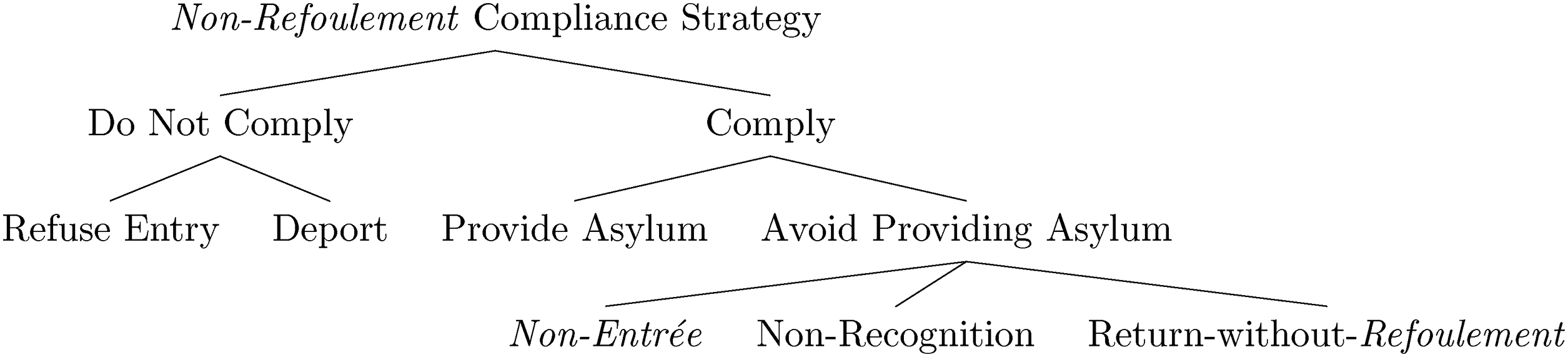
Refugee Non-Refoulement Compliance Strategies.
However, the compliance choice set does not end there. States can opt to comply with non-refoulement while avoiding providing asylum. Non-entrée is one such strategy. But by not limiting the phase of compliance in this decision tree, we can see there are several other related strategies that (a) seek to comply with non-refoulement while (b) avoiding providing asylum. This subset of strategies is enlarged in Figure 2.
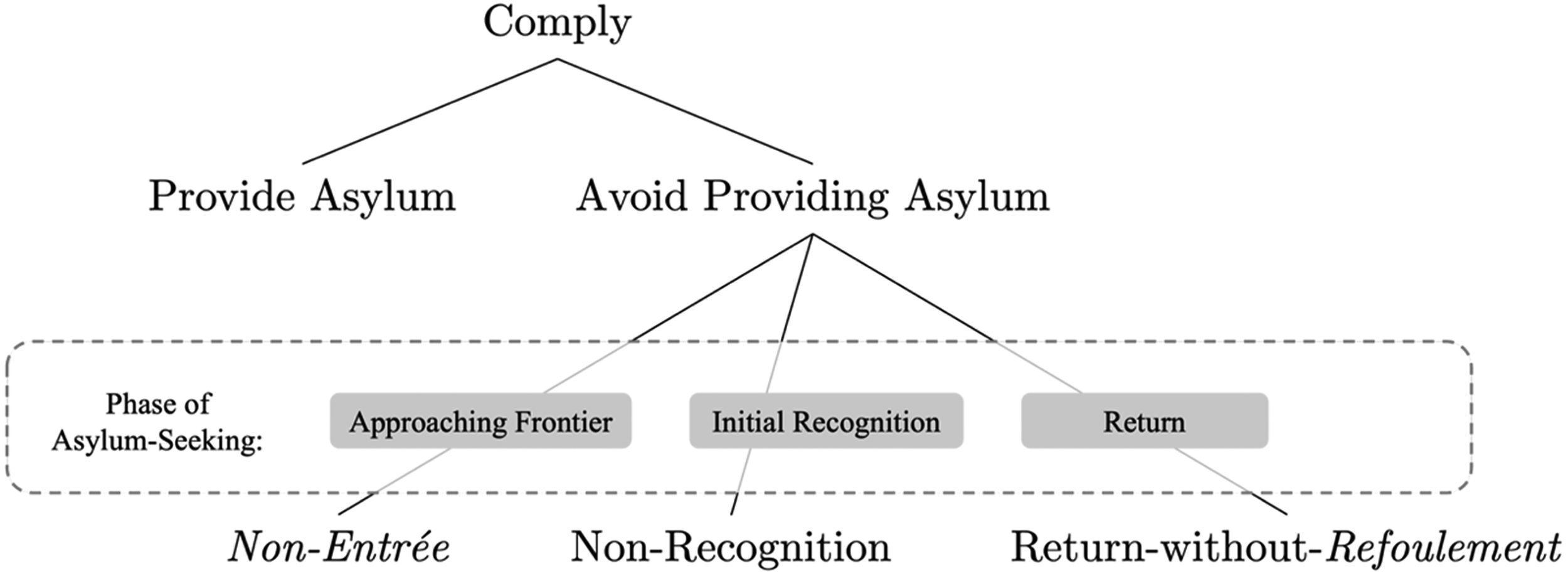
Strategies to Comply but Avoid Providing Asylum.
From this, we can see that the choice set of avoidance strategies is greater if we consider compliance with non-refoulement to be an ongoing decision beyond the initial phase of refugees approaching a border, including initial recognition of refugee status, and refugee return. Strategies to avoid providing asylum are therefore likely more widespread than the assumed limitation to the Global North; they also share the quality of technically complying with non-refoulement, while potentially violating other standards outlined by the Refugee Convention or other regional conventions and human rights laws.
Table 1 introduces a typology of these evasion strategies, organizing them by compliance phase. Non-entrée complies with non-refoulement by preventing asylum-seekers from reaching a states’ jurisdictional territory and precluding protections from being invoked. Non-entrée is more likely to be successful if states are further away from the origin of refugees’ journeys, slowing down the rate of arrival and creating opportunities for cooperation with transit states. Such tactics also tend to require institutional investment, for example building offshore detention centers or using political leverage to coerce transit states to enforce migration control. Moreover, offshoring asylum claims decisions often relies on the delays associated with evaluating each case through individual RSD thereby keeping asylum seekers off the states’ territory for longer. States in the Global North are therefore better able to employ non-entrée tactics as they tend to be further from the origins of cross-border displacement, with harsh geographic obstacles making the approach to their physical border more difficult, and have greater financial, administrative, and political power.
Typology of State Strategies to Avoid Refugee Hosting and Comply with Non-Refoulement.
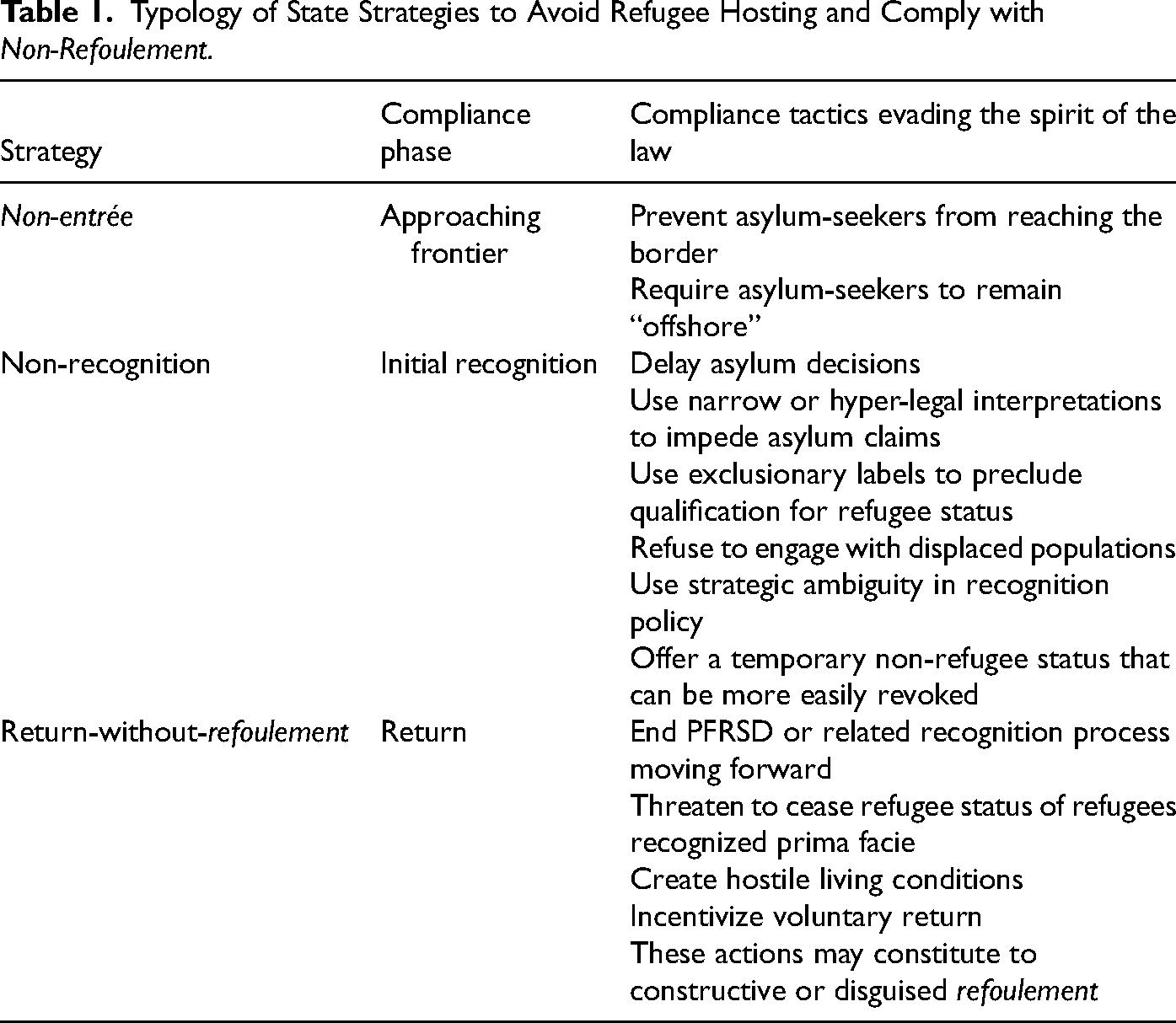
Taking other phases of asylum-seeking into account reveals two other sets of strategies. If refugees make it to—or across—a state's borders, states can refuse initial recognition of refugee status, a strategy type I call “non-recognition.” States may use strict adjudication guidelines to deny individuals’ asylum claims or apply legal or rhetorical labels that discredit asylum-seekers’ claims as “true refugees” to obfuscate official recognition of refugee status (Zetter 2007; Hamlin 2021). Denying asylum claims based on hyper-legal interpretations of the refugee definition allows states to legally expel individuals as they do not qualify for non-refoulement protection.
In cases where there is rapid, mass displacement across a border, it is also possible delay or avoid de jure status recognition for the entire group. For example, states may offer a non-refugee Temporary Protected Status (TPS). This allows states to tacitly comply with non-refoulement by allowing people who qualify for protection to stay but not labeling them as refugees and potentially setting them on a path to more permanent settlement. This is, for example, how the European Union responded to the mass displacement of Ukrainians directly across the border. States may also respond with indifference or ambiguity to avoid initial recognition (Norman 2020; Abdelaaty 2021; Stel 2021; Natter 2021).
Many states in the Global South, however, initially welcome refugees, responding to mass, rapid displacement by prima facie recognizing refugee status for all individuals within a given group. While states may initially allow refugees in, they may not want to continue to provide asylum in perpetuity, despite refugees’ ongoing qualification for protection. However, they are precluded using either non-entrée or non-recognition strategies as refugees are now recognized on their territory. Rather than having no choice but to host refugees, I argue that these states can engage in a strategy I call “return-without-refoulement” to repatriate recognized refugees on the state's territory while arguably upholding non-refoulement. I conceptualize this strategy in full below.
Conceptualizing Return-without-Refoulement
Return-without-refoulement is a political strategy through which a state seeks to facilitate the expulsion of those who qualify as refugees while remaining arguably one step removed from technical violation of non-refoulement. The strategy includes tactics that take advantage of two legal grey-areas: (1) Article 1C(5) and (6) of the 1951 Refugee Convention allows states to end refugees’ protection if the circumstances which forced them to flee cease; 4 however, the legal standard for such improved conditions is opaque and refugees’ views on their safety are considered biased relative to the host state's analysis (Hathaway 2005; Barnett and Finnemore 2004; Cole 2023). Second, while refugees cannot be forced to return to places where their life or liberty may be in danger, they can return to those places voluntarily, and there is no legal standard for when coercive or incentivizing tactics pressuring refugees to return voluntarily cross the line into forced return (Rodenhäuser 2023; Mathew 2019).
Return-without-Refoulement in Practice
Lebanon's response to Syrian refugees provides an interesting example of this tactic. At the outset of the crisis in 2011, Lebanon de facto prima facie recognized displaced Syrians, allowing UNHCR to register Syrians as refugees (Janmyr 2018). While Lebanon is not a signatory of the 1951 Refugee Convention and eschewed the label of “refugees,” the government tactility afforded UNHCR's refugee registration legal value, enacting a residency policy that Syrians could either be registered as refugees with UNHCR or obtain legal status as economic migrants (Janmyr 2018).
By 2014, hosting more than one million Syrian registered refugees, Lebanon sought ways decrease refugee hosting. They imposed restrictions on the registration process and pressured UNHCR to reassess registered refugees’ qualifications for international protection and de-register those who did not qualify. UNHCR readily complied. By October 2014 an estimated 68,000 Syrian refugees had their status revoked (Janmyr 2018). In 2015, Lebanon fully suspended UNHCR's registration of refugees effectively ending the de facto prima facie RSD.
Similar behavior has been documented, for example, towards Eritrean refugees in Ethiopia in (Cole 2023) and against Burundians in Tanzania in 2009–2012 (Rema Ministries 2012; Amnesty 2009).
For example, in 2006 and early 2007 Pakistan registered Afghans arriving on their territory as refugees in a process UNHCR considered PFRSD in everything but name (UNHCR 2015a). In February 2007, Pakistan changed its policy, no longer recognizing newly arriving Afghans as refugees, but not ceasing the status of those already recognized. Years later in 2016 in response to several international and domestic developments, the Pakistani government engaged in a violent campaign to pressure refugees to return. The government subjected Afghan refugees to police abuse and detention, made persistent threats of deportation in the media, raided refugee shelters, excluded Afghan refugee children from state schools and closed refugee schools (Human Rights Watch 2017).
Bangladesh used similar coercive tactics against the Rohingya in 2022, for example, with the government intensifying restrictions in camps, demolishing thousands of shops, and banning Rohingya teachers from setting up schools to pressure them to relocate or return. (Human Rights Watch 2022)
Not all coercive tactics are negative. Many states incentivize refugees return by offering aid packages to those who return voluntarily. These packages may be state sponsored, as is the case in Germany, or administered in coordination with UNHCR (Rebecca Seales 2017). Working with UNHCR effectively launders actions that might otherwise be construed, even by UNHCR's own standards, as coercing return. In the case of Pakistan described above, UNHCR worked with the government on a massive cash incentive program, offering approximately $400USD to Afghan refugees in Pakistan who chose to return. Between the coercive tactics and cash incentives, an estimated 365,000 of Pakistan's 1.5 million Afghan refugees were coerced into returning. 5
Kenya has used similar incentives to coerce the Somali refugee population to return. In 2016, for example, the government issued renewed threats that they would close down Dadaab Refugee Camp. Despite UNHCR's statement that conditions in many parts of Somalia were not safe, following Kenya's threats to close Dadaab, UNHCR worked with the Kenyan government to accelerate voluntary repatriation, intensifying their cash incentive programs for refugees. Though UNHCR required returnees who took the cash advances to sign a form stating their choice to repatriate was voluntary, investigative reports have demonstrated how the restriction of aid to Dadaab, intimidation of the refugee population by Kenyan authorities, and the prospect of losing out on the $400USD payment coerced many Somalis to enlist in the program (UNHCR 2015c; Sieff 2017).
Strategic Incentives to Use Return-without-Refoulement
For host-states, return-without-refoulement is a response to competing incentives to expel refugees while maintaining international legitimacy. The reputational costs of not allowing refugees in at the height of mass displacement are perceived to be high, and host states may want to maintain foreign economic assistance, protect their reputation as a good faith actors in the refugee protection regime, or they may see accepting certain refugee populations as beneficial foreign policy (Greenhill 2010; Adamson and Tsourapas 2019). At the same time, however, host governments may face domestic pressure to stop hosting refugees due to influential elite-level preferences and/or popular xenophobia or racism (Betts 2013; Norman 2020; Abdelaaty 2021).
While return-without-refoulement is a host-state strategy, it is more likely to be successful when host- and home-state preferences align. It is easier for host states to engage in return-without-refoulement when they can make a plausible argument that the situation in the refugee-sending country is safe enough for refugees’ return. A return-without-refoulement strategy, therefore, may function as a form of mutually beneficial migration diplomacy (Adamson and Tsourapas 2019). Countries-of-origin get to project the appearance of “safe conditions” for return and host states can improve their popularity among domestic constituencies without jeopardizing international aid or reputation. Unilateral use of these tactics may occur but is riskier reputationally.
And indeed, many refugee-sending states also have incentives to encourage refugee repatriation. Large-scale voluntary refugee return is a useful for countries looking to improve their reputation with regard to human rights, providing “evidence” that people are willing to return. Moreover, orchestrating that return allows for increased origin-state surveillance of civilians who they believe oppose the regime (Turner 2013; Tsourapas 2020). Syria's President Bashar al-Assad, for example made repeated calls for refugees to repatriate, touting the safety he brought to the country by defeating ISIS. Controlling return and filtering civilians as “loyal” or “disloyal” was part of the government's strategy in constructing its postwar regime (Abboud 2024).
Scope
Return-without-refoulement is a host state strategy that may work in tandem as migration diplomacy with refugees’ countries-of-origin. This is distinct but related to both international organizations’ behavior (e.g., Barnett and Finnemore 2004) and individual-level perceptions of pressure to leave (e.g., Braithwaite, Ghosn and Hameed 2021).
While return-without-refoulement can and has been used worldwide, it is more common in the Global South. Rich democracies’ success using non-entrée and non-recognition tactics like TPS precludes the need to use return-without-refoulement. Moreover, return-without-refoulement is easier to use where states have initially recognized refugees prima facie, and PFRSD is most common in the Global South. This is not because states initial application of PFRSD was nefarious. Rather it is because (a) in-country refugee protections under PFRSD are often limited, and states therefore have more tools to coerce return; and b) since the strategy involves questioning refugees’ qualification for international protection, it is easier to use and likely to affect a greater number of people where refugees were recognized based on characteristics of a group as opposed to having to reevaluate qualifications on a case-by-case basis.
Return-without-refoulement is also district from orchestrating truly voluntary return or return under truly improved circumstances. Voluntary return and return-without-refoulement may occur simultaneously, as there is likely to be a heterogeneity of return preferences among refugees. Recognizing the agency of those refugees who repatriate voluntarily and protecting the right to return is paramount (Bradley 2013). Identifying certain state behaviors as return-without-refoulement tactics, however, demonstrates how states shape the choice set available to refugees by manipulating conditions in exile.
Finally, return-without-refoulement is distinct from outright refoulement of refugees.
Whereas the simplest route to end refugee hosting would be expulsion, a return-without-refoulement strategy is designed to be at least one step removed from expulsion, often through more cumbersome and less effective tactics. Relatedly, using a return-without-refoulement strategy does not mean that states will be successful at forcing refugees to return. Indeed, return-without-refoulement is likely to be less effective than strategies like non-entrée as it is harder to eject already recognized refugees on a states’ territory if said state is concerned about the appearance of upholding non-refoulement.
Return-without-refoulement is therefore not a legal classification; rather it describes a strategy that is intentionally legally opaque. Many experts argue the tactics described above should and do constitute violations of non-refoulement. International law scholars including the International Law Commission, human rights advocates and (at times) UNHCR classify tactics designed to make life so difficult that refugees “choose” to leave as “constructive” or “disguised” refoulement. However, at present, there is no international treaty or soft law instrument explicitly prohibiting such practices. Moreover, proposed legal standards for disguised refoulement remain high: demonstrating that actions or omissions attributable to the state created conditions intended to provoke refugees into leaving and that they do in fact leave (Rodenhäuser 2023). UNHCR is also uneven in sanctioning states for engaging in such tactics, and they themselves are often implicated in facilitating their use. Return-without-refoulement tactics therefore include disguised or constructive refoulement, as well as tactics that create hostile living conditions that may fall short of “creating no other choice,” or in cases where refugees choose to stay despite the increased precarity. Recognizing return-without-refoulement as a political tactic distinct from a legal classification reveals how international legal norms shape states behavior, even in their attempts to thwart its spirit.
Case Study: Coercing Voluntary Return from Tanzania to Burundi (2017–2024)
The following section examines Tanzania's hosting of Burundian refugees from 2017 through 2024 to illustrate use of a return-without-refoulement strategy. I first outline Tanzania's policies prior to 2017. I then analyze their response post-2017 highlighting (1) the observable tactics of return-without-refoulement described in typology and (2) the strategic incentives for engaging in return-without-refoulement.
Prior Refugee Hosting Context
Burundians have periodically sought refuge in Tanzania amid a decades-long history of cycles of violence in their country-of-origin. Most recently, in 2015 Burundian President Pierre Nkurunziza's decision to run for an arguably unconstitutional third term in office sparked a political crisis in which the government carried out widespread repression against anyone perceived to oppose them. Once the darling of the peacebuilding community, Nkurunziza's actions received a direct public rebuke from then-U.S. President Barack Obama, whose administration subsequently levied sanctions against the Burundian government, a marked ratcheting up of international pressure (VOA News 2015). Amid the crisis, hundreds of thousands of Burundians sought refuge in Tanzania.
Prior to their arrival, in 2005, the ruling Chama Cha Mapinduzi (CCM) party in Tanzania had committed to making Tanzania “refugee free” (Milner 2013). 6 Towards this end Tanzania had been engaging in a two-pronged approach. For the nearly 200,000 Burundian refugees who had been in Tanzania since the 1970s in camps called the “Old Settlements,” the government made the unprecedented offer of naturalized citizenship. With all eyes on the extraordinary nationalization program, Tanzania took a much harsher approach to Burundian refugees who arrived during the civil war in the 1990s living in the so-called “New Settlements.” While Burundi's civil war ended in the early 2000s, and an estimated 500,000 Burundians voluntarily returned, many aspects of the conflict remained unresolved, and refugees’ return had increased local tensions (Schwartz 2019). Many of the Burundians remaining in the New Settlements therefore did not feel safe returning. Despite these conditions, in 2009 Tanzania announced they would be closing these camps and ending Burundian refugees’ status. Over the next several years, the government worked with international organizations to interview all the Burundian refugees in the New Settlements to see if they qualified international protection based on individual persecution. In the end, approximately 37,000 refugees had their status revoked with only around 2,700 found in need of continued international protection. In tandem, from 2009 to 2012, Tanzania also used violent tactics to coerce refugees to return including intimidation, withholding of aid, restricting access to schools and markets, alleged burning of refugees’ homes, and violently forcing refugees on to buses back to Burundi (Rema Ministries 2012; Amnesty International 2009).
It was only a few years later in 2015, that thousands of Burundian refugees again began to cross the border into Tanzania daily.
Return-without-Refoulement, 2017–2024
For the first year and a half of the crisis, Tanzania allowed Burundians to cross the border, with an estimated 216,000–246,000 Burundian refugees recognized prima facie between 2015 and 2017 (UNHCR 2023). By 2017, however, the Tanzanian government was looking for ways to avoid hosting hundreds of thousands of Burundians indefinitely. In January 2017, Tanzania announced an end to the prima facie recognition policy: all newly arriving Burundians would have to apply for individual RSD (UNHCR 2018). And government officials began to encourage voluntary return. In July 2017, following a meeting between Tanzanian president John Magafuli and Burundian President Nkurunziza, President Magafuli stated “It's not that I am expelling Burundian refugees. I am just advising them to voluntarily return home,” while President Nkurunziza added, “Today I want to tell Tanzanians and Burundians that Burundi is now peaceful and I am inviting all Burundi refugees to return home,” (Okiror 2017; Nkundikje 2017). In the 2 years following the end of PFRSD, Tanzania did not recognize status for any newly arriving Burundians (UNHCR 2022).
While publicly touting improved circumstances, Tanzania began a public information campaign informing Burundians they would soon be kicked out if they did not leave on their own and creating adverse living conditions to encourage return. This included a so-called phased shut down of the camps, starting by reducing the number of market days in camp, restricting permits to travel outside of camp, and banning the sale of transport, telecommunication and other non-food items (Van Laer 2018). Over the next few years, there were further restrictions shuttering nearly all economic activity in camps (Boeyink and Falisse 2021). Tanzanian officials regularly went to the camps to inform Burundians they must go home now because it was peaceful, and signs were posted around camp advertising the closures of markets and emphasizing the need to return (Van Laer 2018). Given Tanzania had used similar tactics in 2009–2012, rumors swirled among camp denizens that refugees from 2015 would soon be kicked out, just like before. 7 Amid this uncertainty and pressure, thousands of Burundians began returning. Others–still too scared to return–stayed despite the worsening conditions.
In 2019, a confidential bilateral agreement between Burundi and Tanzania leaked detailing the governments’ plans to coordinate their efforts to return the refugees. The agreement included that if refugees would not return voluntarily, the governments would seek to forcibly return them (Human Rights Watch 2019; Amnesty International 2019). Thus, while the goal of returning refugees regardless of non-refoulement was clear, the governments had tried to keep those intentions secret, even if they were not successful in doing so.
Once leaked, UNHCR rebuked the agreement, issuing a statement that all returns must be voluntary and reiterating that the agency would only assist in spontaneous voluntary repatriation rather than organizing efforts to repatriate refugees (UNHCR 2019a). UNHCR's refusal to organize a coordinated campaign was due to their assessment that the political situation in Burundi had not improved enough. Indeed, the situation in Burundi remained dangerous. A United Nations Commission of Inquiry into the human rights situation found that human rights violations were ongoing (United Nations Human Rights Commission 2018). Still, UNHCR continued to engage in tripartite discussions for planning future returns and facilitated the return of those Burundians who chose “on their own” to return.
One reason UNHCR was hesitant to take stronger action against Tanzania's clear efforts to coerce return was because the agency was in the process of working with the Tanzanian government to finalize the naturalization of the Old Settlement refugees, which was stalling out. In interviews, NGO staff and UNHCR officials repeatedly referenced Tanzania's gracious naturalization of the 1972-cohort as a reason why they could not press the government on its treatment of the 2015-cohort. 8
Central to Tanzania and Burundi's efforts to repatriate refugees was a public campaign to reframe Burundians living in Tanzania as economic migrants fleeing poverty, who therefore did not qualify for refugee status to stay in Tanzania. As one ministry official explained to me in 2017, the Burundians were only leaving because they were hungry and wanted to come back to Tanzania to “reap the benefits” of being in camp. 9 Tanzania also denigrated the Burundian refugees in public and private statements. Government officials played on stereotypes of Burundians as criminals and bandits, bringing instability and violence from their country-of-origin with them to Tanzania. 10
As a part of this campaign, the government promoted a legal fiction that they were complying with international law. The Minister of Home Affairs stated in 2017, for example, that “International law has dictated that if people want to return to their homeland voluntarily, it is the responsibility of the government in the relevant country to communicate with stakeholders involved in refugee issues for their repatriation,” (Damian 2017). In 2019, a new Minister of Home Affairs went so far as to proclaim, “Peace has returned to Burundi, this reason does not give refugees the opportunity to obtain refugee status in [this] country, that is a government order’ (Karlo 2019).
All these actions—restriction of movement, maintenance of unlivable conditions, ending prima facie RSD, reframing refugees as economic migrants, undermining claims to international protection—aligned with Tanzania's ruling party's stated goals since 2005 of creating a refugee free Tanzania. However, the government did not simply deport Burundian refugees en masse. Instead, they invested in a multifaceted campaign framing Burundian refugees as no longer qualified for international protection and enacting restrictions on their daily life, suggesting a desire to remain at least one step removed from outright violation of non-refoulement.
While return-without-refoulement is a host-state strategy, in this case, Tanzania's goals aligned Burundi's. Burundian President Nkurunziza had incentives to demonstrate his continued rule was legitimate to extend his term in office and repress opposition, despite US sanctions, a United Nations commission of inquiry, and International Criminal Court investigations into human rights violations. To this end, Nkurunziza and other Burundian government officials repeatedly claimed that refugee return was evidence of peace and stability in the country, and that those claiming Burundi was not peaceful were lying for their own agenda. For example, in 2016, Foreign Minister Willy Nyamitwe went before the United Nations General Assembly to claim that all was well in Burundi, using the alleged return of 90,000 refugees as evidence. In 2017, he tweeted “#Tanzania Minister for Home affairs says thousands of #burundi refugees went back home but #UNHCR doesn't want it to be known.” 11
And Tanzania was invested in supporting Burundi's improved international image. As Tanzanian Minister of Home affairs explained in 2019, “Tanzania…is not ready to be seen painting a bad image of Burundi… If we deny [the] repatriation, it's an indication that we are painting Burundi, that there is no peace. So, one way to paint Burundi a good image, is to make sure that we facilitate all Burundians to go back home, and to show the world community, that Burundi is ok, Burundi is peaceful” (Kangi Lugola, Minister of Home Affairs 2019).
Despite the governments’ insistence that Burundi was peaceful, there was mounting evidence that the government targeted returned refugees as potential threats to the regime (Maclean 2019, Freedom House 2021). Burundians who remained in exile were assumed to be opposition-party supporters, and Burundi was gearing up for two electoral campaigns (a 2018 constitutional referendum, and 2020 multi-level election). By encouraging refugee return, but then covertly surveilling, detaining, torturing, or killing returning refugees, the Burundian government could signal to the international community that their human rights record was improving because refugees were “choosing to return,” while maintaining strict control over perceived opponents.
After Nkurunziza's sudden death in June 2020, newly installed President Evariste Ndayishimiye held the line against international interference in Burundi, insisting the country was peaceful and referencing refugee return as evidence thereof. At his swearing in, Ndayishimiye urged all refuges living abroad to return. Then, in September 2020 at the UN General Assembly, Ndayishimiye rebuked the international community for intervening in the country's affairs in the name of human rights, claiming that “the massive voluntary return movement is an obvious manifestation of the return of peace, tranquility, trust and stability in the country” (Ndayishimiye 2020).
The strategy was relatively effective. In 2020, the UN Special Envoy for the Great Lakes region noted “the prospects for greater regional stability, as illustrated by the return of Burundian refugees from Rwanda and the United Republic of Tanzania” (United Nations Security Council 2020). In the same meeting, Russia and China used the same litmus test to praise Burundi's progress towards peace, claiming that, given such indicators of peace, the Council should remove Burundi from its agenda (United Nations Security Council 2020).
Since 2017, UNHCR reported that 178,000 Burundian refugees have “voluntarily” returned, and that as of November 2024, 144,500 refugees remained in camps. In press releases responding to media reports that Tanzanian government officials had announced they planned to close of the refugee camps by the end of 2024, UNHCR insisted that no one would be forced to return and that any return must be truly voluntary as outlined by the 2001 Tripartite agreement (UNHCR 2024). However, by December 2024, UNHCR announced that they are gearing up to support the government in an exercise that sounds eerily familiar to the efforts in 2009–2012 to close the camps, “undertaking comprehensive protection and solutions-based assessments… to identify appropriate solutions for Burundian refugees who are yet to return” (UNHCR 2025).
Conclusion
Why are states attempting to coerce refugees to return when one of the world's strongest human rights norms, non-refoulement should preclude it? Using a novel typology of state responses to asylum seeking, this article demonstrates that rather than evidencing non-refoulement's weakening, non-refoulement's continued strength is evident in shaping the ways in which states go about coercing refugee return. I demonstrate this through the identification of return-without-refoulement as common strategy states use to avoid continuing to host refugees. States do not simply deport refugees on their soil but take costly action to frame their efforts to coerce refugees into returning “voluntarily” as legal, given changing circumstances in refugees countries-of-origin.
Identifying and describing the return-without-refoulement strategy advances forced migration research in several ways. First, without recognizing this set of behaviors as a strategy parallel to other evasion strategies, we fail to observe how many states in the Global South manipulate liberal policies towards illiberal ends, just as rich democracies do. Obscuring this pattern has attendant measurement and research design implications for the discipline. For example, measuring de jure state asylum policy in the Global South significantly advances our understanding of state responses to displacement (Blair, Grossman and Weinstein 2021). Identifying return-without-refoulement, however, suggests de jure measures may not reflect the liberality of states’ asylum policies in practice. This suggests a need for future cross-national data collection on de facto state responses to displacement, including those presented in the descriptive typology.
Relatedly, identifying return-without-refoulement suggests that measurement of refugees’ individual- and group-level decision-making vis-a-vis return must take state practice into account. Recent events, particularly in Syria, spurred interest in understanding the micro-dynamics of refugee return (see e.g., Alrababah et al. 2023; Ghosn et al. 2021; Braithwaite, Ghosn and Hameed 2021). Identifying states incentives to use return-without-refoulement demonstrates how refugees’ choices whether to return are shaped by strategic incentives at play between host countries, countries-of-origin, and international organizations. As such, without denying refugees’ agency in decision-making, questions of “who returns?” and “why?” cannot be answered exclusively at the level of individual choice.
The article also points to new avenues of research on the distinction between compliance and strength of human rights norms. Human rights scholars have shown how compliance with the letter of international law can have perverse effects on the intended spirit (Búzás 2021). The typology presented above demonstrates that within the refugee governance regime such strategies may be the rule, not the exception. Identifying the widespread use of norm evasion suggests that future research on human rights norm strength would benefit from a regime-level approach, asking whether an overemphasis on one norm over others can “hollow out” a normative regime, such that a central rule like non-refoulement remains strong, but the protection of rights is eroded. In addition, having identified behaviors previously analyzed independently as, instead, tactics of a commonly used strategy in the Global South, this article lays the conceptual groundwork for future comparative analysis of the relative strength of asylum norms and their effects on state behavior.
Finally, identifying how return-without-refoulement tactics violate other human rights laws and standards outlined in the Refugee Convention reveals a different source of vulnerability for refugees: safety in asylum. While there may be low levels of documented voluntary refugee return, states’ attempts to coerce refugee return by threatening status cessation and creating hostile environments create increased physical and legal precarity for refugees who are meant to be being provided with international protection. This vulnerability is particularly acute for refugees recognized prima facie—the majority of refugees worldwide.
These findings therefore suggest a different diagnosis of the central pathology of the refugee regime. Both scholars and practitioners point to states in the Global North's evasion of asylum norms exacerbating inequalities in refugee hosting as one of the central issues plaguing the regime. Conversations among scholars and policymakers on how to improve refugee protection therefore focus on “responsibility sharing” between the Global North and South (see e.g., Gibney 2015; Betts and Collier 2017; Aleinikoff and Owen 2022). Even critical views that move beyond the language of responsibility sharing argue that migrants from the Global South should have the right to live on the territory in rich democracies (Achiume 2019). And attempts at policy reform, including the 2016 New York Declaration on Refugees and Migrations and 2018 Global Compact on Refugees, seek to provide a framework for more predictable and equitable responsibility-sharing.
Recognizing return-without-refoulement as state strategy and placing it analytically alongside strategies of non-entrée and non-recognition, however, suggests a different issues: that the emphasis on non-refoulement over all other rights and standards in the regime has perverse effects: simultaneously reinforcing the principle of access to asylum, while eroding the practice of protecting refugees. This erosion persists even in places where asylum-seekers are admitted and recognized as refugees on a host-country's territory. As such, advocates seeking to improve the global refugee and asylum system may need to consider how to improve the quality of refugees’ protection in host states, rather than focusing on which states’ territory they should be hosted.
Footnotes
Acknowledgments
The author extends their sincere thanks to Fiona Adamson, Jack Amon, Rawan Arar, Chris Blair, Kate Cronin-Furman, Tamarice Fakhoury, David Fitzgerald, Page Fortna, Kelly Greenhill, Alexandra Hartman, Michael Kenwick, Sarah Khan, Rana Khoury, Milli Lake, Adam Lichtenheld, Zeynep Mencütek, Lama Mourad, Rohan Mukherjee, Achel Nimenya, Derya Ozkil Kusoglu, Barry Posen, Jack Snyder, Abbey Steele, Beth Whitaker, the participants in MIT Security Studies Program seminar, the University College London Conflict and Change workshop, and the LSE Security and Statecraft seminar, as well as panelists and discussants at International Studies Association 2021, 2022 and Midwest Political Science Association 2022.
Declaration of Conflicting Interests
The author declared no potential conflicts of interest with respect to the research, authorship, and/or publication of this article.
Funding
The author received financial support for the research from the National Science Foundation, the U.S. Institute of Peace, and the Columbia Global Policy Initative.
