



Abstract
International football can be considered the main site for meaning-making processes related to national and racial/ethnic diversity. Various scholars have argued how international football, with the World Cup as its apex, can be seen as a barometer for understanding dominant attitudes towards societal diversity. A key domain where this diversity is interpreted and given meaning to is mediated football. To provide a wider overview of – often intersecting – meanings given to nationality and race/ethnicity over a longer period of time, this explorative study uses a historical approach to inquire how Dutch-mediated football – especially football commentary on television – has given meaning to a diversifying Dutch national team at three moments in time (the World Cups of 1974, 1998 and 2014). Further, it discusses how mediated football serves as a site for the (re)construction of discourses surrounding nationality and race/ethnicity in the Netherlands. Our findings show that meanings given to nationality and race/ethnicity are fluid, context-dependent and reconstructed in a particular temporal context. Further, it appears that key players have provided a significant role in meanings given to (super-)diversity of the Dutch national football team. Commentary on White Dutch key players was dominated by positive comments (in the World Cups of 1974 and 2014), while comments on Black Surinamese Dutch key players was relatively more negative (in the 1998 World Cup). Moreover, our results contrast with earlier studies in that Dutch commentators did not rely on stereotypical representations of Black Dutch footballers as ‘naturally’ athletic.
Keywords
In recent decades, many national football teams have become more diverse in terms of their players’ (dual) nationality and racial/ethnic backgrounds, 1 mainly reflecting the migration histories of these countries. Despite diverse backgrounds, national representatives are formally part of the nation they represent on the field (Van Campenhout, 2022). However, within mediated discourse, they are often still seen as being different from the national imaginary. One key domain where these diverse players are being represented and given meaning is in (football) media. While following of football online has become popular in the past decade, televised football remains a core component of football consumption in many countries worldwide, especially during major events such as the World Cup. Given the diversity of players it shows and the massive audiences, we consider televised football as a key cultural domain for the display of and meaning given to (super-)diversity in contemporary multi-ethnic society (Ličen, 2015; Van Sterkenburg et al., 2019).
Previous studies on mediated football have found that overwhelmingly White and male, football commentators often ‘speak through’ dominant and occasionally stereotypical discourses on nationality and race/ethnicity (Bruce, 2004; Campbell and Bebb, 2022; McCarthy et al., 2003). Studies identified various forms of ‘othering’ towards national representatives with a migration background 2 (Campbell and Bebb, 2022; Van Campenhout and Van Houtum, 2021) and (re)productions of the ‘natural Black athlete’ stereotype (Hylton, 2009; Longas Luque and Van Sterkenburg, 2022; McCarthy et al., 2003; Van Lienden and Van Sterkenburg, 2022). Various other studies have shown that also in the Netherlands dominant discourses on the nation, nationality and race/ethnicity are reproduced and reconstructed in football commentary (Van Sterkenburg, 2011, 2013; Van Sterkenburg et al., 2012). However, these studies – in the Dutch context and beyond – generally focus on contemporary sporting events while a historical perspective and contextualisation of findings usually does not take centre-stage. A historical contextualisation can, nonetheless, help to expose how discourses surrounding nationality and race/ethnicity are dynamic, and to illuminate the role mediated football plays in these processes. We, therefore, pose the question ‘How have Dutch football commentators given meaning to the (super-)diversity of (players of) the Dutch national team during the World Cups of 1974, 1998 and 2014?’ As our study is on the (re)production of discourses in past and present, it delivers insights in the – historically shifting – collective (re)constructions of ‘Dutchness’ and the Dutch nation in various historical phases of migration in the Netherlands and, hence, into the temporal contextuality of national and racial/ethnic discourses.
This article starts by explaining how (super-)diversification of societies is predominantly a reflection of national migration histories, which in itself seems to be reflected in the selections of players to the national football team. This is made insightful by shortly discussing the migration history of the Netherlands, relating these changes in migrations to alterations in national imaginaries of ‘Dutchness’. Using the Dutch national team as a case study, we explain how in mediated football meaning is given to racial/ethnic and national diversity and how this provides insights into the (historical) reconstruction of social categories of race/ethnicity and nation in the context of international sporting events like the World Cup. The diversification over time of the (men's) Dutch national team is then explained by focussing on the live commentaries of Dutch football commentators during selected matches of the Dutch national team in three editions of the World Cup: 1974, 1998 and 2014. After this, our methodological section describes how we used qualitative verbal content analysis in the selected games of these World Cups, before moving on to our findings and discussion in which we identify and discuss the key themes emerging in this analysis.
(Super-)diversification: Dutch migration history and ‘Dutchness’
In many national contexts, the composition of its representative football team offers a snapshot of its societal ‘diversity and demography, while the football press and public's attitudes to the teams make the politics of nation and migration, race and ethnicity, more transparent than in many areas of public life’ (Goldblatt, 2021). Research also indicates that, throughout the history of the World Cup, some national football teams – mostly the ones with a rich migration history – are characterised by a national team existing of (super-)diverse national representatives (Van Campenhout, 2022). While the presence of football players with a migration background in these national teams is nothing new, as it corresponds to broader patterns and trends in international migration and more specifically reflects national migration histories (Taylor, 2006; Van Campenhout et al., 2018), the heterogeneity of these national representatives is increasing in terms of their countries of origin, ethnic and national groups, religions and languages; an increase that can be seen as an expression of (super-)diversification in many contemporary societies (Van Campenhout and Van Sterkenburg, 2021; Vertovec, 2007). This so-called globalisation of migration (Castles et al., 2014) has brought with it a transformative diversification of diversity (cf. Hollinger, 1995). Vertovec (2007: 1025) argues that studying these multiple processes of diversification in solitude ‘provides a misleading, one-dimensional appreciation of contemporary diversity’. As we are witnessing a level and kind of complexity of diversity that surpasses anything society has previously experienced, Vertovec (2007: 1024) coined the term ‘super-diversity’ to emphasise the dynamic interplay between these multiple processes of diversification and to extend our understanding of diversity. Nonetheless, in some – mainly Western – societies, diversity remains predominantly observed in terms of country of origin or race/ethnicity, in both social sciences and the wider public sphere.
Diversity is considered to be characteristic of the Netherlands because of its long and rich migration history (Lucassen and Lucassen, 2018). Like certain other West European countries, the Netherlands can be considered a ‘country of immigration’ (Hollifield et al., 2014: 13; Lechner, 2008) – meaning that it historically has witnessed a larger inflow of migrants than outflow – although ‘the Dutch did not regard their country as one of immigration’ (Van Amersfoort and Van Niekerk, 2006: 324). This mismatch, between the actual number of immigrants to the Netherlands and its imaginaries, especially arose after the 1960s when the face of migration to the Netherlands changed. Whereas immigration to the Netherlands before then tended to be predominantly temporary, with migrants moving back ‘home’ when employment decreased, after the 1960s immigration often had a more permanent character. This change was mainly fuelled by (a) improved living conditions in the Netherlands, (b) global processes of decolonisation and (c) changes in national legislations, policies and ideologies on immigration and naturalisation (Lucassen and Lucassen, 2018).
Looking at the most prevalent non-Western minority groups in today's Dutch society, five countries of origin stand out: (a) Indonesia, (b) ‘the Netherlands Antilles’, 3 (c) Suriname, (d) Morocco and (e) Turkey. The majority of the 350,000 people with an Indonesian migration background currently living in the Netherlands – whose population counts almost 17.5 million in 2022 – are in some way related to the (estimated) 250,000–300,000 persons who forcefully left the Dutch East Indies 4 after its independence from the Netherlands in December 1949 (Statline, 2021; Van Amersfoort and Van Niekerk, 2006). In the Dutch Caribbean, Suriname gained its independence from the Netherlands in November 1975 – unlike the islands of the ‘Netherlands Antilles’ which are still part of the Kingdom of the Netherlands (though some have independent national governance within the Kingdom). Whereas historically, Surinamese people already migrated to the Netherlands before the 1970s, mainly in search of better living conditions and greater social security, the number of Surinamese migrants to the Netherlands took a flight in the 1970s in anticipation of Suriname's independence (Van Amersfoort and Van Niekerk, 2006). Today, nearly 360,000 Dutch inhabitants have a Surinamese migration background, and over 170,000 people have their roots in the ‘Netherlands Antilles’ (Statline, 2021). 5 The presence of people who belong to the Moroccan and Turkish minority group in Dutch society mainly stems from the migrations of guest workers from these countries in the 1960/1970s. As a consequence of these migratory movements – and subsequent chain migrations – to the Netherlands, nearly 415,000 people of Moroccan descent and 422,000 people with a Turkish migration background are now living in the Netherlands; making them the two largest minority groups in Dutch society (Lucassen and Lucassen, 2018; Statline, 2021).
As immigration has not been a fundamental part of Dutch national identity, public attitudes towards (specific groups of) immigrants are rather hostile (Kešić and Duyvendak, 2019; Lucassen and Lucassen, 2018). In particular, this hostility seems to be directed at Muslim immigrants from Islamic countries and at people with a migration background whose phenotype differs from the White Dutch stereotype (Kešić and Duyvendak, 2019). A rather hostile attitude towards those who are in everyday discourse often seen as ‘foreigners’ might be surprising ‘given the reputation of the Netherlands as a progressive and tolerant country’ (Kešić and Duyvendak, 2019: 443), a reputation that is ‘historically and selectively linked to the nation's Christian past’ (Bertossi et al., 2021: 4165). Although the meaning and interpretation of ‘Dutchness’ is dynamic, and therefore changes over time, there seems to be a historical and continuous core that defines ‘Dutchness’, at least for the dominant social group (Bertossi et al., 2021); ‘being exceptionally modern, freedom-loving, democratic, civic-minded and egalitarian’ (Duyvendak, 2021: 4215–4216). In the Netherlands, like in many other countries, for many – performance of – the Dutch national team is linked to the construction and reproduction of ‘Dutchness’ (Bairner, 2001; Lechner, 2007, 2008). This comes to the fore in popular meaning-making processes, such as witnessed in mediated football, where often stereotypical discourses regarding the nation, nationality and race/ethnicity are habitually reproduced (Billings et al., 2015; Campbell and Bebb, 2022).
Dutch football media: Meanings giving to (super-)diversity in the Dutch national team
The role sports media play in giving meaning to the nation and nationality in international sporting events has been the subject of an extensive body of literature (e.g. Billings et al., 2015). In recent years, there has been an increase in scholarly attention to how mediated meaning-making practices regarding nationality and race/ethnicity intersect, and how these social dimensions are mutually constituted in the context of international sporting events (Campbell and Bebb, 2022; Longas Luque and Van Sterkenburg, 2022; Van Lienden and Van Sterkenburg, 2022). These studies found that commentators regularly reproduce a stereotype of the ‘natural Black athlete’ (Hylton, 2009). According to this stereotype, Black athletes ‘naturally’ possess exceptional physical and athletic qualities. This fixation on Black physicality in the realm of sports reverberates with dominant imaginaries of Black masculinity – stemming in part from colonial modernity – that circulate in wider society in many White-dominated national contexts, often portraying Black men as being innately physical and, inversely, lacking mental qualities (Carrington, 2011). Interestingly, these studies also show that representational patterns of Black football players are inflected by their national background, with notions of physicality particularly concentrating on football players of African nationalities (Longas Luque and Van Sterkenburg, 2022; Van Lienden and Van Sterkenburg, 2022).
In the context of the Netherlands, Van Sterkenburg et al. (2012) found in their study on televised Dutch club football that Black Surinamese players tended to be represented by Dutch commentators in terms of their physicality, thereby reproducing the ‘natural Black athlete’ stereotype. Moreover, an earlier study focussing on representations of the Black Surinamese Dutch representatives Ruud Gullit and Patrick Kluivert highlighted how stereotypes of Black masculine hyper-sexuality permeate representations of this social group (Hermes, 2005). Interestingly, Van Sterkenburg et al. (2012) found that non-Surinamese Black athletes were not disproportionately commented upon in relation to their physical qualities. This illustrates how dominant racial/ethnic conceptualisations – both in sports media and other social domains – are not predetermined according to a Black–White dichotomy but seem to be context-dependent and complexly layered, in part through their intersection with nationality.
These findings show that it is essential to carefully contextualise the particular ‘functioning’ of race/ethnicity in Dutch-mediated football within the various historical periods of the Netherlands. Although football ‘does not give any straightforward answer to the question who the Dutch “really” are’ (Lechner, 2008: 11), it can give us a clue of how the Dutch national team intersects with dominant imaginaries of ‘Dutchness’ (see also Lechner, 2008). Such (historical) contextualisation should take into consideration how, in the Dutch context, discourses surrounding national and European belonging are often implicitly infused with reconstructions of racial/ethnic hierarchies in which White identities are seen as the norm to which the ‘Other’ is measured (Essed and Trienekens, 2008). Previous studies have shown that hegemonic meanings given to ‘Dutchness’ privilege an imaginary of the Netherlands as a White, Christian country (Duyvendak, 2021; Essed and Trienekens, 2008; Kešić and Duyvendak, 2019; Wekker, 2016). Whiteness, in this study, is understood as a set of discourses and subjectivities that privilege those classified as White in a particular society, while at the same time making White an ‘invisible’ norm to which other racialised groups are measured (Hylton, 2009; Wekker, 2016). Whiteness operates in diverse ways, depending on social, geographical and historical contexts. In the Netherlands, Essed and Trienekens (2008) found that explicit mentions of Whiteness are averted, yet are ever-present in discourses concerning nationality, ethnicity, religion and Western civilisation. Conflations of racial markers (phenotype) and ethnic markers (cultural differences) are also noted in everyday discourses on minoritized racial/ethnic groups in the Dutch context. In order to do justice to these conflations in everyday use, we use ‘race/ethnicity’ as a conflated concept rather than treating the two as isolated dimensions.
Methodology
The methodology we employ in this article is a qualitative verbal content analysis (Van Sterkenburg et al., 2012) of mediated representations of the matches played by the Dutch national team after the first group phase in the World Cups of 1974, 1998 and 2014 (Table 1). As this study aims to historically contextualise the live commentaries of Dutch football commentators, the matches were selected based on three main criteria: (a) the increase in the diversity of players selected for these Dutch national teams (Figure 1) 6 , (b) historically distinctive time periods in Dutch society and (c) the success of the Dutch national team at the World Cup and the corresponding high viewing figures. In the selected editions of the World Cup, the Dutch national team managed to, at least, reach the semi-finals. The latter is important as the live broadcasts of the games after the first group phase generally enjoy the largest audiences, meaning that discourses (re)constructed by the commentators reach a higher number of people, arguably heightening their societal impact. 7
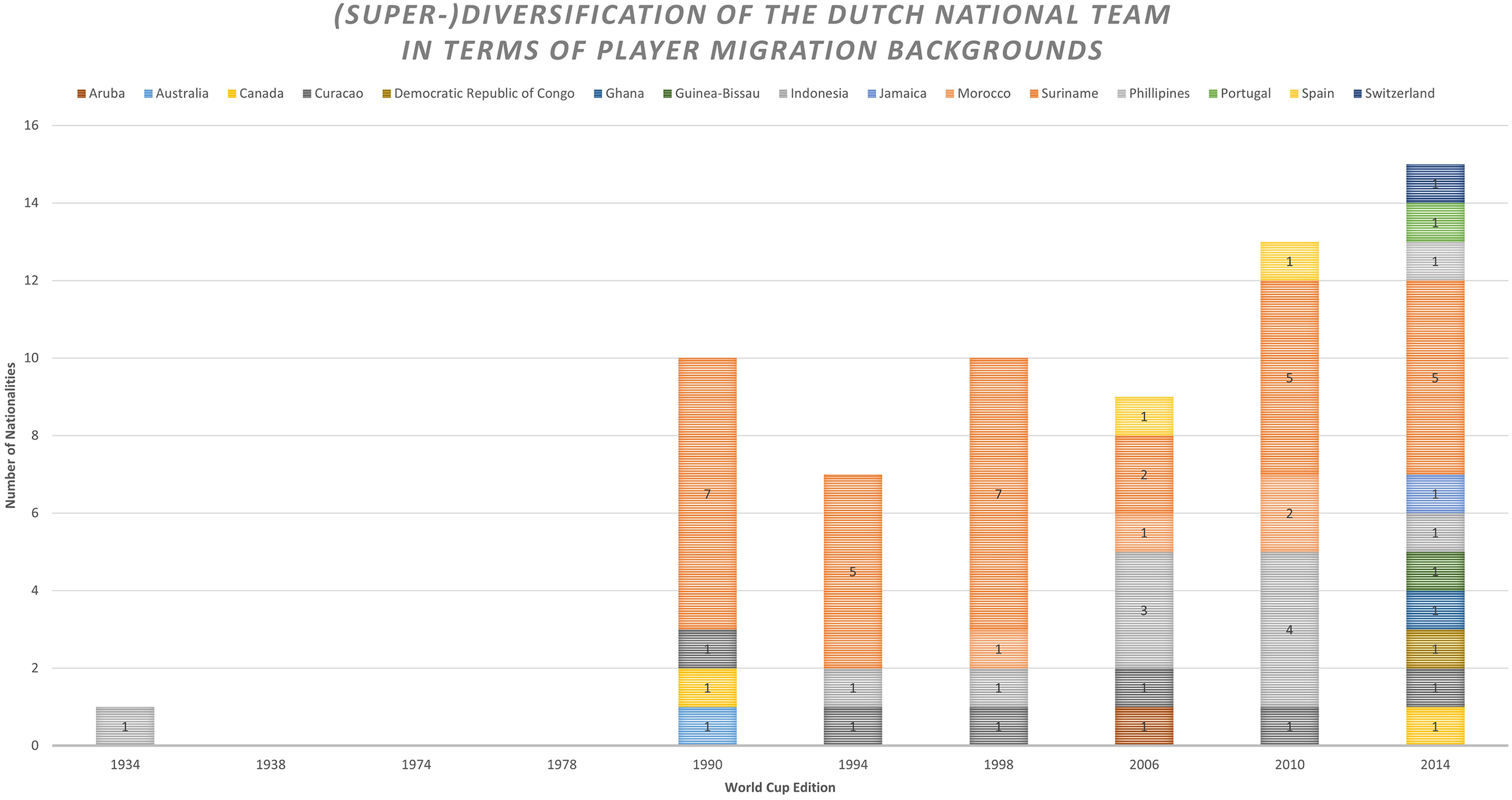
(Super-)diversification of the Dutch national team in terms of player’ migration backgrounds.
Analysed matches of the Dutch national team at the 1974, 1998 and 2014 World Cup.
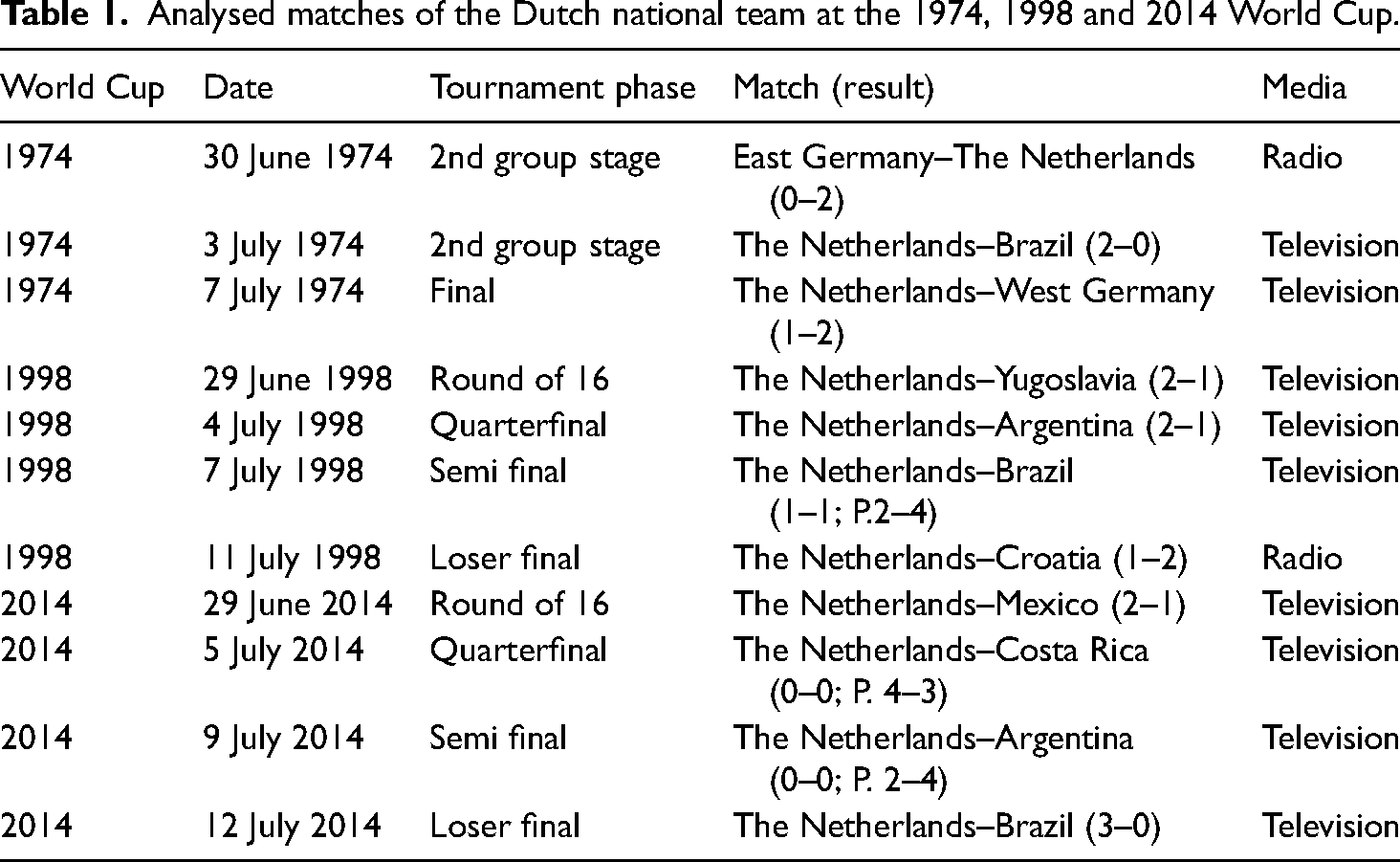
To gather the data for this study, we used a research environment called the Media Suite. The Media Suite is an online application for doing research with and on audio-visual data collections, and related multimedia sources such as radio- and television broadcasts, from various institutional content owners in the Netherlands. Being an infrastructure for media data collections, the Media Suite is a tool ‘where content and metadata can be explored, browsed, compared and where personal virtual collections can be compiled and stored in a personal workspace’ (Ordelman et al., 2018: 133). As international matches of the Dutch national team have historically been broadcasted integrally, both on television and radio, by the Dutch Broadcasting Foundation NOS (Nederlandse Omroep Stichting – the Dutch state-funded broadcaster), the Media Suite enabled us to search through this data collection for the strategically selected matches.
In total, the live commentary of 11 matches of the Dutch national team at the indicated World Cups was analysed (Table 1). For 9 of the 11 matches, the live television commentary was analysed. For the other two matches, the live radio commentary was analysed as the integral televised broadcasts were unavailable via the Media Suite. The relatively small dataset of our study can be considered a limitation. However, we do not claim to provide generalisable understandings into dominant discourses regarding nationality and race/ethnicity in wider Dutch society for the time periods under analysis. Rather, due to their high viewing figures, the live commentary during these matches can provide a relevant ‘snapshot’ of meanings given to nationality and race/ethnicity in the context of the Dutch national team in different time periods and how these meanings are temporally shifting. Our findings can potentially serve as an interesting point of departure for more extensive historical analyses in the future.
Data analyses
The coding process consisted of two distinct steps. In the first step, all qualitative comments relating to individual players were coded as either being positive or negative. These comments were also conceptually divided according to what quality or capability of the player they referred. To the dominant conceptual themes were derived from a previous study by Van Lienden and Van Sterkenburg (2022) into football commentary focusing on the Polish national team. A somewhat similar coding scheme has also been used in other studies, among them Van Sterkenburg et al. (2012) and Campbell and Bebb (2022). The conceptual themes relating to individual players were labelled as ‘general/evaluative’, ‘technical’, ‘physical’, ‘cognition’ and ‘character’. A final conceptual category was labelled ‘national meaning-making’. This category did not refer to individual players but to the various discourses that Dutch commentators relied on in giving meaning to and (re)constructing ‘Dutchness’. We were alert to the possibility of new conceptual themes arising inductively throughout the coding process, but no dominant new themes emerged.
Comments labelled as ‘general/evaluative’ referred to commentary that evaluated a player positively or negatively beyond something directly related to an on-pitch action or event. A typical positive comment in this theme is ‘he is a pure football player’ or ‘he was unmatched’. Comments in the category of ‘technical’ evaluated the technical and ‘learned’ football capabilities and qualities of a player. Typical comments in this category are, positively, ‘well played’ and ‘he wins the header’, while negative comments are along the lines of ‘bad passing’ or ‘he can’t control the ball’. ‘Physical’ commentary evaluated the physical qualities of a player. An example of a (positive) comment in this category is ‘he looks fresh and fit’. Comments labelled under ‘cognition’ evaluated the on-pitch decision-making and positioning qualities of players such as ‘well anticipated’, whereas comments labelled under ‘character’ related to off-pitch, general characteristics and traits of players, for example, ‘calm and in control’.
The second step in this coding process entailed linking the comments in the dominant conceptual themes to how specific individual players would be classified racially/ethnically in wider Dutch society. This step aimed to identify whether and how commentators differentiate in their representations and meaning-making practices between different racial/ethnic Dutch representatives. These racial/ethnic categorisations are derived deductively from previous academic literature (Van Sterkenburg et al., 2012; Wekker, 2016) and from popular (football) media on the Dutch context. These categorisations include White Dutch and the largest non-White ethnic minority groups present in the Dutch national team: Surinamese, Indonesian, Dutch Antillean and Moroccan. 8
Although we use qualitative verbal content analysis of mediated representations of the matches, part of our results are presented in percentages. The percentages presented mainly serve to provide some context of the frequency of certain representational patterns in the live commentaries. Moreover, due to the limited amount of data analysed, these relative numbers are mainly supportive of the content under discussion.
Results
Historically, the live commentaries of Dutch football commentators can be seen as rather positive towards the players of the Dutch national team. More than two-thirds of the analysed football commentary is positive in nature (67%) across the three editions of the World Cup. This is in line with earlier findings (Campbell and Bebb, 2022; Van Lienden and Van Sterkenburg, 2022). Of the 1231 coded comments, 273 comments were marked for the 1974 World Cup (22%), 538 remarks for 1998 (44%) and 420 codes for 2014 (34%). The analysis further showed that the highest number of comments were, by far, on players’ technical skills (nearly 60%). With regards to the often-used prejudice of the ‘natural’ physicality of the Black athlete in football commentary (Hylton, 2009; Van Lienden and Van Sterkenburg, 2022), convincing evidence that Dutch football commentators are reproducing these images in their comments on Black Dutch representatives could not be found.
We did find, as a by-catch to our analysis, that Dutch football commentators do tend to fall back on well-known, national and racially/ethnic-based stereotypes when commenting on opponents of the Dutch national team such as being passionate when discussing (both Black and White) players from South American countries and referring to the ‘natural physicality’ stereotype when giving meaning to Black players, for example, about the 1998′ Brazilian centre backs: ‘Aldair. One of those two giants in the centre at the back, and then Júnior Baiano who is even bigger’. This usage and reproduction of dominant discourses on nationality and race/ethnicity towards opponents’ players can be explained by the unfamiliarity of Dutch commentators with (some of) them. It seems that the more football commentators know about a national team and its representatives, the less they tend to (re)construct hegemonic stereotypes related to nationality and race/ethnicity. Likewise, the relatively limited knowledge about (some) opponent’ players – in comparison to ‘their own’ national players – may render commentators more reliant on general, wider circulating knowledge and discourses including those on race and ethnicity instead of using more personalised information on individual players in their comments.
Despite an increase in the diversity of Dutch representatives in terms of migration backgrounds over time (Figure 1), it is interesting to note that barely any (direct) comments by Dutch football commentators referred to the issue of dual nationality. It may be that at least for the 90-min of play the Dutch football commentators considered the Dutch representatives as belonging to the same national ‘we’ (Van Campenhout and Van Houtum, 2021). These observations, however, do not mean that after the temporal context of an international football match these national ‘we – feelings' are still there, especially when a game is lost. On the contrary, several studies have indicated that players with a migration background – quite often the ones who are also from racially/ethnically minority backgrounds in national hegemonic discourses – tend to be the first to be scapegoated by the media and public when the team results are under par (Van Campenhout and Van Houtum, 2021; Van Houtum, 2010; Van Sterkenburg, 2013).
1974: An all-White Dutch national team
The Dutch national team at the 1974 World Cup was an all-White team, with all its players born in the Netherlands to parents and grandparents of Dutch descent (Lechner, 2008). While, at the time, nobody noticed this as the selection of players did not differ in composition from the Dutch national teams of the 1970s and before, Dutch society in 1974 was significantly more diversified than this national team reflected. While the immigration of Surinamese to the Netherlands was already reflected in the Dutch national team before the 1974 World Cup – albeit to an absolute minimum and nothing in proportion to the presence of this minority group in Dutch society – representatives from other migration groups in Dutch society, such as those with a Dutch Antillean, Moroccan and Turk background, were completely absent in this and other representative teams of the 1970s. As a result, in the commentary, we did not identify explicit comments on ‘Dutchness’ or notice the reproduction of national racial/ethnic stereotypes related to minority groups.
Our findings show that the bulk of the live commentary given during the 1974 tournament was positive in nature and primarily directed at three key players: Johan Cruijff, Willem van Hanegem and Wim Rijsbergen. In doing so, commentators often relied on terms such as ‘conductor’ and ‘pivot’ to give meaning to the football qualities and attributes of these key players. For instance, typical comments would be ‘Cruijff with the very intelligent pass’, ‘That's well anticipated by Van Hanegem’ and ‘It's great how [Rijsbergen] has developed in these weeks during the World Cup’. These descriptors revolve around mental qualities which previous studies have found to be often associated with White athletes (Hylton, 2009), and relate to discourses of Whiteness in general (Dyer, 2017). These individual descriptors also align with more general descriptions within media of the 1974 Dutch team's ‘total football’ tactics, characterised by complexity and constant motion on the field (Jensen, 2014; Lechner, 2007, 2008). Still today, the 1974 team is popularly lauded – with ‘total football’ having achieved mythical status in the Netherlands – and reflects ‘Dutch’ qualities regarding individuality, creativity and moral and aesthetic conscience (Jensen, 2014; Lechner, 2007, 2008). Therefore, this 1974 Dutch team has become the benchmark for the future representative teams of the Netherlands.
With the above in mind, our findings show that Dutch commentators implicitly confirm and (re)construct dominant Dutch racial/ethnic hierarchies in the specific context of 1970s Dutch society, where increasingly groups of non-White immigrants were popularly perceived as essentially racial ‘Others’ (Wekker, 2016). Meanwhile, the Dutch national team remained an unsullied reflection of the hegemonic perception of ‘Dutchness’ as White and Christian (Lechner, 2008; Wekker, 2016). The descriptions of White mental qualities pertaining to individual players especially gain meaning when read in conjunction with the mythical status the team has acquired in popular Dutch football discourses (Jensen, 2014; Lechner, 2007, 2008). No other Dutch representative team has become equated with supposedly Dutch qualities to the extent the 1974 team has and still does, especially regarding those qualities such as creativity and conscience that are often associated with Whiteness (Dyer, 2017; Lechner, 2008).
1998: A more diverse Dutch national team
For the 1998 World Cup, the commentary reflects the increasing diversity of this Dutch national team (Figure 1). In the analysis, 62% of the overall commentary pertains to White Dutch players, whereas 38% involved comments on Black Dutch footballers. This latter group predominantly involved players with a Surinamese background; except for one player with a Moroccan background, Pierre van Hooijdonk. That these Black Surinamese Dutch players, such as Edgar Davids, Clarence Seedorf and Patrick Kluivert, received a relatively large share of commentary means that they can be considered (some of) the key players in this Dutch national team.
Two main patterns can be identified when looking at how the commentary is divided across the conceptual themes regarding the various national and racial/ethnic backgrounds within the 1998 Dutch national team. Firstly, Black Surinamese Dutch players receive on average more negative comments regarding their technical skills and character than what their average share in the comments would suggest. Whereas the average percentage of comments on Black Surinamese Dutch players was 37%, they received respectively 43% and 65% of negative comments regarding technique and character. Secondly, Black Surinamese Dutch players were underrepresented regarding positive evaluative comments, where they received only 27% of the commentary. Together these patterns show that during the 1998 World Cup Black Dutch players were relatively negatively portrayed by White Dutch commentators, and that it was – conversely – overwhelmingly the White Dutch players that were positively commented upon regarding technical skills and character. In other words, noticeable patterns of differentiation can be witnessed in the commentary on Black Surinamese Dutch players in this more diverse Dutch national team.
Although these patterns are based on a relatively small number of games, the findings gain significance when read in conjunction with previous works focused on the representations of Black Surinamese Dutch football players. Hermes (2005: 59) argues that the cohort of Black Surinamese Dutch players in the 1998 World Cup campaign were popularly read through ‘the specter of the dangerous young Black male’. This contrasted significantly with representations of Black Surinamese Dutch players in the 1980s, such as Ruud Gullit and Frank Rijkaard. Although representations of these latter two players were not exempt from racialised significations, they were generally elevated to national symbols of multicultural success stories. These contrasting representations should be read through the historical context of the late 1990s, in which popular and political discourses increasingly criticised and destabilised previously hegemonic positive understandings of multiculturalism (Joppke, 2004; Lechner, 2008). In the context of the Dutch national team, this increasingly polarised discourse regarding multi-ethnic society was exemplified by events surrounding the so-called ‘Cable’; a tight friendship between Black Surinamese Dutch players. This group of players had, on various occasions, spoken about issues surrounding race/ethnicity in the White-dominated Dutch national team and, as Hermes (2005) argues, it was their manifestation as a group rather than as individuals (such as Gullit and Rijkaard) that made popular discourses connote them with racialised notions of gangs and violence. The exceptionally critical discourses that were drawn upon to give meaning to this group of players particularly pertained to the 1996 European Championship, but with many of the players still active two years later this critical stance could arguably still have resonated with White Dutch commentators in their representation of Black Surinamese Dutch players during the 1998 World Cup. Meanwhile, the negative emphasis on the character of (some of the) Black Surinamese Dutch players can be said to (re)produce discourses of frivolity and irrationality that are commonly associated with Blackness in White Dutch discourses (Wekker, 2016). These reproductions are, for example, reflected in comments such as ‘Seedorf walks away, doesn’t control the ball well. It is too frivolous, too playful’, ‘Kluivert, he is too careless, it's too easy’ and ‘Seedorf is really playing for himself tonight, he is absolutely not trying to play for the team’.
Interestingly, although Black Surinamese Dutch players are portrayed rather negatively, the commentary for the 1998 World Cup does not appear to (re)construct the stereotype of the ‘natural Black athlete’ regarding these players. Previous studies in the Dutch context indicated that associations with physicality come to the fore, particularly in the representation of Black Surinamese footballers (Van Sterkenburg et al., 2012). Moreover, amongst the general (Dutch) public, Black players were often made sense of in terms of their athletic ‘genetic’ capabilities and qualities (Van Sterkenburg et al., 2019). As the section above indicates, this does not mean that representations of this social group during the 1998 World Cup were free of racialised significations. Previous studies focusing on the intersection between representations of nationality and race/ethnicity in international football have suggested that closer proximity and familiarity with players for commentators can result in representations coalescing around more diverse representational frames than the ‘natural Black athlete’ stereotype (Van Lienden and Van Sterkenburg, 2022). This shows that for the commentators in our study, discourses that negatively evaluated the technical skills and characters of Black Surinamese Dutch players were more salient than relying on stereotypes of natural Black athleticism.
2014: A super-diverse Dutch national team
Although the 2014 Dutch national team can be considered the most diverse of the three teams under analysis in terms of its representatives’ migration backgrounds (Figure 1), our findings show that Dutch commentators mainly focused on White Dutch players in their commentary as they received 86% of all comments – a significantly higher share in the commentary than our data on the 1998 World Cup revealed. This difference can be explained by the absence of high-profile Black Dutch key players in the 2014 selection. This means that Black Dutch representatives in the team, such as Nigel de Jong, Memphis Depay and Bruno Martins Indi, did not garner the same level of attention by Dutch commentators as Edgar Davids, Clarence Seedorf and Patrick Kluivert did in 1998. During the 2014 World Cup, Dutch commentators primarily focused on three White Dutch key players: Arjen Robben, Robin van Persie and Wesley Sneijder.
Our findings on the 2014 Dutch national team show that White Dutch players received general positive evaluations more frequently than in 1998, even though the final result of the Dutch national team in these tournaments barely differed (4th in 1998, 3rd in 2014). 9 Where in 1998, 69% of all praising comments were directed at White Dutch players, this was 94% in 2014. Also in terms of players’ character, White Dutch players were relatively overrepresented in the commentary. In this category, 94% of the comments praising the character of a player were reserved for White Dutch players. It can be argued that some of the positive comments on White Dutch players were articulated through discourses drawing on particular White-situated imaginaries of ‘Dutchness’. For instance, a comment on Dirk Kuyt and Arjen Robben was that ‘Kuyt symbolises this football team, he's someone who doesn't mind cycling with a headwind. Arjen Robben, also a headwind cyclist’. This assemblage of desirable qualities of determination and steadfastness – cognitive qualities that are often associated with Whiteness (Dyer, 2017; Hylton, 2009) – combined with the Dutch cultural symbol of cycling can be said to draw on and (re)construct a ‘banal’ imaginary of ‘White Dutchness’, especially since it is relatively most often White Dutch people that cycle in The Netherlands (Kuipers, 2013). On the contrary, similar comments linking popular Dutch cultural symbols to Black Dutch players’ football skills and qualities could not be found in our data.
Even though the 2014 Dutch national team represented a wider array of migration backgrounds and a higher number of Black Dutch players than the Dutch national teams of 1974 and 1998, the commentary on the 2014 Dutch national team overwhelmingly focused on three White Dutch key players, evaluating them positively in general terms and in terms of their character. Occasionally, these forms of praise can be said to explicitly draw on a ‘banal’ (re)construction of ‘White Dutchness’.
Conclusions and discussion
National migration histories have resulted in national and racial/ethnic (super-)diversity in certain national representative teams, as in the case of the Netherlands (Figure 1). A variety of scholars have examined the meaning-making processes related to these diversities, especially within one of the most influential domains where such meaning-making occurs: televised football (e.g. Campbell and Bebb, 2022; Ličen, 2015; Van Sterkenburg et al., 2019). These earlier studies on meanings given to nationality and race/ethnicity in mediated football have mainly focused on one specific time period, usually the coverage of players during one sporting season or one major event such as the World Cup (Campbell and Bebb, 2022; Van Sterkenburg et al., 2012). While these studies generated relevant insights, they were not able to provide a wider overview of meanings given to – the intersection of – race/ethnicity and nationality over a longer period of time. The current, explorative study can be considered quite unique in its analysis of Dutch football media coverage at three different moments in time (1974, 1998 and 2014). Findings of our study show how meanings given to race/ethnicity and nationality are not stable over time, but are context dependent and reconstructed in a particular temporal context (Van Campenhout and Van Houtum, 2021; Van Sterkenburg et al., 2012). Contextuality of (re)constructions of national and racial/ethnic meanings becomes evident in the differences in meaning making by Dutch football commentators in the different time periods under study.
The analyses of the 1998 and 2014 World Cups, in particular, are noteworthy as in both tournaments a Dutch national team featured that could be considered (super-)diverse in terms of the migration and racial/ethnic backgrounds of its national representatives. However, while in the 1998 coverage Black Surinamese Dutch players were portrayed more negatively than White Dutch players, this did not happen in 2014. Each tournament, thus, seemed to open up different reservoirs of meaning-making for commentators. The discursive resources that commentators used in 1998 to give meaning to Black Dutch football players may have been impacted by, as we mentioned in our results, latent notions of ‘threat’ and ‘danger’, something that earlier North-American research has also identified in media representations of Black athletes (Andrews and Silk, 2010). These notions were possibly amplified due to the supposed disruptiveness of a group of Black Surinamese Dutch football players that were called ‘the Cable’ during an earlier tournament in 1996. Hermes (2005: 58) showed that this group of players – which included some key players of the 1998 team – ‘were read as a gang’ in popular discourses. These discourses may have lingered on in the actual play-by-play commentary that we analysed though in a more implicit manner, representing the character and football-related skills of Black Surinamese Dutch players in a relatively negative light.
In contrast to this, Dutch media coverage of the 2014 Dutch national team seemed more positive regardless of the race/ethnicity and migration backgrounds of its national representatives. This positive coverage squares with a small-scale research project by Schoenmakers (2015) who showed how the single most dominant theme in media used by the Dutch coach (Louis van Gaal) and players of diverse origins during the 2014 World Cup was one that emphasised unity and pride. More specifically, findings show how before and during the event, both coach and players emphasised the unity within the team. The coach Louis van Gaal said, for instance, that ‘the group is really amazing. It is the best group I ever worked with, regarding team spirit and belief. That is just … Unbelievable how fast this has become a group’ (Schoenmakers, 2015: 23). For example, Michel Vorm, the Dutch goalkeeper with a Surinamese migration background who only played in the last match, said that the group process has been very important in the tournament’ (Schoenmakers, 2015: 24). The positive ‘vibe’ around this Dutch national team contrasts, to some extent at least, with the general populist discourse in Dutch society in which policy makers regularly reflect critically on ‘multicultural society’ and where questions around integration of minorities often dominate policy debates. This also shows how discourses that circulate in society do not always reflect, and are sometimes challenged by, football-specific discourses (Lechner, 2008; Van Sterkenburg, 2011). Moreover, Andrews (2002) argues how separate cultural events may open up specific reservoirs of meanings ‘fitting’ to that particular context. Perhaps, the statements around unity and pride promoted by coach and players during the 2014 World Cup became the most ‘fitting’ discourse for Dutch football commentators to draw on in their live commentary. It must be noted, though, that this positive discourse mainly reflects the representation of (three) White Dutch (key) players.
An emphasis on key players was, in a more general sense, one of the consistent findings across the coverage in our analysis. Earlier research shows how mediated football is driven by entertainment values resulting in a continuous search for narratives around a few central players (Hermes, 2005; Van Sterkenburg, 2011). This was confirmed in our analysis which showed how several players received the largest share of the commentary in each of the World Cup editions and were, therefore, constructed as key players. While such an emphasis on individual players may give the impression that commentary is based on individual skills only, and rather unrelated to a player's migration and/or racial/ethnic background (Van Sterkenburg et al., 2012), our findings seem to indicate how racialised discourses may still structure the commentary, to a certain extent at least. More specifically, our results suggest that in the tournaments where White Dutch players were constructed as key players (in the World Cups of 1974 and 2014) the commentary was dominated by positive comments, while in the one tournament where Black Surinamese Dutch players were the key players (1998 World Cup) they received relatively many negative comments. However, more research is needed to provide better insights in this as the amount of data for each tournament in our research remains quite limited.
In contrast to most earlier content analyses on sports media, our analysis does not point to a stereotypical representation of Black athletes as ‘naturally’ strong/fast or less tactically skilled than White players. Most studies reporting a ‘Black Brawn – White Brain’ discourse have been conducted in the US and, to a lesser extent, in the UK (e.g. Campbell and Bebb, 2022; McCarthy et al., 2003). The relatively few studies into Dutch football commentary generally show how this racialised discourse gets reproduced in Dutch commentary as well, but these findings are more nuanced and less clear than in most of the North-American and British studies. Van Sterkenburg et al. (2012), for example, concluded that while Black Surinamese Dutch footballers were associated with their physicality, this did not apply to all Black players who got represented in Dutch club football coverage. At the same time, a variety of audience reception studies reveal the widespread use of a ‘natural physicality’ discourse in describing Black footballers amongst Dutch youth audiences and fans (Van Sterkenburg et al., 2019; Van Sterkenburg and Knoppers, 2004). The mixed findings of these studies, including our current research, indicate that more research is needed to examine how racial/ethnic ‘Othering’ exactly takes place in Dutch-mediated football contexts, and how precisely this intersects with nationality. Such research should then also attend to potential differences between club football media coverage and media coverage of national representative teams, as in the former nationality does not seems to matter (Van Campenhout and Van Houtum, 2021). Earlier research shows how media coverage of athletes representing the nation, as was the case in our current study, may prioritise discourses of national unity above those of racial or gender differentiations (Wensing and Bruce, 2003). Moreover, as we mentioned in our results, a high level of familiarity with national representatives amongst commentators may result in diverse representations of players that go beyond one-dimensional racialised framings. In that sense, it is interesting to observe how commentators, when giving meaning to Black players of opposing teams in our study (with whom Dutch football commentators are less familiar), tended to fall back on racialised discourses that incorporate stereotypes.
Lastly, in terms of future research, it is important to also attend to the general public, and explore if, and in what manner, the meanings in football media coverage are congruent with those found amongst people who consume football on a regular basis. While media content inscribes specific messages for its ‘readers’, audience research is necessary to gain more insights into how what is reported in the media gets accepted (or challenged) by media audiences.
Footnotes
Acknowledgements
The authors would like to thank Mari Wigham of the Netherlands Institute for Sound and Vision for her support with the technical aspects of data collection via the Media Suite. The authors are also thankful for the support that several researchers in the article received from NWO for the NWO VIDI project ‘How racist is televised football’ (project number 016.Vidi.185.174).
Declaration of Conflicting Interests
The authors declared no potential conflicts of interest with respect to the research, authorship, and/or publication of this article.
Funding
The authors disclosed receipt of the following financial support for the research and/or authorship of this article: This research was funded by a research grant from The Netherlands Institute for Sound and Vision.
