




Abstract
The inclusion of foreign-born sportspeople in national sports teams has become increasingly common. At the same time, the assumed increase in diversity within national football teams has turned into a major subject of (inter)national controversy and debate. This applies, in particular, to the football World Cup, as the assumed increase in foreign-born players in national football teams detracts from the (homogeneous) nation-state basis of the Fédération Internationale de Football Association’s (FIFA) international football competitions. However, the actual dynamics and complexities of the presence of foreign-born players in national football teams within this context have remained under-researched. In this paper, we use the idea of ‘migration corridors’ to examine the underlying structures that contribute to the diversification of national football teams, in particular during the World Cup. We do so from both an immigration and emigration perspective. By connecting our foreign-born player data to three types of migration corridors, we discuss the bidirectionality of player movements and nationality choices. Our outcomes indicate that the selection of foreign-born footballers within national football teams in the World Cup can mainly be considered as an echo and/or reversal of preceding migration flows between pairs of countries, indicating that historically embedded migration corridors sustain or are rediscovered in this process.
Introduction
The diversity, in particular the ‘Africanness’, of the victorious 2018 French (men’s) national football team became the subject of public and political debate in a manner that was both positive and not so (Beydoun, 2018; Kuper, 2018a). A review of this French national football team’s roster reveals its multiculturality, as 19 out of the 23 players had a ‘genuine connection’ with a country other than France. Fourteen of the French representatives were affiliated with an African country, of which two were actually born on the African continent (Storey, 2020): Steve Mandanda (Zaire/Democratic Republic of Congo) and Samuel Umtiti (Cameroon). Further, at the 2018 men’s World Cup, 84 out of the 736 footballers (over 11%) represented a national football team other than of their country of birth (van Campenhout et al., 2018). Of these 84 so-called foreign-born players, an astonishing 29 footballers were born on French soil (nearly 35%). Therefore, besides selecting players with a migration background for their representative national football team, France also ‘lost’ several players to other national football teams. As the (extreme) example of France illustrates, national football teams seem to be increasingly represented by players who originate from other, often more varied, nationalistic and cultural backgrounds than ever before (Dubois, 2010; Maguire and Pearton, 2000; Storey, 2020).
While migration affects both sending and receiving areas, relatively little attention has been paid to the causes and consequences of migration on the latter (Castels et al., 2014). A dominant focus on the diversification of destinations (immigration diversification) has not only skewed ‘research towards the causes and consequences of migration only in the destination areas, but more fundamentally, such research introduces a scientific bias when it only includes those who migrate’ (Bakewell, 2014: 305). Opposite migratory movements (emigration diversification), and the causes and consequences of migration for countries of origin, have remained underexposed while, arguably, they are just as important when studying diversification. In addition, most research on the migration of footballers is conducted within the context of association football and has focused on the period after the Bosman ruling in 1995 1 (Elliot and Harris, 2015; Maguire and Falcous, 2011; Maguire and Pearton, 2000; Poli, 2010). Although some articles touch upon the causes and consequences of player migration within the context of international football, the above-mentioned foci have led to an underrepresentation of research on foreign-born football players in national football teams and, moreover, to a lack of historical depth on research about this specific form of ‘player movement’ (van Campenhout et al., 2018).
The specificity of this form of football migration lies in the fact that foreign-born players have not necessarily ‘migrated’ into the country they represent in international football. While some foreign-born players do move to the country they represent in international football – for various reasons like the migration of their parents when they were young or because of an international club transfer – others do not cross international borders themselves. Instead, they have used their eligibility to compete for a country other than the one in which they were born. By making use of national citizenship regimes, and in line with the Fédération Internationale de Football Association’s (FIFA) regulations around player eligibility, many foreign-born players have (purposely), in some cases literally, ‘swapped’ their nationality and national allegiance to another country, most notably to their parents’ country of origin, without having migrated to that country themselves (Jansen et al., 2018; Storey, 2020). Despite the increasing ubiquity of foreign-born players in national football teams, the dynamics and underlying structures have remained under-researched; this article, therefore, aims to gain a better insight into this phenomenon.
In this article, we first discuss the diversification of the World Cup over time. Second, the idea of migration corridors is used as an organisational frame that helps explain the (increasing) diversification of national football teams within this context. Third, in the method section, our dataset on foreign-born players at the World Cup between 1930 and 2018 is discussed, followed by an analysis of ‘movements’ and nationality choices of foreign-born players within the migration corridors distinguished. The outcomes focus on the historical evolvement and sustainment of (specific) migration corridors by illustration of some telling examples.
Diversification of the football World Cup
A good way to study the processes of diversification at the World Cup is to take on both an immigration- and an emigration perspective in relation to the presence of foreign-born players within the selections of national football teams. Immigration diversification, which has been the main approach in studying diversification in international migration studies (Castels et al., 2014; Czaika and De Haas, 2014), takes the destination country of football players as a starting point. In the case of foreign-born football players, their destination country relates to the ‘adopted’ national football team they represent at the World Cup. On the contrary, emigration diversification focuses on outward movements and related nationality changes. Within the context of the World Cup, this means that the focus is on the sending countries who have ‘lost’ native players to other representative national football teams. This perspective, in other words, shows the geographical spread of footballers from a certain country towards a range of national football teams.
According to the body of literature on international migration, migrants seem to originate from ‘an increasingly geographically distant and diverse array of origin countries’ (Castels et al., 2014; Czaika and De Haas, 2014: 291). Similar patterns of change are observable for the selection of foreign-born players in representative national football teams throughout the history of the World Cup (van Campenhout et al., 2018, 2019), and likewise for other international sports events such as the Olympics (Jansen and Engbersen, 2017). The selections of national football teams have become more diverse over time through the inclusion of (foreign-born) players who ‘originate from a wider, more diverse, range of countries in the latest editions [of the World Cup]’ (van Campenhout et al., 2019: 20). Other scholars on sports migration, however, argue against a truly increased diversification of foreign(-born) athletes in international sports. They consider these specific migratory processes to primarily be a reflection of trends in international migration, which have mainly ‘led to a quantitative reinforcement of older [migration] channels’ (Poli, 2010: 499; Taylor, 2006). Van Campenhout et al. (2019: 20) acknowledge that ‘although the diversification of “countries of origin” increases, these “newly” involved countries are not at random, . . . [instead] the selection of foreign-born players is guided – or restricted – by historical relationships between [pairs of] countries’.
Despite these patterned movements, huge differences between national football teams exist regarding the selection of foreign-born players (van Campenhout et al., 2019). These differences seem to be closely related to underlying structures of migration such as (historical) differences in migration policies, citizenship regimes and naturalisation regulations between (the respective) countries (Hollifield et al., 2014; Vink, 2017). It is, for example, relatively easy to acquire the nationality of a foreign country for footballers who can prove a ‘genuine connection’ to that country through the nationality of one of their (grand)parent(s). In addition, players may also qualify for citizenship when they meet the specific residency requirements set for a country, including possible additional naturalisation conditions (Hall, 2012; Storey, 2020). Moreover, as these regulations are set, and adapted, by national governments, imbalances in the possibilities for people, and therefore also for football players, to acquire citizenship exist (Hall, 2012; Vink, 2017). These imbalances directly influence the (possible) diversification of national football teams and, thereby, of the World Cup since the main principle of FIFA’s player eligibility criteria to play for representative national football teams is related to a generalised version of citizenship acquirement: ‘holding a permanent nationality that is not dependent on residence in a certain country’ (FIFA, 2016: 70). Because of this, countries with strict regulations around immigration and naturalisation, like the USA, are a step behind countries with less restrictive migration regimes (Hall, 2012; Hollifield et al., 2014). It can, therefore, be argued that these FIFA regulations have ‘created loopholes that players and national governing bodies have been willing to exploit’ (Hassan et al., 2009: 747), enabling ‘the emergence of “passport players”’ (Hall, 2012: 191): (talented) football players with no affiliation to a country who can be offered citizenship to compete for a country’s representative national football team. Despite the possibilities of ‘nationality swapping’ in this manner, the presence of ‘passport players’ within national football teams has remained relatively rare. The majority of foreign-born players, or other foreign-born athletes, have swapped nationality along family lines or in line with national residency requirements (Jansen et al., 2018; van Campenhout et al., 2019).
Migration corridors
In order to gain better insights in the dynamics and complexities of the presence of foreign-born players in national football teams during the World Cup, we will use the idea of ‘migration corridors’. Although migration corridors are not empirical phenomena in and of themselves, they can become identifiable through the use of empirical data. In this study, following Carling and Jolivet (2016: 19 [emphasis in original]), migration corridors are used as ‘frames for observation’ and analytical structures, because they can exist ‘independent of the level of activity within them: they can be empty, or nearly so’. This means that migration corridors can be studied even when a (clearly observable) flow of migrants is not assumed to exist between (pairs of) countries, for example when only a small number of people migrate from one country to another like an interchange of migrants between Columbia and Iceland (Carling and Jolivet, 2016: 19). Further, the notion of corridors leaves the direction of movement open. So, while migratory movements within a specific corridor may empirically seem to be a one-way street, it still remains possible to study the bidirectionality of movements within a migration corridor from either an immigration and emigration perspective (Carling and Jolivet, 2016).
Moreover, based on countries’ migration histories and trends in international migration, migration corridors can be characterised by specific, historically determined, relations, for example, colonial relationships, labour migration connections, or similarities because of geographical proximity (Bakewell et al., 2016; De Haas, 2010). In the context of football migration, and following Taylor (2006: 30), ‘much of the movement of footballers across national and continental borders . . . is actually based on established systems and networks. The story is of the adaptation of existing patterns rather than any radical breach with the past’. This may also apply to the process of nationality swapping by foreign-born players who compete at the World Cup, where the switching of nationality may not be random but part of the same process of following historically established migration paths and networks.
One distinguishable adaptation to the existing patterns of nationality choices by foreign-born players is what Jansen et al. (2018) refer to as ‘reverberative causation’. According to these authors, ‘reverberative causation’ is the process that ‘causes contemporary migration patterns to be the echo or reversal of migration flows by which they were preceded’ (Jansen et al., 2018: 8 [emphases added]). The omnipresence of players originating from former French (African) colonies in the French national squad at the 2018 World Cup is an example that illustrates how current patterns of nationality swapping in international football can be considered an echo of earlier migration flows towards France. On the contrary, there seems to be a growing tendency, in particular amongst smaller football nations, to reverse the main direction of a country’s preceding migratory movements of football players. Within the context of national football teams, such a reversal of national migration patterns mainly seems to take place between former colonies and ‘the coloniser’. In this respect, the former (finally) tries to take advantage of the latter, which is illustrated by the selection of French-born players in the current national football teams of Algeria, Morocco and Senegal. Furthermore, migration flows characterised by guest workers have seemed to reverse in the context of international football as, increasingly, German-born Turkish footballers and Dutch-born Moroccan players are deciding to represent the national football teams of their (grand)parents, Turkey and Morocco respectively, instead of their country of birth (Kuper, 2018b; Seiberth et al., 2019).
Methodology: from concept to data and back again
While (the history of) football migration is carefully watched and documented in the context of association football, the presence of foreign-born players in national football teams has remained relatively understudied. To overcome this, we created a database on the footballers who were selected to represent ‘their’ country at the World Cup. As we structured our database around biographic details of the players, such as their place of birth and ancestry, we, like most studies in the field of international migration, relied on foreign-born data (Dumont and Lemaître, 2005; Özden et al., 2011). Even though this way of measuring diversity has its limitations, it has proven to be the most reliable and practical way of creating a historical overview of the diversification of societies and, as a result, of the heterogeneity within national football teams (see van Campenhout et al., 2018).
For the purpose of this paper, the dataset of 996 foreign-born players 2 was taken from our general database on the World Cup: 10,137 footballers between 1930 and 2018 (van Campenhout et al., 2018). As we aimed to explore the relevance of migration corridors for a better understanding of the increased diversification in national football teams during the World Cup, we selected the five national football teams that included the greatest number of foreign-born players in their World Cup selections (immigration diversification) and the five countries that had ‘lost’ the highest number of indigenous players to other national football teams (emigration diversification). This resulted in ten different countries and their representative national football teams; from an immigration perspective, the selection included Algeria, Portugal, Republic of Ireland, Switzerland and the USA, and from an emigration perspective the selection existed of Argentina, Brazil, England, France and (West) Germany. The Netherlands, as the eleventh case, was added to this selection because of the country’s migration history and the researchers’ interest and background knowledge of Dutch society.
The diversification of national football teams is not random, as Taylor (2006) has already argued, but generally takes place along the lines of historically established migration patterns or migration corridors. As already stated, this does not mean that football players who ‘swap’ nationality may move along these migration corridors literally – after all, they often do not migrate to their adopted country themselves, they just take on its nationality. It does mean, however, that these historically constituted corridors may have an impact on the practice of nationality swapping amongst football players. The selection of migration corridors in our study was guided by what we know from academic literature about national migration histories (Hollifield et al., 2014), trends in international migration (Castels et al., 2014; Czaika and De Haas, 2014), and international transfer networks in association football (Maguire and Pearton, 2000; Poli, 2010; Taylor, 2006). These theoretically informed insights led to the following three partly overlapping types of migration corridors, which are named after the main ‘migration relationship’ between the pairs of countries:
Colonial migration corridors: Historically evolved (and sustained) migratory movements of people between coloniser and colonies;
Geographical proximity migration corridors: Migration corridors that have come into existence because of geographical proximity between (neighbouring) countries;
Guest worker migration corridors: Migratory movements of people between countries mainly driven by shortages in labour in one country and a surplus of labourers in the other.
Results: the evolvement and sustainment of (football) migration corridors
In this results section, we will look at the 11 selected national football teams/countries through the lens of the three migration corridors. Within the context of colonial migration corridors, the historical relationships between France–Algeria, England–Jamaica, the Netherlands–Suriname, and Brazil–Portugal are studied in more depth. Within the context of geographical proximity migration corridors, the football player movements between England–the other (three) British home nations, England–the Republic of Ireland, and Switzerland–(former) Yugoslavian states are discussed. Within the guest worker migration corridors, the evolvement and sustainment of player exchanges between Argentina–Italy, Germany–Turkey, and the Netherlands–Morocco are the focus of analysis.
Colonial migration corridors
The national football team of France has, from an immigration perspective, selected the highest number of foreign-born players (61 players), originating from the widest range of countries (19 different countries) of all national football teams throughout the history of the World Cup (Table 1). The majority of these 61 foreign-born players were born in a former colony of France like (French) Algeria, (French) Morocco and Senegal, or moved to ‘metropolitan’ France from France ‘d’outre-mer’ (overseas France, mostly relics of the French colonial empire) such as Guadeloupe, Martinique and New Caledonia (Dubois, 2010). As these overseas French territories are administratively part of France, people born in these countries automatically acquire French citizenship. The national football team of France, in particular, used their colonial connections in the 1930s, as exemplified by the selection of nine (French) Algerian-born players throughout this period.
Immigration diversification of foreign-born players within the eleven selected national football teams.
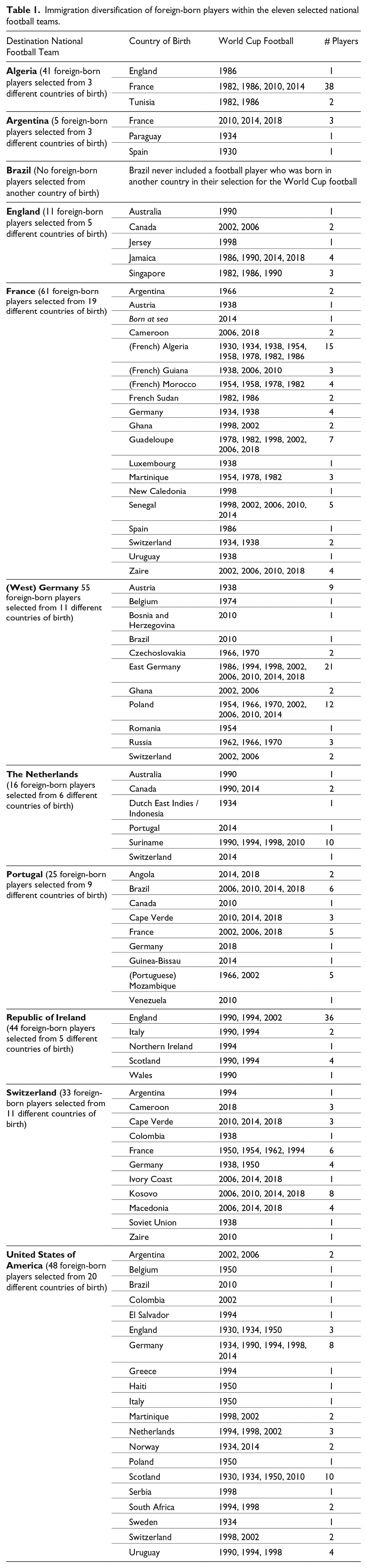
Although the national football team of France has continued to select players born in former colonies well beyond the collapse of French colonialism in the 1960s, the main direction of player movements seems to have reversed over time. This process, in which French-born players come to represent the national football team of one of its former colonies, seems to emerge around the 1980s with the inclusion of Nourredine Kourichi and Ali Fergani in Algeria’s national football team. This reversal of player movements took off after the 2000s when the national football federations of Morocco, Senegal and Tunisia (all former French colonies) widened their scopes to include football players from their national diasporas (Kuper, 2018b). Nowadays, mainly the national football teams of former colonies seem to make use of these pre-existing migratory paths. This observation reflects a change in the main direction of player movements, indicating both the evolvement and sustainment of these (colonial) migration corridors (Figure 1). Arguably, the best examples of such a reversal are to be found in the two latest World Cup-squads of the Algerian national football team as they included 16 French-born players in 2010 and 17 in 2014 (Table 1). From an emigration perspective, France has ‘lost’ 114 French-born footballers to 14 different national football teams throughout the history of the World Cup (Table 2).
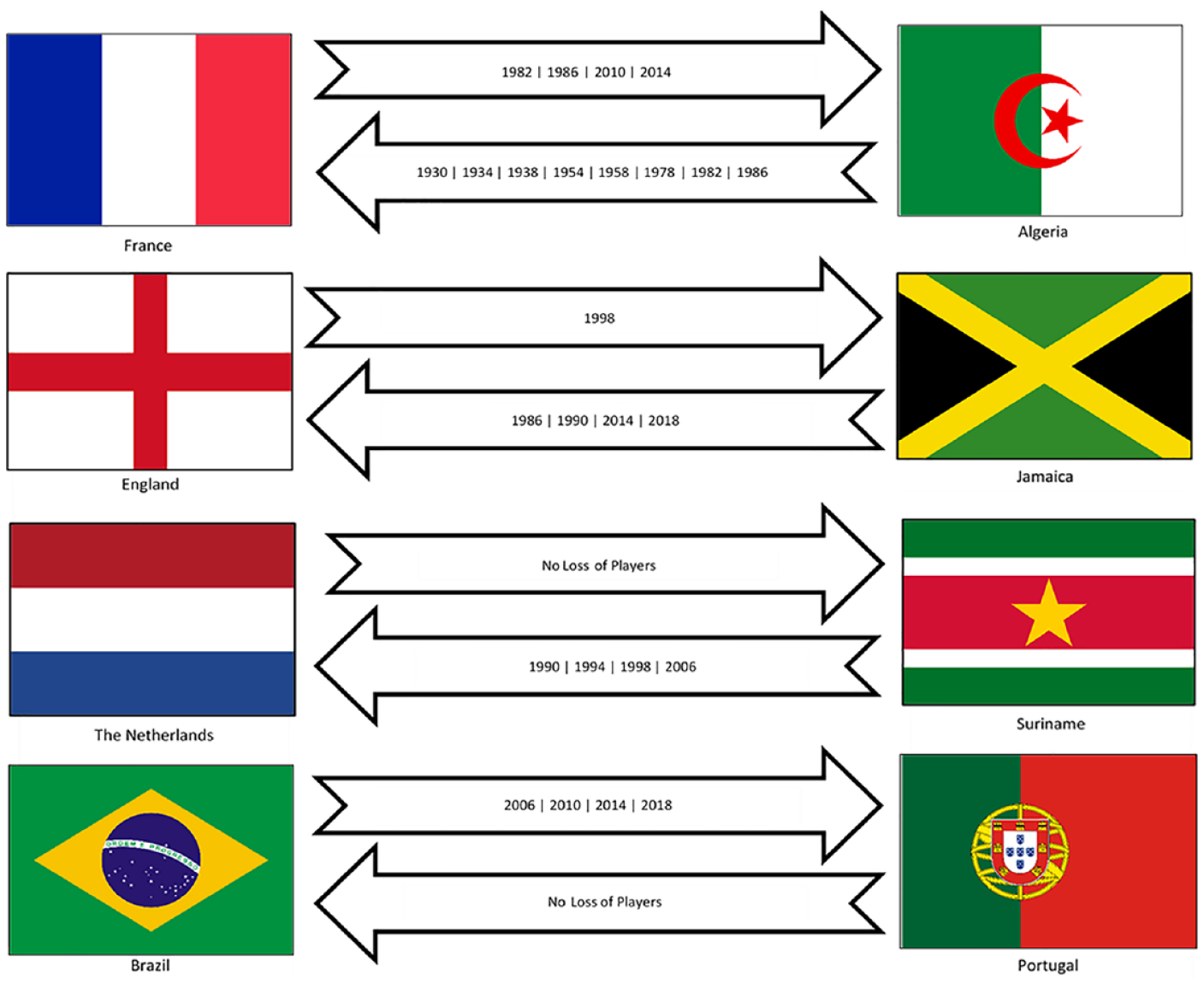
Colonial Migration Corridors.
Emigration diversification of foreign-born players who were born in one of the eleven selected countries.
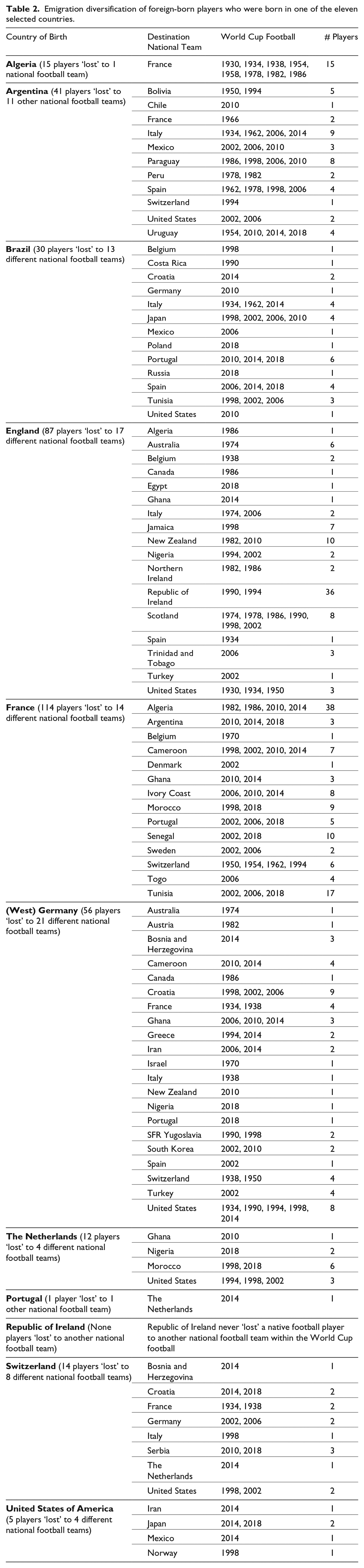
As in the case of the French national football team, the diversification of the national football teams of England (11 players selected from five different countries of birth) and the Netherlands (16 players selected from six different countries of birth) can mainly be considered an inheritance of their colonial pasts (Table 1). Despite this, and contrary to France, England only included eleven foreign-born players in their national football squad throughout their participations at the World Cup. With four representations by two players, England’s ‘busiest’ incoming colonial migration corridor is from Jamaica (immigration perspective), the country in which John Barnes and Raheem Sterling were born. Although Barnes and Sterling were born in Jamaica, they effectively grew up in England since they moved there at the age of 12 and 2 respectively (Shennan, 2012; Sterling, 2018). Because these two Jamaican-born players were raised and schooled in England, they gained British citizenship at adulthood and therefore should not be considered ‘passport players’ or as players who ‘swapped nationality’. Further, it can be argued that, in terms of quantity, England has rarely used its (former) overseas colonies in the strengthening of its World Cup teams; perhaps the pool of native England players was considered better than the eligible football talents overseas. However, beyond the scope of the England national football team at the World Cup, the English have included Jamaican-born players as well as ‘British-born sons of a large immigrant population from Jamaica’ (Maguire and Pearton, 2000: 185). Conversely, from an emigration perspective, England has ‘lost’ 87 players to 17 different national teams. Due to the historical extent of the British Empire, over 90% of the ‘lost’ English-born players represented one of England’s former colonies at the World Cup, most notably New Zealand (ten players), Jamaica (seven players), and Australia (six players) (Table 2).
To select the best football players for its national football team, the Dutch football federation could, quite easily, include Surinam-born players in its squad, as specific regulations to acquire Dutch nationality are in place for people born in Suriname and individuals who are of Surinamese descent (van Amersfoort and van Niekerk, 2006). However, the flow of migrants from Suriname to the Netherlands was characterised by a drastic increase in the 1970s, mainly because of Suriname’s independence from the Netherlands in 1975, the consequences of these movements only became visible in the selection of the Dutch national football team later on. While most of them effectively grew up in the Netherlands, the selection of three Surinam-born players for the Dutch national football team at the 1990 World Cup (Aaron Winter, Henk Fraser and Stanley Menzo), two footballers (Aaron Winter and Ulrich van Gobbel) at the 1994 World Cup, and four players at the World Cup of 1998 (Aaron Winter, Edgar Davids, Clarence Seedorf and Jimmy Floyd Hasselbaink) can, therefore, be considered an echo of the main directional movements between the Netherlands and Suriname (Table 1). Although invisible within our foreign-born data on footballers at the World Cup, Surinamese influences on Dutch football have been present since the late 1980s, exemplified by players such as Ruud Gullit, Frank Rijkaard and, a little later, Patrick Kluivert; footballers of Surinamese descent who were born in the Netherlands (Carmichael, 2017). The national team of Suriname has, however, benefitted far less from the sustainment of this colonial migration corridor (Figure 1), as Dutch-born football players with Surinamese blood were obliged to give up their Dutch nationality if they wanted to take on the Surinamese one. 3 To overcome this, an amendment to Suriname’s citizenship regime, the so-called ‘sport passport’, was introduced in November 2019 which makes athletes with a Surinamese father, mother, grandfather or grandmother eligible to represent Suriname in international sports without giving up their Dutch citizenship (ANP, 2019; NOS Voetbal, 2019).
The national football team of Brazil has never included a foreign-born footballer in their ‘Seleção’ for the World Cup, despite being a primary destination for Portuguese citizens because of historical colonial ties (Table 1) (Engbersen et al., 2016). Conversely, reversed movements of football players along the same (old) colonial migration corridor, from Brazil to Portugal, have become quite common in both association football and within the Portuguese national football team (Table 1) (Nolasco, 2019). With the inclusion of at least one Brazilian-born player in their national football team during each of the four latest World Cups, Portugal clearly used this historically beaten path to their advantage (Figure 1). The combination of cultural, religious and linguistic proximities between Brazil and Portugal, and the fact that Portuguese naturalisation processes have remained relatively easy for Brazilians (Engbersen et al., 2016: 215–216), have arguably contributed to the sustainment of this specific migration corridor for Brazilian-born footballers. Further, as the Brazilians are known as world-class football players, making the selection of the Brazilian team might be one of the hardest things to accomplish for Brazilian-born footballers. ‘Swapping’ nationality could therefore become an interesting alternative in one’s individual quest to compete at the highest level possible in international football: the World Cup (De Vasconcellos Ribeiro and Dimeo, 2009). The best known Portuguese-Brazilian footballers who have taken this beaten path, as both played for Portuguese clubs, are Deco and Pepe. In addition to the selection of Brazilian-born players, Portugal has also benefitted from some of their other (former) colonies in the recruitment of players for its national football team, most notably players born in Cape Verde and (Portuguese) Mozambique (Table 1).
Geographical proximity migration corridors
Geographical proximity has also guided migratory movements between countries. In this respect, the bidirectional movements of football players between the neighbouring ‘four British home nations’ (England, Scotland, Wales and Northern Ireland) is of particular interest, especially as these countries are tied together by British citizenship (Iorwerth et al., 2014). Because of this, footballers born in one of the four home nations possess the same citizenship, which makes them, theoretically, eligible to represent either one of the four national football teams. To overcome (overt) battles for British-born football talent, the four home nations ‘have agreed to a remove [of] the residency clause, and therefore British citizens may only represent one of the four nations if they or their parents or grandparents were born on the relevant territory’ (Iorwerth et al., 2014: 331). The data on immigration diversification reveals that the national football team of England has never selected a player born in one of the other three British home nations for one of its World Cup campaigns (Table 1). This, however, does not mean that England has never selected a player born in one of the other three home nations outside of the World Cup context, as the examples of Scottish-born John Bain (a sole appearance in 1877), and the Welshmen Frederick Green (one appearance in 1876) and Rob Jones (six games between 1992 and 1996) illustrate (Smith, 2016). From an emigration perspective, the national football teams of Northern Ireland (two players) and Scotland (eight players) have selected English-born players, thereby contributing to the sustainment of their ‘neighbouring’ migration corridor with England. There are, however, ‘no losses of players’ within the England–Wales corridor in either direction in the World Cup context, mainly because the Welsh national football team has only managed to qualify once for the World Cup, in 1958 (Figure 2(a)).
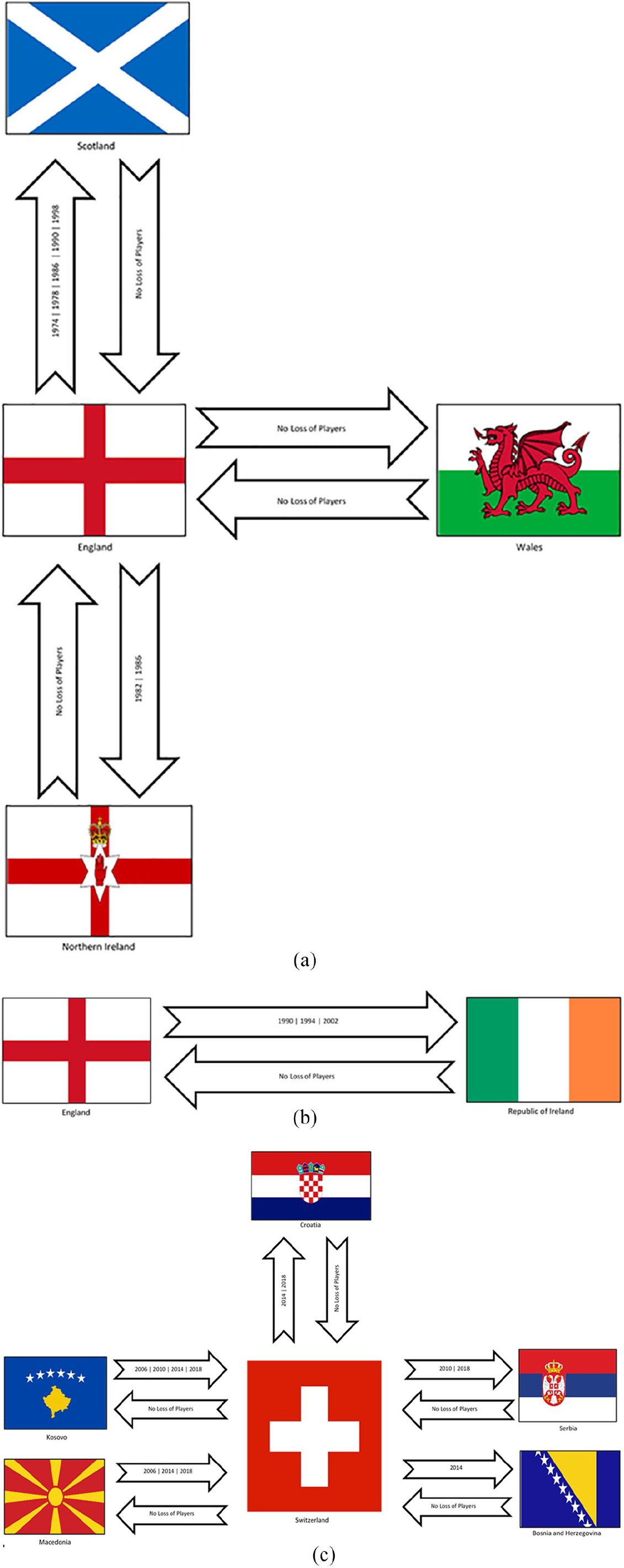
Geographical proximity migration corridors.
In addition to the British migration corridors, the number of English-born players who competed for the Republic of Ireland at the World Cup catches the eye (although it is debatable whether to categorise these movements within the colonial- or geographical proximity migration corridors). The 36 English-born players selected for the Irish national football team, in only three World Cup tournaments (1990, 1994 and 2002), can be explained by the fact that the coaches back then, Jack Charlton (between 1986 and 1995) and Mick McCarthy (between 1996 and 2002), were themselves English and, partly therefore, actively tapped into the Irish (football) diaspora that played profesional football in their neighbouring country (Holmes and Storey, 2011) (Figure 2(b)).
With the selection of 33 foreign-born players, the national football team of Switzerland seems to confirm its country’s reputation as a ‘country of immigration’ with a foreign national population of over 20% (Hess, 2014; Hollifield et al., 2014). These 33 foreign-born players originated from 11 different countries as diverse as from the South American continent (Argentina and Colombia), African states (like Cameroon, Cape Verde, Ivory Coast and Zaire), and neighbouring countries like Germany, France, Macedonia and Kosovo (Table 1). The Swiss national football team seems to have benefitted most from countries geographically proximate to them, as the inclusion of French- and German-born players in the 1950s and 1960s indicates. More recently, especially since the mid-2000s, the selection of footballers born in one of the former Yugoslavian countries, like Kosovo and Macedonia, make up a large part of the foreign-born players within the Swiss national football team (Figure 2(c)). Like most of the foreign-born players from ex-Yugoslavia, Xherdan Shaqiri emigrated to Switzerland with his parents at a young age (4 years old) when war in the former Yugoslavia broke out in the 1990s (Shaqiri, 2018). Besides the inclusion of foreign-born players, there are even more so-called secondos (second generation immigrants) in the Swiss national football team: footballers who are born in Switzerland and are the offspring of immigrants (Hess, 2014). Haris Seferović, Granit Xhaka and Ricardo Rodríguez are some of the plentiful examples who currently represent the Swiss in international football.
In terms of emigration diversification, the destination national football teams (eight different ones) to which the 14 Swiss-born players have moved are mainly neighbouring countries like France (two players), Italy (one player), Germany (two players), and several Balkan states like Bosnia and Herzegovina (one player), Croatia (two players) and Serbia (three players) (Table 2, Figure 2(c)). Whereas the main directional movement of migrants has been towards Switzerland, as a consequence of the political unrest in the Balkans in the 1990s, Swiss-born footballers of Yugoslavian descent started to move in a reverse manner along the same migration corridors after the installation of the independent states. Moreover, as soon as FIFA acknowledged the national football teams of these newly formed states, various Swiss-born Yugoslavs tried to apply for citizenship – mainly along blood lines – of one of these new states as they foresaw an opportunity to represent their ethnic ‘home’ country (Brentin, 2013). One of them was Ivan Rakitić, who opted to represent his parents’ country of Croatia in 2007, despite the fact that he had represented Switzerland in all youth categories (Rakitić, 2017).
Guest worker migration corridors
As a consequence of demographic and economic changes in large parts of Europe in the late 19th and early 20th centuries, many (southern) Europeans migrated to the South American continent in search of jobs. Many Italian labour migrants moved to Argentina because of ‘the relative short cultural and religious distance that separated Italy from Latin America’ (Goebel, 2016: 7) but they, most probably, did not left Italy with the intention of settling in Argentina permanently. Despite the establishment of a migration corridor between the two countries, no Italian-born player has ever competed for the Argentinian national football team within the context of the World Cup (Table 1; Figure 3).
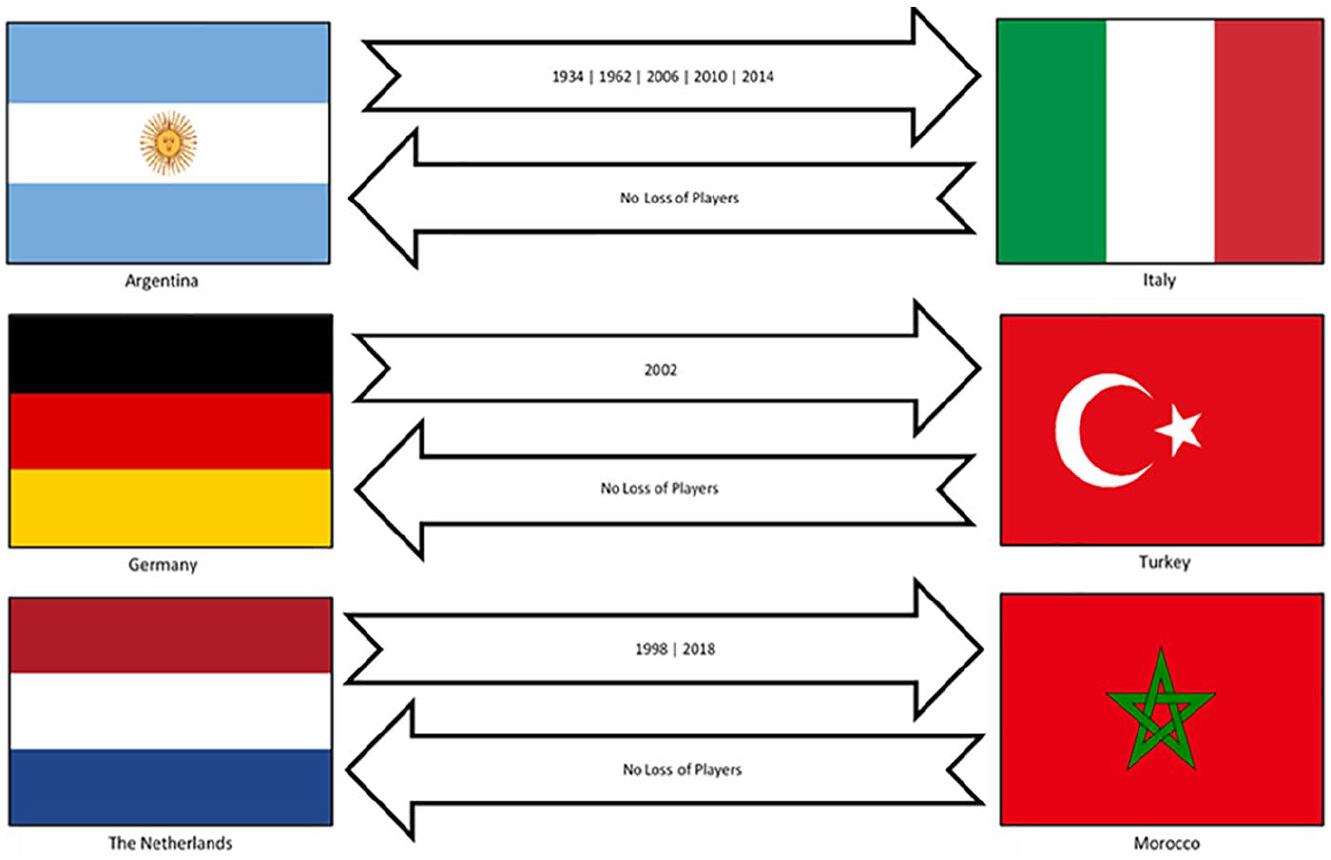
Guest worker migration corridors.
Studying the Argentina–Italy (football) migration corridor from an emigration perspective, Argentina has ‘lost’ nine native football players to the national team of Italy (Table 2). Five of these Argentine-Italians, referred to as Oriundi, even won the World Cup with their adopted country Italy (in 1934 and 2006). At the 1934 World Cup, Italy triumphed with the help of four Argentine-born players – Luis Monti, Raimundo Orsi, Enrique Guaita and Attilio Demaría – who were personally persuaded by the Italian leader Benito Mussolini to compete for its representative national football team, partly because of their performances at Italian football clubs (Martin, 2004). In 2006, Mauro Camoranesi was the latest Argentine-born Italian to lift the World Cup trophy after he obtained dual Argentine–Italian citizenship in 2003, for which he qualified through his great-grandfather Luigi, who had emigrated to Argentina in 1873 (Scragg, 2018).
In the aftermath of the Second World War, most Western European countries started to recruit temporary labour ‘to speed up the reconstruction and to compensate in part for wartime manpower losses’, in either a spontaneous or systematic way (Castels, 1986: 761–762). The active recruitment of guest workers by governments stimulated the movement of (mainly low-skilled) labour from, amongst other countries, Turkey to Germany and from Morocco to the Netherlands, thus establishing guest worker migration corridors between these pairs of countries. Like the Italian immigrants to Argentina, it was expected that these guest workers would return home after the temporary peaks in labour. However, as many of them found permanent jobs in their adopted country, they decided to stay (Castels et al., 2014). As immigration policies in Germany and the Netherlands allowed for chain migration, including the possibility for guest workers to acquire German/Dutch citizenship, these guest worker migration corridors have been sustained by the movements of families and loved ones of Turkish and Moroccan guest workers (Castels et al., 2014; GLOBALCIT, 2017). As a consequence of these migratory movements and German citizenship laws, nearly 3 million people of Turkish ethnicity live today as German citizens or have dual citizenship; the German-Turkish community is the largest immigrant population in the country (Seiberth et al., 2019). At just over 400,000 in number, of whom 170,000 are first generation migrants, people of Moroccan descent are one of the largest immigrant groups within Dutch society (Statline, 2019).
The guest worker migration corridor between Germany and Turkey has sustained in the context of the World Cup, but mainly with a reversed direction of movement, as the four German-born ethnic Turks who represented Turkey at the 2002World Cup illustrate (Table 2). Although many more German-born Turkish footballers have chosen to compete for the Turkish national football team over time, they have not represented the country at the World Cup. On the contrary, despite the amount of first generation Turkish immigrants in Germany, no Turkish-born footballer has competed for the German nationalfootball team at the World Cup (Table 1; Figure 3). However, as a consequence of Turkish guest workers’ immigration, many of today’s talented football players in German elite football have a Turkish migration background. While these football players are born and raised in Germany, went to German schools, and often represented Germany at various youth levels, they have yet to decide on their national allegiance in international football: Germany or Turkey (Seiberth et al., 2019). Several German-born ethnic Turks have made such a decision in favour of the German national football team, and have represented Germany in international football, Mesut Özil and İlkay Gündoğan being the most notable.
The Dutch experience of guest workers originating from Morocco seems to largely mirror Germany’s, as no Moroccan-born player has represented the Dutch national football team during a World Cup. Again, like Germany, there have been several Dutch-born Moroccans who have represented the Dutch national football team at the World Cup such as Khalid Boulahrouz and Ibrahim Affelay, and even more Dutch-born, ethnic Moroccan players beyond the context of this event. The main direction of football player movements within the Netherlands–Morocco migration corridor can, however, be seen as a reversal of the historical movements by Moroccan guest workers. This reversed migratory process is illustrated by the six Dutch-born Moroccans who defended the colours of Morocco at the 1998 and 2018 World Cup tournaments (Table 2; Figure 3). Since the national football federation of Morocco decided to actively tap into the Moroccan diaspora in 2010, which was possible because their general principle towards citizenship is based on descent (GLOBALCIT, 2017), the national football team of Morocco consists of a relatively large number of foreign-born players. At the most recent World Cup, the Moroccan national football team had the most diverse selection at the event as their 23-headed squad included 17 foreign-born players, originating from six different countries. Five of these players were Dutch-born – Mbark Boussoufa, Karim El Ahmadi, Hakim Ziyech and the brothers Nordin and Sofyan Amrabat – who were all eligible to represent Morocco because of their Moroccan families (Kuper, 2018b).
Conclusion
Our study reveals that although foreign-born players at the World Cup originate from a wider, more diverse range of countries over time, most of these ‘nationality swaps’ are guided by underlying migratory structures such as national migration policies, citizenship regimes and historical events. By using the idea of migration corridors, we have illustrated how the selection of foreign-born players within national football teams can largely be considered an echo and/or reversal of preceding migration flows between pairs of countries. In other words, the diversification of national football teams seems to be closely related to an (intensified) (re)use, or rediscovering, of existing, historically established (football) migration corridors between pairs of countries.
To critically reflect on the structures that underlie the nationality changes of footballers, a theoretically informed typology of three, partly overlapping, (football) migration corridors was distinguished based on historical and ongoing relations between pairs of countries: colonial, geographical proximity, and guest worker relationships. More often than within the other types of migration corridors, players’ nationality swaps within the studied (football) colonial migration corridors seemed to have a bidirectional character when studied over time. Within the colonial migration corridors between African and (Western) European countries, for example, the inclusion of foreign-born footballers in (West) European national football teams mainly seemed to echo, often with a slight delay, trends in international migration that were based on colonial relationships. Whereas former colonial empires, like France, England and the Netherlands, selected foreign-born players from ‘their’ colonial talent pools, this (slowly) stopped after these former colonies gained independence and FIFA permitted their national football teams to compete in international competitions. As a consequence of decolonisation, many colonial (football) migration corridors are nowadays witnessing a reversal of preceding migratory movements mainly because national football federations from former colonies, like Algeria, Morocco and Tunisia, are selecting the best possible players from their country’s diasporas. Both the echoing of preceding trends in international migration and the reversal of the main direction of movements within these colonial migration corridors can be related to what Jansen et al. (2018) have coined reverberative causation. Within the guest worker migration corridors, all nationality swaps of foreign-born players displayed a reversed pattern of the historical main direction of migration. While German-born Turks and Dutch-born Moroccans have, for example, competed for the national football teams of Turkey and Morocco respectively, no first generation migrant footballer from either country has managed to represent Germany or the Netherlands at the World Cup. In a similar vein, reversed ‘movements’, in terms of nationality choices, seem to continue to characterise the sustainment of the (football) migration corridors based on geographical proximity. For example, quite a number of German- and English-born players have chosen to represent the country of birth of (one of their) immigrated parents or even grandparents within international football, thereby making a nationality choice that goes against the main direction of migration within these corridors.
To conclude, we believe this study contributes to the knowledge base on the diversification of international football, in particular through its historical depth and the insights it gives into underlying structures and patterns of footballers’ nationality changes. At the same time, we acknowledge that our findings need to be considered in light of some limitations. We, therefore, end this paper by making explicit some of these limitations and providing some suggestions for future research. Firstly, we only discussed the most prominent (football) migration corridors that can be derived from the literature and connected those to our data on foreign-born football players. The three, partly overlapping, migration corridors enabled us to gain more insights into the complexities around nationality choices of foreign-born football players in national football teams throughout the history of the World Cup. The explorative character of our study, however, also means that some other less prevalent and nuanced mechanisms underlying nationality changes of footballers over time have not been discussed. This includes some interesting, specific, historical relationships between countries that also influenced the nationality changes of football players such as the relationship between Germany and the USA. As Table 1 illustrates, many German-born footballers have competed for the USA, in particular in the (recent) history of the World Cup. This can probably be explained by a combination of events, amongst other things the post-World War II situation in which US servicemen lived in Germany for some time and had children with German women; some of these German-born children later played for the US national football team. In addition, the (coincidental) appointment of a German coach (Jürgen Klinsmann) to the US national football team had an impact on the diversification of its selection for the 2014 World Cup as he included four German-born players based on their ancestry. Future research is needed to further examine the effects of such specific historical events and situations on nationality changes amongst footballers. Secondly, the study is limited to the national football teams that competed at the World Cup. This raises questions of how our findings may apply to both the broader context of international football and in relation to other international sports and/or sporting events. Future research can say more about that, but we do know that comparable studies on the Olympics have come to similar conclusions (Jansen and Engbersen, 2017; Jansen et al., 2018). Moreover, Taylor (2006: 8) noted that the migration of (professional) footballers also reflects complex established linkages between ‘sets of countries – linkages that have deep social, cultural and historical roots’. Lastly, within the colonial migration corridors, our findings show that recent nationality swaps of football players can be considered a reverse of the main directional migratory movements within this corridor. However, this does not mean that the national football teams of former colonial empires are not still benefitting from their colonial past. Clearly, many of the current players in the national football teams of France, England and the Netherlands, to name a few, have genuine links with one of their country’s former colonies despite not being born there (Storey, 2020). It would therefore be interesting to gain a fuller understanding of the experiences and motivations of footballers who belong to the second or third generation of migrants or who possess two or more nationalities on representing ‘their’ country in a nationalistic sporting context.
Footnotes
Declaration of Conflicting Interests
The author(s) declared no potential conflicts of interest with respect to the research, authorship, and/or publication of this article.
Funding
The author(s) received no financial support for the research, authorship, and/or publication of this article.
