




Abstract
Despite the undisputed existence of antisemitic incidents in sport, little is known about their exact prevalence and forms of manifestation. Also in Germany, physical and verbal attacks against Jewish sports clubs have repeatedly come to light. To estimate the prevalence of antisemitic incidents in German grassroot sports, a standardised online survey was conducted among members of Jewish sports clubs in Germany (N = 309, data collection 3 November 2020 to 24 January 2021). Results show an accumulation of cases in football: more than two-thirds (68%) of the football players have experienced an antisemitic incident at least once, while the share in other sports is only 14%. The results indicate that football offers a particularly large number of constellations that lead to the expression of antisemitic patterns. At its core, football is shaped by a clash of group identities. It is widely accepted that opponents and their supporters are devalued through aggressive and emotionalized behaviour. A tendency towards underreporting can furthermore be observed in dealing with the incidents, among other reasons due to a significant proportion of those surveyed do not trust the sanction mechanisms of the sports associations – this in turn applies to footballers and non-footballers.
Introduction
Despite the crimes of National Socialism against Jews before and during World War II, we observe tendencies towards the rejection of guilt, or even a complete denial of the Shoah in Germany and other European countries (Bergmann, 2014: 4). Nevertheless, after 1945, in Europe and especially in Germany antisemitic opinions could no longer be expressed openly due to political and social pressure (Bergmann and Erb, 1986: 223). Public ostracism of antisemitism led to an overall decrease in antisemitic incidents for a long time. Yet, antisemitism prevailed in latent forms. It was expressed either subtly or privately in semi-public spaces. As a result of this taboo, antisemitic resentments evolved from religiously or racially-based forms of anti-Judaism to differently coded, more subtle forms of expression (Salzborn et al., 2011: 1202). However, studies of antisemitic attitudes in German society show notable approval of such coded forms of antisemitism, as well as a decreasing condemnation of openly expressed hatred against Jews in recent years (Zick and Küpper, 2021). Furthermore, the existence of taboos does not mean that antisemitism is no longer relevant in Germany. As a recent study has shown, the fear of Jewish people about overt and covert antisemitism is pronounced. Antisemitism is experienced in both the analogue and digital worlds, and Jews are pessimistic about the future in this regard (Zick et al., 2017: 82).
Against this background, it seems that organized sports, and especially professional football, have continuously been settings where the expression of unambiguous forms of discrimination is much easier than in other social fields (Doidge, 2016; Kassimeris, 2021). This also applies to antisemitic incidents, which have been recorded in European sports time and again in the past few decades – with a particular accumulation in football. According to Poulton (2021: 20), each facet of antisemitism has been observed in European football on and off the pitch in recent years. This can be illustrated with two examples from summer 2021:
Steven Berghuis, former captain of Dutch club Feyenoord Rotterdam, moved to Ajax Amsterdam in July 2021. After completing the transfer, Berghuis was painted on a large graffiti in the city in the unmistakable clothing of concentration camp inmates with a yellow star on it – described with the words ‘Joden lopen altijd weg’ [Jews always run away] (Tamsut, 2021). During the escalation of the Middle East conflict in May 2021, German Maccabi
1
sports clubs were confronted with a number of antisemitic online incidents. Similar to the (attempted) attacks on German synagogues during this period, Jewish and non-Jewish Maccabi members were collectively held responsible for the escalation in the Middle East and abused and threatened online (Armbrecht, 2021).
Research on antisemitism in sport is often historical or, regarding football, only focuses on the professional branch. Therefore, we decided to examine the prevalence of antisemitism in grassroot football by analysing the situation of Jewish sports clubs in Germany. Our central research questions were: How often do German Maccabi members experience antisemitic incidents? Which different types of incidents take place? Which effects do these have on the members’ sense of security? And how do they perceive measures of sport organizations to deal with antisemitism? The methodological basis is a quantitative survey among members of the German Maccabi clubs (N = 309), regarding their experiences of antisemitism.
In the following, we first review the literature on antisemitism in football with an emphasis on the differences between amateur and professional level. After the description of the methods used, we present central results of the survey. In the discussion, we focus on the high number of incidents in football and discuss implications of the results for current and future research.
Literature review
In 2020, a commission of 25 experts from various areas of science, politics and civil society came to the conclusion that research on racism in Germany is underdeveloped by international comparison (Expert Commission on the Framework Conditions for Integration Potential, 2020: 57). Only recently, a national monitoring scheme of discrimination and racism was established. Its initial study revealed that more than 20 percent of the population have experienced racism themselves and almost half of the population have witnessed racist incidents (DeZIM, 2022). Discrimination may occur on grounds of appearance, language, name, religion or nationality, targeting people perceived ‘as non-white, as having a history of migration, as a non-German or as a non-Christian’ (Melter, 2015: 7). Although this applies to Jews too, and although research indicates that there are strong connections between antisemitic, racist and other discriminating attitudes (Zick and Küpper, 2021), there are also aspects which make it necessary to distinguish antisemitism from racism. Most of all, while other ‘races’ are usually constructed as inferior, Jews are frequently imagined as extraordinary powerful and are held responsible for negative facets of capitalism and modern society (Salzborn, 2010). Such myths were also an integral part of Nazi ideology and as it led to the unprecedented crimes of the Shoah, antisemitism has been a specific issue in German politics, society – and social research – ever since.
Turning to the sociology of sport, neither racism nor current antisemitism are prominent topics in Germany. In comparison to the stance of racism as a rather well-established research topic in the international (or at least: anglo-american) scientific community (Carrington, 2015; Nauright and Wiggins, 2016), the German discourse has long been dominated by a rather positive framing of sports’ potentials to integrate migrants into society (Braun and Nobis, 2016). Only more recently, racist phenomena in sports have been addressed more thoroughly (Delto, 2018; Nobis and Lazaridou, 2022; Stahl, 2021).
When looking at football in particular, social scientific research across Europe has addressed several types of discrimination, such as racist incidents and structures in professional sports (Back et al., 2001; Doidge, 2016) as well as in grassroot football (Long et al., 2000). However, studies on antisemitism have mainly been shaped by historical works that relate to the time of National Socialism (Blecking and Peiffer, 2012; Dee, 2014; Wahlig, 2015). Only more recently, scholars started to focus on current forms of antisemitism in sports – e.g. fan behaviour in professional football (Curtis, 2019; Schubert, 2021), or antisemitic attitudes among voluntary sports club members (Delto 2018; Delto and Zick, 2021) – and also policies tackling it (Poulton, 2020). But apart from few British studies (Dart, 2021; Dart and Long, 2020), the perspectives of persons affected by antisemitism in contemporary grassroot sports, and in Germany in particular, have been neglected.
Antisemitism in professional football
When looking at antisemitism in professional football, incidents usually take place in the stands or on the way to and from the matches. Those incidents are mostly committed by a ‘small number of fans and the rest do not participate, but they are a silent majority, not likely to take action to prevent or stop the problem’ (Curtis, 2019: 285). Well-known manifestations of antisemitism in European professional football are attacks against clubs with a widely perceived ‘Jewish’ identity, such as Tottenham Hotspur, Austria Wien or Ajax Amsterdam (Poulton and Durell, 2016; Stratton, 2015). Various antisemitic facets can occur here, as was recently the case with the singing of ‘Hamas, Hamas, Jews to the gas’ before Ajax Amsterdam's match against Vitesse Arnhem (Liphshiz, 2021). Interestingly, it can be observed for Ajax and Tottenham that their fan culture has, over the years, adapted and embraced the originally derogatory classification as Jewish clubs (Efron, 2006; Lunn, 2021).
However, antisemitic incidents do not necessarily derive from the allegedly Jewish identity or history of a club. For example, antisemitic insults by football-fans have been present in Poland since the early 1990s, although fewer incidents were reported in recent years (Kossakowski et al., 2020). Burski and Wozniak (2021: 48) claim that the main reason for the persistent use of antisemitic ‘language fossils’ lies in the complicated history of the formerly multi-ethnic Poland and that its use today varies across regions. The absence of research on antisemitism in other sports suggests again that football (or more precisely: its fan culture) has various characteristics that can trigger discrimination: Football provides a distinct, perhaps even unique, arena – both inside/around the physical stadium and a wider discursive “virtual” space – that affords a degree of “legitimacy” to “soft” racism and casual forms of other discrimination, such as antisemitism, homophobia, and sexism, yet where certain fan language and behaviors, directed toward opposition supporters, that mock or use stereotypical traits may not always necessarily be intended as racist, antisemitic, homophobic, or sexist by the (ab)users, though they might have this effect. (Poulton, 2021: 28)
In relation to his analysis of German fan culture, Schubert (2019: 434) states that, apart from football, there is no other social setting where groups of people cooperatively insult others in an antisemitic manner and he classifies the derogatory use of the word ‘Jew’ as the greatest possible insult in German football. According to Brunssen (2021), the prevalence of antisemitism at the level of German professional football can be analytically divided into four forms:
Right-wing extremist antisemitism describes a form that originates from German hooligans and neo-Nazis, which positively relates to National Socialism (e.g. in the context of international matches of the German national team against Poland) Classical antisemitism explicitly devalues ‘Jews’, often in combination with traditional antisemitic stereotypes such as conspiracy theories Secondary antisemitism essentially includes post-Shoah antisemitism (mechanism of defence against guilt) as well as Israel-related forms of antisemitism Antisemitic resentment communication includes resentment along antisemitic lines in the context of criticism of capitalism, especially against the Red Bull owned football club RB Leipzig, which is not directly attacked as ‘Jewish’, but as rootless, global and inauthentic
Certainly, the issue is addressed to some extent by German sport and football authorities. For instance, the German youth sport association (DSJ) or the German football association (DFB) have launched programs for diversity and against discrimination (Deutsche Sportjugend, 2022), including campaigns against racism (DFB, 2022). Regarding antisemitism in particular, there is broad support for the annual ‘!Nie wieder’ [!Never again] Remembrance Day among the clubs in the 1st and 2nd Bundesliga (Nie Wieder, 2021). In addition, similar to the British Premier League (Conn, 2020), the German Football Association and the German Football League have recognized the International Holocaust Remembrance Alliance ‘Working Definition of Antisemitism’ in 2021 (DFB, 2021a; DFL, 2021). The working definition aims to offer practical criteria for the detection, identification, documentation, combating and criminal prosecution of antisemitism. Herbert Hainer, President of FC Bayern Munich, said on the occasion of the recognition in January 2021: ‘[…] We will continue to be involved in this issue that is important for our social cohesion, as is now the case with the initiative to adopt the IHRA definition of antisemitism to make aware of it’ (FC Bayern München, 2021). It should be mentioned that the ‘IHRA Definition” is not without controversy in international (scientific) discourse. For example, the authors of the ‘Jerusalem Declaration on Antisemitism’ – another attempt to classify the phenomenon of antisemitism – argue that the IHRA approach blurs ‘the distinction between antisemitic speech and legitimate criticism of the State of Israel and Zionism’ (JDA, 2020). Regardless of the controversial view of the IHRA Definition, its recognition by football clubs and associations can definitely be seen as an indication that football authorities are aware of the issue of antisemitism. Despite these activities of individual clubs and associations, according to Lazar (2020: 18) and Schubert (2019: 306), there are still significant deficits with regard to the prevention, recording and punishment of antisemitic incidents in German football.
Antisemitism in (German) amateur football
While cases of antisemitism in professional football are instantly recognized and discussed in the media, antisemitism in amateur football is less public. One way to gather information on the phenomenon is to analyse official reports of discriminatory incidents in the grassroot football leagues. According to these, a discrimination was documented in 755 of 1.57 million games (0.19%) in the 2020/2021 season (DFB, 2021b). However, it must be questioned if these statistics paint a realistic picture. For example, incidents that the referee does not notice, deliberately ignores, or in which he himself appears as a ‘discriminator’, are not registered in the match reports database (Vester and Osnabrügge, 2018: 15). Thus, it seems likely that there is a large number of unreported cases. To improve the recording and processing, ‘contact points for incidents of violence and discrimination’ for collection and (referral) advice for football district associations and sports courts were created in all regional German football associations by summer 2020 (Lazar, 2020: 30). In the next few years, it will be observed whether the creation of the contact points leads to an increase in the number of reported cases.
In addition to analysing officially documented incidents, another way to examine the topic is to look at attitudes of sports club members. Delto and Zick (2021) studied antisemitic attitudes and other discriminatory tendencies among sports club members in German regions Brandenburg and Saxony-Anhalt (N = 3417). Results show, among other things, that a high level of education, a positive conception of diversity and especially the rejection of social dominance orientation (SDO) reduce the approval of classic antisemitism.
Apart from Germany, there are primarily studies from Great Britain on grassroot sports as the situation of Jewish amateur athletes in Great Britain was examined by Dart (2021) using a qualitative approach (N = 20 interviews and N = 2 focus groups). The participants’ experiences of discrimination in the context of sport confirmed the impression of other ethnic minorities: the risk is primarily related to the visibility of ethnicity. In the opinion of the Jewish respondents, easily recognizable minorities are even more affected by prejudice. On the other hand, players in the British Maccabi leagues felt very identifiable but explained that they did not encounter antisemitism in connection with their sporting activities (Dart, 2021: 689). Based on the same survey, Dart and Long (2020: 258) stated that the overall level of antisemitic abuse the participants had experienced within sport ‘was low and had declined in recent years’. In general, the majority of respondents rate the situation in sport as an indicator of the spread of antisemitism in society as a whole.
In contrast, antisemitic incidents against German Maccabi-members, especially in football, have been reported – in waves of varying frequency and intensity – over the entire period since the (new) founding of Maccabi clubs in the 1960s (Brunssen, 2021: 44; Schubert, 2019). Alon Meyer, current president of MAKKABI Deutschland, the association of German Maccabi clubs, considers the recent situation as ‘more aggressive and hateful than ever before’, especially in the field of lower-league football. He outlines a range of ongoing antisemitic incidents, from ‘insults to fist fights and knife attacks’ (WELT, 2018). Despite a large number of cases that have become publicly known in the media and in qualitative studies (Schubert, 2019: 261–288), no data is available yet on the frequency of incidents against Maccabi members.
Methods
To estimate the prevalence of antisemitic incidents in grassroot sports, an online survey among Maccabi club members in Germany was conducted. The concept of the questionnaire was based on a literature review and the consideration of findings from a total of N = 6 expert interviews. The questionnaire contained standardised items and open questions about participant's own sporting activity, antisemitic experiences with Maccabi (incidents that the participants themselves classified as antisemitic), and the perception of measures taken by sports associations to combat antisemitism. The first version of the survey was pretested by a total of 15 people (Maccabi and external), in order to optimize the data collection ex ante. Finally, an online questionnaire (via SoSciSurvey, version 3.2.19) with 34 questions in browser-based and mobile form was launched. For ethical considerations, especially with regard to the recapitulation of incidents that have been experienced in the questionnaire, a minimum age of 16 years was set. The survey was mainly distributed by the boards of the local Maccabi clubs, who were sent text modules via email and WhatsApp for forwarding to the members. All respondents were informed about the topic of this survey and answered the questions voluntarily. At this point, a bias in relation to the willingness to participate cannot be ruled out. It is conceivable that members with no experience of antisemitism were more likely to refrain from participating because they felt they could not contribute much to the topic. The survey was run from 3rd November 2020 to 24th January 2021. The data analysis was carried out with SPSS 27.
Sample
The target population included all current members of the German Maccabi clubs aged 16 and over. According to official statistics, 5319 people were member of a Maccabi-club in 2020 (DOSB, 2020). The exact number of members aged over 16 is not available, it lies between 3234 (total number of at least 19-year-olds) and 3716 (total number of at least 15-year-olds). Out of these, a total of N = 329 members fully completed the questionnaire, after data cleaning, this resulted in N = 309 valid cases, representing a share of between 8.3% and 9.6% of the targeted population. Regarding age, a decreasing proportion of participants in older age groups is visible with a mean of 34.8 years (SD = 15.2), Similar to the statistics of MAKKABI Germany (74.8%), the sample consists mainly of male participants (78.9%) (Table 1).
Participants’ characteristics.
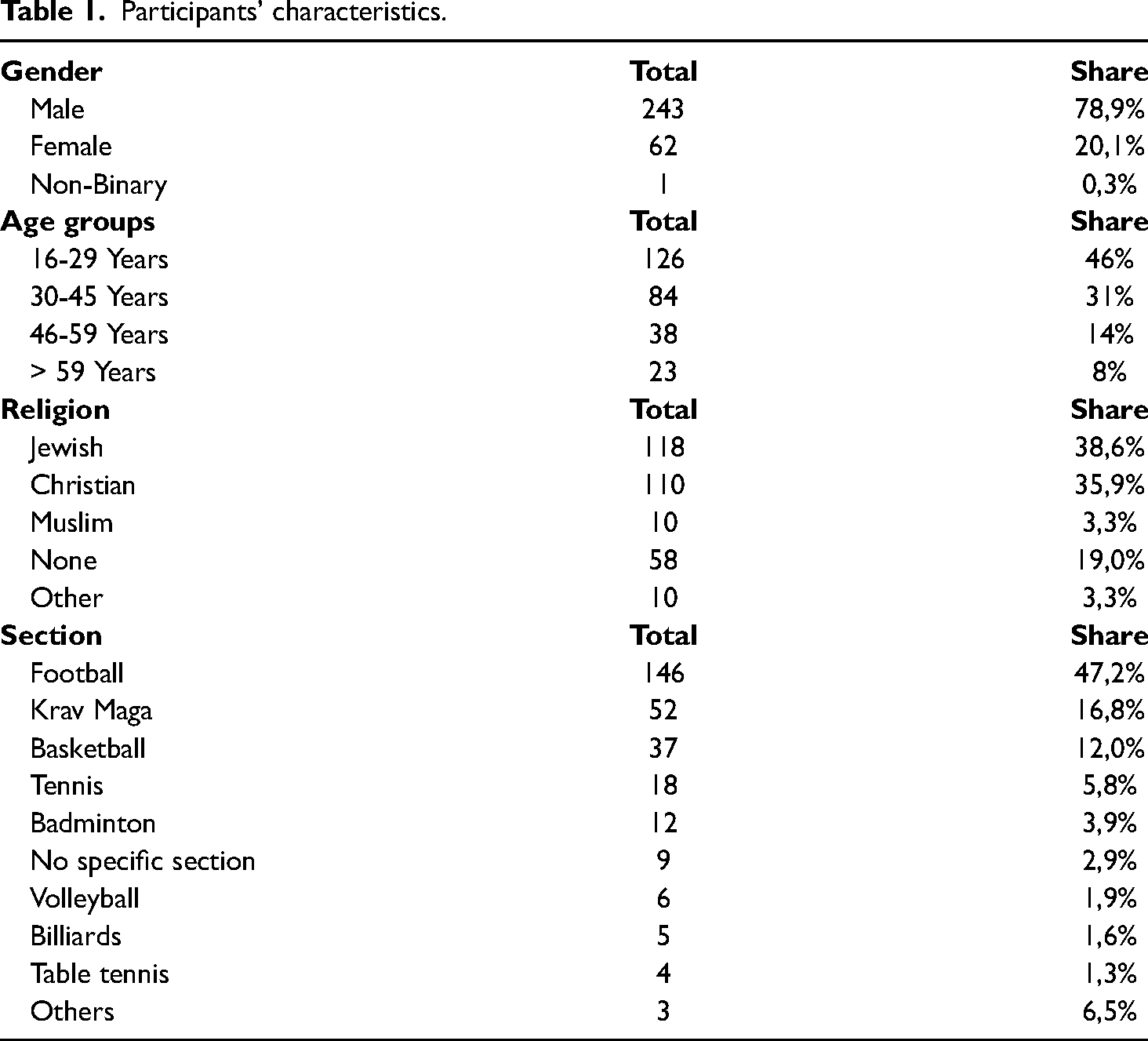
In total, members from at least 20 (of 39) local clubs participated in the survey. As expected, the biggest club ‘Makkabi Frankfurt’ (approx. 2000 members) recorded the largest number of participants (142). Furthermore, other local clubs with a high number of members from Munich, Berlin, Düsseldorf, Cologne and Hamburg are well represented in the sample, too. With a share of 39%, Judaism is represented as the largest religious group in the present sample. The next largest subsets are the Christian members (36%) and those who do not belong to any religious community (19%). After being (re)founded in the 1960s, the Maccabi Clubs were created as a safe space for their members, and to make visible the life of a very small Jewish community in Germany. But since the 2000s, some clubs have consciously and successfully opted for a more open, intercultural approach that also attracts non-Jewish athletes for sporting and non-sporting reasons (Müller and Haut, 2021: 32).
47% of the respondents assigned themselves (mainly) to the football section, followed by Israelian martial arts Krav Maga (17%) and basketball (12%) – in total, 21 sport sections were mentioned. 63% of the respondents stated that they had already participated in competitions for their Maccabi club (most as an athlete or coach). Among the members of the football sections, the share of ‘competitors’ is noticeably higher at 90%.
In order to gain a better understanding of aspects of the club culture at Maccabi, reasons (both) for joining Maccabi as well as for participating in sports were surveyed. 86% of the respondents stated that they joined their club because they identified with the Maccabi values. 62% (rather) agreed that Maccabi's Jewish identity was a reason for joining. It is noteworthy that also 38% of the non-Jewish members (rather) affirmed this motive. In addition to the identity-related motives, sport-specific factors are also relevant for the decision to join a Maccabi club: 70% of the respondents stated that they came to Maccabi because it suited their individual sporting goals. In summary, it can be said that the sample represents the population within Maccabi clubs in Germany in essential aspects as gender, age, and type of sport correspond to distributions in the available statistics of the nationwide association.
Results
In this section, we will first present the findings on the frequencies and different types of antisemitic experiences of Maccabi members. Subsequently, we discuss their effects on the members’ sense of security. Finally, we show how respondents assess sports authorities’ efforts against antisemitism.
Frequency of antisemitic incidents
Of N = 309 respondents, 39% said they had been personally affected by an incident that they considered as antisemitic at least once (Table 2). A distinction based on further characteristics shows that Jewish members were confronted significantly more frequently with antisemitic incidents (54%) than non-Jewish members (39%). As expected, football in particular proves to be a field that enables occasions for antisemitic discrimination significantly more often – over two thirds of the respondents (68%) from the Maccabi football sections were affected by an incident at least once, 55% even several times. Furthermore, male members are confronted with incidents significantly more frequently according to the sample than the female ones (46% at least once vs. 16%). However, the gender-differences strongly mix-up with the distinction between footballers and non-footballers: the six female members, who have assigned themselves to the football sections, experienced 50% of the incidents against females.
Incidents experienced personally.
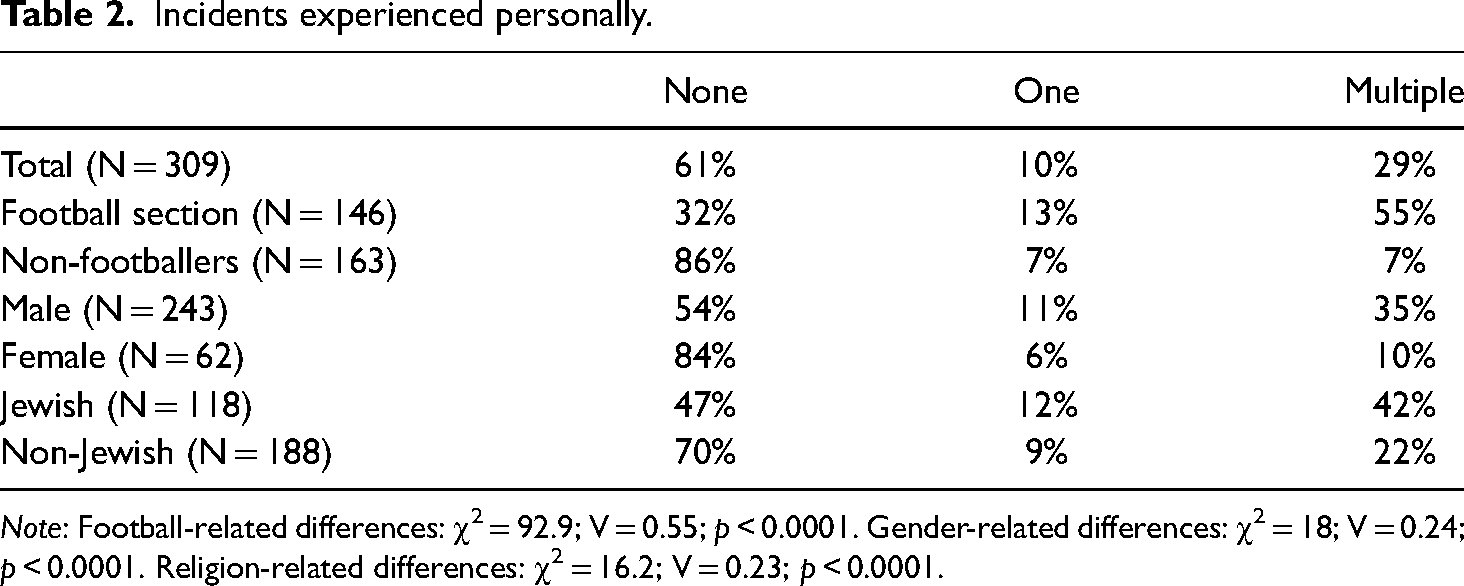
Note: Football-related differences: χ2 = 92.9; V = 0.55; p < 0.0001. Gender-related differences: χ2 = 18; V = 0.24; p < 0.0001. Religion-related differences: χ2 = 16.2; V = 0.23; p < 0.0001.
Compared to the personally experienced cases, an even greater proportion of the respondents has observed incidents: About half of the participants stated that they had already observed an antisemitic incident against other members or against Maccabi as a whole (Table 3). Filtering according to risk factors paints a similar picture to the member's personal experiences – once again, the football-related, gender-related and religion-related differences were statistically significant. Especially members of the football sections are much more likely to observe antisemitic incidents. Nevertheless, the occurrence of antisemitism is not an exclusive phenomenon in football: every fourth member of the other sports sections also stated that they had witnessed an incident aimed at Maccabi as a perceived Jewish organization at least once.
Observed incidents.
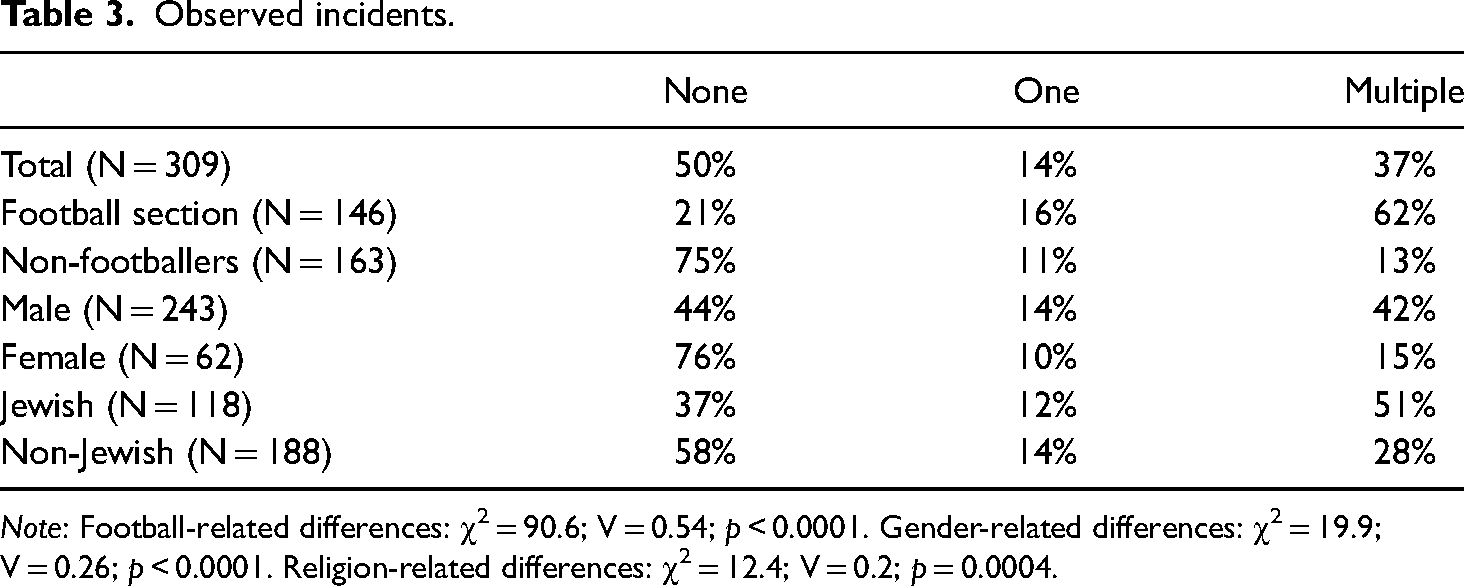
Note: Football-related differences: χ2 = 90.6; V = 0.54; p < 0.0001. Gender-related differences: χ2 = 19.9; V = 0.26; p < 0.0001. Religion-related differences: χ2 = 12.4; V = 0.2; p = 0.0004.
Participants were also asked if they had ever observed an antisemitic incident in sports that was not related to Maccabi, e.g. while visiting a stadium or doing sports in another club. With a share of 49%, almost half of the respondents stated that they had already experienced such a situation at least once. Once again, the share among the members of the football section (63%) clearly exceeds the rest (37%), possibly because footballers are more often football fans, too, who witness antisemitism in stadiums.
Categorization by type of incident
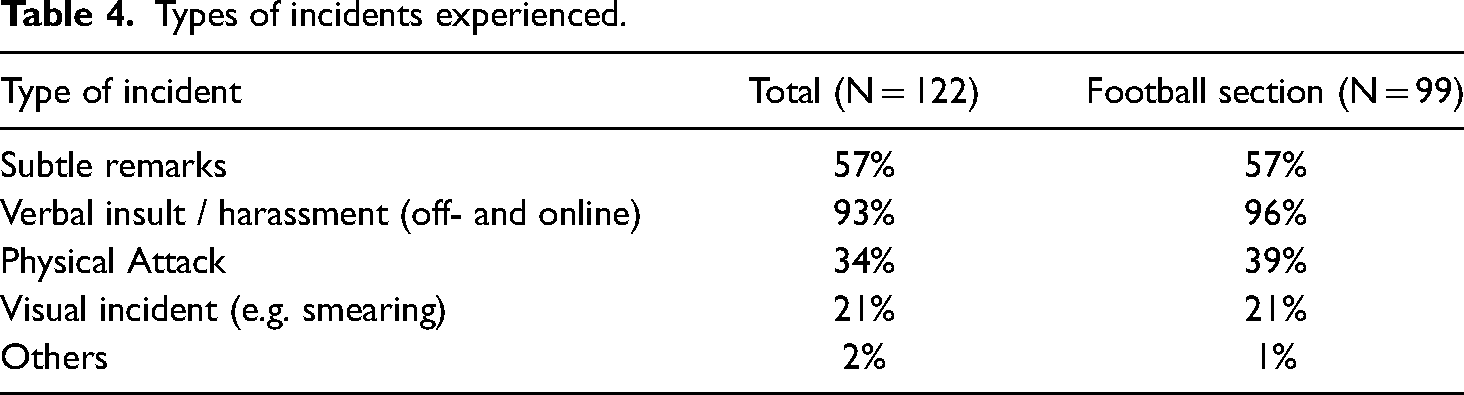
Based on a categorization from a (not sport-specific) study regarding antisemitism in Germany (Zick et al., 2017), the participants were asked to indicate which types of incidents they had already experienced or observed in their Maccabi careers (Table 4). After evaluating the pretest, answer options were expanded to include ‘visual incidents’, as smears on locker rooms or sports facilities with clearly antisemitic messages were mentioned several times. By far the most common forms of expression are verbal insults and harassment: 93% had already experienced at least one such incident against themselves (96% among the members of the football department), 88% had observed at least one antisemitic insult/harassment against other members or against Maccabi as a whole. The frequency of physical attacks with an antisemitic connotation (34% of personally experienced incidents, 44% of incident observations) is thus many times higher in sports than in other areas of everyday life (Zick et al., 2017: 20).
Types of incidents experienced.
Categorization by type of antisemitism
In a free text item, the participants of the survey were asked to describe one personally experienced antisemitic incident in connection with their Maccabi membership that stuck in their minds. The 89 (not disjoint) answers collected were analysed with qualitative content analysis according to Kuckartz (2018), i.e., the categories were first derived theoretically and then inductively expanded. The categories were based on those of the ‘Research and Information Centers Antisemitism’ (RIAS, 2021), supplemented with the aspect of ‘Intersectionality’ and reduced by ‘Anti-Judaism’ (stereotypes based on Christian religion), which did not occur in the descriptions. In the following, the individual types of antisemitism are illustrated using answers from the free-text items.
Antisemitic Othering - Description of Jewish or Jewish-perceived people as not belonging to (majority) society
An under-12 youth football game in which an opposing player was frustrated after the final whistle (as his team was defeated) and let himself be carried away to make a statement like: “Lost to the fucking Jews.” […] Furthermore it was said: “Since when are Jews talented in playing football.” A colleague from another club, a high school teacher in professional life, insinuated special rights for Maccabi in relation to city decision-makers. In fact, it was about competitive behaviour on such a low level that it was just embarrassing to even mention it. […] An opponent in (youth) football yelled: “You filthy Jew you should be gassed”. His mother (even the youth leader of the opposing club) accepted this and herself said that Jews always get everything they want from the state. I went to fix my cell phone with Maccabi clothes. After I got the receipt on which my address was supposed to be, it said “Holocauststraße” [Holocauststreet] instead. Shortly before the end of the game against [team name] we were insulted by players on the pitch. I don't remember the exact accusations, but it was something like: “You will be gassed anyway and then all burned together in one heap” […] After a defeat we were insulted by players of the opposing team as “Shit Jews” - to which they showed us shirts under their jerseys that said Free Palestine! During a football game, an opponent called upwards with both hands: “You are a filthy people - freedom for Palestine” […] Back then in my youth and still today in Men's football, I am often approached like this: “Shit black Jew”; “You should be gassed”; “Are you not ashamed to play for the filthy Jews”, “You [N-word] in a Jewish dress” - Usually only from opponents. I was seen as a traitor, which is because I support the Jewish children, I was insulted as an asshole and a son of a whore. I was also confronted physically.
Modern Antisemitism - Attribution of particular political and economic power, often in the context of conspiracy myths. Maccabi clubs are often accused of having special influence on sports associations or local politicians (Schubert, 2019: 276–279)
Post-Shoah Antisemitism - Antisemitic statements with reference to the Shoah or National Socialism
Israel-related Antisemitism - Collectivization of Jews in the context of statements relating to the State of Israel
Intersectionality - Multiple discrimination, which mainly affects non-Jewish Maccabi members (own category)
During the competition or when wearing Maccabi clothing outside the sports facilities, Jewish and non-Jewish members are perceived as ‘Jewish representatives’ and can experience (antisemitic) discrimination. The type of insult or attack can vary within the spectrum of antisemitic patterns. For those Maccabi members who already belong to another social minority group, the representation of a Jewish organization can result in a special form of multiple discrimination. This ‘intersectional discrimination’ can come from ‘majority society’ as well as from members of their ‘own’ community. Muslim Maccabi members in particular find themselves repeatedly exposed to accusations of treason, as the descriptions of the incidents confirm.
Since it is only a selection of individual incidents, no statistical statement can be made about the actual spread of the respective forms. Nevertheless, it delivers an initial overview of which facets are represented and in which situations they occur: 69 of the 89 descriptions were made from members of the Football section.
Coping and sense of security
For further consideration, we collected coping practices of those affected (N = 122) with regard to the personally experienced incidents described in the previous section as well as perceptions of the personal sense of security of the whole sample (Table 5).
Coping practices and sense of security.
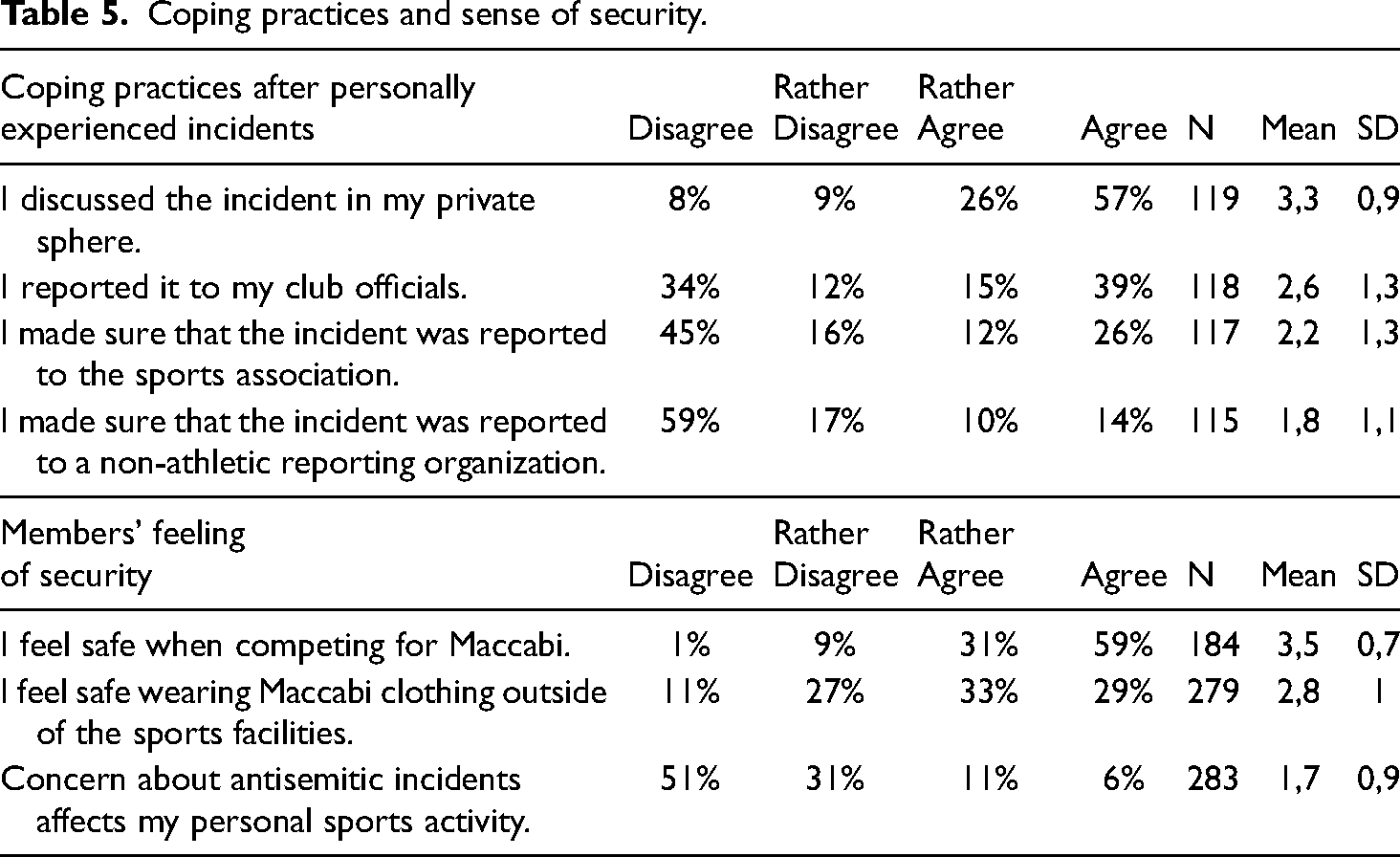
A frequent accusation against the Maccabi associations is that every smallest incident is made publicly and is ‘inflated’ (Schubert, 2019: 277). In fact, the results show quite the opposite. Only just over half of the respondents reported the incident to a member of their club board (M = 2.59, SD = 1.3) and only 38% ensured that the case was reported to a sports governing body (M = 2.2, SD = 1.26). Among the members of the football section, this rate was slightly higher at 42%. There seems to be a considerable number of antisemitic incidents in sports that are not officially reported.
About 17% of the sample (M = 1.73, SD = .9) and even 26% in the subset ‘Jewish members’ reported that their personal sporting activity is influenced by concerns about antisemitic incidents. In addition, the feeling of security outside of the immediate club life were collected: 38% of the respondents stated that they felt (rather) unsafe when wearing Maccabi clothing outside of the sports facilities (M = 2.8, SD = .98). One person addressed this feeling in the final remark of the survey: ‘My children are afraid of taking the subway, for example, in their Maccabi sportswear’. In contrast, the feeling of security in competitions for Maccabi is more pronounced, 90% feel (rather) safe (M = 3.5, SD = .68).
Perspectives on antisemitism in organized sport
Looking back over the past five years, Maccabi members rate the development of the frequency of antisemitic incidents in sport as increasing or constant. 47% of the respondents felt an increase in this period, only 11% estimate that the frequency of incidents in sport is falling. With a share of 45%, the relative majority believe that antisemitism in sports occurs just as often as in other areas of life. Among the footballers (N = 136) it is only 38%, here the majority (55%) are of the opinion that incidents in sport happen more often. Furthermore, 43% see antisemitic incidents as a phenomenon, which is mainly present in lower game or competition classes, 56% see the level of athletic performance as insignificant, only three people rate higher classes as particularly at risk. Here the picture emerges for footballers (N = 137) that lower leagues (53%) are more often viewed as at risk than for non-footballers (33%; N = 129).
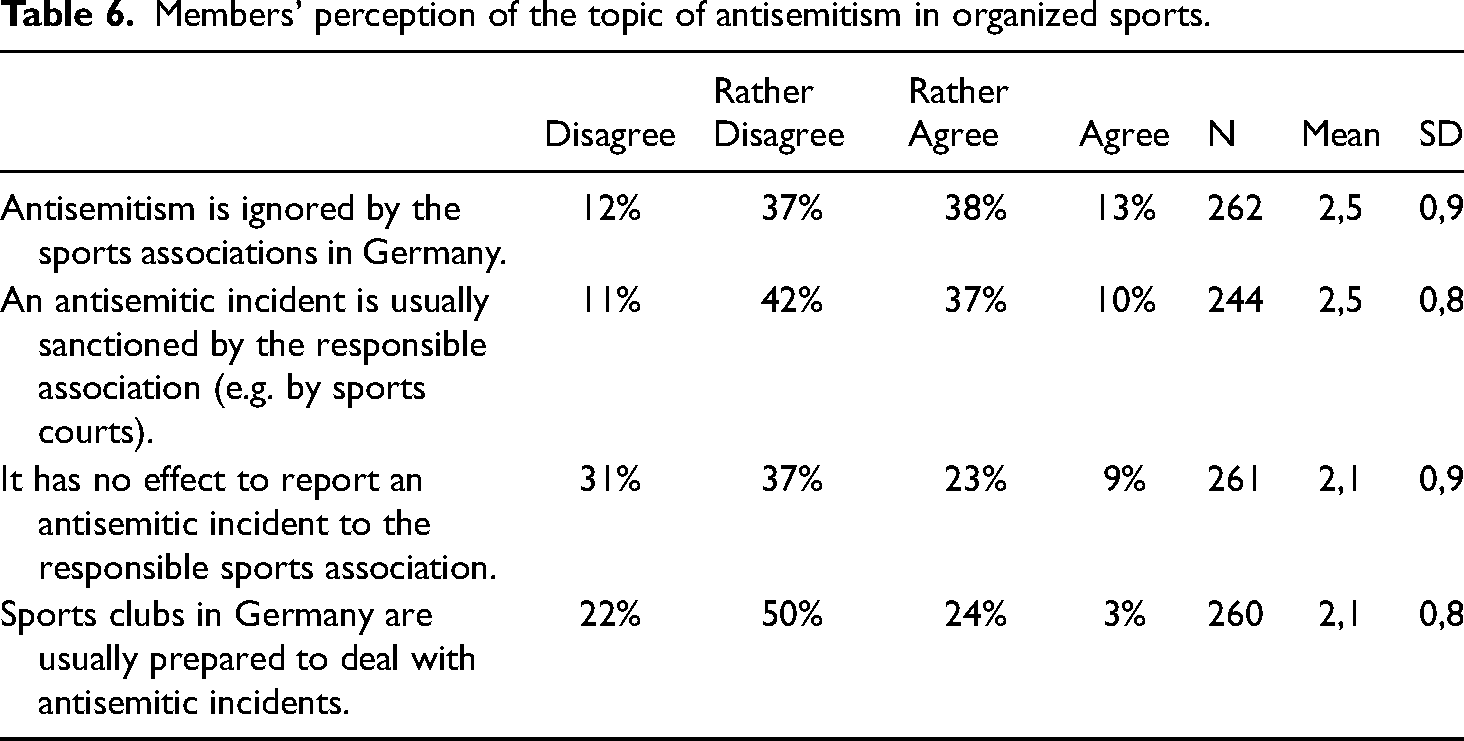
With regard to the awareness of the problem in the German sports associations, opinions are divided (Table 6): 51% of the respondents (rather) perceive a disinterest in the topic of antisemitism among the sports associations (M = 2.52, SD = .86). The assessment of whether an antisemitic incident is usually punished shows a low level of extremes, with 10% ‘agree’ and 11% ‘disagree’ – the majority is undecided (M = 2.47, SD = .82). Despite this uncertainty regarding the likeliness of a punishment, the respondents emphasize the relevance of reporting an incident more strongly: Only one third (rather) agrees with the statement that reporting to the responsible sports association has no effect (M = 2.09, SD = .94). The cause of this deviation could be that the reporting of an incident, irrespective of its punishment, causes at least a statistical recording and thus a visualization of what happened. When assessing the intervention competence of other clubs, the overall picture is very critical: Only 3% of the respondents see sports clubs as being prepared to deal with explicit antisemitism, 24% see at least a partial competence (M = 2.09, SD = . 77). Overall, it can be stated that the work of the associations against antisemitism is rated largely similar by the individual sub-groups; this also applies to the comparison of the Jewish with the non-Jewish members. The perception of the problem does not only exist among the footballers and those already affected but is also shared by the other members.
Members’ perception of the topic of antisemitism in organized sports.
Discussion
The main finding from the survey is a fairly simple, but crucial one: Members of Jewish sports clubs in Germany are regularly confronted with antisemitism. The results contrast with the situation of athletes in the British Maccabi leagues examined by Dart (2021), who felt clearly identifiable as members of a Jewish club but did not perceive antisemitism as a relevant problem in connection with their sporting activity. Of course, it should be noted here that doing sports in a Maccabi league creates a kind of ‘protected’ area, at least when taking part in competitions. In contrast, our findings from Germany indicate that the risk of experiencing antisemitism when representing a Maccabi sports club (in competitions or by wearing sportswear in public) applies not only to Jewish members, but also to members of other religious communities.
Incidents manifest in openly aggressive or subtle forms, from smears and verbal insults to – clearly less frequent – physical attacks. In this respect, there do not seem to be many differences from manifestations of racial discrimination. However, regarding the ideological motives appearing in symbolic and verbal discrimination, antisemitism is expressed in some rather specific forms: Maccabi members are accused of having a powerful influence on authorities in sport and society. They are blamed for exploiting the Shoah for their own advantage and threatened with a ‘repeat of their treatment in the past’. Last but not least, they are held responsible for actions of the state of Israel in the Palestine conflict. Thus, although there are similarities to racial discrimination in terms of othering and the outsider status, such particularities of antisemitism should be considered in future research.
Notably, there is an accumulation of incidents in football. More than two out of three footballers have already been personally confronted with antisemitism in relation to their Maccabi membership. The high prevalence in football can be attributed to various causes. On the one hand, it must first be established that when team sports are practiced, several athletes can experience an antisemitic act or provocation directed against them at the same time, e.g. when an entire team is insulted. Furthermore, almost all footballers in this sample take part in competitions (90%), among the rest it is only 38%. It can be assumed that the risk of experiencing an incident is higher in direct confrontation with other teams than in the ‘protected space’ of training on the club's own facilities. If sports are generally characterised by processes of unification and conflict between groups (Dolan and Connolly, 2016), this applies to football in particular. Football can be viewed as a clash of identities, in which the formation and reinforcement of ‘we-groups’ and ‘they-groups’ seems to be more likely than in other individual or less popular team sports. As a result, the ‘us against them’ mentality that accompanies football can turn the devaluation of the sporting counterpart into part of the game or even turn it into a goal in itself. In order to achieve this, insults are picked out from an arsenal of antisemitic patterns depending on the situation, also in an attempt to trigger in the counterpart as strong a reaction as possible. A parallel to the fan behaviour described by Poulton (2021: 28) can be drawn here: Football supporters have a tendency to go for the perceived Achilles’ heel of their rivals. […] Of course, this level of “banter” can degenerate into vulgar, disparaging, and derogatory insults, which recourse to abuse of a discriminatory nature based on race, ethnicity, gender, sexuality, religion, and other identity markers, as a means of ascription, denigration, and demonization.
In general, especially in the lower leagues, aggressive behaviour and violence are much more normalized in football than in other sports or everyday life situations (Ribler, 2010). Another reason could be the popularity of football in Germany and its heterogeneous membership structure. In organized football, existing social resentments appear as in a magnifying glass. In the case of Maccabi, they become manifest in the confrontation with Israel-related forms of antisemitism. Nevertheless, it should be noted once again that every 7th member outside of the football department has also personally faced an antisemitic incident at least once.
In any case, incidents have an impact on the victims’ sense of security and their behaviour. Regarding possible reactions, the analysis of the sample indicates that there are still structural deficits in the recording and documentation of incidents with antisemitic connotations in sport. A tendency towards underreporting was identified due mostly to a lack of trust in sports associations’ responses. It is unclear to what extent other factors ensure that incidents are usually not reported (e.g. tiredness after decades of confrontation or the desire to just do sports and ignore discrimination). Footballers and non-footballers alike assess the competence of other sports clubs to act in the event of an incident as insufficient, and the work of the responsible sports associations against antisemitism is seen as mediocre. This perception is reminiscent of Poulton's findings (2020: 44) on the activities of the British Football Association (FA). She states that antisemitism has now been included in the association's anti-discrimination agenda. In order to make clear the need for implementing those activities at the professional and grassroot level, however, the tireless commitment of individuals was necessary. The complexity of the struggle against antisemitism can be compared with that against other forms of discrimination: Hylton (2010: 350) argued that the omnipresence of racism is a challenge to anti-racism, but these challenges do not just focus on the more obvious, often overt racist politics of the right, but also the more complex nuances that emerge in the middle of society – this seems to be the case with antisemitism, too.
Undoubtedly, there is a great need for further research in this area. First of all, it should be noted that antisemitic incidents against Maccabi are probably only the tip of the iceberg. Antisemitism also affects Jewish athletes in ‘regular’ sports clubs and it can also take place in the absence of Jewish people. On the one hand, there is a need for more realistic data from the football authorities, which is currently very much dependent on whether referees recognize incidents, penalize them and report them to the association as cases of discrimination (and not just as a ‘regular’ insult). On the other hand, further social science research on the prevalence in non-Jewish clubs is necessary. In addition, research on the impact of prevention activities by sports associations (and large professional football clubs) is still underexposed.
Footnotes
Declaration of conflicting interests
The author(s) declared no potential conflicts of interest with respect to the research, authorship, and/or publication of this article.
Funding
The author(s) received no financial support for the research, authorship, and/or publication of this article.
