




Abstract
This paper examines online expressions of rivalry and hate speech in relation to antisemitic discourses in Dutch professional men’s football (soccer), with specific attention devoted to how this has developed within the context of the COVID-19 pandemic. This study analyses football-related antisemitic discourses in the Dutch-speaking Twittersphere between 2018 and 2021. Assuming that during the ongoing COVID-19 pandemic fan activity has moved increasingly toward the online domain, we specifically examine whether and how the past pandemic years have influenced football-related antisemitic discourses on Twitter. Tweets were scraped using the Twitter application programming interface and 4CAT (a capture and analysis Toolkit), producing a dataset of 7,917 unique posts. The authors performed thematic analysis of the Tweets and a selection of the Tweets was analyzed in depth using narrative digital discourse analysis. The findings show how these Tweets, while seemingly targeted exclusively at football opponents, contribute to wider exclusionary discourse in football and society that may have become more aggravated during the COVID-19 pandemic.
Introduction
Dutch professional men’s football is regularly confronted with antisemitic behavior. Football supporters use the term “Jew” or “nose” (a reference to the stereotype that Jews supposedly have big noses) as an insult or slur, or chant “Hamas! Hamas! All Jews to the gas” 1 and mimic the sound of escaping gas from Nazi gas chambers (Gans, 2013; Seijbel et al., Forthcoming). Fans themselves mostly attribute this to their rivalry with the Amsterdam-based football club Ajax. Within Dutch football—and sometimes abroad—Ajax is cast as a “Jewish” club and, as such, fans of rivaling teams such as Feyenoord Rotterdam, FC Utrecht, and ADO Den Haag make antisemitic references toward Ajax to express their rivalry with the club (Kuper, 2003). This kind of football-related antisemitic behavior is reproduced in stadiums, bars but also online (Seijbel et al., 2022). While online racism and combating online racism in the context of football has received some attention in recent research (e.g., Cleland, 2014; Farrington et al., 2014; Kilvington & Price, 2018), online football-related antisemitism remains largely overlooked. In general, research on digital forms of antisemitism and their dissemination in online contexts remains relatively scarce (Bossetta, 2022). This paper attends to this research gap by specifically examining antisemitic discourses in the context of football (soccer) on Twitter. Moreover, we are interested in how the COVID pandemic has potentially influenced online football-related antisemitism. He et al. (2020) and Elias et al. (2021) have shown how the pandemic has caused increased polarization and experienced racism and discrimination within society. This paper aims to examine the online expressions of antisemitic discourses in Dutch professional football, with specific attention to how this has developed within the context of the COVID-19 pandemic. The COVID-19 outbreak and the far-reaching lockdown measures had direct and indirect effects on all social domains, including football fandom. Research shows, for instance, how many supporters turned to their individual digital and mobile devices to remain connected to football and their club (Crawford et al., 2021). According to Crawford et al. (2021), this was already in process but the global pandemic has accelerated the shift in consumption of football increasingly toward digital (participatory) experiences. This may also mean that antisemitic behavior in stadiums was increasingly transferred to online domains.
Antisemitism in contemporary Dutch society is substantial, both online and offline (Centre for Information and Documentation Israel (CIDI, 2020; van Gool & van de Ven, 2020). Research by journalists Van Gool and Van de Ven in cooperation with the Utrecht Data School (2020) shows that online antisemitism (on Twitter) in the Netherlands is significant. Their research analyzed almost 1.3 million Tweets which in a broad sense touched on the theme of antisemitism, from the year 2019 (van Gool & van de Ven, 2020; Verbeek, 2020). It is likely that online antisemitism in the Netherlands increased during the pandemic, which started in Dutch society in the first months of 2020. Previous findings in international literature suggest a convergence between COVID conspiracies and antisemitic discourse, blaming for example “Jews” and “Zionists” for the pandemic (Ehsan, 2020; Teter, 2020). In addition, the CIDI observes that conspiracy theories about “Jewish control,” including the belief that Jews have created the coronavirus, rose dramatically in the COVID-19 context in the Netherlands (CIDI, 2021). These narratives circulate both in online and offline spaces and have been observed empirically on other social media such as Telegram (Peeters et al., 2021).
Among football studies scholars, the effects of COVID-19 on the game have received increased scholarly attention (Horky, 2021; Parnell et al., 2021; Weimar et al., 2021). Weimar et al. (2021) have examined fan attention for smaller leagues versus bigger leagues on social media in the context of the pandemic and found that the number of followers on social media platforms of Belarus clubs (a league without suspension) strongly increased during the global lockdowns. The results of their research suggest that fans search for temporary social connections when their usual groups disappear. Our paper, however, is unique in exploring online football-related antisemitism over a period of several years, thereby also addressing the question if and how football-related antisemitism was affected by the COVID-19 pandemic. With this paper, we aim to contribute to knowledge on online football-related antisemitism and online discrimination and hate speech in general. More specifically, we address how football-related antisemitic rhetoric is reproduced on Twitter before and during the unique context of (global) lockdowns and empty stadiums perpetuated by the COVID-19 pandemic.
To understand online football-related antisemitism in general as well as in the context of the COVID-19 pandemic, we analyzed Tweets between 2018 and 2021 that made reference to football-related antisemitism. We have chosen to incorporate two pre-pandemic years (2018 and 2019) to see whether antisemitic narratives changed during the pandemic years (2020 and 2021). The structure of the paper is as follows. First, we will conceptualize (online) antisemitism and football-related antisemitism. Second, we will explain the context in which football-related antisemitism prevails in the Netherlands. Third, we reflect on the methods used, which will be followed by our analysis of football-related antisemitic Tweets sent between 2018 and 2021. Finally, we will reflect on the scholarly and societal implications of our research findings.
Conceptualizing Antisemitism, Online Antisemitism, and Football-Related Antisemitism
As noted earlier, in Dutch football, antisemitic discourses are continuously being reproduced. The use of the term “Jew” within the Dutch football context is complex. Within football fan culture, the term has taken on different meanings as it may refer to football club Ajax and its fans but the term is also used to insult the referee or express discontent with, for example, the Dutch football association. Supporters usually explain this kind of antisemitic behavior by attributing it to their rivalry with the supposed Jewish club Ajax. They narrate that it is not their intention to hurt the Jewish community, but that it is solely directed to their football rival (Seijbel et al., Forthcoming).
We argue that, even though the said intention may be to target the football opponent and not the Jewish community, this kind of behavior should still be considered antisemitism (Seijbel et al., Forthcoming). We argue that football-related antisemitism is considered “real” when it is based on an exclusionary discourse or has exclusionary effects. While antisemitic banter may be unintentional or not intentionally directed toward the Jewish community, it is serious in its consequences as some Jewish fans are hesitant to visit football grounds because of it (Seijbel et al., Forthcoming). In addition, this kind of behavior and the reproduction of antisemitic rhetoric in both online and offline domains can lead to the normalization of the (symbolic) exclusion of Jews. We therefore use a definition of antisemitism as “verbal or active manifestations of antagonism toward the Jewish group as such, irrespective of whether they are direct or indirect, intended or not” (Van Arkel, 2009, p. 77). This definition proves to be useful by understanding antisemitism as occurring directly and intentionally as well as indirectly and unintentionally.
In this study, we explore football-related antisemitism on social media, specifically on Twitter. Social media platforms enable people to interact with like-minded others, find support, and share information, but on the other hand social media platforms also facilitate antisocial behavior such as online harassment, cyberbullying, and hate speech (Khosla et al., 2019). Cleland (2014) claims, after studying the use of online message boards and social media among football fans, that online user experiences of racism, both subtle and overt, mirror experienced racism in the physical world. Online expressions of hate reflect offline experiences of oppression, disadvantage, and prejudice (Farrington et al., 2014). Khosla et al. (2019) argue that with more people sharing content on social media daily, the amount of hate speech is steadily increasing. To combat online hate Twitter has developed their hateful conduct policy to combat abuse motivated by hatred, prejudice, and intolerance. Users can report misbehavior and Twitter may decide to delete Tweets that instigate hate and ban users that have a record of violations (Twitter, n.d.). While these policies exist, a study conducted by researchers of the Center for Countering Digital Hate (CCDH) shows that a sizeable amount of the messages reported remain online. CCDH evaluated antisemitic content on Facebook, YouTube, Instagram, and Twitter for 6 weeks and found that 84% of antisemitic posts were not acted upon by social media companies (Center for Countering Digital Hate, 2021).
Within the recent COVID-19 context, racism and discrimination have increased in society at large (Elias et al., 2021) and much communication has been transferred to the online domain. During the times of crisis, social media usage in general has been shown to increase. In addition, many countries, including the Netherlands, have tried to manage the outbreak through the use of “physical distancing,” which involves restriction of physical contact, making social media the leading medium used for communication with other people during the COVID-19 pandemic (Kaya, 2020; Wong et al., 2020). This also applies to football where COVID-19 prevented fans from physically meeting up for matches, resulting in increased online interaction among fans. One of the relevant questions we address in this paper is if and how this move to the online domain has affected the form and extent of football-related antisemitism in the Dutch Twittersphere.
Theory: Backstage and Frontstage
In this study, we approach Twitter as a frontstage that people perceive as backstage, building on Kilvington’s (2020) work on online hate speech. To understand factors that motivate online hate speech, Kilvington (2020) uses Goffman’s (1959) notions of frontstage and backstage. Kilvington argues that communication via new media, such as Twitter, has blurred the boundaries between frontstage and backstage. Frontstages are traditionally known as a public space where people perform for a public audience, whereas backstages are private spaces in which people express themselves more freely. Goffman’s (1959) theory of human interaction and behavior was exclusively based on the analytic interpretation of face-to-face situations where people are physically co-present. The frontstage and backstage metaphor suggests that people present different versions of themselves through guiding and controlling impressions in public (frontstage) and private (backstage) spaces.
Kilvington (2020) has altered the model in such a way that it is better applicable to the online domain and argues that, while social media platforms are overtly frontstage spaces in which people perform for others, they can feel like an (anonymous) backstage in which people are more prone to express prejudice (Kilvington, 2020; Kilvington & Price, 2018). Both Kilvington (2020) and Suler (2004) describe the online disinhibition effect in this context; that is, the lack of restraint people experience when communicating online in comparison to in-person offline communication. Online disinhibition usually means that people experience fewer behavioral boundaries and inhibitions while acting in cyberspace. Kilvington (2020) argues that all virtual communication, whether it is posted in a virtual frontstage (Twitter feed) or in a virtual backstage (Twitter direct messages) is created or composed within a space that simulates backstage feelings of privacy, safety, and security.
Contextualization: Perceptions of Ajax as a “Jewish” Club and Football-Related Antisemitism in the Netherlands
Antisemitism in contemporary Dutch football largely targets the Amsterdam-based football club Ajax. As mentioned earlier on, the club is often perceived as having Jewish roots, and image that stems from begore the Second World War (WWII; Gans, 2017). Several factors have contributed to this image. Vermeer (1995) argues that this perception of Ajax being “Jewish” was built on the club’s relatively large Jewish supporter base pre-WWII. During the interwar period, Ajax’s stadium was located in the east of the city. Most of Amsterdam’s Jewish inhabitants lived in this part of the city or near the Waterlooplein in the old Jewish quarter (Gans, 2017). Before the war, most Dutch Jews lived in Amsterdam. Almost 10% of the capital’s population was Jewish, contributing to the image of Amsterdam being a “Jewish” city (Gans, 2017). Kuper (2003) adds that, even though Ajax was not a Jewish club, Jewish culture did play a role at the club because of its sizable Jewish supporter base. Kuper (2003) describes how many Jewish inhabitants of East Amsterdam would make their way to the stadium every time Ajax played a home game.
This image of Ajax being a Jewish club persists today and, as such, much of the antisemitic rhetoric prevalent in the Dutch football context is targeted at Ajax. Today, Ajax does not have a substantial Jewish fan base, but fans, players, and people involved with the club are othered as being “Jewish” by some of their opponents. In the collective imaginary of supporters from different Dutch professional football clubs, the term “Jew” is detached from its original meaning. In the football context, the term has little to do with Judaism or Jewish culture, but more with Ajax and Amsterdam (Spaaij, 2007). Ajax supporters themselves often use the term “Jew” as a self-referent and a badge of honor, naming themselves “Super Joden” (“Super Jews”). Here a parallel can be made with fans of the London-based football club Tottenham Hotspur. Some Tottenham fans refer to themselves or their team as “Yids” or “Yid Army.” They do so with positive intent to mark identification and camaraderie with the in-group (Poulton & Durell, 2016). Spaaij (2007) argues that philosemitism and antisemitism are important for certain supporter groups in their construction of Self and Other. The chant “Hamas! Hamas! All Jews to the gas” that is sometimes heard in football stadiums in the Netherlands first appeared in the mid-1990s at Feyenoord and FC Utrecht stadiums (Gans, 2010). It is not only the most fanatic fans or those within hooligan subcultures who make antisemitic references. Rather, many supporters believe that philosemitic and antisemitic chants and symbols are a legitimate part of the football experience (Spaaij, 2007; Van Wonderen & Wagenaar, 2015).
Supporters often explain their behavior by arguing that they do not want to hurt Jewish people, but the football “Other” (Seijbel et al., Forthcoming). Even though supporters narrate that they are “only” referring to Ajax when using the term “Jew,” antisemitic rhetoric goes beyond the rivalry between Ajax and other clubs. Antisemitic rhetoric has become part of the vernacular culture of fans. Term such as “Jew” or “Nose” are expressions of rivalry, used, as a swear word or an insult. For example, on social media such as Twitter and Instagram the hashtag #KNJB, meaning Royal Dutch Jew Association, is used to express discontent toward the Royal Dutch Football Association (KNVB). The belief that being called a Jew is offensive stems from a hegemonic discourse of othering regarding Jews in the Netherlands (and beyond) which is then used by particular fan groups to express rivalry between Ajax and other clubs. This is strengthened by some fans’ perception that Ajax, their rival, is a “Jewish” club. This is strengthened by some fans’ perception that Ajax, their rival, is a “Jewish” club (Seijbel et al., Forthcoming).
Due to the antagonism between Ajax and other clubs, practices and narratives that evolve around performances of rivalry and loyalty become significant. In the current paper, we build on a previous study that explored how rivalries and loyalties between Dutch football clubs Ajax and Feyenoord are performed in the Dutch Twittersphere in the context of football-related antisemitism (Seijbel et al., 2022). One of the main findings of that earlier study was that antisemitic discourse was pertinent in Dutch football and expressed similarly in online and offline worlds. While in offline settings such as the stadiums or bars antisemitic chants played a more prominent role in the expression of rivalry, more implicit references toward these chants were also found in online supporter-generated content such as Tweets. The study additionally showed how football fans drew upon various discourses relating to Ajax’s supposed Jewishness to construct the Other and express rivalry and self-identification. In this previous study, three main overlapping themes were identified. The first theme consists of coded derogatory referencing of Ajax fans or players as, for example, “smouzen” or “nose.” The second set of Tweets Jew was used as a self-referent or badge of honor. The third group of Tweets drew on or made reference to antisemitic—or philosemetic—chants inside and around the football stadiums. This group consisted of Tweets that were parts of (antisemitic) chants, but also Tweets that condemned antisemitic chanting (Seijbel et al., 2022).
Compared to this earlier study, in this paper, we specifically look at how antisemitic discourses and narratives have developed during the COVID-19 pandemic. Furthermore, we broaden the scope of the investigation, not only by looking at multiple years but also by focusing on fans of different Dutch football clubs instead of only looking at Ajax and Feyenoord fans as the previous study did. In the next section, we discussed the methods used to analyze these issues. We will first provide some detail about Twitter as a platform, followed by an overview of our data collection and analysis.
Methods: Multi-Method Approach to Researching Antisemitism Online
Twitter is a social networking and microblogging service. It encourages users to answer the simple question “what’s happening?” in short Twitter messages of maximum 280 characters that are referred to as Tweets. We consider these Tweets as computer-mediated discourse or digital discourse, meaning communication produced when humans interact with each other via networked and mobile computers or other digital communication devices. Examples of digital discourse are emails, chats, blogs, and social media such as Twitter (Herring & Androutsopoulos, 2015). People that use Twitter often add a “#” to the beginning of a word or unbroken phrase, this creates a hashtag. When you use a hashtag in a Tweet, it becomes linked to all the other tweets that include the same hashtag. For example, when Feyenoord plays Ajax, the hashtag #feyaja 2 is often used by Twitter users to refer to the game.
We scraped Twitter data to explore rhetoric which fuels antisemitism among Dutch football fans on Twitter. We collected data from Twitter using the Twitter application programming interface (API) 3 and 4CAT, a reference and analysis tool developed by researchers at the University of Amsterdam (Peeters & Hagen, 2021). Twitter’s standard search API returns a collection of Tweets matching a specified query. We inductively identified antisemitic chants and slurs common among Dutch football fans through earlier research (Seijbel, Sterkenburg, & Oonk, Forthcoming; Seijbel, Sterkenburg, Oonk, Verhoeven, et al., Forthcoming) and through (digital) ethnographic work. 4 This resulted in a list of specific keywords which we used to scrape messages using the following query: bergneus OR kkjood OR kkjoden OR wegaanopjodenjacht OR wijgaanopjodenjacht OR jodengaaneraan OR wgojj OR kkneus OR kkneuzen OR knjb OR neuzenclub OR kankerjoden OR “we gaan op jodenjacht” OR “wij gaan op jodenjacht” OR “wie niet springt die is een jood” OR “joden aan het gas.” These search terms all refer to anti-Jewish rhetoric in Dutch football. We scraped tweets posted between 2018 and 2021, with 2020 and 2021 being the “COVID-19 pandemic years” and 2018 and 2019 as pre-pandemic years. After cleaning the data and filtering for Dutch language and unique Tweets, our dataset consisted of 7,917 unique posts. The content of these Tweets ranged from the use of the terms “Jew” or “nose” (neus or neuzen) in a derogatory manner to making references to antisemitic chants commonly heard in and around some football stadiums, and to people condemning this kind of football-related antisemitic behavior. With regard to the latter category, we identified 51 Tweets that condemned football-related antisemitism; these Tweets were omitted from the analysis, leaving us with a final dataset of 7,866 Tweets.
In this paper, we focus on football-related antisemitic discourse and attend to changes in antisemitic discourse between 2018 and 2021, potentially as a result of the pandemic. We used thematic analysis and narrative digital discourse analysis to code and interpret the Tweets. Digital discourse analysis focuses on language and language use and makes use of discourse analytic tools to analyze digitized messages. This method aligns with the main aim of the paper to explore and develop insight into the narratives that circulate among fans, rather than only quantify the extent or prevalence of football-related antisemitic tweets. Critical discourse analysis assumes that power is transmitted and practiced through discourse. We do not merely describe the content of Tweets but we also explore what possible ideological goals the text might serve or which discursive consequences it might have (Machin & Mayr, 2012). Text, and thus Tweets, reflects and encodes values and ideologies related to wider societal discourses. This means that discourses produced in online and offline settings interact and influence each other. Since the interpretations of text—and thus Tweets—only works when we understand the context in which the text is (re)produced (Lucy & Simon, 2012), interpreting Tweets and this online–offline interaction requires in-depth contextual knowledge. Thus, to understand the antisemitic narratives we interpreted the Tweets within the wider context of Dutch football, where Ajax is perceived as a “Jewish” club, and within the wider discourse of antisemitism in Dutch society in general and Dutch football in particular.
In addition, to answer the research question, we need to take the COVID-19 situation in the Netherlands into account. Because of the COVID-19 pandemic, the last football matches of the 2019–2020 season were canceled and almost the entire 2020–2021 season and the first half of the 2021–2022 season had to be played behind closed doors in the Dutch highest football league, the Eredivisie. This did not only apply to the Dutch Eredivisie, but also to most other leagues in Europe. While Ajax–Feyenoord matches have been played without away fans in the stadium for over 10 years already, 5 home fans were not welcome either during the pandemic years due to the COVID-19 restrictions in the Netherlands. As no fans were allowed inside the stadiums, we assume that people tweeting about the match watched it either on television or online. To safeguard people’s anonymity, all Tweets have been de-identified in this paper. Tweets have also been translated from Dutch to English for readability purposes and to ensure that Tweets are not easily traced back to individual users.
Results
General Overview
Our study found 7,866 Tweets produced between 2018 and 2021 that were antisemitic in the Dutch football context. The content of these Tweets ranged from the use of the terms “Jew” or “nose” (neus or neuzen) in a derogatory manner to making references to antisemitic chants commonly heard in and around some football stadiums. We will provide an overview and possible explanation for the number of football-related antisemitic Tweets in the Dutch-speaking Twittersphere between 2018 and 2021. Following on from this, we will discuss the main narratives that circulated in the Tweets in more depth. Finally, we will pay attention to how these narratives have developed within the context of the COVID-19 pandemic.
Figure 1 shows the number of (overt) antisemitic Tweets found by our query per year. We should consider that in reality numbers are likely to be significantly higher as our inquiry focused exclusively on explicit, overt references to football-related antisemitism. These figures show a fluctuation in the number of antisemitic Tweets sent on a yearly basis. During the year 2018, we found a total of 1,620 Tweets, but this increased significantly to 2,834 during 2019. During 2020, the first pandemic year, there was a decline in Tweets to 1,479, while we found 1,933 football-related antisemitic Tweets during 2021. This suggests a fluctuation in the number of Tweets that discussed football-related antisemitism, with the biggest drop in the year 2020. This finding is contrary to our expectation that anti-Semitic expressions in and around Dutch stadiums would increasingly be transferred to online domains during the pandemic years. This still may be the case; however, the COVID-19 pandemic does not seem to have caused an overall increase in football-related antisemitism on Twitter. The relatively low number of Tweets in 2020 compared to the years 2019 and 2021 was likely caused by the cancelation of the Dutch leagues because of the pandemic. Due to the COVID-19 pandemic, the 2019–2020 season was canceled early (in March 2020) with no promotion or relegation and no champions. The competition was stopped just before De Klassieker 6 between Feyenoord and Ajax, which was supposed to be played in Rotterdam on March 22, 2020. It is likely that this game would have generated a relatively large proportion of antisemitic content. According to many Dutch football fans, De Klassieker is more than just a football match. It is a battle between the two largest cities of the Netherlands, the capital against a big harbor city (Schots, 2013). Until approximately the 1960s, they both had more important in-city rivalries, but the rivalry and hostility between Ajax and Feyenoord increased during 1970s. Antisemitic abuse and other forms of violence during matches between the two clubs have been an ongoing cause for political concern (Spaaij, 2007).
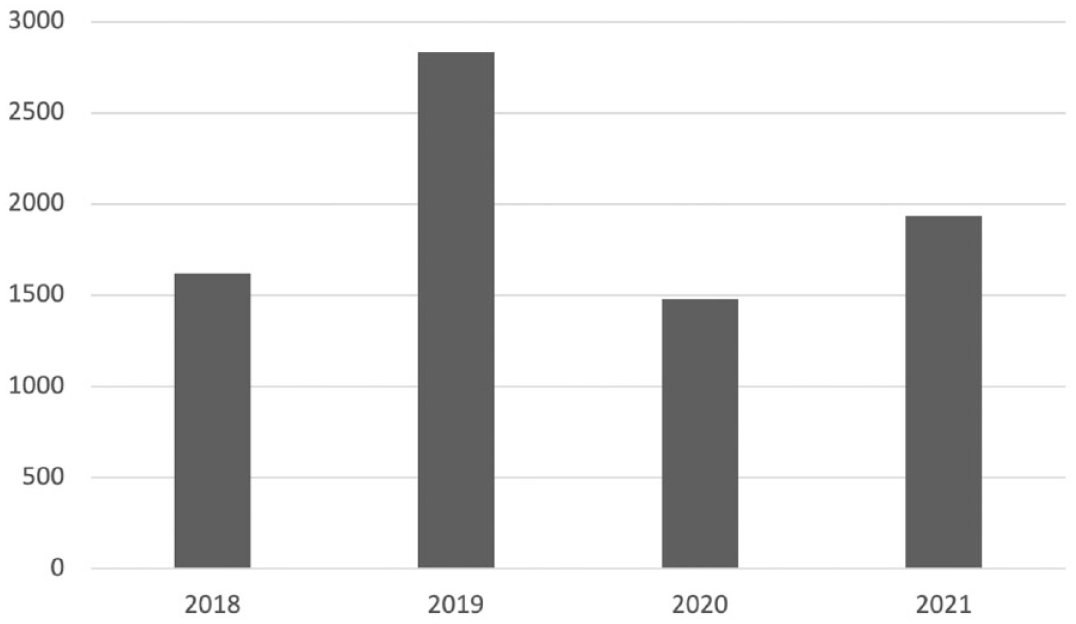
The number of football-related antisemitic Tweets per year, 2018–2021.
When looking at the total number of antisemitic Tweets on a monthly basis (see Figure 2), we see a clear peak in April 2019. During this month, a total number of 756 Tweets engaged with football-related antisemitism. Surprisingly enough, however, Ajax did not play its rival Feyenoord during this month. Instead, in this month, many of the football-related antisemitism on Twitter was targeted against the KNVB. On social media, the abbreviation KNJB instead of KNVB was used, KNJB referring to “Royal Dutch Jew Association” as a way to express discontent toward the KNVB. A large part of the antisemitic hate speech generated during April 2019 was in fact a reaction to a change in the playing schedule of the Eredivisie and was therefore targeted at the KNVB who is responsible for the playing schedule. We then see a drop in the number of Tweets between May and Augustus 2020, which is likely caused by the unique context of (global) lockdowns and empty stadiums and the cancelation of football matches in the highest league from March 2020 onwards, perpetuated by the COVID-19 pandemic.
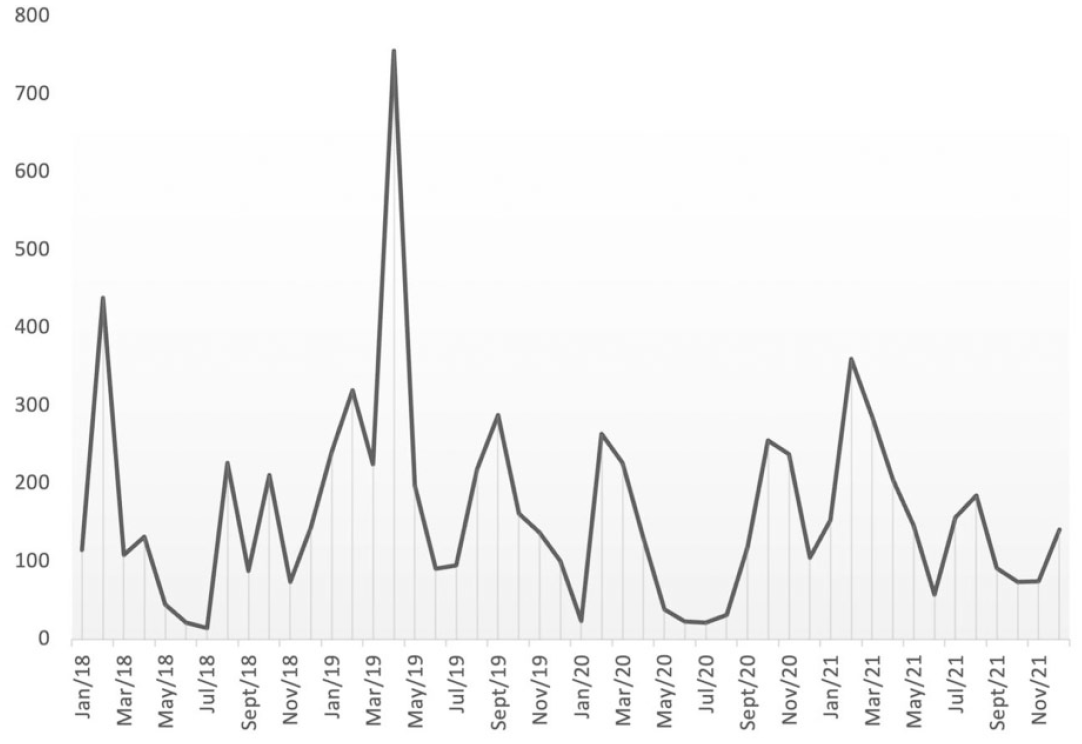
Football-related antisemitic Tweets between 2018 and 2021, by month.
On a narrative level, we see two major—in some cases overlapping—themes emerging from our data, namely a “pro-Ajax” conspiracy and the use of “Jew” in a derogatory manner. We will turn to these two themes now.
Antisemitism, KNJB and “Pro-Ajax” Conspiracies
Most of the antisemitic hate speech in our data is targeted at the KNVB, while the majority of Tweets in the “pro-Ajax” conspiracy theme also make a reference to the KNVB that gets referred to as “KNJB” in response to decisions (e.g., by the referee or the Video Assistant Referee) that are perceived as favoring Ajax. An example of such a Tweet (sent during a match between FC Groningen and Ajax) is “KNJB cunt referee (April 20, 2019). The person tweeting here was likely thinking that the referee made a decision in favor of Ajax. The applied “logic” that being Jewish is offensive stems from a hegemonic discourse of Othering regarding Jews in the Netherlands (and beyond) which frames being Jewish as being inferior and which is then used by particular fan groups to express football-related rivalry or hostility. Within the specific rivalry with Ajax, this is then strengthened even more by supporters’ perception that Ajax, the opponent, is a Jewish club.
The dominant antisemitic narrative related to a “pro-Ajax” conspiracy is also exemplified by the following Tweet: “Time they start calling it KNJB instead of KNVB. Always helping the Jews” (February 9, 2018). Tapping into the “pro-Ajax” conspiracy narrative, the fan who wrote the above Tweet implies that the KNVB helps Ajax or favors Ajax. By supposedly helping Ajax, the so-called “Jews’ club,” the KNVB becomes a “Jewish association” in the words of the fan. The abbreviation “KNJB” is not only used when the football association supposedly makes a decision in favor of Ajax. It is also used by (presumably) Ajax fans to mock fans of other teams: “Getting some snacks and beer: it is time to read some #knjb tweets #calimero #ajax” (February 8, 2020). This Tweet was sent in the context of a game between FC Utrecht and Ajax that was canceled due to a storm. This Ajax fan anticipated other fans’ tweets about the pro-Ajax conspiracy and mocked those who would complain about the KNVB and the weather using the term “Calimero,” thereby referring to the so-called Calimero Syndrome that some fans of clubs other than Ajax appear to espouse.
The term KNJB is not only used in the context of Ajax; it is also used when other teams play against one another: “Complete mystery why PSV does get a penalty and Vitesse did not. KNJB or something” (April 7, 2019). The above Tweet was sent during a game between PSV and Vitesse. In all examples, the use of KNJB can be considered as coded language in the sense that it is not necessarily recognized as antisemitic by people who are not familiar with the Dutch football context.
Derogatory References
Another example of coded derogatory referencing is the use of “nose” as a referent for Ajax supporters or players, which is a common practice among some Dutch football supporters. The use of the words “Jew” or “nose” in a derogatory manner brings us to the second major theme we identified in our dataset. Identifying people and groups by naming them in a derogatory manner is an elementary form of rhetorical discrimination (Reisigl, 2005). This type of discrimination is rather common in the Dutch football context, which our dataset confirms. The mere reference to a term such as “Jood” (Jew) in the football context can be sufficient to perform and reproduce a hegemonic antisemitic discourse as the term in itself connotatively conveys disparaging, insulting meanings without any other attributive qualification. As noted earlier, this connotative “logic” stems from an existing, widely known hegemonic discourse of Othering in the Netherlands (and beyond) which is then used by particular fan groups to express the rivalry between Ajax and other clubs. An example of a Tweet in which this elementary form of rhetorical discrimination is expressed as “Makkelie is a Jew #knjb” (February 28, 2021). In this Tweet, referee Danny Makkelie is called a “Jew,” which in the football context connotatively conveys an insulting meaning. Just referring to the term is enough for it to be an antisemitic slur. Another example of this form of discrimination is “Bergjood*, I hope you get a great birthday present. . .2 broken ankles perhaps? #classic #bergneus* #Feyenoord” (December 29, 2021). The word “Bergjood” is a reference to Ajax player Steven Berghuis, who is a former Feyenoord captain. During the summer of 2021, Berghuis made a controversial transfer from Feyenoord to Ajax. Many Feyenoord fans saw this transfer as a betrayal and he quickly got a new nickname as “neus” (nose) and “Bergneus.” As noted, the term “neus” in antisemitic discourses draws on the antisemitic stereotype that Jews supposedly have big noses. Such coded derogatory referencing is used within the Dutch football fan context more generally to refer to Ajax supporters or players, thereby drawing on a discourse that has been normalized outside of the football context for centuries (Gans, 2010). Other Twitter users also connect “noses,” Jewishness and Ajax using a nose emoji to refer to Ajax.
The two main themes we have discussed so far—the derogatory use of “Jew” or “Nose,” and the “pro-Ajax” conspiracy and reference to KNJB—sometimes merge and overlap, as in the following example: “Noses again favored by KNJB” (February 2, 2019). While the stereotype of the Jewish big nose is centuries old, football fans also draw on a more recent discourse which associates Jewishness with gas (i.e., the gas chamber) stemming from the 20th-century Nazi Germany context in which Jewish people were deported and murdered in gas chambers (Gans, 2010). An example of such a Tweet is “Hamas, hamas, jews to the gas” (February 8, 2020).
Connection with the Pandemic
Our data show how COVID-19 or pandemic-related narratives trickle down to, or merge with, football-related antisemitism. This mainly occurs by adding an element to the pro-Ajax conspiracy narrative, as is evidenced by the following Tweet: Why does the Dutch competition now continue with spectators while the corona cases are currently higher in #thenetherlands compared to when the competition was stopped? Oh wait the #KNJB wanted #ajax to end number 1. (September 26, 2020)
This Tweet implies that the KNVB had a hidden agenda during the COVID-19 pandemic to make sure that Ajax finishes at the top of the league. Another Tweet suggests something similar: “KNJB has been successful: the Klassieker will be played without support! Next year they will plan this game just before Christmas again? I think so!!” (December 18, 2021). This Tweet implies that the KNVB deliberately scheduled the game between Feyenoord and Ajax in during a time (winter), it was likely that the government would announce COVID-19 measures due to a high infection rate. Because of the COVID-19 situation at the time, the game was played without any supporter and Feyenoord thus missed some of its home advantage.
This conspiratorial narrative is expressed slightly different in the following Tweet: “Coronavirus in one big hoax so that Ajax could beat sc Heereveen [sic] through a false positive test #knjb” (October 10, 2020). This Tweet was likely sent in response to a malfunction in one of the lab systems, which created false-positive COVID-19 tests by three of SC Heerenveen’s players before the game against Ajax. The fan implies that the KNVB and Ajax are responsible for the malfunction in the laboratory so that Ajax would win the game. Another fan takes this conspiratorial line of thinking a step further and implies that Ajax imported COVID-19 into the Netherlands: “This is Ajax’s fault because Ajax has ties with China and they brought Corona here knjb!!!!” (November 2, 2020). Previous studies have suggested a convergence between COVID-19 conspiracies and antisemitic discourse, blaming, for example, “Jews” and “Zionists” for the pandemic (Ehsan, 2020; Teter, 2020). Our study shows something similar in the context of Dutch football in the Twittersphere.
This conspiratorial narrative is contested. Some fans on Twitter overtly mock this line of reasoning by making reference to the conspiratorial ideas and gossip about supposed “Jewish control” of society which also became more prominent and visible in other online contexts (Peeters et al., 2021) and wider society during the COVID-19 pandemic: “Where are the football supporters’ of certain clubs who think that corona was developed by Ajax and the KNJB?” (April 2, 2020).
Discussion and Conclusion
In this study, we view Twitter as a frontstage that people (partially) perceive as a backstage following Kilvington’s (2020) work on online hate speech. While social media platforms are overtly frontstage spaces in which people perform for others, the nature of the so-called online disinhibition effect means that it can feel like a backstage environment in which people are more prone to express prejudice (Kilvington, 2020). As such, it is not very surprising that people express football-related antisemitism akin to how they might do inside the stadium. Communication via Twitter—or other social media—has blurred the boundaries between frontstage and backstage, leaving some fans to feel no obstacles to tweet in an impulsive way including in a derogatory, antisemitic manner. This can be an explanation for the manifestation of football-related antisemitism in online spaces. It also means that football-related antisemitic behaviors such as certain chants and the use of the term “Jew” in a derogatory manner, which are more commonly heard in and around football grounds, now potentially reach everybody who has access to the Internet. Regardless of the medium, the anti-Semitic rhetoric in the Dutch Twittersphere draws on familiar antisemitic discourse. In both the “pro-Ajax” conspiracy narrative and the use of “Jew” and “nose” in a derogatory manner, being a Jew is equated to being unwanted or being inferior. In this sense, online spaces can be seen as both a mirror for physical spaces and as contributing to the normalization and reproduction of football-related antisemitism. These Tweets, while seemingly targeted toward the football Other, contribute to an exclusionary discourse in which being a “Jew” is not wanted.
The findings presented in this paper resonate with those of an earlier study on performances of rivalry and loyalty between Feyenoord and Ajax fans in the Dutch Twittersphere (Seijbel et al., Forthcoming). In that study, we also identified antisemitism through the derogatory use of the term “Jew” and found that antisemitic (and philosemetic) slurs find their way into the online domain, either explicitly or implicitly. In this current study, we have broadened the scope of our research by focusing on football-related antisemitic behavior among fans of different Dutch football clubs. We found that the main target of antisemitism on Twitter is the KNVB. The pro-Ajax conspiracy narrative, which features prominently in our data, includes the use of the KNJB as a way to express discontent toward the KNVB.
A primary question we address in this paper is if and how the COVID-19 pandemic has affected the nature and extent of football-related antisemitism in the Dutch Twittersphere. Our findings indicate that the prevalence of football-related antisemitism on Twitter did not increase during the COVID-19 pandemic. We found that the number of antisemitic Tweets fluctuates, with the most significant decline occurring in 2020, the first year of the pandemic. The decline in football-related antisemitic content on Twitter during this time can likely be explained by the early ending of the 2019–2020 football season due to the lockdown in the Netherlands.
The aforementioned narratives around COVID-19 conspiracies and antisemitism seem to have been prevalent in the football context to a certain extent, revealing some similarities with the conspiracy “smoothy” or “singularity” (Klein, 2020) that has been observed in antisemitic rhetoric on other (social) contexts on social media such as Instagram and Telegram (Peeters et al., 2021; Shane et al., 2021), in which diverse narratives and their associated agendas seem to converge around the time of the pandemic. Indeed, as we have discussed earlier in this paper, recent international literature suggests a convergence between COVID conspiracies and antisemitic discourse, blaming, for example, “Jews” and “Zionists” for the pandemic (Ehsan, 2020; Teter, 2020). We observe something similar happening in Dutch football, where the pro-Ajax conspiracy narrative partly changes and takes on a new element by using the pandemic as evidence that the Dutch football association only helps Ajax, or, more radically, that “Jewish club” Ajax brought the pandemic to the Netherlands. This dynamic is similar to what Klein’s (2020) notion of “conspiracy smoothie,” in which diverse narratives and their associated agendas seem to blend or converge around the time of the pandemic.
This study of online football-related antisemitism contributes to our theoretical and empirical understanding of the reproduction of football-related antisemitism on the social media platform Twitter. Further research could focus on online football-related antisemitism across different national contexts. Such studies could provide valuable insight into the extent to which our findings are unique to the Dutch football context. A limitation of this study is that we have used a specific query to detect football-related antisemitism in Tweets. This query excludes more subtle and less overt forms of antisemitism in football. Future research might also examine more subtle forms of football-related antisemitism on social media to paint a fuller picture of its extent and nature in contemporary football during and beyond the pandemic.
Footnotes
Declaration of Conflicting Interests
The authors declared no potential conflicts of interest with respect to the research, authorship, and/or publication of this article.
Funding
The authors received no financial support for the research, authorship, and/or publication of this article.