




Abstract
Most of the scientific literature concerning former high-level athletes is devoted to their professional retraining. There are comparatively few empirical studies dealing with their body representations and practices. Based on Pierre Bourdieu’s theoretical framework, this article presents the results of an interview survey with 30 former high-level athletes. It shows that their relationships with their bodies result from their specific body trajectories, marked by family socialization and social background, sports socialization, injuries, and the possession of different forms of capital. In contrast to mondains, who have relatively stable body trajectories, oblates are marked by less homogeneous socialization and see their body trajectories divided between a form of personal dissatisfaction on the one hand and a feeling of saturation with their sport on the other.
The question of how former high-level athletes deal with their own bodies has been very rarely addressed. In sociology, the few studies about former high-level athletes examines their social trajectories and professional retraining (Conzelmann and Nagel, 2003; Fleuriel and Schotté, 2011). Some psychological studies have paid more attention to former athletes’ bodies and have shown that retirement from competition can lead to a “bodily crisis” (Stephan et al., 2005), particularly through the emergence of eating disorders (Lavallee and Robinson, 2007). However, these studies are limited to the period immediately following retirement from sport and, above all, question about individuals’ social characteristics (e.g. social background, gender, generation) appear only marginally.
The present study’s goals were to identify former athletes’ relationships with their own bodies over the long term and determine the body trajectories that led to them. In particular, we focused on physical activities, examining the type and intensity of practices as well as the values that underlie them. We addressed this from a Bourdieusian perspective, on the one hand by considering former athletes’ relationships to physical activity as a set of dispositions to how they treat, perceive, and evaluate their bodies, and on the other hand by paying particular attention to the effects linked to the social background and trajectories of individuals. For this purpose, we distinguished three chronological periods (before, during, and after a sports career) in the body trajectories of high-level athletes and we considered the different socializing processes that contributed to creating athletes’ relationships with their bodies during each period. Their relationships to their bodies were analyzed as the product of trajectories that were indissociably sporting and social.
This article reviews the literature on the body socialization of athletes, describes our survey data, obtained through semi-structured interviews, and then presents our results, which led us to distinguish two idealtypical profiles – the mondains and the oblates.
High-level sport and body socialization
The few scientific studies on former athletes have mainly focused on their professional retraining (Conzelmann and Nagel, 2003; Fleuriel and Schotté, 2011). The question of their body representations and practices only appears on the sidelines of certain works (Fogelholm et al., 1994; Messner, 1990). We therefore had to turn to research on aspiring and active athletes to identify the socialization processes contributing to shaping body trajectories. These works revealed five elements that can be considered to affect athletes’ relationships with their own bodies.
The first element involves family socialization and social background. Bourdieu (1984) showed that family socialization plays a determining role in one’s relationship to one’s body and that the modalities of this socialization are linked to social position. Family socialization also affects sports activities: children from privileged backgrounds are more often the “heirs” to the sporting practices of at least one parent (Forté and Mennesson, 2012) 1 . Furthermore, social backgrounds influence both the choice of particular sports and the “styles of sporting practice” (Lahire, 2004), as the same discipline can be practiced for either relaxation, health, or self-fulfillment (Longchamp, 2009). The choice of a sport discipline by middle and upper class parents for their children may thus be part of a more or less conscious strategy of accumulating various forms of capital, the competitive objective being minimized in favor of more general social and cultural skills (DeLuca and Andrews, 2016). The structure of capital plays a key role here: Mennesson et al. (2017) showed that parents belonging to the economic fractions of the middle and upper classes adhere more to competitive sports for their children than those belonging to the cultural fractions.
The second element involves socialization within a sports club. Athlete supervision (by trainers, doctors, etc.) contributes to imposing a constant “state of urgency”, which leads athletes to develop a relationship with their body that alternates between constant overexertion and preserving their fundamental physical integrity (Viaud and Papin, 2012). This type of socialization can lead athletes to reinterpret pain as a positive sign or one that they should develop “resistance” to it (Mennesson et al., 2012). The injunctions of the athlete's entourage concerning body weight control can also lead to the embodiment of body self-surveillance, and even to eating disorders that can last well beyond the sports career (McMahon & Penney, 2013). Some studies have shown that family socialization can be more or less congruent with sports socialization (Rasera, 2016), and that the latter more often represents transformative or conversion socialization for working-class athletes, while it is more akin to reinforcement socialization for those from middle- and upper-class backgrounds (Longchamp et al., 2023) 2 .
The third element concerns the “dual career” track (Debois et al., 2015) of sports and academic studies that some athletes follow. Torregrosa et al. (2015) showed that athletes pursuing a dual career “voluntarily retire” more often than those prioritizing their athletic career. Other research has shown that the investment and efforts put into sporting and academic pursuits are communicating vessels, with an increase on one side resulting in a decrease on the other (Bertrand, 2009). These studies also revealed that high-level sport functions as a social field (Bourdieu, 1993): it requires owning a specific kind of capital, “sporting capital” 3 , the accumulation of which can compete with a fundamental kind, academic capital. Athletes’ social backgrounds are connected to these two forms of capital: Forté and Mennesson (2012) hypothesized that the shorter careers of athletes from higher social classes could be explained in part by their strong commitment to their academic studies. These results suggest a close link between more privileged social backgrounds, an accumulation of academic capital, and an early and voluntary end to one’s sporting career. In contrast, a more working-class social background seems more closely associated with a smaller accumulation of academic capital, a longer sporting career, and an unplanned end to that career.
The fourth element is injury, which affects a significant proportion of high-level athletes. Although injuries occasionally contribute to strengthening a sporting vocation, their chronicity often leads to a new phase in an athlete’s career, one marked by a questioning of the charmed relationship they have had practicing their sport to date (Forté, 2018) and by a “sporting downgrade” (Bertrand, 2009), e.g. being relegated or not being selected, which overexposes athletes to the temptations of resorting to doping products (Aubel and Ohl, 2015). Situations involving physical vulnerability and fragility often push athletes to retirement (Stephan et al., 2005). Borrowing a perspective from the sociology of impedance, we might then ask how far academic capital can help athletes turn their injury ordeal into new opportunities, as Darmon (2021) observed in his study of stroke victims.
Finally, the fifth element, and the one that will be of particular interest to us, involves athletes’ social trajectories. Individuals’ relationships with their own bodies are closely associated with their social trajectory (Bourdieu, 1984). Sports careers are associated with a certain amount of social mobility, usually upward (Conzelmann and Nagel, 2003; Fleuriel and Schotté, 2011; Moret and Ohl, 2019). Atkinson (2011) shows, for example, that the fact that some athletes perceive their own bodies “as veritable machines to be worked” (p. 238) and develop emaciation preferences can be explained in part by the search for distinction typical of the middle classes seeking social mobility. From this perspective, the transformations that many athletes experience in their dispositions should not only be interpreted as functional adaptations to high-level competition but also as the manifestation of the slope of their trajectory, with ascending trajectories, for example, being associated with stronger body control (Darmon, 2011).
Reviewing the literature revealed three aspects little explored by research. First, the five elements identified were rarely linked, making it difficult to understand how their effects were associated and accumulated with one another. Secondly, since studies have mostly focused on specific moments in a career, opportunities to measure the long-term effects of these elements have been limited. Thirdly, our five elements are not systematically linked to athletes’ relationships with their bodies. More specifically, studies focusing on athletes’ body representations and practices mainly examine aspiring or active athletes, but almost never former athletes. By studying how different body trajectories have led former high-level athletes to have different relationships with their bodies, the present study contributes to filling these gaps and make it possible to formulate proposals concerning the support of athletes during their careers.
We mobilize a Bourdieusian theoretical framework, which gives a central place to the notion of capital (economic, cultural and social) and to the social position of individuals (Bourdieu, 1984). Defined as a system of dispositions 4 , the notion of habitus allows us to apprehend the social in its embodied state (Bourdieu, 1986), and to pay particular attention to socialization, defined as “the way society shapes and transforms individuals” (Darmon, 2006, p. 6). In this perspective, the body would appear as a social marker that refers to both social position and the slope of the social trajectory. According to Bourdieu (1978), the relationship to one’s own body constitutes a fundamental dimension of the habitus that explains both the attraction for this or that sport and this or that way of practicing it. Members of the upper classes tend to treat their body as an end in itself, hoping for benefits that touch on the very functioning of the body (the “form” or “health”) or on its aesthetic dimension. Underpinned by a distant and neutralizing disposition towards the social world, such a sporting practice is akin to a kind of “physical art or art’s sake” (p. 823) invented by the aristocracy and the upper middle class within the English public schools in the second half of the 19th century. As one moves towards the popular classes, the hygienic and aesthetic dimensions fade away to make way for an instrumental relationship to the body which requires “sometimes a gambling with the body itself (…)” (p. 838), as has been shown for the case of boxing in the Chicago ghetto (Wacquant, 1995). Bourdieu (1978) reminds us that such a relationship to the body, which implies behaviors far removed from the “ratuity” and “fair play” characteristic of aristocratic sports, is linked to the social trajectory of working-class athletes, for whom a sporting career represents one of the only possible paths of upward social mobility.
In sum, this theoretical framework appears particularly relevant for studying the bodily trajectories of athletes, by linking them to their social backgrounds and the different forms of capital in their possession.
The survey
We conducted interviews in Switzerland with 30 former national and international athletes from five disciplines: soccer, tennis, boxing, gymnastics, and figure skating. The choice of the disciplines aims at obtaining a diversity with regard to the social and gendered recruitment, the physical qualities required (endurance vs. explosiveness) and the collective or individual aspect.
Recruitment began via sports clubs, associations, and social networks and continued via participants’ referrals to personal contacts. Three requirements governed the constitution of our population. First, we ensured sufficient variability in the main socio-demographic variables: our population included 17 men and 13 women aged between 27 and 65; half came from the lower classes, and the other half was equally divided between middle- and upper-level socio-economic groups (see Table 1) 5 .
Characteristics of our population.
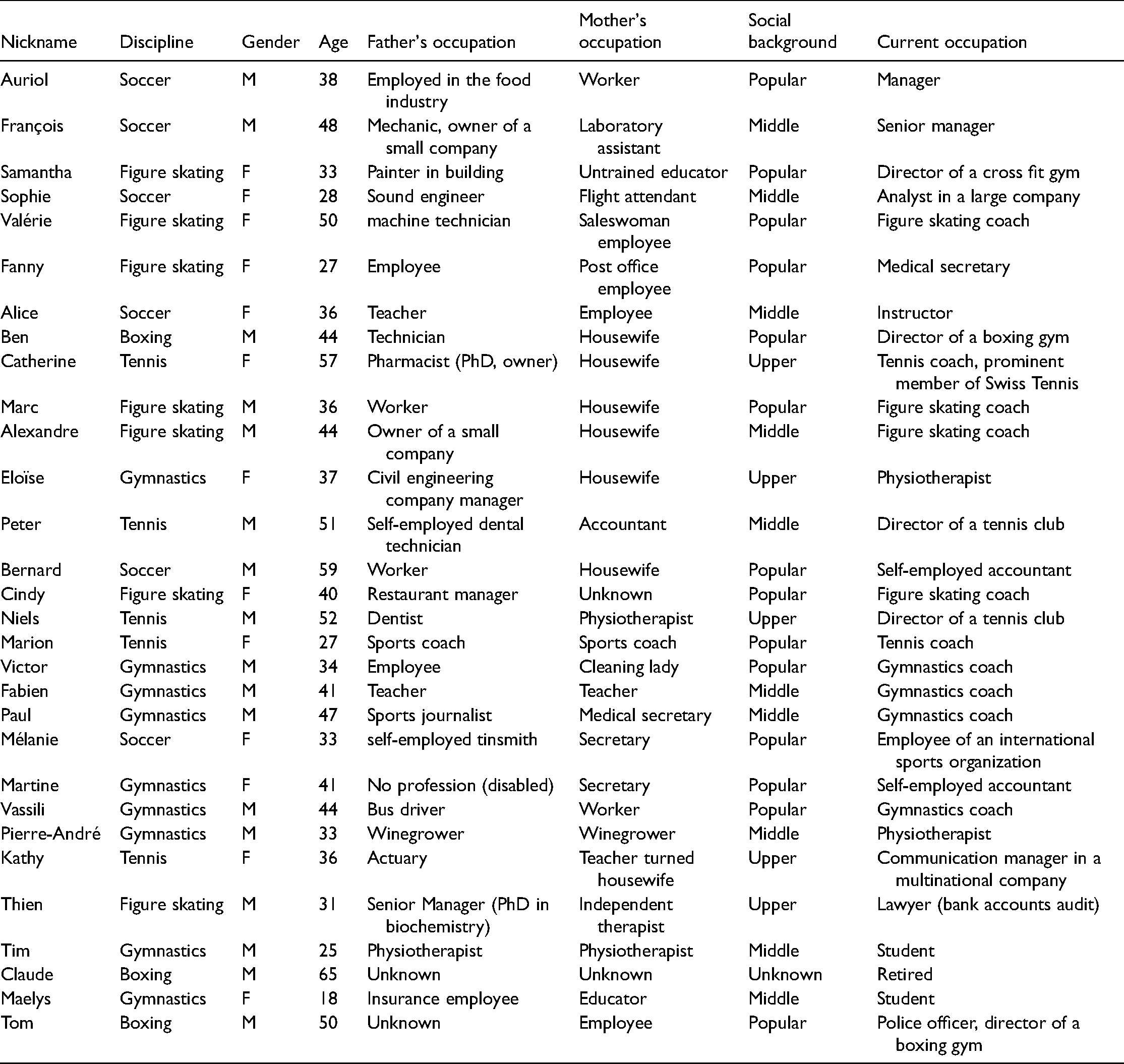
Since our objective was to analyze body trajectories, the second requirement led us to select former athletes rather than active athletes. This option enabled including the end of athletes’ careers in the analysis and helped us understand the effects that sports socialization produces after sporting careers.
In order to avoid the risk of over-representing the socio-economic categories least affected by (self-) exclusion on the one hand, and of generalizing specific characteristics (such as athletes’ very strong illusio with sport) that are in fact only the product of selection processes in high-level sport on the other hand, we imposed the third requirement of a population including former athletes who had had a lasting career in adult categories and others who had reached the international level in youth categories but had nevertheless given up, often at the threshold of the adult category.
Our efforts to reveal the processes of socialization that result in former athletes’ relationships with their bodies were inspired by the biographical interviews which allow us “to address the question of the genesis of dispositions” (Lahire, 2002, p. 37). Interview questions concerned four areas of practice in particular that reveal athletes’ relationships with their bodies: physical appearance, diet, physical activities and sports, and, finally, health. Because of the limited space available, this article focuses on physical activities. Typical questions were about beginning sport in childhood or adolescence, training intensity during career, most enjoyed or disliked body sensations, injuries, retirement conditions, and current sport practice.
The interviews were submitted to a qualitative analysis which follows the outline of reflexive thematic analysis proposed by Braun et al. (2019) 6 . Each interview was analyzed by two members of our team and then discussed during weekly team sessions. The themes identified during the analysis phase consisted of patterns of shared-meanings. In line with our theoretical framework, the latter were most often related to dispositions underlying the representations and practices of former athletes. In accordance with the Weberian approach (Weber, 1949), these themes allowed us to identify two idealtypical relationships with the body. These two idealtypes were then articulated with the social characteristics of our population, in particular with the social background.
Mondains and oblates
Our analyses led us to distinguish two idealtypical profiles among former high-level athletes. First, those we called mondains, by analogy with individuals characterized by a relationship of great familiarity with erudite culture. According to Pierre Boudieu (1984), a mondain is an individual “who, being on the side of nature, the ‘natural', is content to feel and enjoy, and who expels all trace of intellectualism, didacticism, pedantry from his artistic experience” (p. 76). Individuals we call mondains show an analogous relationship with sports, especially a significant continuity between their family socialization and their sports socialization. This continuity manifested itself, in particular, by the adoption of regular, moderate post-career physical activity.
Second, those we called oblates, a notion introduced by Pierre Bourdieu (1980) in opposition to that of heirs, and which designates “a deferent relationship, even outright dependence, to institutions to which certain agents are bound because of their social background and/or their training” (Suaud, 2020, p. 613). Individuals we called oblates experienced more contradictory forms of physical socialization than those we called mondains. Above all, their accumulation of sporting capital had been to the detriment of other resource types (notably scholarly). Relegation or no longer being selected in their sport, particularly in the event of injury, would leave them with few alternative sources of capital. After their careers, some oblates had continued with intensive physical activity, reflecting a type of lack of fulfillment, whereas others (those who had experienced long periods of injury) described feelings of saturation that had led them to abandon all forms of physical activity.
As ideal types, the mondain and oblate categories were created unilaterally by accentuating “one or more points of view” (Weber, 1949, p. 90). They are, therefore, in no way a “reflection” of reality but rather points in an analytical grid within which the various cases observed empirically can be situated.
The mondains
Family sports socialization and scholarly dispositions
The mondains came from the middle and upper classes with relatively high cultural capital (see Table 1). All the mondains had benefited from early, family-based sports socialization, making them the “heirs” to a sporting tradition in the sense described by Forté and Mennesson (2012). All of them mentioned having been initiated in sports by their parents, which makes them “direct heirs” 7 . Catherine started playing tennis at a very early age and practiced with her parents and older brother: “Every weekend, or very often, we spent at the club.” Tim, whose father is a cycling enthusiast, was introduced to gymnastics at the age of 5: “My mother also did mother and child gymnastics.” Notably, some families’ sporting culture went back several generations, as illustrated by Niels, who felt “that a fire got lit” playing tennis with his grandmother: “You know exactly what's going to happen for the rest of your life!”. By analogy with what can be observed in “high culture” groups, mondains therefore benefit from the privilege of a “total, early, imperceptible learning, performed within the family from the earliest days of life” (Bourdieu, 1984: 66).
Beyond their early introduction and embedding into a particular sport and its environment, mondains were characterized by the specific relationship with that sport instilled into them by their parents. Implementing a sports socialization typical of the cultural fractions of the middle and upper classes, those parents tended to euphemistically label the instrumental dimension of sport (the search for skill, performance, and victory) with the expressive dimensions of “pleasure” and “fulfillment” (Mennesson et al., 2017), or with valuing the acquisition of social and cultural skills (DeLuca and Andrews, 2016). Catherine evoked her family’s sporting practice “with no competition, just the pleasure of getting some exercise”. Any thoughts of a career plan seemed absent at this stage: “There was no big plan behind it, like ‘Now you have to do this, that and the other..’ Not at all,” said Niels. “I never saw a decision made somewhere, like ‘We're going to do this or you have to do that,’ ” reiterated Kathy. And when the possibility of a high-level sporting career appeared on the horizon, the search for performance was expressed within the context of a personal experience. “My parents were really cool. And then said to me, ‘If you don't live out this experience, you'll regret it' ” (Eloïse). Similar to the sportsmen of the late nineteenth century from the nobility who opposed the bourgeois values of performance by exalting disinterestedness, prowess, or originality (De Saint Martin, 1989), the mondains form a new sporting nobility that tends to euphemize the importance of pure performance in favor of values such as health, pleasure, or fulfillment.
Such a relationship to the practice of sport reveals a scholarly disposition – a “detached and distant [disposition which] is acquired in an early experience relatively free from necessity” (Bourdieu, 2003, p. 33). This disposition turns out to be decisive for the continuation of careers among mondains. Even when they reach the top levels of their sport, they continue to euphemize their performances and results, as was the case for Niels, who reached the top-10 of the Association of Tennis Professionnals (ATP) rankings: “What interested me was seeing who I really was and how I would react in different situations (…) For me, being at my peak (…) was when (…) I was in equilibrium within myself. So, it's not necessarily [getting] the best result.”
Academic capital and the vulnerability of the illusio
Although it might not prevent access to the highest levels of sport, a scholarly disposition nevertheless leads to a multiplication of personal investments: a “dual career” (Debois et al., 2015), both athletic and academic. It was thanks to the intervention of Thien’s parents that he obtained adjustments to his school timetable: “It was my parents who asked if they could lighten, perhaps … or rearrange my classes … to skip physical education.” He began university while pursuing his sporting career, before starting to prioritize his studies. Whether by enrolling their children in private schools, orienting them towards the most promising courses, or negotiating their educational conditions with teachers, parents’ attitudes revealed that a sporting career was only acceptable on the condition that it remained compatible with a significant investment in the academic branch of the dual career.
This investment seemed to lead to a form of vulnerability to the mondains’ “sporting illusio”, understood as their belief in the sport itself, but also in the stakes involved (Bourdieu, 2003). Trying events such as injuries or illnesses revealed that young athletes were reluctant to sacrifice their bodily or psychological integrity on the altar of performance, thus maintaining a certain distance from the constant state of urgency characteristic of high-level sports (Viaud and Papin, 2012). Having “grown up with homeopathy,” Thien stated that he “never really took any heavy or strong stuff for pain.” When injured, he could also count on a “highly competent” coach who did not hesitate to adapt his training. In the same vein, Niels, whose parents never gave him anti-febriletics as a child, described how he always preferred not to play rather than take medication: “Never! I never touched a thing. No, never! (…) Why? Fever is a good thing! (…) When I was sick, I never played.”
As we can see, the family body socialization of the mondains weighs on their practices and seems to meet little resistance from the sports institutions. This distance from the state of urgency also allows them to limit the effects of heterogeneous socialization and thus to preserve the coherence of their habitus 8 . Eloïse's case is particularly revealing. When she was a gymnast, she did not have any particular difficulty maintaining her body weight, because she had already internalized strong food monitoring practices in her family environment: “I didn't have too much trouble [with] everything related to managing my body, being careful with food”. However, this did not prevent her from adopting certain deviant practices, such as the vomiting technique that is widespread among gymnasts. But she emphasizes the detached relationship she had with these practices, which were considered a means of inclusion in the group of gymnasts: “We all tried it, eh! (…) For me, it was just for fun to come and try. (…) But I didn't have any problems either [with my weight]. Maybe it helps”. Thus, although they are not spared from heterogeneous socialization resulting from hanging out with their peers, mondains have the means to limit their effects. The possession of alternative capital to sporting capital is one of these means, and helps them to limit the costs of leaving at the end of their career.
Moderate “exit costs”
For mondains, maintaining some distance from the constant state of sporting urgency appeared to be a necessary condition for pursuing a sporting career. Overcoming obstacles, which might have presupposed a marked commitment to that state of urgency, often sounded the death knell of their sporting careers.
These obstacles can be the feeling of having to sacrifice the expressive aspects of sports for their instrumental competitive aspects, the realization that being among the world’s best is beyond their reach, or injuries. Whether it comes from the academic capital provided by their studies or the economic capital linked to the income made during their career, mondains share the common advantage of having alternative capital to their sporting capital. The direct consequences of this are lower career “exit costs”. At the age of 18, Kathy realized that she would not be able to reach the top of the Women’s Tennis Association (WTA) world ranking. Having the required academic credentials, she decided to join her friends at the University. “I said, ‘This is a waste of time, I'll go do something else!'”. The same opportunism can be seen in the case of Thien, who decided to retire at the age of 23 due to an ankle injury. “It was also a personal choice. I said to myself (…): ‘You can either go back to basics, take a year off at [university], and then go all out to get back up to scratch (…). Or, well, you finish your [Master's].” By facilitating their professional retraining (often outside the sports field), the alternative capital possessed by mondains allows them to avoid the “sporting downgrade” that often precedes the end of careers (Bertrand, 2009), as well as the disenchantment that accompanies it (Forté, 2018).
In addition to their physical and psychological integrity, mondains preserve above all the coherence of their dispositions, by avoiding submitting themselves entirely to the state of urgency, which would be too contradictory to their primary socialization. Retirement from sport thus resembles a reversal of fortunes, and typically takes the form of a “end to impedance” that can be observed in other domains where individuals are endowed with more than one form of capital (Darmon, 2021).
A well-balanced, post-career outlook on physical exercise
During the period immediately following their sporting retirement, some mondains experience a period of slackening off exercise. However, all of them eventually converged towards a well-balanced practice of physical exercise—regular and sometimes intensive, yet remaining far removed from the state of sporting urgency to which they had never fully adhered. Four years after having stopped competing in gymnastics, Tim took advantage of his university vacation periods to climb, paraglide, ski, run trails, and go mountaineering. He also practiced gymnastics once a week for fun: “I'm looking to redo some stuff, to have a little fun. To take a little pleasure in doing what I mastered before”. In the same spirit, Eloïse was keen to distance herself from any competitive objectives in her running: “I don't do interval training or crazy things to improve my time. I don't care, I do an hour's run and then I come home and relax.” It is as though retirement from sports allows mondains to fully update the scholarly disposition they had acquired in childhood and had never been completely put on hold during their sporting career. By reproducing their parents’ sporting practices, retiring athletes integrate physical activity into a lifestyle that tends to euphemize pure performance using the terms of pleasure, health, and a form of personal fulfillment. ***
The continuous trajectories of mondains’ bodies can be related to the stability of their social trajectories. Because practicing a sport is a genuine part of their family lifestyle, socialization in a high-level sports setting reinforces their primary dispositions, which is all the more valid since their resources (notably academic) allow them to maintain a healthy distance from the “state of urgency”. Because they have been less affected by injury and are less inclined to persevere when it hinders their progress, mondains are thus predisposed to carrying out the twin necessities of exploiting their bodies without overexploiting them. Retiring before reaching physical saturation, mondains experience relative body continuity in their post-career years—their sporting practice, although less intensive, remains above all associated with health and well-being.
The oblates
Non-sporting but highly involved parents
Most olbates come from the working classes or the economic fractions of the middle classes (see Table 1) and seem to be engaged in a process of social ascension. Many of their parents had never practiced sports regularly. Alexandre mentioned that his parents were “very busy” and not sporty: “We don't come from a sporty family.” The parents who had practiced sports had done so during their youth, and the oblates had only heard about it. Some oblates are thus sporting “heirs” (Forté and Mennesson, 2012), but only indirect heirs who had never practiced sports with their parents.
However, the relative absence of sporty parents did not mean an absence of belief in the possibility of a sports career—quite the contrary. This was evidenced by parents’ involvement, which, similar to what has been observed among working-class parents in relation to school (Thin, 1998), alternated between “over-investment” and “distant monitoring”. “Over-investment” can result when parents do not hesitate to intervene in their child’s training regimen, sometimes in defiance of the rules. Maelys’s father did not hesitate to attend all of his gymnast daughter’s training sessions: “My dad, sometimes, it was a bit much. He came to watch me at every training session. (…) Normally, parents weren’t allowed. (…) But my father never respected that.” Such over-investment can often lead to family tensions. Alexandre’s sister still reproaches him for her feelings of losing out because of the financial sacrifices and time devoted to his sport: “It's complicated. Two years ago, there was an argument. (…) That came out, among other things. Yeah, I can understand that!” Similarly, Cindy evoked her relationship with her younger brother, made difficult by the fact that he was forced to develop in his older sister’s shadow: “He struggled to make his mark (…). He ran away from me.”
A “distant monitoring” manifested itself as parents’ refusal to interfere in their children's training. However, far from suggesting a lack of expectations, such an attitude can be interpreted as the sign of a “belief in their child's athletic talent and the golden careers that the sporting illusio makes shine” (Viaud, 2008, p. 73). This distant monitoring highlights a specificity of the oblates compared to the mondains: outside of the training sessions, they were sometimes left to themselves or to the influence of their peers, which reinforced their exposure to heterogeneous socializations, notably with regard to diet or healthy lifestyle. Victor alternated between periods of deprivation during which he submitted to the injunctions of his trainers, and periods of extreme relaxation with heavy consumption of alcohol, tobacco and junk food: “With regard to food, we never really paid attention. In terms of health, what we drank (…), as long as we managed to reconcile our results…”. Victor was thus delivered to socialization by peers, which partly reinforced his family socialization (he spoke of a smoking father and a diet based on pleasure rather than on health). Parental distance can also lead to darker situations, as in the case of Alexandre, who suffered his coach’s verbal and physical reprimands, unable to count on parental support: “They trusted him because the results were good. (…) As long as I wasn't injured, that was fine with them.” Such delegation of responsibilities to a sports institution is reminiscent of the oblatio (gift) certain secular families made, from the end of antiquity, when they entrusted their children to work in a monastery in return for their material and spiritual care.
Whether “over-investment” or “distant monitoring”, the parental attitude of oblates can represent a source of fragility in that it leads to overexposure to family tensions, various forms of abuse and peer socialization. As we shall see, this fragility is particularly evident when athletes are faced with challenges such as injuries, and when the spheres of socialisation (e.g. family, sport) are very compartmentalised.
Sporting capital and social advancement via the body
Although it manifests itself in actions rather than words, the parents’ belief in their child's sports career nonetheless produces durable dispositions among their children: unlike mondains, oblates do not euphemize the instrumental dimension of sport; they explicitly considered sports as a means of achieving physical and social excellence. This is shown by the spontaneity with which they display their initial ambitions. “Soccer and my dream of being a pro and playing on the national team structured my life!” said Mélanie. “I had clear objectives: to become the best in the world, make a world final, or get a medal!” stated Pierre-André. “I wanted to be a champion! (…) I wanted them to say, “Wow, you are too good; I saw you on TV yesterday!” said Victor. Access to the top level of sport thus appears to be a means of social advancement via the body, as in the case of Ben, who perceived his boxing career as a way “of doing well, of managing [to] reach the top”.
When it is perceived as the quickest route to social excellence, the accumulation of sporting capital can compete with academic capital. Several oblates mentioned difficulties at school, which they put down to their investment in sports: “When I was young, I would get up in the morning: ‘Hey, today there's gym class!' But school, bah! (…) I wasn't really studious,” said Victor. This sporting illusio also manifested itself as oblates’ propensity to train harder than others. “I wasn’t someone who was particularly talented, so I worked non-stop,” said Tom. “I felt that the coaches (…) were not good enough for me, and that the intensity of the training wasn't high enough, so I was very frustrated (…). I had five to six practices a week: climbing, swimming, skating, other stuff… They allowed me to make up for that a little bit,” explained Mélanie.
Injuries and the body as a tool
Oblates’ body and soul investment exposes them to a particular risk of injury. But rather than seeking to “turn around” this ordeal, they tend instead to want to erase it in order to renew with their sporting destiny, an attitude that seems typical of individuals relatively devoid of alternative capital (Darmon, 2021). Following a back injury, Ben did not hesitate to intensify his efforts to be able to return to boxing as soon as possible: “I did almost all the recovery by myself. (…) I remember that I’d even get up at five in the morning, I’d go running, I’d go training.” This need for a quick return to training shows unreserved adherence to the state of urgency: “The goal, when you are injured, is to come back as soon as possible!” explained Mélanie. This type of injury management reveals athletes’ specific relationship with their body: the body is a tool whose performance must be ensured by all means. Hence the frequent recourse to analgesics, which sometimes appears to be the best way of avoiding interruptions to practice. For example, Marc remembered participating in many gymnastic competitions thanks to cortisone injections “to keep the pain at bay”.
While oblates are already highly exposed to heterogeneous socialization due to the distance between their family and sport socializations (especially in terms of diet and weight control) on the one hand, their overexposure to peer influence on the other, their persistence in fighting injuries redoubles this phenomenon and challenges the coherence of their habitus. Although they have a strong sporting illusio, paradoxically, this can be strained to breaking point when injuries are prolonged. As the victim of kidney problems following his heavy consumption of painkillers, Victor began to distance himself from the maintenance of his physique: “It was also something that made me say, ‘Wow! This is the end of the line. I'm not going to take drugs every day and ruin my health! ' ” Others become overcome by a general weariness: “Internally, I was exhausted, you know? (…) I think that I consumed myself. (…) Too much training killed me,” said Cindy.
When the sporting illusio ruptures, however, that does not always mean the end of a career. Relatively devoid of alternative capital (which would allow them to promote their professional retraining outside the sports field), some voluntarily seek a return to sporting success. However, then they expose themselves to being sidelined by the sports community itself. Experiencing a “sporting downgrade” (Bertrand, 2009) leaves its mark on an oblate athlete’s relationship with their body.
Professional retraining and the lock-in effect
The low convertibility of sporting capital (Fleuriel and Schotté, 2011) locks in those who, like oblates, have no real alternative capital. All the oblates interviewed had moved on to professional activities that were more or less related to the sporting domain: coach, physical education teacher, an employee in a sports institution, or physiotherapist This only reinforces the analogy with religious oblates, who most often ended up working in the clergy.
Although retraining for a position within the field of sports allows former athletes to make a living, a limited one but far from negligible (Bertrand and Rasera, 2019), it should also be emphasized that this is often following aborted attempts at professional retraining outside the field. Samantha's first experiences in the world of hairdressing were not very successful, and her return to sport (she now works as a fitness trainer) seemed obvious to her: “Sport, it's still… well, it's what I grew up with, I can't see myself doing anything else, in fact.” In the same vein, it was a failure to retrain in business that led Paul to reconsider the domain of gymnastics—the only one where he really felt he belonged: “It also allowed me to be more conscious, to say to myself: ‘Where are my skills? Where do I feel good? Well, in a gym; in the world of gymnastics!' ”.
Such a professional retraining in the field of sports has a direct effect on the relationship to the body. In fact, for most oblates the body remains the main tool of work beyond their sports career.
Between unfulfilled bodies and saturated bodies
Whether they have had a short or long career, when they were spared injury, oblates often continued to practice sports intensively and with competitive spirit during their post-career. When asked about the expected benefits of this practice, they most often mentioned the “void” in their lives or the fear of pain that would arise in the event of physical inactivity.
Beyond these physiological aspects, and in the continuity of their careers, the continued practice of sports appears to be a means of fulfilling a need for physical and social excellence. If this need remains unfulfilled, it invariably leads to a feeling of frustration. Despite his four weekly riding lessons and coaching boxing, Tom feels he could do more: “I think I could be better. I know I could be better!” Added to this is the fact that the body remains the main tool of work for those former athletes who have become trainers or coaches. This was expressed quite explicitly by Ben: “I get paid according to how much work I can do. So, this challenges my physical and mental capacities—how fit I can be for the people who ask me [for help]”.
Although this feeling of non-fulfillment characterized the oblates who were spared injuries, on the contrary, those whose careers were marked by the trials of injury (usually long careers) perceived a form of physical saturation. In addition to the breakdown in the sporting illusio experienced by these former athletes, they were reminded daily of their physical bruises by the lasting after-effects of injury: Mélanie, at the age of 33, said her “knees are 60 years old”.
Attempting to distance themselves from anything that might remind them of their past bodily investment, these oblates tend to adopt a sedentary lifestyle that they justified by their great weariness: “Since I was so fed up, I couldn't do that anymore,” said Marc. But in parallel to this feeling, oblates also see sport as “necessary”, something they “should” do, even if that means adopting a proactive stance. Although there are many “good reasons” for practicing sports in their discourse, it is a long way from intention to practice. Sporting activity gives rise to a form of “recognition without desire” (Longchamp, 2014), with long periods of sedentariness alternating with short periods of “recovery”, as in the case of Victor, whose desire to run was proving very tenuous: “It's a bit cold now, so I'm not running anymore.”
This lack of engagement and activity in sports may seem contradictory to the attitude these oblates displayed during their careers. However, it testifies to the permanence of the idea of the “body as a tool”, which, because there must be a strictly proportional return on investment, leads to a refusal to expend any energy for free (Vandebroeck, 2015). This seems to explain the “sports wandering” experienced by some oblates: far from adhering to the expressive dimension of physical effort, Mélanie conceived sports only as a challenge (“I need more competition!”), which is why she abandoned all her attempts to return to sports. At the time of the interview, she seemed to have finally found a boxing class that would allow her to let her dispositions run free: “I don't go there for… for the details. I go there to work out, to suffer!”. Therefore, whether oblates pursue intensive sports activities or adopt a sedentary lifestyle, they have the same relationship with their body. ***
Oblates tend to associate their sports career with advancing their social status—whether hoped for or real. That hope is nurtured by their relatively low initial endowment in alternative resources, and their advancing social status translates into them handing their fate over to the institution of sport, notably via significant adherence to the continuous state of urgency. Their physical socialization is thus heterogeneous, with tensions between their family, sports and peer socialization, to which are often added the specificities linked to long periods of injury. Their retirement from sport can become a complete break in their biography, the effect of saturation leading them to put certain dispositions acquired during their sporting career on hold and to adopt a sedentary lifestyle in line with that typical of their social background. Contrary to these aborted body transformation trajectories are those of the oblates who were spared injury, who tended to continue their social advancement thanks to their body beyond their initial sporting career. Having internalized an ethos of body work and individual achievement, they then tended to pursue transformational socialization by implementing sporting practices that were underpinned by the idea of “advancement”.
Conclusion
The different relationships with their bodies that can be observed among former high-level athletes result from specific body trajectories. Most often coming from middle and upper classes, those whom we called mondains experience a strong congruence between their family and sports socializations, and accumulate sports and academic capital. While allowing them to preserve the coherence of their habitus, this situation also protects them from injury: first, because it favors a certain distance to the state of urgency, thus decreasing the probability of injury; second, because, even when injury occurs, mondains possess the necessary dispositions and resources to “turn around” in order to seize new opportunities (Darmon, 2021; Ville et al., 2014). In all cases, their bodily trajectory presents a strong continuity, which leads them to maintain a regular and measured physical activity after their sports career.
Coming most of the time from the working classes, those we called oblates experience a more contrasted socialization between their family and sports environments and are doubly exposed to injuries: on the one hand, because they perceive their career as a means of social ascension, they adhere more closely to the logic of urgency, increasing the probability of their occurrence; on the other hand, because they are less endowed with academic capital, they tend to continue their career even when injuries occur. Injuries thus appear to be the ridge that divides the oblates into two distinct bodily trajectories: while those who have been spared injury tend to pursue a “bodily progression” beyond their sports career by practicing intensive physical activity, those who have been confronted with it tend on the contrary to adopt a sedentary lifestyle.
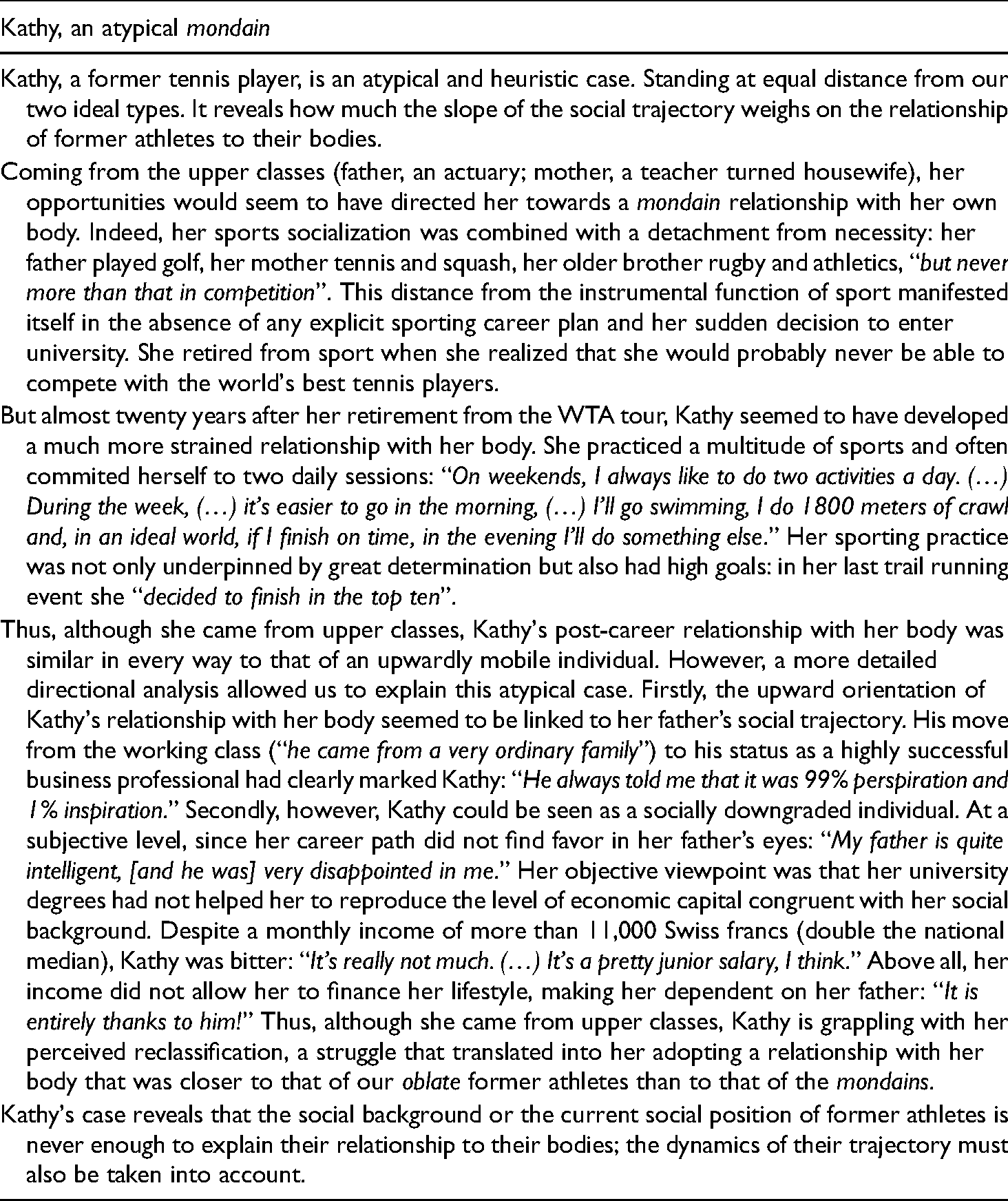
Although social background has a determining effect on former athletes’ relationships with their bodies, everything indicates that the slope of their social trajectory plays an equally important role. Our results were convergent with those of Bourdieu (1984) and Darmon (2011), showing that ascending social trajectories were most often associated with body conversions, and stable trajectories were more likely to result in forms of body continuity. This slope must be considered objectively and subjectively. From an objective viewpoint, our results confirmed that former high-level athletes occupied social positions equivalent or superior to those of their parents (Conzelmann and Nagel, 2003; Fleuriel and Schotté, 2011; Moret and Ohl, 2019). Subjectively, hopes (whether fulfilled or not) of a rising social trajectory achieved through sports were more likely to be held by athletes from lower classes. Those hopes were associated with a form of frustration with their body that pushed them to pursue intense physical activity, underpinned by a strong competitive attitude, beyond their careers. But such relationships with their own body also seem to be found among certain former athletes from upper classes who, after having suffered a social downgrade, are seeking to upgrade again. The slope of the trajectory could therefore prove to be as important, if not more so, than social background.
Given the limitations imposed by the format of a scientific article, we have focused on physical activity. Future research should examine other indicators of former athletes’ relationships with their bodies (diet, physical appearance, health, etc.). The gender dimension also deserves further investigation from a body trajectory perspective. We know that the meaning given to sporting practice varies greatly according to gender (Mennesson, 2005). Indeed, our own data also suggested that women were more likely to be exposed to a conflict between the physiological changes linked to puberty and their expectations about their body in light of their sporting practice. This conflict can affect the athlete’s relationship with their body in a similar way to chronic injury. Another hypothesis that could be further explored is that of the different fundamental kinds of capital pursued during and after the sports career: further analysis might establish a closer link between the different relationships to the body and the relative importance given to economic, cultural and social capital.
Another question that we have deliberately left unanswered is that of the differential effects that different sporting disciplines might have on athletes’ relationships with their bodies. This question relates more broadly to the relative weight that behaviors owe to the position athletes occupy within a social space, on the one hand, and to the dispositions they incorporate during their social trajectory, on the other. While some sports (e.g. gymnastics) impose almost standardized rules (due to early maturity, very intense training, and a low tolerance for deviations from the ‘ideal’ morphology), others (e.g. soccer) offer their adepts more latitude. In the same way that the regions of the political field whose functioning most closely resembles “apparatuses” or “total institutions” are those that tend to consecrate political oblates (Bourdieu, 1980), one could hypothesize that it is within the sporting disciplines demanding the most standardized bodies that one finds the most sports oblates. Although our data didn't allow us to establish such an association, future quantitative research could further investigate this question.
Our results provide some arguments regarding the athlete's welfare management. In order to compensate for the body insecurity inherent to high performance sport, the social precariousness of athletes should be reduced as much as possible. This can be done by encouraging the accumulation of alternative capital, in particular through the promotion of dual careers, which not only favors a more distant relationship to the state of urgency, but also facilitates professional retraining at the end of a career (Torregrosa et al., 2015). In the same way, and taking into account the long-term effects, any injunction relating to the body (e.g. weight loss) should be accompanied by a real framework (e.g. on dietetics).
Footnotes
Declaration of Conflicting Interests
The author(s) declared no potential conflicts of interest with respect to the research, authorship, and/or publication of this article.
Funding
The author(s) received no financial support for the research, authorship, and/or publication of this article.
