




Abstract
Investigating the data that universities collect on the characteristics of staff and students offers an insight into which aspects of diversity they prioritise. We sent Freedom of Information requests to 24 Russell Group institutions asking them to report the data they collect on the class background and protected characteristics of staff and students. We also reviewed university equality policy documents using content analysis. Analysis showed that while all institutions collect data on the protected characteristics of staff and students, and 18 universities collect data on the class background of students, just one university collects data on the class background of staff. This is despite 10 institutions recognising class background as being an important component of diversity within their policies. We propose recommendations on what data universities should collect on the class background of staff, and how they can use these data to support intersectional diversity.
Keywords
Introduction
Enhancing equality, diversity and inclusion (EDI) has become an ‘increasingly dominant discourse’ within higher education (Koutsouris et al., 2022: 885). These efforts aim to create inclusive environments in which people feel valued and able to thrive regardless of their background or identity. In the UK, this commitment is underpinned by the Equality Act 2010, which identifies the following characteristics as protected by law: age, disability, gender reassignment, marriage and civil partnership, pregnancy and maternity, race, religion and belief, sex, and sexual orientation (UK Parliament, 2010). These are known as the ‘protected characteristics’. Section 1 of the Act also includes a public sector ‘socioeconomic duty’ for government and public organisations to work towards reducing socioeconomic and class inequalities, yet this section has never been enacted in England. Consequently, organisations are not required by law to protect against discrimination related to socioeconomic or class background in the same way that they must safeguard protected characteristics.
From a Bourdieusian perspective, social class is understood through three concepts: field, habitus and capital (Bourdieu, 1984). Fields are the social and institutional contexts in which individuals live and work, each operating according to unwritten socio-cultural codes, rules and etiquettes. Habitus is a person’s social biography or background, which predisposes them to think, feel and behave in particular ways. Capital represents the actual or potential resources that an individual possesses (Crew, 2022). The latter can include (1) economic capital (material assets, income, personal and generational wealth, and savings), (2) social capital (social networks, associations and connections) and (3) cultural capital (education, tastes, cultural activities, dialect, dress, etc.). A person’s habitus and the extent to which they possess different forms of capital affects their perceived value, and advantages they are likely to possess, within specific fields.
Bourdieu’s theory of social class helps to illuminate how class structures work to reinforce inequalities within higher education. A growing body of work has drawn on Bourdieu to demonstrate how academia may be considered a field that is dominated by and privileges middle-class habitus and forms of capital. Alongside the existence of class pay gaps within academia (Friedman et al., 2017), financial precarity is rife for those who do not have the economic capital, savings or generational wealth to insulate them against the insecure contracts, debt, unpaid work and low pay typical of academia (Crew, 2022; Warnock, 2016). Research shows that 17% of people on casualised contracts struggle to pay for food and 34% struggle to keep up with rent payments (University and College Union, 2018). Working-class academics also report barriers related to social and cultural capital, including a sense of not ‘fitting in’ (Crew, 2021) and being belittled or overlooked due to their class background. This can take the form of microaggressions or symbolic violence related to class stereotypes and classist language, including having their accents, communication styles, hobbies, dress-sense, humour and tastes critiqued and ridiculed (Crew, 2021, 2022; Haney, 2016; Warnock, 2016).
More needs to be done to address class inequalities, discrimination and diversity across the higher education sector. Crucial to this is measuring, monitoring and publishing data on the class background of staff, alongside having policy commitments that promote class diversity (Friedman and Laurison, 2019). Within the UK, the Social Mobility Commission have worked with academic experts, employer representative bodies, employers and social mobility charities to develop measures of class background for use in public and private institutions (Social Mobility Commission, 2021b; see Table 1). However, it is unclear what data are collected by higher education institutions on the class background of staff. The aims of this work are to: (1) identify the data that Russell Group universities collect on the class background of staff and compare this with data collected on protected characteristics and data collected on student backgrounds, and (2) analyse the content and commitments made to promoting staff class diversity in relevant policy documents.
Data requested on staff and student characteristics within our Freedom of Information request.

Methods
We collected data through Freedom of Information requests sent to the 24 Russell Group universities in the UK. Under the UK Freedom of Information Act 2000, a person has the right to ask to see recorded information held by public authorities and a response to this request is required within 20 days. We asked institutions to report the data they collected on the class background and protected characteristics of staff and students (see Table 1, and online Appendix file 1 for a copy of the Freedom of Information request). We also requested access to each institution’s EDI policies, including the ‘main’ policy documents (i.e. overarching staff/student institutional policies related to EDI) and other relevant policies related to EDI (e.g. policies on bullying and harassment).
We present the data that universities collect using a colour-coded heatmap. Policy documents were analysed using content analysis. For this we created an initial framework and highlighted where policies (1) mentioned the Equality Act and/or protected characteristics, (2) recognised EDI as going beyond the protected characteristics included within the Equality Act and (3) mentioned social class or socioeconomic background.
Findings and Discussion
All 24 universities responded to our Freedom of Information request.
Policy Documents
Table 2 provides an overview of our policy analysis. Social class was acknowledged in the policy documents of 10 institutions. In each of these, social class was mentioned briefly without expansion on why class was important, or details of how institutions aimed to enhance class diversity or deal with instances of class discrimination. In contrast, policy documents often provided more detail on how institutions are working towards enhancing diversity related to protected characteristics, especially race, sex, gender identity, sexual orientation and disability. Many policies went beyond simply acknowledging these characteristics to outline strategic plans of action on how they are improving opportunities and experiences for staff from these under-represented groups, and signposted additional policies, documents and resources.
Summary of main and additional equality, diversity and inclusion EDI policies/strategies across the 24 Russell Group universities.
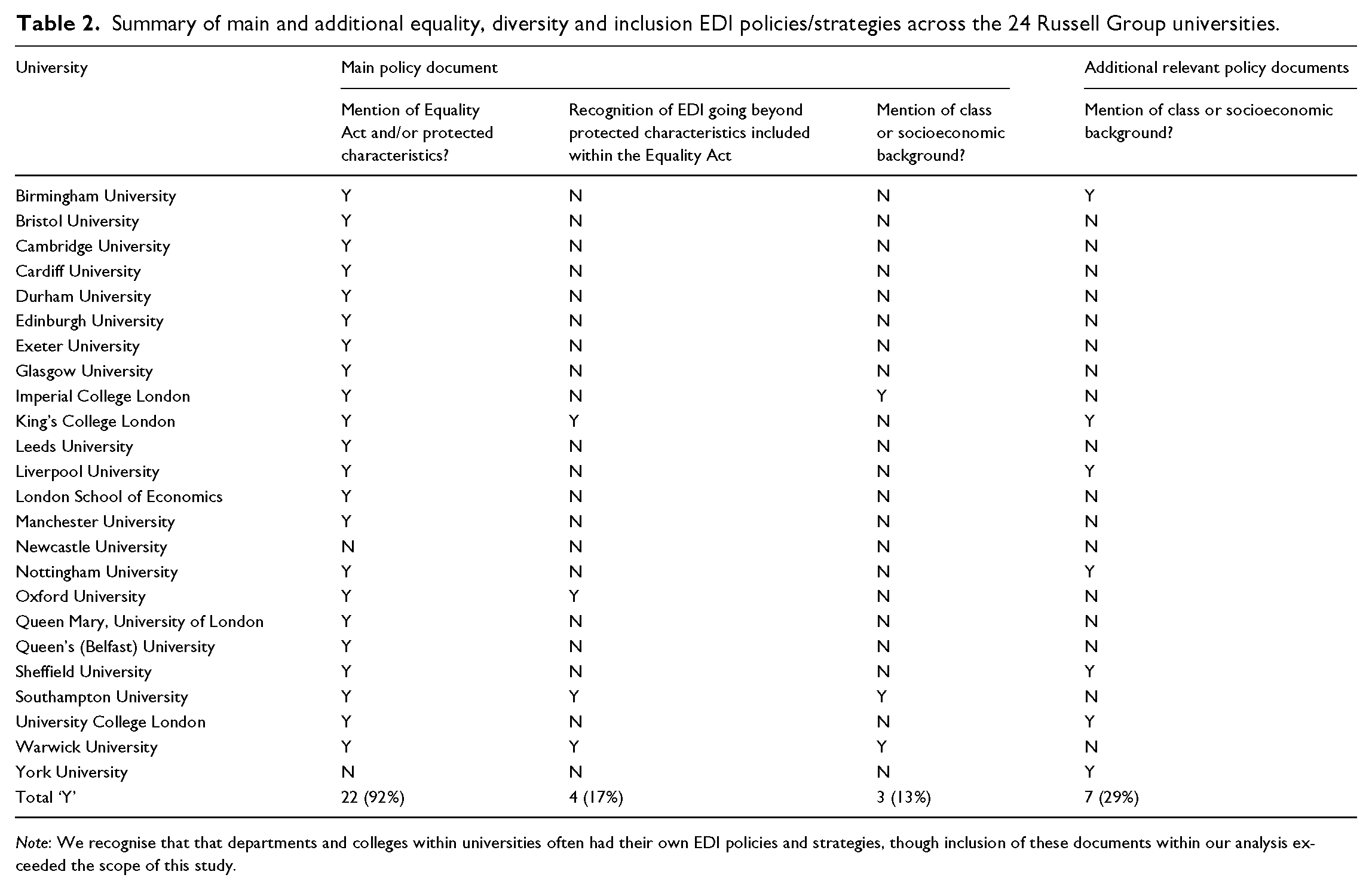
Note: We recognise that that departments and colleges within universities often had their own EDI policies and strategies, though inclusion of these documents within our analysis exceeded the scope of this study.
Evidence (see Crew, 2021, 2022; Haney, 2016; Warnock, 2016) shows that working-class academics frequently experience what Crew (2021) labels as ‘hostile encounters’; subtle or overt forms of classism that make academia feel unwelcoming and alienating. In a survey study of the Canadian professoriate by Haney (2016), 40% of respondents reported experiencing classist language. For these reasons, recognising and including social class within EDI policies is crucial in protecting staff and students against class-based inequalities and discrimination. That the majority of Russell Group universities omit or provide only vague reference to social class in their policies is problematic for an intersectional diversity agenda. Without robust policies and strategies to underpin how to recognise, report and address class discrimination, people working in academia are less likely to be aware of what constitutes class discrimination, making it ‘easier’ and more acceptable for overt classism to propagate (Crew, 2021; Warnock, 2016).
Data Collected on Students and Staff
Table 3 summarises the data that institutions collect on staff and student backgrounds. Almost all institutions collect staff and student data on age, disability, race, religion/belief, sex and sexual orientation. Most universities collect data on staff gender identity, gender reassignment, marriage/civil partnership and pregnancy/maternity, but far fewer collect data on these characteristics for students. Only one institution (University of Warwick) collects data on staff social class background, compared with 18 institutions that collect at least one measure of social class background on students.
Data collected by each university on the class background and protected characteristics of staff and students. Green indicates where data are collected, red indicates that data are not collected, and amber indicates that data are partially collected.
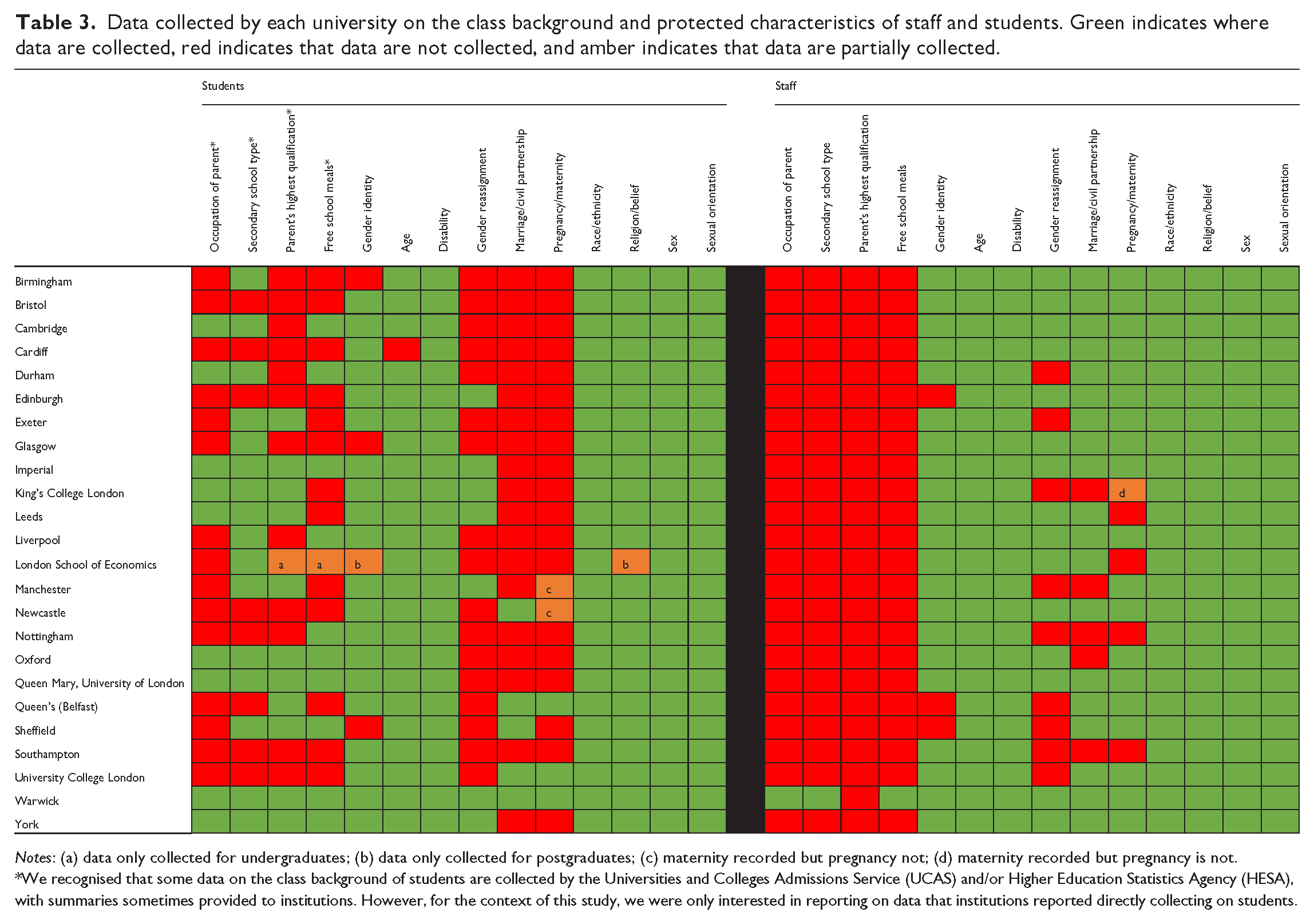
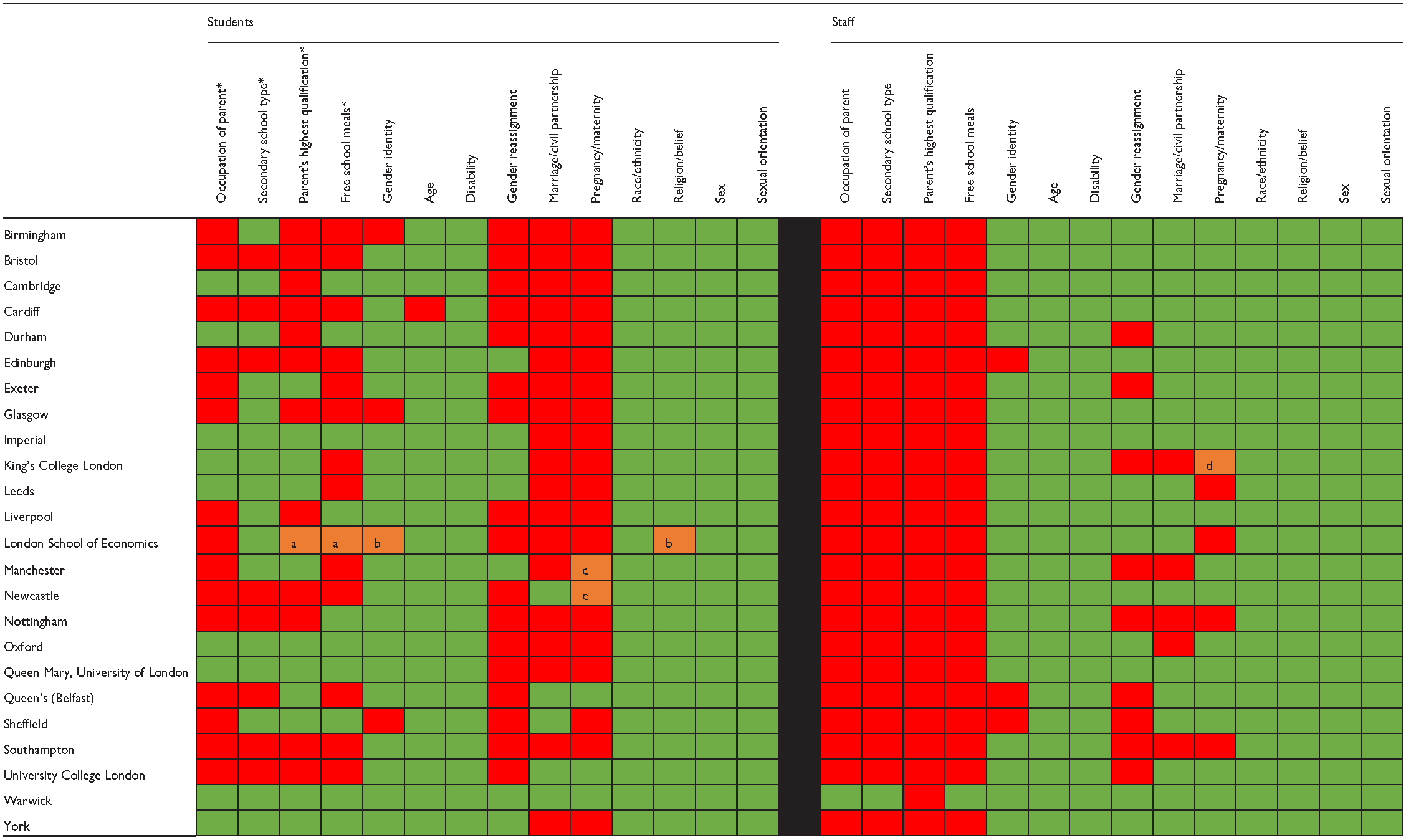
Notes: (a) data only collected for undergraduates; (b) data only collected for postgraduates; (c) maternity recorded but pregnancy not; (d) maternity recorded but pregnancy is not.
We recognised that some data on the class background of students are collected by the Universities and Colleges Admissions Service (UCAS) and/or Higher Education Statistics Agency (HESA), with summaries sometimes provided to institutions. However, for the context of this study, we were only interested in reporting on data that institutions reported directly collecting on students.
These findings can be partly explained by the policy context of higher education. Collecting and using data to support diversity activities across protected characteristics is commonplace for both students and staff within higher education. These efforts are often underpinned by the Equality Act, alongside frameworks and strategies such as Athena Swan, Stonewall and the Race Equality Charter. For students, the Widening Participation strategy (UK Parliament, 2018) also sets out priorities for increasing access to higher education for people from disadvantaged backgrounds and lower-income households. As part of strategy, the Department for Education, Universities and Colleges Admissions Service, and Higher Education Statistics Agency collects, monitors and publishes data on the class background of students entering higher education. However, no similar initiatives exist for addressing class inequalities for staff. Some scholars have gone further in explaining that the lack of initiatives and data collection practices to support class diversity is not simply an oversight, rather it reflects resistance to diversifying higher education along class lines for fear of disrupting long-held class hierarchies and power within academia (Warnock, 2016).
However concerted the omission, our findings suggest that, for staff, there has been a decoupling of class and identity-based inequalities within higher education (Gunn et al., 2015; Welsh Government, 2021). That is, while initiatives exist within higher education dedicated to race, sex, gender identity, sexual orientation and disability, and this is reflected in the policies and data that Russell Group institutions collect, social class is rarely considered in the same way (Case, 2017). Given this, class may be viewed as an overlooked (or deliberately ignored) piece of the puzzle of intersectional diversity for staff in higher education.
Contributions and Calls to Action
This research contributes both empirically and methodologically to sociological debates on class inequalities within UK higher education. It is the first study that uses Freedom of Information requests to investigate data collection practices for staff and students across Russell Group universities, and to explore congruence between data collection practices with the content and commitments made within corresponding institutional EDI policies. While all institutions collect data on the protected characteristics of staff and students, only one university collects data on the class background of its staff. In contrast, 18 institutions collect data on the class background of students, and 10 institutions recognise class as an important characteristic in their EDI polices. These findings offer empirical insight into the low prioritisation of social class within the wider EDI agenda for staff at Russell Group universities, and support calls to more critically consider the groups for which diversity and inclusion are being enhanced within higher education, and the groups excluded from this agenda (see Case, 2017; Crew, 2022; Warnock, 2016).
Staff data on class background are routinely collected, analysed and used to understand and address class inequalities for employees in large organisations outside of academia, including the Civil Service, BBC and KPMG (see British Broadcasting Corporation, 2018; Civil Service, 2018; KPMG, 2021). That these data are not collected routinely in UK Russell Group universities suggests that current data collection practices operate in ways that reinforce class inequalities by failing to collect the data required to understand and address inequalities and discrimination related to class. This article provides a methodological contribution by demonstrating the potential for Freedom of Information requests to be used as a research tool for generating data to inform contemporary sociological debates (Savage and Hyde, 2014).
Drawing on our findings, existing work on class in higher education (Case, 2017; Crew, 2021, 2022; Warnock, 2016), and examples from further afield (e.g. British Broadcasting Corporation, 2018; KPMG, 2021; Social Mobility Commission, 2021a, 2021b; Welsh Government, 2021), we outline the following recommendations for how universities can address the omission of social class within their EDI efforts.
Collecting and using class background data to support diversity and equality. Higher education institutions must prioritise class as an important criterion for staff/workforce diversity. This needs to be reflected in the data they collect and how they use it to address class inequalities. The Social Mobility Commission (2021b) provide a toolkit that employers should use to measure the class background of their workforce, which includes questions to ask, why to ask them, response options and how to integrate these into existing work structures. Employers report that the collection of these data is relatively simple, low-cost and straightforward (Social Mobility Commission, 2021b). These data can support equality, equity and diversity through mapping the number of working-class academics within institutions and departments, exploring how class impacts career trajectories, exposing and addressing class pay gaps, and combining with data on protected characteristics to better understand how class intersects with other known inequalities within higher education.
Embedding class diversity in policies. Class diversity must be legitimised through institutional policies. Only three of the main Russell Group EDI policies mentioned class or socioeconomic background as an important component of diversity. To effect change, we recommend a strategic coalition for class diversity across higher education institutions, which complements, rather than competes with, existing diversity policies and initiatives (i.e. Athena SWAN).
Changing institutional culture. Addressing class diversity requires higher education institutions to think and act differently. Conversations about race, sex, gender identity, sexual orientation and disability are increasingly becoming normalised in higher education. This must also happen for social class. Alongside the collection and use of data, this requires leaders and institutions to publicly advocate and be held accountable for class diversity, inclusion and equity within their departments, institutions and beyond. It also requires changing hiring practices through making efforts to widen talent pools through actively recruiting, retaining and supporting career progress for people from diverse class backgrounds.
The above recommendations are a starting point for actions that institutions should take to address class inequalities in higher education. It may well be that these things are already occurring at some non-Russell Group universities, though exploring the data collection practices and EDI policies of all universities within the UK exceeded the scope of this work. Additional research exploring this, alongside highlighting areas of best practice, would contribute to further understanding and addressing class inequalities within higher education.
Aside from being a matter of social justice and equality, failing to meaningfully address class inequalities risks devaluing higher education. Research shows that working-class staff contribute unique forms of capital and ‘pedagogical gifts’ (Crew, 2020: 139) across teaching, research, administration and student support. These include (but are not limited to) linguistic capital (the ability to communicate in more than one style and to explain complex ideas without academic jargon), resistance capital (using lived experiences as motivation for challenging structural class inequalities) and navigational capital (providing higher quality pastoral care to students from diverse backgrounds) (Crew, 2021, 2022). It is widely acknowledged that these contributions and the incorporation of more diverse perspectives across intersectional characteristics have the potential to make higher education intellectually and culturally richer (Case, 2017; Crew, 2022; Warnock, 2016). Yet, data from the Labour Force UK survey show that although people from working-class backgrounds represent 29% of the UK workforce overall, only 14% of academics are from working-class backgrounds (Friedman et al., 2017). Working-class people remain marginalised in academia, while those who are able to contribute are often forced to downplay their class diversity or risk their contributions being relegated as less ‘worthy’ forms of capital.
While higher education institutions have a role to play in addressing class inequalities, we also recognise that class inequalities are deeply engrained within society, impacting on people’s health, wealth, education and opportunities long before they enter higher education (Friedman et al., 2017; Marmot, 2010; Pickett and Vanderbloemen, 2015; Savage, 2015). Consequently, it is essential that efforts to address class inequalities and diversity are supported at governmental level through enacting the ‘socioeconomic duty’ of the Equality Act 2010 in England, so that public institutions are required by law to protect people from class discrimination, as is the case in Wales and Scotland (Scottish Government, 2021; Welsh Government, 2021).
Conclusions
Policies and data collection practices at Russell Group universities highlight that social class is the overlooked element of EDI for staff at higher education institutions in the UK. The low priority and lack of recognition of social class at staff level contrasts with efforts to widen participation in higher education for students from diverse class backgrounds. We found that just one Russell Group university collects data on the class background of its staff, compared with 18 institutions collecting these data for students, and 10 recognising socioeconomic and class background as an important component of EDI within their policies. Considering the well-documented challenges for working-class academics in terms of being employed and progressing in higher education, it is imperative that Russell Group universities begin to collect and monitor staff data on class background as part of wider efforts to increase the intersectional diversity of their workforce. Doing this is relatively easy and low cost. We draw on study findings, alongside work from within and beyond the higher education literature, to recommend how this may be achieved across Russell Group universities.
Supplemental Material
sj-docx-1-soc-10.1177_00380385241286383 – Supplemental material for Social Class, the Overlooked Element of Diversity within Higher Education: An Analysis of Policy Documents and Data Collection Practices by Russell Group Universities in the United Kingdom
Supplemental material, sj-docx-1-soc-10.1177_00380385241286383 for Social Class, the Overlooked Element of Diversity within Higher Education: An Analysis of Policy Documents and Data Collection Practices by Russell Group Universities in the United Kingdom by Andy Bradshaw, Joanna M Davies, Lesley Williamson, Beka Torlay, Debbie Braybrook, Hannah Scott and Sabrina Bajwah in Sociology
Footnotes
Funding
The authors received no financial support for the research, authorship and/or publication of this article.
Ethics statement
In line with King’s College London Research Ethics Guidance, we did not need ethical approval for this research. We did not use primary data or work with human subjects in this study. Policy data used in this study are freely accessible in the public domain and we did not request or use personal or identifiable data on the characteristics of staff or students.

Supplemental material
Supplemental material for this article is available online.
References
Supplementary Material
Please find the following supplemental material available below.
For Open Access articles published under a Creative Commons License, all supplemental material carries the same license as the article it is associated with.
For non-Open Access articles published, all supplemental material carries a non-exclusive license, and permission requests for re-use of supplemental material or any part of supplemental material shall be sent directly to the copyright owner as specified in the copyright notice associated with the article.
