




Abstract
Mountains have long been dominated by men and hypermasculine practices. Women have worked hard to find a legitimate space in them. This paper is drawn from a qualitative study which explores the experiences of 10 women, based in Scotland, who have dedicated part of their lives to mountains. It adds to existing insights on women who have made inroads into mountaineering. Conceptualising mountaineering as a social field structured by masculine domination, the paper seeks to understand the conditions which have enabled the women to successfully embody a disposition to mountaineering over time and interrogates how the women's practices represent a challenge to the continuing dominance of men and hypermasculine narratives that prevail in this field. The paper shows that a number of structural changes in wider society and in mountaineering have enabled women to claim a mountaineering identity but that the field continues to be inflected by narratives of exclusion.
Introduction
This paper seeks to contribute insights into women and mountaineering. There are no comprehensive figures about how many women wander up and down or around mountains for leisure (Dilley and Scraton, 2010) but what figures are available show that women are minority participants in elite and professional mountaineering: only 5% of high-altitude mountaineers (Allen-Collinson et al., 2019), only 20% of Outward Bound instructors (Outward Bound Trust, 2021). The pass rates to the award of Summer Mountain Leaders 1 by women have increased from 19% to 27% and from only 6% to 17% of Winter Mountain Leaders (Personal communication from the MTA, 03/06/2021).
The academic literature, propelled by Feminist concerns, has identified a range of factors accounting for women's under-representation in mountaineering, highlighting in particular the hypermasculine nature of mountaineering (Frohlick, 2000). Women have joined the field and claimed a place in it in the face of substantial obstacles (Doran et al., 2018) – interpersonal, intrapersonal, structural, discursive and technical – which have shaped their strategies for participation (Doran et al., 2020), their search for legitimacy and the negotiation of identity (Dilley and Scraton, 2010; Doran and Pomfret, 2019). Two questions require further investigation: how do women become and remain mountaineers as embodied practice over time and how do they position themselves within this field.
This paper will therefore explore the conditions of possibility for Scotland-based women who are active mountaineers to forge a mountaineering career. The focus will be on their encounters with mountaineering, the processes which have, throughout their lifecourse, facilitated the incorporation of aspirations and dispositions consistent with the norms, values and forms of capital constitutive of mountaineering as a social field structured by male domination and how they have navigated masculine domination.
Literature review
It is generally accepted that mountaineering as a formal sport was ‘invented’ in the mid-19th Century by privileged British men, first in the European Alps (Ring, 2011) propelled by new European sensitivities about mountains (Macfarlane, 2004). By the turn of the 20th Century alpinism moved beyond Europe to other mountain ranges around the world.
Women have by no means been absent from mountains, and their exploits have been recorded by a number of writers (Coffey, 2003; Craig, 2013; Rose and Douglas, 2000). However, they represent a substantially lower proportion, both as practitioners and as producers of writing about experiences (Moraldo, 2013).
Women's exclusion from mountains
The factors facilitating or inhibiting entry into the social field of mountaineering have varied over time and geographically. Some of these are cultural obstacles. High altitude mountaineering is still perceived as an inappropriate pursuit for women because of the high risks entailed and women climbers continue to suffer from this perception in the public sphere, especially women with young children (see Rose and Douglas (2000) book about Alison Hargreaves, mother of two young children, whose mountaineering achievements gave rise to negative media representations about her character as a mother after she died on her way down from the summit of K2). But also perceptions of incompetence still prevail, especially in relation to orienteering and map reading (Gillonnier, 2009; Ottogalli-Mazzacavallo and Saint-Martin, 2009), as well as in women's ability to develop the physical capital (for instance the strength to rescue clients) required in some situations (Ottogalli-Mazzacavallo, 2009). Morin et al. (2001) also noted the tendency to diminish women's exploits by demoting the difficulty of an ascent or by men going on to attempt ever greater challenges.
At an organisational level, mountaineering organisations have actively or tacitly operated gender restrictions such as exclusions from clubs, (Le Comte and Porrini, 2009) or lack of funding, appropriate equipment and training (Ottogalli-Mazzacavallo and Boutroy, 2020). These forms of exclusion have been sustained by masculine narratives in mountaineering.
Dominant narratives in mountaineering
Hypermasculinity
Books and films about mountains and mountain sports since the middle of the 20th Century (Frohlick, 2000; Ortner, 1999) follow a recognisable template which has fuelled dominant narratives about the values and practices that constitute mountaineering, rehearsing excessive forms of masculinity. The glorification of danger and risk, claiming a summit (often constructed as feminine) (Hansen, 2013), and overcoming extreme physical hardships (Ortner, 1999), have been conceptualised as hypermasculinity (Frohlick, 2005). Frohlick’s (2005) study of women audiences’ reception of films featured at North American mountain film festivals revealed that they had a keen awareness that through these films they were bombarded with what she conceptualises as ‘an adventure imagery of difference’ (p 188), in which the hypermasculine subject who is white, displays elite athleticism, travels the world, ‘seeking a challenge’ was constructed and normalised (p 184). In addition, mountaineering biographies follow a consistent narrative arc seeking the roots of high achievement delving in the male mountaineer's early years (Moraldo, 2015).
A much lower proportion of this production has been written by or about women (Moraldo, 2013). Women's apprenticeship, especially of the ability to understand and manage harsh snow and weather conditions in high altitude mountaineering (Allen-Collinson et al., 2019) has received less attention. Accounts of early 20th Century women mountaineers such as Pilley (1935) position them firmly as privileged, of independent means and whose exploits are often conditional on the support of men, whether significant men or mountain guides (Frohlick, 2005).
The case of Scotland
Scotland is a good case study that bears witness to the ubiquity of hypermasculinity in mountaineering. Scotland's summits do not reach the altitudes of those found in alpine ranges. But the climate and morphology that prevail in upland areas make venturing into them particularly challenging. Arctic conditions, high winds, whiteouts, and rapidly changing weather patterns can turn an apparently benign prospect into a dangerous endeavour warranting, at worst, rescue by one or more of Scotland's 24 Mountain Rescue Teams (https://www.scottishmountainrescue.org/). At the inception of the British Alpine Club in 1857, its members would travel to Scotland to practice winter and summer climbing before venturing to the European Alps (Parsons and Rose, 2003). Hypermasculinity in Scotland's mountaineering culture is manifested inter alia in the classification of its mountains (or hills, the terms are used interchangeably by British mountaineers but will have salience in the findings). The process of identifying, naming, and climbing them was started by a man, Sir Hugh Munro, who gave his name to the 282 distinctive summits that are 3000 ft and above (914.4 m). There are other classification systems also engendered by men for lower hills. There is a growing interest in the practice of ‘bagging’, i.e. collecting, these summits and recording one's achievements in the lists held by Clerk of the List of the Munro Society. Currently there are just over 7000 ‘compleaters’ (sic) of the Munros, this author being compleater No 6177. In an analysis of membership undertaken by the secretary of the Society for the years 2010–2015, it was found that the male/female gender split ranged from 81%/19% to 76%/24% (personal correspondence with the current President 28/05/2021). Women's increasing presence in this practice and in mountains worldwide is perhaps evidence of transformations in the field of mountaineering. Indeed,
This begs the question of how women position themselves in this hypermasculine world. It could indeed be hoped that women's greater presence has destabilised men's dominance (see Morin et al., 2001). However, the picture is more complex and ambiguous.
Managing constraints
The literature has revealed ‘practical’ constraints to women's participation. Doran et al. (2018) have identified a typology of barriers: intrapersonal or efficacy, interpersonal, structural and family constraints. In an ethnography of women climbers Dilley and Scraton (2010) identified work, sexual relationships and domestic and caring labour. Included in the latter was motherhood, as a normative obligation or as an existing condition that had to be managed. Sexual relationships were also perceived as a threat, because of the compromises that might need to be made to make time to go on an outing or to manage the men's tendency to take control. Thus women's mountaineering careers, they found, are fragmented.
Physicality emerged as important. Doran (2016) conducted an ethnography of a Himalayan expedition, joining a group of ‘led mountaineers’, i.e. competent but paying clients led by a guide. She found that the women were particularly concerned about being fit enough and had done substantial physical preparation prior to the trip. Dilley and Scraton (2010) noted the women were not estranged from their bodies and derived their identities as mountaineers from their physical strength, their skills and their knowledge of the mountain environment. They were conscious that they needed to work hard at acquiring what can be conceptualised as physical capital (Bourdieu, 1978) normally associated with masculinity. Doran et al. (2020) explored other strategies used by women to overcome barriers and ensure that they can maintain participation, and these included identifying the benefits of mountaineering for personal development, social networks and identity. However they recognised that these and other strategies do not necessarily challenge hypermasculinity. Dilley and Scraton (2010) identified the emergence of a new binary, with climbing femininities being less favourably contrasted to climbing masculinities.
Resisting hypermasculinity?
Are women mountaineers offering a challenge to the structural constraints and narratives of hypermasculinity that are constitutive of mountaineering? Are the climbing femininities noted earlier subversive? Ottogalli-Mazzacavalo and Boutroy (2020) have recently noted three moments in women's 100-year struggle for equality in mountain sports, of: i. access to mountains in the early decades of their participation, ii. treatment, as women began to be allowed into expeditions, and iii. in the last 30 years recognition as legitimate practitioners by other mountaineers as well as institutions and sponsors. For instance Destivelle’s (2014) and Hill's (Hill and Child, 2002) autobiographies, in which they showcase their apprenticeship, bear witness to the various forms of discrimination they have encountered and which they defied by asserting their competence, seeking to emulate men's achievements (Moraldo, 2013), could be seen as a journey towards equality of treatment and legitimacy. Both climbers were born around 1960, thus their journey straddles the successive challenges women have faced with treatment and recognition, in the second half of the 20th Century. This positioning is however precarious (Moraldo, 2013). Their empowerment (Doran, 2016) has been obtained by sacrificing relationships and parenthood (Dilley and Scraton, 2010). Ottogalli-Mazzacavallo and Boutroy (2020) note that younger women seem oblivious to the history of struggles for access and treatment that earlier cohorts have experienced and that they rejected the feminist qualifier as stigma.
Frohlick (2005: 186) also showed that women viewers of adventure films (whose mountaineering ability is not specified) ‘share axes of identity with […] the men on screen (whiteness, relative wealth, first world citizenship and mobility)’. The women could also be quite critical of the few women mountaineers that they had witnessed on screen, questioning how they displayed their femininity or even their competence, musing that perhaps they owed their presence in expeditions not to their physical capital but as the performance of diversity. Not only is their competence questioned but the spectators did not show interest in these young women's backstory or identity.
Nevertheless, there are examples of non-Western women being well aware of persistent male domination of mountaineering such as the Cholistas Escaladoras, Bolivian Aymara women. In 2015 they started climbing mountains in traditional dress driven by curiosity but also as part of a long process of resistance to their social marginalisation in Bolivian society. The visibility of their achievements (summitting Andean peaks, including Aconcagua (6962 m) in 2019) widened the appeal of mountaineering, hitherto practiced mostly by western tourists, to local people (von Kaenel, 2019).
Theoretical framework
Important headings can be distilled from this review: women's lower visibility in mountains and adventure has been associated with narratives of difference as well as a range of barriers (structural, institutional, technical, intra and interpersonal, physical) which continue to hold sway. Dilley and Scraton (2010) have argued that research should broaden to the women's wider lives. It is also evident that we need to take a historical as well as a biographical perspective to understand how barriers and strategies have been experienced at the start and subsequently. Echoing Dilley and Scraton (2010) work in this area must be informed by a structural concern for inequalities of access to the field and recognition within it, whilst also examining issues around identity. Doran's research also draws attention to the intra-personal dimension of practice. That said, changes have also taken place. The work which follows builds on these concerns. It takes the argument forward by focusing on the conditions of possibility that enable women to become mountaineers.
I propose framing research questions within a pluralist theoretical approach informed by Bourdieu's conceptual framework and Butler’s (1999) reflections on gender as performativity. Bourdieu (1992) draws attention to how our decisions and practices result from our internalisation of social hierarchies, particularly (although not exclusively) class, prevalent at particular points in time. We develop dispositions and aspirations to act consistent with our social location, or habitus, which, whilst structurally generated, are taken for granted, naturalised, guiding our decisions and identities. In later work Bourdieu (1998) explored the reproduction of masculine domination and its manifestations in dispositions and bodies. I conceptualise mountaineering as a social field structured by masculine domination manifested in the prevalence of forms of physical capital and hierarchies of values which naturalise gender inequalities (Bourdieu, 1992, 1998). Because women have made some inroads into the field, the focus can turn to the factors which have facilitated their entry into the field, the acquisition of appropriate dispositions of mind and body and the forms of capital inherent in the field – especially physical capital – that would confer or deny a legitimate sense of belonging, and the negotiation of physical capital set against doxic, ie unquestioned, naturalised norms of embodiment (Wacquant, 1992). The focus is therefore on practices and on the wider society in which the field is located. A second important aspect that using Bourdieu's work invites us to consider is the time-bound nature of processes of transformation, charting the conditions that have predisposed the women to come into contact with the field, how over time they have acquired and developed the urge to become mountaineers as the field and wider society have changed. This raises the question of reflexivity and whether women's presence in the field constitutes fundamental disruption of its masculine structures. To address this I have sought inspiration from Butler’s (1999) reflections on gender as performativity. She defines gender performativity as the repetition of acts. These acts, which are constitutive of established practices, have shared social meanings. Engaging in these practices has power effects: reproducing the gender order. This is manifested in self-recognition in established identities. Thus identity is also performative: gender subjectivity is constituted within gender norms which are essentialised (Shams, 2020). Butler (1988) offers a way out, proposing that the potential for challenging the gender order is possible. Gender norms can be contested through the repetition of acts which can become subversive and change power relations in the field.
Research questions
This theoretical and conceptual toolkit, therefore, led me to the following questions: What are the conditions which have enabled the women to develop a disposition to mountaineering? Do women mountaineers’ practices represent resistance to dominant narratives in the field of mountaineering?
Methodology
The research questions were consistent with the adoption of an interpretive epistemology (Silverman, 2006). I was propelled by a concern to unlock practical experiences, as well as sensed evocations of these experiences. I also wished to facilitate or give the women opportunities for self-reflection on their own stories and practices (Ingold and Vergunst, 2008; Smith et al., 2016). I recruited research participants via hillwalking websites and the Ladies Scottish Climbing Club (LSCC) 2 . I obtained positive responses from 10 women, aged from 38 to 80, who all lived in Scotland. Seven of the women, who were aged 50+ and were members of the LSCC, had a longstanding career in mountaineering combining climbing, the bagging of Munros and other Scottish mountains, sometimes doing several rounds, wild camping, ski touring and going on unsupported expeditions. The other three women (aged 38–54) had a more varied profile, ranging from systematic Munro bagger to a more relaxed approach to mountaineering. None of them enjoyed rock climbing and the expeditions they had done were as guided clients.
To access how dispositions were acquired and embodied over time, within a broader societal context, and to elicit reflections on the nature and meaning of practice, I adopted an ethnographic and ultimately pragmatic approach (Chamberlain, 2012) to data collection: life history interviews (Lincoln and Lanford, 2019) to recreate mountaineering biographies, locating them in the broader social, cultural and historical context in which they have unspooled (Tulle, 2017); walking interviews (Hubbard, 2000; Ingold and Vergunst, 2008; Savage and Flemmen, 2019) to put myself in the women's shoes (Goodson, 2001) by walking with them, understand their embodied relationship to mountain spaces and access their sensibility; and lastly fieldnotes. I am also an experienced mountaineer, a Munro ‘compleater’ and a member of the LSCC which I joined on completion of data collection. Joining the club has enabled me to spend more time with women, to witness discussions relating to gender issues and gain a greater understanding of social relations as they are performed during meets. I meet members for mountain outings but also at climbing walls and hut maintenance days. I had previously walked or skied mostly with men or on my own so this all-women environment has been instructive, for myself as a mountaineer but also for challenging my interpretations. I ended up with a mix of recorded material, fieldnotes and personal reflections.
The data was analysed inductively, with an eye on my research questions to test out and identify possible new connections. Working with the women to recreate their biographies enabled me to understand how their identities, their practices and values had developed. These negotiated stories could also be treated as works of history in their own right (Riessman, 2003). The analysis thus sought to render visible the historical, cultural and structural markers which had given the women's lives their shape as well as explore how the women positioned themselves in their story telling and constructed their subjectivity (Germeten, 2013). I was also alert to the possibility of unexpected findings or interpretations. One such unexpected finding concerned the extent to which the women belonging to the women-only club perceived their practices as resistant.
Thus, three theoretically-rich themes were identified: i) Developing the disposition to climb mountains, ii) gender performativity in the hills, and iii) apprenticeship, belonging and identity.
Findings
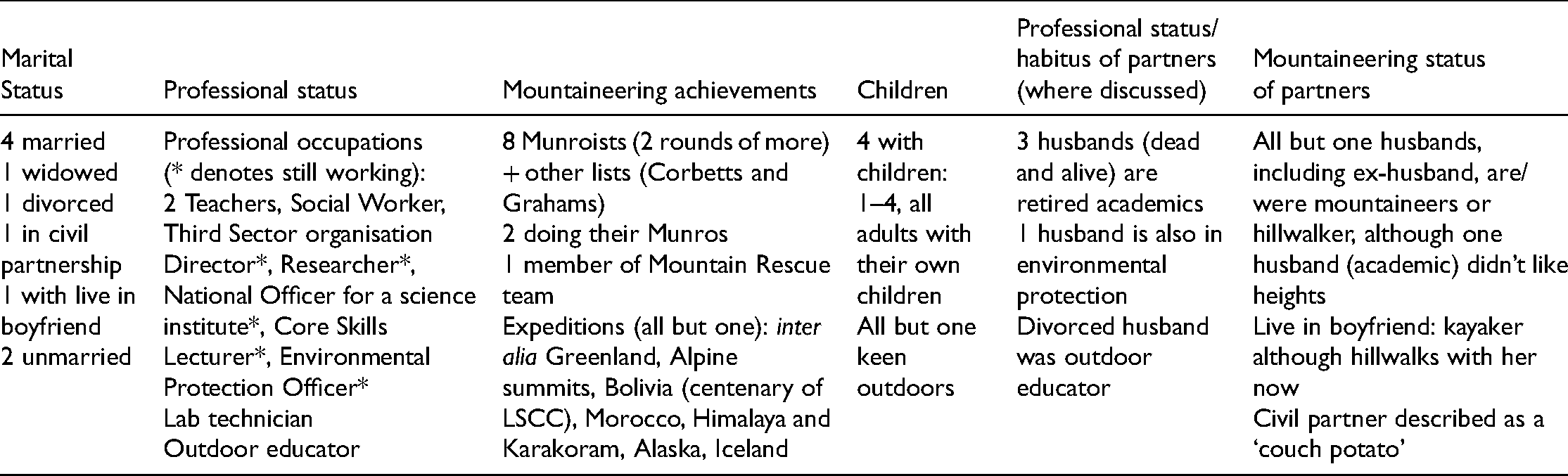
The information provided in Table 1 presents the women in their structural context focusing on occupation and marital status. The women were in white collar professional occupations and they tended to have been married to men in middle class occupations. Thus they tended to be located in a middle class habitus (Bourdieu, 1984). At the point of data collection most of the women had few constraints either from intimate relationships or from caring obligations. By charting the women's mountaineering biographies, I was able to highlight the structures and processes that enabled them to develop and internalise the disposition to climb mountains.
Women’s social location.
Theme 1: developing the disposition to climb mountains
I asked a number of questions about the circumstances which led them to discover mountains and achieve sustained engagement over the lifecourse which appeared to constitute the conditions necessary for these biographies to unspool as they did, in a historically sensitive framework. Thus, I focused on the encounter with mountain walking, the processes which would have helped the women “get the bug” to deepen and legitimise their engagement, opportunities for enskilling, as well as family and other social relationships.
All the women aged over 50 had a long involvement in mountaineering, coming into contact with the activity in their teens in one case or their early 20s at the latest They described themselves as ‘outdoorsy’ or good at sports, thus as having an innate disposition to active physicality, which positioned them well for being literally hooked into emergent structures and practices: outdoor education or mountaineering clubs.
Age played an important role, as it revealed historically significant points and modalities of entry. Outward Bound or the British section of the Austrian Alpine Club (AAC) were mentioned by the older women in the sample (Abigail aged 80 and Angela aged 73), who would have come of age in the 1950s. Indeed in 1951 Outward Bound inaugurated a course in outdoor pursuits for young women. The AAC, unlike many alpine and mountaineering clubs, had no gender barriers to membership and was thus in theory open to young intrepid women, who otherwise would have found few structures in which to gain proficiency and experience in mountain sports. In both cases the discovery of these two organisations was unplanned, reliant on recommendations by others.
Women born later, in the 1950s and 1960s, tended to encounter mountaineering at their University's mountaineering clubs but would then have to transfer to other structures after graduation. This would assume knowledge of clubs in which women were welcomed as legitimate participants, some financial resources (to buy equipment, to pay for transport and accommodation abroad) and time. For the two women born in the 70 s, the encounter took place much later in the lifecourse, fortuitously. Rona (aged 39) moved to a small town in the north of Scotland for professional reasons, in proximity to mountains. This triggered her forays, with her husband, into hillwalking. Octavia (aged 38) had danced as a youngster so had an early history of putting her body in movement in a structured setting. The discovery of hillwalking came in her 30 s and was unplanned. With a friend they decided to attend a talk organised by her local hillwalking club; she was sufficiently attracted to join club outings and formalise her membership, where she now serves as an office bearer. Thus, using a Bourdieusian framework, we can ponder whether the claim to sportiness or outdoorsiness that some of the women made could have translated into a lifelong disposition without the presence of facilitating structures.
Indeed enskilling was a crucial element in the ability to pursue mountaineering. Two women (Laura, aged 51 and Isla, aged 63) had acquired skills in navigation and hillwalking at school and within their families. Isla's parents had themselves been mountaineers, her mother informally joining the outings of the Lomond Mountaineering Club in the late 1930s before it changed its constitution in 1938 to formally allow women to join as members. This is also where Isla's mother met her future husband. Isla and her brother were thus brought up in a habitus where outdoors pursuits were integral to life, internalising the disposition to head out into the hills from an early age. Isla's children have also internalised the disposition to be outdoors. Laura's parents were keen sailors and taught their three children to sail and navigate. She herself was introduced to hillwalking in secondary school. All siblings have been physically active at various stages of their lives, although it is Laura who has been consistently involved in mountaineering. She has no children. In these two case studies we can see how dispositions and relevant physical capital can be reproduced across generations.
The family thus plays an important and unsurprising role. However, in other women this was manifested differently. Indeed, except for Laura and Isla, most of the women in the sample were not brought up in a milieu where mountaineering was a legitimate pursuit. However women such as Anne (aged 78) and Victoria (aged 70) reported childhoods during which either walking or camping/caravanning was a family tradition or even benign neglect by parents who allowed their daughters to wander alone or pursue active leisure choices.
Marital status was significant, with an important caveat. None of the women started their mountaineering becasue of their partners. Being married to a mountaineer was both a manifestation of successful membership of the mountaineering social field and a useful condition for developing a mountaineering biography, especially for those who went on to have children. Indeed, future husbands were met at clubs. Isla (aged 63) articulates the legitimacy that a prior identity as a mountaineer gives women after they’ve had children: It never occurred to me that anyone was going to stop me doing what's a, well a, an integral part of myself. And I also met my husband mountaineering. I met him at a crag. Yeah, yeah. So when you had your own children, how did that affect your own mountaineering? As little as possible [laughs].
The encounter with mountaineering organisations, as we have already seen, played a role as entry point for nine of the women: they provided apprenticeship in practice and skills, mentoring and also an appreciation of the lore of mountaineering. Within the LSCC the women developed their sensitivity to the gender patterning of mountaineering and they became acquainted with the heroines and lore of women's mountaineering, including its founding members (Steven, 2010). There are other mixed hillwalking clubs and ‘meet-up’ groups, that is groups that form on an ad hoc basis for a particular outing prompted by a volunteer. Facebook groups have also come into existence. All these have provided more opportunities for women to embed themselves in Scotland's mountain culture, in particular Munro-bagging (to which I will return later).
Taking a biographical and historical stance I drew out the conditions that were necessary to enable the start and fashioning of a mountaineering biography. These findings echo what is found in the writings of earlier women mountaineers: the salience of class habitus that gives the women time, freedom and the financial means to develop appropriate dispositions for mountains in line with the logic of the field, that is the culture of mountaineering. Returning to the claims to ‘outdoorsiness’ and ‘sportiness’ as innate characteristics that would predate their encounter with the field, it is noteworthy that several of the women had been taught appropriate skills early in the lifecourse. Being outdoorsy is therefore dependent on processes of internalisation which serve to naturalise the urge to be outdoors, what Wacquant (1992: 249) described as ‘cultivated nature’. Furthermore looking at the women's family backgrounds, we can see that the process of democratisation identified by Moraldo (2015) has benefited women from aspirational backgrounds (Bourdieu, 1984). Thus outdoorsiness is performative for class and gender: not only does it reflect the women's class habitus, it also gives legitimacy to their leisure choices as women. What is thus beginning to emerge is that gender remains a prominent feature that has to be addressed, especially interactions with men and the acquisition of appropriate physical capital. Whether the women do so reflexively or not, what steps they take to address gender constraints and what political meaning they might attach to this is explored next.
Theme 2: gender performativity in the mountains
Gender issues became manifest in several ways: as we saw earlier in the biographical construction of the disposition to be outdoorsy and the ability to translate the urge to be outdoors into a biography inflected by mountaineering. They also become relevant in the practice itself and the women's strategies. Two sub-themes emerged here: managing masculine norms and narratives of male mountaineers.
Managing masculine norms
Here I focus on the practices that women engaged in to manage and resist the gender imbalances they encountered in the field. Indeed masculine norms continued to dominate and this demanded a response in decisions about when and where to go, walking pace, the negotiation of risk taking and recognition as a competent mountaineer. Women married to mountaineers also had to contend with gender politics. Isla (aged 63) referred to this as ‘marital games’. The legitimacy of their right to go mountaineering was not in doubt. Rather, it was the decision-making process and the competition that they felt existed with their husbands.
Both Isla and Victoria (aged 70) kept their activities apart from their husbands’, the majority of the time. The only occasions when they came together were for joint holidays, as I witnessed in slide show presentations of joint trips organised by the local branch of the LSCC. Isla did not tell her husband how many Munros she still had to achieve to complete the list, to avoid a race to the finish (they were both a handful short of finishing).
Whilst Victoria bemoaned the tendency of men to take charge of outings, Octavia (aged 38) and Laura (aged 51) emphasised the differences in pace between men and women. Octavia had one regular male walking partner who was considerably faster than her. She described the discrepancy in speed in evocative terms: Like my pal Jim that I walk with a lot, he walks a lot faster than me, we laugh, he’ll say, we’re walking together tomorrow and I say no, we have lunch together Jim (ET laughs), […] er, he was having an off day and he walked at my pace, just recently, and I was like, Jim, I think that's the first time we’ve even walked together, are you all right? He says, I feel really tired.
Laura, who was a very accomplished all round mountaineer (rock climber, ski tourer, Munroist, member of her local Mountain Rescue Team (MRT)), after claiming that her choice of walking partners was not determined by gender, then nuanced her approach in this way: Oh it depends on the people. It's not really men or women, it's more about who the person is.[…] Although as it happens I mostly walk with women now. Just because generally they’re similar speed and a similar kinda mentality.
We will return to Laura's experience later, especially what she refers to as mentality. The women's concern with pace is a confrontation with gender differences in physical capital (Bourdieu, 1978) which puts their legitimacy at risk.
Tracey's (aged 53) strategy was to try to compensate for her slower pace by a rigorous regime of physical training and skills acquisition. After encountering mountaineering at university in the 1980s, she never joined a club after graduation, relying instead on friends and, later, meet-up groups. Her walking network was dominated by men. Tracey was a small but strong looking woman, who until arthritis set in her feet, ran twice a day, in addition to swimming, cycling, gym training and hillwalking. After a fallow period throughout her 20s and 30s, she started an intensive period of hillwalking in her 40s when she made the decision to climb all the Munros. She got equipment for all weather conditions, including winter. She tells anecdotes of danger and risk in winter conditions where she positions herself as a minority voice and having to endure the consequences of bad decisions. She refers to these situations as follows: I went out with very hard core super fit, super duper fit people, I was always at the back of those groups but we were going so fast, you know, as well. So…I was, I was lucky, it was a really exciting time.
Being confronted with wide discrepancies in pace demanded a response. Tracey signed up for several navigation courses to protect herself in case she was left behind in a whiteout by the group. This was also because by always trying to keep up with others she had become de-skilled in map-reading, never having the opportunity to practice: I got lost in a whiteout. This was with friends, they got lost in a whiteout. Also in Glen Affric cause there's no roads you have to do big long walk-ins. And then my friends would just think, ‘oh well’. They would sort of assume that, ‘well it's quite obvious where we go’. And I’m, you know, I’d be like, ‘is it obvious where we go?’ And I’d lose them for ages. I mean I, they probably, I probably wasn't in danger but felt, felt as if I’ve walked, I’ve been walking now for two hours on my own and I don't know where you are.
Her rigorous fitness regime was a strategy to keep pace. However latterly she started walking on her own or with another female friend, at first to practice her navigation, to be more in control but also because her arthritis now precluded strenuous days. The consequence of walking with men on their own terms was, for her, spoilt physical capital.
Choosing to walk with other women as a strategy to counter pace discrepancies was also why some joined the LSCC. The club does have entry criteria however: it is not for beginners so a level of proficiency in walking, navigating and climbing is expected. The club gathers women with competence as well as a sense of gender reflexivity derived from the social and cultural capital available to them, as discussed earlier.
These findings echo the observations made by Frohlick’s (2005) women spectators that women mountaineers were invisible in mountain films. My participants made their presence felt by acquiring appropriate physical capital (Bourdieu, 1978) and joining forces with other like-minded women. These were pragmatic strategies which could also be seen as subversive (Butler, 1988) as they challenged norms of feminine physicality and obviated the need for men to control proceedings. How they responded to dominant narratives is thus instructive.
Narratives of male mountaineers
Among the women, gender is performed in the rehearsal of a ubiquitous narrative of gender differences. Men are constructed as competitive and goal driven, in hot pursuit of the summit. Men do tend to be more competitive, there's no doubt about it. They’re less supportive and more competitive always (Tracey, aged 53)
In contrast women narrated themselves as more sensitive, supportive, focused on enjoying (a ubiquitous verb in all interviews) the experience itself, both sensitive and spiritual, what Laura referred to earlier as ‘mentality’: Quite often it's about going to a nice place and doing nice things and not necessarily needing to do the latest, greatest, hardest It's more about having a journey and looking at the wildlife and enjoying the scenery while doing something that challenges us as well. So it's kinda having that joint purpose. (Laura, aged 51)
Solo walking also emerges as a strategy to counter these masculine tendencies. All the women in the sample walked alone and were therefore self-sufficient.
The construction of male mountaineers as goal driven and competitive is at times challenged by the women themselves. I interviewed Anne (aged 78) and Angela (aged 73) on a rainy day whilst walking in a country park and later in a café. We had planned to climb the Cobbler, an iconic hill with significant scrambling and climbing sections, but the poor weather conditions precluded it. Anne and Angela have mountaineered together for 30 years as members of the LSCC. Early in the interview, I referred to mountaineering as ‘wandering the hills’. Angela picked up on this after they had detailed their achievements – how many rounds of Munros they had done, finishing the Corbetts and starting on yet another list At this point, she said: You made some comment about being out wandering the hills, but I would say whenever I go out I almost have a purpose, I just don't go aimlessly wandering. (Angela, aged 73)
Soon after she confirmed that the purpose of mountaineering was to achieve a summit. Thus, goal-setting, whether it is achieving a summit or the systematic completion of a list, is also inherent in the women's practice. Although not professional mountaineers, the women nevertheless take an instrumental approach, appropriating the dominant values of the field.
There were of course variations in the extent of goal-setting. I interviewed Rona (aged 39) on a warm sunny day. We had jointly agreed to climb two hills in Perthshire. Rona approached hillwalking as purposeful ‘wandering’, targetting a summit via a thorough exploration of the hill itself, its contours, knolls, lochans, flora and fauna, giving her the opportunity to step off the path and discover the whole landscape around the hill (fieldnotes 05/07/2018). Rona's practice can be seen as resistant to the masculine values of the field.
Strikingly, the third note of nuance to the dominant narrative reducing men's practice to goal setting and competitiveness came from Laura. She was describing what she termed her ‘outlook’ on mountains and at first seemed to go along with this narrative: Well the, the women I choose to walk and climb with, we’re ambitious ish but we’ll give up as well. You know, not totally goal driven. Quite often it's about going to a nice place and doing nice things and not necessarily needing to do the latest, greatest, hardest […] And it's not always easy to find somebody who thinks that way and walks at a similar pace and climbs at a similar level. So I’ve got two particular friends that I do quite a lot with now. It just so happens they’re women. And [sighs] I just haven't really met any blokes that have the same outlook.
But then she adds: […] see the trouble is you don't really know whether you’re being biased. You know, am I unconsciously biasedly putting things on men that we expect them to be like or not, you know?
What emerges from her account is reflexivity, manifested in a doubting of gender stereotypes as they apply to power relations but also to the deployment of alternative sensibilities – dispositions – in wild places. A few seconds later she reflected that in the MRT, her competence as one of six female members (a 10% proportion) in an otherwise male dominated team was recognised and respected, although she surmised her age and thus her longevity in mountaineering played an important role in mitigating any loss of recognition and authority her gender might attract.
The women's stories allude to a pretty consistent concern: to be taken seriously, to remain visible, on their own terms, to achieve a happy balance between goal-setting and enjoyment or even a spiritual experience. There was also a reckoning with the body: entering the logic of the field on masculine terms could perhaps be achieved but at the expense of physical capital. Thus the strategy that dominated among the research participants was to retreat to women-only spaces, where what could be conceptualised as climbing femininities could be constructed (Dilley and Scraton, 2010). The latter is important because ultimately it is wholly tied up with identity, belonging and legitimacy, an issue to which we turn now.
Theme 3: identity negotiation
Elsewhere I raised the issue of self-labelling as an important component in legitimacy and positioning in the field of mountaineering (Tulle, 2017). In Scotland those who engage in mountain sports have a choice of labels to describe themselves, inter alia mountaineer, climber, hillwalker, Munro bagger. Asking women how they appropriate any of these labels to describe themselves is important as it tells us how confident they are that they belong in a field characterised by forms of extreme physical hardship or endurance such as those found in stories of mountaineering and deemed to be constitutive of mountaineering (Doran et al., 2018).
I asked every woman to choose between a non-exhaustive list of labels. The women who were members of the LSCC were more prone to describing themselves as mountaineers, even if they were no longer physically able to do anything technical. The other women would choose either Munro-bagger or hillwalker. To this extent they were well integrated in Scotland's mountaineering culture and terminology.
Asked to justify their choice of labels, the women used a set of criteria which was remarkably stable: mountaineers went out in winter and carried appropriate equipment (crampons and ice axes), they were willing to walk in deep snow. At the very least they scrambled but also climbed. Ski touring, wild camping or staying in bothies (unsupervised mountain huts) were also listed. Visiting other mountain ranges part of the historical canon of mountaineering or with year round snow cover, high altitude or requiring the employment of a local guide were also constituents (women listed trips to the Himalayas, South Georgia, Morocco, Bolivia, Greenland, Iceland). Tracey (aged 53) who described herself as a Munro-bagger turned hillwalker justified her decision as follows:
Mountaineering, I have done mountaineering but it's not like, I’m not gonna go out with somebody else and lead, you know, a hard graded winter scramble. So I’m not a mountaineer cause you have to really be using ropes for that. Right okay so that's the difference between hillwalking and mountaineering is ropes? I would say so. But in those days climbing's, I think, quite elitist and, you know, there was not as many women in it. I mean you’re talking about, well I would be…late twenties. So a long time ago.
Elsewhere we can find clues that help us understand her reluctance to self-identify as a mountaineer. We saw that her strategy to manage hypermasculine practices was to improve her navigation and her fitness to withstand the rigours imposed on her by others – emulating mountaineering masculinities. She also spurned opportunities to climb despite encouragements by a male friend. Tellingly, aside from the need to use ropes and learn techniques which she found bothersome, she also mentioned the danger inherent in climbing, that called for a level of technical ability that she never achieved because her male mentor moved on to concentrate on family-making. Recalling her 20s she emphasised the male dominated and socially situated nature of climbing:
She did not seem to have the inclination to enter the climbing field in her own right. Thus not climbing is itself performative as it does not challenge its masculine connotations.
What comes out very clearly is the women's awareness of gender disparities within mountaineering and prevalent narratives. The act of self-labelling is therefore meaningful and functional as it enables the women to assert their rightful place in this social field. But it is also a subject position (Butler, 1999), reflecting the women's familiarity with the internal logic and rules of the field (Bourdieu, 1992).
This is not translated into recognition of their stance as feminist I asked Isla (aged 63) if she saw herself as feminist (the course of the interview led naturally to this unplanned for question). Her response was complex. At first she rejected the appellation, associating feminism with conscious activism where her practice would have been driven all along by the need to make a point. As she went on, she began to recognise women's situation as structurally influenced and her actions, especially in how she managed her relationship with her husband, as a response to inequality, ie as a marital game with a meaning:
So did you consider yourself like a, a feminist mountaineer? I, I, I really don't know how to answer that because I think that, that's almost something I’m striving to do and I’m not. I’m doing it because I love it, I’m confident in it. I don't need to prove anything to people most of the time but I really liked proving it in Bolivia [interviewer laughs] so there's a wee contradiction there, you know, I, I understand that. Yes, yes but I have to admit to being quite proud when I do something because I’m a woman. […] There must be that part that is kind of, ‘see [laughs] I can do it too’. So I’m not completely without it and I would say I don't have the same confidence as some of the younger women have that, that they’re just there. Just…they’re just fine. They come across as not having to prove as much.
After more reflection, she articulated what seemed like a more consciously resistant stance, a product of the historical period through which her career was formed when finding alternative narratives had to be deliberate:
Isla's reflections were not universally shared by LSCC members. At an LSCC meet of 12 members which I attended as a member, one woman raised the question of amending the name of the club to the Women's Scottish Climbing Club. She had long felt that the Ladies appellation was outdated, redolent of the class and gender structures that prevailed when the club was created in 1908. Reactions around the dinner table were split 50 : 50, between those who did not find the gender connotations of the appellation problematic, appealing instead to the need to preserve a sense of history, and those who were more combative, supporting a name change. Those in favour of the status quo claimed that they had never experienced any sexism or any questioning of their competence. Nor did they accept its class connotations as problematic. They relied on traditional narratives of femininity to explain women's exclusions: women with children could or would not remain mountain guides, women cared too much about their appearance, women were not motivated enough. The members articulating these views tended to be the older women.
By dismissing the salience of class and gender disparities, these women did indeed engage in gender performativity, potentially reproducing the conditions which exclude women or make them ancillary, even if their own practice was subversive (Frohlick, 2005).
Discussion
What emerges from this analysis is a complex picture. Combining Bourdieusian and Butlerian theoretical and conceptual tools enables the time-bound nature of mountaineering, the salience of structures and narratives to emerge. Becoming a mountaineer or hillwalker takes time and takes place within specific historical circumstances which affect the extent to which women can enter this particular social field, align themselves with its internal logic, claim a legitimate presence and assert their visibility.
If we measure social change by the incorporation of women into a social field hitherto resistant to them, then we have intimations that the field has become permeable to them: the women have been able to embody but also to give expression to the disposition for venturing into mountain areas in their own right. This has been facilitated by an explicit relaxing of gender interdicts in outdoor structures. Thus mountaineering is a social field that has been transformed, from the outside but also by the women themselves. That said, men continue to occupy a dominant position in the field.
The most ubiquitous route to independence for women has been in their response to men's dominance: seeking the company of other women, in segregated spaces, learning to walk solo and enskilling themselves to do so safely. The learning necessary to acquire appropriate dispositions and capital (autonomy, competence, gear as extension of the body) could be conceptualised as ‘the practices of repetition’ (happily required by the logic of the field) which women mountaineers have appropriated to be ‘culturally intelligible’ (Shams, 2020, p 19) within the field. The identity claims made by the women are thus part of a process of subject positioning. Taken together these practices have resistant potential: unsettling the gender order and the doxic body (Bourdieu, 1984; Butler, 1999).
However whilst the women have successfully embodied their dispositions to mountaineering, some have also become impervious to the social and historical affordances which had enabled their participation to begin with, encapsulated in the recourse to the outdoorsy or sport subject position, the reluctance by some to recognise gender as a power structure and the refusal to play a public advocacy role to encourage more diverse participation. In other words they have naturalised their achievements (Wacquant, 1992). This, I propose, is performative in that it reproduces the social constitution of the field as the realm of middle class, masculine embodiment, undisturbed by climbing femininities (Dilley and Scraton, 2010). Whilst it was noticeable that the LSCC members were at ease with the rules of the field (Bourdieu, 1992), the women who were not members occupied a more ambiguous position, having to continue to navigate persistent gender norms. These women could be understood as experiencing a disjuncture or hysteresis (Bourdieu, 1992) between the norms of the field (inflected by its history and its class values) and their own sense of inclusion within it. That said these women have exploited these disjunctures to open the field more widely.
To conclude I propose that the active encouragement of women's right to explore mountains and the provision of apprenticeships must be an essential remit of mountaineering organisations. Mountaineering's history of exclusion continues to hold sway, with the voices of privileged white men and women at ease in their bodies and comfortable in wild places continuing to dominate. The culture of women's mountaineering can be enriched by unearthing silenced voices, encouraging more diverse women in the UK and elsewhere to add to these voices.
Footnotes
Declaration of Conflicting Interests
The author(s) declared no potential conflicts of interest with respect to the research, authorship, and/or publication of this article.
Funding
The author(s) received no financial support for the research, authorship and/or publication of this article.
