




Abstract
The Korean government established the Korea International Cooperation Agency (KOICA) in April 1991 as an agency of the Ministry of Foreign Affairs (MOFA) to design and execute most of its official development assistance (ODA) grants. Since then, KOICA has administered two forms of Korean sport grants: sport aid projects (e.g. the construction of sport facilities and provision of sport equipment) and sport technical cooperation programs (sport volunteering and Taekwondo coaching programs). Drawing on Murray’s (2018) categorization of sport diplomacy, as well as Foucauldian discourse analysis, we examine how KOICA sport initiatives have, over three decades, operated to support the government's foreign policy and diplomatic goals. The findings reveal that KOICA sport initially prioritized elite sport development in an approach akin to traditional sport diplomacy. Now, however, it appears to have adopted global sport for development (SFD) strategies with a focus on social development, in line with a new sport-oriented, public diplomacy approach. Through the combination of these two strategies, the role played by KOICA sport as a diplomatic tool of the Korean state has become more sophisticated.
Keywords
Introduction
Sport diplomacy has been employed distinctively in Korea, where it was effectively integrated into the government's political aspirations and formed a foundation for inter-Korean relations in the broader context of the Cold War. Korea has utilized sport as a diplomatic tool to propagate South Korea's ideological superiority over North Korea (Merkel, 2008), shape international perceptions of Korea's rebirth (Black and Peacock, 2011) and justify the legitimacy of its various military regimes to the international community (Lee, 2016). It has indeed focused on sport's potential in international relations as a cultural resource to attract and persuade, that is to exercise “soft” power (Black, 2008). Like Canada, Norway and the United States (Coalter, 2010; Hasselgård, 2015), Korea later incorporated international sport-for-development (SFD) initiatives into its foreign policy and diplomatic schemes as the SFD movement became increasingly popular within twenty-first century, international development agendas. Korea has implemented a variety of overseas sport programs and sport aid projects in the Global South through the leading governmental aid agency, the Korea International Cooperation Agency (KOICA). The Korean government established KOICA in April 1991 as an agency of the Ministry of Foreign Affairs (MOFA) to design and execute its official development assistance (ODA) grants, consisting primarily of aid projects and technical cooperation programs in a variety of fields, including sport. Since then, KOICA has administered two forms of sport grants: sport aid projects (e.g. the construction of sport facilities and provision of sport equipment) and sport technical cooperation programs (e.g. sport volunteering and the dispatch of Taekwondo instructors overseas), which we collectively termed KOICA sport.
We offer an empirical analysis of how KOICA sport has served as a diplomatic tool for the Korean government and how its role in the complicated dynamics of sport diplomacy in Korean international development has changed over the course of three decades. We examine both KOICA sport initiatives framed as sport development and those purporting to pursue broader social development goals. Our focus on sport diplomacy to analyze KOICA sport programs is coherent with Korea's use of SFD to pursue state foreign policy objectives and provides an alternative to the prevailing approaches of current SFD perspectives in English-language international SFD studies that have highlighted the influence of the politics of global foreign aid (Giulianotti et al., 2019).
In the same way that international relations aspirations have shaped the Korean state's involvement in sport, Korean ODA has been largely initiated and driven by the state's political and diplomatic objectives (Lumsdaine and Schopf, 2007). Like sport, development assistance can be described as an official instrument of soft power (Nye, 2009). KOICA specifically has been used as a tool to pursue the state's diplomatic interests and leverage its status in the international community as a middle power (Kim, 2016; Watson, 2014). Hence, in Korea, as in other SFD donor states (Coalter, 2010; Giulianotti et al., 2019), foreign aid and SFD programs cannot be freed from the influence of national interests and policy imperatives. Hasselgård (2015) thus calls for more research that pays attention to the policy objectives, foreign aid system, and political considerations of individual donor countries, arguing that a comprehensive understanding of SFD at the international level requires not only an assessment of SFD in recipient countries, but also how it is structured in different donor domestic contexts. Giulianotti et al. (2019) also invite further exploration of how SFD is shaped by the national politics of development aid and foreign policy goals as donor states seek to enhance their “soft” power. This appeal for specific consideration of donor countries’ domestic context is critical in Korea's case. Its state-led sport for international development and broader ODA programs sets it apart from the generally non-state-oriented Western SFD. Furthermore, the forthrightness of the Korean government's use of foreign aid, including KOICA sport, to pursue national interests and diplomacy objectives also distinguishes it from Western SFD. Finally, Korea pursues a model of ‘Asia-Asia cooperation’ illustrated by the fact the majority of Korean ODA has been directed to the Asian region (KOICA, 2011c). This focus on Asia stems from Korea's desire to establish itself as an emerging donor distinct from the Western donor nations and its efforts to enhance its status to become a powerful actor in Asia (Watson, 2014). Korea positions itself as nation sharing commonalities with its poorer neighbors that can offer development knowledge and experiences that Western donor nations, which have not experienced conditions of underdevelopment, cannot (Kim et al., 2013).
The growing amount of development assistance by Asian donors like Korea is not so much triggered by a determination to pursue development-related goals as it is by national political considerations, related to domestic or foreign matters. Researchers are thus encouraged to explore alternative approaches to understand the distinct use of SFD in Asia, such as a greater adherence to sport-based goals, in contrast to the social development goals prevailing in Western SFD (e.g. Giulianotti et al., 2019; Young and Okada, 2014). While the focus of their study is not on Asia, Huish et al. (2013) offer one such alternative, combining the “sport development” and “SFD” approaches in a comprehensive review of Cuban state-led coaching programs abroad. While the Cuban government pursues South-South cooperation through elite sport development programs carried out by Cuban coaches in recipient countries, these programs operate to align with the development of social and community capacity, influenced by the transformative values of development aid (Huish et al., 2013). Huish characterizes this Cuban model as a “counter-hegemonic alternative” (Huish, 2011: 430) to mainstream SFD approaches led by the West.
Next, we present the conceptual framework of our analysis, drawing on Murray’s (2018) categorization of sport diplomacy, followed by details of the study's design. The findings reveal that KOICA sport initially prioritized elite sport development through an approach akin to traditional sport diplomacy, but now appears to have adopted a new global SFD strategy focused on social development, in step with the current UN development agenda, through a new sport-oriented public diplomacy approach. We conclude with a discussion of the contradictions inherent in KOICA sport's overt and covert aims.
Two categories of sport diplomacy
Murray (2018) proposes two categories of sport diplomacy: “traditional sport diplomacy” and “new sport diplomacy.” He refers to traditional sport diplomacy as the diplomatic use of sport in more temporal, tactical, and competitive ways, a method often involving elite sport athletes and elite sports competitions to achieve a state's foreign policy and diplomatic goals. The practice of traditional sport diplomacy is occasional, opportunistic, and “somewhat clumsy” (Murray, 2018: 61). A country's central government played a key role in this earlier, predominant approach, capitalizing on sport as a foreign policy tool to uphold or upset diplomatic relations, or to diffuse diplomatic messages. Murray and Pigman (2014: 1099) further describe this form of diplomatic affairs as “a dialogue between states”. This does not mean, however, that states acted on their own. Dichter (2021) provides examples of how foreign ministries interacted with national and international sport leaders to realize their diplomatic objectives through sport. Studies have outlined the political interests that motivated different states’ interest in hosting mega-events or other large sport tournament (Black, 2008; Grix and Lee, 2013). Yet, the point here is that the state takes a leadership position in what Murray terms “traditional sport diplomacy” or what Dichter (2021) calls “sport diplomacy”. The Korean state certainly engaged in traditional sport diplomacy to demonstrate its might over North Korea (Merkel, 2008) and to showcase its economic achievements.
Dichter (2021) points out that states are involved in both (traditional) sport diplomacy and in sport-as-diplomacy. That is, they use sport to achieve their foreign diplomacy goals, and they also engage with national and international sport organizing bodies, within a broader diplomatic network that also includes global firms/sponsors, the media and civil society, in matters of international sport exchanges and competitions (Beck, 2020; Dichter, 2021; Murray and Pigman, 2014). This latter form, sport-as-diplomacy, is akin to what Murray (2018: 89) calls new sport diplomacy, “a far more inclusive, amateur and networked model that embodies the type of state, non-state and public partnerships” corresponding to twenty-first century diplomacy in which a state's international relations policy is no longer the sole preserve of foreign ministries and their diplomats. Indeed, by the end of the Cold War, the liberal international order shaped international politics (Williams, 2012) and the predominance of liberalism legitimized the intervention of a variety of non-state actors in the promotion of democracy and human rights, integrating new buzzwords in foreign policy like “soft power” and “public diplomacy” (Melissen, 2005). While Murray’s (2018) framework acknowledges that traditional sport diplomacy continues to overlap with new sport diplomacy, he claims that in new sport diplomacy, state-driven foreign policy and diplomatic strategies instrumentalize sport as a vehicle for the state's public diplomacy goals. Public diplomacy is an instrument deployed by multiple actors in the governmental and non-governmental sectors “to understand cultures, attitudes and behavior; to build and manage relationship; and to influence thoughts and mobilize actions to advance their interests and values” (Gregory, 2011: 353). Conceptualizing twenty-first century public diplomacy as “new public diplomacy,” Melissen (2005: 12) highlights its transition from a “hierarchical state-centric model” to a “network environment” that includes not only governmental agencies and conventional official diplomatic actors, but also non-governmental organizations and civil society. New sport diplomacy practices are thus tied to new public diplomacy. Indeed, sport diplomacy currently comes under the umbrella of public diplomacy within Korea's foreign policy framework (Ma et al., 2012), implying that sport diplomacy dovetails with the state's public diplomacy objectives.
The feature of new sport diplomacy most significant for our analysis is its targeting of unofficial individuals and groups, rather than foreign state representatives. Soft power as “the ability to obtain preferred outcomes through attraction” (Nye, 2009: 160) is linked to the state's public diplomacy policy that aims to communicate with global publics. Through public diplomacy the state directs its soft power efforts to “shape the preferences” of foreign populations and align them to its national interests (Grix and Lee, 2013: 526). Brazil, China and South Africa pursued public diplomatic goals with a strategy focused on hosting sports mega-events to engage with world-wide populations through the global media. Through the coverage of the 2008 and 2018 Olympic Games and the 2010 and 2014 FIFA World Cup, these states aimed to “practice the politics of attraction by championing universally shared and admired sporting norms in ways that project a positive image of themselves in order to increase credibility and status” among broadcast audiences across the world (Grix and Lee, 2013: 536). Korea's hosting of the Summer Olympic Games in 1988 was another example of the role of sport public diplomacy in helping rebrand Korea's international image by shedding its identity as an impoverished country and emerging as a newly minted industrialized power (Black and Peacock, 2013). Similarly, the 2008 Beijing Olympics illustrate “a dual strategy” of public diplomacy designed by the Chinese government to consolidate multiple ethnic groups into Chinese nationalism, on the domestic front, as well as to project a positive image of China in the global community to overcome its poor reputation linked to human rights abuses (Grix et al., 2019). This indicates that sport is a telling example of how states deploy public diplomacy to build a potential bridge “between governments and peoples” (Johns, 2014: 3) in a strategic effort to enhance their image abroad as they respond to “a changing milieu of world politics” (Hocking, 2005: 41). We will show later how the KOICA sport focus on Taekwondo translates into a public diplomacy strategy to pave the way for goodwill between Korea and recipient countries.
While states may expand their interest beyond elite sport in new sport diplomacy, as exemplified in different SFD initiatives (Huish et al., 2013; Kidd, 2008), the centrality of elite sport persists. Yet, new sport diplomacy focuses on the regular and long-term effects of elite sporting practices (Huish, 2011) rather than traditional sport diplomacy's exploitation of its opportunistic and short-term effects (Murray, 2018) and in its use of SFD, it also integrates the social development goals advocated by humanitarianism and global civil society (Kidd, 2008).
Rofe (2016) correctly highlights that Murray's state-based approach to sport diplomacy targets the relationship between international sport and national governments whereas a global diplomacy perspective, equally linked to the new brand of public diplomacy, targets the network of various national, international, and transnational stakeholders involved in sport diplomacy. Indeed, Murray’s (2018) categorization of sport diplomacy is limited to the methods by which sport is conventionally or newly regulated by the state, making it a suitable framework for examining how KOICA sport has fulfilled various diplomatic purposes related to the foreign policy and diplomacy objectives of successive Korean governments. While this paper focuses on the Korean state's direct involvement in SFD to pursue its foreign policy objectives without delving into KOICA's actual negotiations with Korean or international organizations or with recipient countries, we acknowledge that public diplomacy through sport is carried out through engagement and collaboration with a network of actors. For instance, Rofe (2018) outlines the International Olympic Committee's role in international sport diplomacy efforts to defuse tensions between North and South Korea and show unity which resulted for instance in athletes from both countries marching together in the opening ceremony of the 2018 Olympic Games in PyeongChang (South Korea), and in the creation of a joint women's ice hockey team. This is but one example that shows that the Korean state does engage with non-governmental organizations in its sport diplomacy efforts. However, the following analysis focuses on the specific political context that frames state-led SFD programs and their foreign policy purposes. In our use of Murray’s (2018) framework, we focus on the “public policy” feature of “new sport diplomacy” to highlight the Korean state's practice of soft power directed towards attracting and persuading foreign publics rather than examining the breadth or interactions of the non-governmental actors involved in KOICA sport programs.
Methods
Eight sets of key documents published by KOICA were analyzed (see Table 1). These documents include important statements, memoirs, historical events and interviews related to KOICA sport, and indicate the link between KOICA sport and Korean foreign policy.
List of documents analyzed.
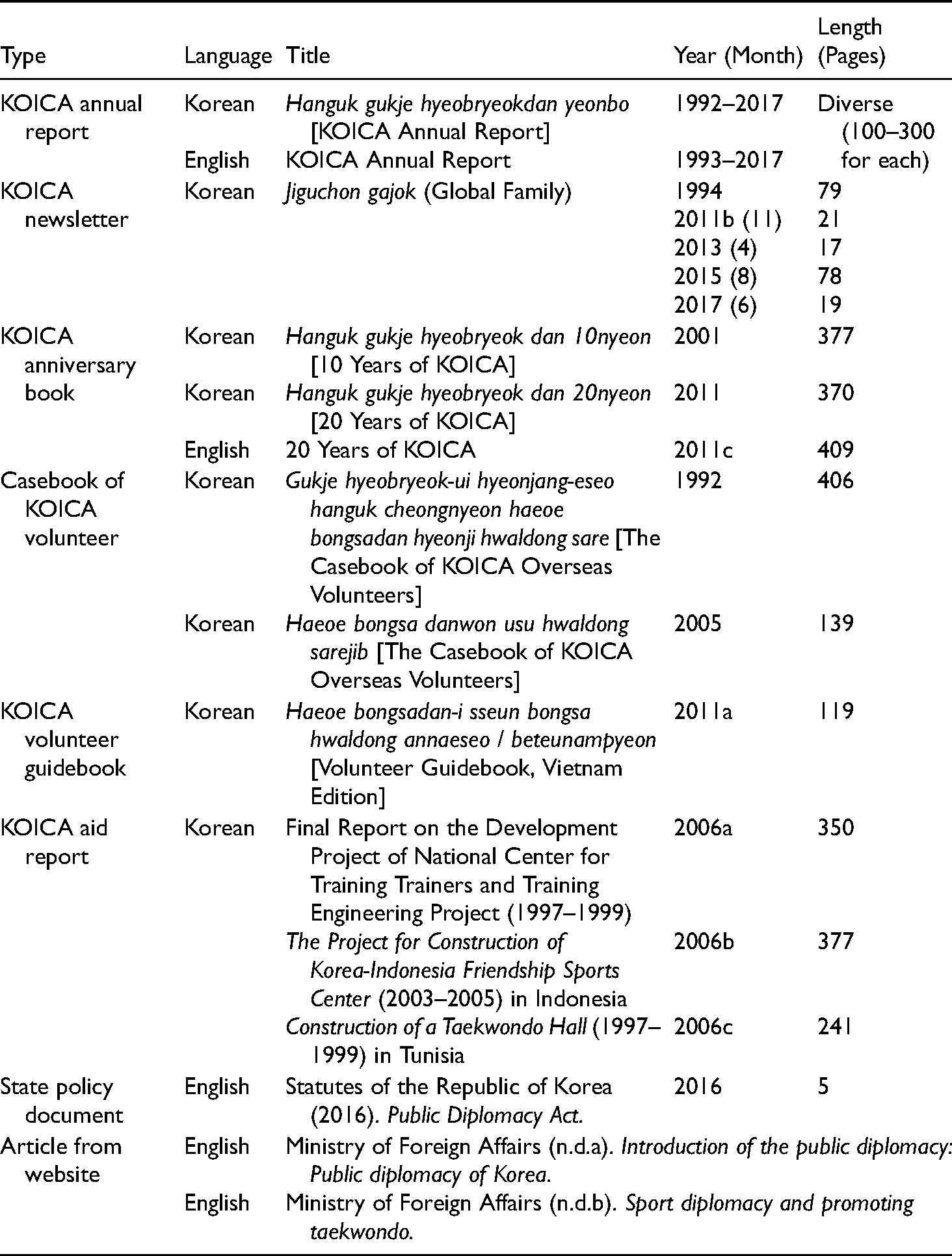
The documents collected were analyzed in four stages. In the first stage, Korean-language documents were analyzed in Korean by the first author (as a bilingual Korean/English researcher). Documents produced in both Korean and English, such as annual reports, were first analyzed by the first author in Korean and then compared to their English versions. Analysis was directed towards texts on or related to KOICA sport, allowing for insight into the various representations of KOICA sport practice and the identification of both events relevant to KOICA sport and different linkages between KOICA sport and the political schemes (including policy goals) of the Korean government. The second stage of analysis focused on two critical, common themes that appear in KOICA sport documents: “assisting elite sport development” and “contributing to social development.” Select extracts from the documents were translated by the first author based on Shklarov’s (2007: 532) notion of the “dualism” of the bilingual researcher engaging with “his or her own translator,” which can contribute to the quality of analytical results in cross-language research (Korean/English in this case) through infusing the research process with insights, background, and understandings of the cultural contexts. The third stage of analysis identified singularities in how the themes were framed over time. Drawing on Murray’s (2018) categorization of sport diplomacy, distinctive features of KOICA sport themes in its early period (early 1990s to early 2000s) and the later period (the late 2000s to the present) emerge. The first theme and features of the earlier period (centered on elite sport) were framed through traditional sport diplomacy. The second theme, focused on social development and public diplomacy, and predominant features in the later period were linked to KOICA's efforts to operate in step with a new sport diplomacy.
Assisting elite sport development
Developing elite sport in the Global South emerges as a central theme in early KOICA sport documents, frequently highlighted in its promotional stories, reports and program documents. For instance, one annual report describes the impact of its Dispatch of Taekwondo Instructors program, which sent qualified Korean instructors to coach Taekwondo in recipient countries, as follows: “The program has been very successful in helping the recipient countries organize national teams and win prizes at international Taekwondo competitions” (KOICA, 1996: 71). The primary objective of this program sending Taekwondo instructors abroad was to promote the development of organized Taekwondo and ultimately help local elite athletes triumph internationally. The point was, of course, not only to support excellence in international competition, but also to share or spread Korea's distinctive national sport through SFD initiatives. We will return to the use of Taekwondo as a cultural product in the discussion of public diplomacy. Here we wish to focus on how Taekwondo instructors were sent abroad not only to spread the sport internationally but to specifically develop elite sport. Most success stories from the KOICA sport's early stages, beyond accounts of the Dispatch of Taekwondo Instructors program, detailed how Korean volunteers were posted to local and national sport federations in recipient countries to serve as elite coaches, where they successfully contributed to the achievement of athletic excellence.
International prestige achieved through Korean elite sport knowledge and expertize
KOICA's promotional material highlighted its programs’ contribution to sporting excellence, showcasing volunteers who led their teams to international success. For instance, the 2005 casebook featured a Korean volunteer who helped his athletes achieve consecutive wins at international sporting events during his two-year service as coach of Kazakhstan's national Taekwondo team, stating, “He has constantly looked for opportunities to promote Korea in the remote country of Kazakhstan, and really put his heart into Taekwondo development there” (KOICA, 2005: 103). The casebook focused on this example to show how the guidance of elite KOICA volunteer instructors (Taekwondo) was instrumental to elite sport development by helping developing countries win medals at global sporting events. These wins, in turn, are then explicitly described as enhancing their sporting status, “now Taekwondo has become the most important sport in this country, and further, is regarded as the sport with the most potential to boost international prestige” (KOICA, 1994: 15). More importantly, these achievements are framed as the result of KOICA sport's knowledge and expertize. Consequently, KOICA sport's contributions to elite sport development in recipient countries ultimately serve the diplomatic goal of promoting Korea's global standing. Hence, international prestige links Korean sport knowledge, international development and the state's diplomatic objectives.
Notably, Korean elite sport knowledge delivered through KOICA as a form of international development transforms the recipient athlete into the ideal Korean athlete with an emphasis on ganghan jeongsinryeok [strong willpower] and respect for coaches, two strategies common to Korean elite sport culture. For instance, the coach's role in building character and willpower among athletes emerges in the description of a Taekwondo volunteer who served as a national coach for an overseas team, “athletes got tired or injured easily because of nutritional deficiencies, and training was difficult because of the hot and humid equatorial climate. However, he worked hard to train the athletes by instilling in them a ganghan jeongsinryeok” (KOICA, 2005: 100). Ganghan jeongsinryeok refers to strengthening the athlete's drive and has circulated for decades within Korean sport culture and elite sport training specifically (Kwak et al., 2018). Ganghan jeongsinryeok is frequently evoked by volunteers in KOICA documents. It is so deeply ingrained in Korean sport culture that volunteer coaches expound this belief along with the nutrition plans, sport equipment and training facilities promised by KOICA projects. Athletes are encouraged to directly confront and overcome any difficulties they encounter. Similarly, emphasis on a “can-do spirit” has framed Korea's international sport feats, instilling national pride and confidence amongst the Korean public (Koh, 2005). This can-do subjectivity, introduced by Park Chung-hee's regime during the 1970s to mobilize the population's participation in national development initiatives, was advanced as the only viable method to attain national prosperity and modernization (Doucette and Müller, 2016). Subsequent success achieved through these projects reinforced Koreans’ belief in the value of the can-do spirit (Jeong, 2017). Likewise, Korea's storied sporting victories at high-profile competitions, including consecutive Olympic Games, sustain a conviction among KOICA instructors about the importance of mental strength to reach sporting excellence.
Local athletes are also expected to be polite and respectful towards their coaches. This emphasis on respect in the operation of KOICA sport in recipient countries is not intended to teach manners but to reinforce authority. It demands obedience from athletes. For instance, one volunteer noted: Here, I focus on teaching manners to trainees and make them go through intensive training. In return, they show so much respect to me that they don't dare to even breathe in my presence. I also teach them proper greeting methods, and all [of the trainees] have reacted positively. (KOICA, 1992: 136)
The instructor's firm conviction of the importance of instilling respect for coaches in athletes is obvious and supersedes the need for intensive athletic training. This was evident in the way he taught respect to his athletes so well they dared not even breathe in his presence. His perception of respect exceeded good manners or politeness to constitute a form of submission. The subservience expected of these coach-athlete dynamics reproduces the culture of absolute obedience to authority commonly found in Korean sport culture, intrinsically implying hierarchical power relations and reflecting the entrenched moral values of Korean society (Park et al., 2012). Korean media have often reported that athletes must defer to authority (i.e. coaches and their orders) in the Korean sport system (Park et al., 2012). This requirement mirrors the moral values of respect and veneration in Korean society (Kwak et al., 2018).
Some statements in KOICA sport documents suggest that harsh training methods, hierarchical power relations, absolute obedience to coaches and even acceptance of physical violence is common, as in the following statement by a former KOICA coach concerning the Cambodian national swim team: “when I was training as an athlete, I received punishment 100 times a day …” (KOICA, 2005: 21). Critically, in Korean sport culture, any violence from coaches is often justified or forgiven when they lead their athletes to win medals at international sport competitions (Kwak et al., 2018). The mentality of winning at all costs has been a key factor that transformed Korea into a sport powerhouse (Park et al., 2012). This outcome-oriented approach results from the government's efforts to promote Korea's international reputation (Lee, 2016). Within this perspective, the harsh training and any possible physical punishment that the KOICA swim coach had endured might be considered justified: after all, it had shaped her into a coach able to lead the Cambodian national team to their first medal at the Asian Games and to qualify for the Olympics for the first time (KOICA, 2005).
In short, for the sake of increasing international prestige, elite athletes in recipient countries were required to enact the subjectivity typified in Korean sport culture and adopt the Korea-specific mindset of strong willpower and respect for coaches (e.g. obedience to authority). Compliance led the Cambodian national swimming team to international success and opened access to the global sporting stage. Importantly, all these achievements are credited to KOICA sport and Korean sport expertize, which in turn simultaneously bolsters the prestige of Korea and the recipient country. To take it a step further, the hierarchical relationship between KOICA coaches and local athletes in recipient countries can be replicated at the international level, framing a hierarchy of donor (Korea)/recipient relations in global politics. In the same way that sport was deployed during the Cold War era to demonstrate superiority (Johns, 2014), traditional sport diplomacy mechanisms were deployed through KOICA to establish Korea's sport expertize as valuable and better than that of recipient countries; it aimed to convert them to Korea's elite sport culture.
Conditional aid to achieve international prestige goals
One sport aid project in particular, The Construction of a Taekwondo Hall, illustrates the operations of KOICA sport in assisting elite sport development as a means to increase its international prestige through conditional aid. This SFD project brought together seemingly unrelated political goals such as the elite development of Taekwondo abroad and securing support for Korea's bid to host the FIFA World Cup. Implemented in Tunisia from 1997 to 1999, this initiative is widely recognized among the emblematic projects of KOICA's first decade (KOICA, 2001). Once the modern, fully-equipped Taekwondo facility was built, highly qualified coaches and volunteers were dispatched to train the national team. These features of the deployment of this sport aid are reminiscent of Murray’s (2018) description of the use of elite sport in traditional sport diplomacy to convey specific diplomatic messages and project a rebranded national image to the world of both the recipient country and Korea.
Yet, the Construction of Taekwondo Hall project also illustrates a second type of Korean traditional sport diplomacy scheme: conditional aid projects aimed at improving Korea's global standing. After quickly overcoming the 1997 Asian financial crisis, hosting the 2002 FIFA World Cup was considered a timely opportunity to enhance Korea's national image abroad as part of the state's explicit top-down and unilateral cultural diplomacy practice (Kang, 2015). This diplomatic purpose was unambiguous in the nation's spending campaign to convince key FIFA decision-makers, including the president of the Tunisian Football Federation, to support its bid to host the 2002 FIFA World Cup. The Construction of a Taekwondo Hall project was an important KOICA sport aid project implemented in Tunisia from 1997 to 1999 along with the National Centre for Training for Trainers and Training Engineering project. These two projects were seemingly offered with strings attached, specifically, on the condition that Tunisia would support Korea's bid to host the football mega-event. In fact, the overview section of the report on the vocational center project states that it was motivated by “a promise to support activities tied to our country's bid for the World Cup” (KOICA, 2006b, p. 7). It also notes that during the project's initiation period in May 1996, “the Korean special envoy was sent to Tunisia to win support for Korea's World Cup bid” (KOICA, 2006b, p. 7) shortly before FIFA's decision on May 31. Korean delegates met with the Tunisian Minister of Youth and Childhood who proclaimed, “Tunisia wishes that the World Cup is a success and supports Korea” (KOICA, 2006c: 81). The MOFA approved the project of building an elite training facility in January 1997 before Tunisia filed its project submission in April (KOICA, 2006c). The timeline suggests that the project was preapproved in consideration for Tunisia's vote in the FIFA host selection.
The diplomatic significance of Korea's conditional aid projects in Tunisia hinges on the fact that Korea and Japan were the two frontrunners in the bidding race. This meant that the 2002 FIFA World Cup would be the first held in Asia. Cha (2009) argues that although Korea initially had little interest in hosting the event, its complicated sporting and historical rivalry with Japan meant that allowing its former colonizer to succeed was unthinkable. Although Korea was a latecomer to the bidding race, it saw the World Cup as “a clear opportunity to redress its humiliating past at the hands of Japan and Japanese” (Close and Askew, 2004: 250). The significant worldwide attention focused on the mega-event incited ruthless competition between the two nations as they embarked on a spending campaign to win support for the right to host the event that lasted right up until the final election on May 31, 1996, as illustrated above by the KOICA delegates sent to Tunisia to discuss potential aid projects earlier that month.
An incomplete shift towards new sport diplomacy
While Korea pursued “global leadership diplomacy” from the 1990s and on, it did not emerge as a middle power until the mid-2000s (Mo, 2016: 530). It has since contributed to the liberal international order (Williams, 2012) by taking on a significant role in a variety of global normative, cooperative affairs, particularly in development assistance. Indeed, it purposefully assessed its middle power role through efforts to shape the international development agenda.
Building on its successful transformation from former aid recipient to its new status as leading donor, Korea aims to serve as a bridge between developed and developing countries. Since Korea now espouses global donor values and norms, KOICA no longer exclusively connects its operations to sport-specific or sport excellence goals. Instead, it professes to address non-sport, global social issues related to twenty-first century development as per the United Nations Millennium Development Goals (MDGs) and post-MDGs (Sustainable Development Goals), such as human rights, poverty reduction and world peace. In fact, KOICA sport fully engages with Korea's foreign policy objectives as “a respected global citizen” to obsessively catch up with global norms and issues (Kim, 2016: 79). However, the shifting stated aims of development in KOICA sport documents offer a limited vista. Taking examples from a sport aid project implemented in Indonesia from 2003 to 2005 and the 2013 Special Olympics, we show that the initial development goal of KOICA sport—elite sport development—still regulates its operations, which highlights a disconnect between the themes put forth and the actual strategic purpose of the SFD initiatives.
Global normative values in official pronouncements
The Construction of Korea–Indonesia Friendship Sports Center project represents one of the more notable recent KOICA sport aid initiatives aimed at enhancing “social development through the improvement of culture and sport facilities” (KOICA, 2006a: 5), an obvious contrast with the Taekwondo hall project implemented in Tunisia (1997–1999), which targeted elite athletic performance. At least on the surface of things, the Indonesian sport aid project prioritized social development goals, on the premise that promoting and facilitating greater public participation in sport activities through this new facility would enhance social development in Indonesia. This change in the explicit aims of the Indonesian sport aid project originates from KOICA's desire to abide by the new global development agenda (KOICA, 2011c). Today's ostensible KOICA sport aid goals are therefore substantially different than they were in the organization's earlier period. However, contradictions persist. Despite the shift and stated motives related to social development, three of five key objectives listed in the Indonesian sport aid project report were to “improve the techniques and skills of Taekwondo and other sport [sic],” “develop the best Taekwondo athletes and [sic] their techniques level,” and “to strengthen national performance of Taekwondo and some other sport” (KOICA, 2006a: 14).
Likewise, KOICA's support for the Special Olympics is equally inconsistent. KOICA sport interests in disability sport and people with disabilities emerged in the early 2010s. On October 4, 2013, KOICA signed a Memorandum of Understanding with Special Olympics Korea, a regional branch of Special Olympics International (Chun, 2013). In this agreement, KOICA committed to supporting Special Olympics regional branches in the Global South by dispatching volunteers and experts in the sport and music fields (Chun, 2013). Since then, KOICA has continued to provide support to disabled athletes and disability sport development by signing partnership agreements with the International Paralympic Committee in 2014, the Special Olympics International in 2015, and the Korea Paralympic Committee in 2018. It also supported athletes from Mongolia, Myanmar, Uzbekistan, El Salvador and Uganda at the 2015 Special Olympics (KOICA, 2015). KOICA's support of the Special Olympics in recipient countries is another illustration of its attempt to emulate the global normative values surrounding human rights and disability rights (e.g. right to play) central to the current UN development framework. Nonetheless, KOICA has not discarded its sport-specific or sport excellence aims. Its support for the Special Olympics and decision to dispatch a greater number of sport volunteers since the early 2010s to work on disability sport mainly targets institutions involved in developing elite disability sport. In practical terms, KOICA predominantly contributes toward achieving athletic excellence at international disability sport competitions.
Evidently, the shift from elite sport development to sport for social development in later KOICA sport documents is incomplete: statements focused on elite sport development still circulate and for all practical purposes, programs still target the development of sport excellence. Ironically, this incomplete transformation reveals the complicated dynamics of KOICA sport diplomacy. With the rise of the liberal international order in the 1990s, a focus on human rights gained in popularity and helped frame the critical global issues of the new twenty-first century development agenda (Williams, 2012). KOICA sport's interest in social development and disability rights follows this trend. Indeed, starting in the early 2000s, Korea aimed to join the list of the world's leading donor group, the Development Assistance Committee (DAC) of the Organization for Economic Co-operation and Development (OECD) (Watson, 2014). To achieve this goal, the Korean government adopted international development norms and humanitarian approaches (Howe, 2017). Kim (2016) uncovered a new, dominant strategic stance in Korean foreign aid policy generated in the “ethical leadership discourse” (p. 72) that frames the promotion of Korea's international image as a responsible global leader, abiding by the development norms and principles of the global community. KOICA sport also reproduces the ethical leadership discourse to fulfill its diplomatic role in “promoting Korea's international reputation,” evident in the speech the President of Special Olympics Korea during signing of the memorandum with KOICA in 2013 (Chun, 2013). Sport-related goals (e.g. athletic excellence and winning-oriented training) have been sidelined or replaced in KOICA sport official pronouncements by internationally-favoured social development aims unrelated to sport.
Taekwondo demonstrations dovetailing with Korean public diplomacy
The most notable feature of KOICA sport documents since 2008 is their heavy focus on Taekwondo demonstrations performed abroad by sport volunteers. This is not to say that volunteers no longer serve as coaches in recipient countries, or that performance excellence at international sporting competitions is no longer important. Rather, it underlines how KOICA sport pays special attention to describing the effects of Taekwondo demonstrations overseas in its official and promotional material. This shift seems to result from a new foreign policy direction, the so-called “Korean public diplomacy” concept identified by the Ministry of Foreign Affairs (n.d.a), as “one of the three axes governing our diplomatic relations.” Indeed, after Korea recognized the importance of twenty-first century public diplomacy in 2008 (Kim, 2012), the term “public diplomacy” was mentioned more frequently in KOICA documents, especially in KOICA presidential statements. Accounts of sport initiatives also underlined KOICA's role in public diplomacy efforts, such as the following statement recounting a Taekwondo demonstration in Tunisia: Following, there was a Taekwondo demonstration. The demonstration of pine boards being smashed to pieces appears simple but is actually enormously destructive … As the audience collectively ducked to avoid the pieces of board flying towards them, they also began falling for Taekwondo's charm. (KOICA, 2011b)
This account hints at the creation of new ties between the recipient country spectators and Korean culture through an impressive sport performance. The phrase “falling for the charm of Taekwondo” suggests that the event functioned to connect the Tunisian general public to Korea through Taekwondo, its distinctive national sport. Multiple actors are considered to play a significant role in today's public diplomacy by promoting Korean cultural products, enhancing positive images and contributing to the eventual enhancement of relations with other countries (Gregory, 2011). Melissen (2005) refers to public diplomacy in the twenty-first century as new public diplomacy, and further underlines the involvement of different types of unofficial groups and individuals in diplomatic practice that cultivates an intimate dialogue with foreign audiences. This approach is closely linked to KOICA sport's emphasis on Taekwondo demonstrations performed by its volunteer coaches who introduce the local public to Korean-specific behaviors and cultural attitudes, thereby enhancing the relationship between Korea and recipient countries.
A sport volunteer's recollection of his participation in a Taekwondo demonstration is noteworthy: With each round of demonstrations, the more clapping and cheering there was. Our movements kept the citizens of the host country in suspense and moved them emotionally. It made me extremely happy; I felt like on the left side of my chest there was a Taegeukgi (Korean flag) that grew hot in exuberance. (KOICA, 2011a: 79)
This quote presents two critical points. First, the Taekwondo demonstrations strengthened local ties with Korea and Korean culture, which were enthusiastically received. Second, this positive reaction aroused national pride among volunteers, honored to impart their culture to the local population, with an emotional charge strong enough to compel this coach to evoke the “Taegeukgi” (Korean national flag). Korean volunteers involved in these large-scale, promotional Taekwondo displays were moved by the eager response of local people.
Significantly, volunteers involved in KOICA sport programs, including Taekwondo demonstrations, are generally referred to as “citizen diplomats,” a point illustrated in this statement by former KOICA President Park Dae-won: KOICA volunteers play a role as citizen diplomats and have not only provided dedicated volunteer service, but also lived alongside the local people to exchange culture and promote friendship … They are leading contributors to the upgrading of South Korea's national brand. (KOICA, 2013: 27)
The Public Diplomacy Act defines public diplomacy in Korea as “diplomacy activities through which the State enhances foreign nationals’ understanding of and confidence in the Republic of Korea” (Statutes of the Republic of Korea, 2016: 1). Volunteers performing Taekwondo demonstrations serve as public diplomacy actors targeting the local population to shape public opinion, enhance “the Republic of Korea's image and prestige in the international community” (Statutes of the Republic of Korea, 2016: 1) and indirectly exert influence on the recipient country's foreign policy-making process (Hocking, 2005). This approach supports the focus of Korean public diplomacy “at home and abroad” (Statutes of the Republic of Korea, 2016: 5). Taekwondo demonstrations are therefore executed efficiently alongside the Korean public diplomacy strategy encouraging the public in Korea and in recipient countries to share its vision: “fascinating the world with Korea's charm” (Ministry of Foreign Affairs, n.d.b).
KOICA sport certainly serves a public diplomacy role by influencing the public in Korea and in the Global South. To begin with, Taekwondo demonstrations in recipient countries have featured different Korean cultural practices. KOICA accounts of these events frequently described the diversified cultural program, including “samulnori (Korean traditional percussion quartet) performances, buchaechum (fan dance), and hanbok (traditional dress) parade” (KOICA, 2011b). Chronicles have also highlighted the traditional Korean attire or modernized versions of the hanbok worn by the performers, indicating that the Taekwondo demonstrations were treated as a tool for “the promotion of our culture” (Ministry of Foreign Affairs, n.d.b). Public diplomacy was introduced into the Korean foreign policy agenda through the Global Korea of the Lee Myung-bak government (2008–2012) (Watson, 2014). Lee's initiative involved promoting traditional Korean culture (Ma et al., 2012) operationalized through the establishment of the Korean Culture and Information Services agency in 2008. Since 2014, the use of Taekwondo as a tool to “share Korean culture” with the world (Ministry of Foreign Affairs, n.d.b) has increased under the Sport Public Diplomacy Project. While the earlier purpose of KOICA sport—to develop elite athletes and teams for international success—was also a form of cultural promotion, the latter strategy more widely and explicitly targets a foreign public through large-scale Taekwondo demonstrations.
Next, like the Chinese dual public diplomacy strategy evoked earlier with regards to the 2008 Beijing Olympics (Grix et al., 2019), KOICA sport narratives are also directed at a domestic public. This strategy promotes the “savior” rhetoric surrounding KOICA sport volunteers, frequently highlighting stories about sport volunteers assigned to refugee camps. One example is the dispatch of KOICA sport volunteers since 2013 to the refugee camp in Za’atari, Jordan, created in 2012 to house thousands of Syrians (KOICA, 2013). A Taekwondo camp volunteer experience was highlighted in the KOICA newsletter: Particularly, refugee youth, referred to as the “Lost Generation,” have been in situations where they might have lost not only their country but also their dreams. However, there is one individual who has attempted to keep their dreams alive, through Taekwondo education. (KOICA, 2017)
In such narratives, camp youths are described as desperate, but fortunately, KOICA Taekwondo volunteers, referred to as “saviors,” provide them with hope and encouragement. This rhetoric is also reproduced by the volunteer: It can be seen as a way of expressing negative energy resulting from war trauma and undereducation. This can be positively solved through Taekwondo kyorugi (sparring), and further, by instilling the right competitive spirit in the youth. (KOICA, 2017)
Defining the refugees as traumatized youth with poor anger management skills, he describes Taekwondo as an effective method for healing emotional and psychological wounds and providing a behavioral guideline to lead them down the right path. He added, “I have faced lots of difficulties during the process of creating order from disorder” (KOICA, 2017), highlighting his efforts to overturn anarchical camp conditions. Furthermore, camp youth achievements are framed as enabled by the KOICA sport volunteer in later KOICA sport documents through repeated references to “hope,” “hero,” and “light.” This savior rhetoric is ubiquitous in KOICA social media posts and mainstream Korean media.
Concluding remarks
This study offers an in-depth empirical analysis of how the Korean state has engaged in international diplomacy by employing SFD as a political tool. We have shown how the state's aim to enhance Korean global prestige has remained consistent in KOICA sport overseas programs even if the thematic choices emphasized in official documents have transitioned from imparting Korean knowledge and expertize in recipient countries through elite sport development, to new themes integrating social development values and focused on creating bonds with foreign publics while impressing the domestic population with Korea's impact abroad. Our analysis has shown that while the underlying state strategy may have remained consistent, it brought together unrelated elements (Taekwondo elite development abroad and political support for a bid to host a mega-event) in the earlier political and historical context, whereas it linked contradictory elements (global social development values with sport development practices) in the later period when Korea played global leadership role in cooperation and development. Our broader findings that the thematic shift is incomplete demonstrate that changes in KOICA sport themes are neither clear-cut nor an outright rejection of traditional diplomatic approaches. Besides, Murray (2018) reminds us that no clear boundary classifies a particular actor as an adherent of the traditional or new sport diplomacy. The mixing of covert political aspirations and overt humanitarian missions through KOICA sport programs point to Korea's challenge in fulfilling its role as a middle power and mediator in global development. Mo (2016) explains that strong nationalism and a persisting nationalistic foreign policy forge a limited perspective on what constitutes the national interest and when compounded with domestic politics as shown in our analysis, these factors constrain Korea's ability to coherently deploy a value-based foreign policy through SFD. In this, Korea is no different than other countries who are also guided by their national interests when funding public sports diplomacy (Murray, 2018).
Our comprehensive empirical account of KOICA sport practices and their distinct manifestations as state-led foreign policy instruments also contributes to the SFD studies and to the sport diplomacy literature by exposing the contradictions revealed when examining historical changes over three decades of diplomatic functions. That KOICA sport integrated new global SFD approaches by purportedly shifting its aid priority from elite sport to global normative social goals in accordance with the UN development agenda is not unique to Korea. However, our analysis denotes this Asian nation's ongoing efforts to enhance its international prestige and shows that now that Korea has joined the ranks of industrialized nations, it partakes in the dominant discourses framing the use of sport in ODA while also transforming them. This is reminiscent of Black and Peacock’s (2011) description of international sport initiatives led by Asian developmental states that are entrenched in politics of nationalism consisting of catching up (i.e. following Western development and mainstream SFD), but also of getting even (i.e. outperforming Western SFD models, manifested in KOICA sport being promoted as the epitome of Korean-style SFD). Nevertheless, the early aim of KOICA sport—elite sport development—has been implicitly maintained because of its connection to specific Korean sport expertize and culture as well as the continued imperative to use SFD for specific foreign policy objectives. This indicates that state-led Korean sport diplomacy today takes on a more sophisticated and complicated form. Combining the “unacceptable” goal of elite sport development typical to traditional sport diplomacy with the universally-recognized goal of social development observed in new sport diplomacy, KOICA sport programs demonstrate the shifting and complex dynamics of Korean sport diplomacy. This integration of elite sport and social development to achieve foreign policy objectives emerges in distinct ways in KOICA sport's practice of new sport diplomacy but it also evokes Cuba's mixing of contradictory approaches—sport development and SFD—in the deployment of SFD for sport diplomacy (Huish et al., 2013). This antithetical combination may also be a typical feature of state-led SFD and is certainly worth exploring further.
Footnotes
Declaration of conflicting interests
The author(s) declared no potential conflicts of interest with respect to the research, authorship, and/or publication of this article.
Funding
The author(s) received no financial support for the research, authorship and/or publication of this article.
