




Abstract
Parkrun is a mass sporting community event which presents itself as a global social movement that aims to create a healthier and happier population. Existing research has explored the impact of parkrun on physical and mental wellbeing, and the mechanisms through which it may change physical activity behaviours. This paper draws upon a UK-wide survey of 8157 parkrunners to explore the subjective athletic identities of those who initially self-identified as non-runners. We examine how identity change is associated with perceptions and experiences of parkrun and demonstrate that parkrun has facilitated subjectivity change that leads many former non-running parkrunners to engage in running outside of the event. Using a Bourdieusian framework we argue that those who frequently engage in parkrun perceive a variety of health and performance changes that become legitimising factors for new health/sport behaviours. Our data add to existing research by demonstrating that parkrun provides a platform for individuals to become ‘runners’, whilst also offering a sociological explanation of how behaviour change may occur.
Introduction
Globally, just over one-quarter of adults fail to achieve the level of activity recommended in physical activity guidelines (Guthold et al., 2018). In general, older adults tend to be less active than younger adults, women tend to be more inactive than men, and those living in higher-income nations report higher levels of functional inactivity than those living in lower-income nations (Hallal et al., 2012). Increasing physical activity has been presented as a practical response to improve health outcomes and reduce health inequalities (Haskell et al., 2009). However, public health interventions, imbued with the neoliberal ideology that underpins the means to these ends (Palmer et al., 2019), often fail to realise these goals, falling short of long-term behaviour change (Pettigrew et al., 2019).
A desire to situate health interventions in ‘contextually appropriate’ settings is only beginning to emerge (Reis et al., 2016: 1342). Indeed, as Palmer et al. (2019) have argued, the structural, cultural and biographical processes which promote long-term physical activity participation are still poorly understood. Parkrun is a terrain in which these processes might be captured in vivo, that is, in a contextually appropriate setting. Parkrun’s (2019) mission is to help ‘people live healthier happier lives’, a goal shared by public health and health promotion academics and professionals. To achieve this, parkrun seeks to provide a supportive environment in which participants are encouraged to exercise on a weekly basis. More generally, a growing body of evidence suggests that changes to social identity are important in facilitating long-term physical activity behaviour change (Stevens et al., 2017). In this paper, we focus on the transformation of sporting identity among parkrunners who recall a non-running identity at the start of their parkrunning, and reflect on its salience for promoting change in dispositions and ultimately behaviours, which are consistent with public health orthodoxy.
Every Saturday morning, around 250,000 people run, jog or walk 5 kilometres around a park or other open space in one of 22 different countries (parkrun, 2020). Parkrun is a free event that has a broad target audience, which, according to the organisers, covers ‘those taking their first steps in running, to Olympians’ (Parkrun, 2019). In the UK there are now over 600 weekly events (parkrun, 2020). In contrast to other running events, parkrun does not present itself as a race and is particularly keen to encourage the participation of those who are sedentary and inactive; target groups for many public health initiatives (Kohl et al., 2012). Nevertheless, parkrun continues to rank individual times and finishing positions, while also maintaining course records. As parkrun has developed, average finishing times have slowed, most likely suggestive of a shift toward proportionately higher levels of participation of those from non-traditional sporting or physically inactive backgrounds (Reece et al., 2018).
This paper draws upon a UK-wide survey of 8157 parkrunners to explore the transformative potential of parkrun, focusing here on comparing people who were new to running at registration with parkrun to those who self-identified as being a runner at initial registration, and on exploring whether the parkrun experience differs according to the extent to which non-runners transition to a running identity. These foci are particularly salient as our insights on identity can contribute to understandings of the conditions for behaviour change. We first review the emerging literature on parkrun, identity and behaviour change to situate our work against this body of knowledge, before detailing how we use the ideas of Bourdieu (1977, 1984, 1990; Bourdieu and Wacquant, 1992) to inform our understanding. Having accounted for the research design, we then present our findings in three sections before discussing its wider significance.
Parkrun and health
Parkrun has been appraised for its effectiveness as a community-based public health intervention (Bauman et al., 2009; Murphy and Bauman, 2007). In June 2018, the Royal College of General Practitioners (2018) launched what it described as ‘a ground-breaking initiative that could lead to thousands of patients being “prescribed” outdoor physical activity rather than medication’. This development followed the published testimonials of several GPs who expressed their support for parkrun (Iaccobucci, 2018; McCartney, 2015; Masters, 2014; Rashid, 2018; Tobin, 2018). One proponent of parkrun was Glasgow-based GP Margaret McCartney (2015: 350), who argued that the ‘Olympics were never going to get the nation doing a decent amount of exercise. But community running – inclusive, interactive, and regular runs for ordinary people – is something that might actually make a difference’. UK media has, by and large, also been supportive of parkrun, with Chakrabortty (2018) applauding its not-for-profit approach and Ingle (2018) claiming that it is ‘the big society in action’.
Professionals who laud parkrun as a tool for public health improvement have drawn on early parkrun research. Stevinson and Hickson (2013: 273) suggested that parkrun ‘may contribute to increasing physical activity and wellbeing among [parkrun] community members’ and that ‘a sizable portion of non-runners are progressing to regular vigorous exercise and increasing their fitness after starting parkrun’. They identified non-runners, older adults, women and overweight people as being well represented in their sample of 7308 respondents; on the other hand, ethnic minorities and those of low socio-economic backgrounds were not. In looking specifically at those who were new to parkrun, Stevinson and Hickson’s later work (2018) found that weight, fitness and wellbeing outcomes had all improved after 6 and 12 months of parkrun participation. In an Australian context, Grunseit et al. (2018) found that participation in parkrun led to subjectively defined improvements in physical and mental wellbeing. Their research, based on a survey of 865 parkrunners, suggested that the underlying mechanisms for these improvements were gendered. For women, parkrun was beneficial due to improvements to mental health, while for men, the increase in physical and psychological wellbeing was due to the community connectedness of parkrun. In a study of 20 parkrunners who had received support for mental health problems, Morris and Scott (2019) conclude that parkrun may be a refuge for those with mental health conditions. Parkrun was perceived to aid mental health by providing a sense of achievement, allowing connection with others and being accessible for everyone.
In contrast to these studies asserting positive impact, a more limited number of studies have found either a non-significant or an adverse impact of parkrun on some health and wellbeing metrics. For example, Linton and Valentin (2018) surveyed 1208 UK-based parkrunners, finding that 570 were currently injured. An alarming 86% of these parkrunners continued to run in pain. Those with less than six months of running experience were 1.98 times more likely to be injured than those with 5–10 years of experience, suggesting that newcomers to parkrun may face an increased risk of injury. Stevens et al. (2019), in their study of 289 parkrunners in the south of England, could not find a link between parkrun participation and increased life satisfaction. They surmise that ‘participation in parkrun alone (at most a once-weekly activity) is not associated with greater life satisfaction’ (2019: 226). In comparing average values for parkrun participants to those of the wider Australian population, Grunseit et al. (2018: 5) actually found that parkrunners had lower levels of ‘satisfaction with current achievement, personal relationships, future security and life as a whole’.
Therefore, contemporary research has produced mixed findings on the impact of parkrun on a variety of health and wellbeing measures, perhaps drawing attention to the pitfalls of pinning one’s public health hopes on a ‘miracle cure’ (see Academy of Medical Royal Colleges, 2015). Nevertheless, although not a panacea, there remains strong support and some evidence to suggest that parkrun has public health benefits. In this context, we are encouraged to ask questions about the mechanisms which lead to the take-up and continued participation in parkrunning, in ways which might be health motivated. Our particular area of interest relates to the role of identity shift in sustaining physical activity.
Identity, running and parkrun
Many accounts of parkrun have, consciously or unconsciously, replicated existing typologies of runners’ identities, such as that of Shipway (2008), which divides runners into experienced ‘insiders’; ‘regular’ runners; ‘occasional’ runners; and sporting ‘outsiders’, and Smith (1998), which identifies athletes, runners, and joggers/fun runners. More recently, Evans (2020) created a psychological typology of runners who use Strava. His work divides runners into five types: passionate, invested, fitness, mindful and reluctant. Many of these typologies are atemporal and do not offer an understanding of how people’s engagement with running – their running identity – changes over time.
Other authors draw upon the serious leisure perspective (Stebbins, 2014) to explain how individuals come to acquire their running identity (Pedersen et al., 2018; Shipway and Jones, 2007, 2008). Central to this perspective is the contention that serious engagement with a practice leads to identification with it. Shipway et al. (2013) make a similar point drawing on Unruh’s (1980) concept of social worlds to argue that participants find themselves within a running social world that allows for both individual engagement and communal gatherings, which together develop and confirm a running identity.
The majority of parkrun research on identity has concerned classification. The initial work of Stevinson and Hickson (2013) found that, among their sample, almost one-half described themselves as regular runners when first registering for parkrun (47.8%, n=3433). Occasional runners (26.5%, n=1901) and non-runners (25.8%, n=1850) were almost equally represented among the others. Cleland et al. (2019) also used a survey tool (n=372) to capture pre-registration identity. Their work found that regular runners made up almost one-half of participants (47.2%, n=175), although here there were more occasional runners (38.2%, n=142) than walkers/non-runners (14.6%, n=54). Similarly, sporting identity before parkrun participation is addressed in the qualitative work of Sharman et al. (2019), who also had non-runners as a minority within their sample. In a case study (n=235) of one Nottingham parkrun, Hindley (2018) found that 59.1% of his participants identified as regular runners, with occasional/nonrunners (14%) and recreational/club/competitive runners (26.9%) making up the rest of the sample. Hindley (2018) also found that 12.3% of parkrunners were attached to running clubs, although only 5.1% of his sample identified as being competitive runners. Hindley’s (2018) work expands upon previous understanding of the athletic self-identity of parkrunners, but his work relies on a sample drawn from a single parkrun. From these works, it would appear that the majority of parkrunners already identify as runners before beginning participation. However, none of this work has captured identity beyond the initial point of parkrun registration to explore dynamic changes to subjective athletic identity over time.
In moving beyond classification, Stevens et al. (2019) draw on a sample of 289 parkrunners and use a social identity approach to hypothesise that the stronger the identification with parkrun, the more motivated the individual will be to engage in behaviours normative of the group; in this case, running. Their work looks specifically at the strength of identification with parkrun. The authors’ hypothesised that group identification would impact positively on levels of parkrun participation, satisfaction with parkrun experience, group cohesion and life satisfaction. The authors used confirmatory factor analysis and structural equation modelling to analyse the data, concluding support for the first three hypotheses, but not for life satisfaction. In explaining the non-significant relationship between parkrun identification and life satisfaction, the authors draw upon Sato et al. (2015), who suggest that for running to increase life satisfaction an increase in running volume is required. Aside from Stevens et al. (2019), the research that has considered running subjectivities has not focused on theorising how involvement in a once-weekly event could lead to improvements in physical and mental wellbeing.
How might parkrun change behaviour?
Recent scholarship has sought to understand how parkrun changes physical activity behaviours. Stevinson et al. (2015) conducted semi-structured interviews with 48 parkrunners who had been inactive before parkrun. Their earlier work (Stevinson and Hickson, 2013: 171) found that these parkrunners were ‘most likely to demonstrate fitness improvements and report benefits in health, weight control, mental well-being and confidence for running’. A framework approach in their 2015 study identified freedom and reciprocity as two reasons why these newcomers to parkrun continued their participation. The authors conceptualised parkrun’s accessibility and inclusivity were driving factors that kept people involved as freedom. The authors also divided reciprocity into two themes: giving and gaining. The anticipated health and wellbeing benefits were personal gains whilst volunteering, fundraising and encouraging other participants were also appreciated as ‘givings’.
The importance of the interpersonal is also present in the work of Wiltshire and Stevinson (2018), who explain participation inequalities in parkrun using theories of social capital. Identifying both those groups who are over-represented and under-represented, they suggest that the ability for individuals to ‘tap’ into their social networks accounted for differences in participation patterns. In a finding replicated by Quirk and Haake (2018), Wiltshire and Stevinson (2018) found that most participants had entered parkrun after being encouraged by friends, family and significant others. Cleland et al. (2019), drawing from a survey of 372 adult parkrunners in Australia, also found that those who had the most positive perceptions of the impact of parkrun also had higher levels of social support towards their parkrunning from within the family.
Wiltshire and Stevinson (2018: 58) also suggest that ‘participants invest in and benefit from the aggregate labour of the wider parkrun community’, while also benefitting from ‘the flow of cultural capital within the network of relations from which they have access to advice and guidance related to running performance, injury management and health’. Social capital, therefore, facilitates both the beginnings of a parkrun career and the maintenance of the practice through networked obligations and newly gained expertise. The authors conclude that public health interventions would be more effective if they aided the expansion of social capital, rather than focusing on changing individual behaviour. They also warn that those in society with low levels of social capital will remain adrift from the potential benefits that parkrun provides.
In considering parkrun as a health practice, Wiltshire et al. (2018) suggest that parkrun allows for ‘collective bodywork’ by providing a space for individual body projects in a communal and inclusive setting. Drawing upon 19 interviews with previously inactive UK-based parkrunners, the authors suggest that ‘narratives of self-improvement’ (2018: 9) exist alongside the idea that ‘we’re all in this together’ (2018: 10). The authors contend that parkrun offers a domain in which a plurality of ‘subject positions’ (2018: 11) – walkers, joggers, runners and the elite -– can co-exist. An interesting finding of this qualitative study was that many parkrunners, who initially did not identify with being a ‘runner’, had quickly moved through subject positions and had signed up for distance races longer than 5 km. As such, these individuals had used parkrun as a platform to engage in running beyond parkrun. This paper offers the opportunity to present an extensive and larger-scale analysis of what Wiltshire et al. (2018) describe as changing ‘subject positions’ in parkrun.
What is clear from explanatory accounts of how parkrun might work is that changes to identity are important. Psychological approaches suggest that identifying with particular groups and practices leads to the reproduction of behaviours normative of such groups (Tajfel and Turner, 1979; Turner, 1985). These models align to public health understandings of behaviour change which argue that ‘identity shifts’ correlate with health behaviour change (Kearney and O’Sullivan, 2003). In terms of creating long-lasting behaviour change, Mols et al. (2015: 81) argue that public health policies that ‘nudge’ individuals towards particular practices are only effective if ‘it involves social identity change and norm internalisation’. As such, for parkrun to be successful it must act as a nudge to create changes to identity that are strong enough to bring about the creation of new dispositions. As two of us have argued elsewhere (Palmer et al., 2019), creating new dispositions towards sport and physical activity takes time and requires a social context that legitimises such dispositions and a level of reflexivity that allows for the negotiation of contingencies (injury, illness etc.). In noting the importance on dispositions, we find it instructive to draw on the social theory of Pierre Bourdieu (1984, 1990).
Bourdieu and identity
Following both Wiltshire et al. (2018) and Stevens et al. (2019), we emphasise the importance of charting the connection between social identity as subject position (Foucault, 1982) on the one hand, and individual health behaviours and public health on the other. Therefore, our conception of subjectivity is one which is tied to practices that signify the ‘doing’ of identity. Our position is, therefore, aligned to the social theory of Pierre Bourdieu (1984, 1990) and his work on the logics of meaningful social action.
At the centre of Bourdieu’s understanding of everyday social practices is the concept of habitus. Indeed, Bourdieu (1984) claims that ‘social identity is defined and asserted through differences’ (1984: 167) and considers differing ‘life-styles’ as ‘the systematic products of habitus’ (1984: 168). Habitus refers to the pre-reflexive dispositions that an individual has internalised via, in Bourdieu’s thesis, class socialisation. As such, behaviours, values and tastes are not the result of individual reflexive thought, but instead are a reproduction of social location. Others have extended Bourdieu’s emphasis on class socialisation, arguing for the inclusion of gender (Miller, 2016) and age (Tulle, 2007) as ongoing structures that are constitutive of dispositions. Whilst some render habitus deterministic (King, 2000), others have suggested that reflexive tendencies can be inherent to an individual’s habitus (Schirato and Webb, 2002), providing within the individual an ability to adapt to the values of a particular field of social action. As such, new dispositions, and therefore subjectivities, can be developed via participation in new fields of action, or social fields.
Social fields denote specific areas of social life that reflect ‘a network, or a configuration, of objective relations between positions’ (Bourdieu and Wacquant, 1992: 94). Within each field, specific actions or volumes of capital (social, cultural, economic, physical) are conferred status. The physical capital of a runner finds value in the sporting field, but is of little use in artistic or cultural fields. As such, fields have logics that govern what is valued and what is not. Bourdieu (1990) refers to these logics as ‘rules of the game’, or doxa. The longevity of an individual’s participation in particular social fields is governed by what Bourdieu (1990) terms illusio, a concept that denotes the ‘investment in the game and the outcome’ (1990: 65). That is, individuals will continue in the practices of particular fields as long as their belief in the game and its outcomes remains worthwhile. In applying a Bourdieusian approach, our understanding of new identities assumes that individuals can enter new fields of action, learn the rules of the game and, over time, internalise new dispositions after their initial usage has been legitimised.
The role of the body in Bourdieu’s theoretical toolkit is captured by his concepts of bodily hexis and schema, which map out the ways in which dispositions are embodied. Bodily hexis describes the ways in which socialisation imprints upon the body its way of moving, gait and usage (Throop and Murphy, 2002). Building on a phenomenological base, Bourdieu (1977: 94) argues that dispositions are internalised and embodied but remain pre-reflexive and ‘beyond the grasp of consciousness’. What bodies do, and are seen to be doing, are legitimised or delegitimised by an individual’s ‘body schema’ (Bourdieu, 1984: 215). The body schema describes the framework of embodied practices that are deemed legitimate and aligned to an individual’s class location. Bourdieu (1984: 215) argues that sporting activity can be legitimised only if it does not ‘contradict that class’s relation to the body at its deepest and most unconscious level’. However, the relationship between class location and the legitimacy of particular physical practices is not atemporal. The value associated with particular embodied practices changes over time and the same activity may have different meanings in other societies. As such, classed understandings of what the body can legitimately do can change over time.
In focusing on identity, as dynamic, social and embodied, our quantitative data provide us with the opportunity to explore how parkrun participation impacts on running subjectivity over time, and how this may consequently impact on embodied experiences and overall wellbeing. However, a critical analysis must also contend with the debate regarding the structural dimension, that is the unequal distribution, of what is deemed appropriate health behaviour. Our paper ultimately contributes to this debate by exploring the affordances of behaviour change within the context of running. We are therefore interested in exploring the running trajectories of those who enter parkrun as non-runners as exemplars of individual and structural change.
To summarise, we wish to develop the existing literature by asking the following questions:
(1) How has subjective running identity changed from initial registration with parkrun?
(2) Is there an association between subjective running identity change and how parkrun impacts upon health and wellbeing?
Methodology
Participants
Our sample consisted of 8157 participants who accessed the survey online, of whom 7271 fully completed it. The survey was close to being geographically representative of the UK population, with most participants coming from England (85.7% vs 84.2% actual). The proportion of the survey population from Scotland (7.1% vs 8.2% actual), Wales (4.3% vs 4.7% actual) and Northern Ireland (1.9% vs 2.8% actual) also closely replicated the demographic across national regions in the UK. Most of our sample lived in houses with another adult and with children (45.8%), reflecting the familial appeal of parkrun identified elsewhere (Stevinson et al., 2015). Although the survey population comprised sufficient numbers to explore differences across a wide range of groups, the survey population was not representative of both the UK adult population and Strava-using parkrunners in terms of gender (men were over-represented) and age (those between 30 to 50 years of age were over-represented). Just under one-half of our participants (44.1%, n=3433) had taken part in 11–49 parkruns, with 1.4% (n=106) having taken part in more than 250 parkruns and 20.1% (n=1569) having taken part in fewer than 10. Participant profile by self-assessed running status at registration is described in Table 1 (final column).
Participant profile, by running status on registration with parkrun.
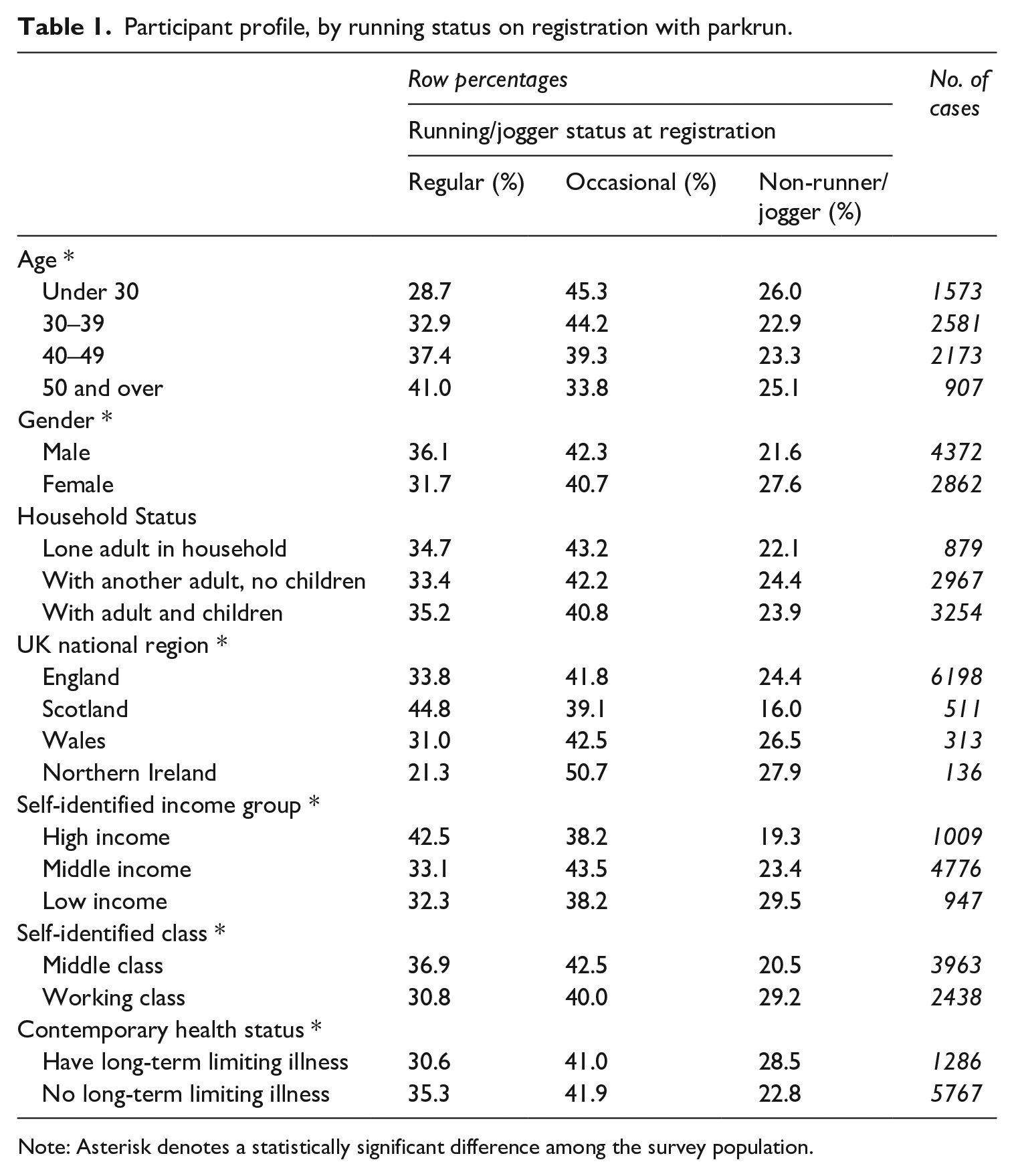
Note: Asterisk denotes a statistically significant difference among the survey population.
Procedures
The authors designed a bespoke survey in 2018, in response to a brief, which was approved by Strava. Strava is an online platform that allows users to track their physical activity using GPS watches and mobile phones. In 2014, Strava and parkrun reached a partnership agreement, allowing parkrunners the ability to connect both online accounts (Klima, 2014). At the time of data collection, 78% of the UK adult population owned a smartphone, meaning that most of the population had the potential to access the free Strava app (Ofcom, 2018).
Wherever possible and appropriate, harmonised survey questions and pre-tested tools on wellbeing were used to facilitate comparison with the general population and findings from existing work. For the same reasons, survey tools used in previous parkrun research were also used. The survey was pre-tested with 30 Strava-using parkrunners, of a wide range of ability and experience, with minor revisions made following feedback. Participants were provided with information on the research and the contact details of the lead researcher (third author). Our information on the survey assured participants that their anonymity would be protected and the survey tool did not collect any IP address data. The decision of the participant to complete the survey conveyed informed consent. No minimum age was attached to the survey, and we had 81 respondents who reported that they were under 16 years of age.
Strava e-mailed Strava-using UK parkrunners on Sunday 18 February 2018 with a web link to the online survey. A further reminder was sent on Saturday 24 February before the survey closed on Monday 12 March. On request, Strava provided details of the gender and age composition of the total population of Strava-using parkrunners in the UK so that proportionate weights for age and gender combined could be applied to ensure that the survey population represented the broader Strava-using parkrun population from which it was drawn.
Measures
The survey explored eight themes. Four of these themes served profiling purposes (patterns of parkrun participation, Strava use, running profile and demographic information). The remaining four topics were substantive, exploring issues related to identity, wellbeing, performance and community. Concerning identity, we asked three specific questions relating to pre-parkrun running status, contemporary general sporting identities and contemporary primary sporting identity. For pre-parkrun running status, we drew from previous research that distinguished between regular runner/jogger, occasional runner/jogger and non-runner/jogger (Stevinson and Hickson, 2013). To capture broader sporting subjectivities, we first asked survey respondents to identify all the subjectivities with which they identified from a list comprising athlete, runner, jogger, parkrunner, triathlete, cyclist or other. We invited those responding ‘other’ to self-describe their status. To establish primary identity, we then asked participants to choose only one category that most closely represented their current sporting subjectivity. Combining data from the two contemporary variables allowed us to specify the proportion of our population for whom runner was their primary sporting identity, subsidiary sporting identity and not a sporting identity. As athlete was one of the response options, in this paper, to avoid confusion, we refer to these identities as sporting identity, rather than what is sometimes referred to as athletic identity in the wider literature.
To capture the experience of parkrun, we asked a variety of questions relating to participation. This included time elapsed since first participation, the number of parkruns completed, the regularity of parkrun participation and attachment to their local parkrun. Following others (Grunseit et al., 2018; Stevinson and Hickson, 2013), we also used Likert scale style questions to assess subjective perceptions around the impact of parkrun participation on performance, health and wellbeing.
As a cross-sectional survey interested in exploring temporal change, our data are participants’ recall and post rationalisation, of the salient processes we were interested in (changes in subjectivity and timing of these changes). In the context of a paper exploring identity shift, this is not problematic. Indeed, the recollection of sporting identity – previous (at first registration), in addition to present – positions parkrunners’ contemporary rationalisation of their sporting identity shift at the heart of our analysis.
Analysis
Data were cleaned and weighted to achieve representability with the broader population of Strava-using parkrunners in the UK. We performed descriptive statistical analysis on the measures detailed above, before undertaking bivariate analysis across these nominal and ordinal variables. In this paper, we are particularly interested to examine which parkrunners were likely to identify as non-runners at the outset, and to better understand which of these non-runners thereafter transitioned to adopt a running identity. We reach conclusions on these issues in two steps. First, we explored which of our socio-economic demographics were related to running identities (gender, age, household composition, self-classified income status, self-classified class status and self-assessed health). In effect, we proposed a series of null hypotheses, asserting that associations among nominal and nominal/ordinal data (or correlations for ordinal data) between dependent and independent variables did not exist. Appropriate statistical tests (e.g. Chi-square tests with nominal data) allowed us to either reject or confirm the null hypothesis. Thereafter, those for which statistically and substantively significant variation was identified were then entered into a logistic regression (bivariate or multinomial, as appropriate) to determine which of the main effects could be judged to exert causal influence when the impact of other candidate variables was controlled. As we are interested in the nature of subjectivity change, our analysis focuses upon the group who self-identified as non-runner/jogger at first registration; that is, the group of individuals for whom parkrun would have the biggest impact on improving health. We present our results in four sections: (a) complex sporting identities; (b) shifting subjectivities; (c) transitions and parkrun participation; and (d) transitions and the perceived impact of parkrun.
Results
Complex sporting identities
The wider parkrun literature focuses on running identity and running practices, at times conflating this with sporting identity and sporting practices (i.e. either alluding to or assuming that those identified as non-runners are also non-sporting or inactive). It is important to acknowledge that parkrun has broad appeal that extends beyond a narrow community of runners. When asking respondents to identify their primary sporting identity and then again to identify all of their sporting identities, a wide range of sports was reported through the ‘Other’ option that we offered in addition to the six sports that we listed as fixed-response options. One-third specified a non-running activity as either their primary or secondary sporting identity (33.7%). Those responding to our survey also identified as swimmers, Obstacle Course Racers, dancers, horse riders, orienteers and many others. Indeed, a minority listed ‘parkrunner’ among their sporting identity (44.2%), while a very small minority did not report any running identity (4.2%).
Not only was a wide range of sporting identities reported by our parkrunners; these identities were often multi-faceted, with the majority self-identifying with more than one sporting identity (60.1%); across the seven options we suggested, 106 combinations of sporting identity were reported (e.g. ‘parkrunner and runner’, ‘cyclist, runner and triathlete’, ‘triathlete and Other (thereafter providing a description)’ etc.).
Within the broader domain of sporting identity, running specific identity was also multi-faceted and multi-layered. Although one-third of our respondents had a uni-dimensional running identity – 28.9% identified only as runners, 5.3% identified only as parkrunners and 2.6% identified only as joggers – it was more common for a multi-dimensional running identity to be described. For example, setting aside wider sporting identities, we also found that 4.9% identified as both ‘athletes and runners’, 17.8% as both ‘runners and parkrunners’ and 6.4% as both ‘parkrunners and joggers’. A small minority of 1.9% had an expansive running identity, self-describing as ‘athlete, runner, parkrunner and jogger’. Similarly, running identities were multi-layered: among the 6.4% who identified themselves as ‘parkrunner and jogger’, 24.6% had a primary sporting identity as a parkrunner and 57.0% as a jogger, while a further 18.4% identified a non-running primary sporting identity. The diversity in the ways in which a running identity is conceived was also evident in how running was qualified in description, with reference being made to the self as a mountain marathoner, ultra-runner, trail runner, club runner and fell runner.
We are interested in transition in running identity in the context of broader sporting identity. Two metrics of contemporary sporting identity are used to indicate status (self-determined by respondents when they completed the survey). First, we use the measure of primary sporting identity, for which runner, parkrunner and jogger were offered among a wider range of sporting options (also including athlete, cyclist, triathlete and Other). However, we also find it instructive to focus on their running identity (setting aside all other sporting identities to focus on whether and, if so, how they identify a running identity). We reduce the 106 combinations of sporting identity to describe overall running status on a spectrum ranging from ‘athlete and runner’, through ‘runner’, ‘parkrunner’ and ‘jogger’, to ‘non-runner’. In this metric, when a respondent identified multiple running identities, we classified status according to that which represents greater embeddedness in a running sporting identity. For example, someone identifying as parkrunner and runner is classified as runner; someone identifying as ‘parkrunner and jogger’ is classified as parkrunner, etc. Rather than over-simplifying with a binarism, we use our data to identify a gradation in ‘becoming a runner’ for those who self-identified as non-runners/joggers when starting parkrun.
Table 2 presents a dynamic summary (past and present) of the multi-layered and multi-faceted running identities in the broader context of overall sporting identities that were reported. Although the majority of our parkrunners report that running is both their primary sporting identity and the furthest point along the running spectrum with which they identify (85.9%), the complexity and range of contemporary running identities and trajectories is readily apparent.
Primary running status and primary sporting identity.
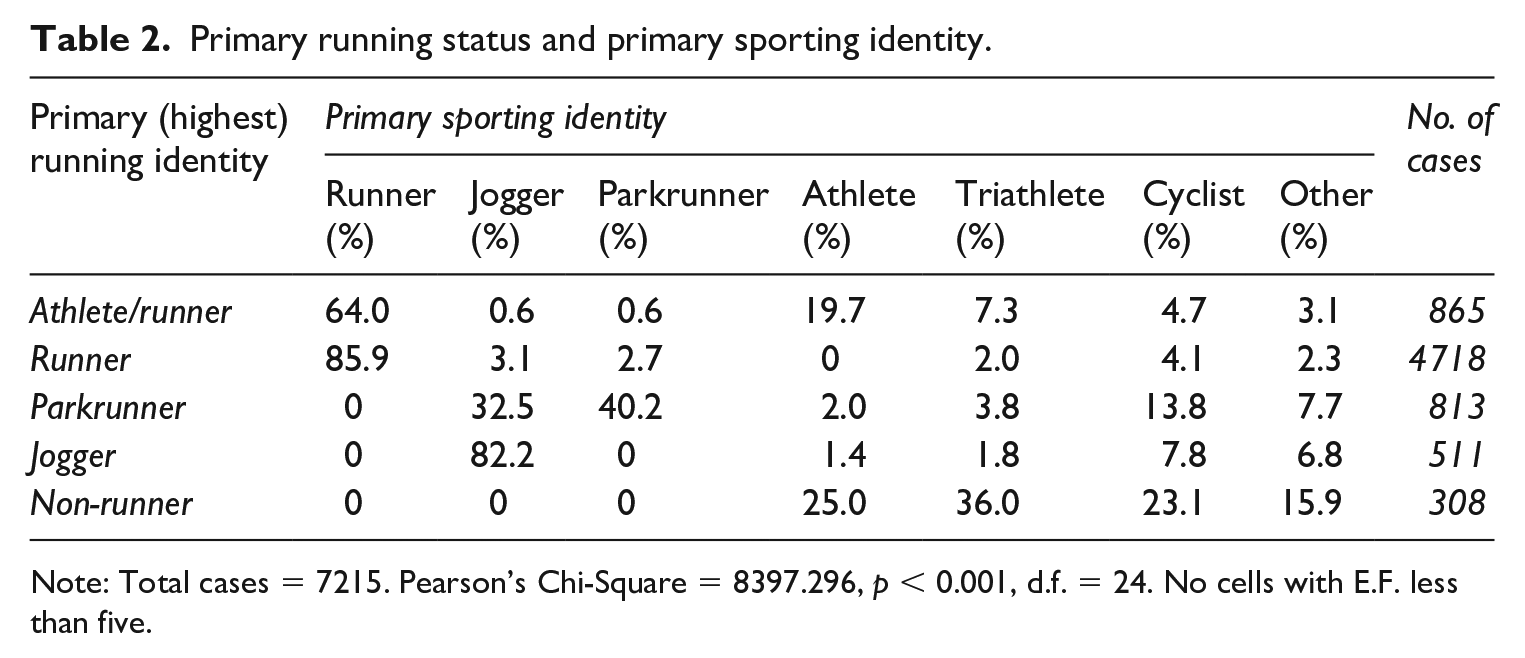
Note: Total cases = 7215. Pearson’s Chi-Square = 8397.296, p < 0.001, d.f. = 24. No cells with E.F. less than five.
Shifting subjectivities
Our interest is exploring the significance of any shift in identity from non-runner to runner. Running status was recollected for the point at which a parkrun was first completed. No particular status was overly prominent, with one-third identifying as a regular runner/jogger (34.2%, n= 2484), two-fifths (41.5%, n= 3015) as an occasional runner/jogger and one-quarter as a non-runner/jogger (23.9% n=1735). As clarified above, this refers to running status and not to sporting/activity status; as we have shown that many parkrunners have a non-running sporting background, it is not assumed that non-running is equivalent to inactive. Although our primary interest is exploring the subsequent experiences and running identity of non-runners, it is instructive to provide an overview of identity shift that also includes those who started as occasional runners or regular runners (Table 3).
Transition in running status.
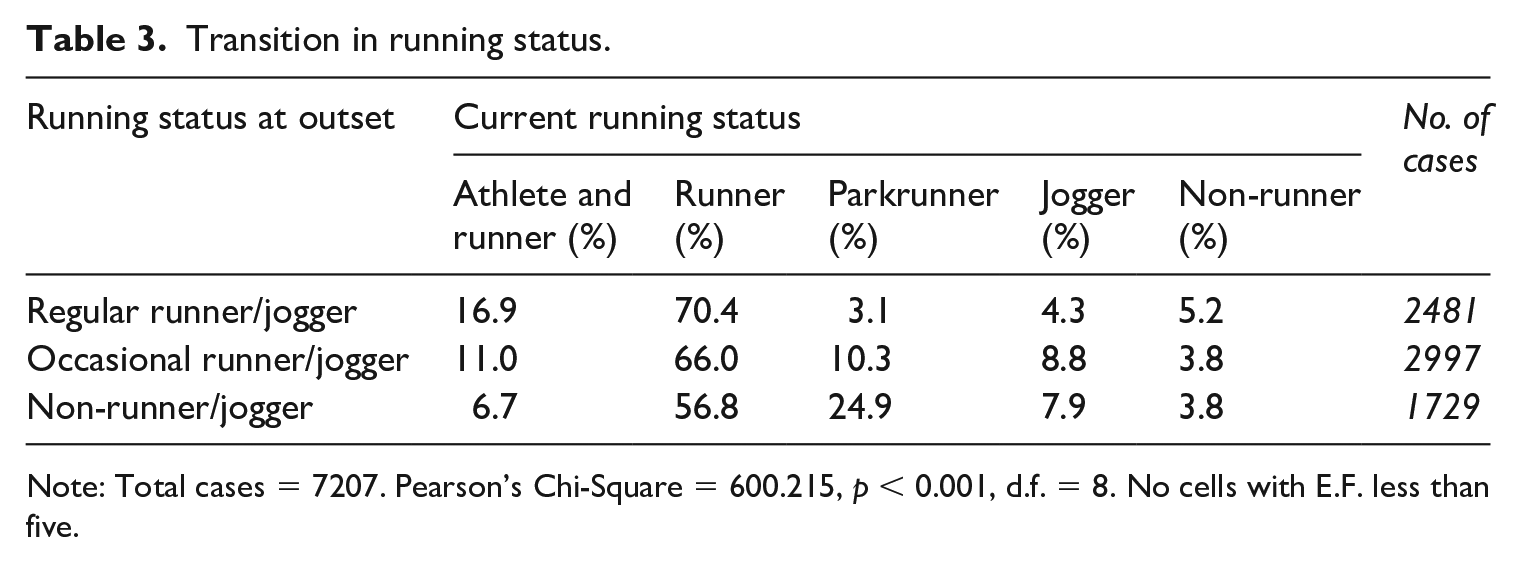
Note: Total cases = 7207. Pearson’s Chi-Square = 600.215, p < 0.001, d.f. = 8. No cells with E.F. less than five.
Those who started parkrunning with a stronger running background were more likely to convey greater embeddedness with a running identity at the point of survey completion. Thus, 87.3% of those who were regular runners when starting parkrunning currently described themselves as a runner (or athlete/runner), compared to 77% of those who were occasional runners and 63.5% of those who were non-runners (Table 3). However, although contemporary running status is weaker among those who were non-runners at the outset, these data confirm that the vast majority of non-runners/joggers at registration have transitioned to a running identity – only 4.3% continue to identify as a non-runner, with 7% now identifying as a jogger, 24.9% as a parkrunner, 55.8% as a runner and 6.7% as an athlete/runner. It is the experience of this group that we explore in this paper in terms of parkrun participation, performance and wellbeing. Beforehand, four other issues are worthy of note in the context of this discussion of running identity.
First, we deployed logistic regression to determine which factors should be understood to have a causal influence on running identities. From our initial exploratory data analysis (e.g. cross-tabulations using χ2 to suggest candidates), we found that age, gender, income status, self-assessed class, self-assessed income and self-assessed health were associated both with running identity at the outset and the running status to which non-runners transitioned. Household status (presence of children, household size and partner status) was not. For example, fewer men than women recollected that they were a non-runner/jogger when starting parkrunning, that is, 21.6% of men and 27.6% of women (χ2= 36.024, p=<.000, d.f.=2, no cells with an E.F. <5). Similarly, it first appeared that age is related to the running status to which non-runners transitioned, that is, those aged under 30 were much more likely than older age groups to report transitioning to the status of athlete/runner; although only 23.7% of non-runners were aged under 30, 50% of those who transitioned to athlete/runner status were of this age group (χ2= 53.647, p=<.000, d.f.=12, no cells with an E.F. <5).
Our multivariate analysis confirms that those who are men, those who are aged under 30, those who do not have a limiting long-term illness and, particularly (referring to the Wald values), those who are middle class are more likely to start parkrunning with an identity as a regular runner/jogger (Table 4 and Table 5). Parkrunning would, on first analysis, appear to give the potential for these groups to transition to a running identity. Interestingly, the multivariate analysis suggests that a few factors can account for the transitions to running status through parkrunning. Gender is related to the likelihood of transitioning from a non-runner to each of athlete/runner, parkrunner and jogger – in each case, men being less likely to transition than women. Those who self-report as being in better health are also less likely to report transitioning from non-runner to parkrunner and jogger. In part, this is suggestive of parkrunning being particularly conducive to strengthening a running identity for women and those in poorer health; however, given that non-runners may have a strong sporting identity that is not running based (Table 2), it must also be acknowledged that the reason for these differences may also reflect men, and those who are healthier, holding on to a non-running sporting identity, as it does to parkrunning being more likely to open up opportunities for women and those of poorer health.
Multinomial logistic regressions non-running identity at outset of parkrunning.
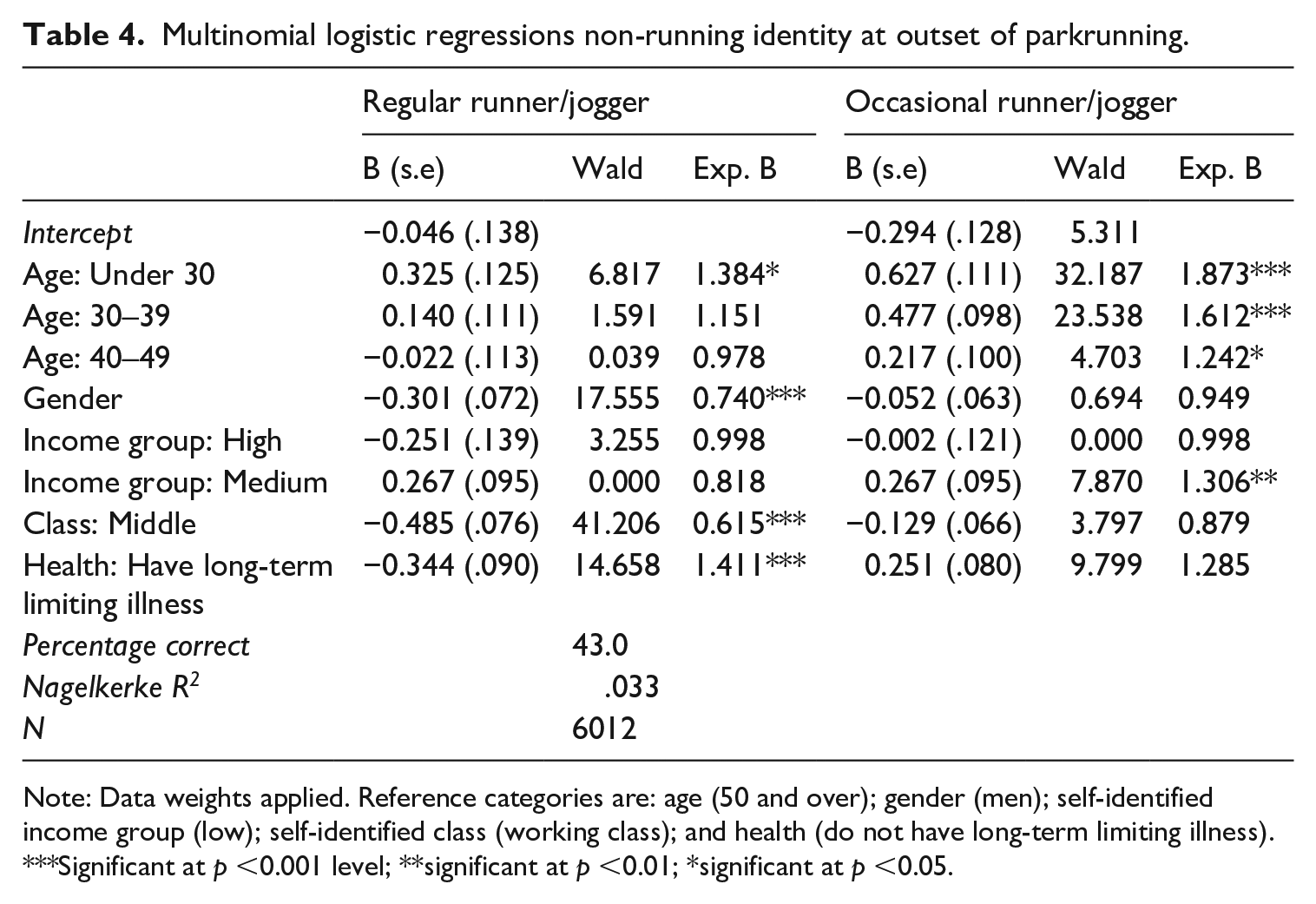
Note: Data weights applied. Reference categories are: age (50 and over); gender (men); self-identified income group (low); self-identified class (working class); and health (do not have long-term limiting illness).
Significant at p <0.001 level; **significant at p <0.01; *significant at p <0.05.
Multinomial logistic regression: Transition to running among non-runners at outset of parkrunning.
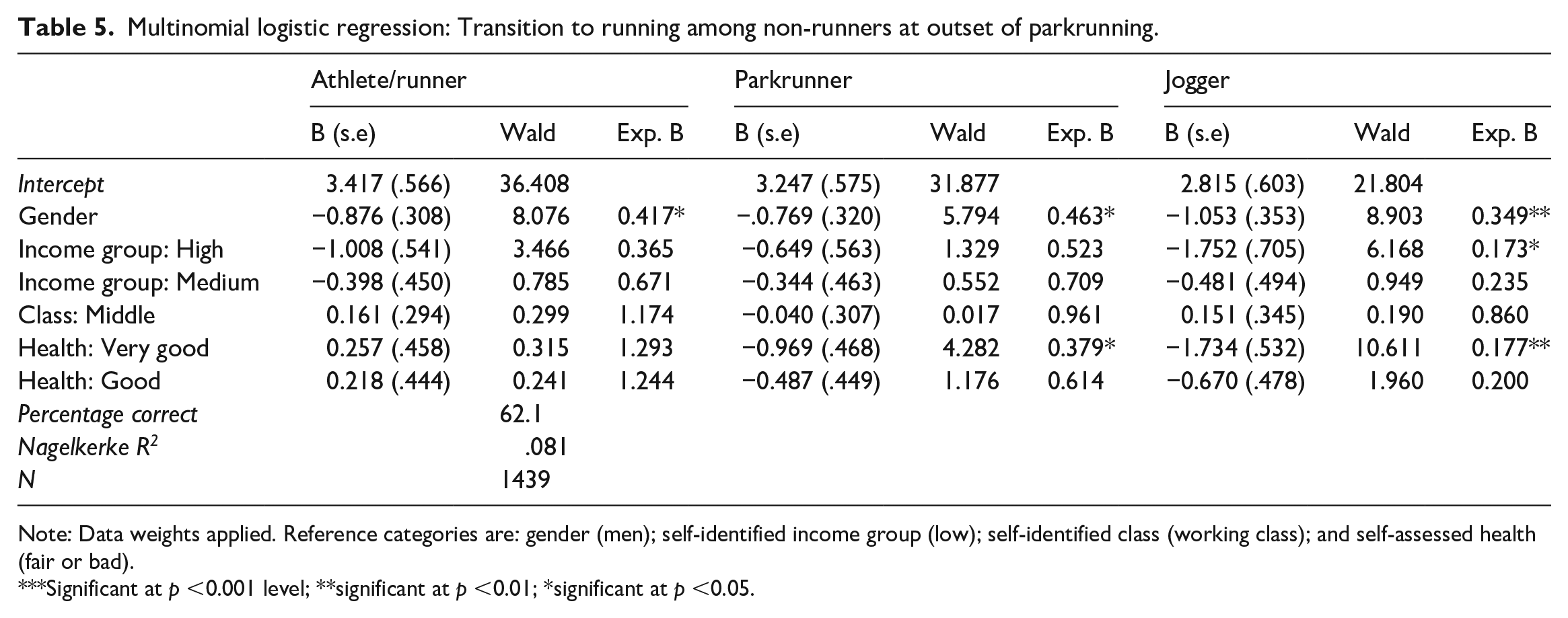
Note: Data weights applied. Reference categories are: gender (men); self-identified income group (low); self-identified class (working class); and self-assessed health (fair or bad).
Significant at p <0.001 level; **significant at p <0.01; *significant at p <0.05.
Second, although Table 3 reaffirms the association of parkrun and the acquisition or strengthening of a sporting identity that prevails in the parkrun literature (Wiltshire et al., 2018), the data are also suggestive that a weakening of sporting identity coincides with an introduction to parkrunning for a minority. Thus, among those who described themselves as regular runners/joggers on first registering with parkrun, 5.2% no longer identify as being a runner. This was also reflected in explanatory commentary:
past my prime
Once did competitive road cycling from 11 years of age to 30 years of age. Attended Commonwealth Games XXX, Central American Games in XXX, did the U23 World Championships in XXX as a teenager and raced in many countries as a cyclist. Took up running in my 30s. I do not race anymore.
I was a runner, but after a recent slip I would say I am a jogger
former runner, occasional cyclist and park runner, golfer
ex footballer turned runner when I feel like it
Although a minority experience, this is a dimension of parkrunning that is often overlooked. Far from being a negative, parkrun may not only have merit in facilitating a transition to a more active life/sporting life; it may also function as a realm in which a sporting life can be sustained, beyond a more intensive or competitive past. There may be merit in further work exploring the role parkrun fulfils in such transitions.
Third, we were keen to explore how these transitions played out over time. Table 6 describes the transition status for three time periods since first registration, that is, within the last year, between one and two years ago, and more than two years ago. These data demonstrate there is a positive association between parkrun duration and the intensity of running identity. For example, whereas fewer than one-half of non-runners had transitioned to running status within 12 months of starting parkrun (45.4%), the majority of those who started between one and two years ago now consider themselves runners (60.8%), as do three-quarters of those who started parkrunning more than two years ago (75.6%).
Transition status of non-runners, by time elapsed since first parkrun.
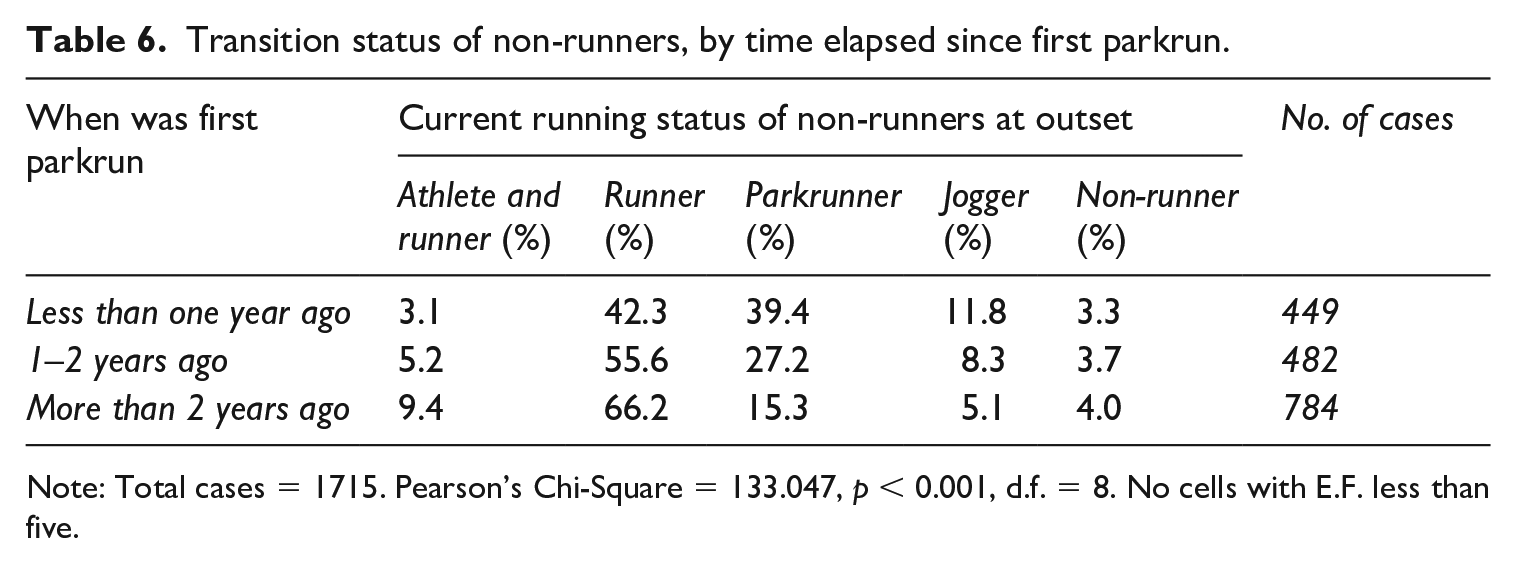
Note: Total cases = 1715. Pearson’s Chi-Square = 133.047, p < 0.001, d.f. = 8. No cells with E.F. less than five.
Finally, we explored two dimensions of attachment to running beyond parkrun. First, those reporting transition to stronger running identities were much more likely to report running outside of parkrun. Three-quarters of athlete/runners reported running most days (78%), compared to 63.2% of runners, 22.4% of parkrunners and 37.7% of joggers (χ2= 237.257, p=<.000, d.f.=4, no cells with an E.F. <5). We then explored membership of running communities outside of the parkrun setting. We found that those who had transitioned most strongly from non-runner into a running identity were significantly more likely to report that they are now members of a UK athletics affiliated club (χ2= 236.920, p=<.000, d.f.=8, no cells with an E.F. <5); membership rates ranged from 63.5% of those who were athlete/runners, 41.2% of those who identified as runners (but not athletes), 9.8% of those who identified as parkrunners and 22.2% of those who identified as joggers. Interestingly, membership was high among those who did not identify as runners (26.6%), providing further evidence that parkrunning is attractive to sportspeople who do not necessarily identify with a running subject position. Our data do not allow more than speculation as to whether engagement in external running groups is cause or effect of the intensification of running identity among parkrunners who were non-runners; what is clear is that many non-runners who parkrun are not only acquiring a strong running identity, but are also progressing to embed themselves in external running communities.
Transitions and parkrun participation
We first explored how initial running status related to current parkrun participation (Table 7), and here we found that a significant number of those who had come from non-runner/jogger backgrounds (45.4%, n=753) participated in parkrun every week. Current levels of parkrun participation were highest among those who started parkrun with a non-running/jogging background; only one-third of those who were initially occasional runners ran at parkrun every week (32.5%, n= 943), as did only one-quarter of those who were initially regular runners (25.0%, n=597). Significantly, this patterning persisted when the effects of length of time since first parkrun participation were controlled. For example, of those who started parkrunning between one and three months prior to the survey, 54.2% (n=39) of non-runners/joggers at registration reported participating every week, compared to 20.5% (n=24) of those who were regular runners/joggers beforehand. Similarly, of those who started parkrunning five or more years ago, 43.1% of non-runners/joggers (n=66) at first registration reported participating every week, compared to 35.4% (n=132) of those who were regular runners/joggers beforehand.
Frequency of participation, by running status on registration with parkrun.
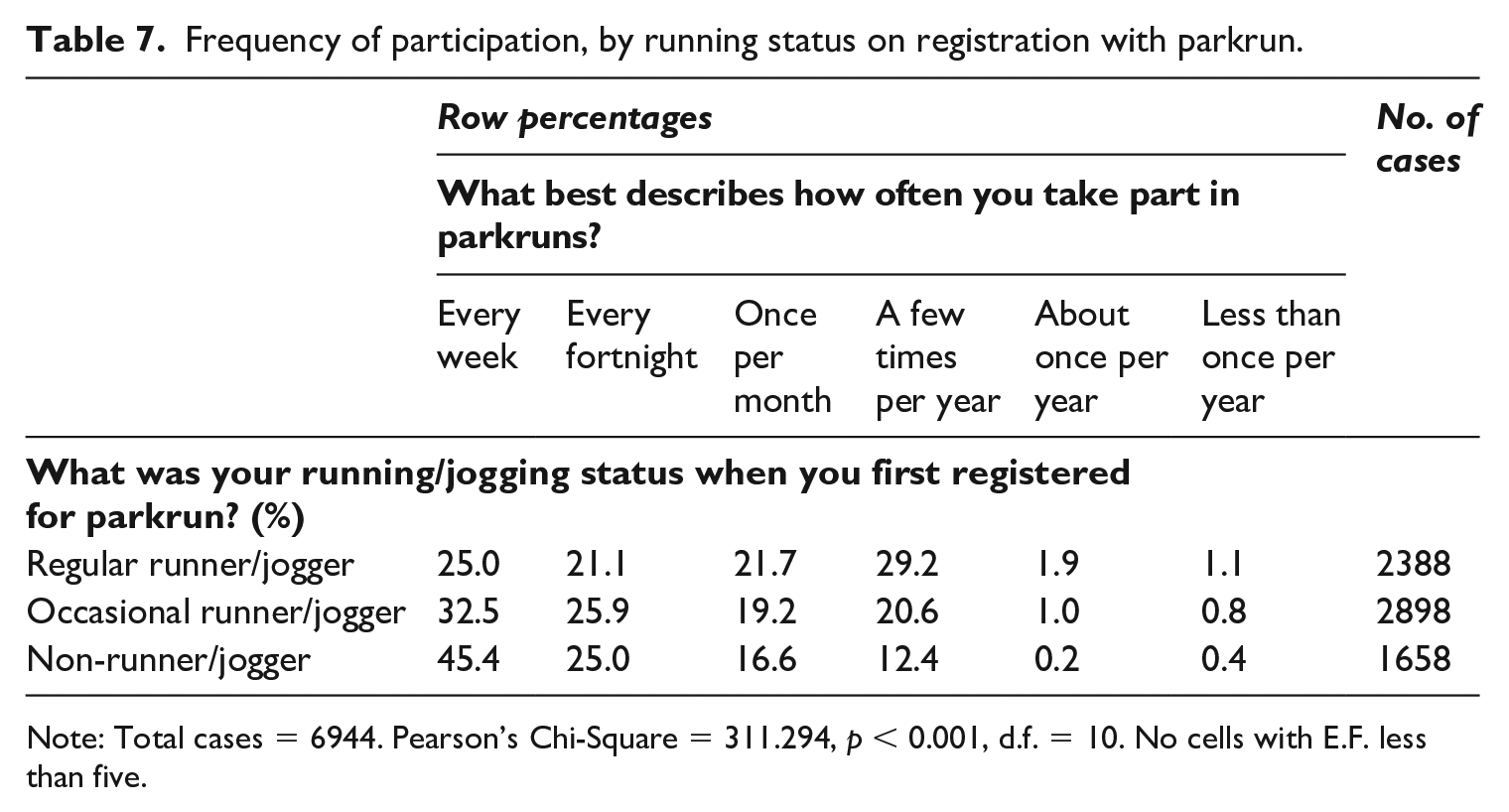
Note: Total cases = 6944. Pearson’s Chi-Square = 311.294, p < 0.001, d.f. = 10. No cells with E.F. less than five.
We then explored patterns of engagement with parkrun among the population who were non-runners/joggers at the outset. It was reasonable to expect that being a parkrunner might rupture a neat association between intensity of running status and parkrun participation, that is, that those identifying as parkrunners might be most likely to participate most frequently, report a stronger attachment to their local parkrun and have completed more parkruns. However, we found that parkrunners, runners and athlete/runners reported similar patterns of participation, that is, 48.6% of parkrunners participated every week, compared to 48% of runners and 32% of joggers (χ2= 60.497, p=<.000, d.f.=8, no cells with an E.F. <5). Furthermore, those reporting a transition to a stronger running status were more likely to have completed more parkruns (e.g. 59.6% of athlete/runners, 44.3% of runners, 23.7% of parkrunners and 18.2% of joggers reported having completed 50 parkruns - (χ2= 139.928, p=<.000, d.f.=8, no cells with an E.F. <5). Similarly, and perhaps somewhat surprisingly, those reporting a transition to a stronger running status were also more likely to report attachment to their local parkrun (e.g. 45.2% of athlete/runners, 41.6% of runners, 31.2% of parkrunners and 18.9% of joggers reported ‘very strong’ attachment to their local parkrun (χ2= 61.818, p=<.000, d.f.=8, no cells with an E.F. <5).
Transitions and the perceived impact of parkrun
Finally, we explored wellbeing and performance, given our concern to examine evidence that changes in physical capital would be an important driver in the process of subjective transformation from non-runner to runner, providing positive reinforcement and incentives to keep participating, perhaps transforming the urge to participate from one based on a health imperative to an endogenous, sporting imperative.
First, we explored how transition status was linked to three aspects of parkrun performance. We asked respondents to self-evaluate the impact of parkrun on 5 km performance, general fitness and motivation to exercise. Strongly positive findings emerged for each group across each issue, with 97% of non-runners reporting improvements in their fastest time to run 5 km, 97% reporting that parkrun had helped improve their general fitness and 90% reporting positive impact on motivation to exercise. Even so, slightly more athlete/runners, runners and parkrunners report positive outcomes compared to joggers and non-runners. For example, 97.7% of those transitioning to parkrunner status report an improvement in their 5 km performance, compared to 87% of joggers (χ2= 58.494, p=<.000, d.f.=4, E.F.<5). Similarly, 91.9% of runners report that parkrun has increased their motivation to exercise, compared to 78.8% of joggers (χ2= 36.645, p=<.000, d.f.=4, E.F.<5). We also found a significant association (χ2 = 433.409, p=<.000, d.f.=1) between status at registration and perception of the impact of parkrun on general fitness. Almost all non-runners/joggers (97.1%) suggested that parkrun had been positive in this regard, compared to 78.5% of those who were already regular runners.
Second, we sought to find out how parkrun participation had impacted our participants’ bodies. At the outset, it is important to note that status at beginning of parkrun participation was associated with contemporary levels of self-reported health (χ2=217.604, p=.000, d.f.=1). Regular runners (54.7%) at the outset were more likely to perceive their current health to be very good than occasional runners (42.8%) and, in turn, non-runners/joggers (34.4%). Initial running status was also associated with the likelihood of perceiving positive impact of parkrun on body weight (χ2=21.696, p=.000, d.f.=1), body shape (χ2=18.1, p=.000, d.f.=1) and body confidence (χ2=12.092, p=.000, d.f.=1). Yet in sharp contrast to general health, in all cases, those initially from non-runner/jogger backgrounds were more likely than occasional or regular runners to perceive that parkrun had had a positive effect on these outcomes.
Once more, we explored these differences among the subset who had transitioned from non-runner to running. For each of six dimensions of general wellbeing we found that transition to a stronger running intensity was associated with the perception that parkrun had had a more positive impact on wellbeing, that is, among non-runners at the outset, those who had acquired a stronger running identity were more likely to perceive that their parkrun participation had helped them improve body shape, self-confidence, social life, happiness and weight, as well as feeling better about their body. For example, 73.5% of those who transitioned to athlete/runner reported a positive impact of parkrun on weight, compared to 68.9% of runners, 57.3% of parkrunners and 48.5% of joggers (χ2=36.868, p=.000, d.f.=4). Similarly, 80.0% of those who transitioned to athlete/runner reported a positive impact of parkrun on social life, compared with 67.7% of runners, 51.5% of parkrunners and 37.0% of joggers (χ2=96.815, p=.000, d.f.=4).
Discussion
We can draw some important lessons from the findings presented above: parkrun does not only appeal to runners, and facilitates subjectivity changes for many of its participants. More specifically, our analysis suggests that a significant number of those who were not runners before parkrun have now adopted the subject position of ‘runner’. Over one-half of those who had been non-runners/joggers at first registration now identify as being a runner. Most non-runners/joggers had been involved with parkrun for over one year and took part either weekly or fortnightly. Parkrun has provided them with the opportunity to become runners by creating the conditions for them to develop a running habitus, propelled by what Tulle (2007) has termed a newly acquired urge to run, having, in some cases, transcended the health imperative. Our discussion, inspired by a Bourdieusian framework, fleshes out the processes which lead to identity shifts.
We conceive parkrun to be an example of a social field, one in which a number of people were entering for the first time as non-runners. Almost one-quarter of respondents came from non-running backgrounds and were entering a social field for which they did not have pre-requisite dispositions. The parkrun social field is distinctive in its ability to accommodate participants with a diverse range of rationales for participation. In this sense, parkrun as a field is all-encompassing and does not have a clearly defined doxa in the same way other sporting/physical activity spaces have. The parkrun social field is a space in which practices, with their varied rationales, can be performed on a regular basis.
The regularity of the parkrun field may lead to an embodied legitimation of the practice. Our non-runners demonstrate this process. We find that this group of participants were the most likely to suggest that parkrun had aided improvements to their 5 km performance, general fitness and motivation to exercise. What this suggests is that these participants had found their new activity legitimated by wider gains in health and wellbeing. Furthermore, our data demonstrate that those from non-running backgrounds were also most likely to perceive positive impacts of parkrun on their bodies (shape and weight) and minds (self-confidence), that is, they perceived the inflection of their physical capital by sporting as well as health benefits. These perceived benefits exist within a group of non-runners for whom 54.6% had internalised a ‘runner’ subjectivity, and 45.6% were taking part in parkrun each week. Therefore, we hypothesise that regular engagement in parkrun and external running is facilitated by the belief that the new behaviour endowed participants with physical capital consistent with both a sporting habitus and the dominant narrative of health. As Palmer et al. (2019) argue, the legitimation of new physical activities is likely an important process that helps produce durable dispositions towards such practices. Legitimation is a process which takes time and repeated engagement and, in a Bourdieusian sense, confirms the presence of illusio. That is, if individuals envisage the ‘parkrun game’ as one that is worth playing and one in which their efforts translate into tangible capital (improved performance, reduced body weight, increased body satisfaction etc.), then participation will be more likely to continue. Repeat participation leads to the internalisation of being a runner.
Another element of the parkrun social field is its ability to facilitate the shifting of rationales which lead to the emergence of becoming a ‘runner’. Our evidence demonstrates that almost one-half of non-runners (48.1%) had become involved in running groups external to parkrun, demonstrating that their participation had extended beyond the weekly 5 km on a Saturday. From this, we can infer that these participants had become more engaged in a running social world (Shipway et al., 2013). If regular attendance at parkrun leads to engagement with external running groups, then it may be that the logics of these other groups have also become to some extent internalised. In a Bourdieusian sense, this would constitute an internalisation of the field’s doxa, meaning that participation takes on a different logic: partaking in running would become less about getting fit, losing weight or improving health, and would broaden instead to encompass a sporting logic (Palmer et al., 2017): running for the sake of running (Featherstone and Hepworth, 1982). We argue that the point at which participants engage in running for the sake of running would be a manifestation of dispositional change at the level of habitus.
We therefore surmise that parkrun in itself is not a direct cause of changes to wellbeing and health, but instead acts as a conduit to broader changes to health-related behaviour, creating the conditions for people to engage in more traditional sporting practices, but also demonstrating the intimately embodied condition of identity.
Conclusion
In this article, we have provided evidence that parkrun appeals to non-runners, who, after engagement with the practice, become a ‘runner’. In doing so, parkrun acts as a ‘nudging’ (Mols et al., 2015) springboard for identity change, which enables those who previously were non-runners to avail themselves of the opportunities that exist beyond parkrun, sometimes through the use of organised athletics clubs or community running groups. The public health potential of parkrun, therefore, lies in its ability to catalyse these ‘identity shifts’ (Kearney and O’Sullivan, 2003). More broadly, our analysis contributes to the increased understanding that initiating durable behaviour change is complex, involves changes in embodied identity and can only occur over a long period for it to yield meaningful health outcomes and become self-sustaining.
By extending an analysis beyond running status before registration (Cleland et al., 2019; Sharman et al., 2019; Stevinson and Hickson, 2013) and attachment to parkrun identity (Stevens et al., 2019), we have been able to make visible the timebound and embodied conditions which are a condition of changes in subjectivity within parkrun participants. Looking forward, we contend that we need to offer more long-term and stable offerings to promote physical activity which enables these identity shifts to take place.
Footnotes
Acknowledgements
We wish to thank the anonymous reviewers for their feedback which improved the quality of this work, Neil McNulty for his advice and support towards the end of the project, and Gareth Mills and Andy Baddeley for their support on the project.
Declaration of Conflicting Interests
The author(s) declared no potential conflicts of interest with respect to the research, authorship, and/or publication of this article
Funding
The author(s) disclosed receipt of the following financial support for the research, authorship, and/or publication of this article: The authors received financial support for the research from Strava. No financial support was given for authorship or publication of the article.
