




Abstract
Due to the massive spread of a new Coronavirus (SARS-CoV-2), many European governments enacted rules and legislations in order to reduce social interactions and contain the spread of the virus. German authorities put in force a lockdown of all non-essential infrastructure, starting on 22 March 2020. These policies included the closing of sports clubs, fitness centres and community sports grounds. Most federal states prohibited social gatherings of more than two people, thereby further restricting opportunities to play sport and exercise together. The paper addresses how Germans adapted their leisure time sport and exercise (LTSE) activities in this unprecedented situation. Based on survey data representing the adult population (⩾ 14 years, N=1001, data collection 27 March to 6 April 2020), the paper shows a significant decline in LTSE activities at population level. Overall, 31% of Germans reduced their LTSE, while 27% maintained and 6% intensified their LTSE level. A share of 36% was not engaged in LTSE, either before or at the beginning of the lockdown. Younger age groups were more likely to maintain LTSE levels compared with older ones. Comparisons of ‘reducers’ and ‘maintainers/ intensifiers’ indicate that the latter group increased home-based workouts and outdoor endurance sports, while ‘reducers’ did not find adequate substitutes for their sporting routines.
Introduction
Few events have the magnitude to affect the life of whole populations in countries or even world regions. However, studies on the Yugoslavian war (Kunovich and Hodson, 1999), the 9/11 terrorist attacks (Calderoni et al., 2006; Verkasalo et al., 2006) or the social and economic instability in Russia after the collapse of the Soviet Union (Notzon et al., 1998) indicate that some singular events can trigger massive changes regarding values, attitudes and behaviours, including health-related behaviours. For instance, the global financial crisis of 2008 had a lasting impact on health outcomes, led to a decline in quality of life (Clench-Aas and Holte, 2017; Drydakis, 2015; Vandoros et al., 2013) and increased social disparities within the most affected countries (Filippidis et al., 2014). Whereas sociological theorizing often argues that social change occurs over long periods, years and decades (Haferkamp and Smelser, 1992), a couple of dramatic singular events can potentially influence and change lifestyles and behaviours very rapidly. A life-threatening global pandemic, as in the case of the novel Coronavirus SARS-CoV-2, in combination with politics curtailing public life surely belongs into this category of events with a high potential for fast and far-reaching social change.
Since first reports of the new SARS-CoV-2 virus in Wuhan, China (Wu et al., 2020; Zhou et al., 2020), the world has witnessed the global spread of this virus in just a few months. With 4.7 million reported cases of infections around the world (Johns Hopkins University & Medicine, as of 18 May 2020) and more than 315,000 deaths directly related to the Coronavirus disease 2019 (Covid-19), the virus has become a major threat to public health. The World Health Organization (WHO) called this outbreak a pandemic and advised national governments to implement protective measures to slow down the spread of the virus (WHO, 2020a). ‘Social distancing’ is considered a key factor to slow down respective outbreaks (Ferguson et al., 2006; Glass et al., 2006). Hence, measures aiming at spatial distancing and self-quarantine were put in effect in many European countries as part of Covid-19 mitigation policies.
In Germany, an uncontrolled spread of the virus would have led to an estimated 40–60 million infections in a short period of a few months (an der Heiden and Buchholz, 2020), and thereby considerably exceeding the capacity of the healthcare system. To prohibit such a scenario, the German government decided on a far-reaching shutdown of businesses and public infrastructure. Starting in March 2020, authorities prohibited mass events, closed schools, malls and retail shops, restaurants, theatres and museums. They further tightened measures on 22 March by prohibiting public gatherings of more than two people (German Federal Government, 2020). These containment measures, as was intended, had massive consequences for public life in general, but also for the pursuit of leisure time sport and exercise (LTSE) activities. Although authorities announced that exercising (alone, with one accompanying person or with household members) in public places was still permitted, sports clubs, community sports grounds, fitness centres, swimming pools and other sport and leisure facilities were closed down.
Sport club membership in Germany is estimated to be close to 27.5 million (German Olympic Sports Confederation (DOSB), 2020) and fitness centres include approximately 11.7 million members (German Association of Fitness Studios (DSSV), 2020). Therefore, the closing of these facilities, although inevitable to cope with the pandemic, deprived millions of Germans from following their regular LTSE routines. Although health authorities reminded people to substitute sporting activities in social settings with home-based workouts (WHO, 2020b), the outreach and observance of these recommendations is questionable. Hence, scholars from sport sciences and medicine express concerns that periods of lockdown and self-quarantine will foster sedentary behaviour that in turn will provoke ‘a kaleidoscope of unfavourable metabolic effects that would dramatically increase the risk of many severe and disabling disorders’ (Lippi et al., 2020: 906). Beyond these detrimental effects for physical health, retaining LTSE may also be beneficial in coping with emotional stressors of quarantine, like frustration and boredom (Brooks et al., 2020).
Overall, it seems likely that Germans reduced the amount of LTSE in times of curfews and self-quarantine. However, the extent to which Covid-19-related austerities impacted on LTSE activities is unclear and this paper is a first attempt to shed light on this question. The present research, based on a Germany-wide representative online survey, addresses four questions: (a) How much did the time spent in LTSE change at the beginning of the pandemic? (b) How large are the groups of people who stopped, reduced, maintained or increased LTSE? (c) Are adaptations of LTSE levels related to socio-demographic variables (e.g. age, education, gender)? (d) How exactly did people adapt or modify their LTSE activities in the early stage of the lockdown?
Materials and methods
Study design
The present study is based on a large-scale, cross-sectional survey design. A sample, representing the German population (⩾14 years), was questioned using computer-assisted web interviewing (CAWI). Representativeness was accomplished by integrating the study into FORSA omninet, an existing nationwide online panel. FORSA is among the leading organizations in public opinion polling in Germany, able to provide timely and reliable public opinion data. A specific feature of this panel is that panel recruitment takes place solely offline via telephone surveys, thus assuring that population groups who use online and internet services only sparsely are still adequately represented in the sample. Data collection took place from 27 March to 6 April 2020. Strict regulations for social distancing and self-quarantine were enforced by the federal government on 22 March, so that data collection proceeded in the second and third week after this aggravation of the situation. Hence, the data captures the initial reactions and adaptations in the German population in the period of the lockdown of non-essential infrastructure. Respondents were invited via email to participate in the survey and were able to answer the survey on their computer, tablet or mobile phone. All respondents provided written consent to be contacted for online surveys, were informed about the topic of this survey and answered the questions voluntarily.
Measures
Respondents indicated their involvement in LTSE in hours per week. Precisely, they were asked to indicate the amount of LTSE (‘How much time did you play sport or exercise in your leisure time’) on an 8-point rating scale with the following answer categories: 1=did not exercise or play sports; 2=less than 1 hour; 3=about 1 hour; 4=about 2 hours; 5=about 3 to 4 hours; 6=about 5 to 6 hours; 6=about 7 to 14 hours; and 8=15 hours or more. To compare the sports activities at the beginning of the Covid-19 pandemic with the usual level of sport from the time before this crisis, the question was asked twice: first, in reference to the time of the pandemic (‘Please think of the last week, i.e. since the measures to contain the spread of the Coronavirus were in force’) and second, in reference to a normal week (‘before the measures of containment were put in place’). These answers are used to estimate the change in LTSE that was due to Covid-19-related policies of containment.
Following these two questions, another question was asked in an open-ended format that reads: ‘How exactly did your sport and exercise behaviour change since the measures for containing the Coronavirus have been in effect? What did you modify, leave out or begin again?’. Overall, 731 of 1001 respondents gave further explanations on how they adapted their LTSE activities (73%). The majority wrote short comments (12.4 words, on average), however, some answers are quite lengthy and provide meaningful descriptions of LTSE behaviours and their adaptation.
Analytical approach
We first document the level of LTSE in the early stage of the Covid-19-related lockdown and compare this level with the self-reported level from ‘a normal week’ before containment measures were put in place. Differences between the two distributions of LTSE are analysed with a Chi square test. To further assess differences in LTSE before and at the beginning of the Covid-19 crisis, four groups are identified: (a) inactive individuals; and those who (b) reduced, (c) maintained or (d) increased the time spent in LTSE. Inactive individuals are defined as those who were not engaged in LTSE either before or during the Covid-19 crisis. ‘Reducers’ had been regularly engaged in LTSE, but reduced their activities considerably at the beginning of the pandemic. ‘Maintainers’ are respondents with an equally high level of LTSE during the early stage of the lockdown as well as the time before. ‘Intensifiers’ were engaged in more LTSE at the beginning of the pandemic than compared with ‘normal’ levels. Moreover, the share of ‘reducers’, ‘maintainers’ and ‘intensifiers’ is also analysed separately for a variety of social groups with regard to age, gender and education. These analyses focus solely on those active in LTSE before the pandemic in order to assess whether adaptations of LTSE levels differ between these social groups.
The open-ended question was analysed based on a quantitative content analysis. Both authors thoroughly read all answers and developed a coding scheme for three main types of answers: (a) statements on LTSE activities that respondents reduced or omitted during the pandemic; (b) statements on activities that respondents started new, maintained or increased; and (c) statements concerning reasons and specific context conditions for adaptations of LTSE activities. The answers were then coded by one author and one student assistant according to the coding scheme (κ=0.77), thereby assigning responses into 26 (sub-)categories. After correcting for coding disagreements, the share of respondents whose open answer fitted into a specific answer category was calculated and the most prominent categories were identified. Thereby, an answer could potentially fit into multiple categories. For instance, if a respondent wrote ‘I stopped going to yoga class, but now I go inline skating twice a week and do strength workouts at home instead’, this answer would have been assigned to three categories, as it contains information on one omitted activity and two categories of activity that were expanded or taken up anew.
Results
The distribution of sports activity during the Coronavirus crisis is significantly different from the reference distribution before the pandemic (χ²=184.4; df=7; p<0.01; see also Figure 1). Overall, Germans have reduced their level of LTSE during the time when containment measures were in effect. Most notably, the share of inactive individuals increased by 20.1 percentage points from 39.4% (before the pandemic) to 59.5% (during the pandemic), while the share of Germans engaged in LTSE for several hours per week decreased considerably: 10.3% were engaged in LTSE for 2 hours per week (–6.7 percentage points compared with ‘normal’ times), 6.8% reported LTSE activities of 3 to 4 hours (–6.7 points), 4.4% of 5 to 6 hours (–2.6 points), and 2.2% practiced LTSE for more than 6 hours (–1.9 points).
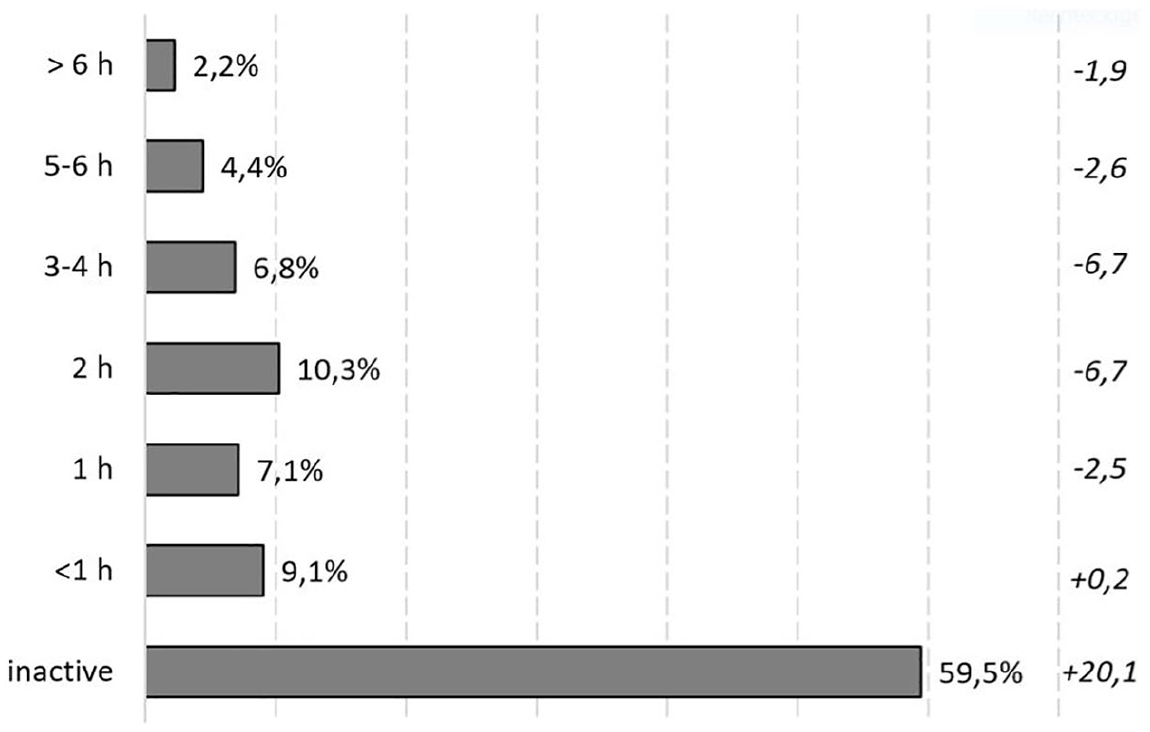
Time spent with sport and exercise activities. Date refer to the first and second week of the lockdown with changes (in italics) compared with a ‘normal week’.
Despite a general decrease in LTSE activities in Germany at the beginning of the Covid-19 pandemic, individual reactions to the containment and mitigation policies are diverse and some individuals managed to maintain or even extend their usual level of LTSE (Table 1). However, the largest share of Germans (36.2%) was inactive before as well as during the pandemic. A proportion of 31.1% belong to the ‘reducers’ who scaled down their LTSE activities considerably or completely stopped exercising. Another share of 27.0% maintained their usual level of LTSE activities. Finally, a small minority of 5.7% increased LTSE during the Covid-19 pandemic. Hence, while a substantial share of people lowered LTSE or responded to the containment measures with inactivity, others were able to retain or increase their activity level.
Self-reported changes in the time spent with sport and exercise activities during the Covid-19 pandemic compared with a ‘normal week’.
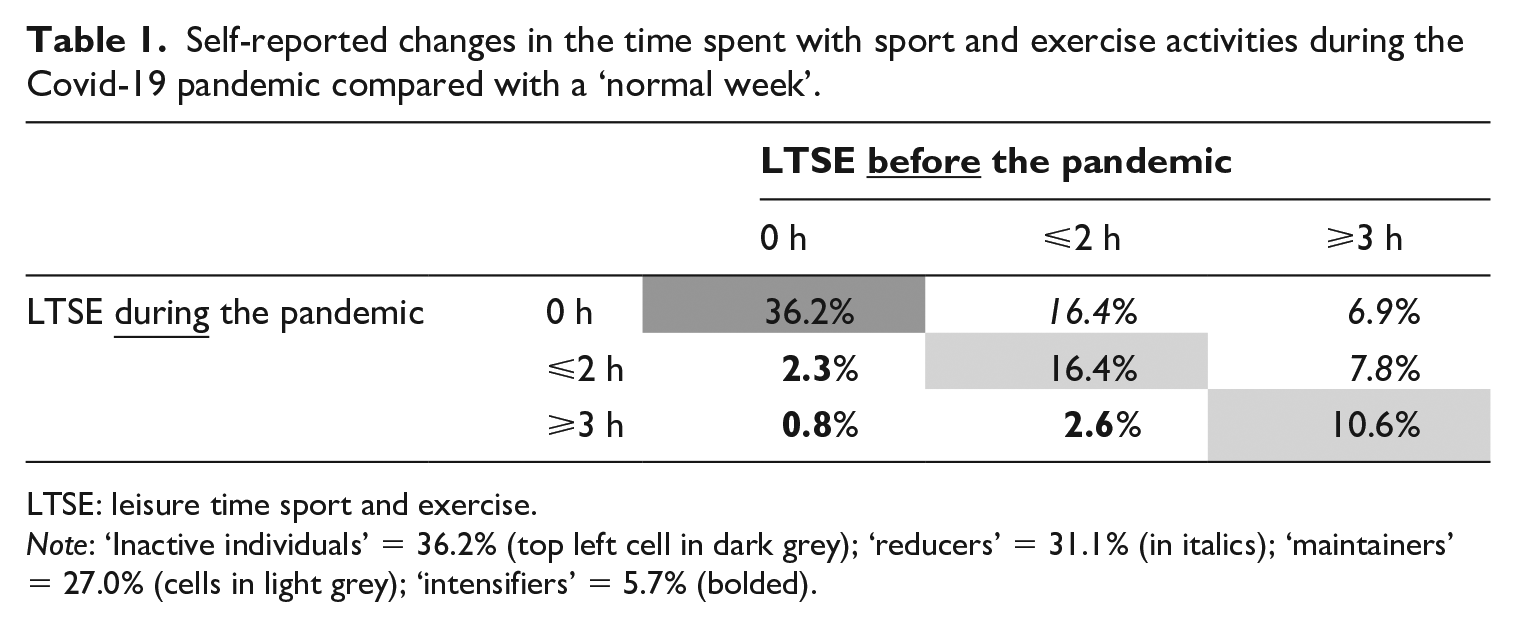
LTSE: leisure time sport and exercise.
Note: ‘Inactive individuals’ = 36.2% (top left cell in dark grey); ‘reducers’ = 31.1% (in italics); ‘maintainers’ = 27.0% (cells in light grey); ‘intensifiers’ = 5.7% (bolded).
A closer look at the population active in LTSE shows that adaptations of activity levels were fairly similar in different social groups (Table 2). Whereas gender- and education-related differences are insignificant, only age is revealed as a significant predictor of changes in LTSE (χ²=12.0; df=4; p=0.02). Of those engaged in LTSE in ‘normal’ times, 35.6% in the youngest age group (<30 years) reduced their activities compared with 51.8% (30–64 years) and 53.0% (⩾65 years) in older age groups. Hence, the age disparity in LTSE further increased due to the pandemic.
Self-reported changes in the time spent with sport and exercise activities during the Covid-19 pandemic compared with a ‘normal week’.
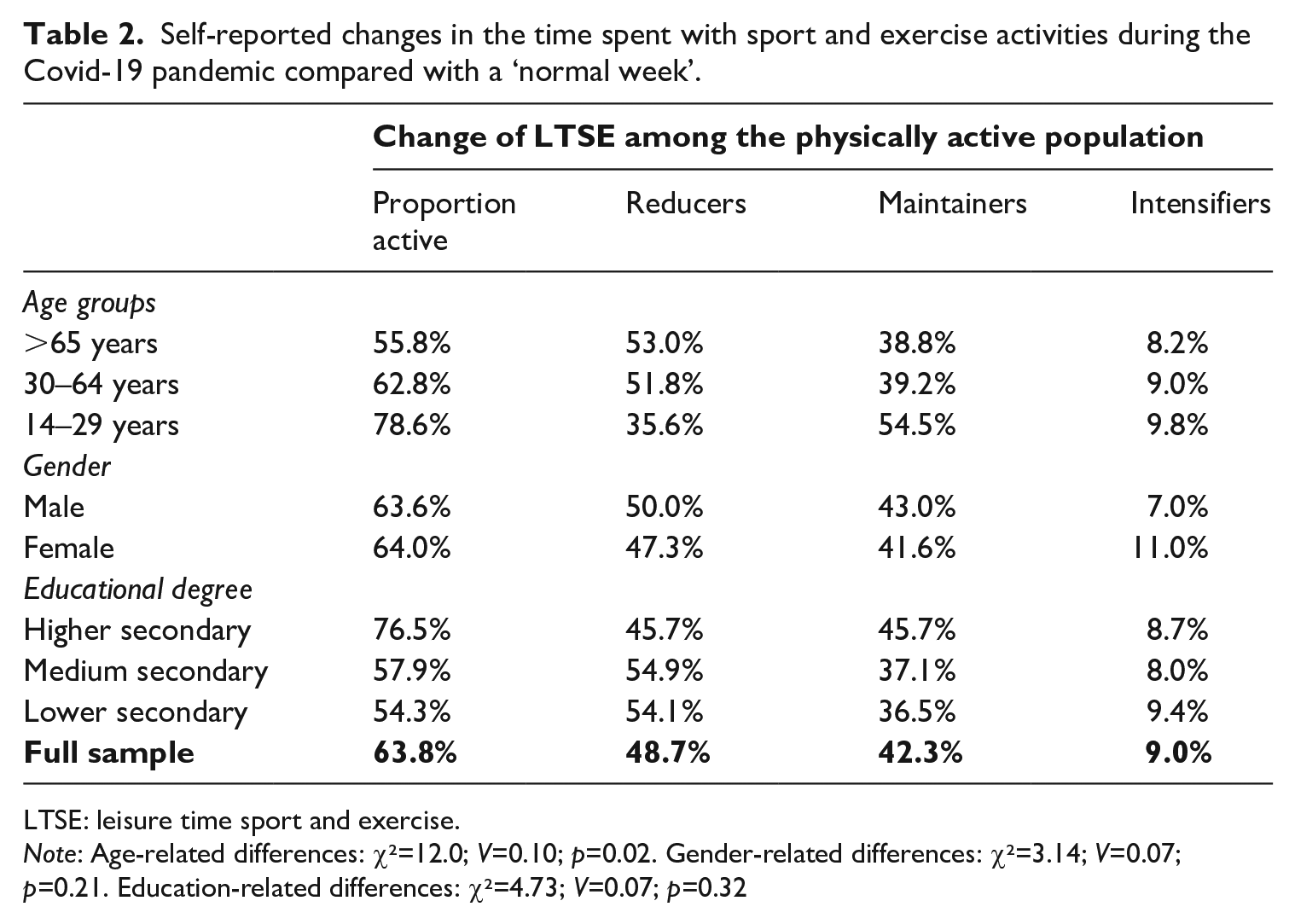
LTSE: leisure time sport and exercise.
Note: Age-related differences: χ²=12.0; V=0.10; p=0.02. Gender-related differences: χ²=3.14; V=0.07; p=0.21. Education-related differences: χ²=4.73; V=0.07; p=0.32
Further explorations using responses from the open-ended question provide some deeper insights on the most frequent adaptations of LTSE activities during the pandemic. Table 3 displays aggregated and categorized responses. Results are shown for the full sample (based on the 731 respondents who answered the open-ended question) as well as for the group of ‘reducers’ and ‘maintainers/intensifiers’. Concerning omitted or reduced activities, a high share of 41% of the respondents pointed to closed infrastructure: particularly the closing of fitness studios and sports clubs deprived a high share of respondents (16% and 14%, respectively) from continuing LTSE, but also activities in rehabilitation centres and other public or commercial sport facilities (like swimming pools, racket centres, yoga studios, climbing halls, etc.) were stopped during the pandemic. Other respondents mentioned that they reduced outdoor activities (12%), trying to spend the least possible time outside the home.
Modifications of LTSE activities during the Covid-19 pandemic. Most frequent responses (open-ended question) for omitted/increased activities and individual reasons.
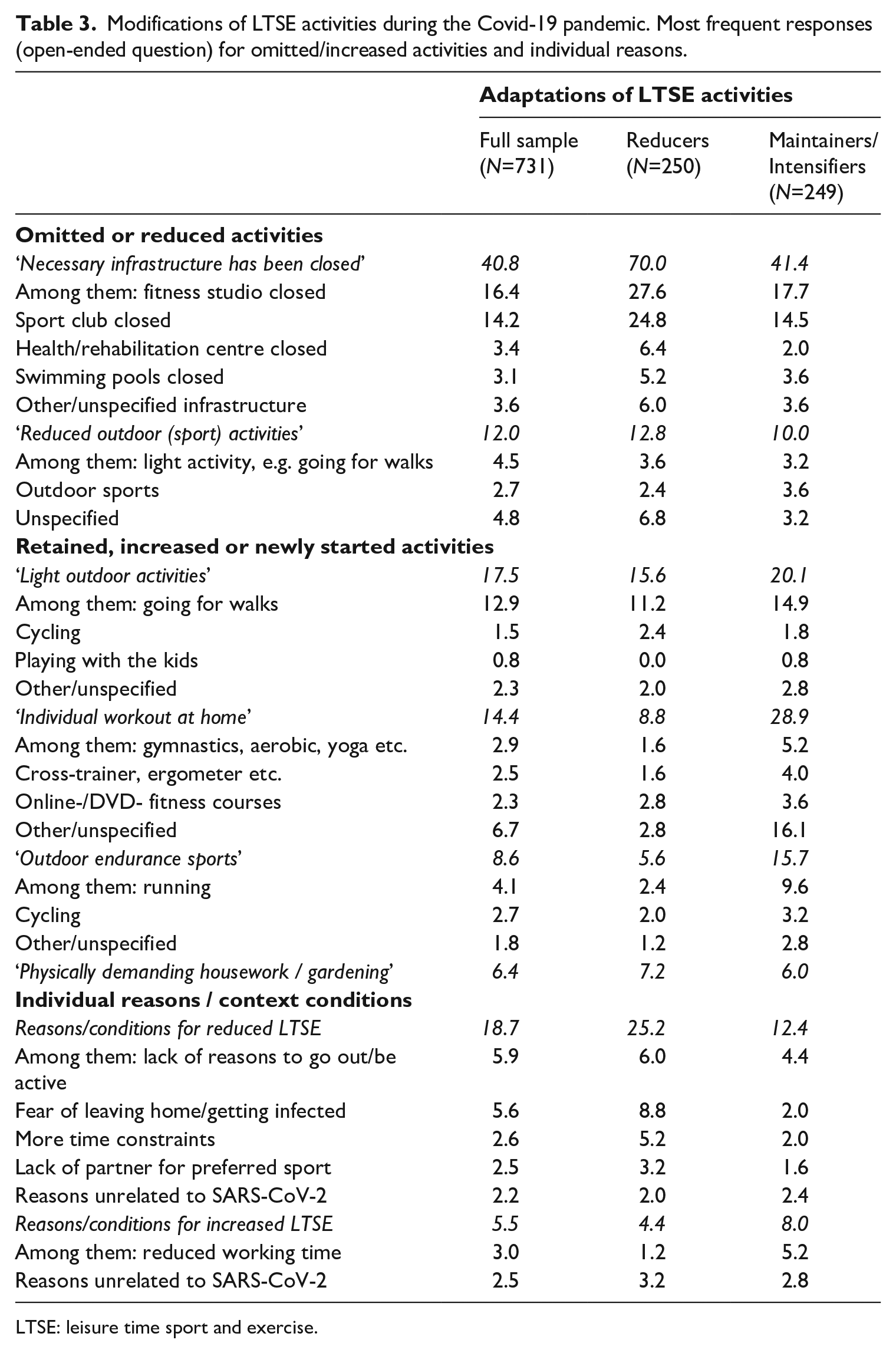
LTSE: leisure time sport and exercise.
With regard to LTSE activities that were kept up, started or increased, respondents refer to increased time spent outdoors: 18% refer to light physical activities (e.g. going for walks) and another 9% indicate outdoor endurance sports (e.g. running, cycling, skating, Nordic walking). Individual workout at home is another popular form for staying active during the pandemic. Overall, 14% of the respondents referred to some form of home-based individual exercise. These exercises ranged from gymnastics, yoga, stretching, or Pilates to weight- and cardio-training with ergometers, treadmills, cross-trainers or training with dumbbells or similar equipment. A smaller share of respondents tried out online- and DVD-based fitness programs (2%). Moreover, 6% indicate more physical activity relating to housework and gardening.
In asking ‘How exactly did your sport and exercise behaviour change?’ the questionnaire did not explicitly probe for the reasons why individuals reduced – or were able to maintain or even increase – their physical activities; yet many respondents provided rationales for adaptations of LTSE during the pandemic when describing changes in LTSE. Reasons that refer to reduced LTSE were mentioned by 19%, whereas 6% gave a reason for retaining or increasing LTSE. Most importantly, respondents justify a reduced activity level with a lack of reasons for going out (6%) and with fears or worries about leaving their homes (6%). For instance, a number of respondents indicated that commuting to work or school by bicycle as well as other trips normally undertaken by bike or on foot had now been effectively taken away (‘I cycle less because I don’t go to my usual destinations like restaurants, the cinema or friends’ houses’; reducer, age 56). As far as fears and worries about going outside are concerned, responses indicate that (especially some older) individuals took calls for social distancing seriously and tried to avoid any unnecessary contact. In this regard, one respondent states: ‘I am a member of the high-risk group, that’s why it has become more difficult to exercise. Not everyone is obeying the physical distance rule and an increasing number of people go out’; (reducer, age 58).
Some respondents pointed to the pandemic having severely minimized their leisure time (3%), in particular because childcare obligations resulting from school and kindergarten closures increased for them (‘Since the gym is closed and taking care of a 2 year-old is not easy, exercise was the first thing to be cut’; reducer, age 36). Hence, for some the shift to working from home especially when combined with childcare obligations resulted in less, not more, leisure time (‘I lack the time to exercise at home because the kids are home and I work remotely’; reducer, age 42). Another 3% indicated that the lack of a partner or a group was the main reason for not continuing with their preferred LTSE activity. One respondent wrote: ‘No sport with others anymore. I am unmotivated to exercise individually’ (reducer, age 45). These and similar responses suggest that the disruptions to the social aspects of LTSE or the elimination of the accountability and routine associated with group activities resulted in a reduction of LTSE.
The comparison of ‘reducers’ and ‘maintainers/intensifiers’ yields further insights: reducers were much more constrained by the closing of facilities compared with maintainers/intensifiers (70% vs. 41%). Only a small minority of reducers but a substantial proportion of maintainers and intensifiers started with home-based workouts (9% vs. 29%) or with outdoor endurance sports (6% vs. 16%). Finally, some context conditions vary between these two groups: Reducers more frequently indicate ‘fears of leaving the house’ compared with maintainers/intensifiers (9% vs. 2%). In addition, 5% of reducers but only 2% of maintainers/intensifiers reported more time constraints during the pandemic. In contrast, the share of those with reduced work obligations, i.e. less time constraints, is smaller among reducers compared with those who maintained or intensified their LTSE level (1% vs. 5%). In other words, some have used the increase in available leisure time for maintaining or increasing their level of LTSE activities or for trying out new exercise routines (‘I go for walks of two or three hours, each day, something we normally don’t have the time for’; maintainer, age 35). This also applies to students: ‘With schools closed, I have more energy, motivation and time to exercise regularly. I now go running almost every day and complete daily strength training routines’ (maintainer, age 17).
Discussion
Based on a representative survey collected in the period of Covid-19-related lockdowns and enforced regulations for social distancing and self-quarantine, it was shown that LTSE levels declined sharply and significantly in Germany. Almost 60% remained or became inactive. Hence, containment and mitigation policies came along with (forced) sedentariness for many. Largely three groups can be identified, each comprising roughly one-third of the German adult population: the ‘inactives’ (36%), who did not engage in LTSE before and during the pandemic; the ‘reducers’ (31%), who stopped or considerably reduced LTSE during the pandemic; and the ‘maintainers/intensifiers’ (33%), who were able to retain or increase their level of LTSE. These tendencies were unrelated to gender and education; however, reductions of LTSE were more common among older age groups compared with younger ones. Hence, existing differences in LTSE in favour of younger age groups (Haut and Emrich, 2011; Klostermann and Nagel, 2012) increased at the beginning of the pandemic in Germany.
Explorations of responses to open-ended questions indicate that the most important factor for reduced LTSE was the lockdown of sports infrastructure. Previous research has stressed the importance of sport infrastructure for sport participation rates (Wicker et al., 2013). Thus, the closing of sports clubs, fitness centres and other activity-related facilities disrupted the regular, fixed LTSE routines of large population groups. In contrast to holidays, where the closing of sports infrastructure only lasts for few days and thus poses little threat for severe and sustained disruptions to exercise routines, the lockdown period of sports facilities in Germany extended over more than two months. However, many people substituted organized sporting activities with individual home-based workouts. A home-based workout is presumably an easier option for those who already have the required equipment at their disposal, the necessary space in their homes and the competence to continue exercising without instructions. Moreover, adherence to home-based exercises is complex and involves a high level of intrinsic motivation (Bachmann et al., 2018). In the course of the pandemic, many sport organizations started developing online-based sport and exercise programs for their members to support home-based training. However, as the data analysed here was collected in an early stage of the lockdown, the question of which share and segments of the membership responded to these new offers remains unanswered.
Light outdoor activities were another substitute for sport and exercise, according to self-reports of respondents. This finding corresponds with cell phone location data released by Google that shows a 61% increase of mobility in parks and other recreational outdoor spaces as compared to a baseline period between early January and February (Google, 2020). However, light outdoor activities have lower metabolic equivalents compared with sporting activity in the narrower sense (Ainsworth et al., 2000). Hence, from a health perspective the question arises whether a change to low-intensity activities (such as walking) suffices for retaining cardiorespiratory benefits of previously pursued high-intensity sports (Martland et al., 2020).
Findings further indicate that people are affected very differently by the Covid-19 pandemic: whereas some have more leisure time due to reduced working hours or can manage to integrate sport and exercise into remote working (‘home office’) routines, others are faced with longer working hours or childcare obligations. Besides these context conditions, findings lend support to the notion that personality factors figure in: the most frequent responses indicated that respondents severely restricted their movement and their time spent in public, thereby implicitly or explicitly referring to concerns of becoming infected with Covid-19, fears of not being able to maintain recommended physical distance from others in public spaces or the self-assessment of belonging to a high-risk group. These responses resonate with findings from the German DeutschlandTREND survey also conducted in late March 2020, which found that 51% were worried about becoming infected by Covid-19 themselves (Infratest dimap, 2020).
Some limitations of this study have to be kept in mind: first, data collection took place only in the beginning of the lockdown and thus it captures people’s first reactions to this new situation. It is likely that people became used to the new situation and managed to further adapt their sport and exercise behaviour accordingly. Hence, LTSE data from later stages of the pandemic would be helpful to complement the picture. Designed as a rapid response to the pandemic, the survey was limited to a small set of questions. Given that LTSE behaviours changed in many meaningful ways, more in-depth investigations with regard to changed sport and exercise routines and their consequences for mental and physical health are needed. In addition, future research should focus on social inequalities in LTSE that may have increased during the pandemic. These studies should consider a wider scope of socio-demographic variables. Finally, the findings hold true for the German context, but may differ in other countries depending on the length and strictness of containment policies that have been put in place.
Taken together, this paper has shown that periods of curfews and lockdowns with reduced opportunities to play sport and to exercise have detrimental effects for LTSE levels. They markedly reduce the share of people who engage for several hours per week in LTSE and increase the share of the inactive. Moreover, those who remain active tend to substitute high-intensity sport with low-intensity activities. The longer that periods of constrained LTSE and forced sedentariness retain, the more likely are negative consequences for well-being and health.
Footnotes
Declaration of Conflicting Interests
The author(s) declared no potential conflicts of interest with respect to the research, authorship, and/or publication of this article.
Funding
The author(s) received no financial support for the research, authorship, and/or publication of this article.
