




Abstract
The reasons young athletes drop out of sport have eluded scientists and sport organizations for many decades. Despite a large body of research on the subject, unanswered questions remain. This article reports on a new research approach that analyses sport withdrawal as a process. The study draws on Ebaugh’s sociological theory of disengagement and is based on data from semi-structured interviews with 12 girls aged 12 to 17 and 12 of their parents. By studying withdrawal from sport as a process, we found that the reasons comprise a combination of several salient interplaying factors related to changes. Organizational changes in sport and changes in the young athletes’ overall lives, together with changes in normative cultural and individual expectations associated with the young athlete role, are decisive for these girls to withdraw from sport. Furthermore, the disengagement process may be fairly long and emotional for young athletes, and less reversible the further into the process they progress.
Introduction
Right now, at this moment, young athletes are likely struggling with the decision to withdraw from sport participation. Although sport organizations strive to retain young athletes, they now quit sport earlier than before (Swedish Sports Confederation, 2019). Fraser-Thomas et al. (2018) found that in western nations, an estimated 20–50% of young people withdraw from organized sport yearly. In Sweden, 77% of children between the ages of 6 and 12 participate in organized sport. However, this proportion decreases to 41% between the ages of 13 and 25, and girls quit sport earlier than boys do (Swedish Research Council for Sport Science, 2018). High dropout rates pose a threat to health organizations’ goals of increasing participation in physical activity worldwide (Møllerløkken et al., 2015). Another problem discussed is that young people miss the opportunity to enjoy the benefits of sport participation (Fraser-Thomas et al., 2018; Wall and Côté, 2007).
Since the early 1980s, researchers have examined how many children and adolescents withdraw from organized sport, as well as at what ages, from which sport and why they withdraw (Crane and Temple, 2015). Despite extensive research, especially in quantitative studies that show high dropout rates, many qualitative questions remain unanswered (Crane and Temple, 2015; Fraser-Thomas et al., 2018; Møllerløkken et al., 2015). More research is necessary to problematize the underlying dimensions of the reasons and how diverse reasons may be interrelated. Fraser-Thomas et al. (2018) argued that the use of similar research designs with nearly exclusive reliance on self-report questionnaires to estimate dropout rates and reasons for withdrawal has simplified the phenomenon, which is far more complex and multifaceted than previously assumed.
We note a lack of research focused on examining the qualitative aspects of sport withdrawal as a process. It is time to ask new questions to create qualitative knowledge and contribute to the understanding of the reasons and possible problems related to situations affecting young athletes which precede their decision to withdraw from sport. By focusing on what happens from the initial stages of the disengagement process, to the final decision to quit and beyond, we set out to investigate young athletes’ sport withdrawal as a social process over time by analysing teenage girls’ and their parents’ perceptions of the girls’ withdrawal from sport using Ebaugh’s (1988) sociological theory of the disengagement process. This research design offers a new approach to studying withdrawal from sport.
Previous research
Researchers from different fields have examined sport withdrawal; however, most such studies were more exploratory than theory driven and often directly targeted reasons for quitting (Crane and Temple, 2015; Fraser-Thomas et al., 2018; Møllerløkken et al., 2015). Psychological studies are most common, and many of these were designed from a motivational (Carlman et al., 2013; Guzmán and Kingston, 2012; Sarrazin et al., 2002) or a developmental perspective (Fraser-Thomas et al., 2008, 2010; Wall and Côté, 2007). Research from other disciplines, such as sociology, is less common (Van Houten et al., 2017). Theories applied within the sociological framework include the resource theory (Van Houten et al., 2017) and role exit theory (Drahota and Eitzen, 1998). Few researchers have used a medical (Figueiredo et al., 2009), socio-ecological (Craike et al., 2009), geographical (Deelen et al., 2018; Imtiaz et al., 2014) or organizational perspective (Armentrout and Kamphoff, 2011).
Researchers have typically used a quantitative design to estimate dropout rates and a quantitative distribution of reasons for the withdrawal among young athletes (Armentrout and Kamphoff, 2011; Carlman et al., 2013; Crane and Temple, 2015; Deelen et al., 2018; Figueiredo et al., 2009; Fraser-Thomas et al., 2008, 2018; Møllerløkken et al., 2015; Rottensteiner et al., 2013; Sarrazin et al., 2002; Van Houten et al., 2017). However, according to Crane and Temple (2015), only half of the research between 1982 and 2011 clearly defined dropping out. To an extent, the existing distinction lies between ‘activity-specific drop-out’, whereby individuals discontinue a specific activity while continuing others, and ‘domain-general drop-out’, whereby individuals permanently withdraw from all sport activities (Butcher et al., 2002; Fraser-Thomas et al., 2018: 228; Gould, 1987).
Within the extensive international sport withdrawal literature, results indicate many different reasons for withdrawal from sport. Crane and Temple’s (2015) review of 43 studies identified intrapersonal (38 studies), interpersonal (28 studies) and structural (15 studies) reasons for dropping out of sport. The two most commonly identified intrapersonal reasons, as well as overall reasons, were ‘lack of enjoyment’ and ‘lack of physical competence’. The two most common interpersonal reasons were ‘pressure from coaches, peers or family members’ and ‘having other things to do’, and the two most common structural reasons were ‘time’ and ‘injuries’. Studies in Nordic countries indicate similarities in that young people’s withdrawal from sport has various causes, such as decreased interest or other interests, lack of fun or excitement, having other things to do and time constraints (Carlman et al., 2013; Rottensteiner et al., 2013; Trondman, 2005). In addition, Taylor (2009) argued that the reasons are related to children’s lack of competence, whereas Wall and Côté (2007) discussed development of expertise as undermining the motivation to continue. There is also a risk of withdrawal when major life events occur, such as changing schools or getting a job (Deelen et al., 2018; Van Houten et al., 2017).
The few scholars who have analysed withdrawal from a gender perspective have found marginal differences between boys’ and girls’ reasons for quitting (Enoksen, 2011; Keathley et al., 2013). While Keathley et al. (2013) showed from interviews with former soccer players how time was an issue for both genders, the coach was a slightly more important factor for the girls. However, according to several studies of young people aged 10 to 20 years, girls seem to withdraw from sport more frequently and earlier than boys do (Enoksen, 2011; Møllerløkken et al., 2015; Trondman, 2005).
Researchers have drawn various conclusions about what is most important for children’s sport participation and withdrawal. Notable are the importance of the coach’s ability to create attractive sport environments to prevent dropout (Enoksen, 2011; Rottensteiner et al., 2013; Sarrazin et al., 2002); support from friends, teammates, parents and siblings (Fraser-Thomas et al., 2008; Rottensteiner et al., 2013); and sport club representatives’ design of the sport programme (Armentrout and Kamphoff, 2011).
According to Fraser-Thomas et al. (2018), the key limitation of previous studies is their superficial examinations of reasons for withdrawal, which failed to reveal the sources of the reasons identified. Crane and Temple (2015) agreed with this and argued that few studies have really unpacked what contributes to young people’s lack of enjoyment and decreased interest in sport. The problem, according to Wall and Côté (2007), is research designs which simply ask former participants why they quit. There is also considerable gender imbalance in the athlete samples, which comprise 89–99% male participants (Crane and Temple, 2015; Møllerløkken et al., 2015). Furthermore, Crane and Temple (2015) concluded that how the interplay between reasons influencing dropout and how the athletes’ experience of sport may contribute to constraint formation are seldom explored. We contribute a new research approach that differs from those of previous studies by examining the disengagement process using an in-depth qualitative approach focused on young former female athletes’ opportunities to explain how experiences that decreased their enjoyment of sport evolved and became critical to their decision to quit club sport.
Aim and research questions
This study’s aim was to analyse and describe teenage girls’ sport disengagement process. We formulated the following research questions. How can reasons for withdrawal from sport be understood by analysing the disengagement process? Which experiences on the part of girls and parents become decisive for girls to enter and continue the disengagement process? What characterizes the disengagement process with regards to girls’ interactions, involvement of others, duration, reversibility and voluntariness?
Theoretical framework
We used Ebaugh’s (1988) sociological theory of the disengagement process as a theoretical framework to examine the process of withdrawal from club team sport among adolescent girls. The research draws on Ebaugh’s (1988) definition of the disengagement process: ‘the process of withdrawing from the normative expectations associated with a role, the process whereby an individual no longer accepts as appropriate the socially defined rights and obligations that accompany a given role in the society’ (3).
Ebaugh (1988) developed this theory of disengagement when she studied over a 10-year period various groups of people who had withdrawn from previous roles and become exes, such as ex-alcoholics, ex-nuns and ex-doctors. The disengagement theory has been used successfully within various research contexts. For example, Decker et al. (2014) drew on Ebaugh’s theory to examine disengagement from gangs during adolescence, and Altier et al. (2014) researched disengagement from terrorism. In addition, Drahota and Eitzen (1998: 275) analysed role exit among male professional athletes and found the theory ‘extremely helpful’ in understanding the process of disengagement in a sport context, though they modified the model to fit the case of ex-professional athletes. Due to a lack of experiences of ‘first doubts’ according to the theory’s first stage, they added a ‘pre-stage 1’ to include doubts the athletes may have had before entering the professional role (Drahota and Eitzen, 1998: 276). This example highlights the importance of sensitivity regarding whether the linear model fits the studied group when using a stage theory.
We used this theoretical approach to provide a qualitative understanding of young athletes’ experiences, thoughts and interactions during the disengagement process. By interviewing young girls and their parents using questions related to each of the stages within Ebaugh’s (1988) theory of disengagement and about the girls’ experiences before they started to doubt their sport participation, this approach provides a more qualitative understanding of this complex phenomenon (Fraser-Thomas et al., 2018).
According to Ebaugh (1988), individuals experience the disengagement process in four stages when withdrawing from a role: first doubts, seeking alternatives, the turning point and creating the ex-role. Ebaugh (1988) described this process as usually gradual and stated that the individual first experiences a vague feeling of dissatisfaction but is unable to pinpoint a clear, specific reason for this.
The first definable stage, first doubt, occurs when the individual questions their established role and experiences doubts about their role commitment and engagement. This stage is focused on reinterpreting and redefining a situation that was previously taken for granted. Cuing behaviour occurs at this stage, which Ebaugh (1988: 70) defined as ‘those signs, conscious or unconscious, that an individual is dissatisfied in his or her current role and is seeking role alternatives’. These cues, displayed by the individual, can be considered early warning signs regarding the individual’s commitment to the role. Significant others’ reactions to these first doubts may be essential for the development of the process. Positive responses (i.e. support and confirmation of the doubts) from significant others may lead the person to look at alternatives, whereas negative responses (questioning the doubts) might lead the individual to reinterpret the signs of dissatisfaction and re-evaluate the positive aspects of their role. Ebaugh argued that several conditions may influence these first doubts, such as organizational changes, drastic changes in relationships, job burnout or specific events.
The second stage is seeking alternatives. According to Ebaugh (1988: 87), this stage is ‘essentially a comparative process in which alternative roles are evaluated’ in comparison with a person’s current role. Although this evaluation of role alternatives is often deliberative and rational, it may also be spontaneous and emotional. In most instances, available alternatives are vague. When the person admits to feeling dissatisfaction with the situation, alternatives may become much more visible and be viewed from new perspectives. Often, a sense of emotional freedom occurs when the individual perceives a choice.
The third stage, turning point, begins when the individual makes a firm, definitive decision to exit the role. According to Ebaugh (1988), the final decision is usually made in connection with some turning point which has gradually evolved to this point or to a more abrupt turning point which mobilizes and focuses awareness that previous lines of action are no longer satisfying and provides the individual with the opportunity to choose a new course of action. The turning point becomes a way to justify and rationalize the decision to exit, both to the person and to others. This third stage also mobilizes the resources with which the person completes the exiting process. Finalizing the decision to exit a role is usually accompanied by some type of public announcement.
The final stage is creating the ex-role, which focuses on creating and adapting to a new role. According to Ebaugh (1988: 149), an individual establishing a new role ‘struggles to become emotionally disentangled from the self-perceptions and normative expectations of a previous role’. This means they present themselves in another way and try to de-emphasize the expectations of previous identity even though this may create anxiety. We term this stage after the decision because our inquiry is primarily directed towards experiences and feelings soon after the decision. The creation of a new role is outside the scope of this study. Thus, our study does not address how past affiliation with the floorball player role influences a person’s new identity, which, according to Ebaugh (1988), is also an element of the theory.
Methodology
Our research approach is qualitative, so it builds a complex, holistic picture by analysing words (Creswell, 1998). To unfold the meaning of the participants’ experiences, thoughts and interactions over a period of time as they relate to the complex social process of role disengagement, we found interviews suitable for data production. A research interview is an interaction between an interviewer and interviewee that constructs knowledge socially (Kvale and Brinkmann, 2015). Interviews give participants the opportunity to express themselves without forcing them to choose from predetermined answers and make the participants more conscious of the meaning of events in which they have been involved.
Selection of sports and participants
In Sweden, floorball is the second most popular sport in terms of the number of activities in sport clubs (Swedish Research Council for Sport Science, 2018). Even though many young athletes drop out of floorball, like in other sports in Sweden, few studies have been conducted on withdrawal from floorball. Much of the previous dropout research is gender biased and focused on boys (Crane and Temple, 2015; Møllerløkken et al., 2015). Therefore, when the Swedish Floorball Federation contacted us and expressed a desire to learn more about girls who drop out of floorball and find ways to reduce the number of girls who withdraw from the sport, we initiated this study. The Swedish Floorball Federation financed this study, but they had no other involvement than supporting us with contact information to floorball clubs.
From these sport clubs, we selected three based on their geographic locations: one each from southern, central and northern Sweden. These sport clubs’ representatives provided us with information about girls who had withdrawn from their floorball teams. Criterion-based sampling was utilized to identify participants (Creswell, 1998) in the three sport clubs. The inclusion criteria were as follows: to decrease retrospective limitations, the girls should have withdrawn from floorball no more than 4 years ago; to ensure experience with the sport, they should have participated on the team for at least 2 years; and the girls should be teenagers (12–18) at the time of the interviews. Due to the importance of understanding significant others’ interpretation of an individual’s disengagement process (Ebaugh, 1988), one parent of each girl was interviewed. The parents themselves chose who would be interviewed.
The selection process for voluntary participants resulted in 12 girls aged 12–17 (see Table 1) who had withdrawn from floorball from a few months to 4 years ago, and 12 of their parents (8 mothers and 4 fathers).
Age and time for the girls’ floorball participation and withdrawal reported by the girls.
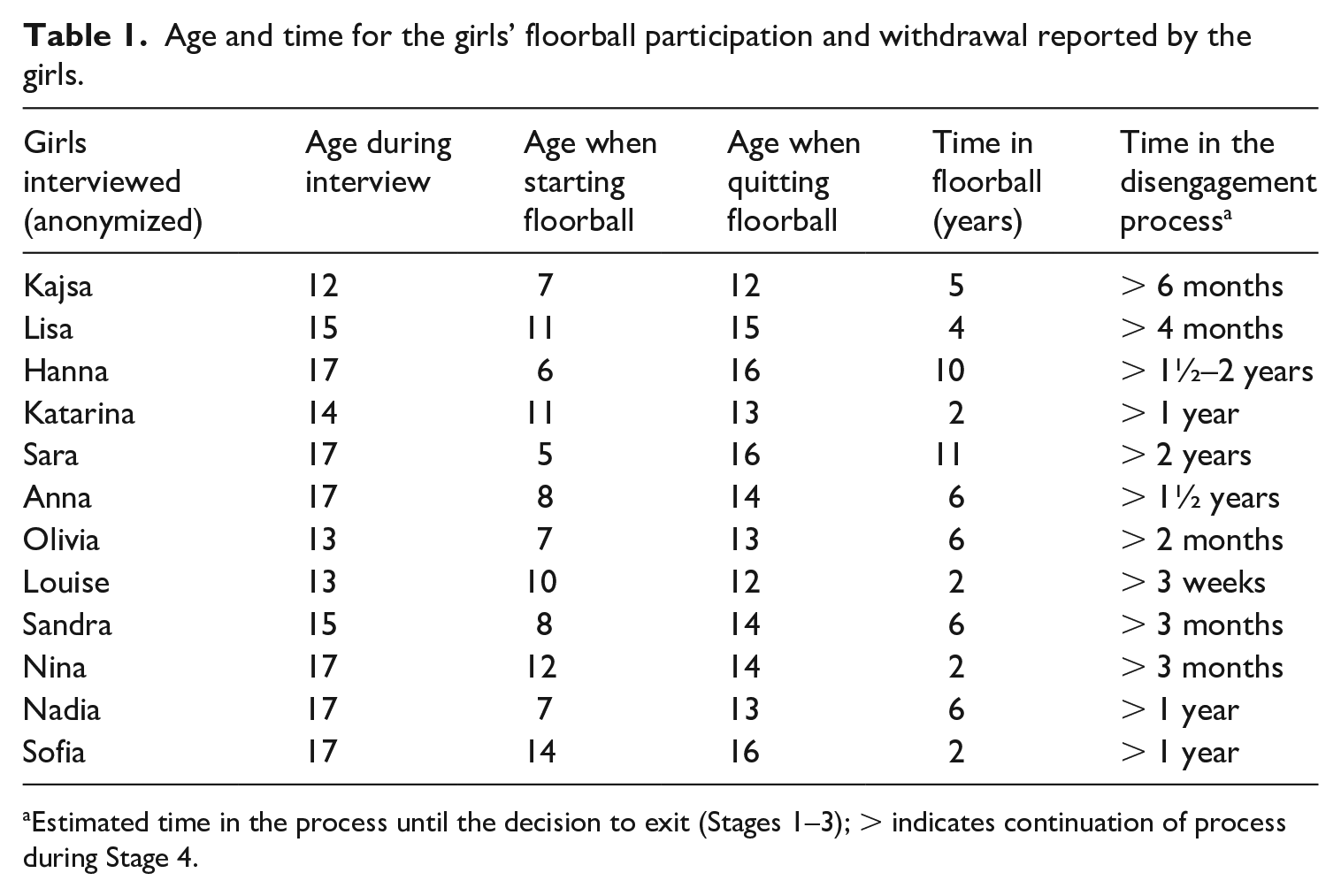
Estimated time in the process until the decision to exit (Stages 1–3); > indicates continuation of process during Stage 4.
The girls in this study had withdrawn from floorball, but many of them continued or started other activities, so we categorized them as activity-specific dropouts (Fraser-Thomas et al., 2018; Gould, 1987).
Procedure
Interview guides were developed based on the stages of Ebaugh’s (1988) disengagement theory. The girls and the parents were asked a series of questions adjusted to the informants’ role. The questions were formulated using everyday language to facilitate the understanding of the questions. Based on Drahota and Eitzen’s (1998) findings about important aspects that may occur before the disengagement process, we also included questions about the participants’ thoughts and experiences from the time when the girls were younger and willingly participated in sport activities (a, b), as well as questions that invited them to reflect on what might prevent girls from quitting sport (g). The interview guide therefore contained the following seven themes: (a) background; (b) involvement (values, feelings and expectations when participating); (c) first doubts; (d) the decision process (who was involved, interactions, duration of the process); (e) the final decision to withdraw (critical factors inside and outside sport, freedom of choice); (f) after the decision (announcement, contact with team); and (g) potential prevention (what could have persuaded the girls to continue).
The parents were contacted first by email with information about the study, followed by a telephone call within two weeks. This gave potential participants time to consider their participation before being verbally asked whether they would like to participate in the research. The girls were contacted through their parents, and informed consent was obtained from all participants who voluntarily agreed to participate. To protect the participants’ confidentiality, floorball federation and sport club representatives were not informed of who finally agreed to participate in the study. The sport clubs were also anonymized. The participants were informed that their answers and names would not be told to anyone else, including sport club representatives and other parents or children.
The interviews with children and parents were conducted separately to prevent them from influencing each other and to protect their confidentiality. To create trustworthy qualitative data, we tried to establish a friendly atmosphere during the interviews by ensuring that the girls and their parents felt safe and well informed. It is important to consider power relations between researchers and participants, especially when the latter are children (Alderson, 2004). We therefore tried to reduce power asymmetry by not using complicated language and by empowering the participants by expressing to them that they had important knowledge to share. Of the interviews, 17 were conducted face to face (9 girls and 8 parents), whereas 7 interviews (3 girls and 4 parents) were conducted via telephone. The face-to-face interviews were conducted at the participants’ convenience and choice of location, which included the clubhouse, sport arena, at a university or in the family’s home.
Analysis
All interviews were transcribed into text, and all words and hesitations were rendered as precisely as possible. The qualitative data analysis was based on condensing and interpreting meanings (Kvale and Brinkmann, 2015) and involved six steps. First, we read the complete interview transcripts to get a sense of the overall content of the data. Second, each coherent transcript unit was assessed according to its central meaning and compressed into shorter statements. Third, the shorter statements were placed in tables to obtain an overview of the results for further analysis. The tables were based on the data’s interpretation in relation to the research questions, with separate columns for athletes and parents, and divided by stages of the disengagement process. Fourth, the statements in the tables were reviewed and discussed by both authors. Fifth, deeper interpretations were made in terms of disengagement theory and previous research. Final conclusions were drawn, and representative quotes were collected. The last step involved developing the written story of the girls’ disengagement process. In all steps, both authors continuously met in a ‘critical dialogue’ (Smith and McGannon, 2018: 113) to discuss the interpretations and ensure rigour and trustworthy results by challenging each other’s views and explore alternative explanations in the connections between data and theory. The data analysis was carried out deductively in relation to the stages of the disengagement process. However, we were also alert to collect data outside the theory’s stages and let results emerge inductively from the data during the analysis. The major themes which inductively emerged from data on girls’ experiences before they started to doubt their sport participation were ‘coaches’ interactions’, ‘expectations’, ‘team cohesion’ and ‘having fun’.
To address the study’s aim and elaborate on the complexity of the stages within the disengagement process, we required 24 participants to reach sufficient data saturation because less new knowledge was yielded during the last interviews. Saturation is according to Kvale and Brinkmann (2015) commonly reached with around 15 +/- 10 interviews.
Results
Most of the girls looked positively upon their initial time playing floorball. The girls and their parents expressed how the coaches’ interactions with the girls, as well as team cohesion, feelings of belonging to a community and having fun together with friends, contributed to this. Sport practices during the younger years were felt to be adapted to the girls’ expectations, desires, skills and ambitions. Despite these positive experiences, all the girls in this study withdrew from the sport. In the following section, the girls’ and their parents’ perceptions of the girls’ withdrawal from floorball are presented through the four phases of Ebaugh’s (1988) disengagement theory.
Stage 1: First doubts
Although the girls initially had positive feelings towards their sport participation, several circumstances changed, especially inside sport, but also outside it. This began the disengagement process and led the girls to redefine their sport participation, which they previously took for granted. Feelings of dissatisfaction grew towards their participation in floorball. For some, this seemed more gradual (for example, becoming more aware of discrepancies between their and others’ goals and expectations), whereas others reported more ‘critical incidents’ (Ebaugh, 1988), like harsh comments from coaches or changes in their team compositions. These doubts made them reinterpret their role as floorball players and question whether the role aligned with their values and ambitions. Below are the six identified significant themes for the girls’ first doubts elaborated on: (a) increased performance and result orientation; (b) new team compositions; (c) new coaches; (d) high demands on themselves; (e) lack of time; and (f) other interests.
Increased performance and result orientation
The girls and their parents expressed that the focus of sport practice became increasingly performance- and result-oriented. This had practical consequences for the sporting practices (for example, feedback from coaches became more focused on performance enhancement, and some girls were not selected to play games) and caused the girls to question their skill levels, ambitions and efforts. Hanna (17 years old; hereafter only the year of age is included after the name) elaborated on her possibilities for continuing if she did not have the same goals as the others: ‘I do not think this was possible because then you feel bad in comparison to the others because they have ambitions and you do not.’ Lisa (15) expressed similar concerns: ‘They (her teammates) wanted to put in the time and effort to be the best, but this was not my goal (to be an elite athlete).’ These questions about the importance of performance made the girls more aware (gradually conscious) of their skill levels and others’ expectations. For a couple of girls, this raised awareness of their skill level, so they began to consider the possibility of developing more in other sports. The parents reported that the girls felt pressured to perform well, showed fear of not being selected and in some cases lost their enjoyment of floorball and began to create excuses for why they would not attend practice.
New team compositions
Most of the girls’ teams merged when they became too small, and some girls were selected to play with more than one team. This contributed to an altered social situation. Nadia (17) felt that ‘everything changed; they wanted our whole team to split . . . I wanted to be with my team and thought, “Shall I put more time into soccer now when it starts to not feel so good here (in floorball)?” ’ It troubled her that when she and some of her former teammates played with another team, the older girls did not talk to them. Several girls expressed that they missed their previous teams’ cohesion and camaraderie. In the new teams, subgroups and increased age differences created negative feelings and some insecurity connected to the girls’ place and role in the new teams.
New coaches
A result of team mergers and the girls growing older was that several girls got new coaches. These new coaches coached with an increased focus on results and sport performance but less on joy. Further, the girls experienced less attention from the coaches on their feelings and needs. Hanna (17) got a new coach which made her doubt her participation as this coach shocked and offended her when he had coached her during a Junior National Championship tournament. The coach told her and another girl that they had ‘no potential’ in floorball and this interaction had significant long-term effects: The coach ‘did not seem to understand girls of our age at all. They seemed not to understand that we took this very personally, that this was a huge thing for us.’ Lisa’s mother also explained how Lisa started to talk about withdrawal when her coach told her that she might not qualify for the team, at the same time as her friend was excluded at the age of 13. Harsh comments from coaches concerning the girls’ skills became cues that were experienced several times and created an awareness of a changing sport culture, which they did not like.
High demands on themselves
According to the girls and their parents, the girls wanted to excel in different areas, which became stressful. Sara (17) explained: ‘The pressure that you had to be good, or the pressure I had on myself, that I needed to be the best . . . it got stuck in my head, and I became afraid of not being good enough.’ Anna (17) said: ‘I do not think I was good enough.’ The expectations that significant others (coaches, parents and teammates) had for the girls were partly unclear – for instance, if all practices were mandatory and how others valued their performances. Consequently, some girls created demands on themselves. Nina (17) said: ‘I think this affected me. The demands, they affected me quite a bit. There were demands, or no one really expressed any demands, but I still felt there were demands.’ For many of these girls, the first doubts appeared during adolescence, which they described as a period when it was important to fit in. The girls and their parents explained how this period often negatively affected the girls’ self-confidence. Kajsa’s mother reflected on how serious everything became when the girls become teenagers. The girls had a very hard time when they also placed high performance demands upon themselves. In addition, Nadia’s mother told us her daughter and her friends constantly worried about their appearance and whom they should be friends with and how this teenage period involved many emotions and concerns. She meant that this added to the pressure of them ‘having to perform their best all the time (in floorball), which might have been too much to handle’. Sara (17) explained the importance of caring about the players’ self-confidence: ‘I believe you have to work a lot with girl teams. Most often, girls have bad confidence at this age.’
Lack of time
Most of the girls were involved in other sports or leisure activities in which the demands and the number of practices increased similarly to those in floorball. In addition, schoolwork became more demanding and took more time. This added to the pressure on the girls, as Olivia (13) stated: ‘I wanted to continue with both (sports) but it is hard to do so . . .. For example, I work at weekends and then there is games, it gets very short with time as I have to study too.’ Katarina’s father also expressed this: It was really due to lack of time, she goes to the lower secondary school now and there is a lot of homework and then she is taking different dance classes so it got difficult to stay afloat. She is also playing soccer in the summer.
Other interests
Having other interests gave them possibilities to compare and value their involvement in floorball with being involved in other activities. Sandra (15) explained: ‘I just did not think floorball was that fun, and I had other sports I thought were more fun. It was handball and track and field. I was also doing gymnastics.’ Being involved in other activities also made them question their chances of becoming good in other areas. Louise (13) valued being good at both soccer and floorball but was convinced she had to choose one of the sports: ‘You cannot think that you will become a World Champion in two sports, you cannot have that approach to both sports. Even if you want to be good at both you still have to choose.’
Stage 2: Seeking alternatives
Valuing cost and rewards
In the process’s second stage, the girls questioned their participation by more consciously comparing the value with the ‘costs and rewards’ (Ebaugh, 1988) of continuing or withdrawing from floorball. On the positive side, feelings of mastering skills, playing and winning games and good team cohesion were reasons to continue. One girl said: ‘I believe the feeling of being good at something, be able to perform and feel excited for games, that was what was fun, the team cohesion and to win games and cups were so very fun’ (Sara, 17). On the negative side, the girls expressed doubts about their skills and ambitions: ‘Sometimes it was good . . . if I fulfilled the demands, but if I did not, it was very difficult, and I became mad at myself.’ They became even more conscious about how others viewed them: ‘During games you thought “these players are always selected”; these thoughts were often on my mind’ (Lisa, 15).
At this stage, they also started questioning their ability to participate in floorball and in other leisure activities while managing school well. Katarina (14) also participated in soccer and dance and said: ‘I felt I did not have time for everything and I felt very stressed, I started 7th grade and it was a lot in school and so . . ..’
Loyalty to teams and increased awareness of discrepant goals
Interestingly, the participants highlighted the fact that in the second stage of the process, their reasoning involved what was best for themselves and what was best for their teams. Lisa (15) explained how she could not play just for fun when her teammates had higher performance goals. Nadia (17) expressed her thoughts: ‘I am going to quit. I do not like it when it is like this, but I might play the rest of the season, as I do not want to let the team down.’ Concern and loyalty towards their teams seemed to influence the time of the girls’ withdrawal.
Sara (17) was a promising floorball player who was selected for the club’s women’s team. However, she felt that her goals clashed with other people’s expectations, which became crucial for her to continue to Stage 3 of the disengagement process and move towards her final decision to quit. Floorball was a big part of her life, and she was a high-performance player, but she could not see herself having a career in floorball: ‘My dad said, “You can’t quit now; you have the chance to become big (successful).” But, I didn’t want to become “big”. I just wanted to play . . .. I had other dreams about what I wanted to become.’ She then referred to her vocational plans that did not involve a floorball career. Thus, becoming the best in the sport is not the given goal for everyone’s participation. Realizing their goals were incompatible with those of the team or of the sport organizations seemed to be an important insight for the girls to continue the disengagement process.
An emotional process
Many of the girls and parents described this decision as difficult. It apparently involved many emotions, and the girls questioned themselves, their goals and their wishes for the future. Katarina (14) thought that quitting floorball would be ‘very hard as I thought it [floorball] was so very fun’. Kajsa’s mother described Stage 2 as a time of separation anxiety. Her daughter was very emotional when she tried to understand how it would feel not to be part of the floorball team she liked so much. This shows the complexity of young people deciding to quit when they still feel the sport is fun.
Interactions with significant others
A typical part of the disengagement process among these young girls was talking with their parents about quitting floorball, especially with their mothers. Some also talked to their friends on the team, and some mentioned withdrawing to their coaches, but nobody seemed to have seriously discussed their thoughts with coaches. Few girls had any contact with other representatives from their sport clubs. During the decision-making process, talking with parents and friends seems to have been of importance for the girls.
Stage 3: The turning point
Reaching the decision to quit
The ‘turning point’ relates to the third stage of the disengagement process, when the girls decided to terminate their involvement in floorball. Interpretations of various cues became increasingly visible and conscious, and the girls reached a turning point that many of them expressed as a relief: It became easier and easier. In the beginning, it was difficult, and then I thought: No, if it is so difficult (to quit), then I should continue. And then, over time, it became easier and easier to think that I would quit. And finally, I thought: No, I don’t feel good doing this, and I want to do things I feel good about. (Hanna, 17).
Another girl stated: ‘I thought about it the whole time, then I decided, and it felt so good’ (Sara, 17). From the analysis of the girls’ and parents’ descriptions, we found that several salient factors, at least three to four, typically became important for the decision to withdraw, though the combination of factors varied to some extent.
Duration of the process
The duration of the whole process varied between the girls. One girl decided to withdraw within three weeks due to some critical incidents. She got a new coach in whom she did not have confidence. For the other girls, the duration varied from a few months to more than two years. The girls who took longer to decide battled feelings of insecurity about how they would feel if they withdrew, especially how much they would miss the sport and their teammates. Another reason for a prolonged process was girls trying to find the right time to withdraw – they did not want to leave in the middle of a season, as this could create problems for their team. Nadia (17) exemplifies this: ‘I am going to quit. I don’t like it when it is like this, but I might play the rest of the season as I do not want to let the team down.’ Generally, the parents’ involvement seemed to prolong the second and third stage of the decision-making process, as the parents encouraged the girls to try a bit more and consider their decision, even though they supported the girls’ decision.
Announcing the decision
When announcing their decision to quit during Stage 3, some girls told their coaches during practice, and one girl wrote about her decision on Facebook. However, many of the girls said they were unsure if they had told anyone or if they just stopped attending practices. In other cases, the parents were messengers who mostly called or emailed the coaches. We interpret the process as a rather ‘silent’ one regarding the sport organization representative’s knowledge about the girls’ disengagement process.
A further complication is that the girls and their parents reported that they did not always tell the coaches the real reasons behind the decision to quit, especially if they had problems with the coach, perceived increases in demands or did not feel competent enough. Instead, they would tell coaches the girls had lost interest or did not think floorball was fun any more. Sofia (17) explained: ‘I wrote (on Facebook) that I did not enjoy it anymore, but this was not really the truth as I wanted to continue to play (floorball).’ Some girls explained that the coaches had said that they were welcome to return but had not asked about the girls’ reasons for quitting. This made the girls unsure of how much the coaches cared about them leaving the sport.
Stage 4: After the decision
Mixed feelings about not playing floorball
It was expressed that the decision to withdraw could be felt as a relief. Sara (17) said: ‘I could start something new . . .. I felt it was nice to not have that pressure . . . that now I have to pack, now I have to eat, now I have to . . .. Now I can take it easier.’ Anna (17) had similar thoughts: ‘I just felt it was so good to not have any pressure.’ Others had mixed feelings about their withdrawal. Lisa (15) said: I look at it as positive as I do not have the same pressure on myself as I had before. I can do things at my own time without feeling stressed. At the same time it is negative because I left the team and am not getting the same amount of training; one is not so active.’
She continued by talking about missing her teammates, the practices and tournaments. Sara (17) said: ‘It was a big part of my life . . . and I was pretty good, after all, so it was boring to quit.’ Some girls also missed the feeling of confirmation from others and from themselves when they performed well.
No formal contacts with the sport clubs
After quitting floorball, some girls randomly met with their coaches, who told them they were welcome to start again, but little formal contact was made by the club representatives. When asked about how they would have felt if they had been formally asked to continue, there was some hesitation. Anna (17) said: ‘I do not know; that would be a bit awkward. But it would be fun if they did notice you are not playing anymore.’ She further said she would have reconsidered her decision if someone had asked, but that it probably would not have made her change her mind. Lisa (15) answered: ‘I had been very happy, I had, but at the same time I did quit for a reason and I would stick with my decision.’ Kajsa (12) was unsure whether she would want to be contacted: ‘Then I maybe would get decision agony again.’ Some girls stated they might have reconsidered their decision if someone had contacted them. Only one girl believed she would take up floorball again, but only if the coach she did not like quit coaching: ‘If he stops, then I will do it again’ (Sofia, 17). Apparently, the further into the process they were, the more irreversible their decision seemed to be. Many girls continued or started other activities during or after the disengagement process. They mentioned, for example, dancing, jogging, music, arm wrestling and football. According to Ebaugh (1988), they started to create an ex-role and to learn new roles which may be associated with more acceptable expectations and obligations.
Discussion and conclusions
We argue that using this process approach via Ebaugh’s disengagement theory was an applicable and fruitful research design that filled some research gaps regarding young athletes’ withdrawal from sport. As such, focusing the research on the disengagement process gave us a qualitative understanding about what experiences, thoughts and interactions build up to the decision to withdraw that contributed knowledge of the underlying complex dimensions of reasons for withdrawing.
Sport withdrawal as a disengagement process
We conclude that the reasons for withdrawing were a combination of three to four of the six factors we assessed as most salient – all connected to changes – that interplay during the process. The risk of a final decision to withdraw (to reach Stage 3) seems to increase when athletes experience several (three to four) factors. Thus, one seldom finds only a single reason for young athletes withdrawing from a sport. Several factors have previously been shown as important reasons for withdrawal, but our study shows how the salient factors interplay and become increasingly significant during the disengagement process; interplay has almost never been explored (Crane and Temple, 2015). The data indicate cultural, structural and organizational dimensions of changes that simultaneously influence and constrain these girls. The salient factors for first doubts were also the ones that became decisive for the final decision to withdraw. If one finds out early what young athletes are dissatisfied with or notice any cues that Ebaugh called early warning signs, one can identify these as risk factors for the athletes’ eventually dropping out.
Changes are decisive for the girls’ disengagement process
We conclude that organizational changes in a sport and changes in a young athlete’s overall life combined with changes in normative cultural expectations associated with the young athlete’s role form the basis of the pattern of salient factors that persuade most of these girls to enter and continue the disengagement process.
The three identified changes connected to the sport organization were ‘increased performance and result orientation’, ‘new team compositions’ and ‘new coaches’. These factors interact in the process to reinforce the significance of each factor when they combine in an overlapping manner, and the risk of withdrawal seemed to increase with time in the process. Early sport specialization has been discussed as undermining motivation to continue in youth sports (Wall and Côté, 2007), but little research has described the potential significance of team changes. As in Armentrout and Kamphoff (2011), we argue that organizational changes that alter social relationships are significant in relation to sport withdrawal. Rottensteiner et al. (2013) argued that social issues and exercises that enable feelings of affiliation and competence are especially important when changes are imminent. Our findings support Moreau et al. (2018), who highlighted the importance of working with social bonds in youth sport, of having a supportive climate in physical activity groups and of finding a balance between outside rules and self-initiated actions in groups.
The three other salient factors in our study, ‘other interests’, ‘lack of time’ and ‘high demands on themselves’, correspond to previous research on reasons for dropping out (Carlman et al., 2013; Crane and Temple, 2015). However, new knowledge from our study shows that even though these factors seemed to originate from outside floorball, they were simultaneously interrelated to changes in the sport’s context. For example, the identified change of ‘increased performance and results orientation’, a cultural change, led to more frequent practices, feelings of increased demands and a lack of time (i.e. changes on a structural level).
During the disengagement process, the girls’ awareness of higher expectations from others and from themselves grew and became more present in their thoughts and decisive for their decisions. This affected the girls’ life situations with increased pressure and insecurity. They questioned their situation and moved towards the decision to quit. Also, unclear expectations (e.g. about mandatory or non-mandatory practices and about competence) led to insecurity among these girls. Augustini and Trabal (1999) similarly discussed how differences between expectations and interpretation of reality in sport may cause withdrawal from the sport.
The significant changes of situation compared to the girls’ initial time in sport impacted them to enter and continue through the disengagement process. In our results, it seemed impossible for them to play for fun any more. We stress that we are not arguing that the six factors described in this study are the only factors that may contribute to young athletes’ withdrawal. In some studies, for example, injuries score high in reasons to withdraw (Enoksen, 2011). Additionally, one girl in our study mentioned recovering from an injury during the process, but we interpreted that several of the factors described above became more salient and decisive in her final decision to withdraw. Our results shed light on the complexity of withdrawal and how the most common causes of dropout, according to previous quantitative research – ‘lack of enjoyment’ and ‘lack of physical competence’ (Crane and Temple, 2015) – are interrelated.
Characteristics of the disengagement process
We conclude that the disengagement process is a rather ‘silent process’ when it comes to the sport club representatives’ knowledge and engagement, that it is fairly long for most girls, that it becomes less reversible the further into the process the girls go, and that the decision to quit often cannot be regarded as fully voluntary.
Significant others’ involvement in the process plays an important role in encouraging or discouraging the young athletes towards alternatives in the process, and they can also be used for reality testing (Ebaugh, 1988). In our study, the coaches affected the girls’ decision to quit through their behaviour, communication and organization of practices. Researchers have previously described the fact that coaches’ ability to create socially stimulating and supportive environments with a focus on fun, enjoyment and skill mastery have an impact on withdrawal (Enoksen, 2011; Fröhlich and Wurth, 2003; Rottensteiner et al., 2013; Sarrazin et al., 2002; Wall and Côté, 2007). Parents’ and peers’ influence on young athletes has been acknowledged in connection to withdrawal (Enoksen, 2011; Fraser-Thomas et al., 2008; Fröhlich and Wurth, 2003; Rottensteiner et al., 2013). Craike et al. (2009) showed how parents also may put pressure on girls to do well academically as they progress through their schooling.
Ebaugh (1988) stressed the importance of making the disengagement as mutual as possible. Our study reveals how important the girls found their parents’ involvement in the disengagement process, as it meant they had someone to talk to who wanted them to make a decision that was good for themselves. According to the girls, neither the coaches nor other club representatives had been involved in or were even knowledgeable about the girls’ thoughts and feelings during the disengagement process; therefore, we term this a ‘silent process’. The consequences of a ‘silent process’ without mutual knowledge and understanding of the situation, or even recognition of the final exit, will lead to knowledge gaps within the organization and create difficulties in knowing what measures may be taken, and result in lack of relevant support to the young athlete, etc. This also impacted how the girls viewed their participation and themselves when few besides their parents seemed to care about their exit.
The duration of the disengagement process refers to the length of time from one’s first doubts to making the decision to exit and to the length of time needed to adapt to a new status (Ebaugh, 1988). The understanding that it took up to two years for some girls to withdraw (Stages 1–3) is valuable (see Table 1). Because the girls had started to recognize feelings of dissatisfaction (Stage 1), they interpreted the sport practices in light of those feelings (Stages 1 and 2), making them highly sensitive to negative actions and experiences.
Ebaugh (1988) discussed reversibility in terms of the possibilities of returning to an exited role and how some roles are much harder or even impossible to take on again. Many of the girls perceived the withdrawal process as emotionally draining; therefore, they were hesitant to go through this process again, which prevented them from considering re-entering the sport. This means that the process itself became a hindrance to their continuing with the sport again. The conclusion is that how far into the disengagement process the athlete is determines whether the process is reversible. Armentrout and Kamphoff (2011) saw similar results, concluding that once young athletes leave a sport, few return.
When it comes to the voluntariness of the decision to quit, the girls in our study regarded their final decision to withdraw as voluntary and something they did due to their own choices. We make a different interpretation. Looking at the decision to withdraw as fully voluntary contributes to a simplification of the complexity of the disengagement process and the underlying and sometimes unconscious dimension. That may steer the reasons for dropping out towards only the individual instead of towards the cultural and structural contexts, organizational values and changes of expectations or other events in the teenager’s life. Exiting is not always what the individual wants, as the present study shows. This provides an additional view on ‘What’s the problem with young people exiting sports?’ We argue based on our data that there is a problem when young athletes quit a sport even though they like the sport and really want to continue. Ebaugh (1988) meant that the degree of choice to exit a role needs to be conceptualized on a continuum because most exits have both forced and voluntary dimensions. Hence, we argue that the level of voluntariness needs to be understood in relation to how young athletes have limited influence over their sport participation and seldom dare to question the authority of their coaches and their sport organization (Eliasson, 2015).
Concluding remarks
In sum, we argue that using Ebaugh’s (1988) theory of the disengagement process as a theoretical framework for this work was useful to create new knowledge on the complexity of withdrawal from sport. Our overall conclusion is that by studying withdrawal from sport as a process, we found that ‘the reason’ comprises a combination of several salient interplaying factors often related to changes which give the girls growing feelings of dissatisfaction with participating in sport. Organizational changes in sport and changes in the young athletes’ overall life, together with changes in normative cultural and individual expectations associated with the young athlete role, were decisive for these girls to withdraw from sport. The fact that ‘the reason’ often seems to consist of multiple reasons which become gradually conscious during the process explains why it may be difficult for young people to explain the reason for their withdrawal. Therefore, we argue there is a strength in interviewing young people to let them give a holistic picture of their experiences and feelings, to decrease the risk of simplification of this complex process. Further, this study sheds light on the ‘problem’ with young people quitting sport; for example, even though some of the girls wanted to continue, they reached the point of decision to stop playing floorball.
Implications and limitations
Implications for practice point to the fact that knowledge of the disengagement process is essential when developing and applying strategies which may prevent unwanted or forced dropouts within sport organizations. Especially important is awareness of changes occurring within and outside the sport in young athletes’ lives and resulting in changed expectations of their socially defined rights and obligations. It is also important to pay attention to any dissatisfaction or first doubts they may have about continuing with the sport by recognizing any cues in the form of changed behaviour or perceptions (early warning signs).
This study also reveals that parents are valuable sources of information who can contribute much understanding about young athletes’ feelings and thoughts. With knowledge gained from children and their parents, it may be easier to understand when young athletes are about to enter the disengagement process, to know when and how to intervene and for what reason, but also when to offer support to the athletes during the process. For example, support that contributes to a positive ending of sport participation and the beginning of the young individuals’ new role as ex-athletes (Ebaugh, 1988). We therefore stress the importance of continuously gathering information about young athletes’ dissatisfaction and perceptions of their sport practices to be alert to whether they are about to enter the disengagement process, and to recognize their needs and ambitions as well as their situation outside the sport and thus to be able to help them thrive in the role and maybe stay in the sport. We recognize the importance for sport clubs’ representatives to develop and apply strategies on how to work with the disengagement process related to the salient factors found in this study and other important factors found in their practices. Because changes like merged teams and new coaches might be unavoidable, it is critical to consider and to deal with those changes in a conscious way in relation to the young athletes’ experiences, which includes consideration of the normative expectations, defined rights and obligations that accompany the role of a teenage athlete in an organized sport.
The study has some limitations. Although the participants were able to clearly explain what they had experienced, and coherent stories were found between the girls and their parents, the use of retrospective self-reported data should be considered. Data depend on the respondents’ memory and their ways of understanding or justifying their withdrawal, which could have changed over time. We do not have data from the sport clubs’ representatives, which could be regarded as a limitation because we do not know the clubs’ views on their roles and responsibilities in relation to young athletes’ disengagement process.
It has been argued that using a linear stage theory when studying human development could be limiting (Hopkins, 2011; Lourenço, 2016). However, with awareness of limitations of more rigid stages within linear theories we analysed the data thoroughly to capture the relative complexity regarding variations in girls’ experiences in relation to significant others and context. We found Ebaugh’s (1988) disengagement theory useful since the stages are broad in the sense that we did not have to force data into the stages. Further, this study has provided insights into a limited number of girls’ disengagement processes within one team sport, and why there is a need for more studies with girls, as well as with boys, in various sports to understand the impact of gender and sport on the disengagement process.
Footnotes
Acknowledgements
The authors would like to thank the participants for sharing their experiences and the anonymous reviewers for their constructive comments.
Declaration of conflicting interests
The authors declared no potential conflicts of interest with respect to the research, authorship, and/or publication of this article.
Funding
The authors disclosed receipt of the following financial support for the research, authorship, and/or publication of this article: This research was funded by the Swedish Floorball Federation and supported by the Umeå School of Sports Sciences.
