




Abstract
This paper refers to the widespread notion that voluntary (sport) organizations produce social capital, popularized through the works of Robert D. Putnam, and compares social trust levels of sport club members with members in other voluntary associations and non-members. We differentiate between in-group trust and out-group trust, highlighting that not only the level of trust but also the “trust radius” counts for social cohesion in modern societies. Refining Putnam’s claims, we argue that social trust among members varies with the quality and intensity of participation captured (for instance, through volunteering), diverse social contacts and the level of membership trust experienced in an association. Based on a nation-wide survey, carried out in Germany during 2017/2018, it is demonstrated that members of civic associations indicate higher levels of trust towards in-groups and out-groups compared to non-members and they regard present society as more solidary and trusting. A fine-grained analysis among members of associations further shows that increased trust is typical for volunteers and individuals in socially diverse associations which, at the same time, are characterized by high levels of membership trust. We conclude that sports clubs need to provide beneficial context conditions for producing high levels and a wider radius of trust.
Introduction
Discussions about social cohesion, integration and solidarity currently shape the public discourse on both the future of Europe as well as of German society. These challenges stimulated scholarly debates dealing with and searching for “producers of solidarity” (Münch, 1997: 141). In this regard, civil society as a public area of voluntary associations and networks plays an important role. Since the mid-1990s, this discussion was substantially influenced by Robert Putnam’s term “social capital” (Putnam, 1993, 1995, 2000, 2015). Putnam did not conceive social capital on a micro-level as an individual’s resource (like Pierre Bourdieu or James Coleman), but rather on a macro-social level, that is, as a capacity of communities and societies to (re)produce solidarity, trust and socially accepted norms, seeing it as a solution for overcoming problems of collective action. With his strong emphasis on voluntary associations, Putnam follows Alexis de Tocqueville’s classic report on democracy in North America which describes small-scale structures of local self-government as a foundation for social cohesion and solidarity in egalitarian, individualistic societies (De Tocqueville, 2001 [1835]: 248 ff.). Voluntary associations therefore play a central role and become “the sole source of (…) social capital” (Cohen, 1999: 217), because they are thought to develop forms of social trust and maintain generalized reciprocity norms.
The notion behind this argument is based on two assumptions that build upon each other (Braun, 2014): first, social interactions in voluntary associations could establish a particular form of community in which active members develop trust in one another (“socialisation assumption”); and secondly, members are supposed to generalize this social trust as a form of habit to other areas of life (“transfer assumption”). In this sense, social capital research presumes that trust won in voluntary associations extends to other social areas as generalized trust and may thus affect social cohesion in a wider local context. This transfer assumption resembles Putnam’s (2000) “rainmaker effect”, that is, that everyone in the same community benefits from group externalities.
Most studies refer to this idea of “general social trust”, usually captured with the survey question: “Generally speaking, would you say that most people can be trusted or that you can’t be too careful in dealing with people”. Yet attention was repeatedly drawn to corresponding methodological difficulties (e.g., Delhey et al., 2011; Engbers et al., 2017), as it remains largely unclear what respondents associate with the phrase “most people”. A few individuals could rather mean people close to them, while others instead have unacquainted persons in mind. Delhey et al. thus emphasize the need to distinguish between the level of trust and the “radius of trust”, because trust may either refer to “small, face-to-face communities where people know each other and interact closely, where social controls are strong (…), and misbehavior can be easily sanctioned” or to the “countless daily interactions between unfamiliar people” (Delhey et al., 2011: 787). As the question regarding how much civic associations – and in particular sport clubs – contribute to in-group trust and out-group trust is unanswered to date, this study will provide first empirical clues regarding this important question.
The focus of this study is on sport clubs since high expectations are regularly put forward in public and scholarly discourses in Germany and other European countries concerning the potential of sport organizations to (re)produce social capital (Rittner and Breuer, 2004). “In countries such as Austria, Denmark, the Netherlands, Switzerland, Germany, France, Northern Ireland, England, Sweden and Belgium there is a broad agreement on the social significance of sport clubs and their ability to contribute to policy objectives with regard to for instance social inclusion, health and safety” (Hoeckman et al., 2015: 427–428). In Germany, about 90,000 sport clubs exist and the German Olympic Sports Confederation (DOSB) – an umbrella organization with 27.5 million memberships – usually claims to be the country’s largest civil society organization (DOSB, 2018). These 90,000 locally rooted sport clubs, which comprehensively cover the whole country, provide on-site facilities and opportunities for competitive and performance-oriented as well as recreational and health-oriented sport. In most of these clubs, opportunities for socializing exist and accompany the practice of sport. Moreover, as the majority of these clubs are smaller ones with up to 300 members, a crucial pillar of these associations is the voluntary engagement of their members. Full-time professionals are usually only found in larger clubs (e.g., Breuer et al., 2015; Thieme, 2017). Hence, sport clubs in Germany can be conceived as textbook examples of voluntary associations.
Against this background, the present study examines whether a membership in a voluntary association and especially in a sport club positively correlates with general social trust. Besides the question to which degree sport clubs produce social trust at all, the findings will provide suggestions whether this trust has a smaller or wider radius, that is, encompassing only the in-group or also out-groups. This perspective has not been addressed in sport-related social capital research so far and may yield important insights. Moreover, the paper will assess how much the quality and intensity of participation, the diversity of social contacts in these associations and the perceived degree of membership trust, predicts a person’s general trust level. Hence, potential mechanisms are focussed upon which may play a role in the production of in-group trust and out-group trust.
State of research
Sport clubs as catalysts of social capital
Although Putnam’s work attracted substantial critique for conceptual crudity, ecological fallacies in his analyses, and an idealization of the positive effects of social capital (e.g., Blackshaw and Long, 2005; Cohen, 1999; Portes, 1998), it still initiated a wide range of social capital research, which spanned from sociology and political science to economics and sport science (e.g., Engbers et al., 2017; Mutz and Nobis, 2012; Okayasu et al., 2010; Quintelier, 2008; Van der Meer and Van Ingen, 2009; Wollebæk and Strømsnes, 2008). This research mostly found small positive correlations between a membership in civic associations on the one hand and social capital indicators such as social trust or political participation on the other. A variety of studies pointed out that social capital effects can differ regarding types of associations, institutional contexts as well as the membership composition of an association (Coffé and Geys, 2007; Paxton, 2007; Quintelier, 2008; Sivesind et al., 2013; Van der Meer and Van Ingen, 2009).
Putnam’s (1995, 2000) studies ascribed a prominent role to sport clubs as catalysts of social capital in society. However, empirical studies on sport clubs and social capital have so far produced mixed results. For instance, Seippel (2006) demonstrated with Norwegian data that generalized trust levels are higher among members of sport clubs compared to non-members. Australian data indicate that a higher sense of connectedness and elevated levels of social trust are typical features of sport club members compared to non-members (Brown et al., 2014; Hoye et al., 2015). An analysis by the German Socio-Economic Panel found that adolescent sport club members have a higher probability for civic engagement, volunteering and helping behaviour in later life (Schüttoff et al., 2017). A similar lifecycle effect was shown with Canadian survey data, where sport participation in adolescence was positively related to involvement in community activities in adulthood (Perks, 2007). However, it seems that analyses which control more rigorously for the social selection preceding a participation in civic associations (e.g., with regard to socio-economic status and family characteristics) usually find only marginal effects (Mutz and Nobis, 2012). This notion is buttressed by qualitative accounts, showing that volunteering opportunities in sports are frequently used by privileged youths (Storr and Spaaij, 2017).
Despite this comprehensive body of research, no study so far has picked up the distinction between in-group trust and out-group trust. Hence, it is still a matter of speculation if the social trust possibly produced in sport clubs and other civic associations has a smaller or a wider radius. Addressing this academic void, our first research question reads:
RQ#1: Is sport club membership (or a membership in another civic association) associated with higher levels of in-group trust and/or higher levels of out-group trust?
Sport clubs as inward-oriented voluntary associations
The question of which types of associations are especially suited for promoting trust has not been satisfactorily answered to date. While Putnam (1993) has favoured leisure associations, Van der Meer and Van Ingen’s (2009) empirical findings are inconsistent with this claim: after comparing different types of associations they conclude that organizations in the leisure and sport sector produce smaller social capital effects compared with political, activist or social welfare organizations. Capturing the many different voluntary associations under one umbrella term has been widely criticized, so that scholars have long since endeavoured to systemize the multitude of voluntary associations (e.g., Banks et al., 2014; Prentice and Brudney, 2018; Vakil, 1997; Zimmer, 2007). However, there is no widely accepted typology of associations, so that the “lack of consensus on how to classify them remains a perplexing dilemma” (Vakil, 1997: 2057). Consequently, each study aiming to compare different associations is faced with the challenge of justifying a typology of clubs. This applies to this paper as well.
In the present context, we refer to Gordon and Babchuk’s (1959) “classic” typology of voluntary associations, distinguishing between inward-oriented and outward-oriented associations. Inward-oriented associations pursue the goal of “member serving” (Knoke, 1990) and are geared “to furnish activities for members as an end in itself” (Gordon and Babchuk, 1959: 25). Outward-oriented associations are viewed as means through which one can reach social or political goals and exert an influence on the social environment. However, expanding the original typology, we further distinguish externally-oriented associations, the objectives of which focus on third parties to realize services for non-members (Horch, 1992; Zimmer, 2007).
This differentiation of four types – sport, non-sport inward-oriented, member-serving outward-oriented and third-party oriented associations – allows us to make assumptions regarding the potential of these types of associations to generate in-group and out-group trust. Sport clubs as well as other non-sport inward oriented associations (e.g., hobby clubs or music groups) are usually characterized by frequent face-to-face interactions among members and a high degree of conviviality, so that members’ feeling of belonging as well as their orientation towards common values and group norms are supposed to be high. Hence, it can be expected that these associations can more easily generate membership trust, which should be a precondition for generalized trust. However, the radius of trust may be smaller and restricted to the in-group. Outward oriented associations’ (e.g., unions and parties) and externally oriented associations’ (e.g., environmental activists or human rights groups) potential to generate membership trust may be smaller, given that critical debate and deliberative processes characterize many activities in these associations. However, these associations may have a greater potential to foster out-group trust, given that members are more likely to come into contact with different social groups and social milieus. Whereas unions, parties or local initiatives (member-serving outward oriented associations) are often regarded as agents of political socialization (Rucht, 1997), externally oriented associations – which are often concerned with the needs of vulnerable groups – are supposed to foster their members’ pro-social attitudes and social responsibility (Youniss and Reinders, 2010). These associations may thus enhance their members’ radius of trust. With these considerations in mind, we can postulate a second research question:
RQ#2: Do members of different types of civic associations differ from each other with regard to their average level of in-group trust or out-group trust?
Qualities of membership
In terms of the development of social capital, outcomes may not only vary with different types of associations but also with different types of individual participation. In this sense, colloquial expressions such as “passive member” or “sleeping member” in themselves raise the question of whether membership alone is an adequate criterion to justify the notion of voluntary associations as a source of social capital. It is more likely to assume that active participation in activities, usually operationalized with length of membership, frequency of attending activities, or an engagement in voluntary work, is prerequisite for any socialization process in clubs. In this regard, studies not only show that volunteering is very prevalent in sport clubs (Ibsen and Seippel, 2010) but that social capital is higher among active members and volunteers compared to passive members (Mutz and Nobis, 2012; Quintelier, 2008; Stolle, 1998; Wollebæk and Strømsnes, 2008). Hence, it seems likely that effects are not produced by membership per se, but solely by active participation. As most previous studies have at least found a “volunteering effect” on social capital, we assume that trust levels are higher among active, volunteering members compared to passive members. In addition, we also test whether or not the length of the club membership matters for trust levels.
RQ#3: Do volunteering and long-standing club members report higher trust levels (towards in-groups and out-groups) compared to non-engaged, passive members?
Lack of consistency in findings could also be related to the fact that (sport) clubs vary with regard to the composition and diversity of members which may have consequences for openness towards new members as well as for the level and radius of trust. In this regard, the distinction between “bonding” (exclusive) and “bridging” (inclusive) social capital has been widely discussed and is regarded as highly important (Putnam, 2000). The notion of bonding solidarity implies that a willingness to help is not regarded as universal, but rather as a form of support limited to smaller communities (Bourdieu, 1996). Everyday language may equal bonding solidarity with “cliques” or “clubbishness” (Braun, 2001; Portes, 1998).
Nichols et al. (2012) have shown that shared values, norms and understandings, that is, the perception that someone is “like us”, are crucial factors in sport clubs, particularly for the recruitment of club personnel and volunteers. Thereby, clubs may have an inherent tendency towards homophily and social closure. This notion, however, is in contrast to Putnam’s original claims. For him, organizations in the realm of leisure are socially inclusive and thus linked to bridging social capital. Bridging social capital is said to contribute to overcoming “social cleavages” between ethnic groups, genders and social classes: “To build bridging social capital requires that we transcend our social and political and professional identities to connect with people unlike ourselves” (Putnam, 2000: 411). In his later contributions Putnam (2007) further elaborates on this argument with regard to ethnic diversity in the US. He shows that increasing diversity in multiethnic societies can have negative effects on trust levels, but then claims that associations bring people from different social groups into contact with each other and thereby help to create shared identities (Putnam, 2007). To sum up, an organization’s potential to foster bridging social capital – and, as a consequence, a wider trust radius – may be a function of the diversity of direct social contacts provided by this association, that is, direct contacts to individuals with a different age, ethnic background, educational level, or political attitude. If this is true, diverse contacts in associations should impact on trust levels, particularly on out-group trust. This assumption has never been put to a test in previous research on sport clubs.
RQ#4: Is out-group trust associated with higher diversity in an organization, namely with the heterogeneity of the direct contacts a person regularly has in the respective club?
Finally, only a handful of studies have tried to detect the mechanisms that produce the social capital effects of sport clubs and other civic associations. For instance, Seippel (2005) measured the social and emotional bonds in sport clubs, but did not find that these bonds affected members’ democratic attitudes and political participation. In another study of solely sport club members, Elmose-Østerlund and Van der Roest (2017) conclude that social trust levels are not affected by sport club members’ participation in social activities and democratic processes in the club. Hence, while studies have shown that social capital differences exist between club members and non-members, the mechanisms producing these differences are still not well understood. In view of the “transfer assumption”, mentioned above, we believe that membership trust must be a crucial factor for any generalization of social trust. Hence, only when members of associations perceive other club members as trustworthy, trusting and solidary attitudes can potentially spill-over to the realms outside of the association. This is maybe the key argument: generalized social trust must be triggered by social trust experienced within a civic association. This is the last research question which will guide the following empirical analyses.
RQ#5: Is generalized social trust (towards in-groups and out-groups) associated with membership trust, that is, the social trust experienced within an association?
Methods
Sample
The analyses are based on the joint project “Organized Sport and Social Capital – Revisited”. The data are derived from a nation-wide representative online survey of 2568 participants, aged 18 and older, conducted in cooperation with Kantar Public, a renowned company for public opinion polls. Data collection took place from December 2017 through January 2018. For answering the survey respondents needed, on average, 12 minutes. The sample represents the adult population of Germany with regard to age, gender, educational level and residency. However, to adjust for minor deviations from the German population, weightings were created which harmonize sample parameters with those known from official statistics. For instance, respondents from single person households were slightly overrepresented in the initial sample and weightings account for this potential bias. Moreover, the raw data were checked for conspicuous responding: a small amount of respondents who make use of ‘straightlining’ (i.e., whose responses show a very small variance or no variance at all), and speedy responding (i.e., answering the survey in less than 5 minutes) were identified and then deleted from the data set. Detailed characteristics of the final sample are shown in Table 1.
Sample characteristics and distribution of trust values in different sub-groups.
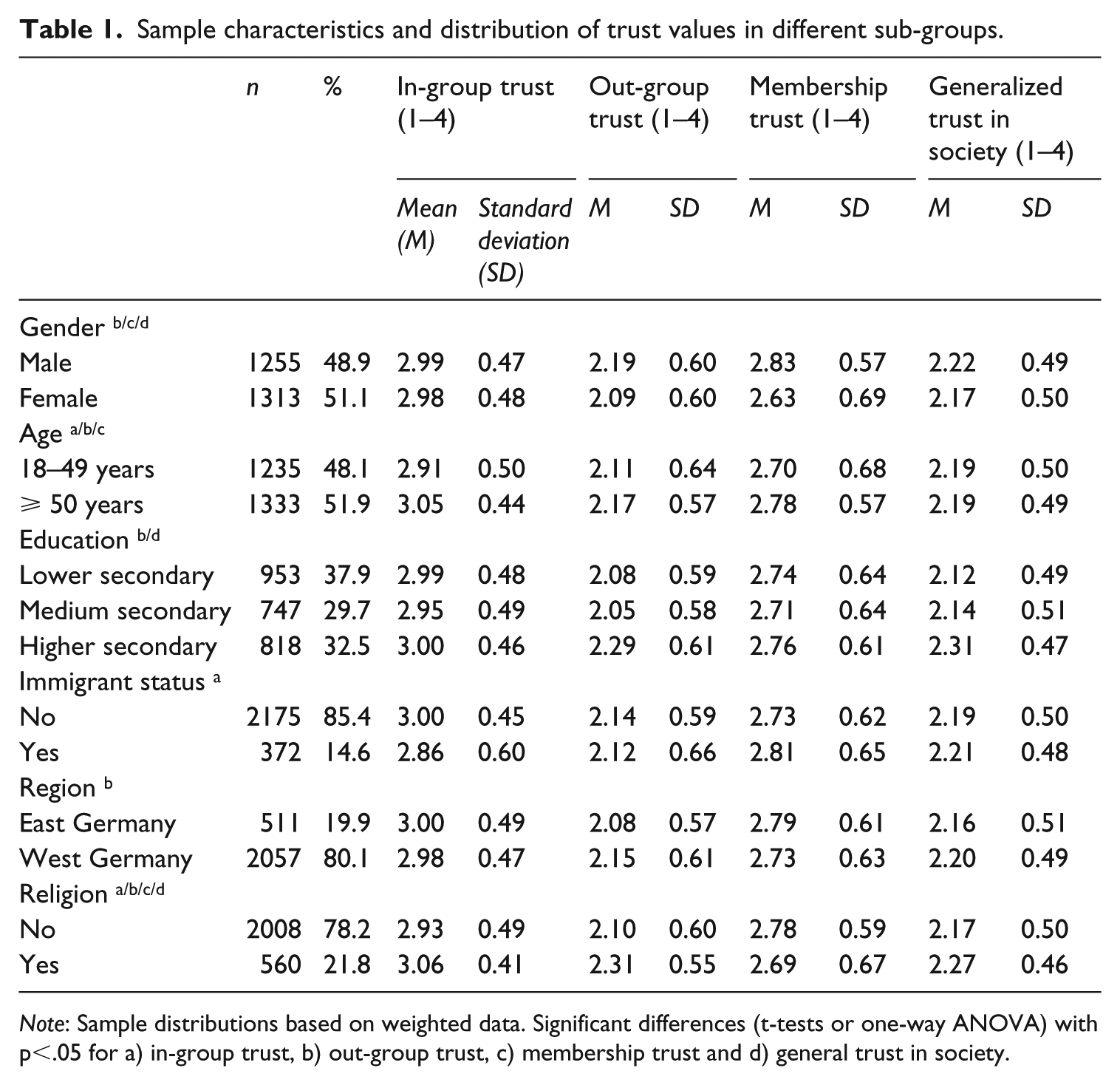
Note: Sample distributions based on weighted data. Significant differences (t-tests or one-way ANOVA) with p<.05 for a) in-group trust, b) out-group trust, c) membership trust and d) general trust in society.
Measures for social trust (dependent variables)
In-group trust and out-group trust
We measured in-group and out-group trust with the item battery developed by Delhey et al. (2011), using a four-point Likert scale. The measure distinguishes between in-group trust, that is, social trust with a small radius, and out-group trust, that is, trust with a wider radius. In-group trust was measured with three items: “I’d like to ask you how much you trust people from various groups. Could you tell me whether you trust people from this group completely, somewhat, not very much or not at all?” (a) “your family”; (b) “your neighbourhood”; and (c) “people you know personally”. Out-group trust was also measured with three items: (a) “people you meet for the first time”; (b) “people of another religion”; and (c) “people of another nationality”. Cronbach’s alpha is 0.80 for out-group trust and 0.57 for in-group trust.
Perceived trust in society
In addition, we were also interested in respondents’ perceptions of general trust levels in present society. This scale was based on three items and measured with a four-point Likert scale: (a) “If you look closely, you will find much helpfulness in society”; (b) “In fact, most people do not care about what happens to their fellow human beings” (inverted); and (c) “Relationships among people are becoming increasingly impersonal” (inverted). These items abstract from personal experiences and tap a very general view of society with regard to trustworthiness, camaraderie and solidarity (or lack thereof). Cronbach’s alpha is 0.53. The three items were already used in a similar survey in 2001 (Baur and Braun, 2003).
Independent variables
Membership in civic associations
People were asked whether they have a club membership, and which association they are a member of. In total, 14 different club memberships in voluntary associations were queried. According to the typology of voluntary associations described above, members were grouped in five categories: (a) sport clubs (n = 245); (b) inward-oriented, non-sports associations, for example, hobby associations such as small gardener, dog breeders associations or musical societies (n = 111); (c) outward oriented member-serving associations, for example, unions, parties or political groupings, professional associations (n = 186); (d) outward oriented third party-serving associations, for example, volunteer fire brigade, rescue services, human rights or ecological activist groups (n = 48); and (e) multiple memberships and miscellaneous memberships (n = 460). The rest of the respondents are classified as non-members (n = 1518).
Voluntary engagement
A dummy variable distinguishes between people who volunteer in a club and those who do not. Respondents had to agree with at least one of two items (“I help regularly”, “I exercise an office in the club”) in order to be categorized as “volunteer”.
Length of membership
To measure the length of membership in a voluntary association another dummy variable was created, distinguishing between those club members with up to 10 years of membership and those with more than 10 years of membership.
Diversity of social contacts in the association
A four-point Likert scale was used to capture personal contacts with different social groups within the association. This scale was taken from the Bridging Social Capital Questionnaire (Villalonga-Olives et al., 2016): “If you think of your club, how often do you socialize with people who…: (a) are much younger or much older than you are; (b) are of a different nationality; (c) have a different skin colour; (d) have different political opinions; (e) a different gender; and (f) a different educational background”. Higher values indicate greater diversity of social contacts. Cronbach’s alpha value for this scale is 0.79.
Membership trust
We expanded the item battery on in-group trust and out-group trust with an additional item for membership trust, capturing the trust generated in civic associations. Hence, all members of a voluntary association were asked how much they trust “other members of their association”. Answers were given on the same four-point Likert scale as described above.
Finally, socio-demographic characteristics are included in the analyses as controls: age; gender; migration background; level of education (lower, medium or higher secondary educational degree); residency in East or West Germany; and religious affiliation (yes/no).
Analytical approach
For analysing our research questions ordinary-least-squares (OLS) regression models with different trust measures as dependent variables are applied. The data comply with all model assumptions (e.g., normally distributed dependent variables, lack of multicollinearity, and independence of errors) for OLS models. In a first step of our analysis, we use the full sample and specify models for in-group trust, out-group trust and perceived trust in society to assess whether or not members and volunteers in civic associations differ from non-members in their mean trust levels. In a second step, we use the subsample of members in civic associations for analysing the impact that quality and intensity of participation and the type of association have on a person’s trust level. Here again, we compare in-group and out-group trust which allows for conclusions regarding the radius of trust. All OLS regressions include sociodemographic characteristics, hence they rigorously control for the social selection preceding a membership.
Results
Descriptive results: level and radius of trust
Descriptive results on the level of different trust variables show that in-group trust, that is, trust in a person’s closer circle of family, friends and acquaintances is generally very high (mean (M) = 2.98) and more pronounced, as expected, than trust in out-groups (M = 2.14) (Table 1). The level of membership trust (M = 2.74) is only slightly lower compared to in-group trust, though considerably higher than out-group trust, indicating that club members are more likely to be regarded as acquaintances than as strangers. Moreover, respondents have a rather sceptical outlook on general trust in society (M = 2.19), with the mean lying below the scale’s midpoint.
Figures 1 to 4 illustrate mean values of trust among members of different types of civic associations and non-members. Furthermore, Figures 1 to 4 show that members of all types of associations report more in-group trust compared to non-members. Out-group trust is also more pronounced among members of civic associations; however, trust levels for sport club members are not as high as for participants in other types of associations. With regard to trust in society a different pattern emerges: here, respondents with a sport club membership and with multiple memberships have a more positive perception regarding the societal level of trust and solidarity. Finally, membership trust is high in many associations, with the exception of those who belong to the outward-oriented, member-serving type. These descriptive results however only give a crude impression and need to be complemented by a multivariate approach.
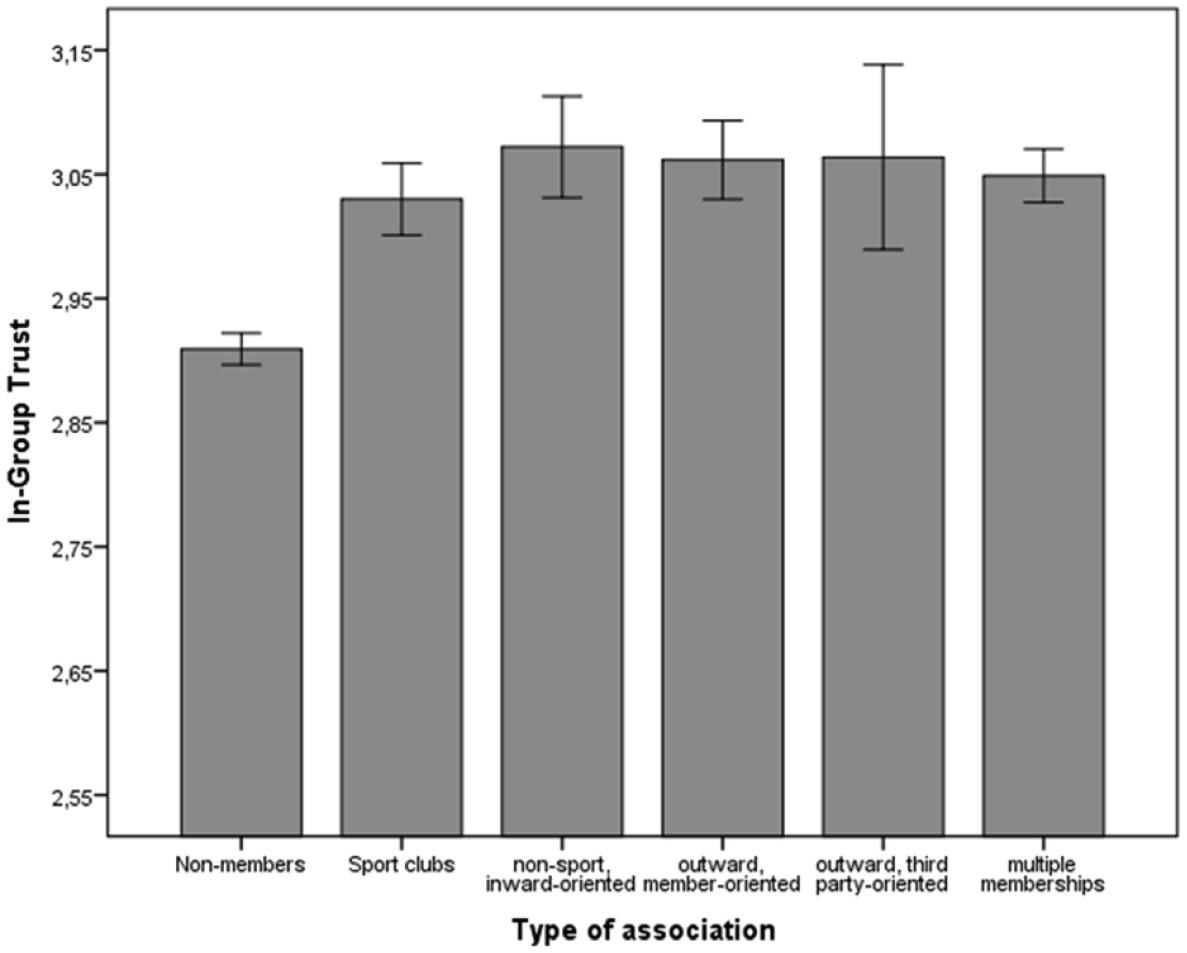
In-group trust levels according to membership and type of association.
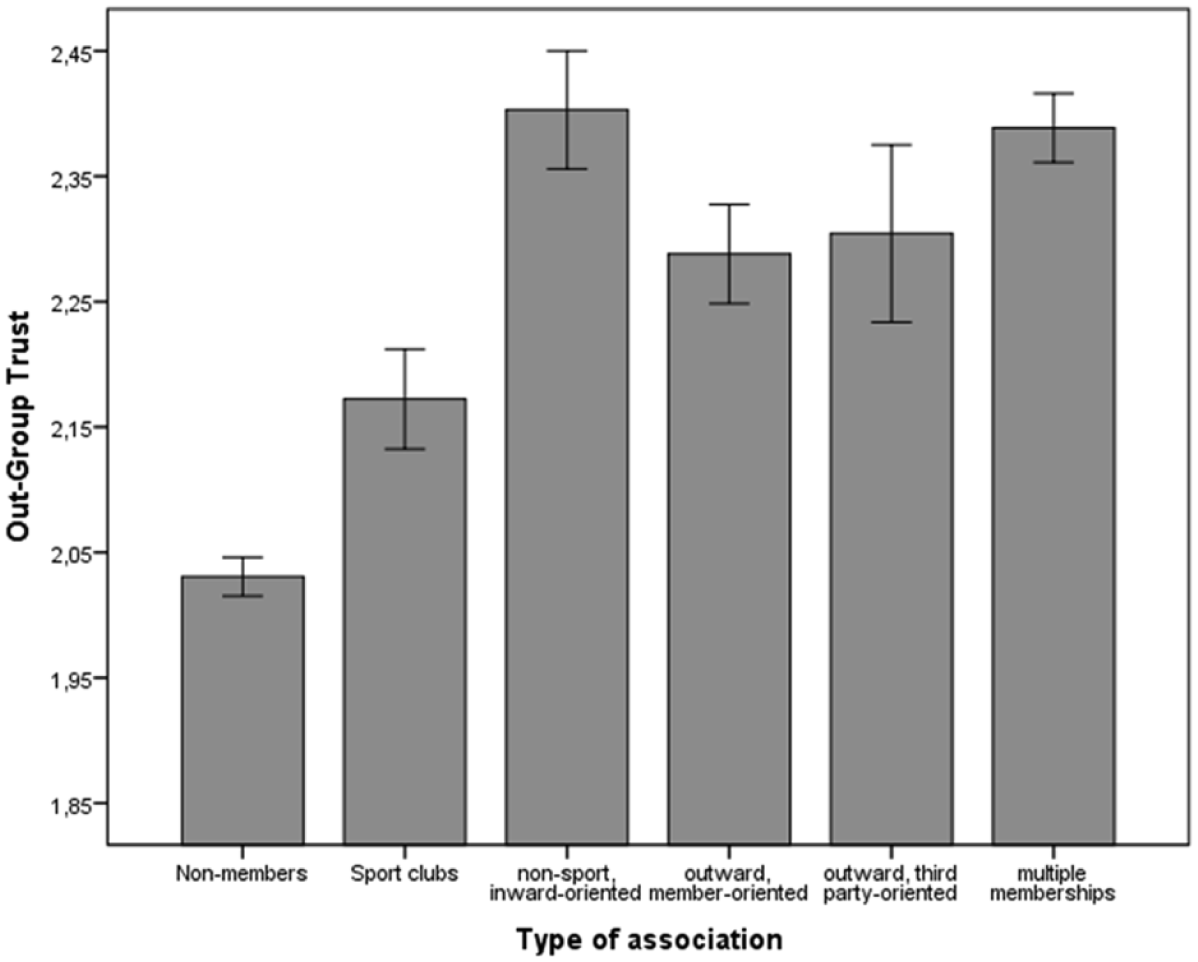
Out-group trust levels according to membership and type of association.
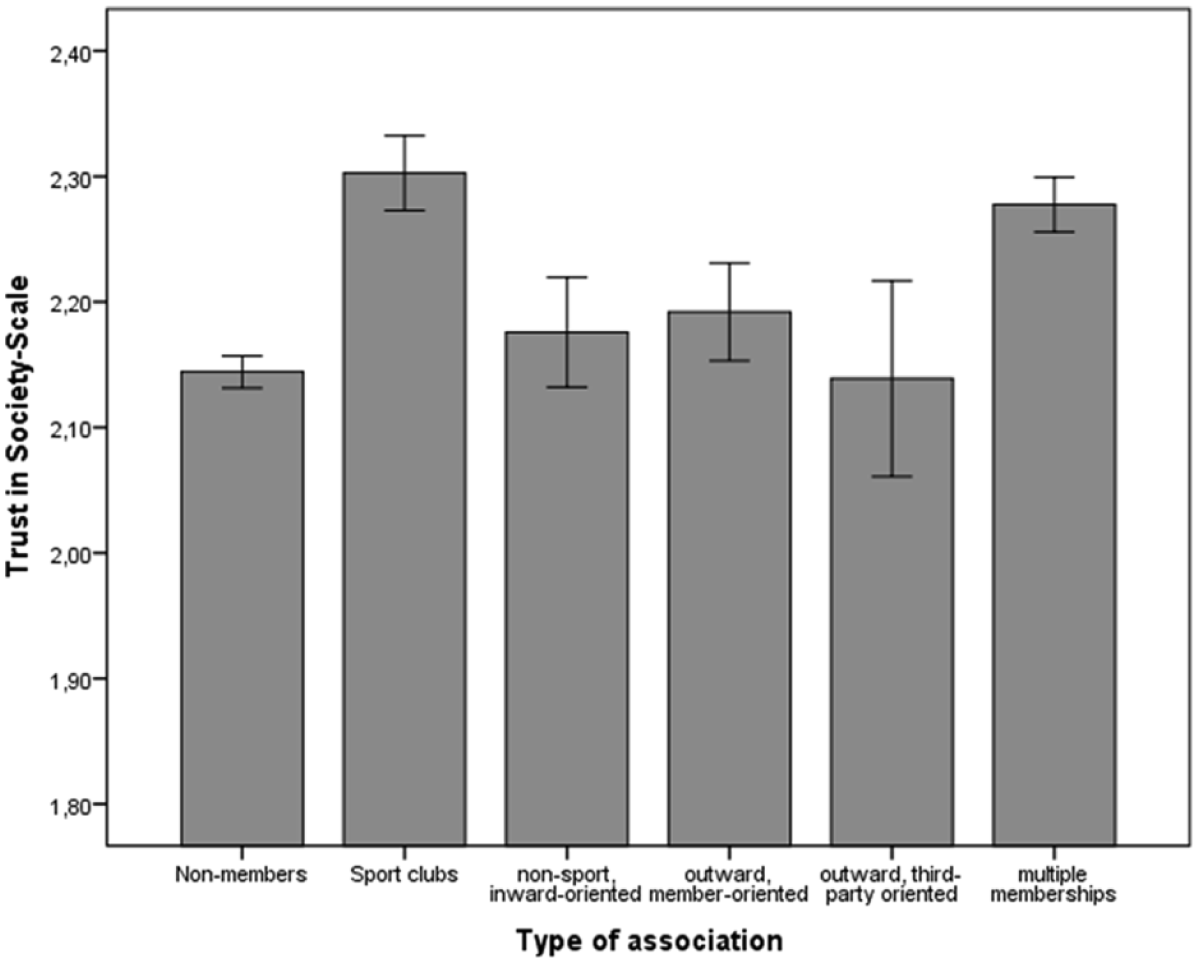
Trust in society according to membership and type of association.
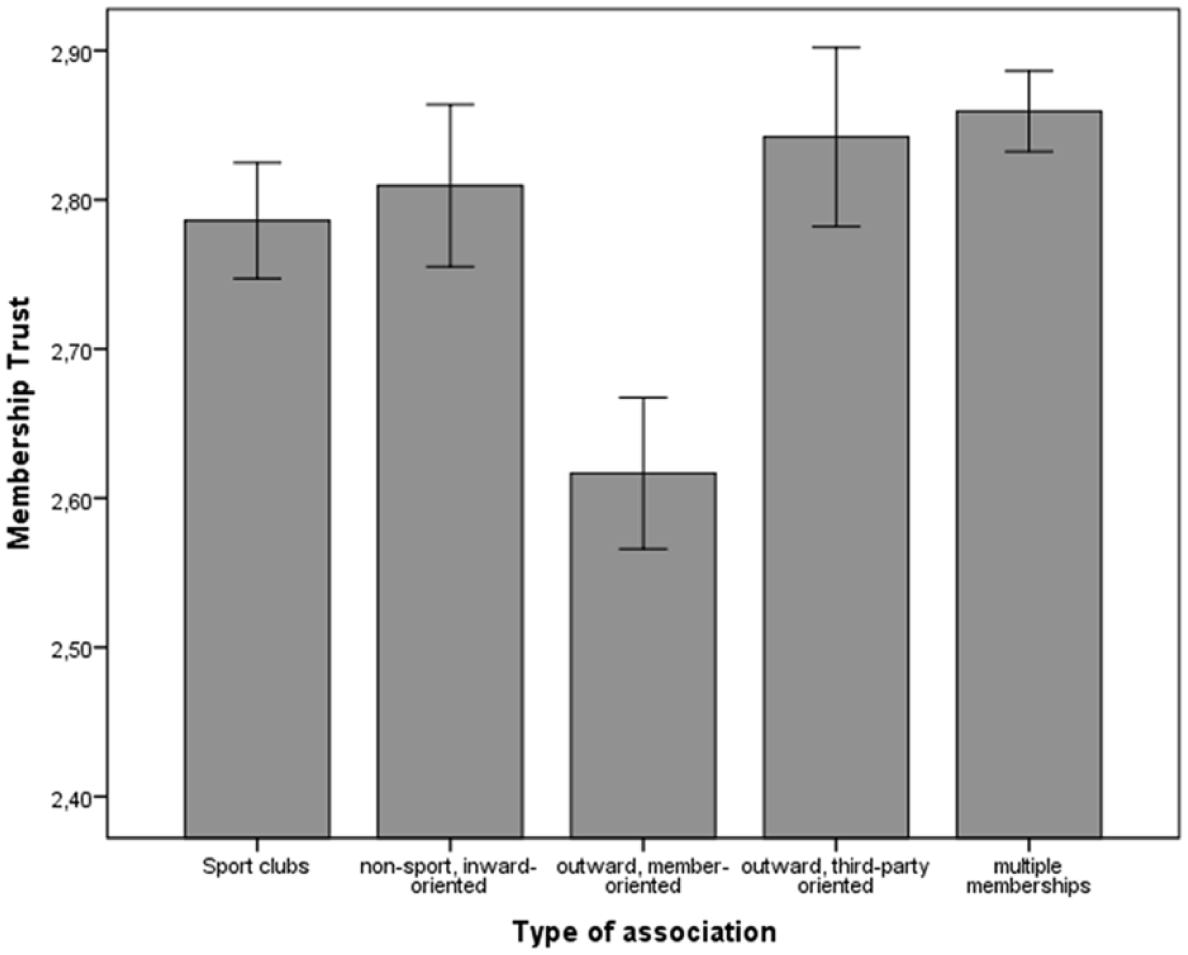
Membership trust levels according to type of association.
Differences in trust levels between members, volunteers and non-members of civic associations
The regression models presented in Table 2 use in-group trust, out-group trust and perceived trust in society as dependent variables. Club membership and voluntary engagement were included as predictors in the first and second steps. In a third step, controls for sociodemographic characteristics were added. The models are based on the full sample (n = 2568) and investigate whether differences in trust levels are found according to civic participation.
Regression models for in-group-trust, out-group trust and perceived trust in society.
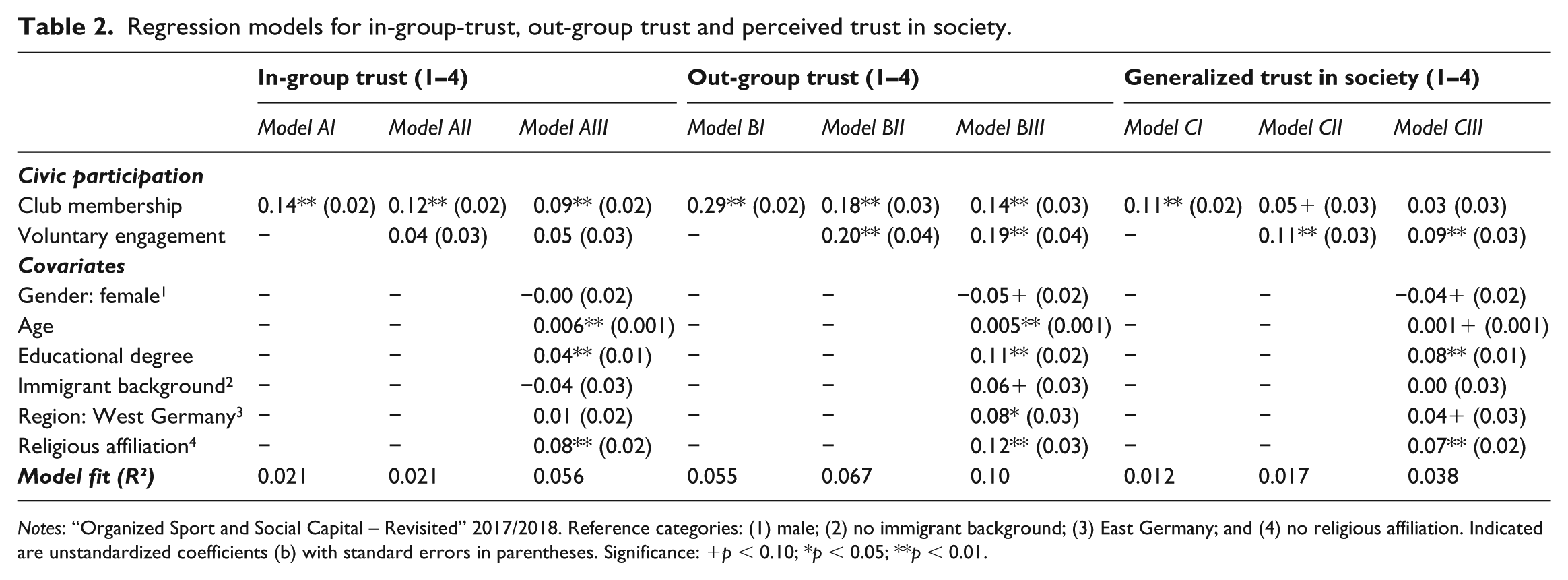
Notes: “Organized Sport and Social Capital – Revisited” 2017/2018. Reference categories: (1) male; (2) no immigrant background; (3) East Germany; and (4) no religious affiliation. Indicated are unstandardized coefficients (b) with standard errors in parentheses. Significance: +p < 0.10; *p < 0.05; **p < 0.01.
With regard to in-group trust it is demonstrated that a club membership comes along with higher trust levels. About 2% of the variance is explained by this predictor (Model AI). A voluntary engagement is not associated with additional in-group trust (Model AII). Although both have more in-group trust than non-members, active and passive members do not differ significantly from each other. The positive effect for a club membership largely persists (b = 0.09, p < 0.01), when sociodemographic variables are controlled for (Model AIII). Control variables indicate that in-group trust increases with higher age, higher educational levels and a religious affiliation. The full model accounts for 6% of individual differences in in-group trust (R²).
Findings for out-group trust reveal that a club membership is accompanied by higher out-group trust. Membership alone can account for 6% of the variance (Model BI). However, volunteering comes along with additional out-group trust, exceeding typical trust levels of passive members (Model BII). In the final regression model, the effect for a club membership (b = 0.14, p < 0.01) and for volunteering (b = 0.19, p < 0.01) both remain significant even when sociodemographic factors are controlled for (Modell BIII). Higher age and education, residency in West Germany and a religious affiliation are significantly associated with out-group trust. The model fit (R²) is 10%.
For general trust in society the analysis shows, at first glance, that belonging to a club seems to be associated with a more positive and trusting outlook to society as a whole (Model CI). However, after adding voluntary engagement in step 2 and sociodemographic variables in step 3 the effect of club membership decreases almost to zero and no longer retains significance (Model CIII). However, volunteering is significantly associated with more trust in society (b = 0.09, p < 0.01). Hence, volunteers perceive society in general as more trustworthy and solidary. In the final regression model trust in society is significantly associated with a higher educational degree and a religious affiliation. The explained variance, however, is rather low with R² = 0.04.
Differences in trust levels between members of civic associations
The next set of regression models (Table 3) are only based on respondents who have indicated at least one membership in a civic association (n = 1050). The models aim to explain the differences in trust with the type of association, which is included to the regression in a first step. Here, respondents with multiple memberships form the reference group. In a second step, data on qualities of participation are added: volunteering; length of club membership; diversity of social interactions in the club; and trust among club members. Hence, these measures distinguish passive from active members, short-term from long-term involvement, homogeneous from heterogeneous associations as well as those with high and low levels of trust among members. In a third step, sociodemographic variables are included.
Regression models for in-group trust, out-group trust and perceived trust in society.
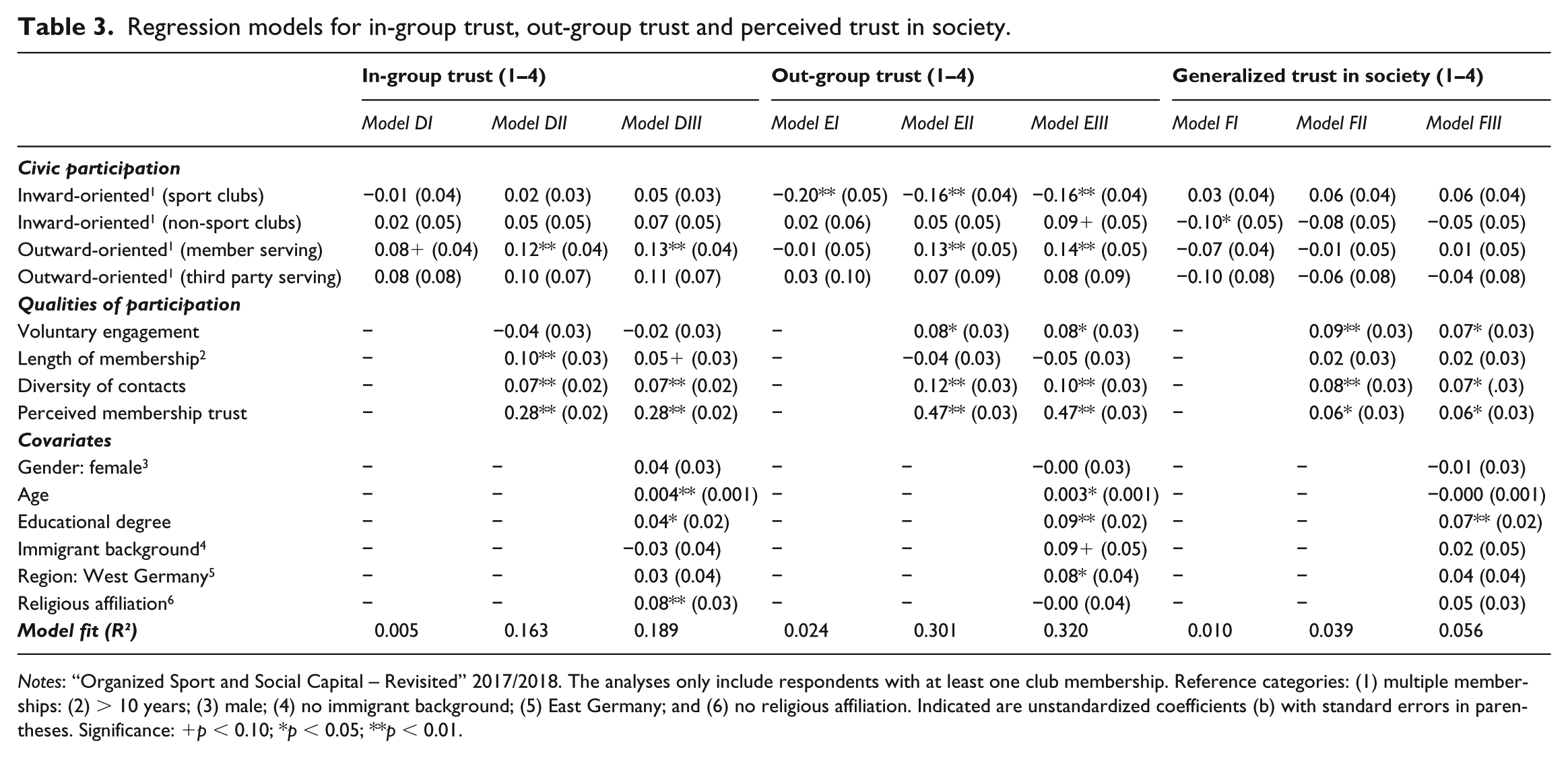
Notes: “Organized Sport and Social Capital – Revisited” 2017/2018. The analyses only include respondents with at least one club membership. Reference categories: (1) multiple memberships: (2) > 10 years; (3) male; (4) no immigrant background; (5) East Germany; and (6) no religious affiliation. Indicated are unstandardized coefficients (b) with standard errors in parentheses. Significance: +p < 0.10; *p < 0.05; **p < 0.01.
For in-group trust the model reveals that the type of association does not impact on trust levels. As the only exception, outward-oriented, member-serving associations stand out with slightly higher levels of in-group trust (b = 0.13, p < 0.01, Model DIII). A voluntary engagement is not associated with higher in-group trust, and also the duration of the membership can be neglected, as the effect is marginal in size and not significant at the 0.05-level of significance. However, the social contacts in the association matter: members with heterogeneous social contacts, that is, individuals representing manifold social groups, report higher in-group trust (b = 0.07, p < 0.01). Most importantly, the regression shows that the level of membership trust is a key determinant of in-group trust (b = 0.28, p < 0.01, Model DIII). The estimated value for in-group trust for a person who is “completely” trusting (= 4) towards other club members is 0.84-points higher compared to a person who has “no trust at all” (= 1) in club members. Control variables indicate that higher age, higher levels of education and a religious affiliation also contribute to in-group trust. The full regression model accounts for a substantial amount (19%) of the variance in in-group trust.
The results for out-group trust indicate that differences in trust levels are associated with the type of the association, with members of outward-oriented, member-serving associations reporting somewhat more out-group trust (b = 0.14, p < 0.01, Model EIII) and sport club members reporting less out-group trust (b = -0.16, p < 0.01) compared to individuals with multiple memberships. Volunteering comes along with additional out-group trust (b = 0.08, p < 0.05). More heterogeneity in social contacts in the club is also positively associated with out-group trust (b = 0.12, p < 0.01). Most notably, however, it is the level of membership trust which predicts out-group trust (b = 0.47, p < 0.01). This is a rather strong effect. Respondents with the highest level of trust in club members have a 1.41 points higher estimated out-group trust score compared to respondents with the lowest level of member trust. Hence, the experience of trust in the club setting indeed could spill-over to a wider social level, including strangers, ethnic minorities and different religious groups. Regarding the sociodemographic variables, higher age, a higher level of education and residency in West Germany are associated with greater out-group trust. The final model accounts for 32% of individual differences in out-group trust.
Findings for general trust in society are less clear as most effects revealed in the models are weak or even insignificant. First of all, there are hardly any differences between various types of clubs and no significant effect remains as soon as sociodemographic controls are included (Model FIII). A voluntary engagement (b = 0.07, p < 0.05), heterogeneous social contacts in the association (b = 0.07, p < 0.05) as well as perceived membership trust (b = 0.06, p < 0.05) are all significantly associated with more trust in society. Furthermore, higher education is accompanied by a more trusting, solidary perception of society as a whole. However, all predictors together only explain about 6% of the variance.
Discussion and conclusions
Following a social capital framework, initially put forward by the works of Robert Putnam, this paper has set up five research questions, which referred to the level and radius of social trust among sport club members. Although our findings show a rather complex and nuanced picture, they still provide answers with regard to these questions.
Analyses have revealed that members of civic associations stand out from non-members through significantly higher in-group trust as well as out-group trust levels. These findings are in line with previous accounts which have demonstrated elevated levels of trust and social capital for members of civic associations (e.g., Coffé and Geys, 2007; Paxton, 2007; Quintelier, 2008; Seippel, 2006; Van der Meer and Van Ingen, 2009). However, this study adds to this research by showing that “generalized trust” includes both in-groups and out-groups (RQ#1).
Models based on all members of civic associations further assessed the characteristics of participation that matter for trust levels. These analyses have demonstrated that the type of association is only of marginal relevance: sport club members show slightly less out-group trust compared to respondents with multiple club memberships. Our general assumption that inward-oriented associations provide in-group trust and outward-oriented associations provide out-group trust generally finds little support (RQ#2).
Active participation – helping regularly or holding an office – is important for out-group trust but not for in-group trust. It seems that the trust radius is extended through volunteering. The membership duration is less important, given that most effects for length of membership were insignificant (RQ#3).
Regarding diversity, the findings suggest that the number of diverse social interactions matters for trust in in-groups, out-groups as well as the perception of society as trusting and solidary. Diversity is positively associated with both in-group trust and out-group trust, showing that a wider trust radius in more diverse associations must not necessarily come at the expense of in-group solidarity (RQ#4).
Moreover, the large effect of membership trust lends support to the notion of spill-over effects, that is, that trust experienced in the club setting is generalized to a wider social level. Hence, it seems likely that trust, which is developed in an association, does generalize to those people and groups who do not belong to the association’s social circle. If other members are perceived as trustworthy, individuals may possibly expand their personal radius of experience of trustworthy contacts to unknown others (RQ#5).
Taken together, these findings make a claim for the significance of qualities of participation. Active participation in a socially diverse club with high-trusting members may not only generate in-group trust, but also more out-group trust – or bridging social capital in Putnam’s terms – compared to passive participation in a homogeneous and less-trusting association. In case members of associations are not only trustworthy but also socially and ethnically diverse, these constellations likely require a person to recognize other viewpoints, values and lifestyles. And precisely these clubs may thus provide a base for a civil society “characterised by a social infrastructure of dense networks of face-to-face relationships that cross-cut existing social cleavages such as race, ethnicity, class, sexual orientation, and gender that will underpin strong and responsive democratic government” (Edwards et al., 2001: 17). In particular, socially diverse and high-trusting civic associations can foster a high level and wide radius of trust, thereby providing a key resource for the integration of modern societies.
For sport clubs, the findings are mixed and may encourage different interpretations. Firstly, it may be concluded that members of sport clubs are not the spearhead of social trust and social capital, as Putnam’s works partly suggested. For in-group trust, effects for sport club members are unremarkable. With regard to out-group trust, they come off with less favourable effects compared to respondents with multiple memberships. Given that respondents with multiple memberships stand out with an above-average level of social trust, it seems likely that trust especially develops when individuals interact in various social networks and contexts covering a broad range of societal domains. Secondly however, this should not hide the fact that sport clubs provide comparably manifold opportunities for volunteering and are characterized by a high degree of sociability. Due to these peculiarities, membership trust is quite high in sport clubs, as was shown in Figure 3. Hence, in our models the overall sport club effect is (intentionally) dismantled into its different components, so that the remaining effect for the club variable accounts only for passive members in less diverse and less trusting sport clubs. Thirdly, it has to be kept in mind that sport club membership is widespread so that the societal impact could still be important, even when the sport club effect is not overly pronounced. The large number of sport clubs is relevant here, as an association’s contribution to common welfare increases with the number of individuals engaged in this association (Rittner and Breuer, 2004). Hence, for assessing the societal impact of sport clubs it does not suffice to take note of effect sizes, for example, regarding trust levels, as the effects become relevant especially in conjunction with the large number of individuals participating in the domain of sport.
Of course, this study is not free from limitations. Due to the cross-sectional design of the study, it is not possible to draw causal conclusions. Causality thus remains a matter of interpretation and speculation. On the one hand, in a theoretical line of reasoning, the manifold interconnected interactions in civic associations promote close social relationships, possibly a foundation for “strong ties” (Granovetter, 1973) and mutual trust. On the other hand, it cannot be ruled out with our data that the greater social trust of members of voluntary associations compared to non-members is a selection effect, according to which participation in voluntary associations would be particularly attractive to population groups with a more optimistic and trusting world view. Theoretically, both interpretations are not mutually exclusive. It is very likely that both effects may exist: a selection process may precede participation in a club but could then lead to a progressive strengthening of trust. Empirically, the models have accounted for selection effects by rigorously controlling for sociodemographic background variables.
Finally, we think that some new perspectives for future research on social trust in civic associations are opened up by this research: future studies may adopt the distinction between in-group trust and out-group-trust for explicitly assessing the trust radius. It would be desirable to consider the inclusion of the in-group/out-group-distinction put forward here into recently developed new measures for social capital in sport clubs (e.g., Forsell et al., 2020). Besides measurement issues, future research may focus on the mechanisms and context conditions through which a wider trust radius is produced in (sport) clubs. This may imply that perspectives must be shifted from “outcomes” to “processes”: how do clubs generate trust among members and how and to whom is this trust then generalized? In this regard, qualitative accounts are highly informative which, for instance, have already shown that bonding and bridging social capital in sport clubs are constituted around shared norms and values (Nichols et al., 2012) and that even bridging social capital is not free from exclusionary mechanisms (Spaaij, 2012). Moreover, there are no widely accepted classification schemes for voluntary associations in the social sciences which makes any comparative research difficult (Freitag et al., 2009). It would thus be helpful to have more research on organizational characteristics that shape the typical experiences of members in different associations, for instance, the frequency of face-to-face interactions, opportunities for democratic participation, specific norms and values. Hence, it would be preferable to cluster associations based on reliable data. And finally, our analysis comes with wider implications for communities: if the social trust produced in associations expands to a wider local context, the question arises about which localities, communities, and social groups benefit from the “additional” (out-group) social trust thereby generated and which localities and groups are left behind. Of course, these spill-over effects are hard to assess, nevertheless such a research perspective would be highly relevant and commendable.
Footnotes
Acknowledgements
The authors express their appreciation and gratitude to TU Dortmund University for supporting this study.
Declaration of Conflicting Interests
The author(s) declared no potential conflicts of interest with respect to the research, authorship, and/or publication of this article.
Funding
The author(s) disclosed receipt of the following financial support for the research, authorship, and/or publication of this article: TU Dortmund University financially supported the data collection for the OSSKAR-survey.