



Abstract
Needle stick injury (NSI) is a common incidence in a health care facility which can have a great impact on the psychological status of a health care worker (HCW). In the present study, over a decade, 76 incidents of NSI were reported. Nurses (47.3%) were at high risk followed by doctors (28.94%). Recapping (30.2%) was the major activity associated with NSI. Percutaneous injury (97.3%) with a hollow bore needle to the fingers was the most common type of injury. Three (3.9%) of the sources were positive for Hepatitis B virus (HBV), and one (1.3%) for human immunodeficiency virus (HIV). Postexposure prophylaxis was administered to eight (10.5%) HCWs with high-risk exposure. The incidence of NSI is low, as there exists an underreporting which cannot be denied. Following stringent universal precautions and adoption of safety-guided devices can reduce the rate of injury to a great extent. Regular training, monitoring, auditing, and adequate control modalities are the core strategies to reduce the incidence of NSI.
Keywords
What we already know
Needle stick injury is an common occupational hazard; it has a great impact on psychological status of the patient.
What this article adds
There exists an underreporting. Sensitization, consistent training, observation, and auditing can improve reporting, which will reduce the likelihood of needle stick injuries.
Introduction
Needle stick injury (NSI) is an occupational hazard caused by needles and sharp objects to health care workers (HCWs) at the time of patient care. 1 It is a common incidence in health care facility, which can lead to mild to serious anxiety, depression, and psychological stress on HCW. 2
In the year 2008, 35 million NSI had been reported among HCWs. In recent times, the concern is more with respect to Hepatitis B virus (HBV) and Hepatitis C virus (HBC) than to human immunodeficiency virus (HIV) as the risk of transmission of infection is higher with HBV (4.2%-40%) and HCV (3%-10%) than with HIV (2%-0.5%). 2
Needle stick injury can happen during a range of activities like recapping, sample handling, patient care procedure, and biomedical waste management. 3 Prompt reporting is very vital, as to initiate postexposure prophylaxis at the earliest, which includes first aid, counseling, assessment, testing, and follow-up. At times, the incidence of NSI is high, but there exists an underreporting and underrating of event, which can lead to serious complications. The following study was undertaken to fill this lacuna and aimed to estimate the incidence of NSI and the profession with a higher risk of contracting NSI and also to determine the activities and type of needle/tool responsible for it.
Methods
The present retrospective study was conducted at the tertiary care center at Chettinad Hospital and Research Institute, Chengalpattu, Tamil Nadu, India. We analyzed the data collected from the incident register which was maintained in the department of microbiology for a duration of 11 years and 2 months from January 2011 to February 2022.
Results
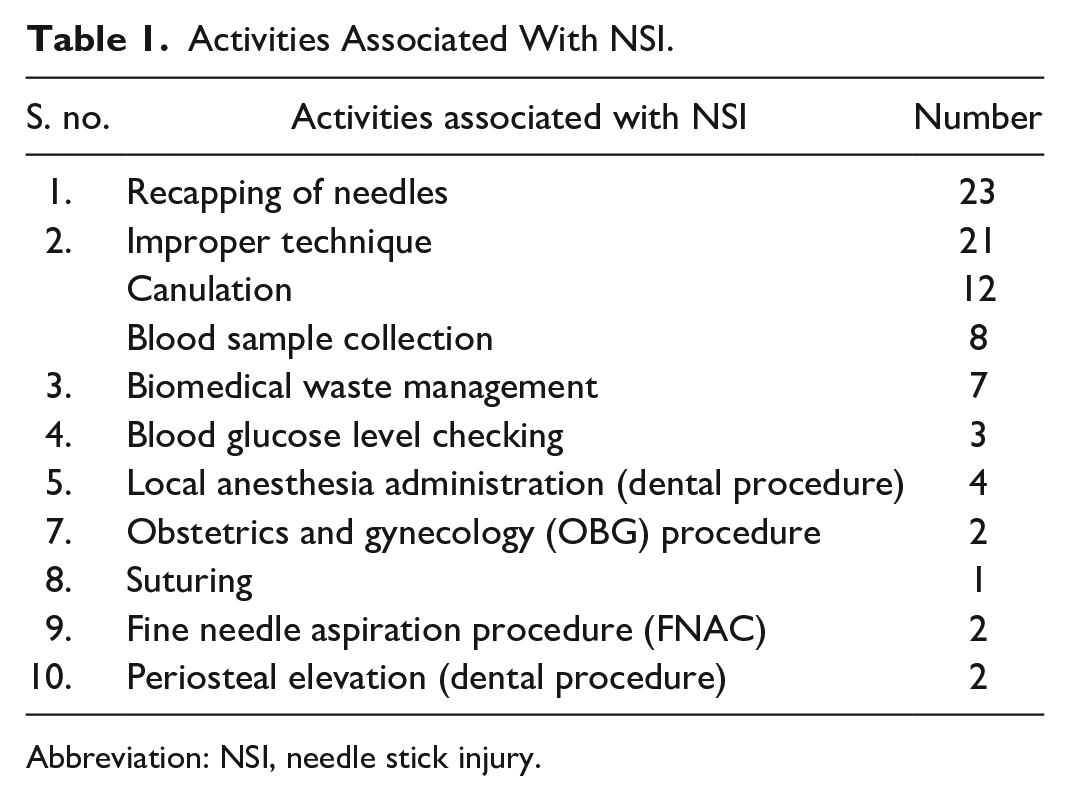
Of the total 76 incidents of NSI, 11 were reported in the first six years from January 2011 to December 2016, whereas in the next five years, from January 2017 to February 2022, 65 incidents were reported. Of the total, 36 nursing staff (47.36%) were affected. Figure 1 shows the occupation with a risk of needle stick injury. Recapping of the needle (23 [30.2%]) was the predominant activity that led to NSI (Table 1). Hollow bore needle (67 [88.15%]) was the most common type of tool (Figure 2). Percutaneous injury was observed in 74 (97.3%) cases.
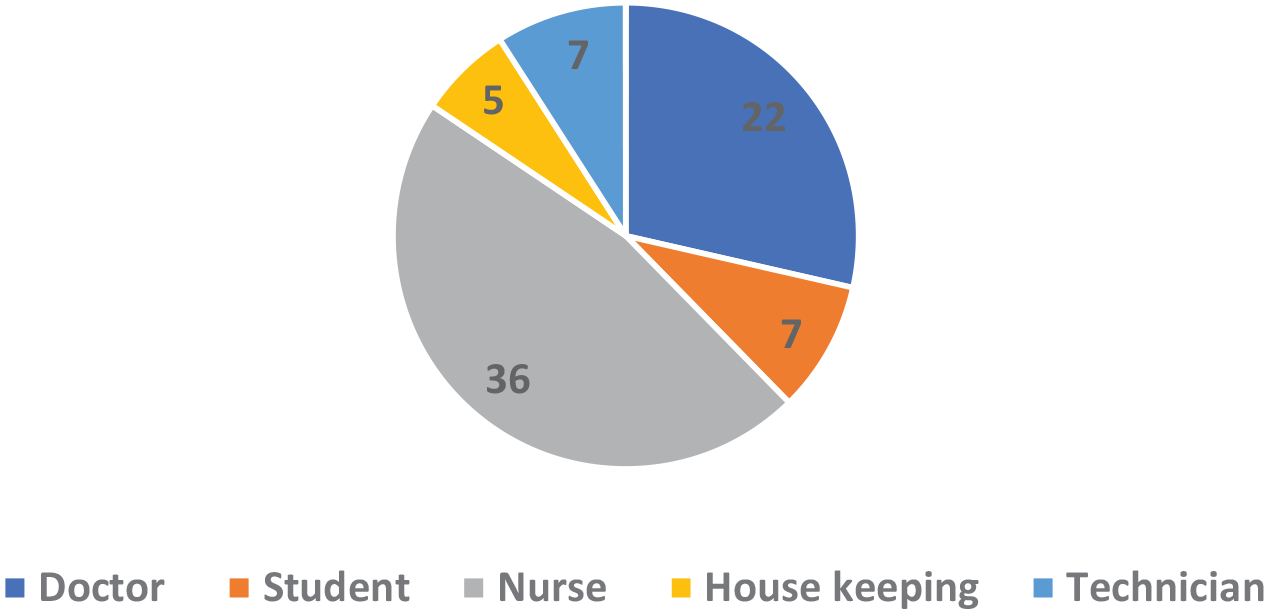
Profession with high risk of needle stick injury.
Activities Associated With NSI.
Abbreviation: NSI, needle stick injury.
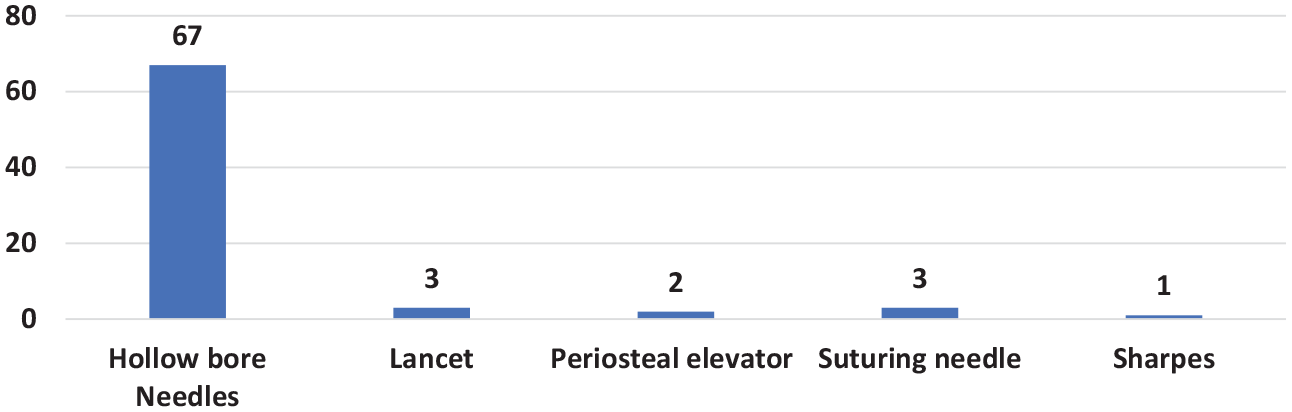
Types of tools that caused needle stick injury.
In four incidents, the source was positive for important bloodborne pathogens: three (3.9%) HBV positive and one (1.9%) HIV positive. In seven (9.2%) of the incidents, sources were unknown. In 65 (85%) incidents, the source was negative for HIV, HBV, and HCV pathogens. Postexposure prophylaxis drugs were administered in eight (10.5%) of the total cases with high risk of developing infection by bloodborne infection. Hepatitis B vaccination was administered in three (3.9%) incidences.
Statistical Analysis of Data
The collected data were tabulated and interpreted using the appropriate statistical method (mean and percentage).
Discussion
Our study estimated 76 incidents of NSI over 11 years and 2 months, which is less than that in other studies. There is a wide range of incidences of needle stick injury data across the world. Pathak et al 4 in his cross-sectional study observed 483 (80.5%) NSI reports. A survey performed on surgical trainees in the United Kingdom showed 582 (83%) incidences of NSI among 699 respondents. 5 Low incidence in our setup could be because of underreporting of incidence, which is not uncommon in a health care setup. The initial years of the study had less reporting of incidences (10) than later. Nursing profession (47.36%) followed by doctors (28.94%) show high reporting of NSI over a decade. There are around 350 doctors, 650 nurses, 50 technicians, and 650 housekeeping workers employed in our setup, and the incidence of NSI and rate of NSI per year per 1000 employees for the year 2021 are 4 (11.4%), 14 (21.5%), 4 (80%), and 3(4.6%), respectively. Technicians have higher rate of NSI followed by nurses, doctors, and others.
Our study showed nursing faculty were at high risk of sustain an NSI, as the nursing faculty are frequently involved in activities of canulation, blood drawing, assisting in surgery, dressing, and many other potential risk activities.
In the subsequent years, frequent training programs for HCW regarding occupational hazards particularly about NSI were effectively carried out, leading to increased awareness among the HCWs, which could be the reason for the increase in reporting of incidences. This emphasizes the importance of training the health care personnel on a regular basis and the importance of reporting such incidents. However, there might be some underreporting.
Nursing staff, technicians, and doctors should avoid recapping of the needles. If absolutely necessary, the scoop technique should be followed. The use of a faulty technique for canulation and blood collection is another important factor for NSI. Used lancets left on the table were inappropriately picked by trainee nursing students, resulting in lancet injury. Two of the pathologists sustained NSI while performing a fine-needle aspiration procedure. Dental faculty are at a high risk of NSI (9.2%) as well, as they work with hollow-bore needle and instruments like elevators. The study conducted by Shah et al at Washington showed 20% of the occupational exposures were among dental faculty. 6 House-keeping staff sustained NSI while handling biomedical waste. A survey on occupational exposure to bloodborne viruses in the United Kingdom revealed a percutaneous route of exposure as the predominant type of NSI and hollow-bore needle as the common tool, which holds good in our study as well. 7
HBV was the most common bloodborne pathogen, followed by HIV, in our study. According to WHO (World health organization) annually there are three million HCW exposed to blood borne pathogens, among them two million are by HBV as cause which is the most common followed by 900,000 by HCV and 300,000 by HIV. 8 HBV infection is preventable, as vaccination is available for it. According to the U.S. Occupational Safety and Health Administration (OSHA) Bloodborne Pathogens Standard (BSP), employers need to vaccinate their HCW with hepatitis B vaccination. 9 Postexposure prophylaxis is only available for HIV and HBV. Furthermore, symptoms of hepatitis may take decades to appear after exposure. So, the only way to prevent infection is by preventing exposure. 9 In our study, there were no serious complications observed.
Conclusion
In the present study, NSI incidence is low. There exists an underreporting, which cannot be denied. Nursing profession are at the highest risk of sustaining an NSI followed by doctors. Needle recapping was the high-risk activity leading to an NSI. Following stringent universal precautions can limit most of the NSIs. Adoption of safety-guided devices can reduce the rate of injury to a great extent. Regular training, monitoring, auditing, and adequate control modalities are the core strategies to reduce the incidence of NSI.
Footnotes
Acknowledgements
The authors thank our colleagues in the Department of Microbiology, Chettinad Hospital and Research Institute, Chengalpattu, Tamil Nadu, India, for the support.
Authors Contributions
K.P. conducted the experiment. P.S. and K.P. contributed to study design, data collection, analysis of results, and manuscript preparation.
Declaration of Conflicting Interests
The author(s) declared no potential conflicts of interest with respect to the research, authorship, and/or publication of this article.
Funding
The author(s) received no financial support for the research, authorship, and/or publication of this article.
Ethical Approval
Not applicable as the this study is retrospective and data were collected from medical records, and patient ID was not revealed (institutional review board name: Chettinad Hospital and Research Institute).
