



Abstract
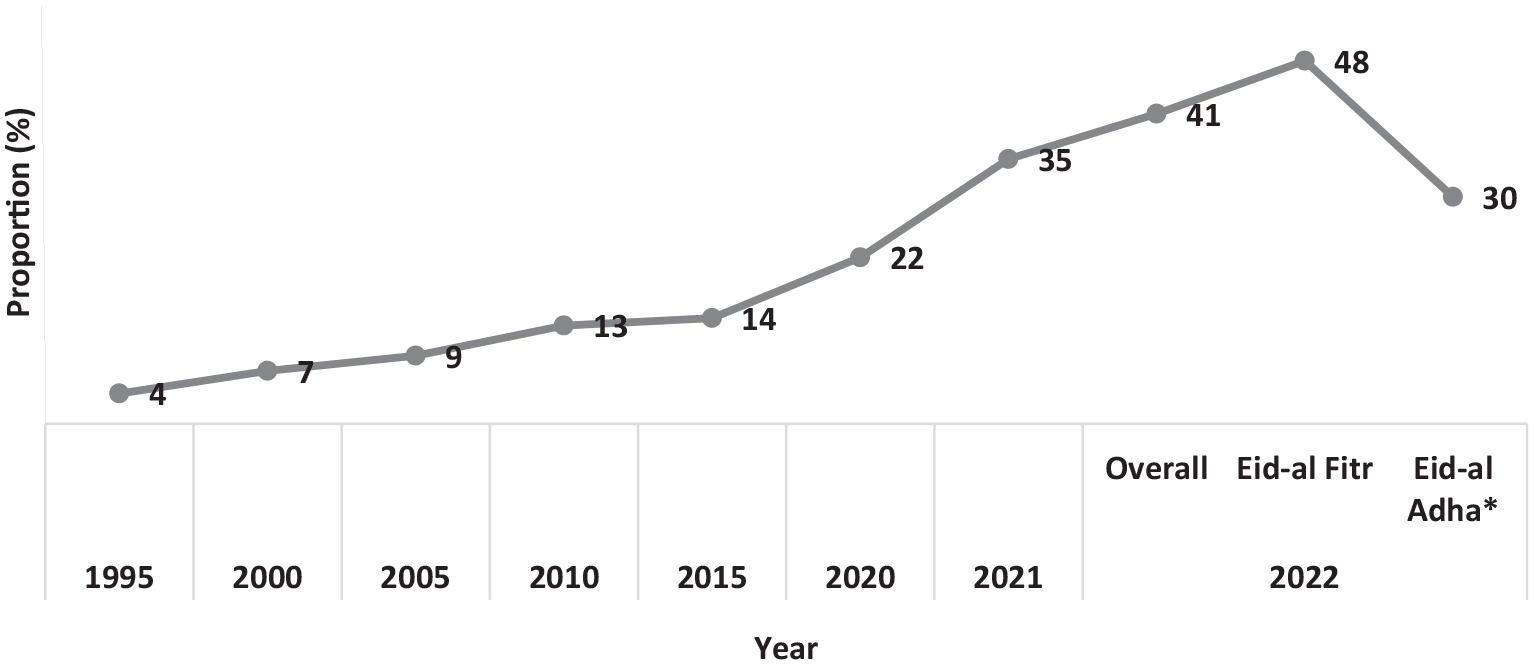
The on-road traffic accident is a significant public health concern for Bangladesh, impeding the country’s way to building safe, resilient, and sustainable cities and human settlements. On-road accidents and causalities doubled in the country between 2011 and 2020, and it increased by 30% in 2021, a shifting pattern of traffic accidents with an increasing number of motorbike accidents. The fatalities by motorcycle traffic accidents were only 4% in 1995 and rose substantially to 35% in 2021, and the situation has been more alarming during the festivals, especially Eid in Bangladesh.
Keywords
What We Already Know
Bangladesh ranks 88th among 183 countries in road accident death rate in 2020, and road crashes have been increasing in Bangladesh.
What This Article Adds
Bangladesh experiences the highest death rates from motorbike accidents among on-road traffic accidents.
A significant number of deaths occur during the festivals of Bangladesh, especially Eid.
Motorcycles with more cubic capacity (CC) carry more risk than those with less CC.
Introduction
On-road traffic accident is a significant public health concern, emerging as a pandemic in Bangladesh and impeding the country’s way to achieving Sustainable Development Goals (SDGs) number eleven and the UN General Assembly’s (UNGA) goal of halving the global number of deaths and injuries from road traffic crashes by 2030.1,2 From 2011 to 2020, road accidents and causalities doubled in the country, increased by 30% in 2021, and acted as one of the top causes of death. 3 Moreover, recent years have been experiencing an astounding increase, a shifting pattern of traffic accidents with an increasing number of motorbike accidents.
Motorbike accidents are becoming one of the top killers on the roads of Bangladesh. According to Figure 1, the percentage of fatalities by motorbike was only 4% in 1995. However, the percentage increased to 14% in 2015 and 22% in 2020, reaching 35% in 2022. Motorbike accidents increased at an alarming rate during the Eid festival. During Eid-al-Fitr, the casualties comprised 48% of all motor vehicle road accidents. Although the government banned two-wheeler vehicles on important highways for seven days from July 7 to July 13, 2022, about 30% of accident deaths during Eid-al-Adha involved motorcycles. 4
On the contrary, the life expectancy (LE) at birth was 72.6-73.0 years between 2019 and 2021. 3 From 1998 to 2017, the population aged 26-30 years (mean of 28) was primarily involved in motorcycle fatalities. 5 If we estimate the year of life lost (YLL) due to motorbike road accidents by multiplying potential years of lost (LE minus 28) with the number of deaths, we get the figure of 207.3 deaths per thousand population. The gross GDP per capita (current US$) loss due to YLL (YLL multiplied by GDP) would be 406.6 million for Bangladesh (taking the exchange rate of 2020 by the World Bank).
Moreover, Pervaz et al found that the number of motorbike accidents and fatalities was concentrated in the ages 16-50 years (especially 26-30 years old). 5 As a result, the losses amounted to over 1.5% of the country’s GDP. 5 According to the Accident Research Institute of BUET, Bangladesh has ranked the highest death rates from motorbike accidents in the world; motorcycles with more cubic capacity (CC) pose a higher risk, and predominant injury patterns were fracture in the right leg (22%) and fracture in the left leg (15%).5,6
Discussion and Conclusion
Economic solvency and demographic change might influence Bangladesh’s recent increase in motorbike accidents. 5 Bangladesh now has many adolescents and young people who prefer motorcycles to speed up and avoid traffic jams; motorbikes with higher CC due to their risk-taking behavior bear a higher chance of danger. The drivers are reckless, do not obey the motorbike ride rules, do not use helmets, and drive without a valid license. The experts said most riders are teenagers and seek excitement by taking risks. 7 In addition, the slow movement of vehicles on highways, reckless speeding, and non-stop driving on empty roads are contributing factors to the accidents. 7
There are more motorbikes on the roads in Dhaka than the total number of motorbikes in the United States. 6 During the Eid-al-Fitr of 2022, 21 360 motorcycles crossed the Bangabandhu bridge (used for communication to the Northern region of Bangladesh), the highest since 1996. Rule-breaking, inadequate training, and unregistered motorcycles are predominantly responsible for accidents at the district or sub-district level. 7 An increasing number of ride-sharing motorbikes in the capital are another factor for unprecedented accidents. After making a rule of the ride-sharing app for motorbikes, the number of motorbikes increased by 10 lakhs in the last five years as Bangladesh Road Transport Authority reported that motorbike registration skyrocketed from 114 616 in 2011 to 406 897 in 2019.8,9 Thus, the ride-sharing motorbike contributed to one third of the increase in the number of motorbikes. Although there was a downward trend in accidents in 2016, it has increased dramatically after making a ride-sharing guideline in 2017. 6 Therefore, ride-sharing can contribute to this escalation of traffic accidents.
The World Health Organization’s (WHO) road safety manual for two wheelers has suggested several guidelines for safe motorbikes, but Bangladesh’s policies have addressed very few. 10 Some issues addressed by the Motor Vehicle Act are the demerit point system, compulsory skill check, and comprehensive helmet legislation. 10 However, very few of them have been implemented properly. Even the ride-sharing act does not have any specific section for motorbike, whereas motorbike consists of a significant portion of ride-sharing vehicles. Nevertheless, the act entails none of the guidelines provided by WHO. 9
In this situation, policy actions must be directed to understand and control this increasing trend of motorbike accidents in the country. Ride-sharing must be strictly monitored and regulated to maintain a sustainable road in Dhaka. The government needs to restore and reduce the order of the roads and streets by fully implementing the Road Transport Act. Most of the accident victims are teenagers and youth who do not have an income. Against this background, parents should refrain from buying their children motorcycles. Moreover, teenagers and youths should be adequately trained to ride and encouraged to follow road rules. In addition, different lanes can be distributed for different kinds of vehicles.
Considering all this, the country can follow the model generated by developed countries, as 93% of the world’s fatalities on the roads occur in low- and middle-income countries, irrespective of possessing 60% of the world’s vehicles. 2 The country can follow the recommendations of WHO by adopting a multisectoral approach such as transport, police, health, education, and actions that address the safety of roads, vehicles, and road users. In addition, designing safer infrastructure and incorporating road safety features of vehicles, enhancing post-crash care for victims of road traffic crashes, setting and enforcing laws relating key to risks, and raising public awareness can function as effective interventions. 2 Bangladesh can follow these to improve the road traffic situation in the country. Overall, planned urbanization and proper implementation of laws are the key to decreasing the GDP loss due to traffic accidents in Bangladesh.
Footnotes
Author’s Note
Md. Zakiul Alam is also affiliated to Department of Population, Family and Reproductive Health, Johns Hopkins Bloomberg School of Public Health, Johns Hopkins University, Maryland, USA.
Declaration of Conflicting Interests
The author(s) declared no potential conflicts of interest with respect to the research, authorship, and/or publication of this article.
Funding
The author(s) received no financial support for the research, authorship, and/or publication of this article.
Ethical Approval
This paper is based on secondary and publicly available sources, including newspaper articles, reports, and journal articles. Therefore, ethical approval does not apply to this paper.
