




Abstract
MicroRNAs are a family of small, single-stranded RNAs that have key roles in regulating multiple signaling pathways within a cell. Studies have implicated aberrant expression of microRNAs in the development and progression of several pathologies including cancer. MicroRNAs are relatively stable and readily available in body fluids and tissues, making them desirable biomarkers for prognostic and diagnostic purposes in an array of diseases. MicroRNA 628 (5p/3p variants) is located in the 15q21.3 cancer-related region, and evidence suggests its association with various pathologies. The -5p mature variant, microRNA 628-5p, has been reported to be differentially expressed in various cancers, and its expression has been mostly associated with tumor suppression but there are few reports identifying its role in cancer progression. Several studies have also suggested its utility in diagnosis and prognosis of various cancers. Dysregulation of microRNA 628-5p has also been implicated in embryonal implantation defects, autism, immune modulation, myogenesis, cardiovascular disease, viral infection, and skeletal muscle repair. Here, we have provided a comprehensive review on available literature explaining the role of microRNA 628-5p as a potential cancer biomarker as well as briefly describe its function in other diseases and normal physiological conditions.
Introduction
MicroRNAs (miRNAs) are a family of small (∼19–25 nucleotides), single-stranded RNAs that have key regulatory roles in gene expression, affecting many cellular processes including growth, proliferation, differentiation, metabolism, and cell death. 1 The biogenesis of these molecules is a canonically preserved process that starts in the nucleus where it is first transcribed into pri-miRNAs by RNA polymerase II. The pri-miRNAs are then cleaved by Drosha and DGCR8 into pre-miRNAs and shuttled from the nucleus to the cytoplasm for further processing with the help of exportin 5 in a Ran-GTP-dependent manner. In the cytoplasm, pre-miRNAs are further cleaved into imperfect double-stranded miRNAs molecules by Dicer. The double-stranded miRNAs are then unwounded by Argonaute proteins and incorporated into the RNA-induced silencing complex (RISC). This complex then binds to the 3′ untranslated region (UTR) complementary sequence base pairing of the target mRNA resulting in the inhibition of translation or imperfect binding resulting in reduction of protein synthesis.1–7
It is estimated that 60% of protein-coding genes have predicted miRNA binding sites in their 3′UTRs. Furthermore, bioinformatics analysis indicates that a single 3′UTR can be targeted by several miRNAs.6–8 This important characteristics of miRNA biology is called “genomic redundancy” as a miRNA is predicted to repress expression of thousands of mRNAs, and each mRNA could be targeted by different miRNAs. 6 Aberrant expression and regulation of miRNAs has been associated with various human diseases, including cancer, autoimmune diseases, and cardiovascular and neurological disorders. 2 The initial observation that miRNAs had an important role in the development of cancer was made by Croce and colleagues,6,7 who showed that the miRNA-15a/16-1 cluster is frequently deleted in chronic lymphocytic leukemia (CLL), suggesting their role as tumor suppressors. Thereafter, multiple subsequent studies confirmed that deregulation of specific miRNAs is associated with cancer growth and progression.9–12
miRNA 628 is located in the 15q21.3 cancer-related region and commonly acts as a tumor suppressor. 5 However, both the 5p and 3p mature variants have been reported to be differentially expressed in various cancers, and their expressions have been associated with both tumor suppressor and oncogenic functions.5,13,14 This observation is supported by evidence that different mature miRNAs, cleaved from the 5′ or 3′ arms of the same stem-loop pre-miRNA, can be independently functional and have different targets. 10 In addition, the 5p/3p pairs can be differentially expressed from tissue to tissue, indicating that their expression might have tissue-dependent regulatory roles. 15 The predicted stem-loop structure and the sequence of both the 5′ and 3′ were obtained using miRBase (http://mirbase.org) and are shown in Figure 1. Thus, study of the specific function of each variant is necessary to understand its role in disease development.
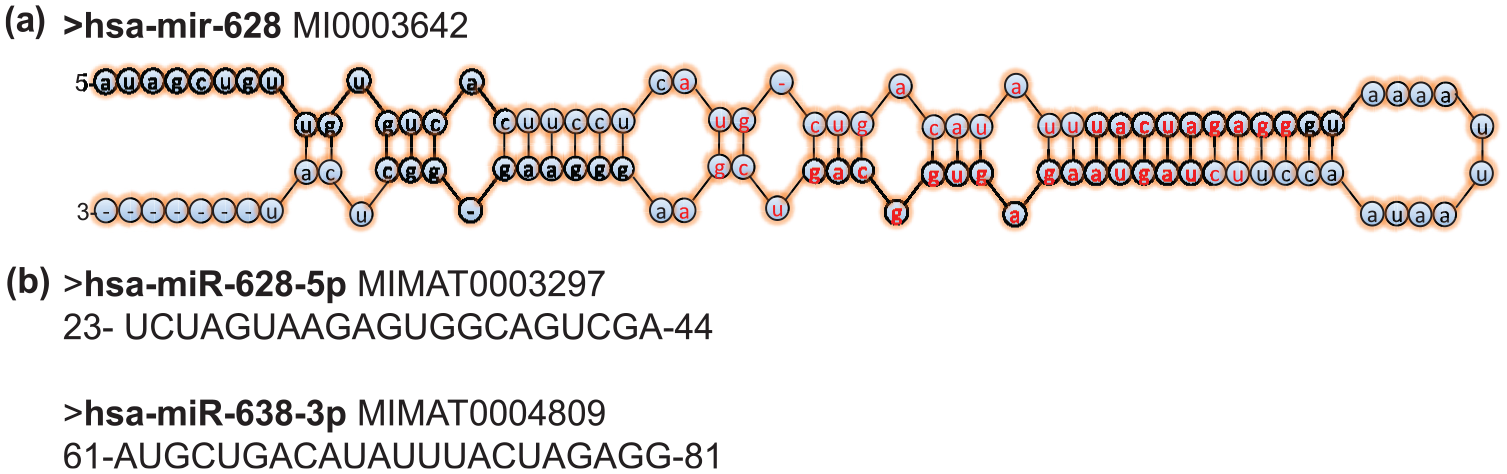
Complete sequence of miRNA 628: (a) stem loop sequence of miRNA 628 and (b) mature sequences of miRNA 628-5p and 3p.
The goal of this review is to summarize available research into implication of miRNA 628 variant -5p in cancer and other diseases. We also seek to highlight the molecular targets of miRNA 628-5p and its utility as a biomarker as well as its potential use in cancer therapy.
miRNA 628-5p role in carcinogenesis
As mentioned above, miRNAs maintain cellular homeostasis by binding to the 3′UTR region of specific mRNAs and negatively regulate gene expression. They can influence major pathways related to cell proliferation, differentiation, cell cycle regulation, angiogenesis, and cell death, and their tissue-specific expression might contribute to their role either as tumor suppressors or oncogenes.9,16,17 miRNA 628-5p role has mainly been implicated in tumor suppression; however, few studies have also suggested its oncogenic functions as outlined below.
Favreau and Sathyanarayana 18 reported the potential tumor suppressor role of miRNA 628-5p in acute myeloid leukemia (AML). miRNA 628-5p expression decreased when AML-193 cells were exposed to the cytokines interleukin-3 (IL-3), granulocyte-macrophage colony-stimulating factor (GM-CSF), and granulocyte colony-stimulating factor (GCSF). They also identified Fox3/Foxo3a as a highly conserved predicted target of miRNA 628-5p. Interestingly, clinical studies have implicated Fox3/Foxo3a upregulation and phosphorylation as a poor prognostic indicator for AML.18,19 This study demonstrated the possibility of an oncogenic pathway linking aberrant cytokine expression with a decrease in miRNA 628-5p expression, resulting in increased Fox3/Foxo3a expression. 18
Single nucleotide polymorphisms (SNPs) have been associated with breast cancer (BCa) susceptibility through their ability to affect miRNA binding sites and mRNA gene regulation. 20 Nicoloso et al. 20 hypothesized that disruption of tumor suppressor miRNA binding in the 5′ or 3′UTRs of TGFBR1 by SNPs could contribute to cancer susceptibility and initiation. They identified SNP-dependent miRNA interactions that might explain the pathogenetic relevance of known BCa-associated SNPs. The investigators observed that overexpression of miRNA 628-5p behaved as a true repressor of TGFBR1 in a cell specific manner and that its repressor activity on TGFBR1 protein level was dependent on the rs334348 variant inside the TGFBR1 3′UTR miRNA target sequence.
Regulation of miRNA 628-5p expression was also demonstrated to be relevant in renal cell carcinoma (RCC) development. 21 The non-classical human leukocyte antigen G (HLA-G) is overexpressed in RCC and has been correlated with a higher tumor grade and a poor clinical outcome. 22 In silico screening for HLA-G regulatory miRNAs, an interaction was predicted between miRNA 628-5p with the 3′UTR of HLA-G, and miRNA 628-5p expression downregulated gene activity of the HLA-H 3′UTR. Expression levels of miRNA 628-5p decreased in HLA-G+ RCC lesions compared with HLA-G– RCC lesions but appeared not to be of clinical relevance since no correlation to clinicopathological parameters including survival of the RCC patients was found. 21 Stable transfection of miRNA 628-5p decreased the HLA-G mRNA and protein levels. miRNA 628-5p did not alter natural killer (NK) cells-mediated cytotoxicity despite the downregulation of HLA-G. It was considered that miRNA 628-5p is a fine tuner because of its lower affinity to the HLA-G 3′UTR. 21
miRNA 628-5p downregulation has been evidenced in glioblastoma (GBM) tumor tissue compared to normal controls; 23 however, further study of miRNA expression signatures found miRNA 628-5p to be “protective” or beneficial to patient outcome. 24 In addition, cell cycle genes, Ttk, Top2a, and Col4a1, were found to be regulated partially by miRNA 628-5p, highlighting a possible regulatory role in this cancer. 24 A separate study by Xie et al. 25 reported that miRNA 628-5p was upregulated in lower grade glioma clinical tissues compared high grade tumors and also in glioma cell lines, U87, and T98. Transfection with miRNA 628-5p mimic decreased cell growth as demonstrated by decreased colony formation and proliferation and cell cycle arrest. In addition, they demonstrated that injecting cells with miRNA 628-5p significantly suppressed glioma xenograft tumor growth. They also demonstrated that DDX59 is a direct target of miRNA 628-5p and upregulation of DDX59 partially attenuated the effects of this miRNA upregulation. 25
Another study suggested the context-dependent role of miRNA 628-5p in ovarian cancer development both in-vivo and in-vitro. 26 Li and colleagues showed that ovarian cancer cells exhibiting stem cell–like characteristics had decreased expression of miRNA 628-5p. In-vivo xenograft studies revealed that treatment with miRNA 628-5p agomir decreased tumorigenicity, possibly due to increased anoikis. To confirm these results, miRNA 628-5p expression was studied in three pairs of epithelial ovarian cancer cells, Hey, HO-8910, and SKOV3, and more invasive daughter cell lines, Hey-A8, HO-8910PM, and SKOV3-IP cells. Expression of 628-5p was 2–6 folds higher in the aggressive cell lines compared to the parental cell lines. Interestingly, cells transfected with mimic had increased membrane invasiveness compared to cells treated with negative controls. Treatment with miRNA 628-5p inhibitor decreased the wound-healing potential of these cells. However, higher miRNA 628-5p level resulted in lower stem-like cell level and decreased tumorigenicity. This study also identified and confirmed fibroblast growth factor receptor 2 (FGFR2), an oncogene, as a target of miRNA 628-5p. FGFR2 is highly expressed in ovarian tumor tissues and its upregulation is correlated with advanced disease and worse prognosis. 26
Wang et al. 27 reported another possible role of miRNA 628-5p in osteosarcoma through regulation of the tumor suppressor IFI44L. Upregulation of miRNA 628-5p was correlated with poor patient prognosis. In addition, it was found to be upregulated in aggressive osteosarcoma cell models, MG-63, U2OS, Saos-2, and SW1353 cells, compared to normal mature osteoblasts. In addition, inhibitor of miRNA 628-5p reduced the cell proliferation, migration, and invasion while knockdown of IFI44L rescued this effect. 27 Finally, miRNA 628-5p was recently identified as a post-transcriptional regulator of BLM gene expression in prostate cancer (PCa) PC3 cells. 28 They also reported downregulation of miRNA 628-5p in PC3 cells compared to transformed prostate cell line RWPE-2. 28
Together, these studies suggest that miRNA 628-5p could act as a tumor suppressor or tumor promoter dependent upon cancer type, stage, or even the experimental conditions. These are summarized on Table 1.
miRNA 628-5p alterations in cancer.

miRNA 628-5p use as a cancer biomarker
Due to their abundance and high stability in various fluids and tissues, miRNAs are currently being explored as prognostic and diagnostic biomarkers in various cancers. 7 Several studies have suggested the usefulness of miRNA 628-5p in cancer diagnosis and prognosis.5,29 Our group was first to report that miRNA 628-5p is differentially expressed in serum obtained from PCa patients compared to the serum obtained from healthy individuals. 29 Differential expression of miRNA 628-5p was validated through quantitative reverse transcription polymerase chain reaction (qRT-PCR) with levels significantly lower in PCa patients when compared to the healthy individuals. Decreased expression of miRNA 628-5p was observed in both African American and Caucasian American populations compared to matched controls, emphasizing discriminatory power and relevance of this miRNA in PCa. 29 This is particularly relevant due to the urgent need to identify novel miRNA in PCa that could result in the development of specific and discriminatory biomarkers as a supplement to prostate-specific antigen (PSA) testing. Our ongoing unpublished studies show that increased expression of miRNA 628-5p decreases tumorigenic potential of different PCa cellular models.
In their study, Watson et al. 30 aimed to identify differentially expressed miRNAs that could potentially be utilized to stratify Wilms tumor patients according to their therapy response to customize current therapeutic regimens at the biopsy stage. They identified differentially expressed miRNAs between the intermediate risk and high risk blastemal cases, with miRNA 628-5p found to be upregulated in the post-treatment high risk cases. Furthermore, when pre-treatment biopsies originating from intermediate risk cases were compared to pre-treatment biopsies of high-risk cases, miRNA 628-5p was also found to be already differentially expressed in the biopsy stage. Considering these results, they identified miRNAs (including miRNA 628-5p), which could be an important indicator of tumor’s response to pre-operative chemotherapy. 30
A study by Schou et al. 31 aimed to evaluate whether profiles of miRNA in whole blood were prognostic for overall survival and clinical outcome in patients with metastatic colorectal cancer before third line of treatment with cetuximab and irinotecan. This group found prognostic miRNAs associated with short overall survival, including miRNA 628-5p. These were found to be upregulated in the blood of these patients. Identification of molecular pathways associated with expression of the identified miRNAs included TCF4, APC, SMAD4, MAPK8, PIK3CG, PIK3CD, DCG, PIK3CA, and MAPK1. 31 In a separate study, in order to identify dysregulated miRNAs in colorectal cancer, Hamfjord et al. 32 utilized tissue from eight patients with colorectal cancer undergoing surgical resection of the colon. Tissues from normal mucosa and tumor were collected from surgical specimens, and miRNA 628-5p was found to be uniformly downregulated in the cancer samples. 32
In another study, Puente et al. 33 analyzed the expression of various genes and miRNAs relevant in pathways involved in RCC development such as the Notch, Hedgehog, Wnt, hypoxia, epithelial mesenchymal transition, and stem cell maintenance signaling in two groups of patients: long-term sunitinib responders and patients exhibiting resistance to the drug. miRNA 628-5p was found to be upregulated in long-term responders compared to the patients with primary therapy resistance. 33 Increased expression of miRNA 628-5p has also been reported in benign or less aggressive cancer samples as reported by Soon et al. 34 when they compared ductal carcinoma in situ (DCIS) to invasive breast cancer (IBC) and lympho-vascular invasion (LVI). Increased expression of miRNA 628-5p was also found in borderline gastrointestinal stromal tumors when compared to malignant tumor samples. 35
On the contrary, Prior et al. 36 aimed to identify candidate miRNAs in metastatic RCC patients treated with a widely used therapy, sunitinib, an oral small molecule inhibitor of receptor tyrosine kinase. The goal was to identify miRNAs that could contribute to the development of resistance. They found increased miRNA 628-5p levels in tumors derived from patients with a resistant phenotype. In addition, increased level of this miRNA was associated with poor prognosis. 36 Increased expression of miRNA 628-5p was also associated with disease development in non-small cell lung cancer as reported by Wang et al. 37 In this study, matched plasma was collected for miRNA profile detection, and miRNA 628-5p was found to be upregulated in the group exhibiting therapy resistance. 37
Overall, these studies suggest that miRNA 628-5p expression could be useful as a cancer biomarker associated with favorable or unfavorable outcome dependent upon cancer type, disease stage, and treatment. These studies are summarized in Table 1.
Role of miRNA 628-5p in other physiological processes
Besides cancer, the role of miRNA 628-5p has been described in several other diseases as well as normal physiological functions. miRNA 628-5p was found to be underexpressed in endometrial samples of women with repeated implantation failures. 38 Further analysis identified downstream targets involved in several biological functions including adherent junction, Wnt signaling, cell adhesion molecules, cell cycle, and cancer pathways. 38 Another study compared young oocytes donor derived blastocysts with blastocyst from women in their 40s to evaluate whether advanced maternal age and embryo chromosome constitution impact miRNA function and contribute to the decline of oxidative defense mechanism in aged and aneuploid blastocyst. miRNA 628-5p was found to be downregulated in the advanced maternal age group but no other association was found in miRNA profiles between normal and abnormal blastocysts. 39 In addition, a study indicated that higher serum levels of miRNA 628-5p early in pregnancy could be an indicator of development of preeclampsia. 40 Women who had higher levels of this miRNA develop mild to severe preeclampsia at a higher rate than women with healthy pregnancies. 40 Furthermore, miRNAs are expressed at different levels in a wide range of cells, including embryonic stem cells (ESCs), induced pluripotent stem cells (iPSCs), and somatic cells. miRNA 628-5p was highly expressed in immature cells compared to cells undergoing differentiation or differentiated cells, indicating its possible role in regulating the proliferation of iPS/ES cells. 41
This miRNA was also reported to be relevant in skeletal muscle development, growth, and repair as described by Portilho et al. 42 and Russell et al. 43 Portilho et al. 42 characterized expression of multiple miRNA in fetal facioscapulohumeral muscular dystrophy (FSHD) biopsies as compared to age-matched fetal control biopsies. They found that miRNA 628-5p was differentially modulated at all three different fetal ages in the FSHD samples. miRNA 628-5p was also predicted to target and possibly regulate the human striated muscle activator of Rho signaling (STARS) transcripts, which signaling plays an important role in muscle signaling and repair. Transfection with miRNA 628-5p mimic reduced STARS transcript expression by 30% compared with cells transfected with mimic control. Furthermore, no reduction of activity was found when cells were transfected with STARS 3′UTR with a putative mutation of the miRNA 628-5p binding site confirming its regulatory role. In addition, reduced expression level of miRNA 628-5p was found in muscle biopsy obtained post-exercise in younger individuals and in the older subjects at rest. Together, these findings highlight the role of miRNA 628-5p in muscle growth, repair, and function. 43
Aberrant miRNA 628-5p expression was also associated with organ transplantation failure. Dysregulation of miRNA 628-5p expression was associated with chronic antibody-mediated rejection following lung transplantation (LT) resulting in bronchiolitis obliterans syndrome (BOS). 44 They also identified Bruton agammaglobulinemia tyrosine kinase (BTK) as a potential miRNA 628-5p target. 44 Neumann et al. 45 reported that miRNA 628-5p was upregulated in patients with cardiac allograft vasculopathy (CAV) compared to the control group, suggesting it could be a potential candidate for distinguishing between CAV and non-CAV patients.
miRNA 628-5p was also found to be involved in lipid metabolism as evidenced in a study by Squillace et al., 46 in which this miRNA was upregulated in the adipose tissue of HIV+ patients and was involved in biological processes such as signal transduction, synaptic transmission, and ion transport. Additional studies demonstrated that miRNA 628-5p expression dysregulation was relevant in lipid metabolism, adipocyte physiopathology, or other related pathways involved in atherosclerosis and plaque destabilization. 47
Finally, miRNA 628-5p was reported to be a potential therapeutic agent against the Middle East respiratory syndrome coronavirus (MERS-CoV) 48 and was found to be overexpressed in samples from subjects with autism spectrum disorder compared to control subjects, indicating its possible functionality as a biomarker for this disease. 49
Conclusions and future directions
miRNAs represent a new frontier in cancer prognosis and therapeutics for their high availability and their ability to target and regulate downstream molecular targets. miRNA 628-5p has the potential to be utilized as a biomarker not only in cancer but also in other diseases. However, more research is necessary to further understand its role particularly in carcinogenesis. Most of the current studies are focused on identifying dysregulation in miRNA expression patterns. Although a necessary first step, additional molecular targets should be identified in order to consider miRNA 628-5p as a possible therapeutic target. It is also important to mention that discovery of miRNA role might vary depending on sample type (benign, less, or more aggressive disease, blood versus tissue expression, etc.), sample number, and experimental approaches. This might explain some of the mixed results observed, in which in the same disease type miRNA 628-5p was associated with both tumor suppressor and oncogenic functions. Another explanation could be that a single 3′UTR region might be the target of multiple miRNAs. Besides, regulation of a protein expression (e.g. post-translational modifications) might be more relevant under specific conditions such as increased cellular stress (hypoxia, oxidative stress, chemotherapy, etc.), thus complicating the identification of candidate disease-relevant miRNAs.
miRNA 628-5p also has important functions in normal physiological processes such as muscle growth, lipid metabolism, embryo implantation and development, and stem cell proliferation. It is important to effectively characterize the function of this miRNA in a non-disease context in order to consider its utility as a therapeutic agent in cancer. As with many other identified molecular targets, off-target effects and toxicity could arise; thus, cancer-specific delivery approaches have to be considered.
Another important issue is the health disparities associated with different types of cancer. Our study found that miRNA 658-5p was decreased in both African American and Caucasian American populations and could discriminate the PCa samples from the healthy controls. 29 However, more samples from clinically underrepresented populations should be analyzed for miRNA 658-5p expression to identify individuals who are particularly vulnerable to develop cancer.
Interestingly, the miRNA 628-3p variant expression was also found to be dysregulated in various cancer types.35,50–56 It would be interesting to study if differential expression of these variants correlates with disease progression and therapy resistance. The relevancy of both variants was recently explored by Jing Hua Li et al. 5 in a meta-analytic study that aimed to evaluate the diagnostic and prognostic value of the miRNA 628 in cancer. This study suggested that both variants could have prognostic and diagnostic roles in various cancers, although more specific studies are needed to expand on this initial observation.
Footnotes
Acknowledgements
We acknowledge Dr. Singh for revising the final version of this manuscript.
Declaration of conflicting interests
The author(s) declared no potential conflicts of interest with respect to the research, authorship, and/or publication of this article.
Funding
The author(s) disclosed receipt of the following financial support for the research, authorship, and/or publication of this article: We gratefully acknowledge the grants U01CA194730, U54MD012392, and R01MD012767 from the National Institutes of Health awarded to DK.
