




Abstract
Astragaloside IV, the active component of Astragalus membranaceus, exhibits diverse biological roles including the anti-tumor activity. In this study, we evaluated the chemosensitive role of astragaloside IV in non–small cell lung cancer cells. Cell Counting Kit-8 analysis was performed to determine cell viability. Real-time polymerase chain reaction and western blot were used to measure the messenger RNA and protein expression. Results showed that astragaloside IV treatment could suppress the proliferation of non–small cell lung cancer cells. In addition, combined treatment with astragaloside IV remarkably enhanced the chemosensitivity to gefitinib in three non–small cell lung cancer cell lines including NCI-H1299, HCC827, and A549. Furthermore, compared with gefitinib-treated cells, the messenger RNA expression of SIRT6 was obviously increased in non–small cell lung cancer cells treated with gefitinib combined with astragaloside IV. In addition, downregulation of SIRT6 was accomplished using small interference RNA technology. As a result, SIRT6 inhibition abolished the sensitization role of astragaloside IV in non–small cell lung cancer cells. Taken together, these data demonstrated that astragaloside IV sensitized tumor cells to gefitinib via regulation of SIRT6, suggesting that astragaloside IV may serve as potential therapeutic approach for lung cancer.
Introduction
Non–small cell lung cancer (NSCLC) is one of the most commonly diagnosed cancers and causes more than one-quarter deaths among the cancer-related mortality each year. 1 The 5-year survival rate of NSCLC is relatively low compared with other types of cancer with approximately 14% and 17% in men and women, respectively. 2 The tyrosine kinase inhibitor gefitinib is widely used in the clinical treatment of NSCLC and benefits a proportion of NSCLC patients. 3 However, the frequent occurrence of drug resistance has greatly inhibited its further clinical application. Thus, it is urgently needed to develop novel and effective therapeutic interventions to overcome gefitinib resistance. To date, numerous natural compounds have been demonstrated to effectively reverse multidrug resistance and become potential chemosensitizing candidates in cancer treatment.4,5
Astragaloside IV (AS-IV), an extract from a kind of Chinese traditional herb Astragalus membranaceus, is a saponin widely used in traditional Chinese medicine with strong immunoregulatory and neuroprotective function.6,7 Moreover, several studies have demonstrated that AS-IV could inhibit migration and invasion of lung cancer cells through mediation of regulatory T cells and cytotoxic T lymphocytes as well as protein kinase C (PKC)-α-extracellular signal–regulated protein kinases 1 and 2 (ERK1/2)-nuclear factor (NF)-κB signaling pathway.8,9 In addition, AS-IV treatment reversed the drug resistance via inhibition of P-glycoprotein, representing a potential modulator of drug resistance in liver cancer therapy. 10 In this study, we aimed to clarify the chemotherapeutic sensitization and underlying mechanism of AS-IV in gefitinib resistance in NSCLC cells.
Materials and methods
Cell culture and reagents
Human NSCLC cell lines including NCI-H1299, HCC827, and A549 were purchased from the American Type Culture Collection (Manassas, VA, USA). AS-IV and gefitinib were purchased from Sigma-Aldrich (St. Louis, MO, USA). All cells were grown in Dulbecco’s modified Eagle’s medium (DMEM) supplemented with 10% fetal bovine serum (FBS) at 37°C in 5% CO2 incubator. Small interference RNA (siRNA) sirtuin family member sirtuin 6 (SIRT6) were purchased from Invitrogen (Carlsbad, CA, USA). Cells were transfected with Lipofectamine 2000 (Invitrogen) according to the manufacturer’s instruction. NSCLC cells at 60%–70% confluence were transfected with 50 nmol/L siRNA using Lipofectamine 2000 (Invitrogen) according to the manufacturer’s instruction. Target sequence for SIRT6: 5′-GAAUGUGCCAAGUGUAAGATT-3′; target sequence for negative control: 5′-CGACAUACUGUACAGGCCUTT-3′.
Cell viability determination
Cell viability was determined by Cell Counting Kit-8 (CCK-8) assay. To be brief, cultured NSCLC cells at the density of 3000 cells/well were seeded onto 96-well plates and incubated with different concentrations of drugs for indicated time points. Then 10-µL/well CCK-8 solution was added and incubated in dark at 37°C for another 2 h. The absorbance was determined with the wavelength of 490 nm.
Quantitative real-time polymerase chain reaction
Total RNAs were isolated from NSCLC cells using TRIzol reagent (Invitrogen), and reverse transcriptions were performed by Takara RNA PCR kit (Takara, Japan) according to the manufacturer’s instructions. Quantitative real-time polymerase chain reaction (qPCR) was performed to measure the mRNA expression with glyceraldehyde 3-phosphate dehydrogenase (GAPDH) used as the endogenous control.
Western blot analysis
NSCLC cells were lysed and protein concentration was determined with BCA Protein Kit (Thermo, Rockford, IL, USA). Cell lysates were separated using sodium dodecyl sulfate polyacrylamide gel electrophoresis (SDS-PAGE) and then proteins were transferred to polyvinylidene difluoride (PVDF) membranes. The membranes were incubated with primary antibodies including anti-SIRT6 and anti-GAPDH (Santa Cruz, CA, USA). The protein bands were visualized with enhanced chemiluminescence method (GE Healthcare, Piscataway, NJ, USA).
Statistical analysis
Data were presented as mean ± standard deviation (SD) and treated for statistics analysis by SPSS program. Comparison between groups was made using analysis of variance (ANOVA) and p < 0.05 was considered to indicate a statistically significant result.
Results
AS-IV suppressed the proliferation of NSCLC cells
In order to determine the cytotoxic effects of AS-IV on NSCLC cells, CCK-8 assay was performed in AS-IV-treated NSCLC cell lines including NCI-H1299, HCC827, and A549. By CCK-8 assay, we found that NSCLC cells exhibited no significant changes in cell viability after treatment with low concentrations (3 and 6 ng/ml) of AS-IV. Nevertheless, we found that higher doses of AS-IV (12 and 24 ng/ml) obviously inhibited the cell proliferation of NCI-H1299 (Figure 1(a)), HCC827 (Figure 1(b)), and A549 (Figure 1(c)) cells. These results suggested that AS-IV could suppress the cell viability of NSCLC cells.

Effects of AS-IV on NSCLC cell viability. Three human NSCLC cell lines including (a) NCI-H1299, (b) HCC827, and (c) A549 were incubated with AS-IV at different concentrations (3, 6, 12, and 24 ng/mL). After incubation with AS-IV for 48 h, CCK-8 assay was performed to measure the cell viability.
Combined treatment with AS-IV increased the gefitinib sensitivity in NSCLC cells
We further incubated NSCLC cells with AS-IV at the concentration of 3 and 6 ng/mL and measured its chemosensitization role to gefitinib. After incubation for 48 h, CCK-8 assay was performed to determine the cell viability of NSCLC cells treated with gefitinib alone or in combination with AS-IV. Results showed that combined treatment with AS-IV for 48 h significantly increased the cytotoxicity of gefitinib in NCI-H1299 cells (Figure 2(a)). Furthermore, we found that AS-IV also sensitized HCC827 (Figure 2(b)) and A549 (Figure 2(c)) cells to gefitinib at the concentration of 3 and 6 ng/mL. Taken together, these results indicated that AS-IV treatment could potentiate the gefitinib cytotoxicity in NSCLC cells.
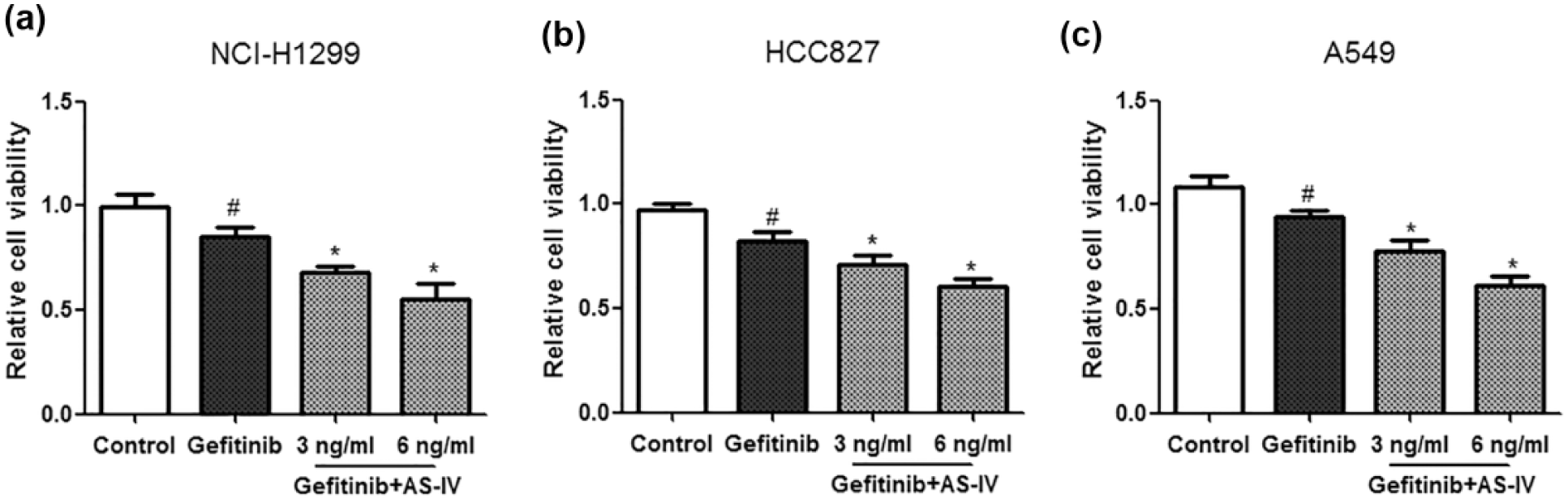
Combined treatment with AS-IV increased the gefitinib sensitivity in NSCLC cells. Three NSCLC cell lines were incubated with gefitinib alone or in combination with AS-IV (3 and 6 ng/mL). Then, CCK-8 assay was used to determine the cell viability of (a) NCI-H1299, (b) HCC827, and (c) A549 cells.
AS-IV increased gefitinib sensitivity via regulation of SIRT6 in NSCLC cells
SIRT6 is a member of the NAD+-dependent class III deacetylase sirtuin family. A previous study suggested that SIRT6 could regulate the tumor behaviors and be considered as tumor suppressor gene. 11 Thus, we aimed to elucidate whether SIRT6 mediated the chemosensitization role of AS-IV to gefitinib in NSCLC cells. Data from qRT-PCR showed that the mRNA expression of SIRT6 was significantly increased in three NSCLC cells treated with gefitinib plus AS-IV compared with gefitinib-treated cells (Figure 3(a)–(c)). In addition, qRT-PCR showed that the mRNA expression of SIRT6 was significantly reduced in SIRT6-siRNA transfected NSCLC cells (Figure 4(a)). In addition, the protein levels of SIRT6 were suppressed in NCI-H1299 cells after transfection with SIRT6-siRNA (Figure 4(b) and (c)). As a result, CCK-8 assay indicated that the downregulation of SIRT6 diminished the chemosensitization role of AS-IV to gefitinib in NSCLC cells (Figure 4(b)). Taken together, these data suggested that AS-IV promoted the gefitinib sensitivity through the regulation of SIRT6 in NSCLC cells.
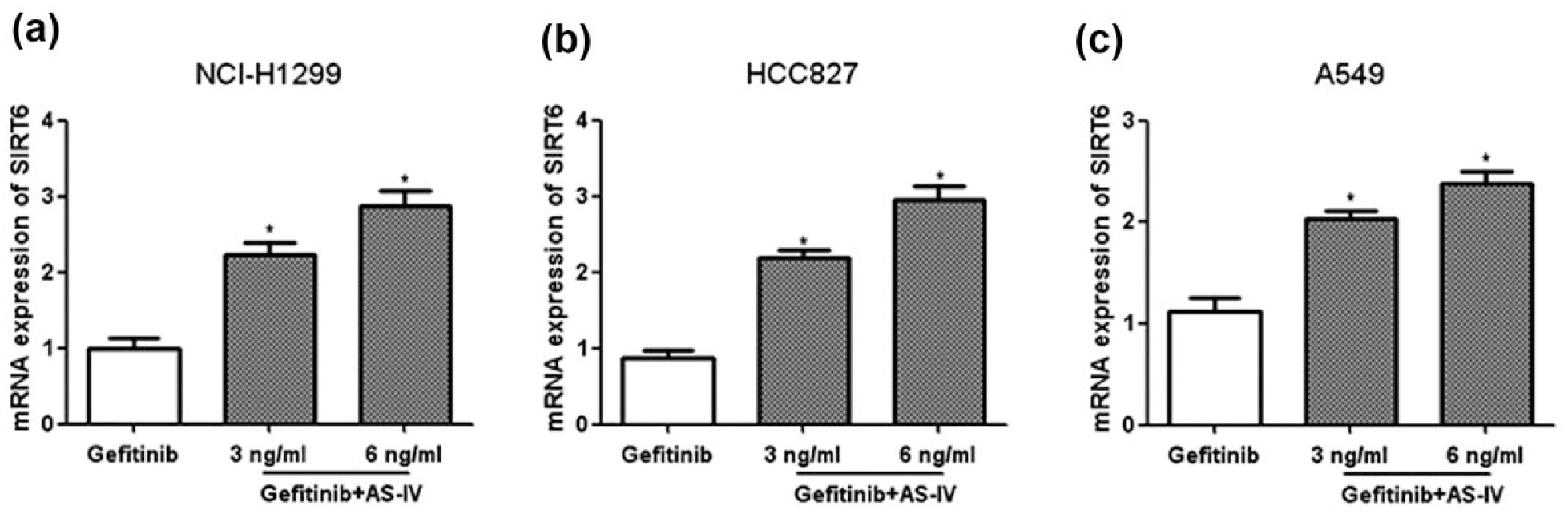
Effects of AS-IV co-treatment on SIRT6 expression in NSCLC cells. The mRNA expression of SIRT6 in gefitinib-treated NSCLC cell lines including (a) NCI-H1299, (b) HCC827, and (c) A549 was determined with real-time PCR in the absence or presence of AS-IV.

Inhibition of SIRT6 abolished the chemosensitive effects of AS-IV in NSCLC cells. siRNA targeting SIRT6 was transfected into NCI-H1299 cells. After transfection of 48 h, the mRNA and protein levels of SIRT6 were measured by (a) real-time PCR and (b and c) western blot. CCK-8 assay was used to determine cell viability in SIRT6 siRNA-transfected NCI-H1299 cells treated with gefitinib alone or in combination with AS-IV.
Discussion
Currently, chemotherapy still remains as the main treatment for end-stage NSCLC patients; however, drug resistance has become a great challenge following the increased application of chemotherapeutics. 12 In this study, our results demonstrated that combined treatment with AS-IV could increase the tumor cell responses to gefitinib via regulation of SIRT6 in NSCLC cells.
The traditional Chinese medicine has been extensively applied as a medicinal herb for its purported ability to treat inflammatory diseases, allergic reactions, and cancers. 13 In addition, the Chinese medicinal herbs have potential applications to reduce the chemotherapy-related side effects and to increase the sensitivity of chemotherapeutics on tumor cells.14,15 AS-IV, a main component of A. membranaceus, has been shown to be capable of alleviation of inflammatory responses, treatment of cardiovascular disease, and sensitization of tumor cells to chemotherapeutic drugs via regulation of intracellular signaling pathway.8,9 Our results showed that NSCLC cells showed a significant reduction in cell viability after incubation with AS-IV at the dose of 12 and 24 ng/mL, while low concentrations (3 and 6 ng/mL) of AS-IV had no significant effects on cell viability. In order to test the sensitization role of AS-IV, NSCLC cells were incubated with gefitinib alone or in combination with AS-IV at the doses of 3 and 6 ng/mL. Results revealed that combined treatment with AS-IV increased the gefitinib cytotoxicity of NSCLC cells including NCI-H1299, HCC827, and NCI-H1299, suggesting that AS-IV was capable of potentiating the gefitinib cytotoxicity in NSCLC cells.
The SIRT6 is a NAD+-dependent class III deacetylase and has been demonstrated to be in involved in a diversity of biological processes including metabolism, genome stability, longevity, and inflammation.16,17 Moreover, multiple investigations have revealed that SIRT6 regulates the pathogenesis of various types of cancers, such as including hepatocellular carcinoma, breast cancer, and pancreatic cancer.18–20 Molecular mechanism exploration further indicates that the diverse roles of SIRT6 in carcinogenesis are implemented through the regulation of cellular signals including ERK, Smad, and Raf/mitogen-activated extracellular signal–regulated kinase/extracellular signal–regulated kinase pathway.18,21 A recent study demonstrated that over-expression of SIRT6 induced a radiosensitization effect on NSCLC cells, resulting in decreased cell growth, cell cycle arrest, and induction of cell apoptosis. 22 In addition, SIRT6 in lung adenocarcinoma has been regarded as a potential prognostic marker and a novel therapeutic target for prediction of chemotherapy sensitivity. 23 In order to determine the role of SIRT6 in NSCLC cell drug resistance, the expression level of SIRT6 was examined in NSCLC cells treated with gefitinib alone or in combination with AS-IV. Results showed that combined treatment with AS-IV significantly increased mRNA expression in three NSCLC cells. In addition, SIRT6-siRNA transfection led to the reduced expression of SIRT6 in NCI-H1299 cells. Consequently, downregulation of SIRT6 abolished the chemosensitive role of AS-IV in NSCLC cells, indicating that AS-IV sensitized lung cancer cells via regulation of SIRT6.
Conclusion
In conclusion, this study demonstrated that AS-IV co-treatment promoted the gefitinib sensitivity through upregulation of SIRT6, implying that combination therapy with AS-IV serves as a potential therapeutic approach for NSCLC patients.
Footnotes
Declaration of conflicting interests
The author(s) declared no potential conflicts of interest with respect to the research, authorship, and/or publication of this article.
Funding
The author(s) received no financial support for the research, authorship, and/or publication of this article.