




Abstract
Background
The Internet of Things (IoT) and wireless sensor networks (WSNs) are now being explored and used in various sectors, thanks to recent technological advancements.
Objectives
The healthcare sector is one of the areas we will examine in this research. This study’s primary focus will be on the fault detection framework (FDF) for healthcare monitoring employing IoT sensors in a wireless environment.
Materials and Methods
Because isolating defects yields more pertinent information about the issues, fault detection first finds weaknesses in a system or process before isolating the intricate process or variable.
Results and Discussion
The outcome demonstrates that the suggested strategy achieves an acceptable level of 80% accuracy in problem identification, in addition to the greater number of patients recorded.
Conclusion
The outcomes show that the defect-detection system for wireless IoT sensor-based healthcare monitoring is efficient.
Introduction
A process or system’s weaknesses are discovered using fault detection, which then isolates the problematic variable or process. Finding defects provides more valuable details regarding the issues. To make things smarter, wireless sensor networks (WSNs) are used in businesses, factories, hospitals, and homes. Several types of sensors are used in this automation technique, described as a small-sample wavelet transform (WT) fault diagnosis method utilizing fault data using generative adversarial networks (GANs). 1 The authors first propose a technique for creating rough fault data, which transforms normal data into rough fault data. The results demonstrate the efficacy of the research’s suggested strategy. Then, they built an enhanced fault recognition process based on K–L divergence in a multivariate statistical analysis frame. 2 This system may identify slight anomalous behaviors by comparing a probability density function (PDF) with a reference PDF produced from a sizable offline data collection. The PDF online is crucial in this investigation. They have concluded that the suggested technique produces better outcomes than several other current methods.
A strategy for a smart agricultural system that uses the Internet of Things (IoT) to identify numerous factors in the farm field was proposed by the authors. 3 Authors presented a fault-detection method based on current and voltage monitoring and assessment to identify common issues with photovoltaic arrays, such as short-circuit faults, open-circuit faults, and shading faults. 4 The effectiveness of the recommended strategy is assessed by modeling diverse photovoltaic system fault patterns. Simulation testing results demonstrate the suggested technique’s efficacy, notably its ability to distinguish between various defects.
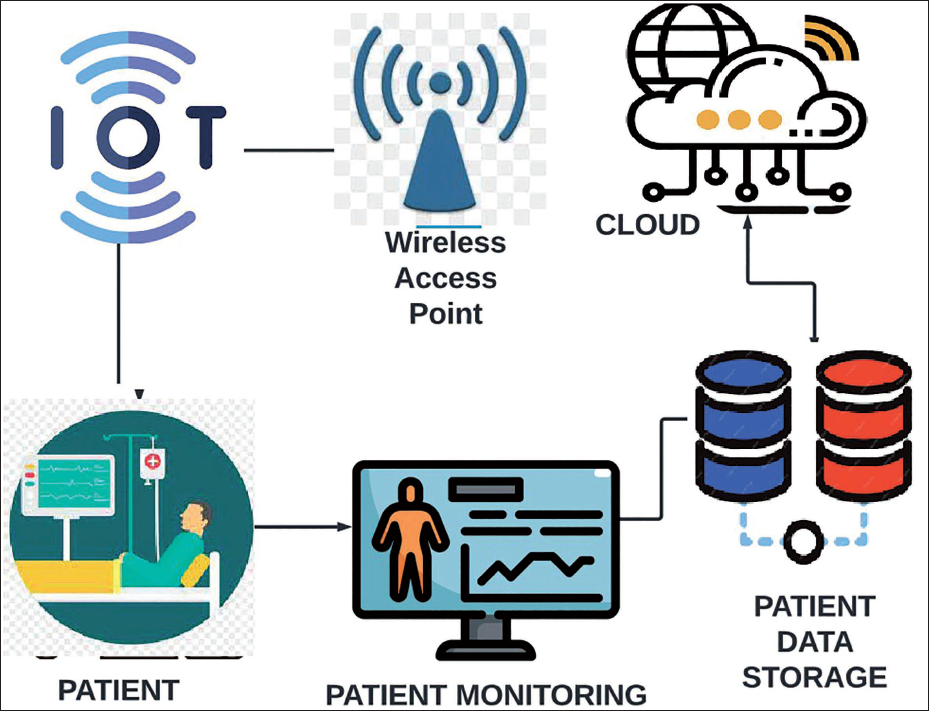
The overall design of a system for healthcare monitoring in a wireless environment is shown in Figure 1. Based on fault-discrimination information, the author provided an enhanced stacking sensor model to identify defects. 5 The statistics and threshold of the model are subtracted from the original data for every single model to get fault-discrimination information. The defect detection strategy employed in the realm of electricity was described by the authors.6, 7 A newly developed distributed failure detection method for WSNs was described and is based on the nodes and their function in maintaining network connectivity.8–11 According to the analysis of time and message complexity, the overhead of the suggested method is less than that of the other alternatives.
Wireless Environment Depicting Healthcare Monitoring System.
The problem of plant-wide procedure tracking was proposed as a novel data-driven fault detection technique that utilized distributed standard correlation analysis. This study focuses on dispersed plant-wide procedures. 12 The proposed method reduces uncertainty by using correlation data from neighboring nodes. An innovative undecimated wavelet transform (UWT)-based fault detection method is designed to get beyond the limitations of WT-based algorithms in real-time applications. 13 First time, the UWT method is being used to identify problems with the quality of the power supplied to microgrids. The results demonstrate the wide variety of applications, rapid fault detection, and dependability of the proposed approach in microgrids. The authors describe two quantitative refrigerant charge fault detection (RCFD) methods for heat pumps that use convolutional neural networks (CNNs). 14 They discovered that the RCFD classification model based on CNN had better prediction accuracy. The regression model’s (CNN-based) prediction error was under 3% of the root mean square (RMS) error. The amount of refrigerant charge may be predicted by modern technology in both cooling and heating modes. 15 Employing fault modeling for a grid-connected, PQ-controlled distributed generation (DG) with a low-voltage ride-through (LVRT) capacity, the features of fault components under various operational situations, such as high-impedance faults and low-impedance failures, were explored.
A defect detection strategy using support vector (SV) data was suggested. 16 The suggested support vector data description (SVDD) model uses domain indicators for cyclic spectral coherence. A methodical fault identification strategy is suggested to assess the bearing state. Run-to-failure weight datasets are used to apply the recommended methodology. The domain indicators for cyclic spectral coherence exhibit exceptional qualities during the detection process. Work concentrated on the challenges of high impedance fault (HIF) detection in distribution networks and the simplicity of capacitor switching and load switching misidentification. 17 This study presents a novel HIF detection strategy using the variational mode decomposition (VMD) and Teager–Kaiser energy operator (TKEOs).
Literature Review
This article reviews several types of literature on defect detection frameworks for wireless IoT sensor-based healthcare monitoring. A novel technique for locating planetary gear issues in variable-speed situations was given. 18 The method does not need angle information and applies to large speed changes. Data from simulations and experiments back up the suggested approach.
The authors described the use of defect detection frameworks within a wireless context. 19 Four classification algorithms—enhanced K-nearest neighbors (KNN), enhanced extreme learning machine (ELM), enhanced regularized extreme learning machine (RELM), and enhanced support vector machine (SVM)—are applied to improve the theory of belief function fusion. Decision fusion reduces energy usage and bandwidth requirements for data transmission by integrating classification results and enhancing classification accuracy. The concept of a function-based decision fusion strategy was used in WSNs as a result of the decentralized classification fusion challenge.
Researchers developed a distributed filtering strategy (WSN) to address the stochastic non-linear systems defect detection challenge. 20 Authors proposed an intelligent and energy-aware defect detection approach for IoT-enabled WSNs. The accuracy of defect identification is increased, and the proportion of false alarms is decreased. The authors created a neuroevolution of augmenting topologies (NEAT) architecture for IoT device fault diagnostics. 21
Proposed System
Figure 2 shows the IoT wearables and sensors that are used to track medical data. As a result of recent technological advancements, sensors, IoT, and cloud servers are now being used in healthcare monitoring systems. Small sensors are worn by patients, and in certain cases, the sensors are implanted surgically within the patients’ bodies. They pick up vital indicators and send them to a central database for analysis and storage. The data are accessible to doctors at any moment and from anywhere. Because it includes healthcare information, a sensor-based monitoring system should be trustworthy and error-free.
Internet of Things (IoT) Sensors and Wearables Used to Track Health Data.
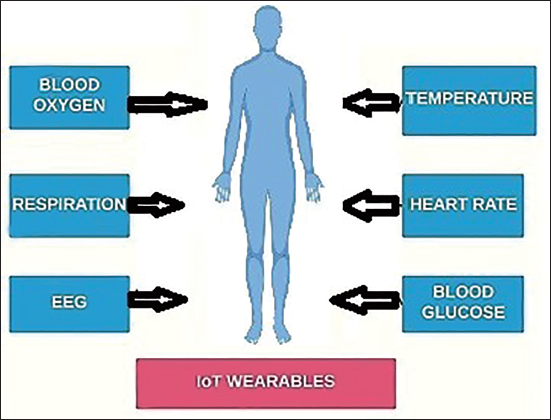
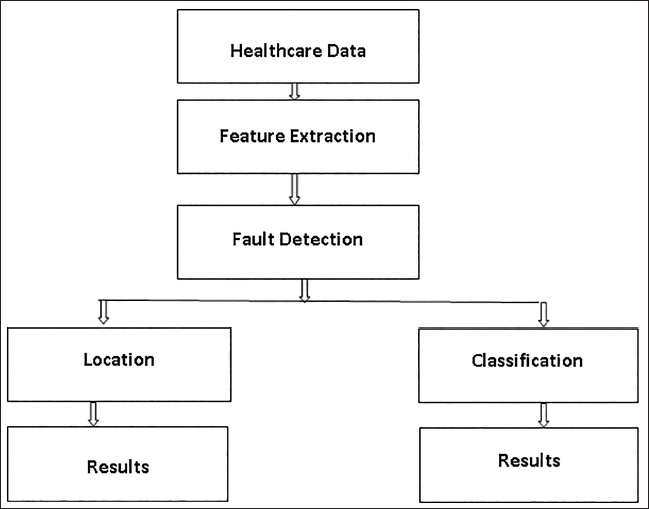
Figure 3 shows how the fault detection framework (FDF) is organized. Device malfunctions, software problems, and communication errors can all result in faults. Technical solutions for health monitoring should be fault-tolerant to function correctly and allow for continued data transmission even in the event of broken sensor nodes.22–24 To monitor healthcare using IoT sensors in a wireless environment, the suggested technique uses an FDF that can identify broken sensor nodes and choose an alternative set of nodes to carry on data transmission. Inefficient nodes are prevented from taking part in data sensing and communication until they become efficient or are replaced by other nodes.25–27
Layout of the Fault Detection Framework (FDF).
When patients demand better service, one scenario is an IoT sensor in a wireless healthcare monitoring or medical firm. The continuous surveillance of an atmosphere is characterized by a large monitoring area, constant monitoring duration, and complicated monitoring circumstances. One typical sensor network application is environmental protection. Networks of sensors have to be small and simple to set up so that there is little human impact on the environment and distribution to specified areas is straightforward. Fault detection is the process of identifying flaws in an operation or system and isolating the problematic step or variable. Finding specific weaknesses reveals more insightful data about the problems. Thanks to recent technological breakthroughs, numerous industries may now research and use WSN and IoT in their respective fields. 28
Results and Discussion
The multiclass support vector machine (MSVM) model was successfully used, and the results have been validated. An SVM model might be created to categorize various classes in such a dataset. The original data from MSVM is classified using a classifier built from numerous hyperplanes that are focused on different threshold levels. At different moments in time, each institution contains four unique types of data. An evaluation predicated on the predicted measurable characteristics is generated to determine a service’s quality range.
In a sector that keeps track of IoT, the condition of a production process can be in doubt. Due to different manufacturing processes and loads in hospital assets, specific devices that are now being produced may need to be turned down (Figure 4). Even if the entire production cycle is still ongoing, the readings from the sensors checking the different closure mechanisms will be too high. Concurrently, the shutdown procedure may cause linked devices to change. The legitimate state modification for sensors must be recognized and disregarded in a defect detection system for healthcare monitoring employing IoT sensors within a wireless context.
Hospital “A” Fault Detection Framework (FDF) for Healthcare Monitoring by Internet of Things (IoT) Sensors in Wireless Environment.
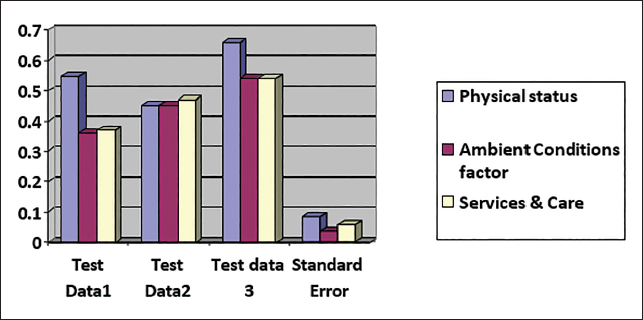
A couple of the performance criteria are projected, and the experiment’s findings have also been gathered. The findings are based on classifications made using sizable datasets with numerous class instances. Tables 1 and 2 show the servicescape variables for hospital A in terms of the patient’s treatment, environmental restrictions, and physical state.
Servicescape for Hospital.

Servicescape for Hospital “B.”

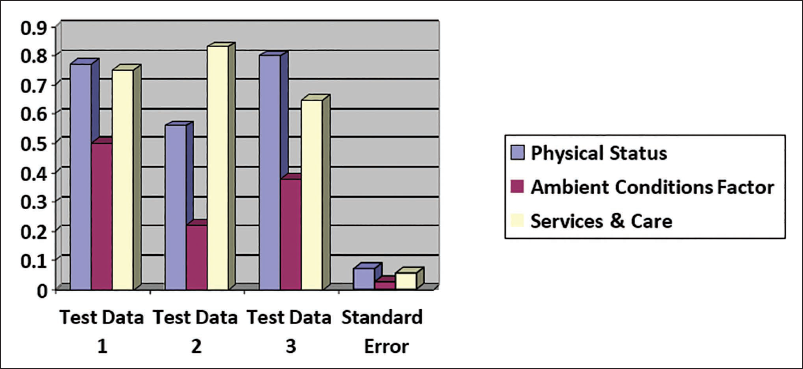
The measurement of the predictor variable determines a variety of performance indicators, including true positive or negative, false positive or negative, and the accuracy of the predictions, which is dependent on it. Figures 4 and 5 show that the estimated accuracy is calculated using the expected service quality factors. The investigation shows that the MSVM approach’s model is more accurate than some others.
Internet of Things (IoT) Sensors with Support Vector Machine (SVM) Classification as a Fault Detection Framework (FDF) for Healthcare Monitoring in Hospital “B.”
Conclusion
In recent years, technological advancements have made life simpler across many industries. IoT, wireless networks, and intelligence-enabled technologies, in particular, are dramatically altering the environment. This study focuses on how IoT devices are used in hospitals or other healthcare settings to track patient health. Additionally, patient feedback is collected and used as data in the study of the monitoring devices’ operation to find faults. SV machine is used against the service characteristics to do the analysis. The outcome demonstrates that, in addition to the more significant number of patients recorded, the suggested strategy achieves an acceptable level of 80% accuracy in problem identification.
Footnotes
Abbreviations
CNN: Convolutional neural network; DG: Distributed generation; ELM: Extreme learning machine; FDF: Fault detection framework; GANs: Generative adversarial networks; HIF: High impedance fault; IIOT: Industrial Internet of Things; IoT: Internet of Things; KNN: K-nearest neighbors; LVRT: Low-voltage ride-through; MSVM: Multiclass support vector machine; NEAT: Neuroevolution of augmenting topologies; PDF: Probability density function; PQ: Power quality; RCFD: Refrigerant charge fault detection; RELM: Regularized extreme learning machine; SVDD: Support vector data description; SVM: Support vector machine; TKEO: Teager–Kaiser energy operator; VMD: Variational mode decomposition; WSN: Wireless sensor networks; WT: Wavelet transform.
Acknowledgments
None.
Declaration of Conflicting Interests
The authors declared no potential conflicts of interest with respect to the research, authorship, and/or publication of this article.
Ethical Approval and Informed Consent
Not applicable.
Funding
The authors received no financial support for the research, authorship, and/or publication of this article.