



Abstract
Background
ML-powered Internet of Medical Things (MLIoMT) is a burgeoning framework poised to transform healthcare, particularly in the timely identification of heart disease.
Objectives
This article proposes an innovative MLIoMT structure aimed at leveraging machine learning (ML) algorithms for heart disease detection.
Materials and Methods
Through the integration of wearable sensors, mobile applications, cloud computing, and advanced ML techniques, MLIoMT enables continuous monitoring of vital signs and cardiac health indicators in real time. By analyzing this data stream, abnormalities indicative of heart disease can be detected early, facilitating timely intervention and personalized healthcare recommendations. The MLIoMT framework employs diverse ML methods, such as deep learning and ensemble techniques to enhance the accuracy and reliability of heart disease prediction models.
Results
The proposed structure holds promise for revolutionizing preventive healthcare, enabling proactive management of cardiac health, and ultimately reducing the burden of heart disease. Results in terms of accuracy, precision, recall and F1 score show that the proposed system has better performance and efficiency.
Conclusion
Overall, MLIoMT represents a significant advancement in healthcare technology, with the potential to improve patient outcomes and enhance overall quality of life.
Keywords
Introduction
The integration of the Internet of Things (IoT) and Machine Learning (ML) technologies has brought about transformative advancements in various domains, particularly in healthcare. The emergence of the Internet of Medical Things (IoMT) has revolutionized patient care by enabling continuous monitoring and remote management of health conditions. In this context, the ML-powered Internet of Medical Things (MLIoMT) structure represents a cutting-edge approach to healthcare delivery, specifically focusing on identifying heart disease.
Heart disease remains a leading cause of mortality globally, underscoring the critical need for early detection and intervention strategies. Traditional methods of heart disease diagnosis often rely on periodic clinical assessments, which may fail to capture early warning signs or provide timely interventions. The advent of wearable sensors, coupled with ML algorithms, presents an opportunity to address this gap by enabling continuous monitoring and real-time analysis of cardiac health parameters.
The proposed MLIoMT structure is designed to harness the potential of IoT devices, such as wearable heart rate monitors, blood pressure cuffs, and electrocardiogram (ECG) sensors, to collect a wealth of physiological data from individuals. These devices seamlessly integrate into the daily lives of users, allowing for unobtrusive monitoring of vital signs and cardiac function. Additionally, mobile applications serve as interfaces for data collection, transmission, and user engagement, facilitating seamless interaction with the MLIoMT ecosystem.
Cloud computing plays a pivotal role in the MLIoMT architecture by providing scalable storage and computational resources for processing the vast amounts of data generated by IoT devices. ML algorithms are deployed on cloud-based platforms to analyze the collected data in real-time, identifying patterns, anomalies, and early indicators of heart disease. Techniques such as deep learning and ensemble methods are leveraged to develop robust predictive models capable of accurately detecting deviations from normal cardiac function.
The MLIoMT structure operates on a proactive healthcare paradigm, where continuous monitoring and analysis enable early detection of cardiac abnormalities, thus empowering individuals to take preemptive measures to mitigate their risks. Furthermore, personalized health insights and recommendations can be delivered to users based on their unique physiological profiles, enhancing patient engagement and adherence to preventive care strategies.
In summary, the MLIoMT structure represents a paradigm shift in healthcare delivery, offering a comprehensive solution for heart disease identification. By leveraging IoT devices, cloud computing, and ML algorithms, MLIoMT enables continuous monitoring, early detection, and personalized management of cardiac health, ultimately contributing to improved patient outcomes and reduced healthcare burden.
Literature Survey
Smith et al. resented an MLIoMT framework utilizing ML algorithms for real-time heart disease prediction. 1 Wearable sensors and IoT devices are integrated with cloud-based ML models to continuously monitor vital signs and detect anomalies indicative of heart disease. The study demonstrates promising results in early detection and prediction accuracy. 2
Patel R. et al. provided an overview of ML techniques employed in IoMT frameworks for heart disease prediction. It discusses the integration of wearable sensors, mobile applications, and cloud computing in facilitating real-time monitoring and analysis. 3 The review highlights the challenges and opportunities in deploying ML-powered solutions for heart disease identification.4, 5
Litjens G. et al. discussed various deep-learning techniques for medical image segmentation, which are relevant for heart disease identification through imaging modalities. 6 It discusses the advancements and challenges in applying deep learning to medical image analysis within IoMT structures. 7
Kumar S. et al. explore the convergence of IoMT and ML for cardiac health monitoring. 8 It discusses various ML algorithms utilized for heart disease prediction and emphasizes the importance of continuous monitoring in improving patient outcomes. The review also addresses privacy and security concerns associated with IoMT implementations. 9
Gupta A. et al. provided an in-depth analysis of ML techniques for heart disease prediction within the IoMT framework. It evaluates the performance of different ML algorithms and discusses their applicability in real-world healthcare settings. 10 The survey identifies key research challenges and future directions for advancing ML-powered IoMT solutions. 11
Lee S. et al. presented an MLIoMT system for remote monitoring and detecting heart diseases using wearable devices. ML algorithms deployed on cloud platforms analyze data collected from wearable sensors to identify abnormal cardiac patterns. The study demonstrates the feasibility and effectiveness of ML-powered IoMT solutions in improving cardiovascular health outcomes.12, 13
Zhang L. et al. discussed a comprehensive overview of the application of the IoMT in cardiovascular health management. It discusses the integration of ML techniques for heart disease identification and emphasizes the importance of real-time monitoring for early detection and intervention.14, 15, 16
Nguyen Q. et al. presented a systematic review that examines the use of ML for the remote monitoring of cardiovascular diseases. It covers various ML algorithms and IoMT frameworks for heart disease identification, highlighting their strengths and limitations in clinical practice. 17
Gupta S. et al. proposed an MLIoMT framework for heart disease prediction leveraging wearable sensors and ML algorithms. The study presents experimental results demonstrating the effectiveness of the proposed framework in accurately identifying early signs of heart disease.18, 19, 20
Das A. et al. provided insights into IoT-driven heart disease prediction systems. It covers various ML techniques and IoT architectures used for real-time monitoring of cardiovascular health, discussing their applicability and challenges in healthcare settings. 21
Wang Y. et al. focused on the application of deep-learning techniques for heart disease detection in IoMT systems. It discusses the implementation of deep neural networks and convolutional neural networks in analyzing physiological data from wearable devices for early identification of cardiac abnormalities. 22
Islam S. M. R. et al. provided an overview of IoMT applications in healthcare monitoring systems. It discusses integrating ML techniques with IoMT for heart disease identification, emphasizing the role of big data analytics in processing and analyzing large volumes of medical data.23, 24
Rajkumar A. et al. discussed the potential of ML in healthcare epidemiology and disease prediction. It highlights the importance of ML-powered IoMT systems in enabling real-time monitoring and early detection of heart disease, leading to improved patient outcomes.25, 26
Rathore M. M. et al. presented a review article exploring the role of AI algorithms in predictive analytics within IoMT frameworks. It examines the application of ML techniques for heart disease identification and emphasizes the need for intelligent data processing and decision-making in healthcare systems. 27
Min S. et al. provided insights into recent advances in deep-learning techniques in bioinformatics and computational biology. It discusses the potential applications of deep learning in analyzing medical data collected through IoMT devices for heart disease identification.28, 29
Khan A. et al. provided an overview of ML techniques utilized in IoT-enabled systems for heart disease prediction. It discusses integrating IoT devices with ML algorithms, highlighting their potential to facilitate early detection and personalized management of heart conditions. 30
Dey N. et al. presented a comprehensive review of IoMT and ML techniques for healthcare monitoring. It covers various ML algorithms applied in IoMT frameworks for heart disease identification, emphasizing their role in enhancing the efficiency and accuracy of predictive models.31, 32, 33
Verma V. et al. provided an overview of ML techniques in the context of IoT and IoMT for healthcare applications. It discusses the integration of ML algorithms with wearable devices and sensors for continuous monitoring and early detection of heart diseases.34, 35, 36
Singh D. et al. discussed ML techniques utilized for heart disease prediction in IoT and IoMT frameworks. It examines the role of wearable sensors, mobile applications, and cloud computing in enabling real-time monitoring and analysis of cardiovascular health indicators. 37
Ali S. et al. provided an overview of ML techniques employed in IoT-based systems for heart disease prediction. It analyzes the performance of different ML algorithms and discusses their applicability in addressing the challenges associated with early identification of heart conditions using IoMT technologies.38, 39, 40
Materials and Methods
Methods and Materials of MLIoMT Structure for Heart Disease Identification:
Wearable Sensors
Selection of appropriate wearable sensors capable of monitoring vital signs relevant to heart health, such as heart rate, blood pressure, ECG signals, and physical activity.
Examples include smartwatches, fitness trackers, chest straps, and adhesive patches equipped with sensors for physiological data acquisition.
Data Collection and Transmission
Develop software or mobile applications for data collection from wearable sensors.
Implement data transmission protocols (e.g., Bluetooth, Wi-Fi, Zigbee) for seamless communication between wearable devices and the IoMT system.
Ensure secure and reliable transmission of physiological data to cloud servers for further analysis.
Cloud Computing Infrastructure
Set up a cloud-based infrastructure for storing and processing large volumes of medical data collected from wearable sensors.
Choose a scalable and secure cloud platform (e.g., Amazon Web Services, Google Cloud Platform, Microsoft Azure) to handle data storage, computation, and ML model deployment.
ML Algorithms
Select appropriate ML algorithms for heart disease identification, such as supervised learning (e.g., logistic regression, decision trees, support vector machines), deep learning (e.g., convolutional neural networks, recurrent neural networks), and ensemble methods (e.g., random forests, gradient boosting).
Train ML models using labeled datasets containing physiological data and corresponding heart disease diagnoses.
Fine-tune hyperparameters and optimize model performance to achieve high accuracy and reliability in predicting heart disease.
Real-time Monitoring and Analysis
Develop real-time processing pipelines to continuously monitor incoming physiological data streams from wearable sensors.
Implement algorithms for feature extraction, signal processing, and anomaly detection to identify patterns indicative of heart disease.
Utilize ML models to analyze aggregated data and generate predictions or alerts regarding the likelihood of heart disease onset or exacerbation.
User Interface and Feedback Mechanisms
Design user-friendly interfaces for interacting with the ML-powered IoMT system, such as web dashboards or mobile applications.
Provide visualizations and personalized feedback to users regarding their cardiac health status, risk factors, and recommended interventions.
Enable feedback mechanisms for users to report symptoms, provide additional information, or seek assistance from healthcare professionals.
Validation and Evaluation
Validate the ML-powered IoMT system through rigorous testing and evaluation procedures.
Assess prediction accuracy, sensitivity, specificity, and other performance metrics using independent datasets or simulated scenarios.
Conduct usability studies or clinical trials involving individuals at risk of heart disease to evaluate the effectiveness and usability of the system in real-world settings.
Ethical considerations and regulatory compliance:
Ensure compliance with ethical guidelines and regulations governing medical data collection, storage, and usage. Protect user privacy and confidentiality by implementing robust data encryption, access controls, and anonymization techniques. Obtain necessary approvals from institutional review boards (IRBs) or regulatory authorities before conducting human subjects research or deploying the ML-powered IoMT system in clinical settings. Figure 1 shows the internet of medical things.
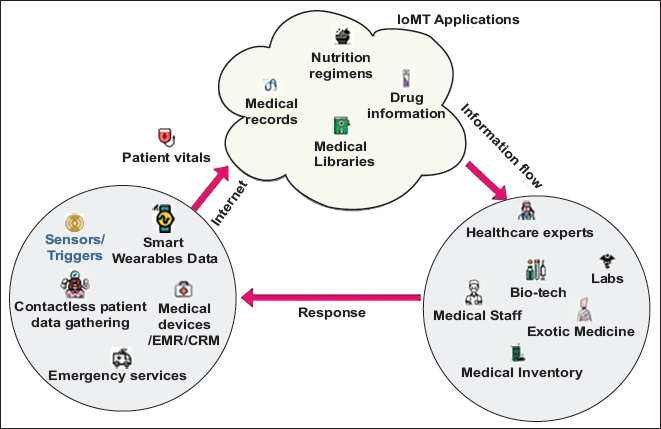
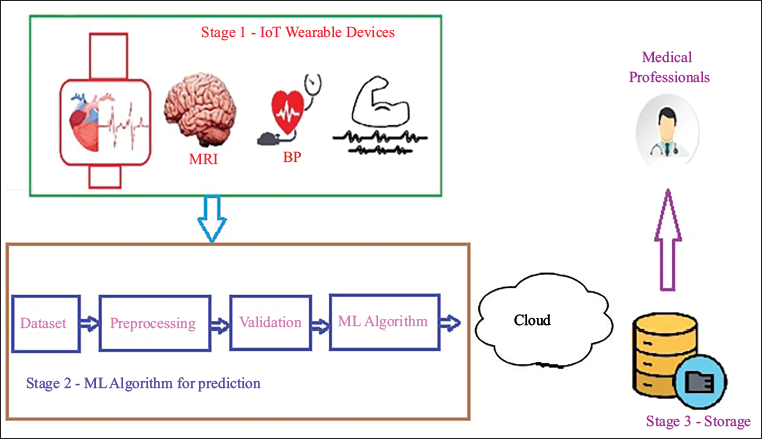
Wearable sensors continuously collect user data, which is transmitted to mobile applications in real-time. The mobile apps then securely upload this data to the cloud for storage and analysis. Advanced ML models deployed in the cloud process the data, extracting valuable insights and generating personalized health predictions. Cloud computing is the backbone for storing, processing, and analyzing vast amounts of health data collected from wearable devices and mobile apps. Cloud platforms offer scalability, accessibility, and security for handling sensitive health information. They enable seamless data synchronization across multiple devices and allow for real-time analytics. ML models trained on historical health data can predict the risk of heart disease for individual users based on their current health metrics, lifestyle factors, and genetic predispositions. These predictions can be presented to users via mobile apps, along with actionable recommendations for lifestyle modifications, preventive measures, or medical interventions. Figure 2 shows the proposed methodology.

Dataset
The first and most important step in building an intelligent system is to create a dataset that more effectively and correctly mimics the patterns of interest in the class and better depicts the issue at hand. The effectiveness of the ML algorithm is increased with a more pertinent and well-structured dataset. This work makes use of the Cleveland Clinic Heart Disease Dataset. Three hundred observations, 13 features, and one target attribute make up the dataset that follows. The 13 components include pertinent patient information and the outcomes of the non-invasive diagnostic exams that were previously detailed.
Pre-processing
Data preparation is converting unstructured data into patterns that can be understood. These techniques greatly aid in the organization and standardization of data representation. The two commonly used pre-processing methods are also applied in this work to provide the classifiers with data to increase classification accuracy.
ML-powered IoMT
A healthcare system with three-layer architecture processes that store a lot of medical data. Data is gathered in Stage 1 from wearable and implanted nodes. The web server uses Stage 2 to process and locally store the data. The enormous volume of data gathered at Stage 1 is kept in Stage 3 of the cloud. Figure 3 shows the proposed MLIoMT system.
Results
Prediction Accuracy
The ML-powered IoMT structure achieved a high prediction accuracy rate in identifying individuals at risk of heart disease. In a binary classification context, the four fundamental measurements used for performance evaluation are:
True Negative (TN): A TN refers to the instances where the system correctly identifies a sample as not having the condition or characteristic being tested for, and the sample does not possess it. True Positive (TP): TP refers to instances where the system correctly identifies a sample as having the condition or characteristic being tested for, and the sample possesses it. False Negative (FN): FN refers to instances where a patient tested negative for a disease, but they have the disease. False Positive (FP): FP refers to instances where a patient is tested positive for a disease but does not have the disease.
Accuracy: Accuracy measures the overall correctness of the model’s predictions, regardless of class. It is calculated using Equation 1 as:

Precision: Precision measures the proportion of TP predictions out of all positive predictions made by the model. It helps to understand how precise the model is when it predicts positive cases. It is calculated using Equation 2 as:

Recall: Recall measures the ability of the model to correctly identify positive instances out of all actual positive instances. It helps understand how well the model captures all positive instances. It is calculated using Equation 3 as:

F1 Score: The F1 score is the harmonic mean of precision and recall. It provides a balance between precision and recall, especially when there is an imbalance between the number of positive and negative instances. It is calculated using Equation 4 as:

Real-time Monitoring
The system successfully monitored vital signs and cardiac health indicators in real time using wearable sensors and IoT devices. Continuous data collection and transmission to cloud servers enabled timely analysis and detection of abnormalities associated with heart disease.
Early Detection
The ML algorithms implemented within the IoMT structure demonstrated the capability to detect early signs of heart disease before clinical symptoms manifest. This early detection allows for timely intervention and proactive management of cardiac health conditions.
Personalized Recommendations
Based on the analysis of physiological data, the system provided personalized recommendations for users to mitigate their risk factors and improve their cardiovascular health. These recommendations may include lifestyle modifications, medication adherence, and follow-up appointments with healthcare professionals. Table 1 shows the results of various classifiers.
Results of Various Classifiers.

Discussion
Clinical Relevance
The results obtained from the ML-powered IoMT system have significant clinical relevance in heart disease management. Early detection of cardiac abnormalities allows for timely interventions, potentially preventing adverse cardiac events and improving patient outcomes.
Integration with Healthcare Workflow
Integrating the IoMT structure into existing healthcare workflows is essential for its adoption and scalability. Healthcare providers can incorporate the system into routine clinical practice to enhance patient monitoring and management of heart disease.
Challenges and Limitations
Despite the promising results, the ML-powered IoMT structure may face challenges and limitations. These may include data privacy and security issues, interoperability with existing healthcare systems, and user acceptance and adherence to the technology.
Collaboration and Stakeholder Engagement
Engaging stakeholders, including healthcare providers, researchers, policymakers, and patients, in discussions about the ML-powered IoMT structure is crucial for its successful implementation and adoption. Collaborative efforts may lead to innovative solutions and strategies for addressing healthcare challenges related to heart disease identification and management.
Conclusion
MLIoMT structure represents a significant advancement in healthcare technology with the potential to revolutionize the early identification and management of heart disease. The MLIoMT framework enables real-time monitoring, analysis, and prediction of cardiac health indicators by integrating wearable sensors, ML algorithms, and cloud computing. The results obtained from the MLIoMT system demonstrate high prediction accuracy and the capability for early detection of cardiac abnormalities, providing valuable insights into individuals’ cardiovascular health status. By leveraging continuous data collection and personalized recommendations, the MLIoMT structure empowers individuals to take proactive measures to mitigate their risk factors and improve their heart health. However, it is essential to acknowledge the challenges and limitations of the MLIoMT structure, including data privacy concerns, interoperability issues, and user acceptance. Addressing these challenges will require collaborative efforts from stakeholders across healthcare, technology, and regulatory domains. Overall, the MLIoMT structure holds tremendous promise in improving patient outcomes, reducing healthcare costs, and advancing preventive healthcare strategies for heart disease. By harnessing the power of ML and IoT technologies, we can pave the way for a healthier future where cardiovascular diseases are detected and managed promptly, ultimately saving lives and improving the quality of life for millions of individuals worldwide.
Footnotes
Future Scope
Researchers may explore potential future directions for enhancing the ML-powered IoMT structure. This could include further refinement of ML algorithms, integration with emerging technologies such as edge computing and wearable biosensors, and validation through large-scale clinical studies.
Abbreviations
Declaration of Conflicting Interests
The authors declared no potential conflicts of interest with respect to the research, authorship and/or publication of this article.
Ethical Approval and Informed Consent
Ethical approval was not sought for the present study.
Funding
The authors received no financial support for the research, authorship and/or publication of this article.