



Abstract
Background
The most common condition that restricts movement is low back pain, which is particularly common in the most productive years of life. Sciatica syndrome accounts for 40% of patients’ severe lower back pain. Psychological strain places excessive strain on the spinal column and is a major contributing factor to the development of sciatica and lower back pain.
Objectives
The illness indicated in Ayurveda has symptoms and signs similar to “Sciatica” in modern, contemporary medicine. In clinical practice, Gridhrasi (Sciatica), the conditions stated in Ayurveda are comparable to those treated in contemporary medicine.
Methods
A 38-year-old female patient suffering from the above ailments, having pain in the lumbar region radiating pain to the left leg, tingling sensation in both legs, difficulty in walking, irregular sleep, and limping gait, was admitted to an Ayurvedic hospital. Her treatment comprised external and internal, consisting of Snehan with Vishgarbha Taila, Kati Basti with Mahamasadi Taila, and Kala Basti with Panchtiktaksheer (medicated enema).
Results
These treatments had a very favorable outcome, it was discovered. Following therapy, there was a significant improvement in walking time, lower extremity motions, and pain alleviation.
Conclusion
This method of treating Sciatica may be helpful in clinical settings and future research.
Keywords
Introduction
Sciatica is a more complex neurological condition. It is defined as pain that travels along the sciatic nerve’s path, which originates in the lower back and runs down each leg, passing through the hips and buttocks. 1 Sciatica is more common than 40%, and low back pain is 50–60% common throughout life. However, only 4–6% of people have Sciatica due to lumbar disc prolapse. 2 The word Gridhrasi (Sciatica) is derived from the word “Gridhraus” by extending “Din” pratayaya. 3 The term “Gridhrasi” (Sciatica) refers to the altered gait of the patient in this ailment, which is caused by stiff, slightly bent legs that resemble a vulture’s walk due to walking too much or traveling in a car. Its characteristics include Stambha (stiffness), Ruk (pain), Toda (pricking pain), and Spandana (frequent tingling). 4 From the Ayurvedic point of view, the signs and symptoms of Sciatica are pretty similar to those of Gridhrasi (Sciatica), including pain, numbness, and tingling in the lower limbs, stiffness, pricking pain, twitching, limited mobility, and bending posture. Basti (medicated enema) and Siravedhan (bloodletting) are Chikitsa (treatment) that can be used in any Vatavyadhi. Because of this anxiety, there are several difficulties in the general acceptance of the surgical treatment currently accessible for this illness in modern science. We have excellent alternative therapy protocols to manage such entities using Ayurveda. Therefore, an attempt is being made to demonstrate the effectiveness of Ayurvedic treatment for Sciatica through the case study. The Gridhrasi (Sciatica) Chikitsa Sutra (treatment protocol) includes Agnikarma Chikitsa (therapeutic heat burns), Siravedhan (bloodletting), and Basti Karma (medicated enema) in Ayurvedic texts. 5 The following treatment concepts are used to manage this illness. The treatment plan for this patient was broken down into two parts: Shamana Chikitsa (internal medication) and Shodhana Chikitsa Vedanasthapana Chikitsa (analgesic); Shothahara (anti-inflammatory); and Vata Dosha (humor) pacifying treatment.
Case Report
A 38-year-old female patient was healthy 6 months ago. She then began complaining of lower back pain, which, over the next 3 months, was accompanied by pain that was radiating to her left leg, her gluteal area, and her lumbar. She is also troubled during walking and sitting, as well as heaviness in both legs and stiffness in the lumbar region from the past 3 months. The patient had allopathic treatment, but the results were only transient. Therefore, after the symptoms worsened, the patient opted for Ayurvedic treatment and visited the Panchakarma outpatient department (OPD) of the Ayurvedic Hospital Wardha. The patient was then admitted that day for more Ayurvedic treatment.
Clinical Examination
General examination: Blood pressure (BP)—130/90 mmHg, pulse rate (PR)—78/min, respiratory rate (RR)—18/min, temperature—98.6°F, and weight—75 kg.
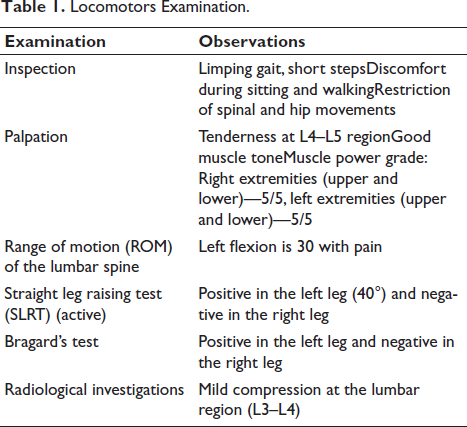
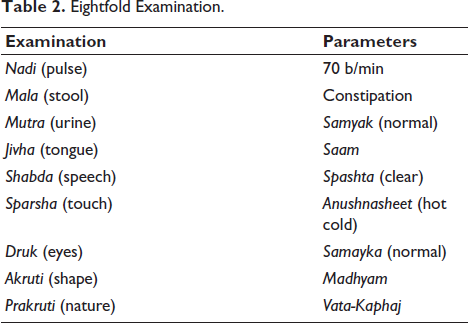
Systematic examination is shown in Tables 1 and 2.
Locomotors Examination.
Eightfold Examination.
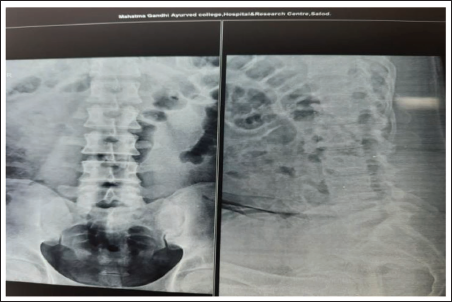
Clinical findings: Investigations like X-ray showed mild compression between L3 and L4. Complete blood count (CBC) and blood sugar were within normal limits as shown in Figure 1.
X-ray of Lumbar Joint (Before Treatment).
Diagnostic Assessment
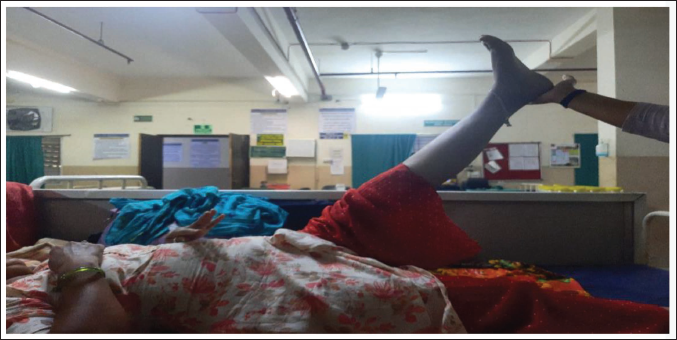
It was Vata-Kaphaj Gridhrasi (Sciatica), and the diagnosis was based on specific examinations, such as straight leg raising test (SLRT) (Figures 2 and 3), Bragard’s test, and the clinical presentation of the disease.
Straight Leg Raising Test (SLRT) Before Treatment.
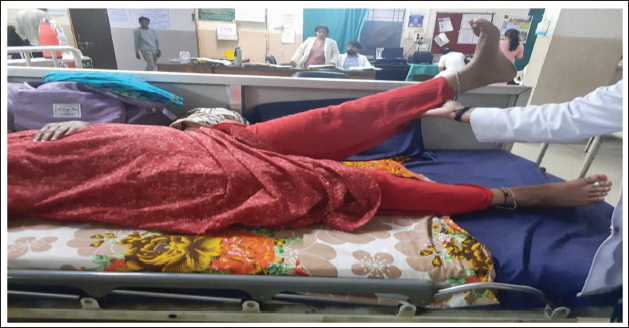
Straight Leg Raising Test (SLRT) After Treatment.
Timeline
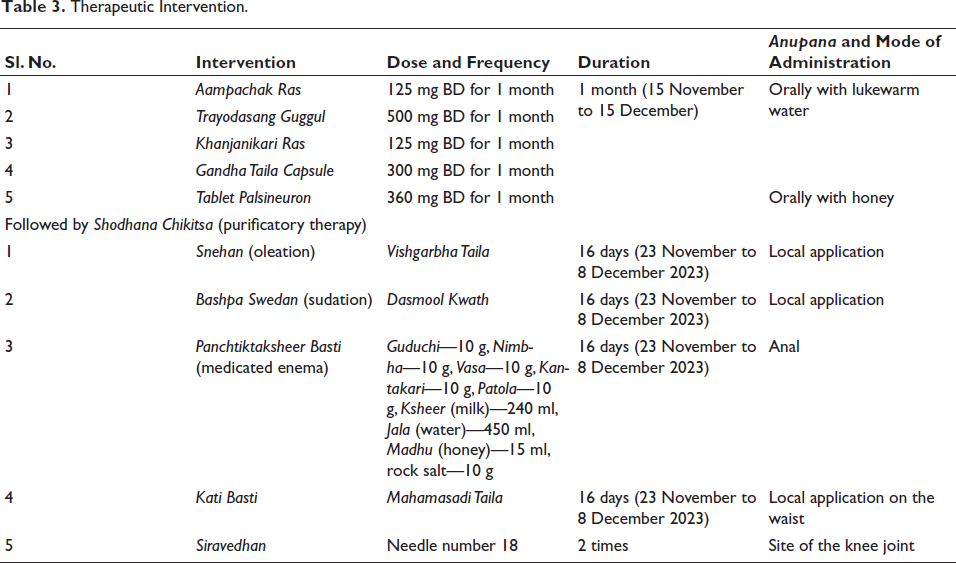
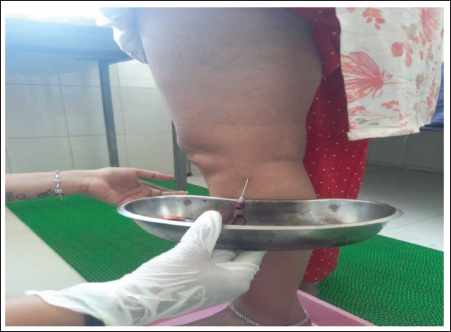
The patient was diagnosed with Gridhrasi (Sciatica) and underwent a 1-month Ayurvedic treatment regimen with oral medication, including Basti (medicated enema) and Siravedhan (bloodletting), for detoxifying channels and improving local blood circulation, which is mentioned in Table 3 and Figure 4. Additionally, adherence to a healthy diet was prescribed as part of Shaman Chikitsa (internal medicine). The therapeutic interventions are shown in Table 3.
Therapeutic Intervention.
Siravedhan During Treatment.
Follow and Outcome
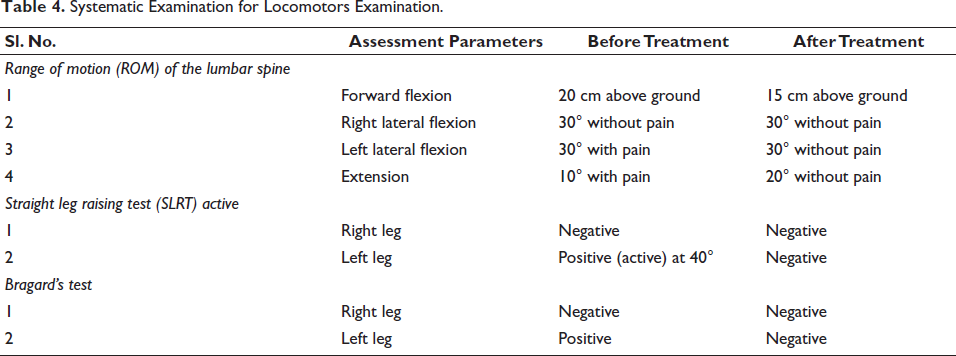
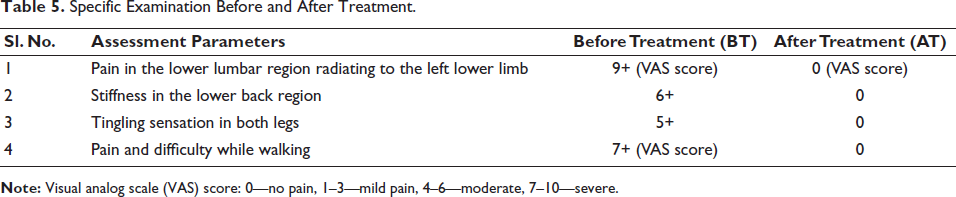
The patient was assessed before and after treatment using specialized grading methods and some specific examinations, such as range of motion (ROM), visual analog scale (VAS), SLRT, and Bragard’s test, which are mentioned in Tables 4 and 5.
Systematic Examination for Locomotors Examination.
Specific Examination Before and After Treatment.
Results
The patient’s condition showed significant improvement after treatment, with marked reductions in pain, stiffness, and discomfort. Initially, the patient reported severe lower back pain radiating to the left leg (VAS 9+), which completely resolved (VAS 0) post-treatment. Stiffness in the lower back (6+) and tingling in both legs (5+) were also alleviated to 0. The difficulty in walking, rated at 7+ before treatment, was also fully resolved. ROM improved notably, with forward flexion increasing from 20 cm to 15 cm above the ground and left lateral flexion, previously painful at 30°, becoming pain-free. Extension improved from 10° with pain to 20° without pain. The SLRT and Bragard’s test, which were positive before treatment, turned negative post-treatment, indicating resolution of sciatic nerve involvement and nerve root irritation. In summary, the treatment successfully addressed the patient’s symptoms, restoring physical function and eliminating pain.
Discussion
One of the largest and longest nerves in the body, the sciatic nerve, has two branches that extend from the buttocks to the tips of both legs’ fingers. It facilitates calf and leg muscle actions and gives the calf and leg region a feel. Compression of the sciatic nerve results in Gridhrasi (Sciatica). The swelling may result from a disc herniation at the level of the lumbar vertebrae, which may have produced compression. The Gridhrasi (Sciatica) Chikitsa Sutra (treatment protocol) includes Agnikarma Chikitsa (therapeutic heat burns), Siravedhan (bloodletting), and Basti Karma (medicated enema) in Ayurvedic texts. The following treatment concepts are used to manage this illness. The treatment plan for this patient was broken down into two parts: Shamana. The following can be used to investigate the likely mechanism of action of the aforementioned Shodhana and Shamana Chikitsa (internal medication).
Sarvanga Abhayanga (Local Massage) with Vishgarbha Taila
One of the Purvakarma (primary action), Abhyanga (local massage), acts on the Snayu, Twak (skin), and Rakatavahini (blood) channels, which are the Mamsavahasrotas (channels carrying nutrients and waste from the muscles). As a result, it can strengthen the deep and superficial muscles and stabilize the joint. Abhyanga (local massage) with Vishgarbha Taila has anti-inflammatory, analgesic, and anti-neuralgic effects. It is recommended for arthritis, back pain, joint stiffness, and muscle spasms. 6
Baspha Sweda (Sudation)
Bashpa Sweda (sudation) alleviates stiffness and heaviness in areas like the lower back and legs affected by Sciatica by inducing sweating and reducing associated pain. The Swedana Dravya’s warmth, sharpness, and subtlety penetrate tissues, improve circulation, and relax muscles and nerves. Combining Sweda (sudation) with Dashmool Kwath directs vitiated Doshas to their channels (Srotas), liquefies Doshas, eases joint stiffness, and enhances flexibility. It breaks down pathophysiology by reducing microchannel congestion and addressing Sciatic symptoms at their source.
Kati Basti with Mahamasadi Taila
Kati Basti uses warm Mahamasadi Taila on the lumbar region (L3–L4) to nourish and strengthen affected areas with disc protrusion, improving intervertebral disc and muscle integrity. It addresses compromised Shleshak Kapha lubrication due to disc degeneration, easing sciatic nerve compression and inflammation. Mahamasadi Taila ingredients balance Vata and Kapha Doshas, reducing irritation and inflammation associated with Sciatica. 7
Mode of Siravedhan
Sushruta considers Rakta (blood) to be a primary cause of surgical disorders, including Gridhrasi (Sciatica) and Siravedhan (bloodletting), which aims to remove vitiated blood from the body. Gridhrasi (Sciatica) is primarily a Vata disorder, and according to Sushruta, vitiation of both Vata and Rakta contributes to its manifestation. Siravedhan (bloodletting) helps balance Vata Dosha (humor) by removing excess blood, which may aggravate Vata and cause sciatic pain. Bloodletting can improve circulation by removing stagnant or vitiated blood from the affected area. Siravedhan (bloodletting) promotes tissue healing and regeneration by eliminating toxins and impurities from the blood. This can be beneficial in addressing any structural damage or degenerative changes associated with Gridhrasi (Sciatica).
Mode of Panchtiktasheer Basti 8
The correlation between the mode of action of Panchtiktaksheer Basti (medicated enema) and Sciatica involves not just muscular or nerve-related issues but also the potential involvement of the Dushti of Asthimajjavahasrotas (bone and bone marrow system) due to nerve compression or inflammation around the spine. Panchtiktaksheer Basti (medicated enema) serves both cleansing and lubricating purposes. This is essential in Sciatica as it helps alleviate the impingement on the sciatic nerve and reduces inflammation in the surrounding tissues. The composition of Panchtiktaksheer Basti (medicated enema), particularly the presence of Akash and Vayu Mahabhuta, along with other beneficial elements, supports the overall health of Asthi Dhatu. This can aid in mitigating the structural issues contributing to Sciatica. The properties of Panchtiktaksheer Basti (medicated enema), such as Vata-pitta Shamaka (pacifying Vata and Pitta), Balya (strengthening), and Sheetaviryatmak (cooling). This is essential in managing the pain and discomfort associated with Sciatica.
Shaman Chikitsa
Aampachak Vati: This formulation promotes peristaltic movement, aiding digestion and reducing aggravated Tridoshas. 9 Addressing digestive issues like acidity, gas, and indigestion indirectly helps alleviate symptoms associated with Sciatica Trayodasang Guggul, 10 known for its antispasmodic action. Trayodasang Guggul alleviates muscle spasms and pain in Sciatica. Its Guru (heaviness) and Snigdhagunatmak (unctuous) properties lessen the manifestation of Gridhrasi (Sciatica) by pacifying aggravated Doshas, particularly during inflammation. Khanjanikari Ras, 11 containing Mallahar Sindoor, Kuchala, and Arjuna Kwath (decoction), is beneficial in neurological diseases and conditions involving Kapha and Vata imbalance. It rejuvenates and acts as an antiaging medicine, possibly supporting Sciatica management through its neuroprotective and rejuvenating properties. Gandha Taila Capsule 12 : As per Ashtanga Hridaya, Gandha Taila improves bone mass and strength, making it useful in conditions like Sciatica where spinal bones may be affected. Enhancing bone strength and mobility helps alleviate symptoms and improve overall spinal health. 13 Tablet Dardnash is an herbal drug that contains Vang Bhasma, Loha Bhasma, Swarnamakshika Bhasma, Ashwagandha, Singhnad Guggul (S. guggul), and Ras Sindoor. Dardnash is specifically designed to alleviate pain and reduce inflammation. Its ingredients synergistically provide analgesic and anti-inflammatory effects, relieving sciatic symptoms.
Conclusion
Gridhrasi (Sciatica) is characterized by pain that originates in the hip area and spreads to the thigh, back, sacral region, popliteal area, calf muscle, and foot, as well as prickling sensations in those areas, altered gait, and in rare cases rigidity or pulsation. Gridhrasi (Sciatica) has vitiated Vata Dosha in the lower back region and involves Kaph in this region, so we used Snehan, Swedan (Sudation), Basti (medicated enema), which is beneficial in the Vaat Shamak and Kapha Nisharak and healing the tissue in the lumbar region. Above Shamana Chikitsa (treatment) effect on the Dosha (humor) and decrease the Dosha (humor) and nourishing the nerve and healing the nerve injury and removing the signs and symptoms of Gridhrasi (Sciatica) and the patient has improved in normal gait and comfortable in walking and standing.
Abbreviations
Footnotes
Acknowledgments
The authors appreciate the patient’s and her family’s permission to share the information.
Authors’ Contribution
Dr. Preeti Borkar conceptualized the data and designed the study. Dr. Pooja Basnal wrote and drafted the final manuscript. Dr. Pratyendra Pal and Dr. Sonia Mandal also provided valuable input in preparing the manuscript. Finally, all authors read and approved the final version of the manuscript.
Declaration of Conflicting Interests
The authors declared no potential conflicts of interest with respect to the research, authorship, and/or publication of this article.
Funding
The authors disclosed receipt of the following financial support for the research, authorship, and/or publication of this article: Datta Meghe Institute of Higher Education and Research (D.M.I.H.E.R), Maharashtra, India.
Informed Consent
Informed consent for publication of the data were taken from the patient.
