



Abstract
Background
Animal models play a critical role in biomedical research, yet comprehensive data on the types and distribution of animals used in different research contexts are sparse.
Objectives
This study aims to provide a detailed analysis of small laboratory animals used in preclinical research, highlighting the types of animal species used, study types, and disease systems targeted.
Materials and Methods
A total of 841 freely available full-text original research articles indexed in the PubMed database from January 2016 to January 2021 were analyzed. Variables recorded included a) type of animal species used for research, b) type of animal studies (in vivo, in vitro, mixed, transgenic, xenograft, others), c) distribution of animals across different study types, d) system and disease-wise distribution of studies, and e) type of animal used and type of studies conducted for different systems/diseases
Results
Mice were used in 75.98% of studies, followed by rats at 22.12%. Most studies were in vivo (35.43%), followed by mixed studies combining both in vivo and in vitro methods (24.49%). The gastrointestinal and genitourinary systems (GIT/GU: 21.04%) and the central nervous system (CNS: 15.33%) were the most studied. GIT/GU research focused on diseases like nonalcoholic steatohepatitis, colitis, inflammatory bowel disease, and various carcinomas. For CNS, studies predominantly addressed Parkinson’s disease, Alzheimer’s disease, and multiple sclerosis. In GIT/GU studies, mice were the most commonly used species (140/177), with in vivo (55/177), mixed (43/177), and xenograft (36/177) approaches. For CNS diseases, in vivo approaches (72/129) were prevalent, utilizing both mice (39/129) and rats (32/129).
Conclusion
The distribution of animal species in these studies validates that mice, followed by rats, are still very commonly used small animals for preclinical research. In disease areas like GIT/GU and CNS, there is a notable use of mixed and transgenic models, which offer a comprehensive understanding of disease mechanisms. The preference for mixed and transgenic mouse models in cancer research, particularly xenografts, underscores the shift towards more sophisticated and disease-relevant animal models.
Introduction
Experimental animal studies are essential for advancing medical knowledge and improving patient outcomes. These studies are critical in developing new treatment methods and testing hypotheses, providing a foundation for future clinical research. The impact of experimental studies on clinical research is significant, resulting in the development of new drugs, medical devices, and treatment protocols. One fundamental way experimental studies in animals’ impact clinical research is by identifying potential treatments and therapies for diseases. 1 Researchers conduct experiments on animals or cell cultures to test the effectiveness of new drugs or medical devices. These studies help researchers understand the mechanisms of action of these treatments and how they might work in humans. 2 Experimental animal studies also provide critical information on the safety of new treatments. Researchers conduct experiments to determine drug and medical device risks and side effects. This information is then used to design clinical trials that can evaluate the safety and effectiveness of these treatments in humans. 3
Small laboratory animals like rats, mice, rabbits, and guinea pigs are commonly preferred for research due to their anatomical and functional similarities to humans. The ideal animal model should exhibit similarities with human disease regarding pathophysiology, phenotypic and histopathological features, predictive biomarkers for disease prognosis, response to therapies, and drug safety and toxicity. 4 The main experimental approaches commonly used in preclinical research are disease induction models (in vitro, in vivo, mixed), xenograft models, and transgenic models. 5
In vitro methods occur in laboratories and involve studying investigational drugs on microorganisms and human or animal cells. These methods only partially represent physiological conditions as they lack the complexity and interactions in living organisms, limiting their ability to. In vivo studies occur within a living organism, thus addressing the drawbacks of in vitro studies. However, in vivo studies face significant ethical concerns. 6 Xenograft models involve transplanting organs or tissues from one species into another. Inbred strains are genetically uniform animals that allow for the study of pathobiology with small sample sizes. 7 Transgenic models involve modifying the animal’s genome to express or eliminate specific genes. 8
There are several issues with experimental studies in animals that can impact their effectiveness. These issues include variations in drug dosing schedules and regimens of uncertain relevance to the human condition and the choice of comparison therapy (none, placebo, vehicle) varying between studies. Nuances in laboratory techniques that may influence results, such as methods for blinding investigators, are often not recognized or reported. Another issue is the selection of outcome measures, which may be surrogates or precursors of disease and are of uncertain relevance to the human clinical condition. Finally, the variable duration of follow-up may not correspond to disease latency in humans. 9 However, selecting animal species and an appropriate study approach is essential for effective preclinical research. Improper selection of the animal species and research approach leads to reduced translational value of animal research to human diseases. A thorough and succinct experimental research study can prevent redundancy and reduce the number of animals used in testing, provide specific information about research questions, and save time and resources. 10
Therefore, this study aims to explore the current status of researchers using animals for experiments. We have focused on the a) type of animal species used for research, b) type of animal studies (in vivo, in vitro, mixed, transgenic, xenograft), c) distribution of animals across different study types, d) system and disease-wise distribution of studies, and e) type of animals used and type of studies conducted for different systems/diseases.
Materials and Methods
The researchers conducted descriptive analysis using data from published literature available in the public domain. Before it commenced, the study received an exemption of review from the Institutional Ethics Committee (EC/OA- 188/2021). We searched the PubMed database (
The variables recorded from the studies included the a) type of preclinical studies (in vivo, in vitro, mixed, transgenic, xenograft) b) type of animal species used for research c) distribution of animals across different study types, and d) System & disease-wise distribution of studies, and e) type of animals used and type of studies conducted for different systems/ diseases. Study results are presented as numbers and percentages using Microsoft Excel.
Results
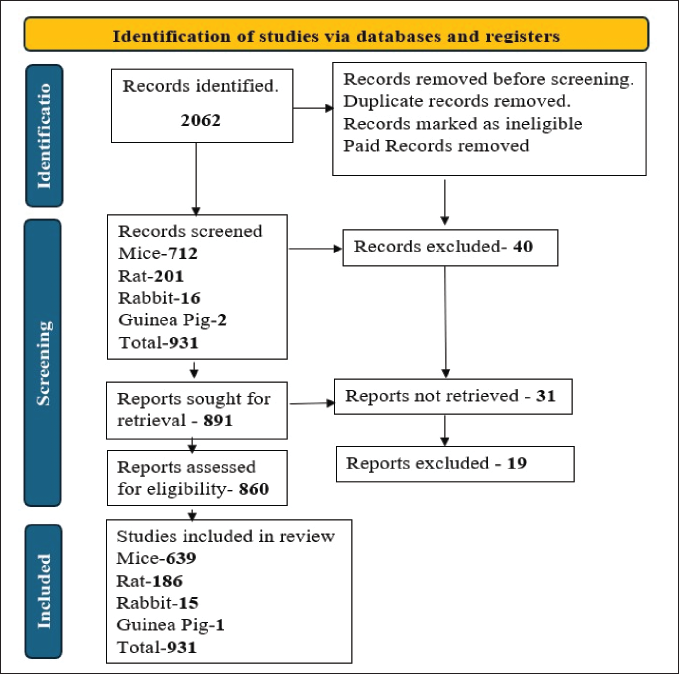
A total of 841 free full-text original research articles selected from 2062 abstracts spanning January 2016 and January 2021 were analyzed (Figure 1).
Flowchart for the Screening of Experimental Studies Conducted from January 2016 to January 2021.
a. Type of preclinical studies conducted and b. Type of animal species used.
Mice were the most frequently used animal species for preclinical research (75.98%) followed by rats (22. 12%). In vivo research approach is very commonly used by researchers (35.43%) followed by mixed research (24.49%) (Table 1).
Type of Preclinical Studies Conducted from January 2016 to January 2021 and Type of Animal Species Used for Research.
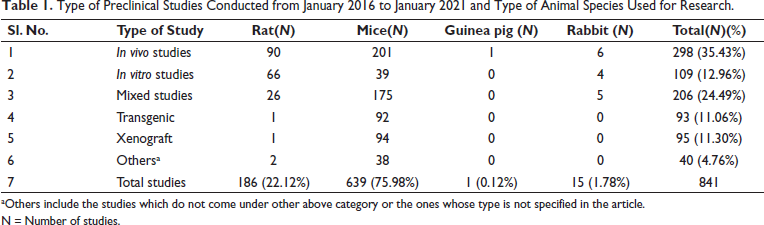
aOthers include the studies which do not come under other above category or the ones whose type is not specified in the article.
N = Number of studies.
Distribution of Animals Across Different Study Types
Analyzing these animals’ use in various research types revealed that mice are preferred for in vivo (201/298, 67.45%) and mixed studies (175/206, 84.95%). Mice are also exclusively used for transgenic and xenograft research. The rats were the second choice of animals for in vivo (90/298, 30.20%) and mixed types (26/206, 12.62%) studies. However, its use for in vitro studies is more than that of mice (rats: 66/109, 60.55% vs. mice: 39/109, 35.77%) (Table 1).
System/Disease-Wise Distribution of Studies
The analysis system-wise distribution of studies revealed that research was maximum in the gastrointestinal and genitourinary system (GIT/GU: 177, 21.04%), followed by the central nervous system (CNS:129, 15.33%). Key disease areas covered among these two major systems included acute pancreatitis, liver cancer, and chronic kidney disease in the GIT/GU system. In the CNS, there was a strong focus on Alzheimer’s disease, Parkinson’s disease, and multiple sclerosis. Detailed distribution of other systems and their disease areas is provided in Table 2.
System/Disease-Wise Distribution for Animals Used As Well As Type of Studies.
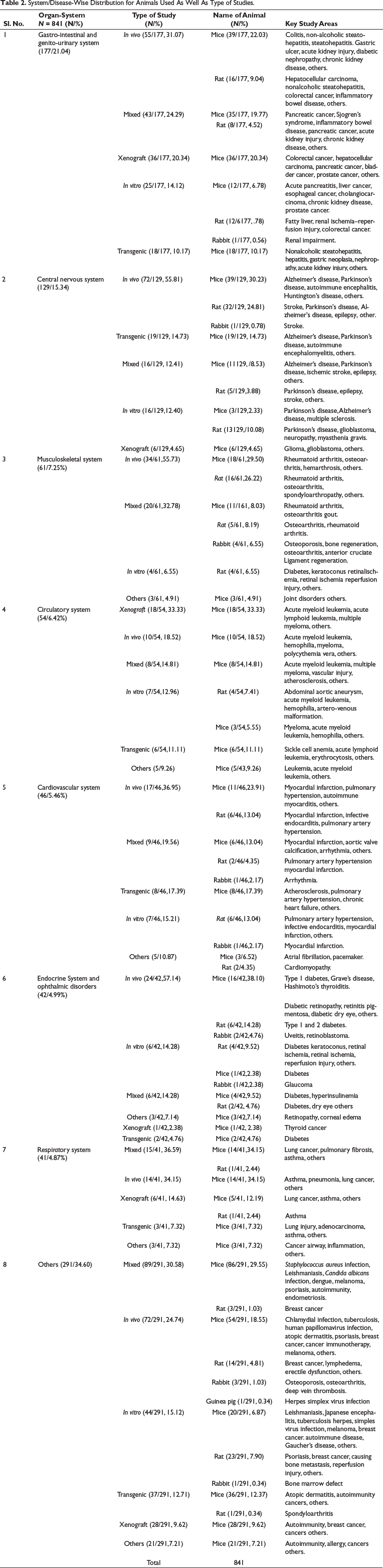
Type of Animal Used and Type of Studies Conducted for Different Systems/Diseases
Mice were commonly used in disease areas within the GIT system (140/177). The in vivo (55/177), mixed (43/177), and xenograft (36/177) approaches of research were common for the GIT system. CNS research used mice (78/129) and rats (50/129). For CNS disease, the in vivo (72/129) approach using both mice (39/129) and rats (32/129) was common. Transgenic studies were notably significant, comprising 14.73% (19/129) of CNS-related studies. Xenograft models were prominent in cancer-related studies, particularly in the GIT/GU and circulatory systems, where they accounted for 20.34 (36/177) and 33.33% (18/54) of studies, respectively (Table 2).
Discussion
Using animals for research has contributed significantly to important discoveries in medicine. However, specific segments of the scientific community have questioned the use of animals in research due to ethical aspects, translational value, and the validity of the research being conducted. 11 Our analysis demonstrates that using animals in research is still quite common.
The distribution of animal species in these studies validates that mice and rats are still very commonly used small animals for preclinical research. In an animal statistical report released in 2023 by Great Britain, mice were the most frequently used species of rodents, and they were involved in 71% of all experimental procedures in 2022. As per this report, the use of rats has declined over the period. 12 These findings were again repeated in the analysis conducted by Domínguez-Oliva et al., which states that rodents are the predominant animal species used for research. The authors of this study also stated that nonmammal use is trending, and the use of animals in research depends on rules and regulations in that particular country. 13 Guinea pigs and rabbits were less widely employed, possibly indicating their usefulness only for specific research areas. Mice, followed by rats, are highly regarded as excellent animal models for experimental research, mainly due to their genetic, physiological, and anatomical similarities to humans, which offer valuable insights into human health across various organ systems. 14 Moreover, these rodents exhibit ease of handling and a docile temperament, which is highly convenient for conducting experiments and behavioral studies.
In vivo and in vitro are common research approaches. However, as evident from study findings, a mixed method, that is, using in vitro followed by in vivo, transgenic, and xenograft models, is a prevalent approach. In vitro studies, besides offering advantages in terms of ethical considerations, are less expensive. Conducting in vitro studies before in vivo studies will reduce the number of animals and help in a focused approach for further in vivo, transgenic, or xenograft studies. 15
Our study findings suggest that the GIT/GU and CNS have received considerable attention in research among the organ systems. In an animal statistical report released in 2023, within basic research, the single largest category in 2022 was a study of the nervous system, followed by the immune system and oncology. 12 This finding is different from the results of our study. It is important to note that the need for more attention may depend on factors such as disease prevalence, impact on public health, and available treatment options. A report published by IQVIA in February 2023 also showed that the most explored therapeutic area is oncology, followed by neurology. 16 We have not categorized oncology as a separate system. However, in our study, as well as under every system, cancer remains a common disease pattern.
As per our study for diseases in the GIT/GU system, mice were utilized more using an in vivo and mixed approach. Transgenic and xenograft approaches were also common in this system because most diseases in these systems were carcinomas. 17 Mice can be genetically engineered to imitate almost any human disease or condition since they share 95% of human genes. Mice also show a significantly high acceptance rate for xenografts, making them an ideal implement for the in vivo culture of human tumors. The immune system of mice is also similar to humans. Hence, mouse xenograft models have provided an indispensable tool for studying tumor initiation, maintenance, progression, and response to treatment. 16
Whereas CNS systems have used rats and mice, primarily in vivo, as shown by our results. These results are similar to those stated in the literature regarding animal use for research in this area. 18 These findings are again correlated with disease patterns shown in this system, that is, Parkinson’s disease, Alzheimer’s disease, and multiple sclerosis. These models are traditionally developed by chemical induction. 19 However, even in CNS, due to advanced research in identifying genes responsible for various CNS disorders, transgenic animal models are commonly used next to in vivo animal models. 20
Animal research in other systems, such as musculoskeletal, endocrine, cardiovascular, circulatory, and infectious diseases, is also common, as our study shows. These were, again, key therapeutic areas discussed by Domínguez-Oliva et al. their study where they have analyzed animal research conducted between 2019 and 2023. 13
This study’s limitation was that it relied on data collected from previously published literature. We did not verify the quality and correctness of the published articles, which may have introduced the possibility of bias and inconsistency. Furthermore, there is a chance that selection bias resulted from the study’s inclusion criteria, which restricted the findings’ applicability by only including freely accessible public domain articles that were listed on the PubMed database.
Conclusion
Our study findings give an idea about the current use of animal species for different research areas, and research approaches depending on the disease area. For conducting research in GIT/GU diseases such as nonalcoholic steatohepatitis and colitis, for research in CNS diseases such as Parkinson’s disease and Alzheimer’s disease, and musculoskeletal diseases like OA and RA, instead of separate in vitro and in vivo rat/mice models, mixed models and transgenic models would be most suitable. Whereas for cancer research, mice xenograft models would be most appropriate. It should be emphasized once more that cost and feasibility play an essential role in the choice of species and research approach for a particular disease area.
Footnotes
Abbreviations
Acknowledgments
The authors acknowledge Dr. Sanket Gaikwad, a third-year junior resident of the Department of Pharmacology and Therapeutics, Seth GSMC, and KEMH, who have helped to verify the raw data and proofread the article.
Declaration of Conflicting Interests
The authors declared no potential conflicts of interest with respect to the research, authorship, and/or publication of this article.
Ethical Approval
The study has received an exemption of review from the Institutional Ethics Committee (EC/OA- 188/2021).
Funding
All authors have declared that they have no financial relationships at present or within the previous three years with any organizations that might have an interest in the submitted work.
Informed Consent
Not applicable.
