




Abstract
Background and Objectives
The aim of this study was to record the prevalence and the characteristics of substance abusers from the year 2007 to 2017 and also to find the most prevalent form of substance abuse and association, if any, between the abusers and their demographic characteristics.
Materials and Methods
Descriptive and retrospective medical record review included patients of substance abuse attending a rehabilitation center in Buraidah from January 2007 to December 2017. A majority of 5,639 patients (63.6%) belonged to the age group of 31–50 years. Twenty-five and thirty-nine percent patients had secondary and higher education, respectively. Notably, more than half of them were unemployed. The commonly abused single drugs were amphetamine (40%), cannabis (11%), and alcohol (7%). High school goers’ cases have continuously spiked over the years. Substance abuse over the years from 2007 to 2017 was above 11% in 2007 and 2015. From 2009 to 2014, it was between 8 and 10%. However, the number of cases reported dropped to below 9% from 2016 onward. Amphetamine saw a downfall except peaking in 2010 and 2015. On the other hand, there was no substantial jump in the abuse of alcohol and cannabis over the years, but an increasing use from 2015 onward was visible. There was also a gradual rise over the years in the abuse of polysubstance (more than three drugs).
Conclusion
There is a growing trend in the use of polysubstance and the combination of two substances. There is a high incidence of drug abuse in high schoolers and also in patients in the age groups of 10–30 years.
Introduction
Substance use refers to the use of psychoactive substances that are harmful or hazardous. Such repeated use leads to dependence, creating an intense craving for the drug and an inability to control its use despite detrimental consequences. 1 In polysubstance dependence, the abuser indulges in the abuse of three or more different classes of psychoactive substances indiscriminately. In practice, the terms substance use and substance dependence are replaced with substance use disorder (SUD).1, 2 SUDs incur severe health and financial loss to the sufferers, their families, governments, and societies. Thus, substance has become a global problem with severe consequences. As per estimates, there are 275 million people abusing substances such as cannabis, amphetamines, opioids, and cocaine (UNODC, United Nations Office on Drugs and Crime). 3 In 2016, the annual prevalence of abuse of these illicit drugs touched 5.6%. Among them, cannabis was alleged to be the most commonly used by around 192 million users globally. It is also pertinent to note that, as per WHO, the opioid overdose alone led to 168,000 deaths in the year 2015. 3 It is also common among abusers to find comorbidities due to the sharing of injecting tools, leading to the spreading of infectious diseases.
Saudi Arabia (SA) observes Islamic laws and practices where societal norms and values are deeply rooted in religion. SA imposes legal prohibitions against the possession and consumption of any illicit substance, including alcohol and narcotic substances. However, studies reported substance use in SA where 7 to 8% of Saudis have used drugs, most of them were 12–22 years old. The most commonly used substances among Saudis are amphetamines, heroin, alcohol, and cannabis, and a majority of them indulge in poly substances. Over the past decade, the use of cannabis and amphetamines has increased, while the use of heroin has declined. The main causative factors for substance use include peer pressure, unhealthy family relationships, and other psychological illnesses, such as depression and anxiety. When parents themselves are drug abusers, their children are more likely to be drug abusers too.4–7
There are limited studies on substance use in SA, and this study is an extension of our earlier study, where we reported the pattern of substance use and the sociodemographic correlates of abusers attending the local psychiatric rehabilitation center (PRC) for the year 2016. 8 This study, however, attempts to record the prevalence and the characteristics of substance users being attended for treatment from 2007 to 2017. We also seek to find the most prevalent form of substance use being exploited by the abusers, and the association, if any, between the abusers and their occupation, education level, or marital status was explored. Through this article, we hope the results will enable the policymakers and authorities concerned to identify priority areas for better care and awareness-raising initiatives to resolve the growing threat of substance use in the region. We also hope that the descriptive data produced in this study will direct prospective researchers to improve further and stimulate the hospital’s academic, science, and collaborative environment.
Materials and Methods
Settings
This is a retrospective study conducted in the PRC, Buraidah, established in 1994, with 50 inpatient beds, an outpatient clinic, and after-care departments. The center caters to a large provincial area of Qassim, Hail, Tabouk, and soldiers in the Military Campus in Hafer Al-Batin. The study was conducted after obtaining written permission from the director, PRC, by the first author following prior approval from the local research ethics committee, Qassim province (06/08/1438 with #20170502) by Dr. Yasir.
Study Design
This study is descriptive and retrospective medical record review of all patients admitted and/or referred to PRC from January 2007 to December 2017.
Sampling
The sample included all the patients (5639) admitted to PRC for 11 years from January 2007 to December 2017.
Data Collection and Analysis
Data were collected retrospectively using a semi-structured checklist from the patients’ records and a table sheet containing different sociodemographic variables from the official documents of patients at the PRC official record department. Patients’ demographic information and substance use data were grouped into various categories. MS Office Excel sheet was used to enter the data and categorize it. The SPSS software package for Windows, version 20, Chicago, USA was used for statistical analysis. Percentage and frequencies were calculated for all categorical and continuous variables. Cross-tabulations with Pearson square and chi-square tests were applied to compare the qualitative variables to find any associations between the type of substance used and patients’ demographic characteristics.
Results
Sociodemographic Distribution of Abusers
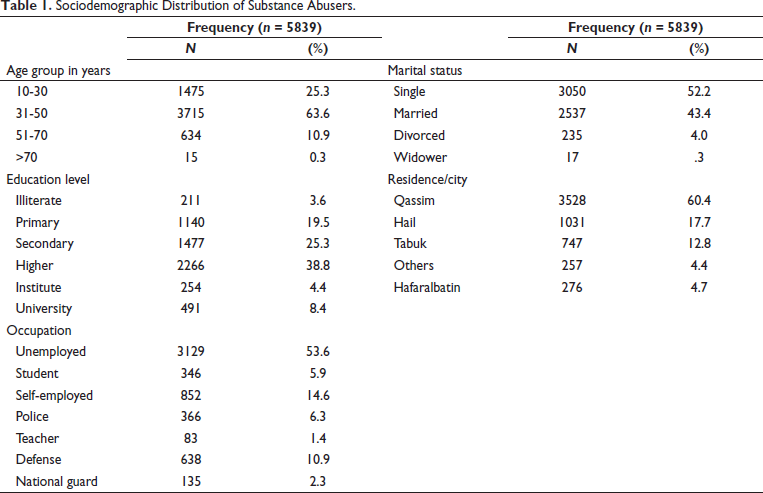
A total of 5,639 patients were enrolled in the study. A majority of them (63.6%) belonged to the age group of 31–50 years, followed by 25.3% of them belonging to 10–30 years of age. Their educational background ranged from no formal education (3.6%) to university level (8.42%). However, a significant proportion had a secondary and higher school of education, 25 and 39%, respectively. Notably, more than half of them were unemployed. Only 14.6% of them reported being self-employed, and the rest were from the governmental and private sectors. More than half of them were unmarried, and 4% of them were divorcees. About two-thirds were admitted from the Al-Qassim region (65%). The occupations of the abusers were 46.4, 17.8, 17.6, 8.2, 5.1, and 4.9% were unemployed soldiers, civilians, privately employed, students, and retired respectively. More than 60% of the patients admitted were residents of Al-Qassim region province followed by Hail (18%) and Tabuk (13%) (Table 1).
Sociodemographic Distribution of Substance Abusers.
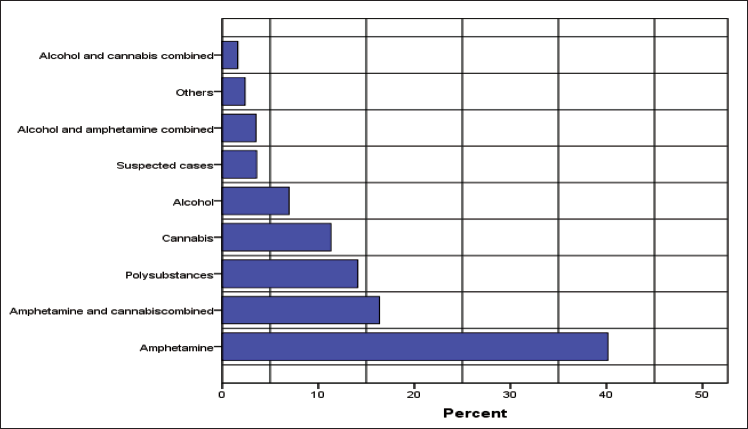
Patterns and Distribution of Substances Used Among Patients of All Age Groups
The commonly used drugs included amphetamines, cannabis, benzodiazepines, pregabalin, opioids, and heroin. They were used as single or in combination. Among the widely used drugs include amphetamine (40%), followed by cannabis (11%) and alcohol (7%). The most commonly used combination of two drugs was amphetamine and cannabis (16.4%), followed by alcohol and amphetamine (3.5%). It is also noteworthy that the proportion of polysubstance users indulging in the use of 3 or more drugs was 14% (Figure 1).
Patterns and Distribution of Substance Abuse Among Patients of All Age Groups.
Association of Type of Substance Used and Demographic Characteristics
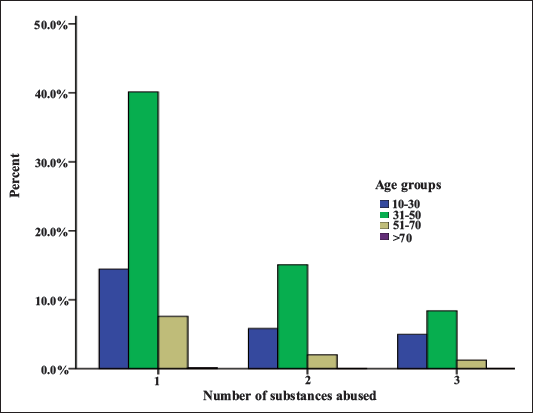
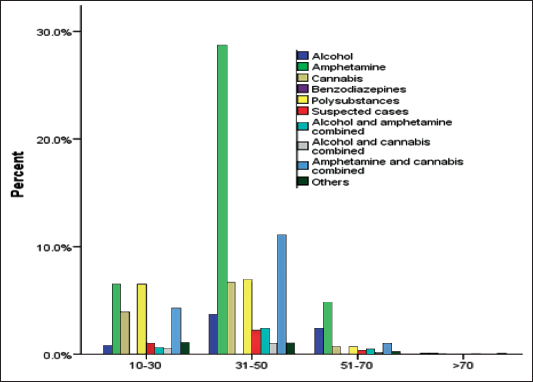
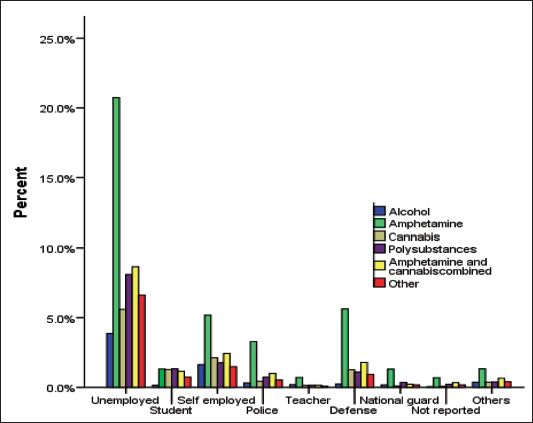
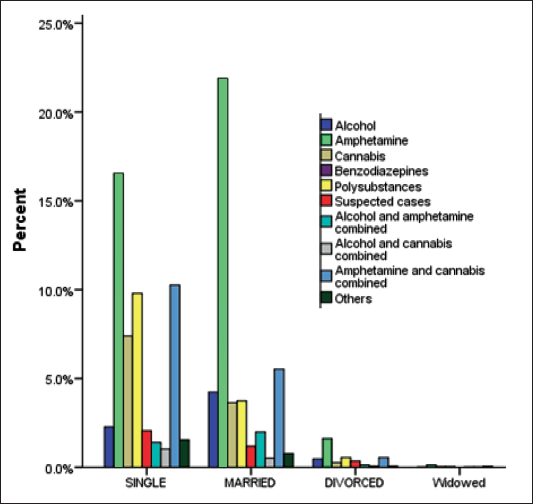
There was an important correlation (X2=689.684 (df=24), p<.001) between the type of substance used and the age of the abuser. More than half of the amphetamine and polysubstance users were in the 31–50 age group (Figures 2 and 3). There was similarly an important correlation (X2 = 295.046 (df=64), p<.001) between the type of substance used and employment status of the abuser, as more than half of them were unemployed and 15 and 11% of them, respectively, were self-employed and defense personnel. Amphetamine (20.7%) followed by cannabis (5.6%), polysubstance (8.1%), and amphetamine and cannabis combination (8.7%) were mostly used by unemployed youths (Figure 4). Comparison of the type of substance used and marital status revealed that (X2 = 429.773 (df=24), p<.001) 22% of married patients were under the influence of amphetamine as against 16.5% of unmarried patients. In contrast, only 3.6% of married patients were found to abuse cannabis, as against 7.4 % of unmarried patients. A similar trend was also observed in the polysubstance use (3.7 and 9.8% in married and unmarried patients respectively) (Figure 5).
Number of Substances Abuse Among Different Age Groups of Abusers.
Association of Substance Abuse and Age of Abusers.
Substance Abuse Among Different Occupations of Abusers.
Association of Substance Abuse and Marital Status.
Influence of Patients’ Demographic Characteristics on the Patterns in Substance Use Over the Period of 11 Years from 2007 to 2017
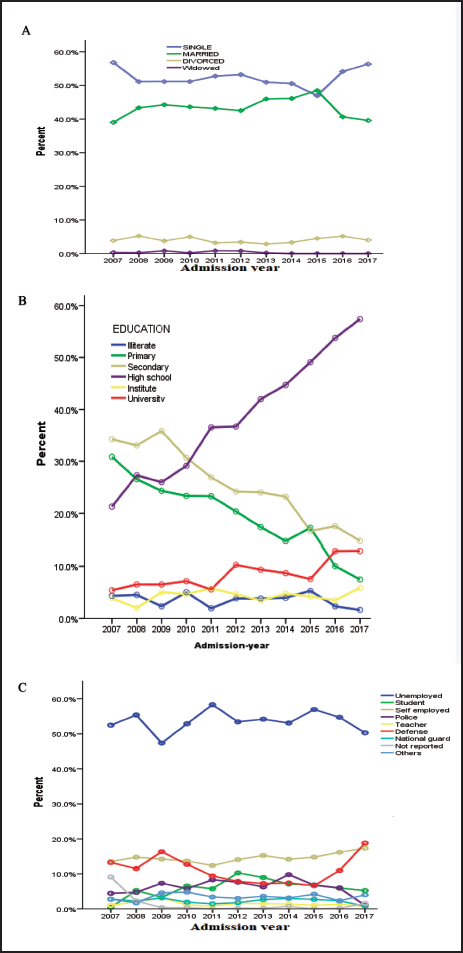
The results clearly uncover that the single status of patients adversely affects the chances of youths being lured into substance use, as there was a gradual increase in the number of unmarried patients over the years from 2007 to 2017 at our rehabilitation center (Figure 6a). Similarly, it is the high school goers who had a substantial share of influence over the cases as their number continuously spiked year after. On the other hand, surprisingly, both uneducated and university-educated seem to be turning away from the menace (Figure 6b). Moreover, the consumption of two substances also follows the same pattern as there is a decrease in the combined use of amphetamine and cannabis. However, being unemployed has heavily influenced the youths toward substance use consistently over the years (Figure 6c).
Influence of Patients’ Demographic Characteristics on the Patterns in Substance Abuse. (a) Influence of Patients’ Marital Status Level on Substance from 2007 to 2017. (b) Influence of Patients’ Educational Level on Substance from 2007 to 2017. (c) Influence of Patients’ Employment Status on Substance from 2007 to 2017.
Distribution and Pattern of Substance Use Cases Over the Years from 2007 to 2017
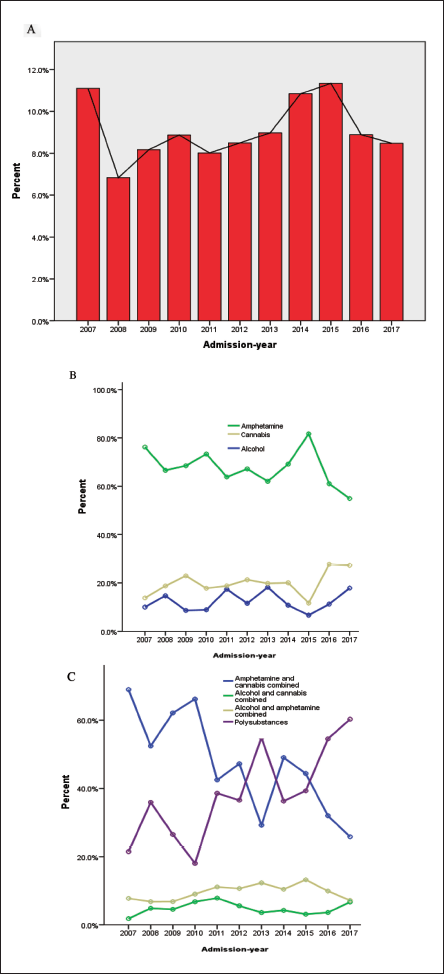
In our study sample, the trend of drug abuse in decreasing order was as follows: amphetamine, cannabis, alcohol, and polysubstances. Benzodiazepines, opioids, pregabalin, and volatile inhalants were the least frequently used drugs. Assessment of the pattern of substance use over the years from 2007 to 2017 at our rehabilitation center shows it was above 11% in 2007 and 2015. From the years 2009 to 2014, it was consistent between 8 and 10%. However, the number of cases reported dropped to below 9% from 2016 onward (Figure 7a). With respect to individual distribution of substances used, amphetamine saw a downfall except peaking at 2010 and 2015. On the other hand, there was no substantial jump in the abuse of alcohol and cannabis over the years, but an increasing use 2015 onward is visible (Figure 7b). Moreover, the consumption of two substances also following the same pattern as there is a decrease in the combined use of amphetamine and cannabis. On the contrary, combined use of alcohol with cannabis or with amphetamine is on the rise. In addition, it is worth mentioning that there is also a gradual rise over the years in the abuse of polysubstances (more than three drugs) (Figure 7c).
Prevalence and Pattern of Substance Abuse Cases Over the Years from 2007 to 2017. (a) Overall Percentage of Cases of Substance Abuse from 2007 to 2017; (b) Pattern of Single Substances Abuse from the Year 2007 to 2017; (c) Pattern of Single Substances Abuse from the Year 2007 to 2017.
Risk Factors for Substance Use
Studies reported in SA found that social pressure, family issues, health-related problems, pleasure-seeking, and curiosity were risk factors for the initiation of drug use. In our research, the potential risk factors for substance use were male, age group 20–40, availability of multiple drug abuse, education only up to high school, and unemployment, which are the major reasons for indulging in substance use. Other research in SA found that social pressure, family issues, health-related problems, pleasure-seeking, and curiosity were risk factors for the initiation of drug use.
Discussion
Substance use is a persistent relapsing brain disorder wherein the abuser loses their self-control and appropriate decision-making. Preventive and early identification and intervention are also of utmost importance in the fight against substance use and addiction. Substance use disorder is a preventable and treatable health issue by reliable, extensive, and multidisciplinary approaches for affected individuals.9–12 These approaches must focus on evidence-based treatments. To complicate this further, the cases of deliberate use of nonmedical and medical prescription drugs are on the rise, especially among youngsters. This calls for the urgent attention of clinicians and regulators to devise plans to regulate this trend.
SA has been experiencing rapid social change in recent years and is at the forefront of the race for a globalized world, opening up Saudi society to further influences who were already well connected with the outside world and world culture. Such situations may provide avenues to youths for experimenting with substance use. Unfortunately, data on drug abuse are scarce in SA in general and Al-Qassim in particular. Studies conducted to date provide an informal overview of drug abuse prevalent in different parts of KSA. However, these and other pertinent issues are well-raised and commented on by some of the recent reviews.5, 7, 13
Al-Qassim is considered a religiously orthodox area with strict observance of Islamic principles, and the use of alcohol and abuse of drugs is strictly punishable. Hence, the issue of substance use is a social dogma and unacceptable in Saudi society, and such cases of abuse are not brought in time, leading to ineffective treatment and causing a high rate of mortality and morbidity. Such concerns were also echoed in a recent scoping review about substance use disorders in SA. However, the alcohol and substance use found here is due to unscrupulous homemade alcohols and smuggled drugs.13–16 Results obtained in our study reinforce our findings in an earlier study at the same center. In the present endeavor, we tried to find the pattern and trends in substance use and the sociodemographic characteristics of patients that influenced it over a period of 11 years, from 2007 to 2017. The results provide a unique pattern about substance use as 63.6% of admitted patients belonged to the age group of 31–50 years and 25.3% from the 10–30 years age group. A significant proportion of them had only up to a higher education (39%). In addition, half of them were jobless and unmarried. An interesting aspect about these factors is the proportion of high schoolers is on the rise, reflecting their vulnerability to drugs and peer influence. These data clearly show that lack of education and employment is a significant cause for young people in the area to be attracted to drug abuse, and the findings corroborate earlier reports. Data suggests that school dropouts and those with low grades or no school affiliation are at greater risk or are already frequent or heavy users of drugs.14, 17, 18
It is also challenging to note that abusers under deaddiction treatment or post-treatment face hurdles in finding employment when entering the job market in addition to drug use itself. As a result, employment rates in these groups are generally low and range from 15 to 35%, so rehabilitating them is an important step to get them back into society. 19 More than 60% of the patients admitted were residents of the province of Al-Qassim, meaning insufficient access to the center’s facilities outside the province. The most widely used single substances were amphetamines, cannabis, and alcohol. The most often-used mixture of two substances was amphetamine and cannabis, followed by alcohol and amphetamine. It is also notable that the increase in the proportion of polysubstance users taking three or more drugs among young people is an indication that affected individuals find it difficult to find any single drug and are compelled to use something made available by unscrupulous means. 8 While the combination of certain substances will definitely improve the desired effects of drugs, the use of polysubstances often increases the possible negative effects of each drug. 18 Most worryingly, single unmarried patients and high school students have consistently been impacting young people on drug abuse over the years and are on the rise. Monitoring the future survey of substance use and behaviors among American school graders has shown promising results in reduced use of alcohol, tobacco, and many illicit substances. 19 This has been made possible by the efforts of scientists who have provided scientific facts about how substances impact the brain and body so that young people can be armed with more knowledge to keep them safer. In addition, informing adolescents and their parents about the dangers of substance addiction and abuse could play a role in tackling the problem, as per the National Institute for Drug Abuse (NIDA), a component of the National Institutes of Health (NIH).19–22 Such initiative must also be undertaken in SA to tackle this issue. The present findings showed a downward trend in drug abuse for amphetamine, cannabis, alcohol, but an upward trend in combination and polysubstances. In our study, the possible risk factors for substance use were male, age group 20–30, availability of multiple drugs for abuse, education only up to high school, and unemployment are the key reasons for drug abuse. The findings are consistent with other studies in SA and elsewhere. According to the WHO authority on international criteria for substance use prevention, the following attributes are correlated with strengthening family bonding, motivating parents to take a more active role in their children’s lives, for example, to track their activities and friendships, and to be interested in their learning and schooling, and supporting parents on how to be a role model for their children.23–26 This study and the body of international research indicate that the general health status of a country is highly affected by the social, educational, and economic status of its citizens, with general educational and income levels being the key indicators in this regard. While further research is required to establish such a relationship, there may well be a correlation between the factors identified and the use of substances by young people.
Conclusion
The findings of this study indicate a growing trend in the use of polysubstances and the combination of two substances that negate the finding of decreased prevalence of amphetamine. It was also found that there was a high incidence of drug abuse in high schoolers and people in productive age groups of 10–30 years. The changes observed in this study demand further reflection to work on new strategies, policies, and interventions for positive changes in people affected by substance addiction and help to successfully revert them back into society.
Recommendations
Our findings offered valuable insights into the factors influencing substance use. The regional policymakers and health authorities concerned should come forward to design educational and awareness programs to target young and high school students. Regulatory authorities may also seek to find how the abusers, especially high schoolers, can procure the multiple types of substances of abuse.
Footnotes
Acknowledgments
The authors thank the staff of the Psychiatric Rehabilitation Center, Buraidah, for providing us with the relevant data for the study. The authors also extend their thanks to Dr. Saad Al Erwi, Dean, Al Rayan College of Health Sciences and Nursing for his help and support
Authors Contribution
Yasir A. Ibrahim conceived and designed the study, conducted research, provided research materials, and collected and organized data after ethical approval. Shalam Mohamed Hussain designed the write-up, analyzed, and interpreted results and finalized the manuscript. Ayesha Farhana Syeda helped in the write-up and word processing. Ahmed Mohammed Farghly, Rana Salem Alsaadi, and Muhammed Hassan Nasr reviewed the initial manuscript, and provided feedback and logistic support. All authors have critically reviewed and approved the final draft and are responsible for the content and similarity index of the manuscript.
Abbreviations
Declaration of Conflicting Interests
The authors declared no potential conflicts of interest with respect to the research, authorship, and/or publication of this article.
Ethical Approval and Informed Consent
The study was conducted after obtaining written permission from the director, PRC, by the first author following prior approval from the local research ethics committee, Qassim province (06/08/1438 with #20170502) by Dr. Yasir.
Funding
The authors received no financial support for the research, authorship, and/or publication of this article.
