



Abstract
Background
The most typical dermatologic disorders worldwide include tinea infections. Skin ringworm infections, such as tinea corporis and tinea cruris, are caused by Trichophyton rubrum, Epidermophyton, and Microsporum canis. These are the main dermatophytes responsible for tinea. Red, scaly, itchy, and growing lesions should be tinea. It is most seen in males compared to females. All skin illnesses are categorized in Ayurveda as Kushta Roga (skin diseases), while Dadru Kushta (tinea) has a connection to the diseases caused by fungi. The illness has aggravated Pitta and Kapha dosha. The line of treatments for these illnesses includes palliative, purificatory intervention, and peripheral biocleansing procedures. However, in this case, we utilize palliative, mild laxative, and peripheral biocleansing procedures. Here, mild laxatives act as purificatory therapy to treat the illness.
Purpose
To study the effect of Ayurvedic intervention in the management of tinea (Dadru).
Methods
In this case report, a 41-year-old male patient receives Ayurveda treatment after 2 months of experiencing relief from ring-like patches, discoloration, and itching in the groin, upper back, and upper and lower thighs. He is diagnosed by presenting clinical symptoms, and pathological examination is the specific tool for diagnosis of fungal infection.
Results
Significant improvements were seen in the parameters, including increased circular skin lesions, eruptions, erythema, and itching. He experienced 70% relief.
Conclusion
Treated with the Ayurveda line of treatment is the best tinea infection treatment.
Introduction
According to the 2014 Global Burden of Disease (GBD) study, skin conditions are the fourth most common cause of disability worldwide. 1 Dermatophytosis, a skin condition, is today a disease of global significance and a significant public health issue in many regions, especially in urban areas of developing and developed countries. 2 Millions of individuals worldwide are affected by superficial fungal infections, one of the most prevalent skin conditions.3, 4
Dermatophytes, particularly the Trichophyton, Epidermophyton, and Microsporum species, are responsible for most superficial fungal infections. 5 Dermatophyte infections are the only ones to which the name “tinea” applies. Tinea infections are categorized based on where they are located anatomically. Fungal transmission can happen when there is direct contact with infected people, animals, soil, or termites. Depending on their habitat, dermatophytes are categorized as either anthropophilic, zoophilic, or geophilic. Dermatophytes that affect humans are the most common anthropophilic causes of tinea infections.
In Ayurveda, skin disorders are categorized as Kushtha (skin disease). Additionally, Kushtha is referenced in Eight Mahagad (terrifying sicknesses). Mahakushtha (major skin element) and Kshudra Kushtha (minor skin element) are subcategories of Kushtha. One prevalent type of skin condition that affects people of all ages is Dadru (tinea). It was classified as Mahakushtha by Acharya Vagbhata and Acharya Sushruta, having involved dosha (humor) kapha, with Atasi Pushpa (flax flower) color appearance. 6 In contrast, Acharya Charaka characterized it as Kshudra Kushtha, and the predominant dosha of Dadru Kustha is Kapha-Pitta. As per his definition, the reddish-colored Pidika (papules) in the form of a Mandala (round swelling or lesion) with elevated borders and itching is known as Dadru. 7
The commentator of Sushrut Samhita has divided Dadru into two parts, Sita (white) and Asita (black). Dalhana further differentiated these two by saying that the “Sita” type of Dadru is easily curable because it does not affect the deeper tissues. Also, it is associated with fewer signs and symptoms. There is no significant involvement of Tridosha (three humor—vata, pitta, and kapha). In comparison, “Asita” Dadru is just opposite of Sita Dadru. 8 On the other hand, Acharya Kashyap distinguished Dadru as a skin condition characterized by “Vridhimanta Mandala,” or widely distributed discoid lesions accompanied by severe burning, itching, and discharge. Due to their similar clinical characteristics, Dadru Kushtha and tinea might be associated with Ayurveda.
Present Case Report
A 42-year-old male patient, who is a farmer, came to the outdoor patient department of the Panchakarma department on 07/13/23 of MGACH & RC (Mahatma Gandhi Ayurvedic College Hospital and Research Centre) Wardha, Maharashtra, with main complaints (Table 1).
Main Complaints.
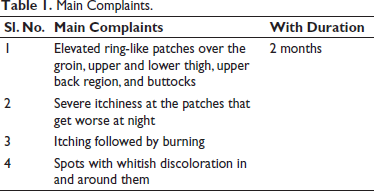
The illnesses develop gradually, one after the other, and are made worse even by treatment. He was diagnosed with tinea following an examination.
Past and Present Medical History
History
Known cases of hypertension (HTN)
No history of diabetes mellitus (DM), thyroid
Family history
Not significant
Personal history
Marital status—Married
Addiction—Betel nut from 10 years
Sleep—Normal
Bowel—Regular one time/day
Diet—Nonvegetarian
Medical history
No drug allergy history
Finding of the patient
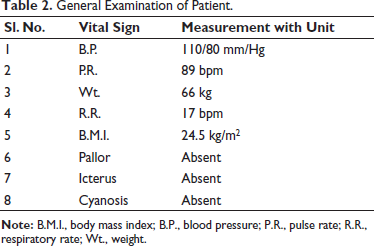
General examination—Table 2
General Examination of Patient.
Local Examination
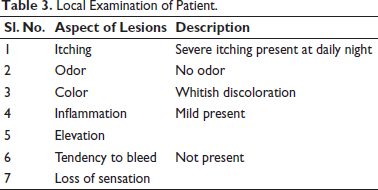
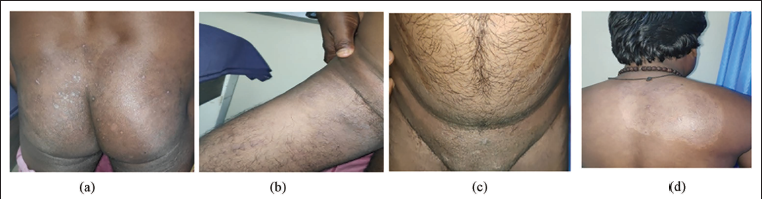
Inequality area over the upper and lower thighs, upper back, buttocks, and groin. Four to five circular patches, with no discharge from the lesion (Table 3).
Local Examination of Patient.
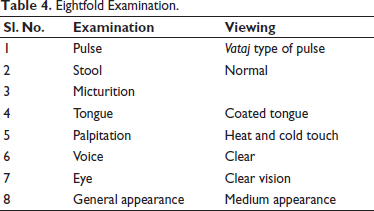
Eightfold Examination of the Patient (Table 4)
Eightfold Examination.
Examination of the Patient’s Strength
All the parameters were within normal limits. Prakriti (body constitution) was Kapha-Vata.
A Pathogenic Factor in a Disease
Dosha (humor)—Tridoshaja (kapha pitta dominance)
Dushya (vitiated tissues)—Twak (skin), Rakta (blood cell), Mamsa (muscle), Lasika (lymph)
Strotas (body channels)—Raktavaha Strotas (blood carrying channel), Rasavaha Strotas (nutritional essence carrying channel)
Strotodushti (type of affliction of body channels)—Sanga (obstruction of the flow of content of the channel)
Udhbhavsthana (site of origin of illness)—Amashay (stomach)
Adhishthana (a place where symptoms are seen)—Twak (skin)
Agni (metabolism strength)—Jatargnijanya Mandya (weak digestive fire)
Diagnosis
On the basis of clinical presentation and the pathology findings [all blood routine and potassium hydroxide (KOH) test], it was diagnosed as tinea infection (Dadru).
Investigation
The patient was advised to undergo complete blood count (CBC), glycosylated hemoglobin (HbA1c), liver function test (LFT), kidney function test (KFT), thyroid stimulating hormone (TSH), blood sugar level (BSL), and KOH examination. Fasting blood sugar was 108 mg/dl, TSH indicated 2.32 mU/L, erythrocyte sedimentation rate (ESR) was 25 mm/h, total leukocyte count (TLC) was 17,880 cells/cubic millimeter, HbA1c is in the normal range, blood urea nitrogen was slightly elevated (29 mg/dl), and 20% KOH examination of scraping from the lesional scale revealed several hyaline septate hyphae.
Total study duration—23 days
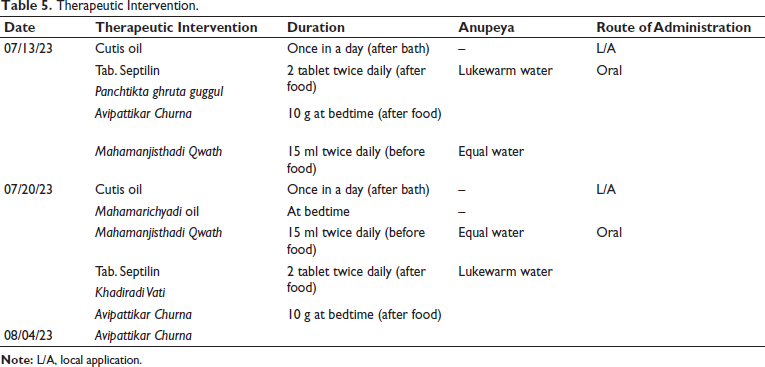
Therapeutic interventions—Table 5
Therapeutic Intervention.
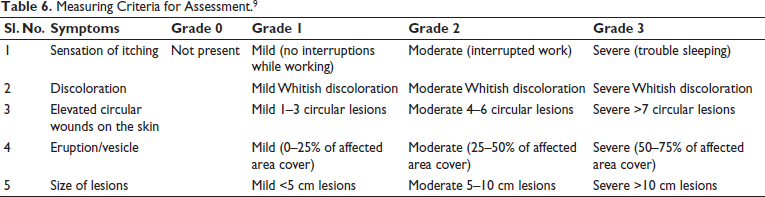
Measuring Criteria for Assessment
The patient was evaluated based on improvements in subjective measures such as Kandu (sensation of itching), Raga (erythema/discoloration), Utsanna mandala (elevated circular wounds on the skin), Pidika (eruption/vesicle), and size of the lesion, which is mentioned in Table 6.
Measuring Criteria for Assessment. 9
Follow-ups and Outcomes
Follow-ups and therapeutic outcomes are mentioned in Table 7.
Follow-ups and Outcomes before and after Intervention.
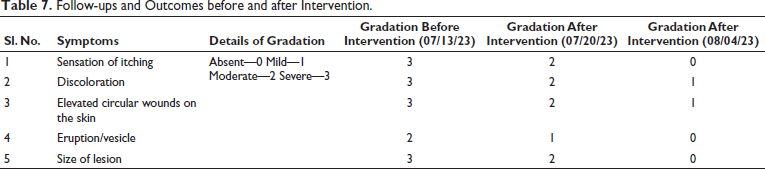
On the basis of the above-mentioned assessment criteria, we are evaluating the patient before and after. After just 1 week of therapy, there was amazing symptom reduction on the skin. For example, prior to therapy, the itching grade was three (severe itching), which decreased to two (moderate itching) during the first follow-up, and it vanished on day 16, shortly after the treatment was finished. The degree of discoloration before therapy was three (severe whitish discoloration), but it dropped to two (moderate discoloration) at the first follow-up and may have even dropped to one (mild discoloration) immediately following treatment. Before therapy, the skin’s elevated circular wounds were graded as 3 (severe >7 circular lesions). During the first follow-up, this grade dropped to 2 (moderate, 4–6 circular lesions), and it may even have dropped to 1 (mild, 1–3 circle lesions) immediately following treatment. Before treatment, the eruption grade was 2 (moderate, 25–50% area is affected), which decreased to 1 (mild, 0–25% area is affected) during the first follow-up. On day 16, immediately following treatment, the eruption grade vanished. Before treatment, the lesion’s size was graded as (severe >10 cm); however, it was decreased to moderate (5–10 cm) during the first follow-up and vanished immediately after. In Figure 1(a–d), the lesion is visible before treatment, while Figure 2(a–d) shows the lesion reduced after treatment. Adverse medication reactions did not occur throughout therapy or the follow-up period. For documentation purposes, pictures were taken both during and after the therapy.
(a–d) Before Treatment on 07/13/23.
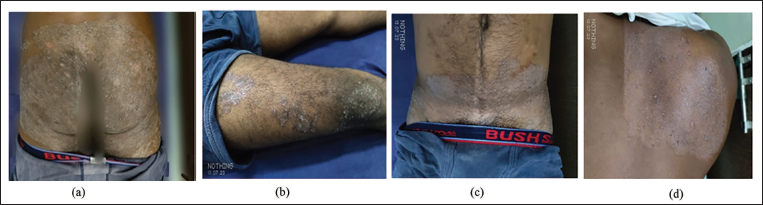
(a–d) After Treatment on 08/04/23.
Discussion
The basic reason for Dadru (tinea) is mentioned in ancient Ayurvedic texts. Many of the unhealthy habits and foods mentioned in Ayurveda as causes of Kustha (skin disease) create a good environment for fungal infection in skin tissue. As per contemporary science, the clinical presentation of Dadru is highly close to that of tinea infection, which can be triggered by various factors such as weakened immunity, poor nutrition, excessive perspiration, and contact with contagious objects. These are the risk factors for tinea infection. 10 Dadru shows severe itching, erythema, elevated circular wounds on the skin, and eruptions on the skin as described in Ayurvedic texts. According to current knowledge, a fungal culture obtained using a KOH scraping test can be used to diagnose tinea along with its clinical symptoms. Except for Acharya Sushruta, who believed that there was a kapha predominance in Dadru, the majority of Acharyas have indicated the prevalence of kapha-pitta dosha (humor) in Dadru. Along with raktavaha dushti (vitiation of the blood-carrying channel), the Ayurvedic texts describe Twak (skin), Rakta (blood cell), Mamsa (muscle), and Lasika (lymph) as vitiated tissues. In the Samhita, repeated Shodhana (biopurificatory) and Shamana Chikitsa (palliative medications) with Kushtaghna (cure skin disease), Krumighna (anthelmintics), Kandughna (antipruritic), and Srotoshudhi kara (biopurificatory) characteristics are specified for Kushta. Nitya Virechana (mild laxative) was chosen as purificatory because Acharya Sushruta suggests Nitya Virechana for Kushta to eliminate Pitta Dosha. After all, Pitta is the Mala (waste product) of Rakta (blood) and has Asraya Asrayibhava (inseparable relationship of abode and resident here tissue and excreta are abode and humor is resident); however, no specific treatment for Dadru is mentioned. In addition, Bahirparimarjana Chikitsa (peripheral biocleansing procedure), or the local administration of medications in the form of oil, was suggested for improved outcomes.
Mode of Action of Cutis Oil
An Ayurvedic mixture called cutis oil of VASU pharmaceutical has components that have antifungal qualities. These elements support the inhibition of fungal growth and reproduction that causes tinea infections. Cutis oil contains the following ingredients: Azadirachta indica oil, Pongamia pinnata oil, Cinamom camphora, and Maharichyadi taila.
Mode of Action of Mahamarichyadi Oil
The Ayurvedic remedy Mahamarichyadi oil contains Maricha (Piper nigrum), which has antifungal properties that help prevent the growth and spread of fungi that cause tinea infections. It also acts as kapha pitta shamak (healer), has antiseptic properties, and reduces itching and inflammation on the skin. 11 When the medication was administered to the skin, the skin allowed it to enter and absorb. It had completed the cutaneous biotransformation, relieved the toxins, and cleaned the microchannels.
Mode of Action of Mahamanjisthadi Qwath
Mahamanjishthadi qwath (decoction) is used in Ayurveda as a comprehensive treatment for skin diseases, promoting blood purification, balancing the Kapha humor, and enhancing the digestion and metabolism of specific tissues, particularly muscle and fat tissues. It is also known to improve the quality and stability of these tissues.
Mode of Action of Avipattikar Churna
Ayurvedic herbal remedy called Avipattikar Churna acts as Nitya virechana (mild laxative). It eliminates putrefaction and humor from plasma, blood, and fat. Nitya Virechana with Pitta Kapha shamak (healer) and Rasa Rakta Prasadana (clear blood and plasma) property, which may be the reason behind reduced itching, burning is mainly due to Pitta Dosha (humor) and Rakta Dusti (vitiated blood cell). 12
Mode of Action Khadiradi Vati
Khadira (Acacia catechu), the main component of Khadiradi Vati (tablet), is widely recognized for having antimicrobial properties (both properties of antifungal and antibacterial). This aids in lowering the skin’s bacteria load. Aside, it is also srotoshudhi kara (clear the body channels) due to its detoxifying properties. 13
Mode of Action Tablet Septilin
Tablet Septilin of Himalaya Pharmaceutical has many benefits such as immunomodulatory, antioxidant, anti-inflammatory, and antimicrobial properties. They can also stop fungal infections. Septilin increases phagocytosis, which aids in the body’s defense against infection, and activates white blood cells (macrophages) that are already in circulation. As a result, it greatly aids in the treatment of infections. 14
Mode of Action of Panchtikta Ghruta Guggul
An Ayurvedic combination called panchtikta ghruta guggul acts as a blood purifier, antitoxic drug, antipruritic, antioxidant, and neuroprotective. Additionally, it improves the cell cycle and lessens the keratinization of the cell layer at the cellular level. As a result, symptoms like itching, a disfigured complexion, excessive sweating, and the development of white or red spots disappear, and the skin’s natural texture is restored. 15
Conclusion
Ayurvedic terminology for a fungal skin condition is Dadru (tinea). People of various ages are impacted by it. Because of unhealthy habits such as sharing clothes, being dirty, and consuming food improperly, the incidence of Dadru is progressively rising daily and is therefore classified as a communicable disease. The treatment given in this case study, which is based on Ayurvedic principles, such as mild laxative as purificatory, palliative, and peripheral biocleansing procedures, is effective in managing Dadru Kustha.
Abbreviations
Footnotes
Acknowledgments
The authors appreciate the patient’s and his family’s permission to share the information.
Declaration of Conflicting Interests
The authors declared no potential conflicts of interest with respect to the research, authorship, and/or publication of this article.
Ethical approval
Not applicable.
Funding
The authors received no financial support for the research, authorship, and/or publication of this article.
Informed Consent
Informed consent for publication of the data were taken from the patient.