




Abstract
Objectives
To analyze Australia’s high-cited papers (HCPs) receiving ≥100 citations in pharmacology during 2002–2021 and examine the research characteristics, study performance of the top 30 leading participating organizations and authors, and identification of top 30 journals publishing in this area and sub-fields of their research.
Materials and Methods
Australia’s HCPs on pharmacology research from the top 30 most productive organizations were identified and extracted from the Scopus database from 2002 to 2021 on 21 September 2022 using a search strategy. Select bibliometric measures were utilized to evaluate the publication productivity of important players in this area. The network analysis was performed to evaluate the collaborative interactions amongst the countries, organizations, authors, and keywords.
Results
Of the 19,418 Australia’s publications (articles) in pharmacology from the top 30 most productive organizations during 2002–2022, only 685 (3.53%) were HCPs, which together received 1,14,623 citations, averaging 164.4 citations per paper (CPP) and the citations ranged from 100 to 1,230. Two papers had more than 1,000 citations and 16 papers had 500 citations. Of the 685 HCPs, 40.58% (278) and 11.39% (78) received external funding support and were international collaboratives. The most productive organizations were Monash University (n = 155), the University of Queensland (n = 111) and the University of Melbourne (n = 97). The most impactful organizations in terms of CPP and relative citation index (RCI) were James Cook University (203.22 and 1.21), Australian National University (196.67 and 1.18) and Queensland University of Technology (193.45 and 1.16). The most productive authors were J. Li (n = 24), C. J. H. Porter (n = 24) and R. L. Nation (n = 23) (Monash University, Melbourne); and the most impactful authors in terms of CPP were A. Christopoulos (Monash Institute of Pharmaceutical Sciences, Melbourne) (288.21), C.W. Pouton (Monash University, Melbourne) (241.50), and D.L. Peterson (University of Queensland, Brisbane) (225.58). The most productive journals were Antimicrobial Agents and Chemotherapy (n = 59), Environmental Pollution (n = 43) and Journal of Medicinal Chemistry (n = 42). The most impactful journals in terms of CPP were Nature Reviews Drug Discovery (371.8), Antiviral Research (286.86) and European Journal of Pharmaceutical Sciences (253.0). The most important keywords with their frequency of appearances were Animal Experiments (108), Metabolism (76), Drug Effects (67), Animal Models (65), Protein Expression (64), Anti-Bacterial Agents (62), Drug Delivery Systems (54), Drug Formulation (44), Signal Transduction (42), and so on.
Conclusion
There is an urgent need to increase national funding and expand international collaboration in priority areas, which will help to increase and diversify research output and improve research impact.
Keywords
Introduction
Pharmacology is a branch of medicine, biology, and pharmaceutical sciences concerned with drug or medication action, 1 where a drug may be defined as any artificial, natural or endogenous (from within the body) molecule which exerts a biochemical or physiological effect on the cell, tissue, organ or organism. More specifically, it is the study of the interactions that occur between a living organism and chemicals that affect normal or abnormal biochemical function. If substances have medicinal properties, they are considered pharmaceuticals. 2 The field encompasses drug composition and properties, functions, sources, synthesis, and drug design, molecular and cellular mechanisms, organ/systems mechanisms, signal transduction/cellular communication, molecular diagnostics, interactions, chemical biology, therapy, and medical applications and anti-pathogenic capabilities. 2
Among various sub-fields of pharmacology, pharmacodynamics studies the effects of a drug on biological systems, and pharmacokinetics studies the effects of biological systems on a drug. In broad terms, pharmacodynamics discusses the chemicals with biological receptors, and pharmacokinetics discusses the absorption, distribution, metabolism, and excretion (ADME) of chemicals from the biological systems. 2 Therapeutics deals with the art and science of the treatment of disease and is the application of pharmacological information together with the knowledge of the disease, for the prevention and cure of the disease. Chemotherapy refers to the treatment of diseases by chemicals that kill the cells, especially those of microorganisms and neoplastic cells. Toxicology studies the adverse effects of drugs on the body and deals with the symptoms, mechanisms, treatment and detection of poisoning caused by different chemical substances. Clinical pharmacology studies drugs in man and includes pharmacokinetic and pharmacodynamics investigations in healthy or diseased individuals. It also includes the comparison with placebos, drugs in the market and surveillance programmers. Pharmacy is the art and science of compounding by dispensing drugs and preparing suitable dosage forms for administration to man and animals. Pharmacognosy deals with drugs in crude or unprepared form and the study of properties of drugs from natural sources or the identification of new drugs obtained from natural sources. Pharmacoeconomics deals with the cost of drugs. Pharmacogenetics deals with the genetic variations that cause differences in drug response among individuals or population. Pharmacogenomics refers to the application of genomic technologies to new drug discovery and further characterization of older drugs. 3
In 1955, Eugene Garfield published the Science Citation Index (SCI), 4 the first systematic effort to track citations in the scientific literature. Under the rubric of bibliometrics, citation counts have been incorporated into metrics intended to measure the impact of researchers, papers, journals, universities, and even countries. High-cited papers (HCPs) could provide interesting information about the contributors, articles and topics, which are influential in the research community during a certain period. 5 HCPs have a greater chance of visibility, thus attracting greater attention among researchers. 14 The output of highly cited papers is one of the important indicators of evaluation of scientific research strength. As an important indicator for evaluating the influence of researchers, academic institutions, and national and regional scientific research, it has always received extensive international attention.6–10
Many countries are moving towards research policies that emphasize excellence; consequently, they develop evaluation systems to identify universities, research groups, and individual researchers who can be said to be ‘excellent’. Such excellence is usually measured by citation counts. 11 As the subject of research excellence has received increasing attention (in science policy) over the last few decades, increasing numbers of bibliometric studies have been published dealing with, characterizing and ranking HCPs in different disciplines. 12 However, many different methods have been used in these studies to identify HCPs. Publications receiving 100 or more citations are considered as highly (or top) cited articles in our study. 13
In the past, no study has been made on bibliometric assessment of global literature on pharmacology and pharmacy, however, few bibliometric studies do exist on bibliometric assessment of pharmacology research at the regional (European Union and Arab Region),14, 15 and national level (USA, Pakistan, Iran, Saudi Arabia, China, etc.).16–20
As far HCPs are concerned, there are no available bibliometric studies that made global, regional and national assessments of HCPs in pharmacology. However, there is only one study by Ahmed et al. 21 which examined 76 HCPs in Indian clinical pharmacology derived from Scopus database during 2000–2014. It analyzed their publication and citation data to study their citation characteristics, and understand what role contributing authors, participating research organizations, and international collaborative countries play in Indian clinical pharmacology research.
Since, hardly any bibliometric study, exists on HCPs in overall pharmacology research at global, regional and national level, we decided to make a bibliometric assessment of Australia’s HCPs in the area of pharmacology. Using bibliometric methods and select bibliometric indicators, we analyzed the HCPs in pharmacology research originating in Australia, with an objective to study the characteristics of literature, productivity, and citation influence of important players and visualize the interaction among productive countries/territories, organizations, authors, and keywords.
materials and Methods
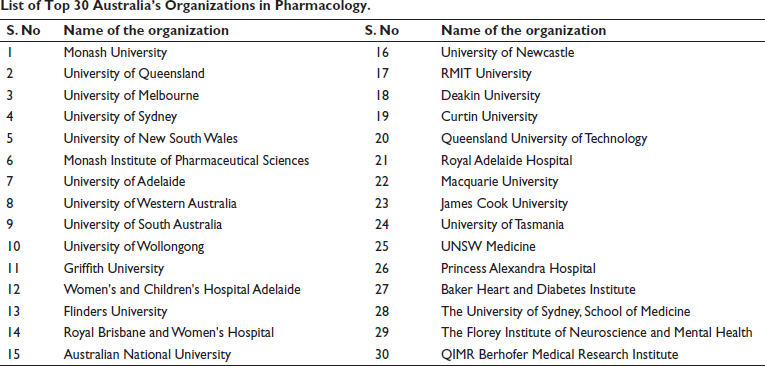
In this study, Australia’s top 30 most productive organizations’ high-cited publications on ‘Pharmacology’ research were identified and obtained from the Scopus database. All Australian papers were searched with Keyword ‘Australia’ in the Country tag of the database from 2002 to 2021. We retrieved 15,81,308 records, of which 10,53,545 were articles. Then the search was restricted to subject ‘Pharmacology, Toxicology Pharmaceutics’ under broad subjects and restricted to ‘Articles’ under document type. We again restricted the search to top 30 most productive organizations (shown in Appendix 1) and as result obtained 19,418 records, which were further arranged in the decreasing order of the number of citations obtained. We obtained 685 articles from 19,418 records, which have received 100 or more citations. The search strategy used, and the list of top 30 Australian organizations are shown in Appendix 1.
These 685 records are marked as HCPs. The bibliographic data on 685 HCPs were exported in MS-Excel for further analyses for the year of publication, affiliations, type and source of document, funding sources, international collaborative publications (ICPs), leading organizations and authors, prominent journals, and significant subject keywords. VOS viewer software (Leiden University, Netherland) and Biblioshiny software (University of Naples, Italy) were used to visualize the collaborative interaction among most productive countries, organizations, authors, and keywords. For the information of readers, highly productive organizations/authors are defined as those who have published more publications than the average production of all organizations/authors. Similarly, high-impactful organizations/authors are defined as those who have received or registered more than average citations per paper (CPP) of all authors/organizations.
Results
Overall Picture
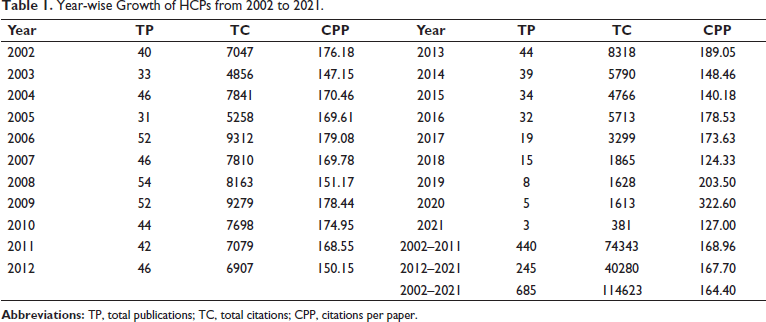
Our search revealed that there was a total of 685 HCPs in Scopus database on pharmacology between 2002 and 2021 contributed by the Australian top 30 most productive organizations. Of the 19,418 articles, only 685 articles (3.53%) received 100 or more citations each and they are assumed here as HCPs. The 685 HCPs fall in the following citation range and show uneven distribution: two in citation range 1131–1230, 14 in citation range 514–955, 29 in citation range 301–487, 85 in citation range 201–299, and 555 in citation range 100–199. The year-wise growth of publications and citations obtained by 685 HCPs are presented in Table 1. A regular increase and decrease of HCP articles were observed till 2012, and then witnessed a continuous decrease of high cited articles (HCPs) till 2021. The cumulative HCAs decreased from 440 during 2002–2011 to 245 during 2012–2021. The 685 HCPs received 1,14,623 citations, averaging 164.40 CPP (Table 1).
Year-wise Growth of HCPs from 2002 to 2021.
Of the 685 HCPs, 278 (40.58%) received external funding support from more than 150 national and international agencies and have received 47,791 citations, averaging 171.91 CPP. The major funding agencies supporting HCPs (along with their output) were National Health and Medical Research Council, Australia (82 articles), Australian Research Council (55 articles), Australian Government, Department of Health (33 articles), National Institute of Health, USA (31 articles), Australia, Department of Education and Training (26 articles), National Institute of Allergy and Infectious Diseases, USA (23 articles), National Natural Science Foundation of China (19 articles), Medical Research Council (18 articles), Seventh Framework Program (16 articles), National Institute of Drug Abuse, USA (13 articles), European Commission, Brussels (12 articles), U.S. Department of Health and Human Service and National Cancer Research Institute, USA (11 articles each), University of Sydney (eight articles), National Institute of Drug Abuse and Alcoholism (7 articles), and so on.
By population age groups, the maximum focus in 685 HCPs was studies related to adults (n = 147), followed by middle-aged (n = 92), aged (n = 69), adolescents (n = 55), and children (n = 17).
By medical classification, the maximum priority was assigned to studies related to clinical research (n = 110) in 695 HCPs, followed by pathophysiology (n = 56), genetics (n = 51), treatment outcome (n = 48), epidemiology (n = 34), risk factors (n = 18), and complications (n = 5).
In terms of the type of studies under 685 HCPs, the maximum contribution consisted of controlled studies (n = 353), followed by in vitro studies (n = 81), clinical trials (n = 58), in vivo studies (n = 45), controlled clinical trials (n = 27), comparative studies (n = 25), retrospective studies (n = 20), randomized controlled trials (n = 18), cross-sectional studies (n = 12), prospective studies and cohort studies (n = 7 each), and observational studies (n = 3).
By sub-field classification of 685 HCPs, the maximum number (n = 461) was on clinical pharmacology, followed by toxicology (n = 30), pharmacokinetics (n = 20), pharmacodynamics (n = 19), therapeutics (n = 10), pharmacy (n = 4), and chemotherapy (n = 1).
International Collaboration
Of the 685 HCPs, 273 (40.73%) were zero collaborative (involve the participation of one organization). The rest of the papers were national or international collaborative and they have together received 46,046 citations, averaging 165.04 CPP. As against this, 406 (59.27%) HCPs were collaborative and involved the participation of two or more countries. These 406 HCPs received 68,577 citations, averaging 168.91 CPP. Among collaborative papers, only 78 (11.39%) are international collaborative and they together received 27,219 citations averaging 348.96 CPP.
The 78 foreign countries participated as partners in 78 international collaborative papers of Australia in pharmacology during 2002–2021. The largest contributions came from the United States and United Kingdom with 23.65% and 15.33% share, respectively, followed by Germany and China (8.03% and 7.45%), France, Italy and Switzerland (from 5.40% to 5.99%), Netherlands, Canada, Spain, Belgium and Sweden (from 3.65% to 4.67%), Denmark, New Zealand, Japan, Austria, Singapore and India (from 2.91% to 2.92%), and Hong Kong and Finland (1.90% and 1.61%). In terms of impact, Austria registered the highest (227.22) CPP, followed by Canada (194.65), Hungary (190.92), United States (187.37), Ireland (185.83), Finland (185.64), Denmark (182.50), Italy (180.22), Switzerland (178.62), Spain (178.45), Japan (176.74), Germany (174.93), Sweden (172.20), and United Kingdom (171.25) (Table 2).
Contribution of Foreign Countries in International Collaborative Articles of Australia in “Pharmacology, Toxicology, and Pharmaceutics” during 2002–2021.
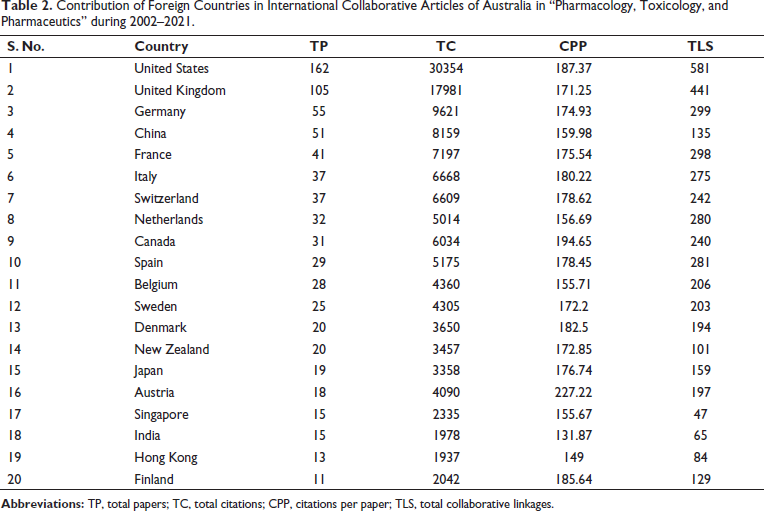
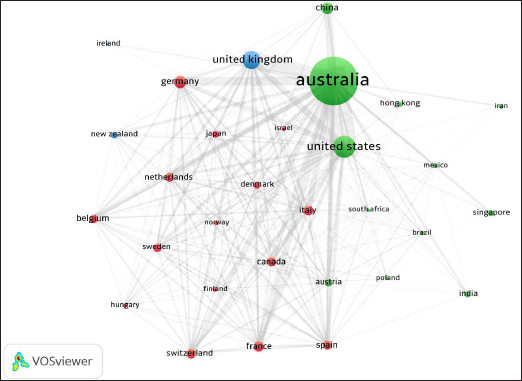
Figure 1 shows the network visualization of collaborations of Australia with other 29 countries using VS Viewer Software. The total link strength (TLS) of Australia with other top 29 countries varied from 19 to 581. The top 5 countries with highest TLS (581, 441, 299, 298, and 281) with Australia were the United States, United Kingdom, Germany, France, and Spain. The network visualization map divides the Australian collaborative links with top 29 countries into three clusters: Cluster 1 (Red, 15 countries) includes Australia with Belgium, Canada, Denmark, Finland, France, Germany, Hungary, Israel, Italy, Japan, The Netherlands, Norway, Spain, Sweden, Switzerland; Cluster 2 (Green, 12 countries) includes Australia with Austria, Brazil, China, Hong Kong, India, Iran, Mexico, Poland Singapore, South Africa and the United States; and Cluster 3 (Blue, 3 countries) includes Australia with Ireland, New Zealand and the United Kingdom. Co-operation between the countries is expressed in terms of thickness and distance between the nodes. Besides, the size of the node represents the influence of the country. Thus, the distance between the countries is not the main principle consideration affecting the partnership and more cooperation between countries could bring advanced scientific research results.
Collaboration Network of Australia with Top 29 Countries.
Significant Keywords
A total of 11,042 author’s keywords plus and 1,956 authors keywords appeared in 685 HCPs. Table 3 shows the top 117 author keywords (occurrences ≥ 4) along their TLS. The most important keywords (along with their frequency of appearance) were Animal Experiment (n = 108), Metabolism (n = 76), Drug Effects (n = 67), Animal Model (n = 65), Protein Expression (n = 64), Antibacterial Agents (n = 62), Drug Delivery Systems (n = 54), Microbial Sensitivity Tests (n = 54), Drug Formulation (n = 44), Signal Transduction (n = 40), Genetics (n = 32), Drug Safety (n = 32), Antibiotic Resistance (n = 30), and so on.
List of Top 117 Significant Keywords.
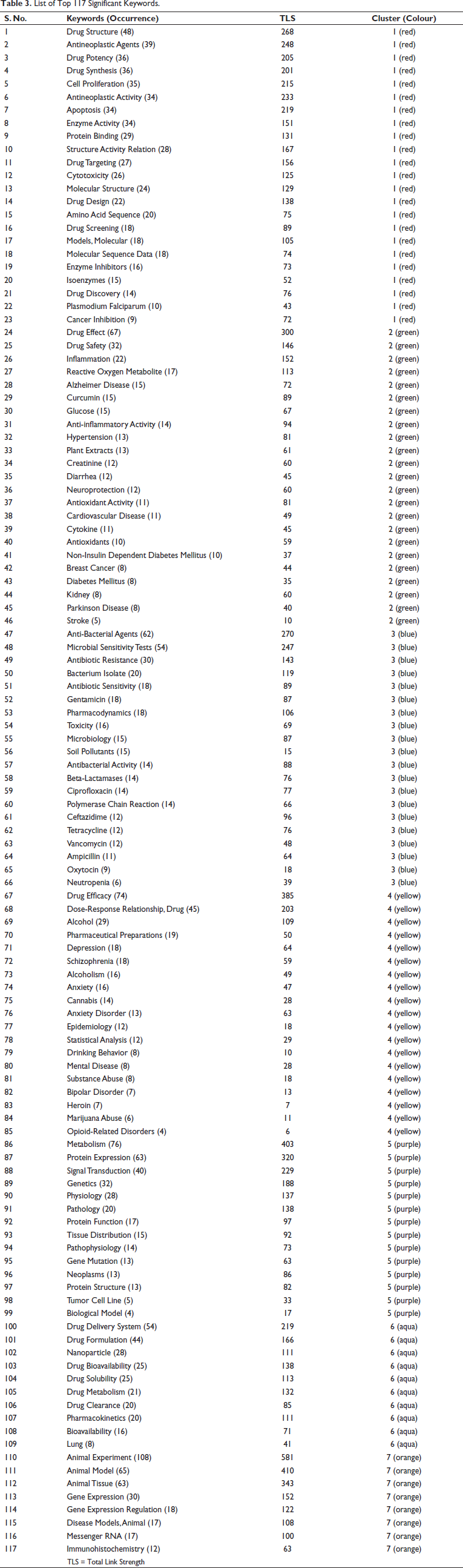
Of the 11,042 keywords extracted for the top 30 Australian organizations, 1,494 keywords reached the threshold, for each of the keywords, the total strength of the co-occurrence links with other keywords was calculated by using VOS viewer tool. Of these 1,494 keywords, 117 keywords were selected which are presented into 7 clusters as shown in Figure 2. The 7 main clusters were represented by red, green, blue, yellow, purple, aqua, and orange.
Top 117 Keywords Co-occurrences Network.
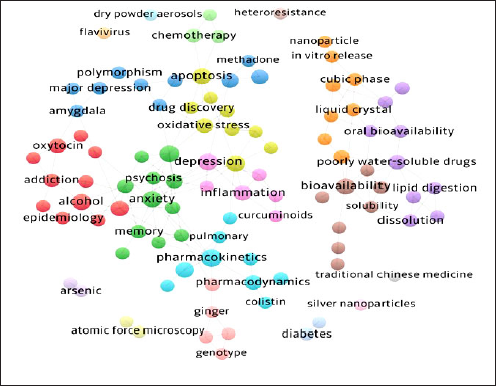
Cluster 1 (Red, 23 keywords) includes drug structure, antineoplastic agents, drug potency, drug synthesis, cell proliferation, antineoplastic, activity, apoptosis, enzyme activity, protein binding, structure activity relation, drug targeting, cytotoxicity, molecular structure, drug design, amino acid sequence, drug screening, models, molecular, molecular sequence data, enzyme inhibitors, isoenzymes, drug discovery, plasmodium falciparum, and cancer inhibition.
Cluster 2 (Green, 23 keywords) includes drug effect, drug safety, inflammation, reactive oxygen metabolite, Alzheimer’s disease, Curcumin, glucose, anti-inflammatory activity, hypertension, plant extracts, Creatinine, diarrhea, neuro-protection, antioxidant activity, Cardiovascular disease, cytokine, antioxidants, non-insulin-dependent diabetes mellitus, breast cancer, diabetes mellitus, kidney, Parkinson disease, and stroke.
Cluster 3 (Blue, 20 keywords) includes anti-bacterial agents, microbial sensitivity tests, antibiotic resistance, bacterium isolate, antibiotic sensitivity, gentamicin, pharmacodynamics, toxicity, microbiology, soil pollutants, antibacterial activity, beta-lactamases, ciprofloxacin, polymerase chain reaction, ceftazidime, tetracycline, vancomycin, ampicillin, oxytocin, and neutropenia.
Cluster 4 (Yellow, 19 keywords) includes drug efficacy, dose-response relationship drug, alcohol, pharmaceutical preparations, depression, schizophrenia, alcoholism, anxiety, cannabis, anxiety disorder, epidemiology, statistical analysis, drinking behavior, mental disease, substance abuse, bipolar disorder, heroin, marijuana abuse, and opioid-related disorders.
Cluster 5 (Purple, 14 keywords) includes metabolism, protein expression, signal transduction, genetics, physiology, pathology, protein function, tissue distribution, pathophysiology, gene mutation, neoplasms, protein structure, tumor cell line, and biological model.
Cluster 6 (Aqua, 10 keywords) includes drug delivery system, drug formulation, nanoparticle, drug bioavailability, drug solubility, drug metabolism, drug clearance, pharmacokinetics, bioavailability, and lung.
Cluster 7 (Orange, 8 keywords) includes animal experiment, animal model, animal tissue, gene expression, gene expression regulation, disease models animal, messenger RNA, and immunohistochemistry.
Top 30 Most Productive and Impactful Authors
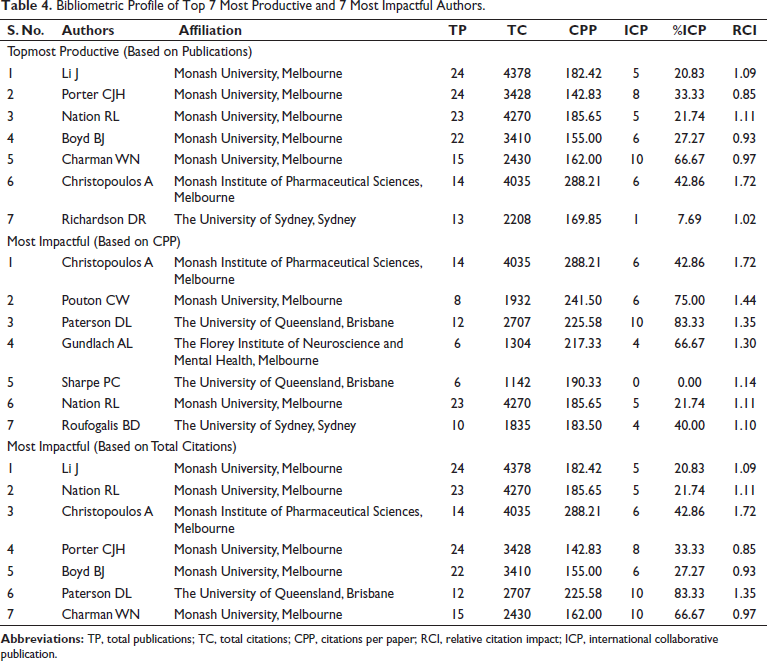
The top 30 out of 4,489 most productive authors individually contributed 6 to 24 papers and these together contributed 316 papers and 55,409 citations, accounting more 46.13% and 48.34% share, respectively, in Australia’s total HCPs publications and citations in pharmacology. On further analysis, it was observed that nine authors contributed more than the average publication productivity (10.53) of all top 30 authors; and 11 authors registered average CPP and relative citation index (RCI) above the average (175.34 and 1.05) of all 30 authors. Table 4 lists the top 7 most productive and 7 most impactful authors.
Bibliometric Profile of Top 7 Most Productive and 7 Most Impactful Authors.
Collaborative Linkages among Top 30 Authors
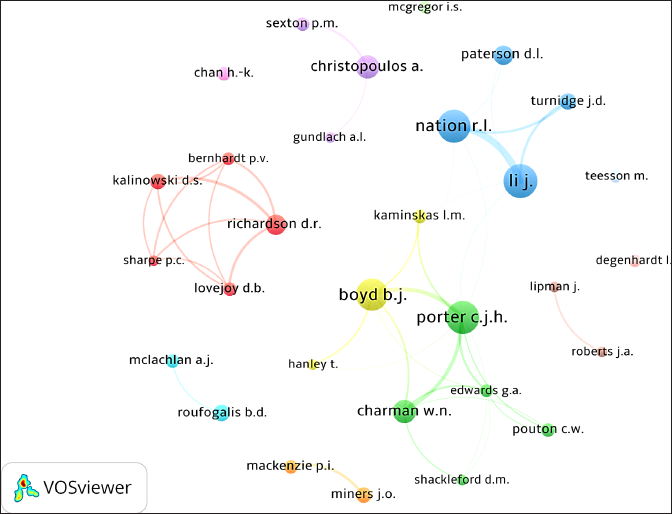
Based on the co-authorship analysis of the 4,498 authors, 38 meet the thresholds. By choosing threshold of minimum number of documents of an author (n = 6), the top 30 authors list was selected and a VOS viewer tool was used to generate Figure 3, which depicts these top 30 authors into 12 clusters, labeled in various colors: (i) Cluster 1 involved 5 authors namely P.V. Bernhardt, D.S. Kalinowski, D.B. Lovejoy, D.R. Richardson, and P.C. Sharpe; (ii) Cluster 2 involved 5 authors, namely W.N. Charman, G.A. Edwards, C.J.H. Porter, C.W. Pouton, and D.M. Shackleford; (iii) Cluster 3 involved 4 authors, namely J. Li, R.L. Nation, D.L. Paterson and J.D. Turnidge; (iv) Cluster 4 involved 3 authors, namely B.J. Boyd, T. Hanley and L.M. Kaminskas; (v) Cluster 5 involved 3 authors, namely A. Christopoulos, A.L. Gundlach and P.M. Sexton; (vi) Cluster 6 involved 2 authors, namely A.J. McLachlan and B.D. Roufogalis; (vii) Cluster 7 involved 2 authors, namely P.I. Mackenzie and J.O. Miners; (viii) Cluster 8 involved two authors, namely J. Lipman and J.A. Roberts; and (ix) Clusters 9−12 consists of 1 author each, namely H.K. Chan, L. Degenhardt, I.S. McGregor, and M. Teesson, respectively.
Top 30 Authors Collaboration Network Map.
Top 30 Most Productive and Impactful Organizations
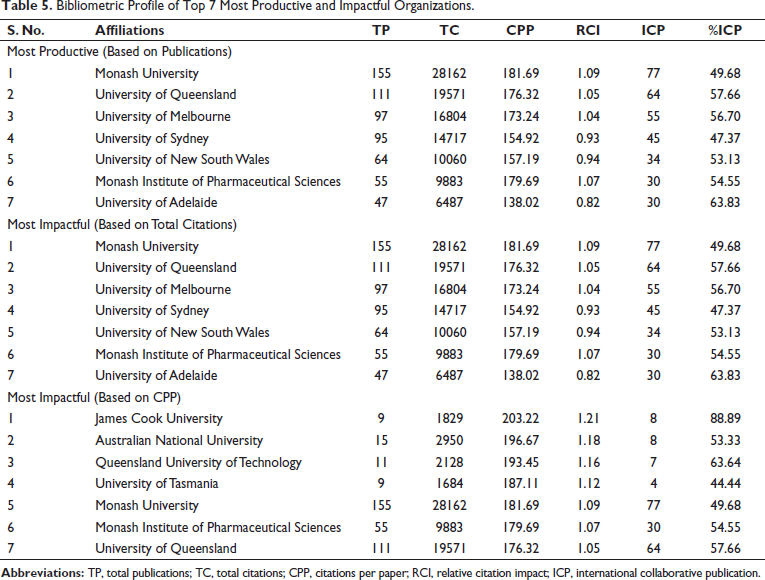
The top 30 out of 1,518 most productive total organizations individually contributed 4 to 155 papers and together contributed 941 papers and 1,55,499 citations, constituting more than 100.0 shares each in top 30 Australian HCPs publications and citations in pharmacology. On further analysis, it was observed that 8 organizations have contributed more than the average publication productivity (31.37) of all top 30 organizations; and 9 organizations registered average CPP and RCI above the average (165.25 and 0.99) of all 30 organizations. Table 5 lists the top 7 most productive and 7 most impactful organizations.
Bibliometric Profile of Top 7 Most Productive and Impactful Organizations.
Collaborative Linkages among Top 30 Organizations
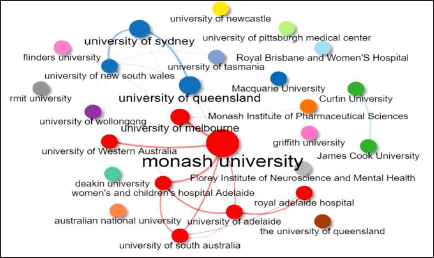
The various organizations’ collaboration network in the study is shown in Figure 4. Where organizations with at least 4 papers (n = 26) were visualized for mapping using the Biblioshiny tool. Each node represents an organization with the size of node indicating the number of publications for an organization. The line thickness between the nodes is proportional to the number of publications in collaboration. The different colors represent different clusters with the same color nodes representing the same cluster. All these 26 organizations are presented into 13 clusters: (i) Cluster 1 includes 7 organizations, such as Monash University, University of Melbourne, University of Adelaide, University of Western Australia, University of South Australia, Women’s and Children’s Hospital Adelaide, and Royal Adelaide Hospital; (ii) Cluster 2 includes 4 organizations such as the University of Queensland, University of Sydney, University of New South Wales, and Macquarie University; (iii) Cluster 3 consist of 2 organizations and include Curtin University and James Cook University; (iv) Cluster 4 consists of 2 organizations and includes RMIT University, and The Florey Institute of Neuroscience and Mental Health; (v) Cluster 5 consists of 2 organizations and includes Monash Institute of Pharmaceutical Sciences and Australian National University; and (vi) Clusters 6−17 consist of 1 organization each and include the University of Wollongong, Royal Brisbane and Women’s Hospital, University of Newcastle, Deakin University, Queensland University of Technology, University of Tasmania, and Princess Alexandra Hospital.
Top 30 Organizations Collaboration Network Map.
Most Productive and Impactful Journals
The 685 HCPs were published in 151 journals. The distribution of HCPs by reporting journals are widely scattered. The top 30 journals published 5 to 59 papers and together published 4,56 papers and 76,903 citations, accounting for 66.57% and 67.09% share, respectively, in total Australian publications and citations. Among the top 30 journals, Antimicrobial Agents and Chemotherapy has published the highest number of papers (n = 59), followed by Environmental Pollution (n = 43), Journal of Medicinal Chemistry (n = 42), Journal of Antimicrobial Chemotherapy (n = 30), Drug and Alcohol Dependence (n = 29), British Journal of Pharmacology (n = 22), and Neuropsychopharmacology (n = 21).
Nature Reviews Drug Discovery registered the highest CPP (371.8), followed by Antiviral Research (286.86), European Journal of Pharmaceutical Sciences (253.0), Neuropsychopharmacology (214.57), Journal of Psychopharmacology (210.17), British Journal of Pharmacology (198.5), Pharmacological Reviews (197.0), and Antimicrobial Agents and Chemotherapy (186.2). Antimicrobial Agents and Chemotherapy received the highest number of citations (n = 10,975), followed by Environmental Pollution (n = 6,348), Journal of Medicinal Chemistry (n = 4,691), Drug and Alcohol Dependence (n = 4,560), Neuropsychopharmacology (n = 4,506), Journal of Antimicrobial Chemotherapy (n = 4,395), and British Journal of Pharmacology (n = 4,367).
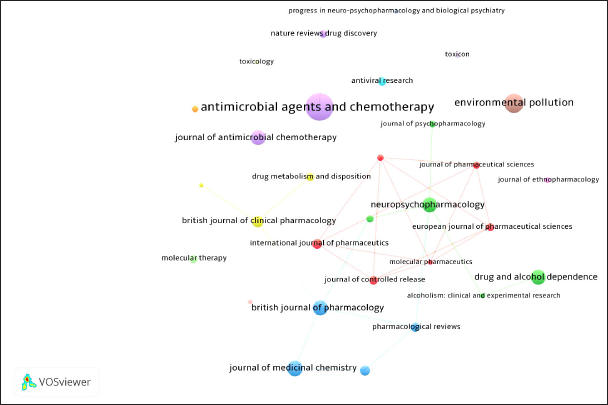
Of the total 151 journals with a minimum number of documents of (n = 5) source, 33 meet the thresholds and a top 30 most productive journals were selected to generate VOS viewer co-citation network visualization map. In the map, two or more journals that cover closely related topics are placed close to one another, and those covering fundamentally different topics are located far from each other. The circle size and font size of a journal node are proportional to the frequency of its co-citations form, Figure 5 depicts 14 clusters. Cluster 1 has 6 journals including the International Journal of Pharmaceutics, Journal of Controlled Release, Journal of Pharmaceutical Sciences, Pharmaceutical Research, European Journal of Pharmaceutical Science, and Molecular Pharmaceutics. Cluster 2 has 5 journals such as Drug and Alcohol Dependence, Neuropsychopharmacology, International Journal of Neuropsychopharmacology, Journal of Psychopharmacology, and Alcoholism: Clinical and Experimental. Cluster 3 with 4 journals such as Journal of Medicinal Chemistry, British Journal of Pharmacology, Molecular Pharmacology, and Pharmacological Reviews, followed by Clusters 4 and 5 with 3 journals each and Cluster 6−14 with 1 journal each and so on.
Top 30 Journals Co-citation Network Map.
Discussion
Bibliometric methods have been employed in this study to analyze 685 HCPs from top 30 organizations in Australian pharmacology during 2002–2021 The 685 HCPs received 1,14,623 citations, averaging 164.4 CPP. Of the 685 HCPs, 278 (40.58%) publications received external funding support and have received 7,47,791 citations, averaging 171.91 CPP. Of the 685 HCPs, 78 publications (11.39%) are international collaborative and received 27,219 citations, averaging 348.96 CPP. The 685 most cited studies were published in 151 different journals and conducted by 4,489 authors from 1,518 organizations, with an overall 1,14,623 citations. Antimicrobial Agents and Chemotherapy was the leading journal with 59 published studies, followed by Environmental Pollution (n = 43) and Journal of Medicinal Chemistry (n = 42). The United States and United Kingdom were the top-ranked collaborative countries with Australia with 23.65% and 15.33% share in ICPs. The most productive institutes were Monash University (n = 155) and the University of Queensland (n = 111). The most prolific authors were J. Li (N = 24), C.J.H. Porter (n = 24), and R.L. Nation (n = 23). The interaction among productive countries, organizations, authors and keywords was also analyzed. The significant keywords and their co-occurrence indicate and throw light on the important concepts in the field.
We conclude that there is an urgent need to increase national funding and expand international collaboration, which will help to increase and diversify research output and improve research impact. The results obtained from the above study might help researchers to identify trends in Australian pharmacology research, identify targeted journals, identify specialized institutions, and identify highly qualified authors. Results will also throw light on past and current research and identify future hotspots in Australia’s pharmacology research.
Appendix-1
Search Strategy Used
List of Top 30 Australia’s Organizations in Pharmacology.
AFFILCOUNTRY (australia) AND PUBYEAR > 2001 AND PUBYEAR < 2022 AND (LIMIT-TO (SUBJAREA, “PHAR”)) AND (LIMIT-TO (DOCTYPE, “ar”)) AND (LIMIT-TO (AF-ID, “The University of Queensland” 60031004) OR LIMIT-TO (AF-ID, “Monash University” 60019578) OR LIMIT-TO (AF-ID, “The University of Sydney” 60025709) OR LIMIT-TO (AF-ID, “University of Melbourne” 60026553) OR LIMIT-TO (AF-ID, “UNSW Sydney” 60028333) OR LIMIT-TO (AF-ID, “Griffith University” 60032987) OR LIMIT-TO (AF-ID, “The University of Western Australia” 60031806) OR LIMIT-TO (AF-ID, “The University of Adelaide” 60009512) OR LIMIT-TO (AF-ID, “Monash Institute of Pharmaceutical Sciences” 60134796) OR LIMIT-TO (AF-ID, “University of South Australia” 60031846) OR LIMIT-TO (AF-ID, “The University of Newcastle, Australia” 60010571) OR LIMIT-TO (AF-ID, “University of Technology Sydney” 60023932) OR LIMIT-TO (AF-ID, “Curtin University” 60031226) OR LIMIT-TO (AF-ID, “The Florey Institute of Neuroscience and Mental Health” 60110201) OR LIMIT-TO (AF-ID, “Queensland University of Technology” 60011019) OR LIMIT-TO (AF-ID, “Deakin University” 60018805) OR LIMIT-TO (AF-ID, “RMIT University” 60011362) OR LIMIT-TO (AF-ID, “University of Tasmania” 60015356) OR LIMIT-TO (AF-ID, “The Australian National University” 60008950) OR LIMIT-TO (AF-ID, “University of Wollongong” 60011664) OR LIMIT-TO (AF-ID, “Flinders University” 60020828) OR LIMIT-TO (AF-ID, “The University of Sydney School of Medicine” 60121699) OR LIMIT-TO (AF-ID, “La Trobe University” 60006925) OR LIMIT-TO (AF-ID, “Royal Brisbane and Women’s Hospital” 60028435) OR LIMIT-TO (AF-ID, “UNSW Medicine” 60011463) OR LIMIT-TO (AF-ID, “Macquarie University” 60019544) OR LIMIT-TO (AF-ID, “Princess Alexandra Hospital” 60025258) OR LIMIT-TO (AF-ID, “The Faculty of Health Sciences” 60090173) OR LIMIT-TO (AF-ID, “James Cook University” 60019870) OR LIMIT-TO (AF-ID, “Baker Heart and Diabetes Institute” 60033409) OR LIMIT-TO (AF-ID, “QIMR Berghofer Medical Research Institute” 60025029)).
Footnotes
Declaration of Conflicting Interests
The authors declared no potential conflicts of interest with respect to the research, authorship, and/or publication of this article.
Ethical Approval
Not applicable.
Funding
The authors received no financial support for the research, authorship, and/or publication of this article.
Informed Consent
Not applicable.