



Abstract
Aim:
This study aimed to assess the characteristics and trends of research on substance use and COVID-19.
Methods:
Keywords related to “Covid-19” and “Substance Use” were used in a search query formulated for the Scopus search engine. The articles published during the years 2020 and 2021, through early November 2021, were considered.
Results:
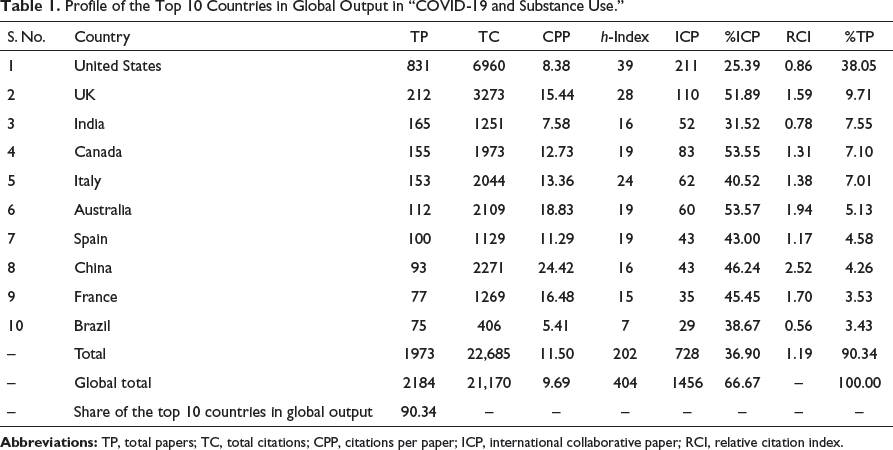
A total of 2184 publications were published on this topic, averaging 9.69 citations per paper. About one-seventh (13.96%) share of global publications was supported by extramural funding support. The maximum number of publications emerged from the United States of America (USA) (n = 831; 38.05%), followed by the United Kingdom (UK) (n = 212; 9.71%), India (n = 165; 7.55%), and Canada (155 papers; 7.10%). In terms of citation impact, publications emerging from China (24.42 and 2.52) had the highest citation impact, followed by publications emerging from Australia (18.83 and 1.94), France (16.48 and 1.70), the UK (15.44 and 1.59), Italy (13.36 and 1.38), and Canada (12.73 and 1.31). When the data in terms of specific institutes were evaluated, Harvard Medical School, USA (n = 52), was ranked first in productivity, followed by the University of Toronto, Canada (n = 47); the Yale School of Medicine, USA (n = 35); INSERM, France (n = −29); and the University of British Columbia, Canada (n = 2s). The University College London, UK (30.24 and 3.12), ranked first in citation impact, followed by INSERM, France (22.0 and 2.27); the Sapienza University of Rome, Italy (17.4 and 1.8); and the University of Toronto, Canada (13.68 and 1.41). When the journals were evaluated, the International Journal of Environmental Research and Public Health (n = 83) ranked first in publication productivity, followed by the Journal of Substance Abuse Treatment (n = 73), Frontiers in Psychology (n = 39), Drug and Alcohol Dependence (n = 28), and International Journal of Drug Policy (n = 26).
Conclusion:
This bibliometric study suggests that a large amount of literature has accumulated during the COVID-19 pandemic on substance use disorders, both from developed and developing countries.
Introduction
The COVID-19 pandemic emerged as a major crisis for humans across the globe. The pandemic led to lockdown for months together in many countries. In some countries, the lockdown was announced suddenly, and people had no time to prepare themselves for their needs. In many countries, the lockdown was also associated with the disruption of various medical services.
The lockdown and disruption of medical services emerged as a major blow for people using different kinds of substances in the dependent pattern. Many of the patients who were using licit substances experienced withdrawal states and landed in emergency, and those who were receiving substitution therapies of illicit substances also experienced difficulty in reaching the medical services. A survey by the World Health Organization (WHO), which included data that was collected during the period of March to June 2020 from 105 countries, showed that across the globe, 90% of countries saw the disruption of their health care services with the disruption of services for mental health disorders to the extent of 61% 1 . Another round of the pulse survey done a year later still shows that there is a disruption in one or more essential health services in about 90% of the countries, with services in the form of mental, neurological, and substance use disorders being still affected in more than 40% of the countries. 2 Another survey by WHO, which specifically focused on the impact on the mental health services in 130 countries and was conducted during June to August 2020, showed that in 45% of the countries, there was disruption of opioid agonist maintenance treatment; in 35% of the countries, there was a disruption in emergency interventions for severe substance withdrawal states; and in 30% of the countries, there was a disruption in access to medication for the management of mental, neurological, and substance use disorders. 3
Considering the huge impact of the COVID-19 pandemic on mental health services, especially substance use services, a large number of publications have emerged on the impact of the COVID-19 pandemic. In this connection a few reviews have focused on the impact of the COVID-19 pandemic on the persons with substance use disorders. 4
Considering the huge impact of the pandemic on the persons with substance use disorders, a large number of publications have emerged on the topic. However, none of the studies have assessed the publication output by using bibliometric methods. Accordingly, this study aimed to assess the characteristics and trends of research on substance use and COVID-19. An additional aim of the study was to identify the broad areas, important keywords, countries of origin of research, different organizations and authors active in research in this area, the journals that published research on this topic, and the highly cited papers on this topic.
Methodology
The authors performed a bibliometric search on the theme “COVID-19 and Substance Use” using a comprehensive search strategy, which identified, retrieved, and downloaded all relevant publication records from the Scopus database (
TITLE (“COVID-19” OR “2019 novel coronavirus” OR “coronavirus 2019” OR “coronavirus disease 2019” OR “2019-novel CoV” OR “2019 ncov” OR “covid-2019” OR “covid19” OR “corona virus 2019” OR “ncov-2019” OR “ncov2019” OR “nCoV 2019” OR “2019-ncov” OR “covid-19” OR “Severe acute respiratory syndrome coronavirus 2” OR “SARS-CoV-2”) OR KEY (“COVID-19” OR “2019 novel coronavirus” OR “coronavirus 2019” OR “coronavirus disease 2019” OR “2019-novel CoV” OR “2019 ncov” OR “covid 2019” OR “covid19” OR “corona virus 2019” OR “ncov-2019” OR “ncov2019” OR “nCoV 2019” OR “2019-ncov” OR “covid-19” OR “Severe acute respiratory syndrome coronavirus 2” OR “SARS-CoV-2”) and Key (“Substance use” or “alcohol” or “opioids” or “cannabis” or “tobacco” or “benzodiazepine” or “caffeine” or “stimulants” or “cocaine” or “Inhalants” or “club drug”).
Results
Overall Output
Global scholars have published 2184 publications (2020 = 1081; 2021 = 1103) on the topic of “COVID-19 and Substance Use” as listed in the Scopus database. These 2184 publications have received 21,170 citations, averaging 9.69 citations per publication (CPP). Of the 2184 global publications on this theme, 176 (8.05%) publications were supported by external funding support from 100+ global research agencies, and they together accounted for 1205 citations, averaging 6.85 CPP. Of the 2184 global publications, articles constituted the largest global share (60.44%), followed by letters and reviews (13.92% and 10.62%, respectively), notes and editorials (7.01% and 6.5%, respectively), short surveys and conference papers (0.96% and 0.46%, respectively), and erratum (0.09%).
Top 10 Most Productive Countries
Profile of the Top 10 Countries in Global Output in “COVID-19 and Substance Use.”
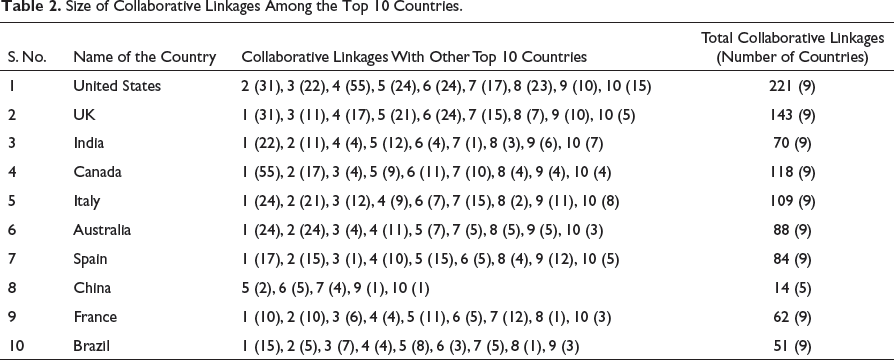
Collaborative Linkages Among the Top 10 Countries
Size of Collaborative Linkages Among the Top 10 Countries.
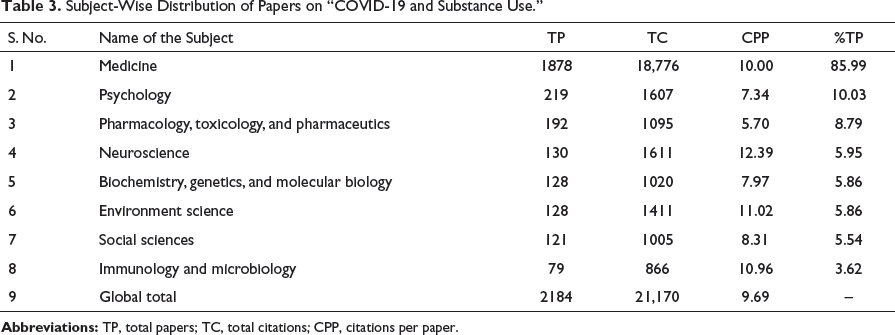
Subject-Wise Distribution of Publications
Subject-Wise Distribution of Papers on “COVID-19 and Substance Use.”
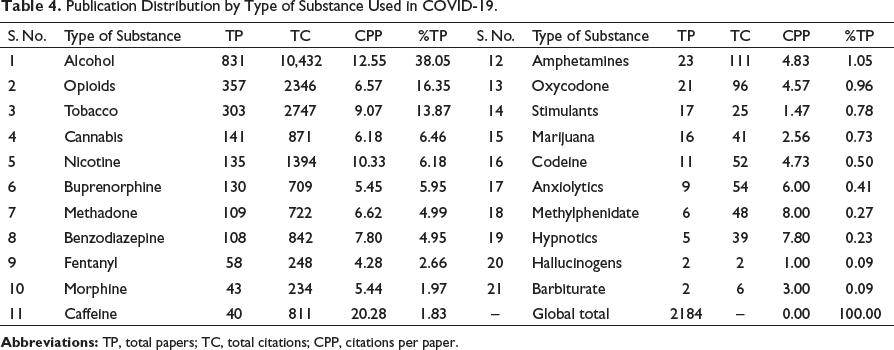
Types of Substance Used
Publication Distribution by Type of Substance Used in COVID-19.
Substance Use by Population Age Group
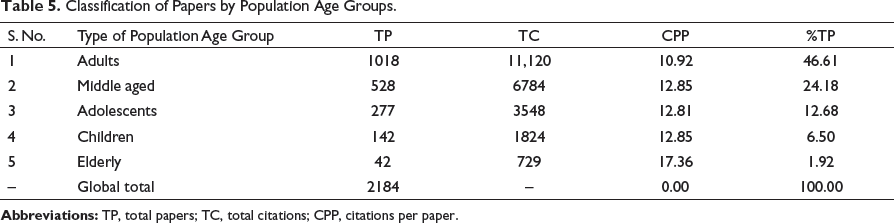
Classification of Papers by Population Age Groups.
Profile of the Top 15 Organizations
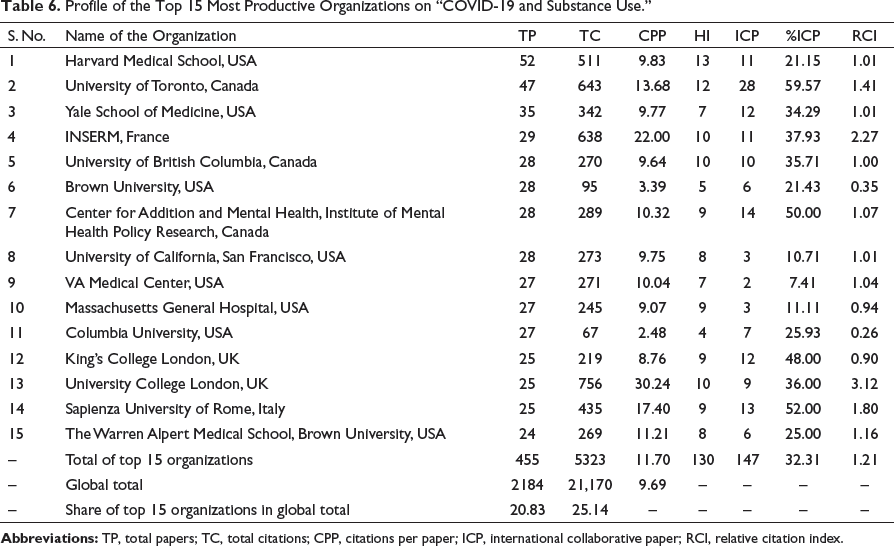
Profile of the Top 15 Most Productive Organizations on “COVID-19 and Substance Use.”
Profile of the Top 15 Authors
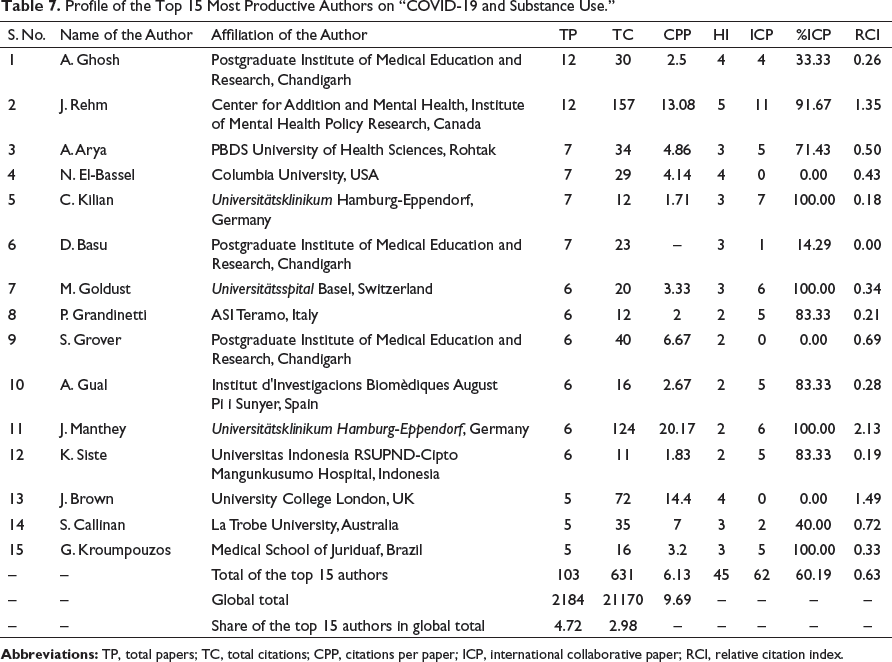
Profile of the Top 15 Most Productive Authors on “COVID-19 and Substance Use.”
Profile of the Top 15 Journals
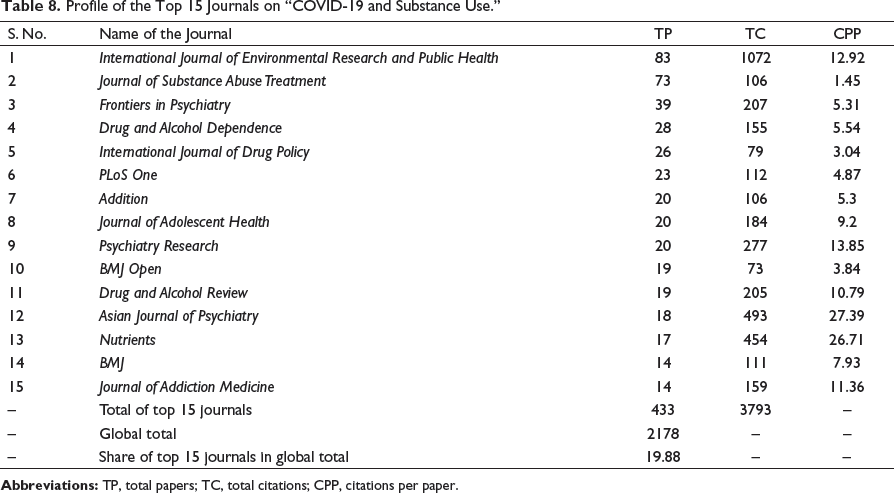
Of the total 2184 global publications on the studied topic, 2178 publications were published in 307 journals, 2 each as a part of book series, trade journal, and conference proceedings. In terms of various journals, 251 journals published 1 to 5 papers each, 31 journals published 6 to 10 papers each, 19 journals published 11 to 20 papers each, 4 journals published 21 to 50 papers each, and 1 journal published 73 and 83 papers, respectively. The top 15 journals that published the most papers are shown in Table 8, and these 15 journals contributed 433 papers, constituting a 19.88% share of total journal publications in this research field.
Profile of the Top 15 Journals on “COVID-19 and Substance Use.”
Highly Cited Papers
Out of 2184 publications on “COVID-19 and Substance Use”, only 30 (1.37) publications were cited more than 100 times, with the highest number of citations being 1903 since the publication, and together, these 30 papers were cited 9102 times, averaging 303.4 CPP. Among 30 high-cited publications, 17 papers received 101 to 188 citations, 6 papers received 204 to 286 citations, 5 papers received 377 to 577 citations, and 2 papers received 1358 to 1903 citations.
Among 30 high-cited papers, the largest number of publications (9 papers each) were published by authors from UK and USA, followed by China (8 papers); Italy (5 papers); Australia and Canada (4 papers each); Switzerland (3 papers); Russia, Singapore, and Taiwan (6 papers each); etc.
Discussion
The present study showed that over a period of about 2 years, a large amount of literature has accumulated on the topic of substance use disorders and COVID-19. The total number of papers published on the topic were 2184 during the years 2020 and 2021, up to November 17, 2021. These publications were cited 21,170 times with a CPP of 9.69. Only a small proportion (14%) of these citations were supported by extramural funding sources. However, the papers that were supported by the funding agencies had an overall CPP that was lower than the average CPP on the topic.
As there are no previous bibliometric studies on this topic, it is not possible to compare the findings of the present study with those of the existing literature. Hence, we would like to compare the findings of the present study with the bibliometric studies published in the area of mental health. When one compares these findings with the overall research output on various aspects of mental health, it can be said that research studies on substance use disorders overall formed a small subgroup of all the publications; however, the CPP for the articles on substance use disorders was higher than that reported for overall mental health. 5 The proportions of publications supported by various funding agencies were comparable for substance use disorders and overall mental health. 5
Research studies on the area of substance use disorders emerged from 114 countries, which is again lower than 158 countries, which contributed to the research in the area of mental health. In terms of specific countries, the research on substance use disorders parallels the research study on mental health in general, with the highest number of publications emerging from USA and UK. Similar to the publications on mental health, although the largest number of publications on substance use disorder emerged from USA, however, the research from USA did not register CPP and RCI higher than the group average. 5
In terms of specific substances, the largest number of publications were focused on alcohol (38.05%), followed by opioids and tobacco. This distribution is understandable, considering the fact that alcohol and tobacco are licit substances. A large proportion of publications focusing on opioids can be understood in the background of the fact that opioid substitution treatment was significantly affected across the globe because of the pandemic (WHO, 2020, 2021). When the data were analyzed for specific institutions, it was evident that the maximum number of publications emerged from Harvard Medical School, USA (52 papers); followed by the University of Toronto, Canada (47 papers); the Yale School of Medicine, USA (35 papers); INSERM, France (29 papers); and the University of British Columbia, Canada (28 papers). When the impact of the organizations was evaluated by considering CPP and RCI, publications emerging from University College London, UK (30.24 and 3.12) had the maximum impact, and this was followed by INSERM, France (22.0 and 2.27); Sapienza University of Rome, Italy (17.4 and 1.8); University of Toronto, Canada (13.68 and 1.41); and The Warren Alpert Medical School, Brown University, USA (13.21 and 1.16). This trend is similar to mental health research in general during the COVID-19 pandemic. 5
When the data were evaluated for the productivity of various authors, A. Ghosh and I. Rehm were the most productive authors, with 12 publications each. Four other authors, i.e., A. Arya, N. El-Bassel, C. Kilian, and D. Basu published seven papers each. An important thing to note here is that among the top 10 most productive authors, 4 were from India. This may possibly reflect the impact of the pandemic on persons with substance use disorders, thus forcing clinicians/researchers from India to highlight the emergent issues. When the impact of the authors was evaluated in terms of CPP and RCI, J. Manthey (20.17 and 2.13), J. Brown (14.4 and 1.39), J. Rehm (13.08 and 1.35), S. Callinan (7.0 and 0.72), and S. Grover (6.67 and 0.69) emerged at the top of the list. This finding suggests that although a large proportion of research on the topic emerged from developing countries, the same was not cited as much as the research emerging from the developed countries.
The maximum number of publications were published in the International Journal of Environmental Research and Public Health (83 papers), followed by the Journal of Substance Abuse Treatment (73 papers), Frontiers in Psychology (39 papers), Drug and Alcohol Dependence (28 papers), and International Journal of Drug Policy. This finding suggests that a large proportion of publications on substance use disorders during the COVID-19 pandemic were published in journals with a broader scope, compared to those specifically focusing on problems of substance use only. With respect to the impact of the journal, the Asian Journal of Psychiatry (27.39) was the most impactful journal in terms of CPP. Similar trends have been seen for the Asian Journal of Psychiatry in the area of mental health research during the COVID-19 pandemic. 5 This has been attributed to the change in the editorial policy to encourage the dissemination of COVID-19 research in a timely manner.
The findings of the study must be interpreted in light of its limitations. The search strategy was limited to the Scopus search engine. This could have excluded publications not listed in the Scopus database and published in regional languages. The quality of the research output was not evaluated. The CPP and citation counts were also limited to the Scopus search engine, which usually records a lower number of citations compared to Google Scholar.
To conclude, this bibliometric study shows that a significant amount of literature has emerged on the topic of substance use disorders and COVID-19 during the last two years. However, it is important to note that the research output is unevenly distributed across different countries. An important finding is that the research studies on the topic were not limited to developed countries, and in fact, the highest numbers of publications were published by researchers from India and Canada.
Footnotes
Declaration of Conflicting Interests
The authors declared no potential conflicts of interest with respect to the research, authorship, and/or publication of this article.
Funding
The authors received no financial support for the research, authorship, and/or publication of this article.