




Abstract
With increased social media (SM) use, users are becoming frequently more exposed to SM influencers. This study aimed to explore SM influencer aspirations among young adults, specifically investigating the desire and rationale to become a SM influencer. Moreover, aspirations of becoming a SM influencer were explored by perceptions of SM influencers and SM use. The sample included 769 young Canadians (aged 16–30) who were mainly women (n = 599, 79%). Overall, 29 (4%) participants considered themselves to be SM influencers, whereas 579 (75%) participants reported that they wanted to (maybe or yes) become a SM influencer. The top three reasons for wanting to be an influencer were money, the opportunity to try new products or services, and it’s fun work. In addition, having certain perceptions of SM influencers (e.g., knowing an influencer, or having been influenced) significantly predicted the desire to be a SM influencer (p < 0.001). Moreover, certain SM usage patterns (e.g., time spent on SM) significantly predicted the desire to be a SM influencer (p < 0.001). These findings could help researchers understand the impact of SM influencers on their followers and the potential reasons why SM users aspire to become SM influencers themselves.
Introduction
Social media (SM) has become a central part of our everyday lives. SM is a field revolving around the culture of connectivity and is constantly changing based on the multidirectional flow of information (van Dijck, 2013; van Dijck et al., 2018). SM can further be defined as ‘Internet-based channels that allow users to interact and selectively self-present opportunistically, either in real-time or asynchronously, with both broad and narrow audiences who derive value from user-generated content and the perception of interaction with others’ (Carr & Hayes, 2015, p. 50). As of 2022, users worldwide spend an average of 147 minutes daily on SM, an increase of two more minutes per day compared to 2021 (Statista, 2022b). However, to some, particularly younger generations, using SM has become habitual (Gottfried & Shearer, 2016) and/or problematic/addictive (Osatuyi & Turel, 2018; Turel & Qahri-saremi, 2016).
With the increase in SM use, users are becoming frequently more exposed to SM influencers; as such, Voorveld (2019) recommends more research on SM influencers as they are becoming increasingly more prevalent. A SM influencer can be a marketing tool for brands by generating content in an area of expertise that targets many followers (Lou & Yuan, 2019). In addition, SM influencers engage their followers by providing their opinions on endorsed products across one or more of their SM platforms (e.g., Facebook, Instagram, Tik Tok), thus furthering the reach of the brand of the respective product (De Veirman et al., 2017). SM influencers have two main goals when posting on SM: to provide heightened knowledge and attractiveness of a product and to increase the purchase intention of their followers (Kay et al., 2020).
It has recently been suggested that consumers have shown more trust towards SM influencers than celebrities (De Veirman et al., 2017; Jin et al., 2019). Consumers’ eagerness to mimic the SM influencers’ behaviours (e.g., sharing posts by SM influencers or purchasing the products they endorse) demonstrates this trusting relationship (Ki & Kim, 2019). Furthermore, Stewart and Cunningham (2017) highlighted that the more frequently a person uses a mobile application, the more they will trust the advertising on that specific application. Even as early as 10 years ago, some brands began using fewer conventional advertisements in both traditional media and social media (De Veirman et al., 2017), and some have completely abandoned them as influencer marketing is considered more credible and authentic (De Veirman et al., 2017; de Vries et al., 2012). SM influencers tend to use various methods by which they take traditional advertising messages and turn them into a form of marketing (Wojdynski, 2016). Specifically, SM influencer marketing is a form of word-of-mouth marketing where influencers post their product opinions and recommendations online for followers to see (Erkan & Evans, 2016).
The idea of engaging in a career one is passionate about makes SM influencer careers seem appealing to others (Duffy, 2017). SM influencers are highly idolized, particularly among younger generations, which often aspire to become SM influencers themselves (Shabahang et al., 2022). An example of a highly idolized SM influencer is Charli D’Amelio, who, at 16 years of age (in March of 2020), was TikTok’s most popular star for her choreographed dances with a following of 46.6 million (Leskin, 2020). Now, at 18 years of age (in 2022), she has 148.6 million followers on TikTok and promotes many lifestyle brands (D’Amelio, 2022). Furthermore, Huda Katten, a makeup artist and founder of Huda Beauty, is the fourth most followed Instagram account of 2022 (Taslaud, 2022). Sometimes, followers even go so far as to write envious comments directed toward SM influencers, despite trying to be like them in their own lives (Abidin, 2016). IZEA Worldwide Inc. (2020; an online marketplace that connects influential content creators with brands and publishers) reported that over two-thirds of SM adult users from the USA aspired to be SM influencers and considered it a more desirable career over traditional careers (e.g., physician, lawyer and teacher). Yet, beyond the desire to become an influencer, very little is known about what kind of person (e.g., demographics and motivations) wants to become an influencer. Shabahang et al. (2022) is the only known study that has investigated the psychological determinants and potential consequences of wanting to be a SM influencer among Iranian university students (N = 421). Results suggested that those with higher scores for the desire for fame, materialism, perceived deprivation, devaluing of education, preference for immediate gratification (over delayed gratification) and confidence predicted the desire to become a SM influencer. However, the factors motivating people to become SM influencers and their SM habits in North America and Canada more specifically, have been highly overlooked in the literature. To the authors’ knowledge, no other studies have been conducted investigating those that want to become a SM influencer, particularly among Canadians and those younger than university-aged.
Therefore, this study aimed to explore SM influencer aspirations among young Canadian adults, as experiences with SM and SM usage can differ depending on geographic region (Digital Marketing Institute, 2021). More specifically, the following research questions (RQs) were developed:
RQ#1: Is the desire to become a SM influencer more common among certain groups of people? RQ#2: What is the rationale for wanting to become a SM influencer? RQ#3: Is wanting to be a SM influencer more common among those with certain perceptions of SM influencers? RQ#4: Is wanting to be a SM influencer more common among certain SM users?
Methods
Participants
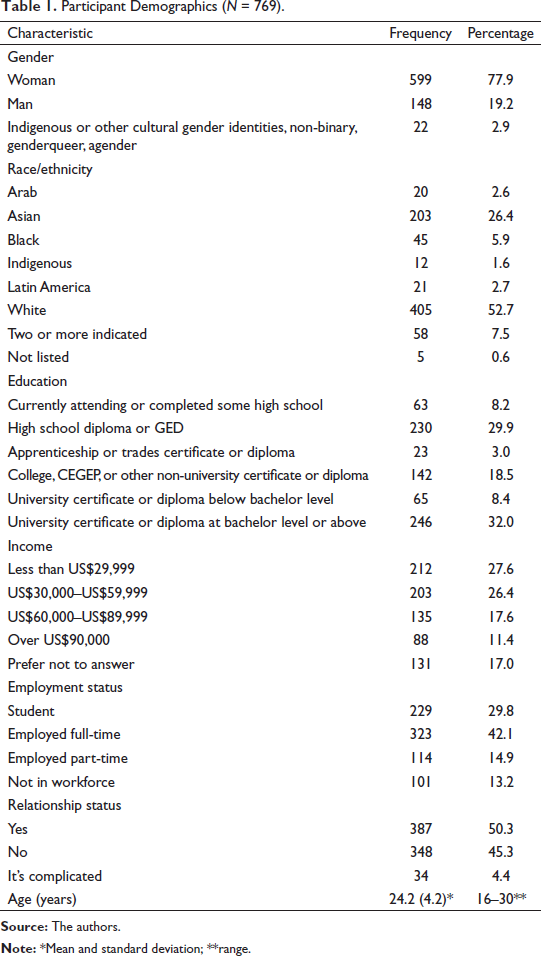
Seven hundred and fifty Canadian participants were recruited via Qualtrics’ online research panel (a commercial survey sampling and administration company; Provo, UT). Study inclusion criteria were as follows: (a) Canadian citizen or resident, (b) aged 16–30 years and (c) SM user (i.e., accessed SM within the past 12 months). Participant demographics (including age, racial/cultural group, education, socioeconomic status, marital status, income and employment status) are available in Table 1.
Participant Demographics (N = 769).
Measures
Participants completed the online survey, which took on average 15 minutes. The survey questions focused on participants’ demographics, perceptions of SM influencing, usage patterns and relationship with SM. Additional questions about the sacrifices they would be willing to make to remain on SM were asked but are not presented in the current study.
Demographic Measures
Survey questions concerning gender, race/ethnicity, education, income, employment, relationship status and age were asked to obtain a profile of respondents’ socio-demographic characteristics. All demographic questions were taken or adapted from national surveys and questionnaires (e.g., the Canadian Community Health Survey and Statistics Canada’s Census of Population Questionnaire).
Perceptions of Social Media Influencing
Eight questions, guided by Abidin (2015), related to perceptions of SM influencing were asked. First, participants answered whether or not they (1) followed any SM influencers (response options included: yes, many, yes, some, or no, not at all and collapsed into yes, many; yes, some; no, none at all), (2) personally know any SM influencers (yes or no), (3) have been influenced in the past (response options included: yes, often, yes, sometimes, or no, not at all and collapsed into yes, often; yes, sometimes; no, not at all) and (4) believe that an influencer is trustworthy (Likert-type scale from strongly agree to strongly disagree and collapsed into 3: agree, neither, disagree). They also answered whether or not they (5) trust a SM influencer more than a celebrity (Likert-type scale from strongly agree to strongly disagree and collapsed into 3: agree, neither, disagree), (6) consider themselves a SM influencer (yes or no), (7) want to be a SM influencer if given the opportunity (yes, no, or maybe) and (8) would they accept money to promote a product or service (response options included: only if I liked the product, even if I did not like it, or not at all). Finally, the reasons for wanting to become a SM influencer were asked, with response options of: making a difference in the world, flexible hours, sharing my ideas with a larger audience, it’s fun work, money, it’s exciting to work, the opportunity to try new products or services, people would see me as an authority figure, fame, other (check all that apply).
Social Media Use
Participants answered several questions regarding their SM use adapted from Ali et al.’s (2020) Social Networking Sites Usage & Needs Scale (SNSUN). Specifically, participants were asked about the number of SM sites they actively use (none, 1, 2, 3, 4, 5, more than 5; treated as a continuous variable), the total time spent on SM per day (less than 15 minutes, 16–59 minutes, 1–2 hours, 3–4 hours, 5–6 hours, 7–8 hours, 9+ hours; recoded to the median of the range and transformed to hours/day; treated as continuous), and the length of time they have had at least one SM account (less than 1 year ago, 1–2 years, 3–4 years, 5–6 years, 7–8 years, 9–10 years, more than 10 years; recoded as the median of the range; treated as continuous).
The Bergen Social Media Addiction Scale (BSMAS; Andreassen et al. 2016), which was adapted from the Bergen Facebook Addiction Scale (BFAS; i.e., the same questions but Facebook was replaced with social media; Andreassen et al. 2012), was used to assess participants’ relationship with SM during the previous 12 months. The BSMAS contains six items, each corresponding to one of the six core elements of addiction (i.e., salience, mood modification, tolerance, withdrawal symptoms, conflict and relapse), as Griffiths (2005) proposed. Each item (e.g., ‘How often during the last year have you felt an urge to use social media more and more?’) is scored on a 5-point Likert scale using anchors of very rarely (1) and very often (5). Composite scores range from 6 to 30, with higher scores indicating more significant addiction (Andreassen et al., 2012; Andreassen et al., 2016). The BFAS and its adaptation (i.e., the BSMAS) have shown good psychometric properties (Andreassen et al., 2012; Andreassen et al., 2016). Cronbach’s alpha for the current sample was an acceptable .81.
Procedures
Upon receiving University of Windsor Research Ethics Board clearance (REB#21-054; spring of 2021), Qualtrics (Provo, UT) was contracted (summer of 2021) to recruit 750 Canadian SM users aged 16–30 years and to implement the online survey. Qualtrics panellists (i.e., potential respondents) were invited to participate via email. An active survey link was provided in the email for those who wished to opt in. After clicking the survey link, participants were asked to provide consent before continuing to the survey. Once consent was provided, participants answered three questions to ensure they met the study’s inclusion criteria (i.e., country of citizenship/residency, age and SM user). In addition, to ensure data quality, attention checks (i.e., items that instructed participants to select a specific response) and speed checks (i.e., respondents with survey duration less than one-half the median survey duration) were utilized. Recruitment took approximately two weeks and continued until 100% complete valid data (i.e., met inclusion criteria, completed the survey, passed attention and speed checks) from 750 respondents were collected.
Data Analysis
All data were processed using Minitab, Inc (version 17.3.1). First, descriptive statistics (i.e., frequencies, percentages, means and standard deviations, where appropriate) were calculated. For RQ#1, differences among groups were calculated using chi-square (categorical variables) and one-way analysis of variance (ANOVA; continuous data), where appropriate. Next, additional descriptive statistics were performed to obtain means and standard deviations for SM usage and the BSMAS variables. Frequencies and percentages were used to determine the rationale for wanting to be a SM influencer (RQ#2). For RQ#3 and RQ#4, after assessing multicollinearity and proportional odds, two ordinal logistic regressions were conducted to determine whether perceptions of SM influencers (RQ#3) or SM usage (RQ#4) significantly predicted the desirability of wanting to be a SM influencer.
Results
A total of 826 participants began the survey. Fifty-seven participants did not complete the survey leaving a final sample of 769 (Table 1 for a summary of demographics). Among the sample, 29 (4%) currently considered themselves to be SM influencers, whereas 579 (75%) participants indicated that they wanted to (maybe or yes) become a SM influencer.
RQ#1
There were no differences in wanting to become a SM influencer by gender (p = 0.54), ethnicity (p = 0.08), education (p = 0.26), income (p = 0.31), or employment status (p = 0.61). However, the mean age was lower among those wanting to be a SM influencer (23.5 ± 4.3 years for yes, 24.4 ± 4.1 years for maybe and 24.8 ± 4.1 years for no; p < 0.001) and more individuals were indicating that they wanted to be a SM influencer for those who described their romantic relationship as it’s complicated (versus yes or no; p = 0.03).
RQ#2
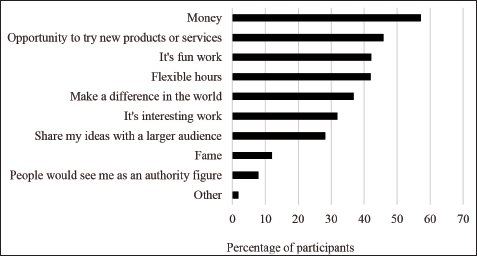
Potential reasons for wanting to be a SM influencer are presented in Figure 1. Overall, money (57%), the opportunity to try new products or services (46%), and it’s fun work (42%) were the top three choices. Out of the 10 possible response options, the majority chose 3–5 reasons (43%), followed by 0–2 reasons (38%) and 6–10 reasons (19%).
RQ#3
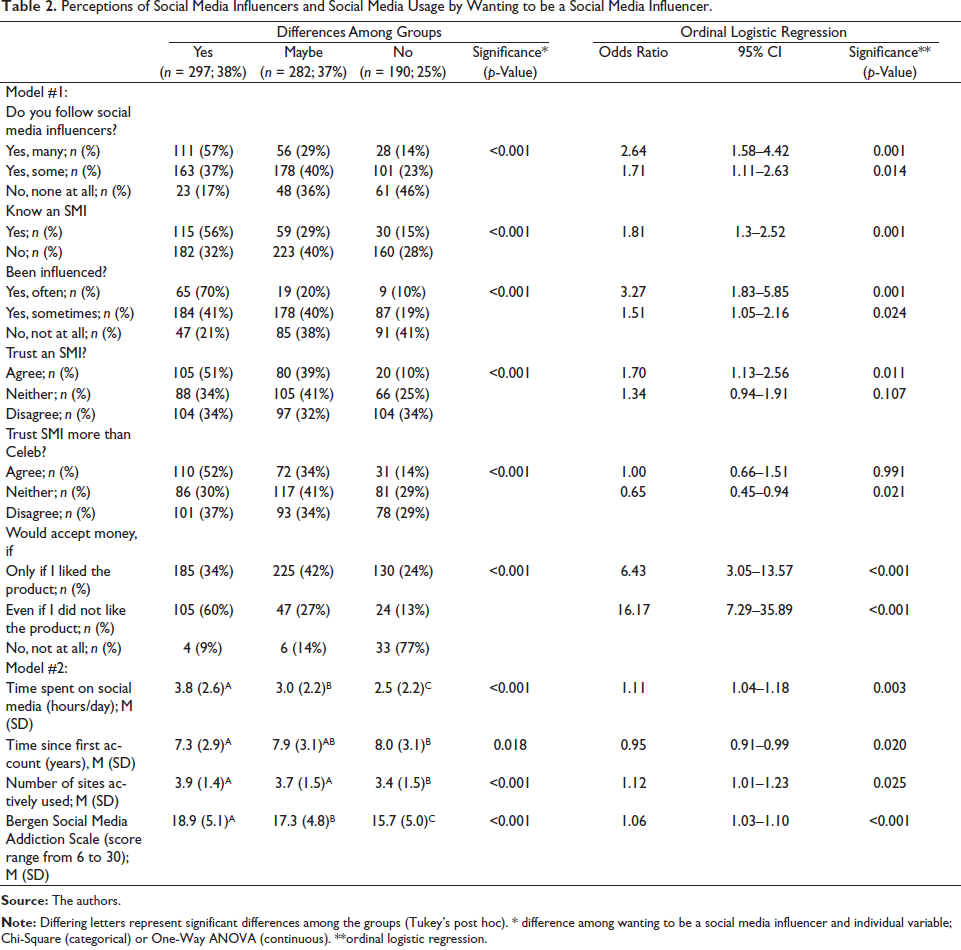
Perceptions about SM influencers and participant SM use (by wanting to be a SM influencer) are listed in Table 2. Certain perceptions of SM influencers significantly predicted the desire to be a SM influencer (p < 0.001; see Table 2 model #1). The following odds significantly predicted whether an individual wanted to be a SM influencer: following many (Odds Ratio [OR] 2.64) or some (OR 1.71) SM influencers (versus none), knowing a SM influencer (OR 1.81), having been influenced often (OR 3.27) or sometimes (OR 1.51) by a SM influencer (versus not at all), trusting a SM influencer (OR 1.70 vs not trusting), neither trusting a SM influencer more or less than a celebrity (OR 0.65 versus not trusting a SM influencer more than a celebrity), accepting money for endorsement only if they liked the product (OR 6.43) and even if they did not like it (OR 16.17; versus not accepting any money).
Perceptions of Social Media Influencers and Social Media Usage by Wanting to be a Social Media Influencer.
RQ#4
Moreover, specific SM usage patterns significantly predicted the desire to be a SM influencer (p < 0.001; see Table 2 model #2). The following odds indicated the desire to be a SM influencer: time spent on SM (OR 1.11, 95% confidence interval [CI]: 1.04, 1.18, p = 0.003), time since first SM account (OR 0.95, 95% CI: 0.91, 0.99, p = 0.020), number of sites actively used (OR 1.12, 95% CI: 1.01, 1.23, p = 0.025) and SM addiction (OR 1.06, 95% CI: 1.03, 1.10, p < 0.001).
Discussion
The present study sought to explore the characteristics of young adult Canadians with aspirations of becoming a SM influencer, as exposure to SM influencers is quite common (Ho & Ito, 2019), with an overall increase in SM use (Statista, 2022b). However, with SM influencers becoming increasingly popular and highly idolized (IZEA Worldwide Inc., 2020), the lack of research examining the desire among young people to become SM influencers is of concern (Shabahang et al., 2022).
Duffy (2017) suggested that wanting to be a SM influencer as a career is becoming increasingly popular and desirable. The findings of the current study confirm this suggestion, demonstrating that three-quarters (75%) of the present study’s population wished (maybe or yes) to become SM influencers, with a small percentage (4%) of the sample already considering themselves to be SM influencers. The current study’s results are similar to IZEA World wide Inc. (2020), which found that over two-thirds of SM adult users aspired to be SM influencers and considered it a more desirable career than more traditional careers. With such a high proportion of our sample population aspiring to be SM influencers, this may be cause for concern or excitement. Potentially concerning is that those with aspirations of becoming a SM influencer are often less able to delay gratification (Shabahang et al., 2022; Wilmer & Chein, 2016), prefer immediate rewards (Shabahang et al., 2022), and value education less (Shabahang et al., 2022). Those aspiring to become SM influencers may view education as a means to success as a more challenging career path and instead believe a career in SM may require much less work in comparison (Shabahang et al., 2022). This is concerning as traditional careers are still significant and contribute to a functioning society; however, with the high number of young people wanting to become SM influencers, there may be new areas and training to explore to ensure they are qualified for the job.
Furthermore, the most common reason for wanting to be a SM influencer was money. Indeed, while being a SM influencer may seem lucrative, with some SM influencers making upwards of US$700,000 in 6 months (Bradley, 2022), the average salary for a SM influencer in Canada is $43,875 CAD, with a starting salary of around $32,419 CAD (Talent, 2022). In addition, SM influencers with a high number of followers (i.e., over one million) can make approximately $670 CAD per post, in comparison to those with a lower level following (i.e., 10,000) can make around $88 CAD per post (Liew, 2022). Furthermore, careers in SM do not come with benefits that many traditional jobs offer (e.g., health benefits, pension, fixed schedule, stability). Duffy (2017) argues that coverage by the media only highlights the few SM influencers who are highly successful, upon which those who desire to be SM influencer base their decisions. Thus, there is a need for a more authentic representation of the profitability of the career to inform career decisions more accurately.
The second most common reason for wanting to be a SM influencer was the opportunity to try new products or services. This is consistent with previous research suggesting that those with high materialistic values are more likely to desire a career in SM (Shabahang et al., 2022), and the very nature of the SM influencer career likely perpetuates this assumed career perk. SM influencers allow their followers a glimpse into their lives through a materialist lens by focusing their content on the products they own and attributing social worth to those products (Debreceni & Hofmeister-Toth, 2018). Additionally, SM influencers tend to flaunt their luxurious lifestyles and possessions (Gentina et al., 2021), inspiring their followers to long for a similarly remarkable life. Since younger consumers are more susceptible to learning through observation (Gentina et al., 2021), their desire to be a SM influencer may be affected by their eagerness to imitate SM influencers’ actions and be rewarded with an equally luxurious lifestyle. Finally, the third most common reason for wanting to be a SM influencer was it’s fun work, which is consistent with Duffy’s (2017) suggestion that people may desire to be SM influencers because it is viewed as doing something that one loves. People who engage in work they love find it more fulfilling as it leads to a deeper sense of well-being, focusing on growth, values and meaning (Allan et al., 2019).
Nearly all perceptions of SM influencers were found to predict one’s desire to become a SM influencer. Furthermore, trusting (versus not trusting) a SM influencer significantly predicted whether an individual wanted to be a SM influencer. Previously, it has been suggested that consumers’ eagerness to mimic SM influencers’ behaviours demonstrates this trusting relationship (Ki & Kim, 2019). The current study observed that ~70% of the participants had been influenced often or sometimes, which is similar to what has been reported in market research (i.e., more than half have been influenced in the past; IZEA Worldwide Inc., 2020).
Trusting a SM influencer more or less than a celebrity was also explored, with results suggesting that neither trusting a SM influencer more or less than a celebrity (versus not trusting a SM influencer more than a celebrity) significantly predicted whether an individual wanted to be a SM influencer. There may be several reasons for this. First, SM influencers are regarded as more interesting than traditional celebrities due to the impression that influencers have more in common with their followers (Danesi, 2018). Second, followers tend to believe SM influencers are more credible, authentic, intimate, believable, accessible and influential in their purchasing behaviours compared to traditional celebrities (De Veirman et al., 2017; de Vries et al., 2012; Djafarova & Rushworth, 2017). This is likely due to SM influencers using their opinion that is seen as unbiased and truthful and, thus, has more influential power (Abidin, 2015; De Veirman et al., 2017). This belief is perhaps driven by the strong relationship SM influencers have with their followers, as SM influencers are often viewed as friends or peers, giving insight into their everyday lives (Balaban & Mustățea, 2019).
Moreover, the perception of accepting money for product endorsement was also explored. Approximately 93% of current participants suggested that they would accept money whether they liked the product (versus 7% not accepting any money). In the SM influencer industry, advertisements are opinionated promotions of products or experiences that SM influencers are paid to endorse (Abidin, 2015). SM influencers monetize their community by incorporating these promotions into their SM activity (Abidin, 2015).
The current study’s results are concerning, given that almost one-quarter of participants would accept money to promote a product that they may not even like. Given this evidence, it is likely that current SM influencers are doing this, and perhaps, greater awareness of this needs to be known among SM users. Followers should be encouraged to question the validity of these sponsored posts/partnerships to create some hesitancy or awareness before trusting SM influencers. This is an area that warrants further exploration.
Finally, participants’ SM use predicted the desire to become a SM influencer. Participants who spent more time on SM had been on SM longer and utilized more SM sites were likelier to want to be an influencer. Zajonc (1968) demonstrated how repeated exposure to a stimulus led to a more positive attitude towards the stimulus, known as the mere exposure effect. Thus, the same may be true of exposure to SM influencers and enhancing SM users’ likelihood of wanting to be an influencer. Furthermore, excessive and addictive SM use is a common behavioural development among SM users (Turel & Qahri-saremi, 2016). Globally, on average, those who belong to Generation Z (i.e., those born in the late 1990s until early 2010s) have reported spending approximately three hours per day on SM, which is, on average, 45 minutes more than Millennials (i.e., those born in 1981 until 1996), and double the time spent on social media by Generation X (i.e., those born in 1965 until 1980; Statista, 2022a). Excessive and addictive SM use can be due to numerous social pressures (Osatuyi & Turel, 2018), such as SM influencers, as influencers try to increase engagement of their followers by persuading them to participate on their SM page(s) and/or with their posts (Farivar et al., 2022). Thus, participants who spend more time on SM, have been active on SM longer, and use more SM sites may be more likely to want to be SM influencers due to high exposure to SM influencers.
Limitations
This study is not without limitations. First, considering this concept is relatively new, there is a dearth of research on this topic. Thus, we did not account for personality type, which would have provided a more comprehensive understanding of the participants and their desire to be SM influencers. Therefore, future research is needed to better understand SM users and their aspirations of becoming SM influencers. Further, the study depended on the participant’s self-report, likely subjected to reporting biases, memory recall and error (Althubaiti, 2016). However, self-reporting is a cost-effective, simple way of collecting data from a large sample and was used for this study. Yet, future research may consider using a more objective measure of SM use. Finally, while we intended to investigate aspirations of being a SM influencer, it would be prudent to investigate those already working in this field for insights into whether or not they always wanted to be an influencer (and, if so, how they made their aspirations a reality).
Conclusion
These findings add to the SM and consumer behaviour literature (e.g., influencer marketing, trustworthiness, idolization of influencers) by exploring the desire to become a SM influencer. In the current study of young Canadians, there was a very high percentage of young adults who do or maybe want to be SM influencers. The top three potential reasons for wanting to be a SM influencer were money, the opportunity to try new products or services, and it’s fun work. Many factors predicted having aspirations of becoming a SM influencer, including perceptions of SM influencers and SM use. In particular, with excessive and addictive SM use being more prevalent among SM users (Turel & Qahri-saremi, 2016), the current findings are important for researchers and clinicians to understand the impact that SM influencers have on their followers and, in turn, the potential reasons why SM users aspire to become SM influencers themselves.
Footnotes
Declaration of Conflicting Interests
The authors declared no potential conflicts of interest with respect to the research, authorship and/or publication of this article.
Funding
The authors received no financial support for the research, authorship and/or publication of this article.
