



Abstract
Artificial intelligence (AI) has emerged as a transformative force across healthcare systems, driven by advances in machine learning, deep learning, and natural language processing alongside the growing availability of biomedical data. This narrative review synthesises current evidence on the application of AI-enabled tools within the healthcare domain, emphasising their role as decision-support systems rather than autonomous decision-makers. In clinical practice, AI assists healthcare professionals in clinical documentation, diagnostic support, and patient communication. In pharmacy practice and pharmacovigilance, AI tools support medication information retrieval, drug-drug interaction screening, medication safety, and adverse drug reaction signal awareness, while causality assessment and regulatory decisions remain dependent on human expertise. In medical education and research, large language models such as ChatGPT facilitate learning support, assessment preparation, literature synthesis, and scientific writing; however, concerns related to accuracy, bias, academic integrity, and data privacy necessitate supervised use and robust governance frameworks. The review further examines the expanding role of AI in the drug discovery and development process. AI-driven approaches have enhanced early-stage activities, including target identification, hit discovery, lead optimisation, toxicity prediction, and clinical trial design, contributing to improved efficiency and reduced time and resource requirements compared with conventional methods. Despite these advances, no drug discovered exclusively through AI has yet achieved full regulatory approval, underscoring persistent challenges related to validation, safety assessment, and clinical translation. Across both healthcare and drug development domains, ethical and regulatory considerations—particularly transparency, accountability, data governance, and bias mitigation—remain central to responsible implementation. Overall, AI-enabled tools hold substantial promise when integrated within human-in-the-loop decision-making models and supported by continuous evaluation and multidisciplinary collaboration.
Introduction
Artificial intelligence (AI) refers to computational systems capable of performing tasks that traditionally require human intelligence, including learning, pattern recognition, reasoning, and predictive decision-making. In healthcare and pharmaceutical sciences, AI primarily encompasses machine learning (ML), deep learning (DL), and natural language processing (NLP), enabling the analysis of complex, high-dimensional biomedical data. The rapid expansion of electronic health records, medical imaging repositories, genomic databases, and real-world evidence, together with advances in computing infrastructure, has accelerated the adoption of AI-enabled tools in clinical practice and biomedical research.[1,2] These tools increasingly support clinicians, pharmacists, and researchers in clinical documentation, diagnostic interpretation, medication information retrieval, data analysis, and patient education, thereby enhancing efficiency and evidence-informed decision-making.[1,3]
Recent advances in large language models (LLMs), such as ChatGPT, have expanded the scope of AI applications across healthcare systems. LLMs demonstrate strong capabilities in medical knowledge synthesis, information retrieval, patient communication, academic support, and research assistance.[4,5] In addition to clinical decision support, AI-enabled tools are being explored in pharmacovigilance for adverse drug reaction reporting, in pharmacy practice for medication safety and drug-drug interaction (DDI) screening, and in medical education for teaching, assessment, and competency-based training. However, limitations related to contextual understanding, potential inaccuracies, lack of explainability, and dependence on training data quality restrict their use as autonomous systems. AI has also gained importance in drug discovery and development, a process traditionally characterised by long timelines, high costs, and high attrition rates. AI-driven approaches support target identification, virtual screening, lead optimisation, toxicity prediction, and clinical trial design, improving efficiency across the drug development pipeline.
Despite the expanding use of AI, existing literature largely examines AI applications in isolated domains such as clinical decision support or drug discovery, with limited integrated discussion across pharmacovigilance, pharmacy practice, medical education, and research.[4] Most studies emphasise technical performance or ethical frameworks, while evidence regarding real-world implementation, human-in-the-loop oversight, and cross-disciplinary impact remains fragmented.[5] This narrative review aims to critically synthesise current evidence on AI-enabled tools across healthcare delivery, pharmacovigilance, pharmacy practice, medical education, and drug discovery, while highlighting limitations, ethical considerations, and governance requirements for responsible integration.
Review
Role of AI in Healthcare
Role in Clinical Practice
LLMs such as ChatGPT are increasingly explored in healthcare as AI-assisted decision-support tools rather than autonomous clinical systems.[3,4]AI tools, such as ChatGPT, are increasingly supporting healthcare by delivering personalised health information, medication-related guidance, and lifestyle recommendations that assist in chronic disease management and improvement of patient-reported quality of life. It can analyse patient data and test results to suggest preliminary diagnoses based on symptoms and history, enhancing diagnostic accuracy. ChatGPT can support health research by assisting with data organisation, synthesis, and interpretation. It may facilitate the analysis of anonymised and aggregated patient and provider-generated textual data to explore medication adherence, disease trends, and patient-reported outcomes, thereby enabling pattern recognition and supporting quality improvement in healthcare research and practice.[5] In medication-related domains, ChatGPT aids drug information retrieval, highlights potential DDIs, and supports patient-focused medication education without prescribing authority.[6] Clinical Decision-Support systems enhance adherence to guidelines, while precision medicine tailors treatments using genetic data. Image analysis also reduces errors in interpreting medical images. In surgical care, its role is limited to educational support, pre-operative planning discussions, and checklist development.[7] In the field of orthopaedics, ChatGPT contributes valuable insights into the treatment options, diagnosis, as well as operative procedures of joint arthroplasty.[8]
Role in Medical Education and Research
AI has significantly changed academia, and rather than posing a threat to professionals, it is a means of delivering high-quality education. ChatGPT enhances medical education by supporting automated scoring of student papers, thus reducing educators’ workload and improving assessment efficiency.[9] Prospects for the future are promising, particularly if AI is included in medical education through a hybrid approach. ChatGPT serves as a teaching assistant by creating quizzes, exercises, and scenarios, while simplifying complex concepts through translations, explanations, and summaries.[10] ChatGPT can generate case studies and scenarios to help medical students enhance diagnostic, treatment planning, and clinical reasoning skills for real-world practice. ChatGPT can effectively serve as a virtual teaching assistant by providing students with thorough and relevant information. It enhances student engagement, supports better learning, and enables interactive simulations for an improved educational experience.[11] It supports competency-based medical education by providing insights for both formative and summative assessments, helping evaluate student performance and guide learning progress.[12] Helping with lecture preparation and improving captivating presentations at conferences and webinars, these multilingual technologies promote knowledge sharing. Additionally, AI systems can actively engage students in learning activities.[13]AI is now being applied in a number of educational fields, including exam integrity, enriched online discussions, educational research, student success metrics analysis, campus connectivity, lecture transcription, and tailoring student experiences based on their strengths and shortcomings. ChatGPT is useful for researchers who create scientific articles because the process of writing an academic essay takes a long time. ChatGPT provides relevant information and references, helps with sentence construction, grammar correction, outline creation, and document streamlining due to the necessity of revisions and thorough research.[14] It simplifies medical research through literature review assistance, data analysis, and summarising key findings from relevant studies.[15] Analyses large datasets to identify correlations and develop predictive models, helping researchers detect patients at risk for specific health conditions.[16] It can conduct surveys on health topics like patient satisfaction, healthcare use, and health behaviours, offering insights to enhance healthcare quality and outcomes.[17] It makes scientific writing, plagiarism detection, and universal access for all students possible. Although ChatGPT has many benefits in the medical field, it has certain drawbacks. Notably, because its training is based on data that will not be available until 2021, it is unable to produce current, real-time information.[18] It also gives students timely and insightful feedback.[19]A study discovered that the created list of references only covers the last 10 years. Even though ChatGPT may provide citations or references for the material, it does not provide correctness. Even though the years are different when it is regenerated, the reference list stays the same. This issue also affects the PMID numbers, which stand for distinct research papers. Based on these findings, the author concluded that ChatGPT’s output may be biased and inaccurate.[20]
Role in Pharmacovigilance
ChatGPT can provide information on drug-adverse drug reaction (ADR) and management guidance based on publicly available data. It also enhances the vocabulary used in ADR reporting and aids in the dissemination of information regarding ADR reporting. Among ChatGPT’s drawbacks are its inability to provide scientific knowledge supported by evidence and its lack of real-time updates. Importantly, human intelligence is always required for causality evaluation, pharmacovigilance decision-making procedures, and ADR management.[21]
Role in Pharmacy
DDIs are information that ChatGPT provides to patients and medical professionals. This aids in deciding when to begin and end specific drug regimens. In pharmacy practice, ChatGPT is a helpful tool that maximises patient care while considering ethical considerations. ChatGPT can provide accurate and up-to-date information about medications, including dosages, uses, side effects, interactions, and cost information. This information can be used by pharmacists and patients to make educated treatment choices. It can assist pharmacists in giving patients drug advice and encouraging them to adhere to their treatment plans. It can help pharmacists identify potentially dangerous interactions and offer alternative medications if needed. ChatGPT can alert patients and pharmacists to any allergies or contraindications related to certain medications, ensuring patient safety. It can remind patients to take their drugs, improving treatment compliance and ultimately leading to improved results. It is crucial to stress that ChatGPT cannot replace people in the pharmacy industry, despite its indisputable usefulness.[22]
Role of AI Tools in Drug Discovery and Development
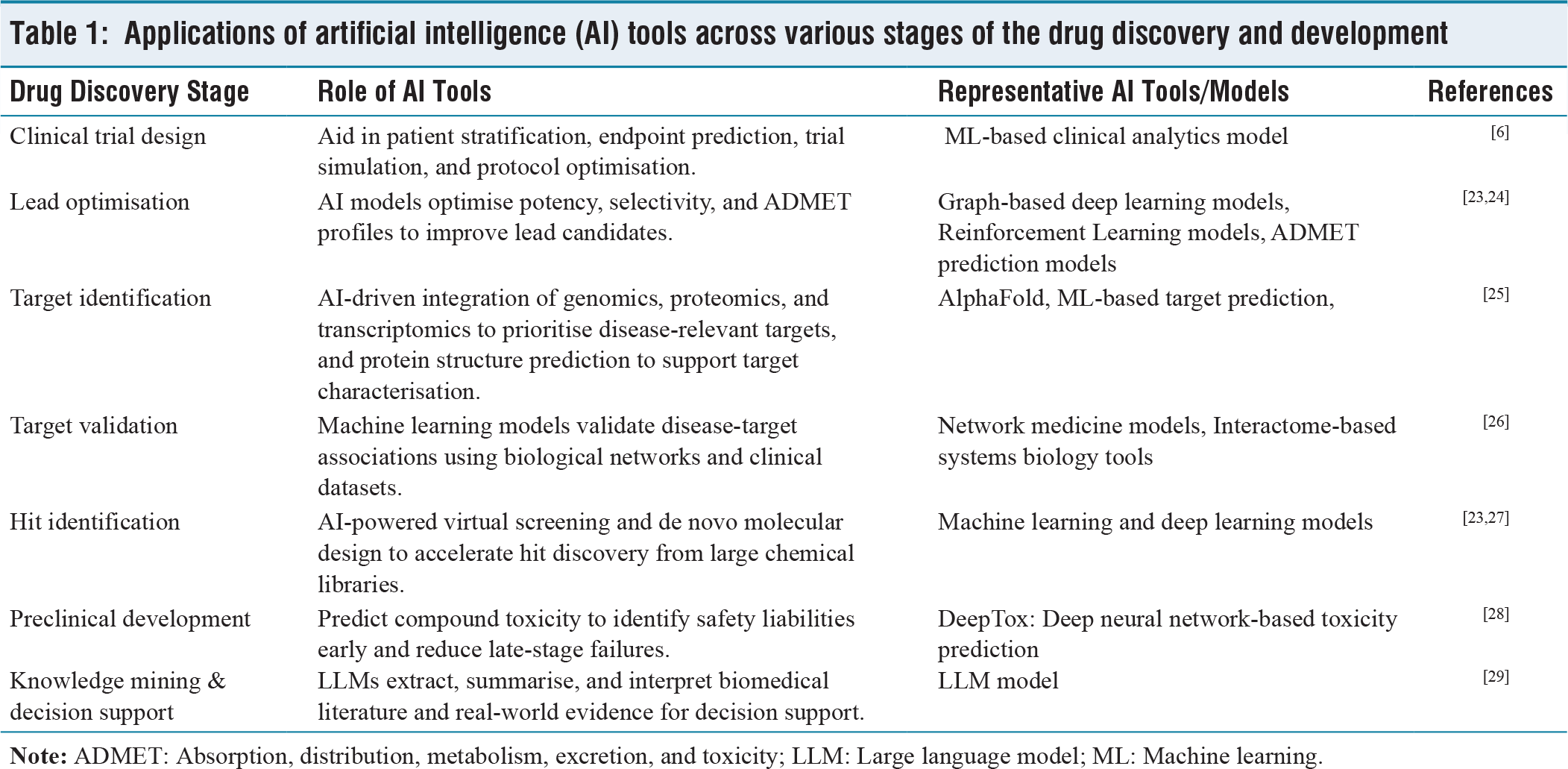
From a pharmaceutical perspective, conventional drug discovery is a resource-intensive and time-consuming process, often extending over a decade with a high rate of candidate attrition during preclinical and clinical development. These challenges have driven the integration of AI tools to improve efficiency, reduce costs, and support rational decision-making across discovery pipelines. Recent advances demonstrate that AI-driven models can effectively assist in target identification, molecular modelling, virtual screening, and lead optimisation, thereby addressing key bottlenecks in traditional drug discovery workflows[23,24] [Table 1].
Applications of artificial intelligence (AI) tools across various stages of the drug discovery and development
Limitation
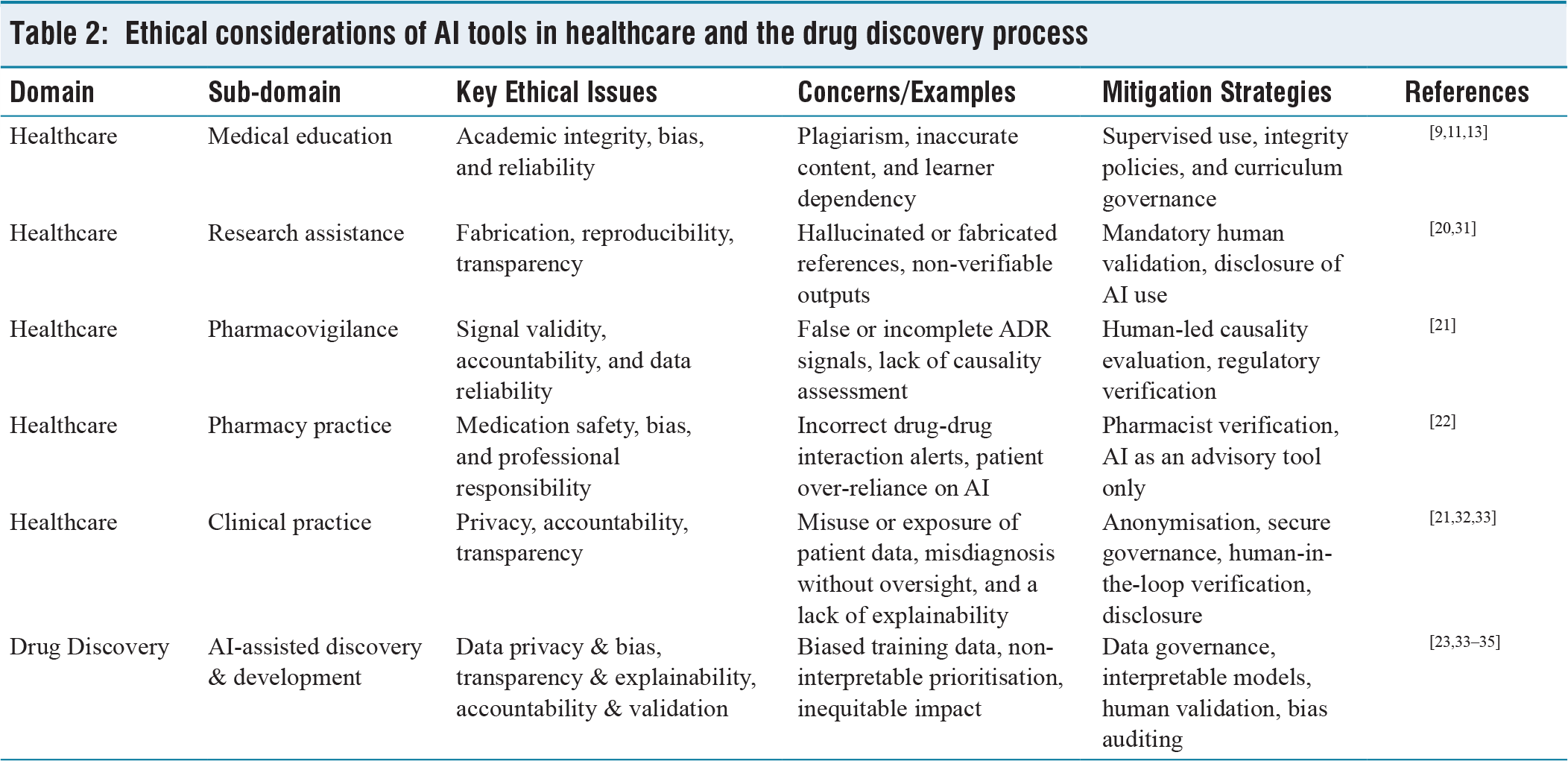
Key limitations of AI tools are limited contextual understanding and outdated data, which can lead to irrelevant or repetitive responses.[30] Ethical concerns arise when AI systems fail to prioritise patient welfare, as inadequate training or limited data can lead to inappropriate or uninformed responses [Table 2].
Ethical considerations of AI tools in healthcare and the drug discovery process
Current Status for Use of AI Tools in Healthcare
LLMs (ChatGPT-style models) are powerful at knowledge synthesis, drafting, and question answering and have demonstrable clinical knowledge in benchmark tests; however, their potential to generate inaccurate or unverified information. They are used as decision-support tools that require human oversight, disclosure, and validation.[29] In current practice, AI tools are applied in pharmacy and pharmacovigilance primarily as decision-support systems, while causality assessment and regulatory decisions remain human-led. In medical education, LLMs are increasingly used as supervised adjuncts for learning support, assessment preparation, and academic assistance; however, concerns regarding accuracy, bias, and academic integrity restrict their use to controlled educational settings.[31]
Current Status of the Use of AI Tools in the Drug Discovery Process
AI-driven drug discovery has accelerated the development of several novel candidates across therapeutic areas. In idiopathic pulmonary fibrosis, ISM001–055 (rentosertib) completed Phase IIa, achieving end-to-end discovery in approximately 18 months with positive outcomes.[35] Similarly, cladribine for multiple sclerosis entered Phase I within ~36 months,[36] DSP-0038, an AI-designed candidate for Alzheimer’s disease, advanced to Phase I after only ~13 months of design.[37] underscoring AI’s ability to shorten development timelines and enable progress against complex targets. Although several candidates entered clinical testing (Phase I/II), none of these had, as of the latest 2024–2025 literature, completed the whole regulatory route to approval, where the origin story could be described as ‘discovered purely by AI’ and then approved as a marketed product.[38] Reviews emphasise that AI speeds discovery and helps nominate candidates faster, but downstream preclinical work, GLP studies, toxicity, and multi-phase clinical validation remain the hard, time-consuming, and failure-prone steps.
Conclusion
AI-enabled tools, like ChatGPT, are increasingly influencing healthcare delivery by supporting clinical decision-making and knowledge synthesis. In pharmacy practice and pharmacovigilance, an AI tool assists in DDI screening, medication safety, and ADR signal awareness, whereas causality assessment and regulatory decisions remain clinician-led. Similarly, in medical education and research, AI tools support learning, assessment preparation, literature synthesis, and scientific writing; however, supervised use is essential due to concerns regarding accuracy, bias, and academic integrity. AI-driven approaches enhance efficiency across drug discovery pipelines. However, current applications function primarily as human-in-the-loop decision-support systems, not autonomous clinical or regulatory authorities. Ethical challenges related to data privacy, bias, transparency, and accountability remain critical considerations. Although several AI-assisted drug candidates have entered early-phase clinical trials, comprehensive preclinical and clinical validation continues to be the major bottleneck. Continued multidisciplinary collaboration, rigorous validation, and regulatory oversight are essential for the responsible and effective integration of AI into healthcare and drug development.
Footnotes
Data availability statement
Nil.
Declaration of conflicting interests
The author declared no potential conflicts of interest with respect to the research, authorship and/or publication of this article.
Funding
The author received no financial support for the research, authorship and/or publication of this article.
Informed consent
Not applicable.
Institutional ethical committee approval number
Not applicable.
Credit author statement
Vipul Dhanjibhai Prajapati: Conceptualisation, Methodology, Formal analysis, Writing - original draft, Writing - review & editing.
Use of artificial intelligence
None.