




Abstract
Introduction:
Artificial Intelligence (AI) is reshaping the healthcare system by enhancing drug development, precise medical care, and the prognosis of the therapy. Antibody-drug conjugates (ADCs) are an upcoming type of oncotherapy that uses monoclonal antibodies to deliver cytotoxic therapeutic agents directly into tumour cells. ADCs reduce the side effects which are generally encountered with traditional chemotherapy.
Method:
AI analyses clinical and genetic data, via machine learning (ML) and deep learning (DL), to anticipate patient response to various ADCs. AI-based software and databases use genomic, proteomic, and clinical trial data to envisage the response of cancer patients to the ADC therapies.
Conclusion:
This review explains the use of AI to predict ADC efficacy, patient selection and therapy outcome. AI techniques, including ML and DL, analyse large datasets and biomarkers to improve targeted therapies. It also explores the drawbacks of AI in healthcare and how it can be managed to ensure positive outcomes of AI in healthcare.
Keywords
Introduction
Healthcare systems globally face the challenge to achieve the main pillars of healthcare: improved patient health, improved patient experience, improved caregiver participation, and making healthcare services affordable. Integration of artificial intelligence (AI) in healthcare can potentially provide solutions to such challenges via multimodal data (genomic, clinical, phenotypic, demographic, and economic) and innovations in technology, such as data security, computational power, etc. AI-driven advancements have dramatically altered oncotherapy, especially antibody-drug conjugates (ADCs).
ADCs are targeted chemotherapeutic agents that use a monoclonal antibody to target a particular antigen present on the surface of tumour cells.[1] ADCs get internalised into the cancer cells, where the cytotoxic drug gets released through a linker for its therapeutic action. These ADCs are developed to be stable in circulation, have a longer half-life, be highly specific, and have a low immunogenicity. ADCs bypass the side effects of traditional chemotherapy (in which the normal neighbouring cells also get affected by the drug) by specifically targeting the cancer cells.[2] Difference in patient response warrants the need for AI to design and develop ADCs for optimised use. AI analyses clinical and genetic data, via machine learning (ML) and deep learning (DL), to anticipate patient response.[3]
In ML, data is fed to the machine with a particular goal to be executed. ML does not follow any fixed rules, but rather acquires the patterns from the data fed to it. There are three important types of training models in ML: reinforcement learning, supervised, and unsupervised techniques. Application of AI in the medical field (to diagnose, plan the treatment and prognose) employs supervised techniques (of ML), which use the input data to predict the output.[4,5]
DL, a part of ML, relies on artificial neural networks, which are more complex, intertwined, and sophisticated as compared to ML. The development of these techniques is heavily inspired by the physiology of electrical impulses in the human brain.[6] DL, on the reception of an input, utilises its training and algorithms to come to a solution.[7] There are three types of artificial neural networks, namely, multilayer perceptron networks, recurrent neural networks (RNNs), and convolutional neural networks (CNNs). DL platforms such as CNNs and RNNs are used to improve the prediction of the response of cancer to therapy.[6–8]
This review summarises the current research on AI in medicine and how it can be used to develop ADCs for cancer patients in the present and future.
AI in Drug Discovery and Development
AI has shown tremendous improvement in the field of drug development and clinical trials by reducing time, effort and money that goes into the entire process of drug development and approval by regulatory agencies. The average cost and time invested in the conventional process of drug development and launching the drug into the market are approximately USD 2.5 to 3 billion and 12-15 years, respectively.[6,9]
Lately, a survey by Boston Consulting Group and Wellcome found that AI can reduce drug development expenses by almost 25%-50%. In a 2022 study, 20 AI-based companies developed 158 drug candidates as compared to 333 candidates by 20 pharmaceutical companies.[10] AI has been, in recent years, used to accelerate the testing of newly discovered drugs by imitating cellular interactions, predicting drug efficacy, and toxicity.[11] AI platforms such as Dallas-based Lantern Pharma[12] and AtomNet (developed by Dr Izhar Wallach, Michael Dzamba and Abraham Heifets, who founded a company known as AtomWise)[13] and a few AI databases such as ChEMBL (a subunit of the United Kingdom-based European Bioinformatics Institute (EBI)),[14] Canada-based DrugBank (Edmonton, Alberta),[15] and The Cancer Genome Atlas (TCGA) are used by pharmaceutical companies to develop new ADCs effectively.[16] RADR→ by Lantern Pharma consists of over 100 billion oncology-driven data points and over 200 advanced ML algorithms to predict ADC efficacy, optimise drug therapy protocols, and identify patient subgroups.[12] AtomNet by AtomWise uses deep CNNs to predict ligand-protein binding affinity, helping in the linker-payload mechanism. It also aids in predicting the binding of new chemicals to their respective therapeutic agents.[13] ChEMBL assists innovative medicine by combining chemical, biological, and genomic data for drug development.[14] TCGA was introduced in 2006 by the National Cancer Institute (NCI) and the National Human Genome Research Institute (NHGRI) in the United States with an aim to subatomically define over 20,000 cancer and matched normal samples across 33 cancer types.[16]
A new database, ‘ADCdb’, has been developed to provide pharmaceutical data of ADCs and describe their biochemical activities. First, the data on the biological activity of each ADC were collected via systematic reviews in PubMed. It was followed by an analysis of the therapeutic use of ADCs identified in the previous step. The most common therapeutic role of ADC was found in cancer, although the collected ADC data also pointed towards the efficacy of ADC in other conditions, such as HIV, arthritis, atherosclerosis, etc. A total of 6,572 ADCs (including all the ADCs- FDA approved, under clinical trial, preclinical testing stage, in-vivo testing stage, etc.), 1,168 antibodies, 511 linkers, 446 payload, 327 antigens and 54 targets have been fed to the database. Additionally, 9,171 published articles were found, which stated various biological activities of ADCs from areas such as clinical trial pipelines, xenograft models, etc. These data were linked to a number of molecular biology databases such as ChEMBL, DrugBank, etc. and are available on ADCdb free of cost at
Predicting Cancer Response to ADCs
AI-based software and databases use genomic, proteomic, and clinical trial data to envisage the response of cancer patients to the ADC therapies. At present, cancer prognosis via AI has shown immense progress compared to imaging-based prognosis.[18] AI incorporates radiomics by analysing data from MRI, CT scans and ultrasonography to identify a tumour and predict the response to therapy. In patients with hepatocellular carcinoma (HCC), AI, along with radiomics, has improved prognosis as compared to conventional radiological techniques by combining and processing data from MRI, CT scans, PET scans, USG images, digital subtraction angiography and X-ray images. AI is also used for biomarker analysis by assessing circulating tumour DNA (ctDNA), cell-free DNA (cfDNA), and tissue biopsies to enhance therapy.[4–6]
These AI models also rank a drug based on its efficacy, biochemical properties, and toxicity. Lantern Pharma, also known as The Response Algorithm for Drug Positioning and Rescue, aims to rapidly develop new ADCs, such as cryptomycin-derived ADCs.[12] Platforms and databases such as CellMinerCDB with TCGA, the Catalogue of Somatic Mutations in Cancer, the Gene Expression Omnibus, obtain data from preclinical and clinical trials, and search for published research to develop new ideas to design the structure of a new ADC.[16] Graph Neural Networks (GNNs) are new AI tools that can design complex ADC structures and interactions, such as linker design and payload behaviour. Models such as XGBoost and Random Forests aid in feature selection from multiple omics datasets (OmicsDI) to predict therapeutic response.[19]
Clinically Used ADCs and Their Potential AI Applications
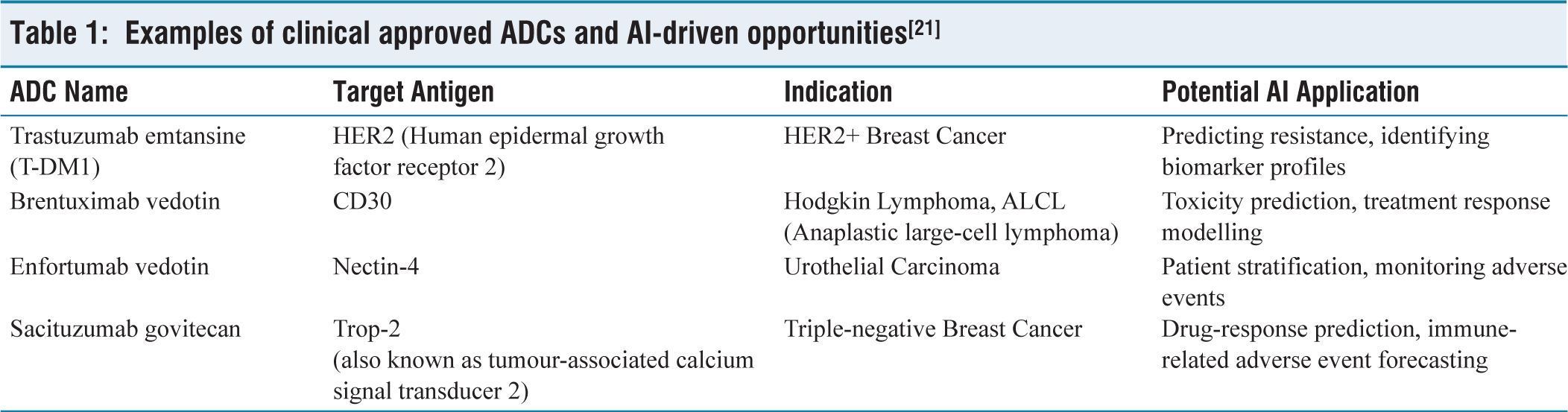
The FDA has approved approximately a thousand AI- empowered medical tools to date.[20] AI can refer to the current scenario of ADCs as a checkpoint to optimise their use in the future. Most of the current AI tools can predict biomarker-dependent classification, drug resistance, and adverse effects in real time, resulting in better therapy outcomes by designing personalised therapy protocols. Examples of clinically approved ADCs and the role of AI have been depicted in Table 1.[21]
Examples of clinical approved ADCs and AI-driven opportunities[21]
Zhang et al., through a DL model, produced a system which could predict the ADC response to trans-arterial chemoembolisation (TACE) by integrating clinical inputs and pre-surgical imaging data.[22] Similarly, Peng et al. designed a PyRadiomics method (ML method) to predict the interaction between ADC therapy and the TACE method by integrating the clinical knowledge and the CT-scan images obtained before the treatment.[23] They also surveyed 46 HCC patients by using TCGA for analysing gene expressions across all the subjects and used ML to incorporate TCGA data (obtained from the TCGA-HCC population) into their existing data. Studies by Ma et al. explored the prognosis of cancer post-ablation therapy by using AI. They used a DL programme, which was incorporated with CEUS (contrast-enhanced US) and compared the results with a traditional ML model to compare post-ablation outcomes in patients with HCC.[24] These AI models have been used successfully by scientists to predict recurrence of a tumour, survival rates after cancer therapy, and response of cancer to ADC therapy. Such image-based AI models require intense standardisation and research before incorporating them completely in a clinical setup.
AI in Immunotherapy
Immunotherapy is a field concerned with the treatment and elimination of cancer in the human body by stimulating the immune system against the cancerous cells. There are two types of immunotherapies against cancer, namely, immune checkpoint blockade and adoptive cell therapy. AI is used to recognise new antigens, design new antibodies in the form of therapies (e.g., ADCs) and predict the therapy response.[25]
Challenges, Limitations and Ethical Considerations
With the incorporation of AI in the healthcare system, ethical concerns have emerged, focusing on patient care and safety.[26] AI models must be developed and upgraded to ensure effective patient care without compromising patient safety. Regulations mandating FDA approval of such AI models in clinical settings must be implemented.[27] An AI model must incorporate: (a) evidence-based data (i.e., good ML practice), (b) have accurate and organised algorithms which allow generalizability, (c) consistent AI analytical methods, (d) validation of all the processes to avoid algorithm biases, (e) transparency in the entire procedure, (f) training the oncologists in these new technologies. These can be accomplished by sincerely incorporating approved steps and protocols.[28] A key limitation in ADC-specific AI models is the lack of high-quality interpretation of multimodal datasets. This leads to poor generalizability of the data. Furthermore, representation biases due to undersampling of minority groups in clinical trials may take place. Technologies employing bias correction algorithms can be used to overcome such limitations.
Privacy and Security Concerns
Concern for the data privacy of the patient develops when it comes to the collection of personal data digitally, with unauthorised access to the data being the primary concern. Needless to say, patient data in medicine must be stored, transferred and protected securely from illegal access. Recently, state-of-the-art innovations have aimed to tackle this issue by adding ‘noise’ into the original raw data (known as differential privacy) or by privacy-preserving computational approaches, such as secure multi-party computation (SMPC) or homomorphic encryption.[29]
Although AI is trustworthy to some extent, one must realise that errors might occur in the form of a wrong diagnosis. Hence, it is important to develop methods which can help in the holistic development of novel AI-based models for diagnosis and prognosis.[30]
Biases in AI Algorithms
One of the most important limitations of AI is Biases, which are specifically evident in data-driven supervised ML techniques. ML learns from the input data, which could be misrepresented in medicine due to the diversity in the population. The generalizability of an AI algorithm might not be good enough to target all the patient groups, despite being trained on a large dataset.[31]
Training in AI
Proper training in AI is of immense necessity for medical healthcare professionals. Basic knowledge of computers is still a complicated task for a lot of doctors, which, if combined with the emergence of AI, can pose a huge challenge for the healthcare system. Implementing AI-computed results into a clinical setup is another challenge since these results are used as additional knowledge to draw a complete diagnosis.
In the coming years, advancements in technology are going to complicate the medical field further, which makes it important for doctors to acquire computational skills along with their medical knowledge.
Discussion
Over the past decade, the medical field has expanded its boundaries through AI. Response to a few cancer treatments still remains unpredictable, despite the success of AI-driven diagnostic techniques.[30] However, more precise prognostic techniques that can forecast whether a patient’s illness would respond to ADCs are required in the field of oncotherapy, where cancer patients are categorised for treatment based on the binding of an expressed receptor on the cancer cell membrane with an antibody carrying the cytotoxic payload. ML has demonstrated significant promise for early breast cancer detection in a variety of domains, including radiography and mammography.[32] It can be applied to forecast the chemistry of new anti-cancer drugs. For these reasons, AI models may be crucial in predicting the future of ADC response. Biomarkers extracted from liquid biopsy from ctDNA, cfDNA, tissue samples, or even the cancer cell milieu are constantly becoming more accessible, according to data from ADC clinical trials.[32-34 ] In order to feed future AI models that anticipate ADC therapy, such data may be extremely important. Since AI-based ADC therapeutic response is still in its conceptual infancy, this review has limitations. Without using AI right now, we provide an overview of this complicated topic in this study, covering everything from active clinical trials evaluating ADCs to AI models for chemical structure prediction. Based on our theory, we anticipate that the information we have compiled here will be a helpful resource for creating new AI models in the future. According to what we now know, predicting the effectiveness of ADCs in the near future may depend heavily on the use of AI models. It is inconceivable to believe that technological advancements will exclude the medical area, particularly cancer, where life is filled with hope. Software developers, data scientists, scientists and medical professionals who make decisions would need to work closely together to implement new AI models, similar to those now available for other prognostic models. The first stage would be for scientists and medical professionals who make decisions.[35,36]
The role of the physicians would be to present data on response to treatment and blood biomarkers, or possibly exhaled breath biomarkers, from current and finished clinical studies utilising ADC in disorders, after the data science has been sorted. Second, a small group of individuals battling cancer should be used to test the prediction method. The ML should be trained on the generated data in order to refine it. Third, a bigger patient group would be used to test the model. The approach could be commercialised once all of these processes are finished. The arrival of bold new ideas will necessitate a change in our perspective on medicine.[35-37]
AI in Other Areas of Healthcare
Integrating AI with healthcare has been proven to be revolutionary. AI chatbots such as ChatGPT(by OpenAI), Gemini and Bard AI (by Google AI), Claude AI (by Anthropic AI), Grok AI, and many more are accessible to the public for providing easy and comprehensive health education to the public, improving patient care, enhancing doctor/healthcare personnel-patient interactions, making medical information available to everyone at personalised levels of comprehension and understanding, and aiding the physician in making accurate decisions for the patient care.[38] AI chatbots have been used to predict the prognosis of diabetes and its therapy, accurately record blood pressure and prescribe treatment for the same, to accurately study human emotions, mood, and behaviour in case of psychiatric patients, in research areas of obstetrics, surgery, orthopaedics, etc.[38,39] AI in gastrointestinal surgeries has been used to predict pre- and post-operative stages, which helps in making important decisions regarding intra-operative procedures such as vessel control. AI has also aided in the selection of stapler types and perfusion maps using indocyanine green (ICG).[38-40] AI in radiology and orthopaedics has also been used to read and interpret diagnostic imaging reports.[39,40] AI, along with digitalisation, has simplified the access of a physician to patient information from any location and at any time. This has simplified patient care and has been shown to improve prognosis, too. This has also led to easy storage of patient data online, which can be accessed and used easily by the healthcare professional. Using such data, AI can detect non-payment of hospital bills, prevent readmission of the same patient under a different patient ID, and aid the hospital administration in various management tasks.[38,39]
Future Directions
In the forthcoming years, AI, being a key part of oncology, will become more popular by improving patient selection for ADC therapy via AI-driven programmes; by incorporating AI with patient monitoring to adjust treatment protocols; and creating standardised guidelines for AI-based therapy.[41]
Conclusion
AI is expected to reshape oncology and oncotherapy by modifying the precision and efficacy of ADC drugs. Through the integration of multimodal datasets and advanced ML models, AI can identify patient-specific biomarkers, predict ADC performance, and guide treatment selection with unprecedented accuracy. As interdisciplinary collaboration between oncologists, data scientists, and regulators deepens, AI-driven strategies will increasingly shape the discovery, optimisation, and clinical deployment of ADCs. With the right infrastructure and governance, AI will not only accelerate drug development but also ensure safer, more targeted treatment for cancer patients.
Footnotes
Declaration of conflicting interests
The authors declared no potential conflicts of interest with respect to the research, authorship and/or publication of this article.
Funding
The authors received no financial support for the research, authorship and/or publication of this article.
Institutional ethical committee approval number
Not applicable since this is a review article.
Participant consent information
Not applicable.
Patient consent for publication
Not applicable.
Credit author statement
Kakoli Patnaik and Nitin Sharma contributed to concept, literature search, and manuscript preparation.
Kakoli Patnaik, Nitin Sharma, and Deepa Thadani contributed in manuscript editing and approval of the final version to be published.
Data availability statement
Data included in the manuscript is available online.