




Abstract
Background:
Self-esteem reflects one’s sense of self-worth, while depression is a serious mental health condition that transcends regular mood fluctuations, affecting all life aspects, including relationships and performance in school and work. The present study aims to elucidate the relationship between self-esteem and depression among medical college students.
Materials and Methods:
A sample of 101 students, comprising 50 males and 51 females aged 18–22 years, was randomly selected from various medical colleges. Data collection was facilitated through Google Forms, employing the Rosenberg Self-Esteem Scale (1965) and the Beck Depression Inventory to assess self-esteem and depression levels, respectively. The analysis involved t-tests to evaluate gender differences in self-esteem and depression, and the Pearson Correlation Coefficient to explore the relationship between these variables. Data analysis was conducted using SPSS 25 software.
Results:
The study found a moderate negative correlation between self-esteem and depression (r = –0.685). No significant gender differences were observed in mean self-esteem scores (males: 19.96, females: 19.75) or mean depression scores (males: 8.24, females: 9.47).
Conclusion:
The findings suggest a moderate negative correlation between self-esteem and depression among medical college students, indicating that higher self-esteem is associated with lower levels of depression. There were no significant differences in self-esteem and depression between male and female students. These insights highlight the importance of addressing self-esteem in efforts to mitigate depression in this population.
Introduction
Self-esteem refers to a person’s overall sense of his or her value or worth. It is a measure of how much a person ‘values, approves of, appreciates or likes him or herself’.[1] In the mid-1960s, social psychologist Morris Rosenberg defined self-esteem as a feeling of self-worth and developed the Rosenberg self-esteem scale (RSES), which became the most widely used scale to measure self-esteem in the social sciences. Low self-esteem includes many factors, such as your sense of identity, self-confidence, feelings of competence and feelings of belonging.[2] Essentially, high self-esteem is a frame of mind that lets one celebrate own strengths, challenge one’s weaknesses and feel good about oneself and life. It allows a person to put daily ups and downs in perspective because at his core, his values, trust and respect him.
Depression is a mood disorder which prevents individuals from leading a normal life, at work, socially or within their family. Depression is also referred to as the ‘common cold’ of psychiatry because of its frequency of diagnosis.[3] It is a state of low mood and aversion to activity which affects a person’s thoughts, behaviour, feelings and sense of well-being.[4] Depression, the silent killer, robs off all self-worth, self-esteem, self-confidence and self-image and has become one of the alarming crises in today’s world. Operant conditioning states that removal of positive reinforcement results in depression.[5,6] Depressed people usually become much less socially active. Prevalence of depression is 15.1% as per the reports of population-based study.[7] Out of which 37.9% has been observed among medical students in India.[8]
Beck identified three mechanisms responsible for depression. The first mechanism is the cognitive triad, which consists of negative automatic thinking about oneself, the world, and the future which creates a pessimistic outlook and results in depression. The second mechanism involves negative self-schemas which contribute to a negative self-image and a sense of inadequacy or worthlessness. The third mechanism is errors in logic, or faulty information processing, such as overgeneralisation, magnification of problems, and minimisation of positive experiences. These cognitive errors reinforce negative thoughts and emotions, trailing towards a depressive state.[9]
Depression and self-esteem are intertwined and contribute to negative affect. Research shows self-esteem influences depression and that depression works negatively to decrease self-esteem. Understanding how much each of these conditions affects the other is necessary for the effective treatment of depression.[10]
Research has documented negative health-related consequences like the development of eating disorders due to body dissatisfaction and low self-esteem among male and female college students.[11]
Objective
To study the relationship between self-esteem and depression among medical students.
To study the difference in level of self-esteem and depression of male and female medical students.
Methodology
A cross-sectional, observational, questionnaire-based study was conducted among medical students in Gujarat, India from December 2023 to January 2024. Exclusion criteria included students with a history of depression or a history of alcohol and drug dependence, ensuring that the sample consisted of individuals without these confounding factors.
Ethical considerations for the study included obtaining approval from the Institutional Review Board before commencing the research (NHLIRB/2023/JULY/13/NO.1). Additionally, the data was collected using Google form which consisted of two components. The first component comprised of the aim of the study, demographic details and informed consent to participate in the study. The second component comprised of questionnaire which had 31 questions.
The RSES is the most commonly used measure of self-esteem in psychology research. It was developed by Dr. Morris Rosenberg as a measure of global self-esteem, one’s overall sense of being a worthy and valuable person. Respondents to the RSES indicate the degree of their agreement with ten statements such as ‘I feel I am a person of worth, at least on an equal plane with others’, ‘I feel I have a number of good qualities’. and ‘I feel I do not have much to be proud of’ (reverse scored). It was originally developed as a Guttman scale but is typically administered with a 4-point Likert response format with scale points corresponding to Strongly Agree, Agree, Disagree and Strongly Disagree. It is a 10-item scale that measures global self-worth by measuring both positive and negative feelings about the self.[12]
The RSES demonstrates strong reliability and validity metrics, making it a robust tool for assessing self-esteem. The RSES shows negative correlations with related psychological variables like anxiety (–0.64), depression (–0.54), and immorality (–0.43) which further supports the validity. These correlations indicate that higher self-esteem as measured by the RSE is associated with lower levels of anxiety, depression, and feelings of social disconnection, thereby validating the scale’s effectiveness in capturing the construct of self-esteem.
The Beck Depression Inventory (BDI, BDI-1A, BDI-II), is one of the widely used 21-question multiple-choice self-report inventories for measuring the severity of depression.[13]
The BDI-II is designed for individuals aged 13 and over, and is composed of items relating to symptoms of depression such as hopelessness and irritability, cognitions such as guilt or feelings of being punished as well as physical symptoms such as fatigue, weight loss and lack of interest in sex.
The BDI-II contains about 21 questions, each answer being scored on a scale value of 0–3. Higher total scores indicate more severe depressive symptoms.
Statistical Analysis
Empirical data were processed with the SPSS version 25 statistical program. Descriptive statistics and correlation analysis were used. T-test was utilised to compare male and female scores on the main variables of the study. Pearson’s correlation was used to determine the direction of a relationship between depression and self-esteem.
Results
A total of 101 responses were received. Out of which, 51 were females and 50 were males.
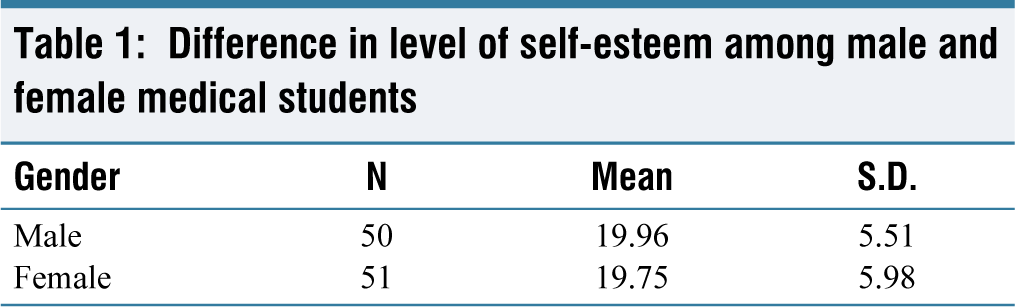
The mean scores of self-esteem of male and female medical students are 19.96 and 19.75, respectively. There is no significant difference in self-esteem between male and female medical college students (p > .05) [Table 1].
Difference in level of self-esteem among male and female medical students
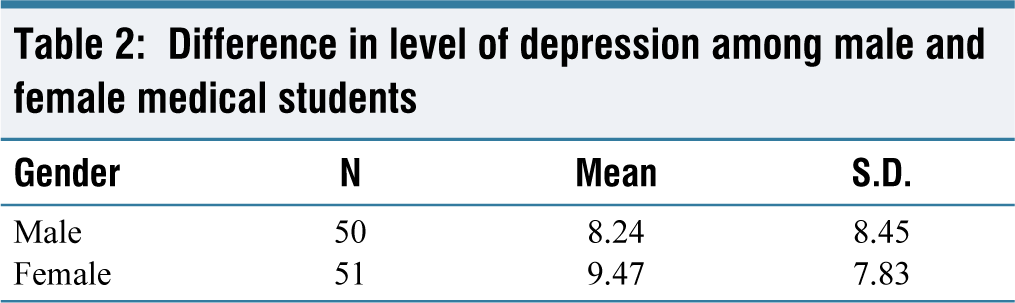
The mean scores of depression of male and female medical students are 8.24 and 9.47, respectively. There is no significant difference in depression between male and female medical college students (p > .05) [Table 2].
Difference in level of depression among male and female medical students
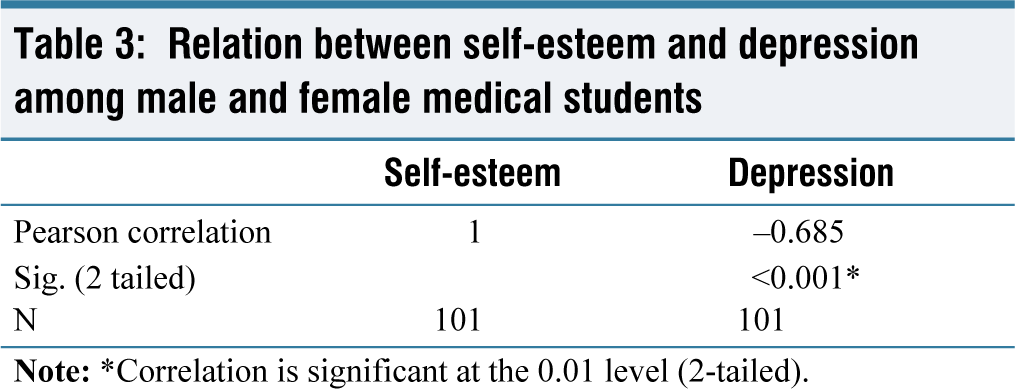
There is a moderate negative correlation between self-esteem and depression of medical college students. Pearson Correlation is –0.685 and p value is .000 [Table 3] which shows that an increase in self-esteem would lead to decrease in depression. Hence, there is a statistically significant correlation between self-esteem and depression.
Relation between self-esteem and depression among male and female medical students
Discussion
The study investigated self-esteem relating to individual variables such as gender. Regarding the variables like gender and self-esteem, we found that there is no significant difference in self-esteem pertaining to males and females.
However, in contrast to our study, a Study of Association between depression and self‑esteem among Dental Students of Udaipur conducted by Nilesh Bhanawat et al. showed that female students tended to have lower self-esteem than male students.[14] Also, in a study done by King et al. boys and girls reported that similar levels of self-esteem during childhood, a gender gap emerges by adolescence, such that adolescent boys have higher self-esteem than adolescent girls.[15] It is reported in the study of Unni Karin Moksnes et al. girls had significantly higher depression/anxiety than boys and showed a slightly significant increase in depression/anxiety, stress and self-esteem during the two assessments. Boys scored significantly higher on mental well-being and self-esteem and reported stable mental health during the school year.[16]
The study investigated depression relating to individual variables such as gender. Regarding the variables like gender and depression, we found that there is no significant difference in depression pertaining to male and female.
In contrast to our study, in the study of depression and self‑esteem among Dental Students of Udaipur, female students tended to have higher depressive symptoms than male students.[15]
Depression is the leading cause of disability for both male and female, the burden of depression is 50% more in female than male.[17]
In this study we explored on relating to variables like self-esteem and depression, there is a significant negative correlation between self-esteem and depression of medical students. This implies that as the self-esteem increases, depression decreases. On the contrary, when self-esteem decreases, depression increases.
Similar to our study, in study done by Orth et al. showed that low self-esteem more strongly predicted depression than depression predicted low self-esteem.[18] Also, Greenberg et al. found that high self-esteem had an anxiety-buffering function among students in an experimental setting.[19]
Likewise, threats to self-esteem have been shown to induce anxiety and to activate strategies that defend or restore a person’s self-esteem.[20,21,22]
Conclusion
It is concluded that there is no significant difference in self-esteem and depression of students of medical college pertaining to gender and there is a significant negative relationship between self-esteem and depression of students of medical college. Research results contribute to the development of an empirical database for a better understanding of relationship between self-esteem and depression and the development of counselling programmes aiming to nurture the student’s self-esteem and hence prevention of depression.
Considering the results of the present study, certain limitations should be kept in mind. Future studies could provide better results from a larger sample size. Selecting participants from other parts of the country can further help conduct a research study on a larger scale. Another limitation of the study comes from the fact that other variables also affect the development of depression such as stress, loneliness, students’ academic background and peer influence.
The study can be used to find out the level of self-esteem and depression among different age groups and find out at which level the individual is operating. An individual can be taught how he/she can increase his/her self-esteem and have better and healthier lifestyle.
Footnotes
Declaration of conflicting interests
The authors declared no potential conflicts of interest with respect to the research, authorship and/or publication of this article.
Funding
The authors received no financial support for the research, authorship and/or publication of this article.
Institutional ethical committee approval number
Ethical considerations for the study included obtaining approval from the Institutional Review Board before commencing the research (NHLIRB/2023/JULY/13/NO.1).
Informed consent
First component of the Google form contained informed consent which is also mentioned in the methodology section.
Credit author statement
Study concept and design: Aashka Kinariwala, Dr. Nidhi Saija, Dr. Supriya Malhotra.
Data collection: Aashka Kinariwala.
Analysis and interpretation: Dr. Nidhi Saija, Dr. Supriya Malhotra.
Statistical analysis: Aashka Kinariwala, Dr. Nidhi Saija, Dr. Supriya Malhotra.
Drafting of manuscript: Aashka Kinariwala, Dr. Nidhi Saija, Dr. Supriya Malhotra.
Critical revision of manuscript: Dr. Nidhi Saija, Dr. Supriya Malhotra.
Data availability
Data was collected using Google form.
Use of artificial intelligence
This article does not incorporate the use of artificial intelligence in any part of its development or analysis.