



Abstract
Introduction:
Dr Bhagwan Din Chaurasia is a legend in Indian Anatomy education. Being his student in 1977–78, I saw him closely and was inspired immensely to write his biography to pay my homage and tribute to this great ‘guru’.
Methods:
Apart from my first-hand information and experience with Dr Chaurasia, I did extensive research on PubMed, Scopus and Google Scholar databases to extract his research publications. I also extracted his personal information from his old students at Gajra Raja Medical College, Gwalior (India), some of the main ones have been acknowledged in this paper.
Results:
Despite a shortened life, Dr Chaurasia’s influence on the field remains immense. His book, Human Anatomy has been an essential guide for countless medical students around the world. He was not only a gifted teacher but also, a dedicated researcher, actively publishing in prestigious journals.
Conclusion:
Dr Chaurasia’s legacy is a testament to the power of clear explanations, innovative teaching methods, and unwavering passion for Anatomy. The name Dr B. D. Chaurasia is synonymous with excellence in Anatomy education. His work will continue to inspire generations of medical professionals to come.
Heroes get remembered, but Legends never die.
–––Babe Ruth
Introduction
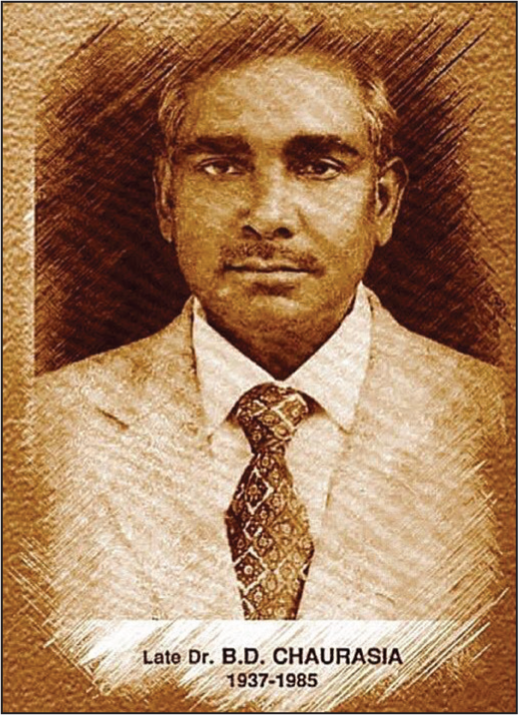
The history of medical education in India is intricately woven with the contributions of remarkable individuals. Among them, Dr Bhagwan Din Chaurasia (Figures 1 and 2), affectionately known as BDC, stands out as a towering figure in Indian anatomy education. His textbooks, particularly ‘Human Anatomy,’ have been a cornerstone for countless medical students worldwide since their introduction in 1979, illuminating the path for countless medical students through his exceptional work in Anatomy education.
Dr Bhagwan Din Chaurasia
Statue of Dr Bhagwan Din Chaurasia at Gajra Raja Medical College, Gwalior

The Great Man and His Life
Born on October 1, 1937, in Barigarh, a small town in central India (District Chhatarpur, Madhya Pradesh), Dr BDC’s life path was forever entwined with the world of Anatomy. His farmer parents, Ramadhin and Radharani Chaurasia, laid the foundation for his remarkable career that would leave an indelible mark on medical education in India.
Dr BDC’s academic journey began at Ewing Christian College, Allahabad, where he completed his schooling in 1954. This formative period instilled in him a strong foundation in core subjects, preparing him for the rigours of medical school. He then set his sights on Mahatma Gandhi Memorial (MGM) Medical College, Indore. There, his passion for medicine blossomed, culminating in an MBBS degree in 1960. His insatiable curiosity for the human body propelled him further, and he went on to specialise in Anatomy, obtaining a Master of Surgery (M.S.) degree in the same field from MGM Medical College in 1965. Dr BDC’s dedication to knowledge extended beyond his initial qualifications. He embarked on a lifelong pursuit of academic excellence, eventually earning a Ph.D. in 1975 from Jiwaji University, Gwalior.[1]
The early years of Dr BDC’s professional career were marked by a commitment to sharing his knowledge with future generations of doctors. He began his teaching career as a demonstrator in the Anatomy department at MGM Medical College, Indore, where he spent three years imparting his expertise to students. He then moved on to Gandhi Medical College (GMC) Bhopal, where he served as a lecturer in anatomy for two years. In 1968, he joined Gajara Raja Medical College (GRMC), Gwalior, as a Reader of Anatomy. It was here that he would not only continue to inspire students but also lay the groundwork for his future contributions to the field.[1,2]
Dr BDC’s early life and academic pursuits were a testament to his unwavering dedication to the field of anatomy. The strong foundation he built in these formative years would pave the way for him to become a leading figure in medical education, impacting countless medical professionals through his innovative teaching methods and ground-breaking textbooks.
Despite his short stature, he commanded respect in the classroom and faculty room alike. Known for his unwavering discipline, he brooked no nonsense, yet his dedication to his students and colleagues was undeniable. A lifelong bachelor, he shared his home with his loyal canine companion, Rani, and his trusted aide, Munne Miyan.
His ‘Amazing’ Anatomy Textbook
Dr BDC’s dedication to enlivening Anatomy studies is legendary. For decades, well before the digital age, his textbooks served as a lifeline for students navigating the complexities of the human body. 3 His immensely popular class notes were the inspiration for his first publication – a meticulously handwritten collection on the Brain, complete with diagrams. In 1978, with typewriters and photocopies being expensive rarities, Dr. BDC cyclostyled these notes himself, making them available to students for a mere ₹10 per booklet. This act of generosity reflects his commitment to fostering knowledge. His talent eventually caught the eye of a major publisher, CBS Publishers in New Delhi, who approached him to write a comprehensive Human Anatomy textbook.
While the exact details are not documented, it is known that he drew inspiration from esteemed figures such as Professor Inderbir Singh from Rohtak and Shri SC Gupta from Jiwaji University, Gwalior. In the book’s acknowledgements, he expressed his gratitude to his teacher, Shri Uma Shankar Nagayach, highlighting the importance of mentorship in his journey. Dr BDC’s most celebrated textbook, ‘Human Anatomy’, was first published in 1979 and quickly established itself amongst students. The book’s success is evident in its longevity—the first edition was reprinted for nine consecutive years until 1988, and subsequent editions have followed suit. As of 2024, the latest edition (the ninth) remains in circulation (Figure 3), 45 years after its first launch, and is being edited currently by Prof. Krishna Garg.[3]
Dr B. D. Chaurasia’s landmark Anatomy Textbook

The impact of Dr BDC’s textbook transcends national borders. Its clear explanations, comprehensive nature, and innovative features have fuelled its immense popularity in India and abroad. The book has been translated into various international languages, making it accessible to a wider audience of medical students. Furthermore, its relevance extends beyond the field of medicine. Students in dental sciences, physiotherapy, and occupational therapy also rely on this invaluable resource, as anatomy forms a crucial foundation in these disciplines as well. The enduring demand for Dr BDC’s textbook is a true testament to its enduring value and its lasting impact on medical education. It continues to be a popular and valuable resource for students of Anatomy, both at undergraduate and postgraduate levels, and also for Clinicians and Surgeons, as well.
The enduring popularity of ‘Human Anatomy’ can be attributed to several factors. Dr BDC’s writing style is clear and concise, making complex anatomical concepts accessible to students. The book offers comprehensive coverage of the subject matter, ensuring students receive a well-rounded foundation in Human Anatomy. Its clear explanations, comprehensive coverage, and innovative features continue to guide aspiring medical professionals on their journey to becoming skilled and knowledgeable physicians. Furthermore, it incorporates a range of engaging features that enhance the learning experience (Figure 4).
Key Features of the Human Anatomy book of Dr B. D. Chaurasia

The key features of his book include:
Visually appealing and easily reproducible coloured diagrams Innovative style of line diagrams to explain the complex anatomical relationships and descriptions Clear labelling of anatomical structures Flowcharts to aid understanding of complex processes Well-illustrated explanations of clinical anatomy for practical application
Since the seventh edition, the textbook has even included a CD with videos on osteology (the study of bones) and soft parts to further assist students in visualising anatomical structures. Additionally, multiple-choice questions with answers are provided to help students prepare for exams. The book even delves into related fields such as histology, embryology, and radiology when relevant, offering a holistic view of the human body.
Before his work, the absence of readily available learning materials posed a significant hurdle. Dr BDC’s clear, concise, and student-friendly language bridged this gap, demystifying complex anatomical concepts and was not limited to theoretical anatomy. He understood the importance of clinical applications and ensured his works included relevant clinical correlations. This approach bridged the gap between theoretical knowledge and practical application, providing students with a deeper understanding of how anatomical structures function in the human body.
However, Dr BDC’s brilliance extended beyond the written word. He recognised the power of visual learning and meticulously crafted his books with well-illustrated and easily reproducible line diagrams. These visuals became a lifeline for students who thrived on a visual understanding of anatomical structures. Furthermore, Dr BDC understood the potential for monotony in anatomy studies. He countered this by incorporating innovative and engaging features. Mnemonics transformed arduous memorisation into a more manageable process. Poems and riddles sprinkled throughout the text breathed life into dry facts, making the learning experience more stimulating. This creativity fostered a deeper understanding and retention of crucial anatomical knowledge.
Research Achievements
Dr BDC’s influence extended far beyond his textbooks. He was a prolific researcher, actively contributing to the advancement of the field through publications in national and international journals. He actively participated in academic societies and served on the advisory boards of esteemed publications like the International Journal of Acta Anatomica and Bionature. He published more than 60 research articles in his relatively short academic career span,[1,2] with 36 published documents listed in PubMed,[4] and 44 in Scopus databases,[5] from 1964 to 1984. It was indeed a great achievement considering the meagre research facilities and landscape in those times. His research has also received a good number of citations over the years and a list of the top 10 most cited publications are presented in Table 1.[6]
Top Ten Cited Publications of Dr B. D. Chaurasia

Dr BDC was a curious researcher with a strong foundation in human Anatomy, as is obvious from the list of his top publications in Table 1. He had diverse research interests within anatomy and related fields such as Neurosciences, Genetics, Congenital anomalies, and even in Botany. Dr Chaurasia’s research suggests a fascination with human variation and anomalies, particularly those related to lateralisation and birth defects.
Accolades
Dr BDC’s contributions were recognised by his election as a Fellow of the National Academy of Medical Sciences (FAMS), India, in 1982. He was also an invited member of several prestigious editorial boards and scientific societies. BDCs dedication to medical education and his exceptional textbook continue to inspire generations of medical professionals. Due to his untimely death at the age of 47 years, due to an acute Myocardial Infarction, his research career was cut short. He was posthumously awarded the prestigious Dr Kailash Nath Katju Award of Science by the Madhya Pradesh Government. In addition, the Central Medical Teachers Association of Madhya Pradesh, India celebrates its birth anniversary on 1st October as Medical Teacher’s Day.[2]
His Influence
In 1977, during the first year of our MBBS program, we had the privilege of learning from Dr BDC. We witnessed his brilliance firsthand during his peak years, from 1977 to 1985. His presence was truly inspiring. He cared deeply for his students but demanded discipline. His teaching style was unmatched. Through clear explanations and colourful, self-drawn and original line diagrams on the blackboard, he could transform even the most intricate anatomical concepts into readily understood lessons. His drawings were so stunning that erasing them from the blackboard after class felt like an act of vandalism! Dr BDC was a true ‘guru’ in every sense of the word.[16] He wasn’t just a master of his subject; he was a phenomenal educator. He went beyond academics, acting as a great human being, and counsellor who instilled values, shared knowledge, and served as a constant source of motivation.
What particularly impressed me was his prolific research career. At the time, Dr BDC had already published a staggering 60 papers – a number that surpassed the combined output of the entire medical college faculty! His influence extended far beyond the classroom. It not only shaped us into competent medical professionals but also ignited a passion for research within me. With over 800 publications to my name,[17] a number that continues to grow, I can’t help but wonder how Dr BDC would have felt. Having the privilege of writing the biography of such an inspiring mentor who ignited a lifelong passion for learning within me is an honour beyond words. His unwavering dedication pushed us all to excel, illuminating the path to knowledge. Dr BDC’s life embodied the wisdom of two powerful quotes: ‘Education is not the filling of a pail, but the lighting of a fire,’ by William Butler Yeats, and ‘Live as if you were to die tomorrow. Learn as if you were to live forever,’ by Mahatma Gandhi. He did not just fill our heads with facts; he ignited a passion for lifelong learning that continues to this day.
My professional career has been greatly influenced by two additional legends and visionaries, namely Dr. Prathap C Reddy[18] and Prof. Bimalendu Das.[19]
Conclusion
Dr B. D. Chaurasia’s life, though cut short, left an indelible mark on medical education. His meticulously crafted anatomy textbooks have become a global cornerstone, a testament to his clear communication, innovative teaching methods, and unwavering dedication to the field. Dr Chaurasia’s influence extends far beyond his textbooks. A prolific researcher, he published extensively in prestigious journals and actively participated in esteemed academic societies, further solidifying his reputation for excellence in Anatomy education. His name remains synonymous with the field, and his legacy will continue to inspire generations of medical professionals. He embodied the rare combination of an exceptional teacher and a distinguished researcher.
Footnotes
Acknowledgements
With gratitude to Dr Ram Lakhan Singh Sengar (Professor- Neurosurgery, Gwalior), Dr Rajendra Prasad Gupta (Consultant Radiologist, Kanpur), Dr Ishwar Dayal Chaurasia (Professo-Neurosurgery, Bhopal) and all the other friends (who were also his students, like myself), for their invaluable contribution of information and images related to Dr BDC.
Declaration of Conflicting Interests
The author is the Editor of Apollo Medicine, but has no role in the peer review and decision making of this manuscript.
Funding
The author received no financial support for the research, authorship and/or publication of this article.
Institutional Ethical Committee Approval
The paper is a review article so no ethical approval is required.
Informed Consent
Not applicable.
CRediT Author Statement
The author has full role in conceptualization, literature search, data collection, Manuscript writing, editing and final approval.
Data Availability
The data for this paper is available in the public domain.
Use of Artificial Intelligence
The author has taken the assistance of Grammarly and Google Bard for better readability and language improvement, but have rechecked the contents for their authenticity and take the full responsiblity.