




Abstract
Background and Aims:
Medical Education Technology has witnessed significant transformation over the years, largely influenced by advancements in technology. From traditional lecture-based teaching to the integration of multimedia tools and virtual simulations, the landscape of medical education has evolved to meet the needs of learners in an ever-changing healthcare environment.
Objectives:
To explore the evolution of Medical Education Technology, highlighting key milestones from the past, assessing the current state of technology integration in medical education, and envisioning future trends and challenges.
Methods:
A comprehensive review of the literature was conducted to examine the historical progression of Medical Education Technology.
Results:
The review revealed a notable evolution in Medical Education Technology, from early implementations of multimedia tools to the widespread adoption of online platforms and virtual simulations.
Conclusions:
Medical Education Technology has evolved significantly from past innovations to the present integration of virtual platforms. Looking ahead, future advancements promise to further revolutionise medical education, ensuring better preparation of healthcare professionals for the challenges of modern practice.
Keywords
Introduction
Medical Education Technology (MedTech) has emerged as a transformative force in the field of medical education, revolutionising the way healthcare professionals are trained.[1] In an era characterised by rapid advancements in medical science and technology, the traditional methods of medical education are being augmented and, in some cases, replaced by innovative technological solutions.[2] The integration of cutting-edge technologies such as virtual reality (VR), artificial intelligence (AI), and simulation tools has opened up new avenues for experiential learning, allowing medical students to hone their skills in a risk-free environment.[3] The symbiosis of medicine and technology not only enhances the efficiency of knowledge transfer but also promotes active and engaging learning experiences.[4] The exploration of MedTech holds immense promise for improving the quality of healthcare professionals and, consequently, the overall standard of patient care. This dynamic intersection of medicine and technology represents a pivotal step forward in addressing the evolving challenges of the healthcare landscape, ensuring that the medical workforce remains adept, adaptable, and equipped to meet the demands of a constantly evolving field. In this discourse, we intend to unravel the evolution of MedTech from its earliest form to the present-day advancements.
Aims and Objectives
Our aim was to explore the evolution of MedTech, highlighting key milestones from the past, assessing the current state of technology integration in medical education, and envisioning future trends and challenges.
Methods
A comprehensive review of the literature was conducted, in January–February 2024, to examine the historical progression of MedTech. Key databases (PubMed, Scopus, and Google Scholar) were searched for relevant studies and articles spanning the past few decades. Additionally, recent developments and emerging technologies in medical education were explored through online databases, professional forums, and expert opinions. We also employed the use of the ‘Pomodoro’ technique[5], a time management tool for academic publication while preparing this article.
Results
The evolution of MedTech revealed a gradual shift from traditional teaching methods to the incorporation of technology-enhanced learning approaches. Early implementations involved multimedia resources such as slide projectors and videotapes to augment lectures, fostering visual learning. Presently, medical education heavily relies on online platforms, virtual simulations, and digital resources, facilitating remote learning and interactive experiences. Emerging trends indicate a move towards personalised and adaptive learning, leveraging AI and VR technologies to tailor educational experiences. Challenges persist, including digital access disparities and faculty resistance, yet opportunities for collaboration and innovation abound. Looking forward, the future promises further advancements in personalised learning, AI-driven platforms, and immersive simulations, revolutionising medical education and better preparing healthcare professionals for modern practice. The journey of this evolution is as below.
Historical Perspective
The early adoption of technology in medical education saw the transition from static slides to more dynamic visual aids. The use of photographic slides allowed educators to present detailed images during lectures, offering a visual complement to traditional teaching methods.[6] Filmstrips emerged as an innovative technology for sequential visual learning in medical education. Educators utilised filmstrips to present a series of images, often with accompanying audio, to guide students through step-by-step processes, procedures, or case studies.[7] Overhead projectors represented a significant advancement, allowing educators to project images, diagrams, and textual content onto a screen in real time. This technology facilitated interactive teaching as instructors could annotate directly on the overhead transparencies during the lecture, enhancing engagement and emphasising key points.[8] The chronology of this development has been highlighted as a timeline (Figure 1).
A Timeline Depicting the Chronology of Advancements in Medical Education. AI: artificial intelligence; AR: augmented reality; VR: virtual reality
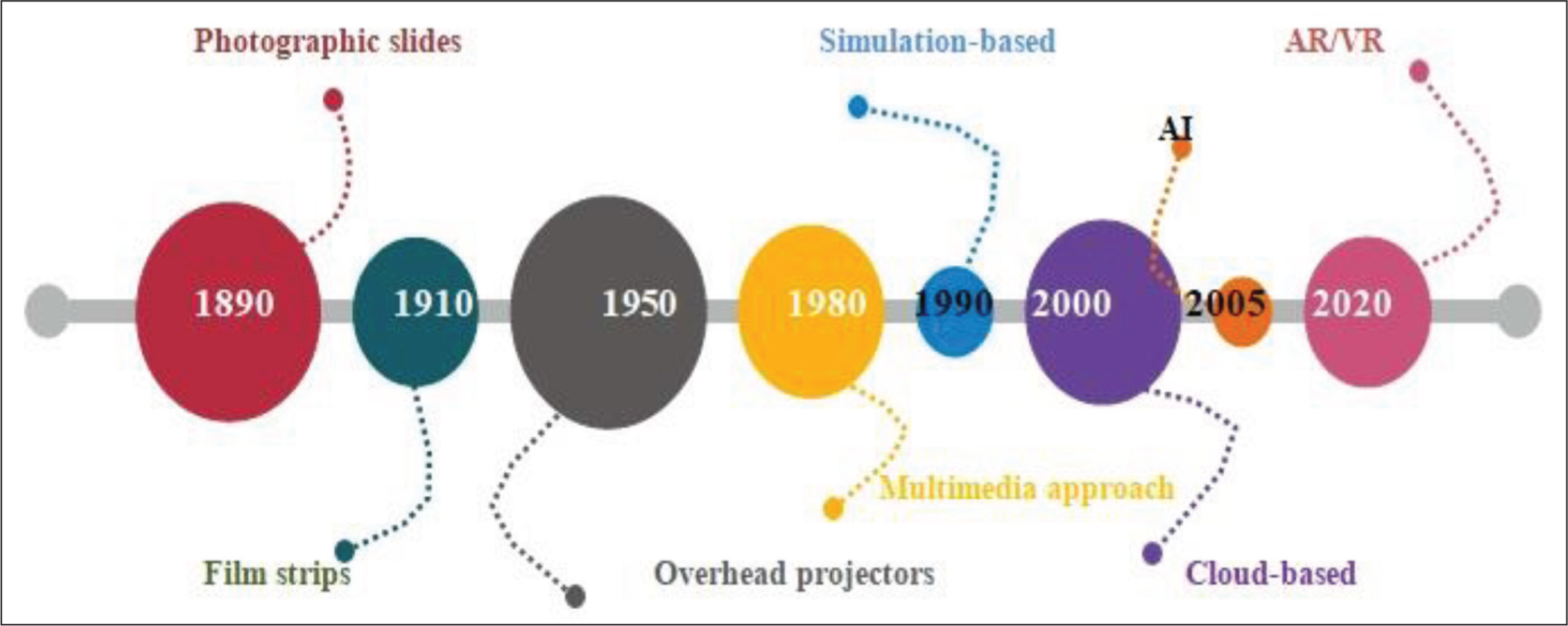
The early stages of incorporating technology in medical education involved the integration of multimedia elements. Educators combined slides, filmstrips, and overhead projectors to create comprehensive presentations that catered to different learning styles. This multimedia approach aimed to enhance the educational experience by providing a richer and more engaging learning environment.[9]
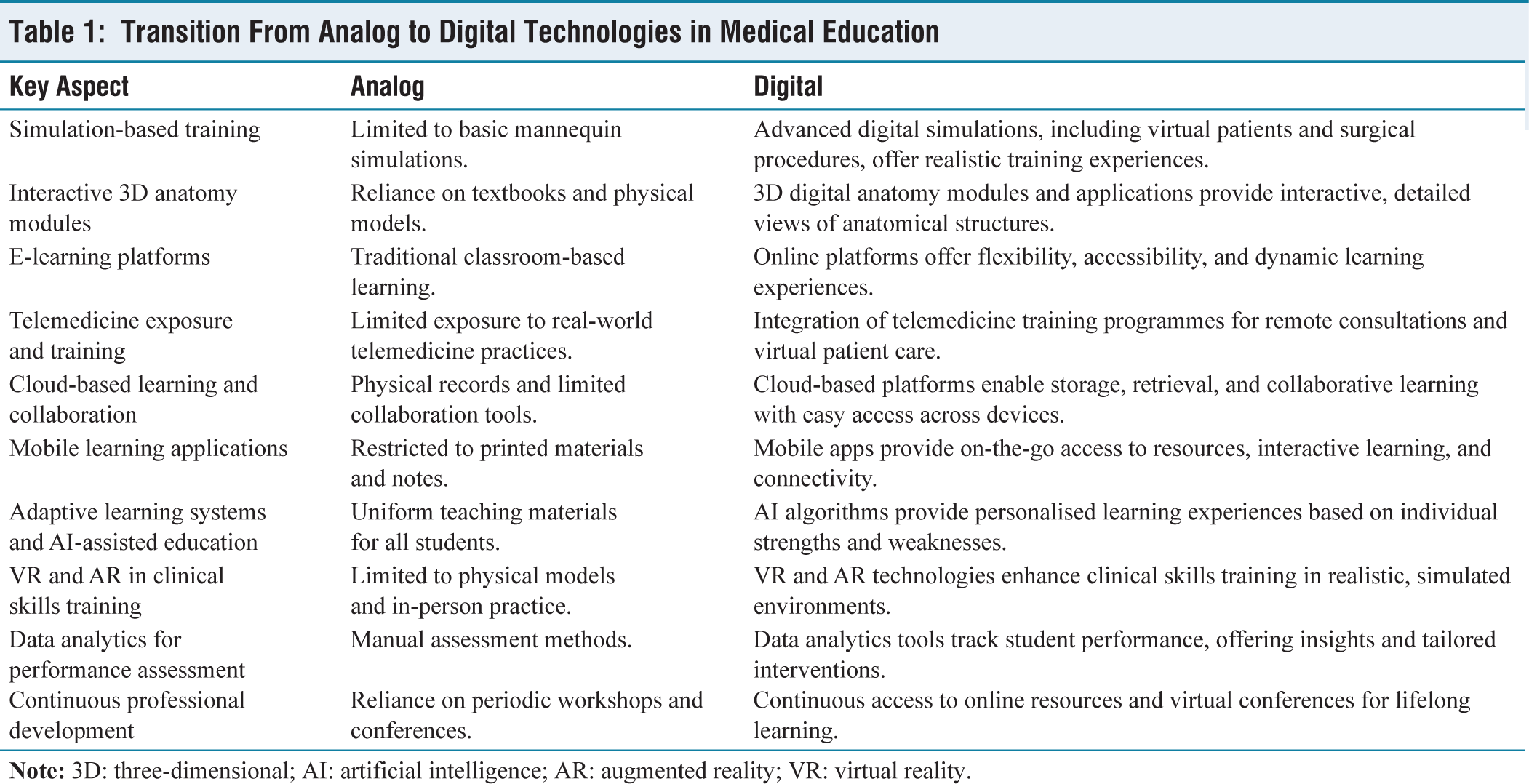
The early adopters of technology in medical education explored innovative teaching methods to promote active learning. The use of slides, filmstrips, and overhead projectors encouraged instructors to move beyond traditional lectures, fostering a more interactive and participatory learning experience for students.[10] There has been a gradual transition from Analog to Digital technologies in Medical Education (Table 1).
Transition From Analog to Digital Technologies in Medical Education
Distance learning in medical education has a rich history, with the earliest forms involving correspondence courses that allowed students to study remotely through mailed materials. These courses often included textbooks, assignments, and assessments sent by post, enabling individuals to pursue medical education without being physically present at a traditional institution.[11]
The emergence of online platforms has transformed distance learning in medical education, allowing for real-time interaction, multimedia content delivery, and collaborative learning. Platforms such as Coursera, and edX offer medical courses and content that are accessible globally. This accessibility enables learners from diverse backgrounds to access high-quality medical education resources regardless of geographical constraints.[12]
Distance learning in medical education provides flexibility, accommodating the schedules of working professionals and learners with diverse commitments. Online platforms offer asynchronous learning opportunities, allowing individuals to study at their own pace. This flexibility is particularly beneficial for medical professionals seeking to upgrade their skills or pursue additional qualifications while continuing their clinical practice.[13] Distance learning has evolved to include blended learning approaches, combining online modules with occasional in-person sessions or practical experiences. This hybrid model ensures that learners benefit from both the flexibility of online education and the hands-on experience provided in traditional medical education settings.[14]
Ongoing technological advancements, including VR and augmented reality (AR), are being integrated into distance learning in medical education. Virtual patient encounters, surgical simulations, and interactive anatomy modules provide immersive experiences, enhancing the quality of education and bridging the gap between theoretical knowledge and clinical practice.[15]
Current Landscape of Medical Education Technology
Contemporary e-learning platforms, such as Moodle, Canvas and Coursera have significantly improved accessibility to medical education resources. These platforms offer a centralised hub for lecture materials, textbooks, and multimedia content, allowing students to access learning materials at their convenience. This flexibility in accessing educational resources promotes self-directed learning and accommodates diverse learning styles.[16]
E-learning platforms provide flexibility in learning formats, enabling medical students to engage with content in various ways. Recorded lectures, live webinars, and interactive modules cater to different preferences and schedules. This adaptability accommodates the diverse needs of learners, allowing them to review materials at their own pace and reinforcing understanding through repetition.[17] E-learning platforms integrate interactive features, such as discussion forums, quizzes, and multimedia content, to enhance engagement during tutorials. Platforms like EdX employ adaptive learning techniques, tailoring content based on individual student performance. These interactive features not only promote active learning but also provide immediate feedback, reinforcing key concepts.[18]
E-learning platforms facilitate collaborative learning through features such as virtual classrooms, group assignments, and collaborative projects. Platforms such as Blackboard Collaborate and Google Workspace for Education enable real-time collaboration and communication among students and educators. Collaborative learning fosters teamwork, communication skills, and a sense of community among medical students. Some e-learning platforms incorporate real-time interaction and simulation tools, such as virtual patient encounters or case-based discussions.[19] Tools like Zoom for virtual meetings or platforms like Touch Surgery for surgical simulations provide immersive experiences that bridge the gap between theory and practice. These features enrich the learning experience by allowing students to apply theoretical knowledge in simulated clinical scenarios.[20]
Virtual patient encounter simulations provide medical students with realistic scenarios to practice clinical skills and decision-making in a controlled environment. These simulations, such as those offered by platforms such as Touch Surgery and Cyber Patient, offer an immersive experience that allows students to interact with virtual patients, diagnose illnesses, and develop patient communication skills.[21]
Surgical simulations in virtual environments, exemplified by tools such as Touch Surgery and Osso VR, provide a safe and controlled space for medical students to refine their surgical techniques. These simulations offer a risk-free platform for practising procedures, improving hand-eye coordination, and fostering a deeper understanding of surgical anatomy.[22] Virtual simulations of clinical scenarios, like those found in platforms such as SIMStation and Body Interact, allow medical students to navigate complex patient cases and make critical decisions. These simulations mimic real-world challenges, enhancing clinical reasoning skills, and preparing students for the dynamic nature of healthcare settings.[23]
Virtual simulations are increasingly used to facilitate team-based learning in medical education. Platforms like DecisionSim enable students to work collaboratively in virtual clinical scenarios, fostering communication, teamwork, and an understanding of the interdisciplinary nature of healthcare.[24]
Mobile applications designed for anatomy, such as Complete Anatomy and Visible Body, offer dynamic three-dimensional (3D) models that enable students to interactively explore and understand complex anatomical structures. These apps have demonstrated effectiveness in enhancing spatial comprehension and knowledge retention.[25] Mobile medical reference applications, including Medscape and Epocrates, provide quick access to up-to-date clinical information, drug references, and guidelines. These apps enhance decision-making in clinical settings and support continuous learning, making them valuable tools for healthcare professionals.[26]
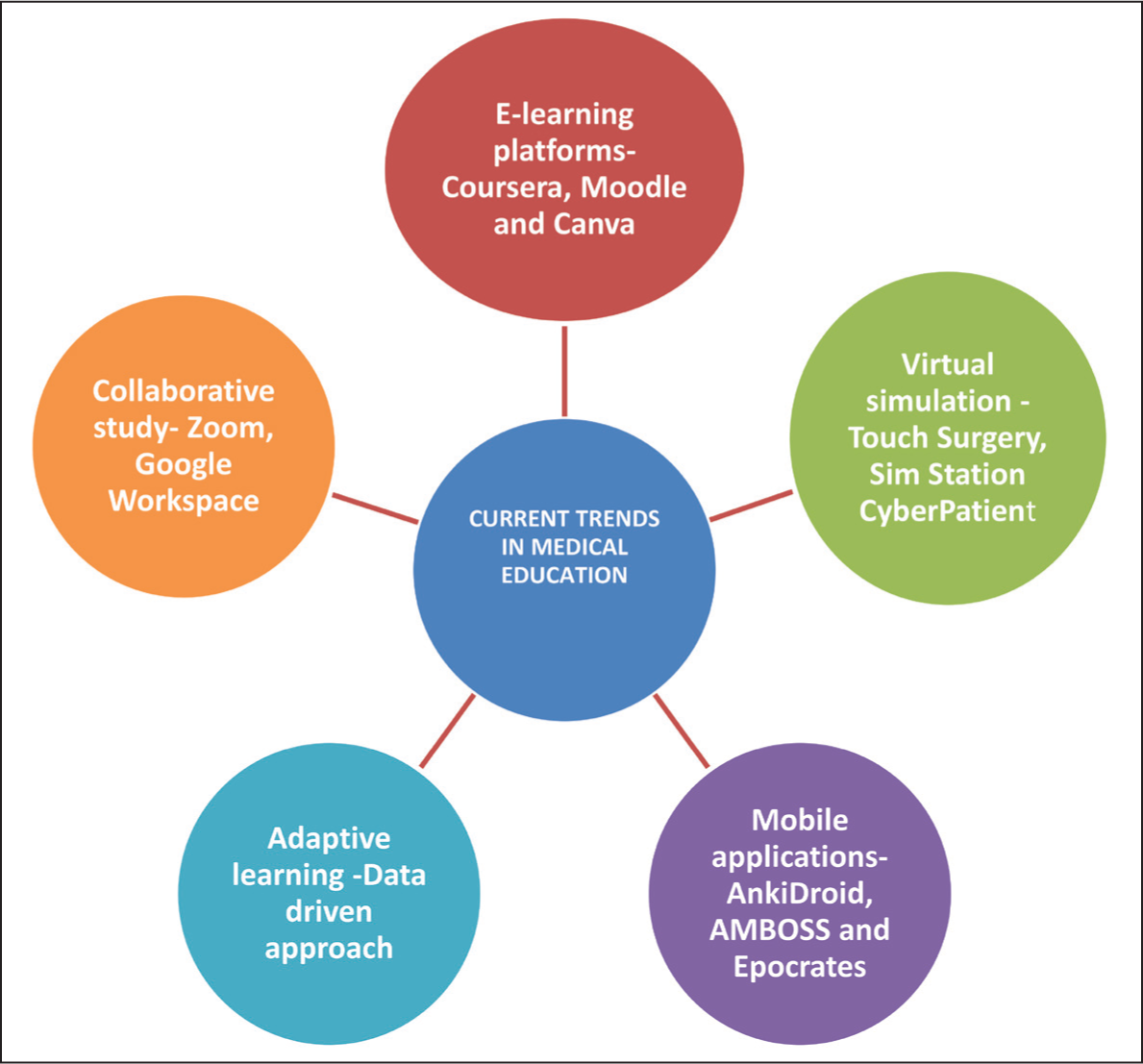
Mobile applications designed for self-assessment, such as AnkiDroid and AMBOSS, play a crucial role in promoting active learning and aiding in exam preparation. These apps utilise features such as flashcards and interactive quizzes to facilitate continuous self-directed learning.[27] A consolidated representation of current trends in MedTech (Figure 2).
Current Trends in Medical Education Technology
Adaptive learning technologies use AI algorithms to tailor educational content based on individual learner needs. In medical education, this approach ensures that students receive personalised learning paths, addressing their unique strengths and weaknesses.[28]
There is a crucial role of technology in bridging gaps in medical education. Our article highlights how technology can augment traditional teaching methods, especially through virtual patient simulations, online learning platforms, telemedicine, and emerging technologies such as AR and VR. These tools not only enhance diagnostic and decision-making skills but also provide students with valuable clinical experiences and mentorship opportunities, irrespective of geographical constraints or staffing limitations.
Future Trends and Innovations
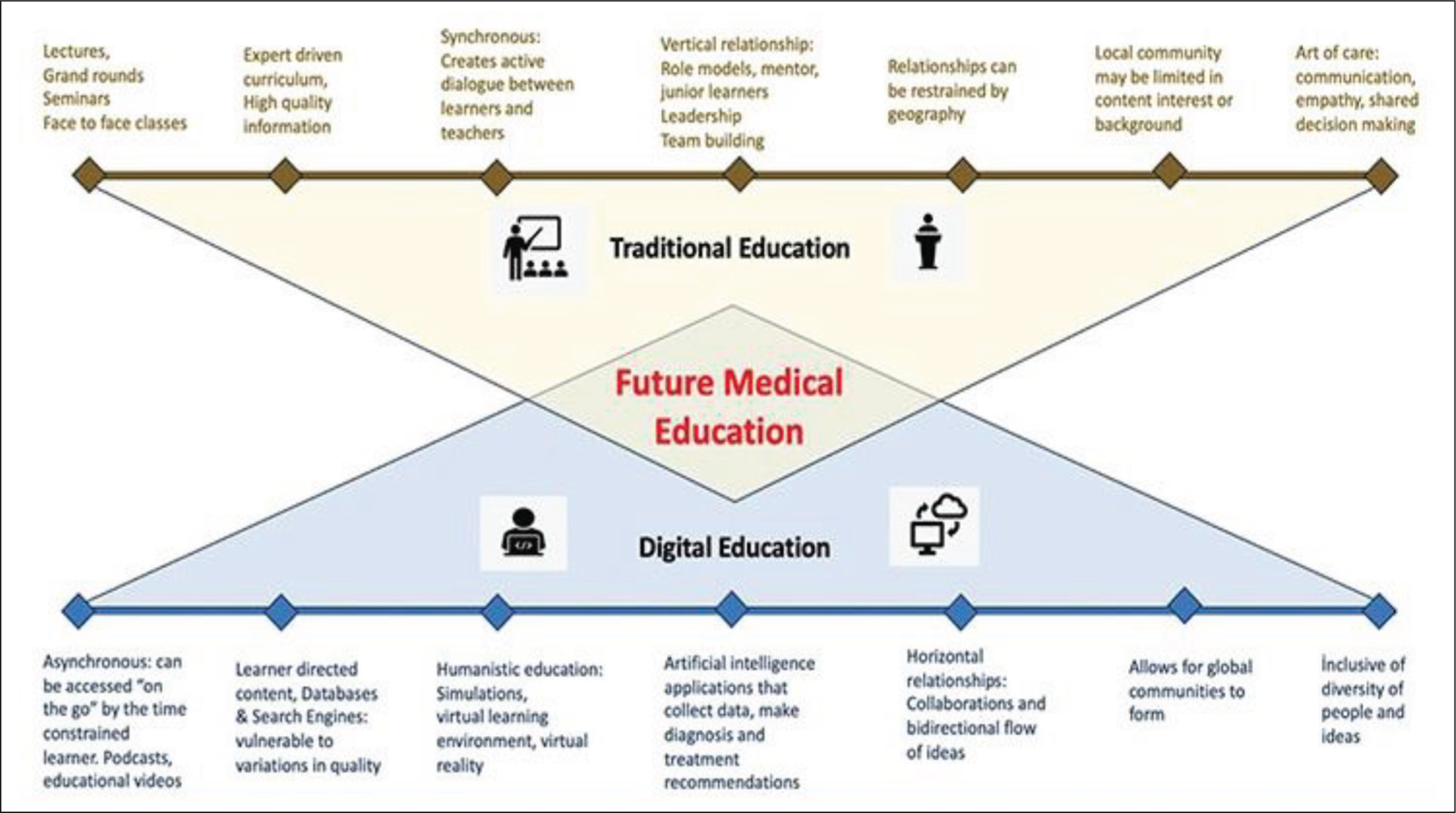
AI in medical education provides educators with valuable data-driven insights. These insights include detailed analytics on student performance, allowing educators to identify learning gaps, optimise teaching methods, and enhance curriculum design.[29] AI-driven simulations offer realistic virtual patient encounters, allowing medical students to practice clinical decision-making and diagnostic skills. Additionally, incorporating AI-based clinical decision-support tools into medical education enhances critical thinking by simulating real-world scenarios.[30] A hybrid model of Medical Education is going to be the need of the hour (Figure 3).
The future is going to be a personalised approach. Tailoring medical curricula involves adapting the educational content to meet the specific needs and preferences of individual learners. This approach recognises the diverse learning styles, backgrounds, and goals of medical students, allowing for a more personalised and effective learning experience.[31]
Adaptive assessments in medical education use technology, often powered by AI, to tailor the evaluation process based on individual learner performance. These assessments adapt in real-time, providing targeted questions and feedback to address specific areas of strength or weakness.[32]
Individualised learning pathways involve creating a unique educational journey for each student based on their progress, interests, and career goals. By leveraging technology and data analytics, medical education can design pathways that optimise learning efficiency and better prepare students for their chosen medical specialities.[33]
AR and VR technologies offer immersive experiences for anatomy education, allowing medical students to explore 3D anatomical structures in a virtual environment. This facilitates a more interactive and engaging learning experience compared to traditional methods.[34] AR and VR enable the creation of virtual patient scenarios, providing medical students with opportunities for realistic and risk-free patient interactions. These simulations can mimic a variety of medical conditions, enhancing clinical decision-making and communication skills.[35] AR and VR technologies play a crucial role in surgical simulations, offering realistic virtual environments for practising surgical procedures. These simulations enhance surgical skills, hand-eye coordination, and decision-making in a controlled setting for budding surgeons.[36]
We acknowledge that while technology offers numerous advantages, it also presents certain caveats that warrant consideration. Specifically, the economic burden incurred by colleges and students in implementing and accessing technology-enhanced resources is a significant concern. The costs of acquiring equipment, software licences, and training faculty on new technologies can strain institutional budgets and place financial pressure on students. Moreover, the digital divide exacerbates inequalities, with some students lacking access to technology or reliable internet connections. Overreliance on technology risks depersonalising the learning experience, potentially diminishing interpersonal skills and teamwork abilities crucial for effective healthcare practice.
While it is undeniable that newer technologies and teaching methods play a crucial role in enhancing medical education and preparing students for the complexities of modern healthcare, it is equally important not to overlook the invaluable lessons learned through bedside teaching. Bedside teaching offers medical students the unique opportunity to directly interact with patients, observe clinical presentations, and develop important clinical skills such as history-taking, physical examination, and patient communication. These experiences are essential for fostering empathy, clinical reasoning, and professional identity formation, which are central to the practice of medicine.
Additionally, concerns regarding the privacy and security of sensitive patient and student data arise with the integration of technology. There is also a risk of skill gaps and technological obsolescence, as students may become overly dependent on rapidly evolving digital tools. We acknowledge that we have no personal experience of using a number of these technological advances as it is a narrative review. However, balancing the benefits of technology with these drawbacks is essential to ensure that medical education remains comprehensive and equitable to the needs of students and patients alike.
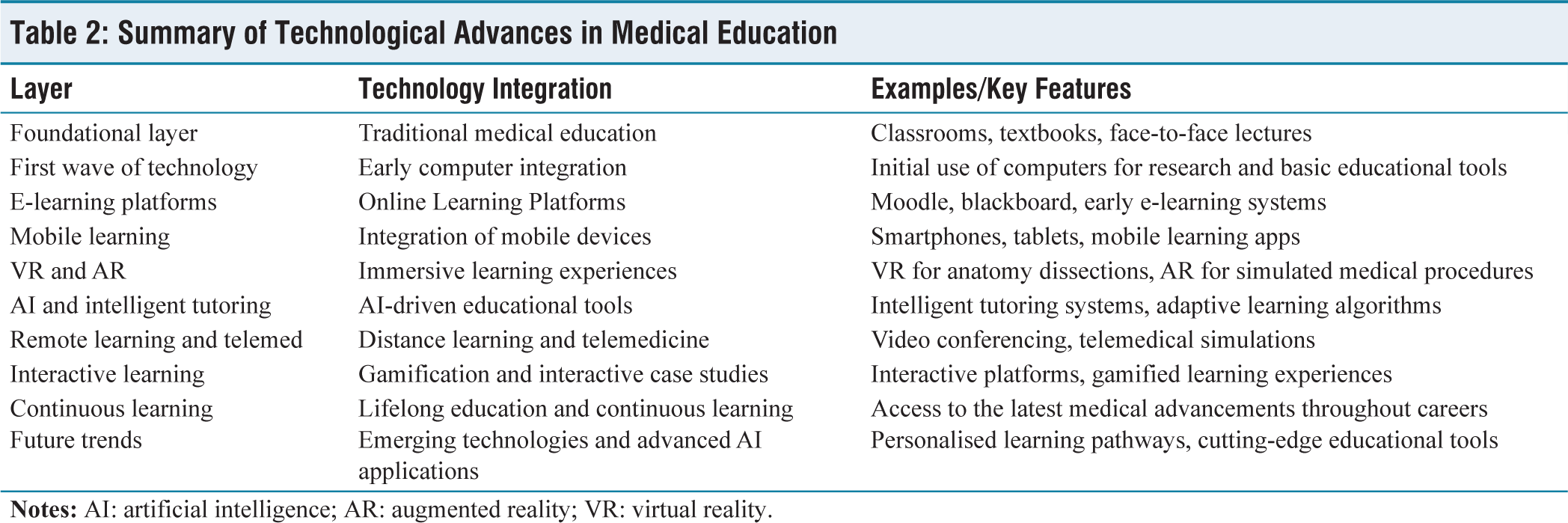
The future is going to be an integration of AI. This will include intelligent Tutoring Systems for Personalised Learning, AI-Assisted Diagnosis and Decision-Making and Virtual Patient Simulations for Practical Experience (Table 2).
Summary of Technological Advances in Medical Education
Conclusion
The evolution of MedTech has been remarkable, from the introduction of multimedia resources to the widespread adoption of online learning platforms and VR simulations. While past innovations have significantly enhanced the learning experience for medical students, the future holds even greater potential with the emergence of AI, AR, and personalised learning platforms. Also, a balanced approach that combines the strengths of both traditional bedside teaching and newer teaching methods is essential for shaping the future of MedTech and preparing healthcare professionals for the complexities of modern practice.
Footnotes
Declaration of Conflicting Interests
The authors declared the following potential conflicts of interest with respect to the research, authorship, and/or publication of this article: Author Raju Vaishya is Editor-in-Chief at Apollo Medicine. The author did not take part in the peer review or decision-making process for this submission and has no further conflicts to declare.
Funding
The authors received no financial support for the research, authorship and/or publication of this article.
CRediT Author Statement
Data Availability
N/A.
Use of Artificial Intelligence
N/A.