




Abstract
This study seeks to interpret the presence of social capital and collective efficacy among residents of neighbourhoods in the Greater Metropolitan Jakarta Area (GJMA) due to the COVID-19 pandemic. A quantitative study was undertaken by surveying 922 GJMA residents on the basis of their perception of the improvement of five components of social capital. During this period, neighbourhood residents improved their social capital and practised collective efficacy in several concrete forms to meet their common goals and procure the required goods. Although this study finds the shared values and norms, social network size, mutual aid and trust, civic engagement and participation in activities improved during the pandemic, the level of monthly income and marital and tenurial status implicated the quality of social ties and capital.
Introduction
Pandemic as a Trigger of Social Capital
During the global COVID-19 pandemic, more than 15,000 people were infected, with more than 500 deaths in Southeast Asian countries as of April 2020 (Association of Southeast Asian Nations, 2020). Carteni et al. (2020) have suggested that people’s movement contributes significantly to the transmission of this deadly disease. Due largely to the high amount of mobility, Jakarta and West Java were the provinces in Indonesia with the highest numbers of confirmed COVID-19 cases as of July 2020 (World Health Organization, 2020). Therefore, limiting people’s movement, typically through lockdowns and stay-at-home orders, became a preferred policy to reduce transmission of the coronavirus.
The enactment of Government Regulation 21/2020, Presidential Decree 11/2020 and Ministry of Health Decree 9/2020 in February and March 2020 established severe restrictions on mobility (Kementerian Kesehatan Republik Indonesia, 2020). Such restrictions pushed many countries and cities to the brink of economic recession (World Trade Organization, as cited in Association of Southeast Asian Nations, 2020) and disrupted the everyday life of people around the world (White, 2020). Many studies warned of the risk of increasing crime rates (Fitri, 2020) because of the rising unemployment levels.
The mutual support structures in the spirit of unity among neighbours as the manifestation of social capital became important to keep the physical distancing and mobility restrictions to contain the spread of COVID-19. This function of social capital in emergency situations had been suggested by prior studies (Vinck et al., 2019). Sampson and Groves (1989) demonstrated that strong formal and informal social networks are an important buffer in times of negative social, financial and health impacts such as those caused by the pandemic. Such networks grow mutual trust among members and encourage them to participate in collective activities or offer mutual support in their everyday activities (Gregson et al., 2004). Mutual support is an important source of emotional comfort, material goods or information for community members, especially in trying times (Van Zandt et al., 2012). It encourages heterogeneous community members with the same interests to solve the common life-threatening problems they are facing to come together and engage in decision-making (Paton, 2003) through the application of collective efficacy (Sampson, 2009) as a form of social resilience (Adger, 2000).
However, many studies in the 1980s posited that high levels of mobility, produced by urbanization schemes such as the Greater Jakarta Metropolitan Area (GJMA), create communities whose members lack a sense of common values because of diverse sociocultural and demographic characteristics. This community disintegration is seen as the root cause of the demise of social capital, which can lead in turn to increased crime and other social problems (Bursik, 1988).
What are the primary factors of social capital that influence collective efficacy in sharing similar norms and actions during a pandemic such as COVID-19 to prevent its spread? What forms of collective efficacy can be deployed to ensure a safe and secure neighbourhood? This study thus attempts to understand the factors of social capital and their application in delivering collective efficacy by residents of GJMA in the face of COVID-19.
Literature Review
Social Ties, Social Capital and Collective Efficacy
Social ties refer to the feeling of belongingness to a group (Perkins & Long, 2002), which meets people’s need for safety and security (Brown et al., 2003) through the practice of mutual aid along with other members (La Guardia et al., 2000). People joined by meaningful social ties can offer each other useful financial, emotional or informational assistance (Henly et al., 2005). Several scholars have highlighted the pivotal role of social ties in enabling communities to cope with social problems (Coleman, 1988; Granovetter, 1973; Putnam, 2000). Social ties can offer social capital through the connections, resources and advantages they provide within social networks and relationships. Social capital is essentially the value that arises from these social ties, and it can manifest in information and knowledge sharing; access to resources including shelter for isolation, internet for study or work and even job opportunities; and also emotional and social support during the hardships encountered.
In a classic study, Granovetter (1973) asserted that the strength of a social tie is based on the emotional intensity, intimacy and reciprocity built among community members over time. It moulds a socially interactive local space that grows friendship, a sense of belonging and community identity. Although social ties at the neighbourhood level can create social cohesion on a community level, they can also contribute to social fragmentation on a larger scale, such as the citywide level (Helliwell & Putnam, 2004). Many studies have provided evidence that strong social ties decrease people’s fear of crime (Ferraro, 1995) and improve their physical and mental health (Helliwell et al., 2014). They also provide a safety net against worsening psychological well-being in times of crisis (Lindström & Giordano, 2016).
Forrest and Kearns (2001) proposed five determining factors of social ties: (a) common values and civic culture, (b) social order and social control, (c) social solidarity and reduction of wealth disparities, (d) social networks and social capital and (e) place attachment and identity. However, an extensive body of literature has added other potential determinants of social ties.
A classic empirical study by Riger and Lavrakas (1981) identified two correlated determinants of a sense of community: social ties and behavioural rootedness. The first relates to an individual’s familiarity with surrounding neighbours, while the second corresponds to one’s length of residence. Furthermore, the intensity of mutual support among neighbours (Hanibuchi et al., 2012), types of housing (Hrast & Dolničar, 2012), sex, age (Van den Berg et al., 2015), family status and structure (Rogers & Sukolratanametee, 2009), secure tenure (Garnett, 2010), employment (Foster et al., 2015), frequency of interaction (Cramm et al., 2013), informal relationships such as friendship or kinship (Raman, 2010) and the availability of public amenities for social interaction (Mehta, 2013) can all affect people’s sense of community.
A study in Brazil by Villarreal and Silva (2006) showed how social ties can grow social capital. Coleman (1988) defined social capital as a resource for action arising from the relations among actors. Putnam (2000) associated social capital with social connections among community members that facilitate mutual collaboration for achieving common goals. Social capital is influenced by deeply embedded trust, reciprocity and social networks shared by community members. In contrast, Coleman (1988) described shared norms and values, mutual trust and shared obligations as prominent components of social capital.
Based on these definitions, Lin (2002) highlighted the inherent resources present in social relationships and access to those resources as the primary components of social capital. Putnam (2000) has cited mutual trust, shared norms and social networks among community members as the essential building blocks of social capital. Therefore, social capital is considered a product of binding ties between community members, according to established and practised self-regulating norms and reciprocal trust (Putnam, 2000). Social capital unites community members to construct collective efficacy and participate in decision-making (Alonge et al., 2019) so that they can prepare for, respond to and recover from hazards or adversities (Helliwell et al., 2014).
However, without collective efficacy, social capital alone cannot guarantee collective action (Halpern, 2005). The theory of collective efficacy has been developed out of the concept of social capital by Sampson (1986), who defined collective efficacy as the activation of social ties among community members to meet their collective goals. Sampson (2009) introduced the term ‘collective efficacy’ to explain how informal social control is established by the mutual engagement of community members who act according to shared social values, norms and trust. Later, he introduced the components of collective efficacy, including trust, reciprocity and generational change (Sampson, 2010). Therefore, collective efficacy is different from social capital because the former relates to active engagement in the exercise of control, while the latter refers to the potential resources of collective efficacy (Coleman, 1988). Ansari (2013) argued that collective efficacy cannot be developed with social capital.
Previous studies around the globe have examined the pivotal role of collective efficacy in improving community health (Gilbert et al., 2013), reducing neighbourhood crime (Maimon & Browning, 2010) and responding to the government’s failure to guarantee the security of community members (Rossi, 2005). Although many studies have taken a pessimistic viewpoint of the potential to build community resilience in low-income neighbourhoods, a study in Chicago by Swaroop and Morenoff (2006) showed that people in a disadvantaged neighbourhood could indeed build collective efficacy and community resilience to overcome the adversities they were experiencing and meet their needs.
Aim of the Study
At the beginning of the COVID-19 pandemic, self-made gated neighbourhoods emerged as a new urban phenomenon in Indonesian metropolitan cities. Community members in such housing complexes built and staffed housing gates to control visitor traffic and implement COVID-19 prevention protocols, targeting visitors. Housing residents considered such measures necessary to prevent COVID-19 transmission within their housing complexes.
Regarding neighbourhood improvement, most prior studies have focused on crime prevention. During the pandemic, the prevention of COVID-19 transmission became an important priority for community members; this concern has been neglected in academic discourse, especially in Indonesia. Therefore, this study examines the determining demographic factors of social capital and clarifies the characteristics of collective efficacy.
The study aims to identify and interpret the presence of social capital and how it is transformed into collective efficacy among neighbourhood residents facing extreme limitations in social activity due to the pandemic. The study contributes to the extensive body of literature on the role of demographic factors on the development of social capital and collective efficacy for coping with unprecedented hazards in urban neighbourhoods.
Methodology
For the purpose of this study, a quantitative research method has been employed to identify (a) the increase of social capital among the respondents during Indonesia’s large-scale social restrictions (LSSR) from 10 April to 31 July 2020 and (b) the forms in which collective efficacy was mobilized to minimize the transmission of COVID-19 in the respondents’ housing complex. This study was undertaken over two months from 29 May to 30 July 2023, during which the respondent-driven sampling (RDS) methodology was used to reach the population in GJMA during the LSSR. The distribution of online questionnaires began with five respondents who lived in the five cities of Jakarta province. They then promoted several respondents who lived in the same as well as different cities to voluntarily participate in this study.
Consistent with the criteria developed by Putnam (2000), questions were asked about shared values, network size, mutual aid and trust, civic engagement and participation in activities so as to measure the level of social capital. In all cases, the respondents were asked to indicate, on a 5-point Likert scale (1 = strongly disagree, 5 = strongly agree), the extent to which their experience of these aspects of social capital had improved since the onset of the pandemic. To measure the first component, shared values, four questions were asked relating to how much more after the pandemic respondents (a) shared the same values as their fellow residents, (b) accepted the lifestyles of their fellow residents, (c) discussed their values with fellow residents so as to identify shared values and (d) respected the different values of fellow residents. For the second component, network size, the respondents were asked how much more they had got to know, made friends with, visited and had regular conversations with their fellow residents. The third component, mutual aid and trust, was investigated by asking for responses to four statements: (a) ‘You are more helpful to your fellow residents’; (b) ‘Your fellow residents are more helpful to you’; (c) ‘You share more valuable information with fellow residents’ and (d) ‘You have developed more trust in your fellow residents’. Regarding civic engagement, respondents were asked how much more they attended community meetings, engaged in decision-making, knew about the community’s organization and felt they and their fellow residents could control the implementation of the results of community meetings. In this category, they were also asked about their level of employment. Finally, with regard to respondents’ participation in activities, they were asked about increases in their activities in common with fellow residents, how much they had enjoyed participating in these activities, how much the activities had improved their physical and social life and how much the activities had established their residential stability in the housing complex.
The responses on each subscale were averaged to identify a score on that subscale, consistent with similar studies (Béné et al., 2016). The average score on each component was then tabulated and linear regressed with the demographic data to understand its implication for the development of social capital. Each question was accompanied by a space for open-ended comments so that respondents could explain why they selected their answers. It is necessary to understand the underlying reasons for the status of each component and for the amount of or any improvement in social capital.
During the LSSR period, most people in GJMA were prohibited by municipal governments from travelling outside their houses or housing complexes and were required to stay at home. Therefore, the primary data had to be collected by distributing the questionnaire through the most popular online communication platforms in Indonesia, such as WhatsApp, LINE and Telegram. Generalization of results had to be limited, as online surveys contained inherent biases due to the lack of control over the participation mechanism (Fricker, 2008), the under-representation of certain demographic groups (Bethlehem, 2010) and slow responses from respondents (Cervantes et al., 2009). However, this study delivers post-stratification weightage according to the proportion of population to calculate and adjust the sample weight for minimizing, as Royal (2019) suggested. This method was applied using Statistical Product and Service Solutions (SPSS) tools before beginning our analysis.
Internal consistency and reliability were tested by measuring Cronbach’s α, the split-half (odd–even) correlation and the split-half with Spearman–Brown adjustment, as shown in Table 1.
Internal Consistency and Reliability Tests.

Previous studies have offered myriad measurement scales for interpreting results. Streiner (2003) asserted that α < 0.5 represents low reliability of the collected primary data, 0.5 < α < 0.8 denotes moderate (acceptable) reliability and α > 0.8 corresponds to high (good) reliability. Meanwhile, Karl (2012, as cited in El Hajjar, 2018) explained that α < 0.5 represents low reliability, 0.5 < α < 0.9 denotes moderate (acceptable) reliability and α > 0.9 corresponds to high (good) reliability. Nonetheless, Table 1 demonstrates that the internal consistency and reliability tests yielded acceptable results.
GJMA was selected as the location for this study since it was the most populous housing area in Indonesia, with the highest risk of COVID-19 contagion (BPS, 2020). The perception of social capital and collective efficacy is generally encompassed within a housing complex or neighbourhood, so social capital or collective efficacy is usually measured on this scale (Grannis, 2009).
Findings and Discussion
Respondent Characteristics
A total of 922 responses were collected from nine cities or regencies, which included 479 males (52.0%) and 443 females (48.0%). The average monthly income of the respondents was US$ 413.33 (equivalent to Indonesian rupiah 6,200,000.00). There were 293 respondents (31.8%) with an average monthly income of less than US$ 300, 352 respondents (38.2%) earning between US$ 300 and 600 and 277 respondents (30.0%) earning more than US$ 600. With regard to marital status, 431 respondents (46.8%) were single and 491 (53.2%) were married. The average length of residence was 6.38 years. There were 251 respondents (27.2%) who had lived in their complex for less than a year, 315 respondents (34.2%) who had been there for one to five years and 356 respondents (38.6%) with more than five years of residence. This demographic data suggests that the respondents’ characteristics were well balanced in the aforementioned categories.
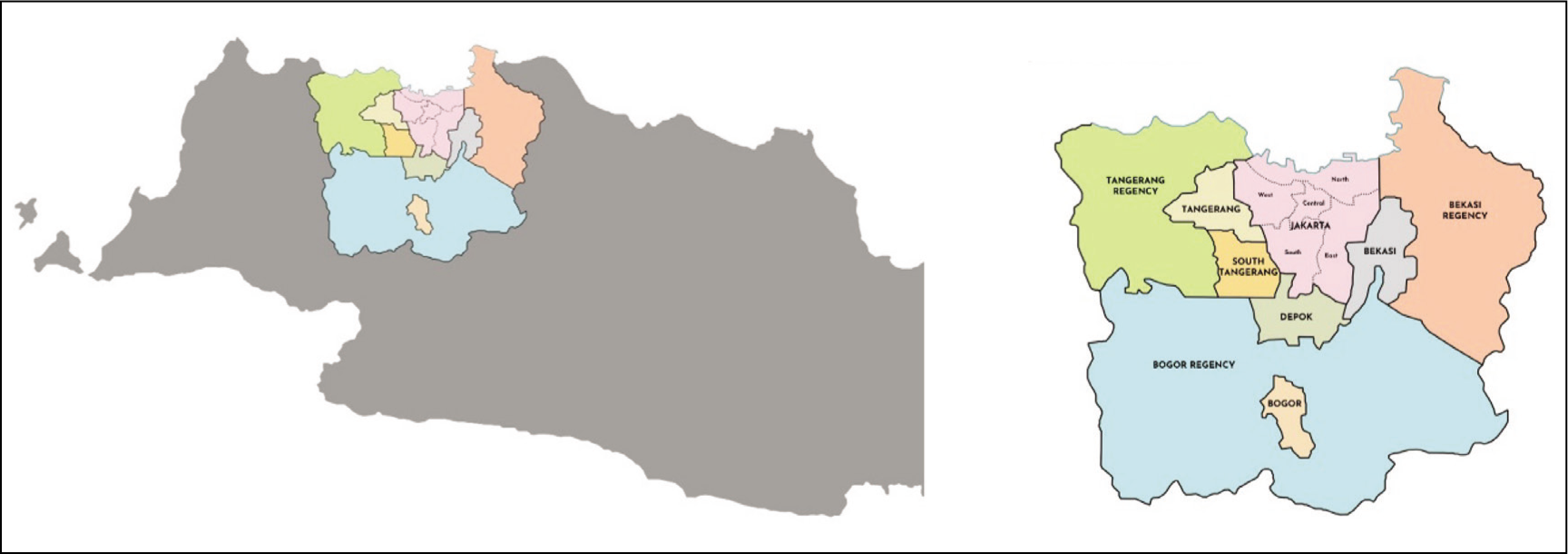
The respondents came from 13 cities (see Figure 1) and regencies, which are located in all three provinces of the GJMA. In total, 37 respondents lived in apartments and 147 respondents lived in detached housing complexes. Most of the respondents who lived in apartments were located in Jakarta (54.04%), as the majority of apartments are in the capital province. Meanwhile, most respondents who lived in detached housing complexes were located in West Java (45.58%).
Greater Jakarta Metropolitan Area.
The percentage of participating male respondents (51.95%) was slightly higher than that of female respondents (48.05%). Those aged 25–45 years were the dominant age group for both female (66.82%) and male respondents (72.46%). Meanwhile, the majority of both female (24.38%) and male respondents (26.19%) earned a monthly income of US$ 1000 or more.
The majority of both men and women were employed at private companies, followed by those who were self-employed, students and civil servants. In all, 71 female respondents who lived in apartments participated in this study, which is higher than the number of male respondents who lived in apartments. However, the number of participating male respondents who lived in detached housing complexes was higher than the number of similarly located female respondents. Therefore, it can be concluded that the common general demographic characteristics are shared among all of the study locations.
Relationships Between the Improvement of Social Capital and the Demographic Profile of Respondents
Although forced eviction of health professionals occurs in some housing complexes, generally the respondents indicated an improvement in social capital and each of its components in their neighbourhood during the LSSR period. The perception of improvement, on an average, was 3.54, which is higher than the midpoint on a 5-point Likert scale. Among the five subscales, the highest improvement was in network size (3.72), followed by civic engagement (3.71), participation in activities (3.70) and mutual aid and trust (3.52). Shared values (3.09) had the lowest amount of improvement.
According to the respondents’ open-ended replies, the LSSR period gave them free time to get to know other residents better and expand their network of relationships more widely, due to having more frequent contact during their daily activities within the neighbourhood. During the pandemic, most respondents spent their mornings doing some form of exercise, such as running or walking to increase their immunity and maintain their health; this enabled them to meet other residents and engage in conversations. As a result of the friendships that developed, respondents began to participate more in activities such as sports, neighbourhood watches or informal social gatherings in the street or at one of their houses. Through these contacts, they shared mutual aid and support during the pandemic, such as by purchasing each other’s homemade food and beverages, lending money, sharing information about job opportunities for those who had lost their previous employment or confiding in each other and offering advice as a form of moral and emotional support. However, these activities were not correlated with the presence of shared values among the residents, as maintaining safety and security during the pandemic was the main value that united them.
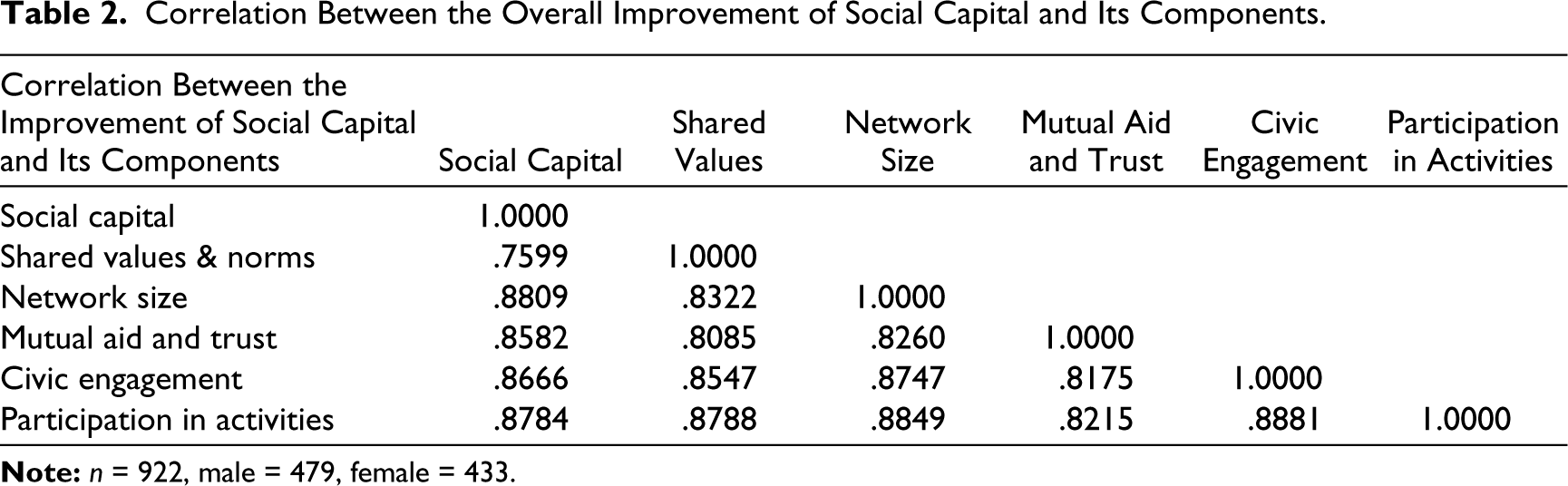
Table 2 shows the correlation among the overall social capital score and its five components. The high correlation levels confirm that shared values, network size, mutual aid and trust, civic engagement and participation in activities all contribute to the building of social capital (Coleman, 1988; Putnam, 2000). Also, the components were positively correlated with each other to a significant degree, indicating their interrelatedness.
Correlation Between the Overall Improvement of Social Capital and Its Components.
According to Table 3, the improvement of social capital is determined by the improvement of all its components, including shared values and norms (p = .0187 < .05), network size (p =.0309 < .05), mutual aid and trust (p = .0139 < .05), civic engagement (p = .0462 < .05) and participation in activities (p = .0087 < .05).These findings are consistent with those shown in Table 1 and again confirm the positive contribution of all the components to social capital.
Interrelationship Between the Improvement of Social Capital and Its Components by Demographic Group.
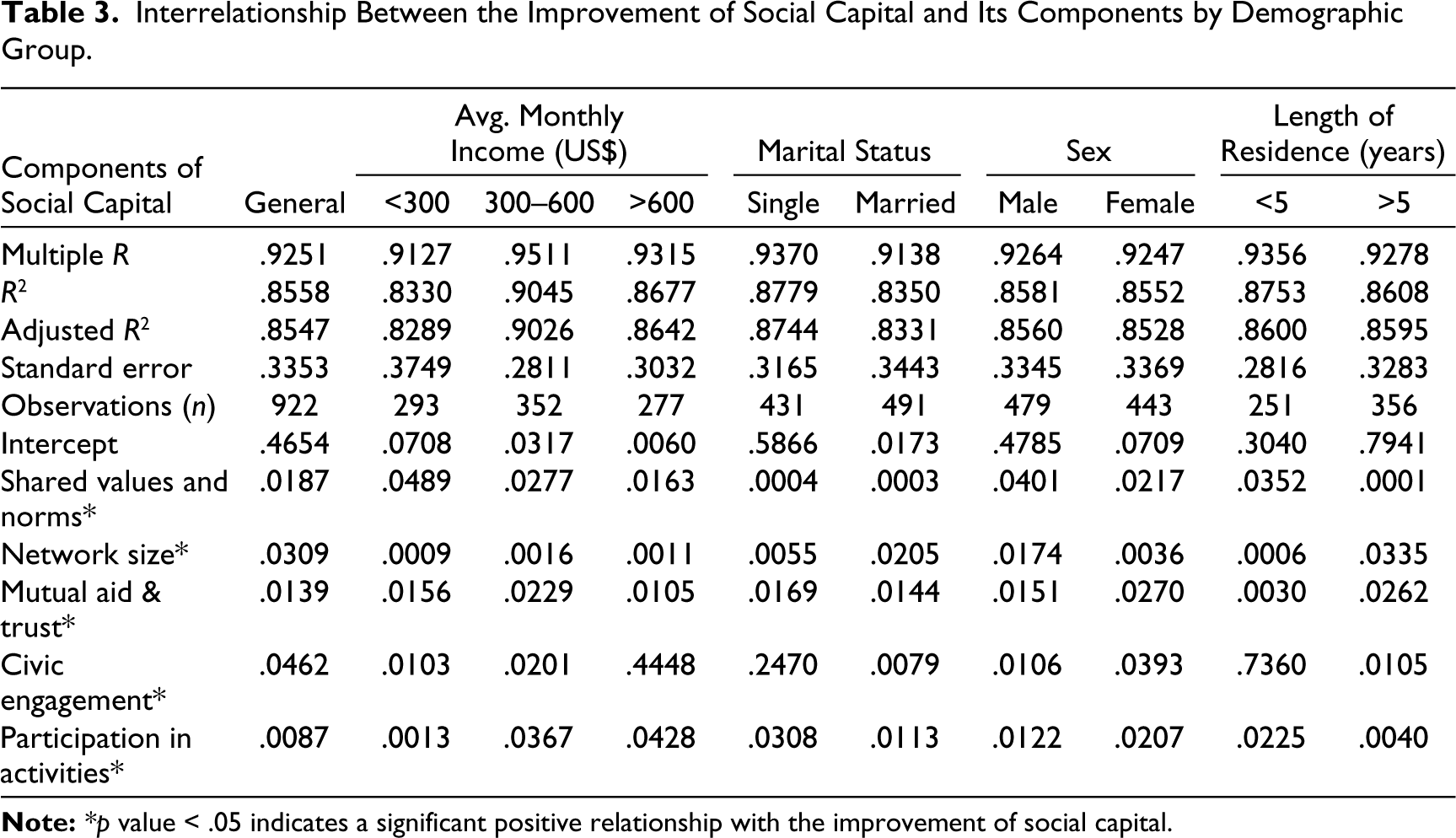
However, some components of social capital do not necessarily have the same relationship across demographic categories. In the category of average monthly income, among those earning less than US$ 300, there were significant relationships between the overall improvement of social capital and the improvement of all components. However, a slightly different result was found for those with an average monthly income of more than US$ 600. In this subcategory, the improvement of civic engagement (p = .4448 > .05) did not have a significant relationship with the improvement of social capital. Similarly, no significant correlation with the improvement of social capital was found among respondents who were not married (p = .2470 > .05) or those who had lived in their residence for less than five years (p = .7360 > .05).
Among the 277 respondents earning more than US$ 600 per month, 67 (24.2%) were reluctant to engage in decision-making or community organizations; their main reason was that they wanted to avoid the conflicts that can arise through intense discussions with other residents. In addition, 44 respondents (15.8%) indicated lack of time (because they were still working from home) or had limited competence, so they preferred to follow instructions given by the community organizations regarding neighbourhood participation.
Among the single respondents, 99 (23.0%) declined to engage in decision-making processes because of their lack of experience and knowledge of how to deal with the pandemic. Another 27 (6.3%) were uninvolved with community decision-making because they were occupied with work from home but agreed to support any actions that the community organization reached with regard to minimizing COVID-19 transmission in their neighbourhood.
Among those who had lived in the neighbourhood for less than a year, reluctance to civic engagement was strongly related to a sense of inferior status in expressing their aspirations to the community organization, which is dominated by longer-tenured residents. This reason was expressed by 88 respondents (35.1% of this subgroup). Another 23 people (9.16%) judged that their lack of reputation in the neighbourhood would hinder their effective participation in the community organization’s decision-making process.
Overall, these responses indicate that the LSSR during the pandemic provided more opportunities for respondents to meet and talk with the neighbours, which created new friendships as well as potential for conflicts with fellow residents. Furthermore, civic engagement requires some political skill and experience in decision-making and community organization, which is not possessed by all respondents.
The findings also indicate that improvement of shared values and norms, network size, mutual aid and trust and participation in activities were all widely considered pivotal determinants in the improvement of social capital in the GJMA neighbourhood during the LSSR period. Respondents were able to increase the size of their social networks and develop stronger mutual aid connections and trust with their fellow residents, as well as increase their participation in activities with their neighbours. However, among several respondent subgroups, engagement in decision-making and community organizations did not improve significantly and did not contribute to improvement of social capital. In these cases, improvement of social capital occurred despite the lack of contribution from one of its components, since these subgroups still experienced improvement of the other components.
Furthermore, the findings highlight the role of demographic factors in the accumulation of social capital and its primary components among members. Although all of the primary components demonstrate significant relationships with built social capital, civic engagement is the only component that is influenced by demographic factors, as it is shared by respondents with monthly incomes over US$ 600, those who are single and those who have lived in the housing complex for less than five years.
According to Table 4, there are three primary components of social capital for respondents who live in apartments: mutual aid and trust (p = .0294 < .05), civic engagement (p = .0144 < .05) and participation in activities (p = .0077 < .05). In contrast, those who live in detached houses have all primary components of social capital, including shared values and norms (p = .0358 < .05), network size (p = .0387 < .05), mutual aid and trust (p = .0165 < .05), civic engagement (p = .0382 < .05) and participation in activities (p = .0249 < .05). This aspect demonstrates that residents of detached housing have more primary contributing components of social capital than those of apartments; such primary contributing components include shared values and norms and network size. Nonetheless, the lack of shared value and norms and network size does not necessarily hinder respondents’ ability to foster mutual aid and trust, partake in civic engagement or participate in activities. It also indicates that the components of social capital are not necessarily interrelated.
The Interrelationship Between the Improvement of Social Capital and Its Components by Housing Type and Provinces Group.
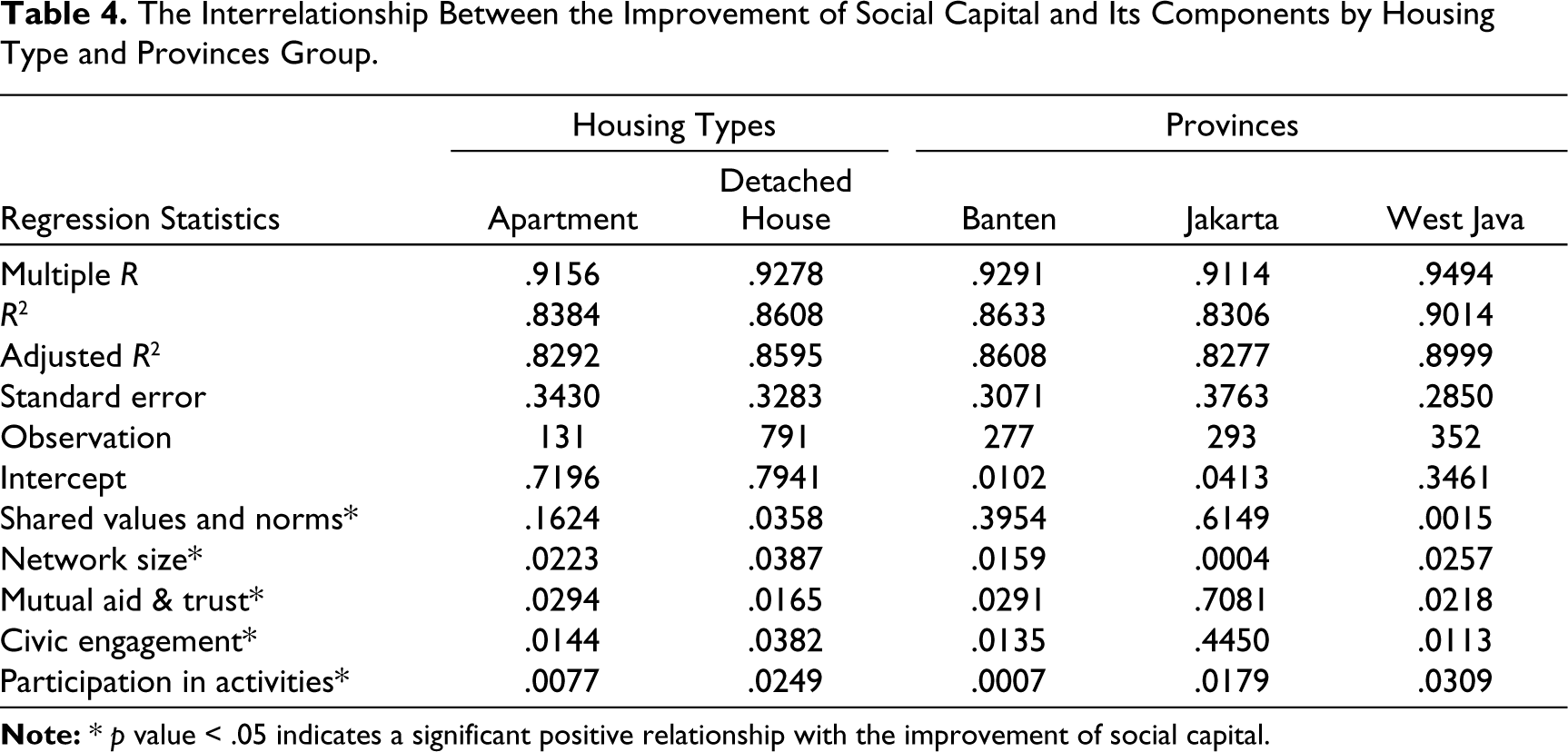
The primary factors of social capital in the three provinces are also varied. As Table 4 shows, only West Java residents possess the primary components of social capital. West Java is followed by Banten, which lacks the primary factors of shared values and norms. Jakarta provides only two primary components: network size (p = .0004 < .05) and participation in activities (p = .0179 < .05). This finding further demonstrates the lack of interrelatedness among the primary components of social capital, which does not implicate the social capital among community members.
Gating as a Concrete Practice of Collective Efficacy
The improvement of social capital was reflected in a specific practice of collective efficacy during the LSSR period, as 741 respondents (80.3%) mentioned spontaneous gating as the primary application of collective efficacy during this time. Gating was implemented to restrict entry into the neighbourhood by non-residents so as to reduce the risk of COVID-19 transmission. Before the LSSR period, the gate was closed only at night to prevent burglaries. During the LSSR period, the gate was renovated, strengthened and kept closed all day and night; it was opened only under the supervision of residents, who took turns standing guard. The guards insisted on checking the temperature of non-resident visitors and required them to wash their hands with a hand sanitizer provided by the residents in an effort to prevent COVID-19 from entering their neighbourhood.
Besides the primary goal of combating COVID-19 transmission, the spontaneous gating also addressed the possibility of increased crime related to the sudden unemployment suffered by many Indonesians. Therefore, it served to enhance residents’ safety and security with regard to two prominent threats.
A guardhouse was constructed to provide comfort for the residents who provided surveillance at the gate. The schedule was arranged by the head of the neighbourhood association, informal community leaders and the residents who participated in community meetings. There were 253 of 741 respondents (34.1%) who participated as gate guards. Others provided safety equipment such as hand sanitizer, thermo-guns, face masks and face shields (8.9%); sent food and beverages to the guards (28.2%); contributed money (25.2%) or even lent televisions and other entertainment gadgets (3.5%) to make the experience of the gate volunteers more comfortable.
The spontaneous gating during the LSSR period changed the distribution of consumer goods to households. Before the LSSR period began, ambulatory vendors could freely enter the neighbourhood and the street would become a space for exchange. However, once the restrictions on movement were implemented, vendors were prohibited from entering the neighbourhood, and the outside gate became the place where residents met them and purchased their commodities. Also, the frequency of online shopping increased during the LSSR period, and the guardhouse became the reception desk for the purchased goods, which residents obtained subsequently after confirming their identity to the guard.
Consequently, the spontaneous gate became the most popular destination for interaction in the neighbourhood according to 566 respondents (76.4%). It far outpaced public amenities such as neighbourhood parks (chosen by 91 respondents, 12.3%) or the street (84 respondents, 11.3%). The gate became the main hub for obtaining information from both inside and outside the neighbourhood on health, hazards or donations related to the pandemic. It thus emerged as the primary place for growing the social network size, obtaining mutual aid or building trust among residents. In effect, the spontaneous gate embodied the reification of collective efficacy, becoming a fertile ground for maintaining social capital among the residents.
A second expression of collective efficacy was the large number of closed-circuit television (CCTV) installations in the neighbourhood. Some residents felt that face-to-face interaction with fellow residents posed a high risk of COVID-19 transmission. Therefore, instead of relying on spontaneous gates that require face-to-face interaction between residents, these respondents preferred to create an electronic surveillance system to protect their neighbourhood.
Seventy-three respondents (7.9%) installed CCTVs in front of or around their houses to monitor the immediate vicinity of their residence. Each CCTV was connected to the residents’ smartphones so that the information could be accessed through wireless communication. Many of these residents placed a water bucket with liquid soap and hand sanitizer in front of their house gate for visitors, especially couriers delivering goods they had ordered, to minimize the risk of COVID-19 transmission. In this way, residents could perform their own surveillance through an innovative self-help method and communicate through social media platforms to reach decisions or participate in common activities. Although it triggers negative implications, such as affecting one’s privacy, communicating through electronic devices did not reduce the residents’ ability to improve shared values and norms, network size, mutual aid and trust, civic engagement or participation in activities. This finding also shows that the respondents shared one important value: the desire to reduce COVID-19 transmission among the residents or from visitors to their neighbourhood.
Providing shared Wi-Fi access was another form of collective efficacy among residents, according to 108 respondents (11.7%). During the LSSR in GJMA, high-speed Internet connection was essential to support telework and remote schooling activities. Unfortunately, Internet quality in GJMA is unstable, potentially disturbing the completion of those activities. Therefore, residents initiated contracts with multiple Internet providers and installed additional routers to ensure good Internet coverage throughout the neighbourhood. This activity illustrates collective efficacy in that the residents collaborated to maintain their mutual welfare by making sure that economic and educational activities could continue without interruption. It confirms the contention by many scholars that collective efficacy grows out of the social norm of trust, through mutual engagement of community members to meet common goals and provide goods (Meares, 2002; Sampson, 2009, 2012; Sampson & Groves, 1989). Shared values and norms were implemented through enlarged social networks in a powerful expression of mutual aid and trust among the residents.
Conclusion and Recommendations
The global COVID-19 pandemic transformed human life around the world. Despite all the adversities that it brought, this pandemic helped the residents of neighbourhoods in GJMA to improve their social capital and collective efficacy. In general, the residents managed to improve their shared values and norms, social network size, mutual aid and trust, civic engagement and participation in activities—the essential components of social capital—to practise collective efficacy and thus ensure their safety and security amidst a contagious, lethal virus and fears of increased crime. Despite the improvement of social capital and all of its components, civic engagement was less strongly related to the improvement of social capital in several demographic categories: people of higher average monthly income, the unmarried and those with shorter tenures as residents. These differences are understandable, because certain skills and interpersonal relationships are needed to engage effectively in the decision-making processes of a community organization. These findings contribute to the understanding of social capital, as they have not been noted previously in the extensive body of literature on this topic.
Therefore, all of the primary components do not necessarily build social capital among community members or guarantee collective efficacy. Shared values and norms as well as network size are among the non-primary components of social capital that guarantee collective efficacy. Furthermore, demographic factors contribute to the primary components of social capital, a finding which complements the existing body of literature on social capital and collective efficacy, especially research conducted in Indonesia.
The overall improvement of social capital enabled residents to deliver collective efficacy in many forms, such as spontaneous gating, CCTV installation and Internet connection provision throughout the neighbourhood. These actions not only helped to prevent COVID-19 transmission and criminal activities in the neighbourhood but also ensured the continuity of residents’ livelihoods and their children’s education.
This study highlights the pivotal role of social capital in achieving collective efficacy to protect the safety of community members during the COVID-19 pandemic in Indonesia. Social capital may already be deeply embedded among community members, as they live in the neighbourhood. However, it can grow rapidly and manifest into collective efficacy only when there is a need to meet a common goal. In such cases, a hazardous event may initiate and accelerate the growth of social capital and its transformation into collective efficacy. Social interaction is the catalyst that accelerates the growth of social capital into collective efficacy; however, this finding also indicates that among other components of social capital, the length of residence, age and monthly income are primary demographic factors that influence civic engagement. Therefore, periodical social interaction among community members facilitated by senior residents may encourage newer residents to improve their social interaction with neighbours and partake in civic engagement.
Due to the possibility of bias in our sample, the results of our study can be generalized only with caution. Future studies could take steps to include those subgroups who may have been excluded from our online data collection, such as the elderly or those who lack Internet access. Furthermore, it would be interesting to examine the interrelationship between social capital and other forms of capital in the overall framework of sustainability so as to understand more comprehensively the transformation of people’s lives during the pandemic. Longitudinal studies could more fully grasp how neighbourhoods are being transformed by the practice of collective efficacy. The phenomena identified in this study could have several negative long-term implications, such as the proliferation of gated communities, fragmented urban structures or severe spatial and social segregation between urban neighbourhoods. Additional studies of this nature could contribute to the development of public policy so as to plan and execute both short-term and long-term government interventions that could improve citizens’ livelihoods and the quality of urban planning on a wider scale.
Footnotes
Declaration of Conflicting Interests
The authors declared no potential conflicts of interest with respect to the research, authorship and/or publication of this article.
Funding
The study was supported by a grant from the Hibah Publikasi Terindeks Internasional (PUTI) Q2 Tahun Anggaran 2022-2023 (Batch 2) scheme under grant number NKB-1348/UN2.RST/HKP.05.00/2022.