




Abstract
The complex challenge of managing urban growth and development in the context of climate and environmental change has led to a proliferation of policy discourses related to the ‘green city’. While useful as a buzzword, it is argued that green city discourses often overlook or even mask questions of social and environmental justice. This case study of Phnom Penh, Cambodia, shows that the presence of green and sustainable city discourses in policymaking does not reflect the reality of urban planning practices. Instead, it has produced an urban vision reflective of the priorities of global capital while contributing to the ongoing destruction of urban biodiversity and the marginalization of urban residents living in poverty. It is argued that a reconceptualization of the green city be undertaken, which incorporates understanding of participatory and distributive justice to ensure that urban planning practices are inclusive and sustainable.
Introduction
The Sen Sok district in the northwest of Phnom Penh, Cambodia’s capital, offers an opportunity to see the transformation of the city, almost in real time. Private residential communities have emerged from the land or water at a high speed, insulating the wealthy from modern urban challenges such as crowded and unsanitary conditions. Yet, rather than offering a solution to urban vulnerability, high-end commercial and residential developments contribute to uneven urban development where environmental goods such as public space, public services and a clean environment are concentrated in wealthy neighbourhoods while poor settlements remain neglected. In many instances, luxury developments that are constructed as green enclaves separate from the rest of the city are being touted as part of a move towards ‘green cities’ (Sanzana Calvet, 2016). These oases are an exclusive output created by global flows of capital with little articulation of local development priorities. This inequality extends beyond the distribution of assets to the processes of decision-making that determine whose interests are advanced in urban development.
Terms such as ‘green city’ as well as its peers—sustainable city, resilient city and others—are intuitively appealing, leading to their use as ‘buzzwords’, where their vague meaning and positive associations can be leveraged to solicit buy-in from diverse stakeholders (Cornwall, 2007). However, it is uncertain to what extent this move towards ‘green’ urban development has actually addressed many of the pressing problems facing urban dwellers in the Global South (Gilbert, 2014). For one, terms such as ‘sustainable’ and particularly ‘green’ are closely associated with prioritizing environmental objectives and can be criticized for overlooking questions of social justice (Campbell, 1996). In other cases, environmental concerns remain aesthetic with ecological credentials used as a branding strategy to attract investors (de Jong et al., 2019). It is therefore important to reveal how discourses of ‘green cities’ have been used to greenwash uneven urban development, further entrenching environmental and social injustices in urban areas.
This article will use the example of Phnom Penh, Cambodia, to show how discourses of green or sustainable urbanization can obscure urban development practices that are both environmentally damaging and socially unjust. First, the main ideas as well as criticisms of the ‘green city’ as a discourse are presented. After that, the article shows how this discourse is used in practice in Phnom Penh, highlighting how greenwashing facilitates the replication of an urban form that serves the objectives of global capital over the city’s diverse residents. The concluding section suggests how ideas of social and environmental justice can be integrated with green city discourses to promote an approach to sustainable urban development that addresses issues of inequality and environmental protection.
What Is a Green City and What Is Not?
Terminologies to describe improvements in urban environments have multiplied since the 2000s, including significant scholarship which describes the evolution of theories related to sustainable urban worlds (Bayulken & Huisingh, 2015; Sharifi, 2016). Some authors (Kahn, 2006; Parsons & Schuyler, 2002) see in the term ‘green city’ the testimony of a semantic evolution in urban planning and production, a category that distinguishes itself from those developed in previous years such as the notion of resilient city, ecological city, garden city or even smart city. Conversely, for other researchers, there is no presumption that the green city is a distinct notion from these other terms (de Jong et al., 2015; Pace et al., 2016). Thus, the green city is at times equated with the resilient city, or equivalent to the notions of garden city, sustainable city, ecological city or smart city insofar as these terms would bring together the common goal of thinking about sustainable urban development (Shen & Fitriaty, 2018).
In the context of low- and middle-income countries, terms such as ‘sustainable’, ‘resilient’ or ‘green’ remain little studied and are regularly associated with funding flows from Western donors and international organizations such as the United Nations (Satterthwaite, 2013). For example, the implementation of the Sustainable Development Goals (SDGs)—with Goal 11 explicitly focusing on the sustainable city (‘make cities and human settlements inclusive, safe, resilient and sustainable’)—and the Habitat III conference in Quito in 2016 have helped to disseminate the notion of the sustainable city and its related concepts on a global scale, especially among cities in the Global South (UN-Habitat, 2019). In 2021, the Association of Southeast Asian Nations (ASEAN) launched a new initiative to promote sustainable and smart cities in ASEAN called Smart Green ASEAN Cities (ASEAN, 2021).
The green city as an object and the implementation processes that accompany it are multiplying around the world where it takes on several forms. Spatially, some green city projects unfold in the heart of the city centre as urban renewal: greening projects to increase the number of cool islands, waste and other resource management programmes or sustainable mobility planning (Phnom Penh Capital Hall et al., 2018). In other cases, green cities unfold on the periphery of the city as ‘utopian’ satellite cities linked to processes of globalization (Leducq & Scarwell, 2019). Sometimes developed on hundreds or even thousands of hectares, these projects can be similar to urban mega-projects, where urban planning is characterized by the omnipresence of the private sector, large and influential developers supported by public authorities in all phases of development (Fanchette, 2015; Shatkin, 2008). What makes these projects green is not always explicitly stated; repeated use of the term without an accompanying definition risks diluting its meaning over time, leaving room for ambiguity (Chang, 2018).
Thus, there is not one model of the green city, but a plurality of green cities. Three broad categories are identified here of how the term is deployed according to the urban studies literature:
As a technical and technological tool: This work is carried out by engineers, architects or even economists, who rely on quantitative and statistical data to evaluate, quantify and formulate urban production techniques. The term ‘green city’ is often adopted alongside a suite of tools, standards and indicators designed to manage and monitor aspects of urban design and architecture in the city, such as energy performance, building standards or water use (Cidell, 2009; Hong et al., 2018; Liu & Chou, 2018). This can be integrated with the adoption of information and communication technologies (ICT), blending a green city approach with a smart city model (Shen & Fitriaty, 2018) and creating a blurred boundary between these two terms. To promote environmental restoration: The green city can also focus on the rehabilitation or restoration of urban ecosystems or green spaces. In this approach, the concept of the green city is seen as a guide by which the promotion of an abundance of plants, trees and green spaces would contribute to improving the urban living environment (DeKay & O’Brian, 2001). As a brand object (Wang, 2019): The term ‘green city’ can also be used by cities to position themselves on the world stage (Chan & Marafa, 2014; Gilbert, 2014). This is often tied to ideas of what is modern, innovative or trendsetting as can be seen in Hanoi’s Master Plan 2030, whose motto is ‘a green, cultural, and modern city’ for 2050 (Leducq & Scarwell, 2019).
In an Asian context, the concept of the green city is inseparable from that of the smart city (Bertrais et al., 2023). As Shen et al. (2018) state with respect to urban and architectural planning:
The recent evolution of the Green city concept in Asia tries to integrate the concepts of the Green city and Smart city to establish the new green-smart concept to achieve an ideal city with a sustainable, smart living environment, with a healthy ecology, low carbon emissions, and resource security in the future. (Shen et al., 2018, p. 15)
Indeed, in Southeast Asia, the green city is characterized by its green–smart hybridity, a reality most in evidence through the example of Singapore (Chua, 2011; Newman, 2010). Thus, green city or smart city models are urban models that circulate and produce at the local scale a ‘hybridization’ between globalized urbanistic practices and local assemblies (Leducq et al., 2017).
Limitations of a Green City Discourse
Despite the popularity and ubiquity of the preceding green city discourses, particularly in urban planning practice, critics have pointed out the tendency for this approach to focus on the production of urban space, overlooking questions of access and distribution or, in other words, justice. Castán Broto (2018, p. 57) notes that one of the greatest weaknesses in the current implementation of urban green policies is ‘the lack of participation and recognition of marginalised voices’. Instead, decision-making as it pertains to the green city is typically perceived as the remit of specialists who can provide technical solutions. This lack of participation and attention to distribution is related to a broader concern that the green city discourse is easily co-opted and deployed as green neoliberalism, ignoring issues of socio-spatial justice in favour of greening the status quo (Gilbert, 2014).
The green city, though regularly described as a virtuous urban model, does not inherently reduce socio-environmental inequalities (Ernstson, 2013; Venter et al., 2020; Wolch et al., 2014). Instead, its focus is often performative greening, which can serve to distract attention from processes of exclusion, in which the less well-off suffer negative externalities (air and water pollution, noise or light pollution, modification of the living environment etc.) and in which biodiversity would be damaged (Kahn, 2006; Wolch et al., 2014). This is particularly the case when green city discourses are mobilized in the service of international capital flows which seek to replicate urban forms like gated communities that have little integration physically, socially or culturally with the rest of the city. From these findings, the green city could come to reinforce socio-spatial and environmental inequalities, while it advocates inclusion through international and local discourses (Kaika, 2017). These would be reflected, on the one hand, in the appropriation of certain amenities by a minority and, on the other hand, in the form of spatial segregations, where the most affluent would inhabit these healthy and peaceful islands while the most deprived would find themselves more confronted with environmental nuisances and risks (Emelianoff, 2017).
Environmental Justice in the Green City
Social injustice is manifested in space, and conversely, the social organization of space can produce injustice (Soja, 2009). Certain urban forms greatly reflect these spatial injustices, particularly those that are planned and inhabited by privileged populations (middle and upper class), such as the gated communities multiplying in cities of the Global South (Coy & Pöhler, 2002; Zhu, 2010), though some authors have noted the diversity and complexity of the gated communities in order to avoid a typology of class stratification (Boonjubun, 2019).
Scholars of environmental justice (EJ) have taken a broad perspective on the environment, making it highly compatible with studying urban environments (Schweitzer & Stephenson, 2007). EJ has attributed an important role to the environment, showing that questions of justice can apply not only to humans but also to the non-human world (White, 2018). Additionally, as ecosystems are destroyed or destabilized, instability comes back to harm communities in other ways, from flooding to food insecurity to health impacts (Ross & Zepeda, 2011). Recognizing the injustice inherent in the destruction of non-human life is a shift from viewing environmental degradation as a symptom of social injustice (Schlosberg, 2013).
Furthermore, scholars have argued that injustice is perpetuated not only through the distribution of environmental harms and goods but also in the power to influence decision-making processes (Larrère, 2017). In urban areas, the lack of participatory justice has manifested as marginalized communities facing increased risk as a result of their lack of power or ‘right to the city’ (Griffin et al., 2017). Thus, in addition to distributive justice, participatory justice, which recognizes the right to have a voice in decision-making, is also critically important to environmental justice (Minkler et al., 2008, 2010; Schlosberg, 2013).
Any conception of justice necessarily implies a potential for conflict and the need for situated understandings of what is just (Campbell, 1996; Schlosberg, 2013). Justice goes beyond the distribution of risks and opportunities and must include recognition of underlying goals for environmental use and benefits (Anguelovski, 2013). These goals will be set and contested by stakeholders based on values and norms, requiring questions of justice to be contextualized to their social and cultural settings. As such, the priorities for urban development must be highly contextualized to take into account different social, cultural and historical factors that shape access to resources, as well as what different communities or stakeholders identify as desirable. This has been a weakness of green city models which tend to be transplanted through international institutions with little engagement with the local context (ASCN, 2018; ASEAN, 2021; Neo & Pow, 2015).
This case study of Phnom Penh, Cambodia, shows how the use of rhetoric related to the green city is deployed as performative greening, while the predominant models of urban growth persist and create enclaves for the wealthy with limited attention to distributive or participatory justice or the non-human world.
Methodology
This article is based on several years of fieldwork conducted by the authors between 2017 and 2022. It includes the results of a finalized doctoral research project (Beckwith, 2020) and a doctoral research project in progress that draws on several months of fieldwork conducted between February and June 2021 and May and August 2022. Beckwith (2020) conducted 47 interviews with residents of low-income areas in Phnom Penh, a household survey with over 100 low-income residents on the impact of environmental change on livelihoods and 36 key informant interviews about Cambodia’s urban development and climate change policies. The latter included 15 NGOs or civil society members, 1 academic, 6 from the UN and other international organizations, 5 donor representatives and 9 government representatives (local and national).
For the doctoral research in progress, Bertrais conducted more than 50 semi-structured interviews with policymakers at the municipal and ministerial levels, as well as with planning practitioners, private developers and residents directly involved in the development of the ING City urban project. In addition, the authors draw on personal observation from numerous field visits and projects underway within the ING City project and ‘observant participation’ work (Bastien, 2007) conducted within the urban planning department of the Municipality of Phnom Penh between September 2017 and July 2018. A book, Phnom Penh Extension et Mutations (APUR, 2019), has been published from this work, focusing on the urban expansion in the south of Phnom Penh and questioning this urban mega-project.
Phnom Penh, Cambodia
Phnom Penh, Cambodia, presents an interesting case to examine how green city discourses have been used to legitimize an urban form that threatens ecosystems and deepens inequality. Like many cities in Southeast Asia, the Cambodian capital is progressing at a frenetic pace supported by a model of governance that greatly encourages openness to foreign capital and stimulates economic growth (7.5 per cent of GDP in 2018) (World Bank, 2020). Vast mega-projects filled with luxury retail space and gated communities are under construction in all corners of the city. These projects come directly at the expense of urban wetlands, which underpin wastewater management and flood protection in the city and are being devastated by in-filling to create new land for urban expansion (Beckwith, 2020). These mega-projects produce a particular urban environment and economic model as funding for them often comes from foreign capital (Ong, 2011). In addition, urban evictions continue to affect poor communities who are removed from valuable land in the inner city, showing persistent inequalities in access to land and housing (LICADHO et al., 2020). While Cambodia’s urban development policy increasingly speaks the language of sustainable development, Phnom Penh’s rapid urban transformation has serious repercussions that render both the urban environment and its population increasingly vulnerable (Saltsman et al., 2021).
In Phnom Penh, this entre soi is organized through the closed borey (Fauveaud, 2015). An urban form that became popular in the late 1990s, the borey represents residential projects implemented by private Cambodian developers. This burgeoning urban typology on the outskirts of the city is highly coveted by Cambodians. This is partly due to the possibility for future owners to acquire a hard title. 1 Some of these boreys call on external private companies for many services such as waste management, security surveillance, maintenance of green spaces and so forth. 2 These services may be scarce or non-existent in other neighbourhoods. Thus, the distribution of services can become a source of inequality.
The scale and distribution of these projects are evidence of the lack of cohesion in urban planning at the city scale. Though the city has developed a Master Plan (to be discussed in detail below), it is rare to find a project which adheres to it since there are no legal instruments to force property developers to follow the recommendations of the Master Plan. In fact, the market has created its own rules and exerts its own forces, often to the detriment of the city’s poorest households that are not a priority given the private sector’s focus on economic returns for their investments (Clerc, 2010).
Green City Discourses in Phnom Penh
Closely linked to the influence of international actors (private sector and international organizations), discourses related to making Phnom Penh a green city have infiltrated urban planning policies and notably the marketing strategies of private developers. For example, the city boasts a Sustainable City Plan, which in its initial stages was called the Green City Strategic Plan, indicating the interchangeable nature of these terms. The most prominent usage of green city discourse in Phnom Penh is that of a brand object. Beginning in the days when Phnom Penh was known as the ‘Pearl of Asia’, the city has traded on its green aesthetics (Yean, 2018). This continues unabated in the promotional materials of private real estate developers, despite the fact that little evidence of an urban nature remains in most of these projects. Instead, this claim exists as a marketing imagery to create the idea that large-scale developments can be ‘green’. 3 Figure 1 shows the use of performative greening with respect to private development projects.
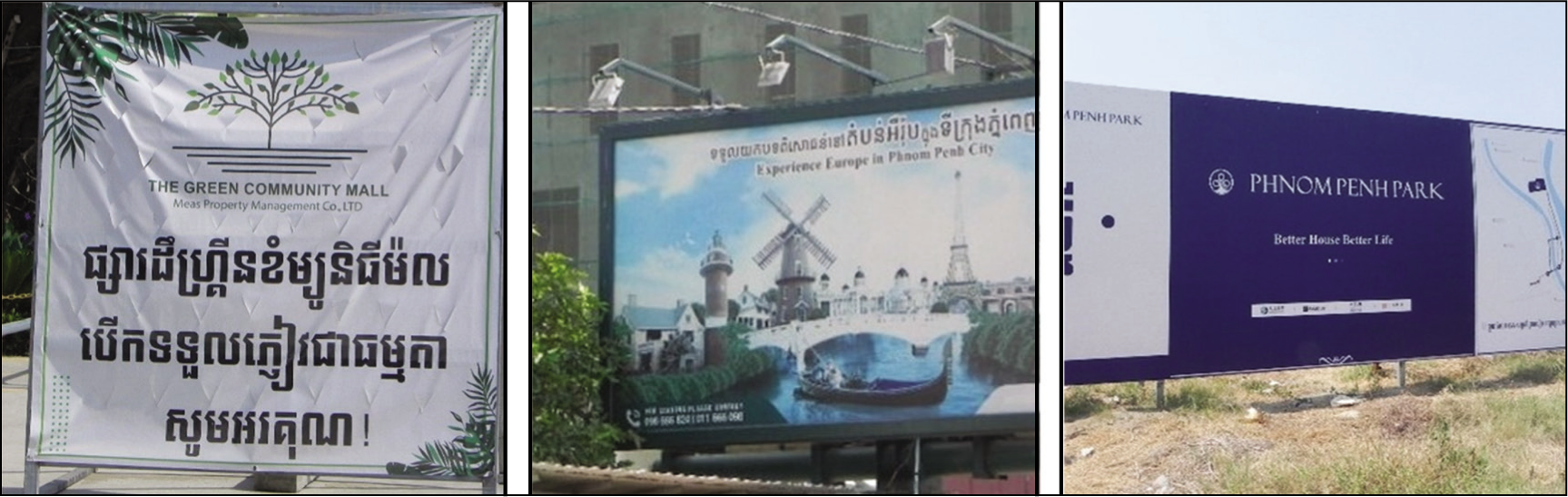
However, the following case study will show that despite the prevalence of green city discourses, many processes that purport to promote the green city are directly contributing to processes of injustice such as social exclusion and environmental degradation.
Case Study: ING City
The shift in policy towards the adoption of green and sustainable discourses is failing to have a positive impact on the urgent environmental problems in Phnom Penh. Instead, the creation of a so-called green city is directly contributing to the loss of critical urban lakes and wetlands. Between 2000 and 2015, an average of 1,000 hectare of built-up area was added to the city every year, including the in-filling of over 6,000 hectare of aquatic environment (Mialhe et al., 2019). Through the construction of vast boreys, often built on top of wetlands, urban development in Phnom Penh often follows a pattern of environmental destruction and social exclusion. Approved by government decree, ING City, the largest of seven planned satellite cities, is a 2,572 hectare development project. Phase I of the project, led by the Cambodian company ING Holdings, is already underway, featuring the construction of high-end gated residential areas and luxury commercial centres. The majority of the development will take place on land reclaimed from lakes and wetlands in the southern periphery. ING City boasts of being fully supported by the Royal Government of Cambodia and being in compliance with the 2035 Land Use Master Plan for Phnom Penh. As the work progressed, with the agreement of many ministerial sub-decrees, the surface area that was to be kept as lake gradually decreased, and in 2020, the surface area of the lake filled in (or was proposed to be) reduced to the point of almost disappearing completely, leaving only a channel of 107 hectare, completely modifying the hydraulic system of the city of Phnom Penh and its surrounds (LICADHO et al., 2020, p. 20).
The significance of this loss cannot be overstated due to the outsized role the lake system plays in capturing and storing rainwater during the rainy season and thus sparing the city from flooding. The ING-led development is taking place at the expense of a wetland area that currently plays a critical role in flood and wastewater management for the region. The lake system receives approximately 70 per cent of the wastewater run-off from Phnom Penh (APUR, 2019), which enters through two pumping stations in the north end of the lake (Irvine et al., 2015). As Phnom Penh has no central sewage treatment facility, this water enters the wetland system containing multiple contaminants including nitrogen, phosphorous, E. coli and detergents (Sovann et al., 2015). The Japanese International Cooperation Agency is funding the construction of a sewage treatment plant in the area, but according to their representative, the plant is a ‘pilot’ and will treat less than 1 per cent of the water flowing into the lake (Nishikawa, 2018). The loss of the wetland will have uneven impacts on the city’s residents. Flooding risk in both the capital and the surrounding region will rise as the absorption capacity of the lakes are lost. This is a clear example of unjust urban development that prioritizes economic accumulation for an elite few at the expense of the majority of the city’s residents who will have to bear the costs (Saltsman et al., 2021).
No environmental impact assessment for the satellite city has been made publicly available, though the Constitution of Cambodia provides in Article 59 that
The State shall protect the environment and balance of abundant natural resources and establish a precise plan of management of land, water, air, wind, geology, ecological system, mines, energy, petroleum and gas, rocks and sand, gems, forests and forestry products, wild-life, fish and aquatic resources.
Despite the presence of green discourses embedded in the institutional framework and promotional materials of ING City, the implementation of the project is creating significant environmental risk for the city and its surrounds as well as contributing to social exclusion.
While Phnom Penh’s government and private sector developers have embraced green discourses, there is little urban planning at the municipal level (Phnom Penh Capital Hall et al., 2018). Instead, private developments such as satellite cities operate independently without a clear vision for the social and ecological impacts that are created in other areas or at other scales. In the case of ING City, low-income residents who live in the area that has been designated to be turned into a satellite city report that they were informed by local officials that plans were underway to build a ‘green city’ in the area. Residents say they were shown a picture which featured glass skyscrapers and told they would only be allowed to stay if they could also build high rises; otherwise, they would have to leave. 4
Additionally, low-income villages in this area are desperately underserved by public services such as waste collection, electricity and drainage. In many cases, communities are forced to improvise their own solutions such as one village that built its own road out of debris from local construction sites (Beckwith, 2021). While established communities get by with no services, nearby huge boreys are being constructed. In these high-end enclaves, private sector actors are brought in to deliver services such as waste collection, maintenance of infrastructure and street cleaning that are absent in other areas. 5 Thus, in terms of a clean urban environment, the green city is represented within boreys and therefore only available to the middle and upper classes. The green city, as proposed by developers of ING City, does not take into account the existing residents of the area. This results in a development pattern of displacement and segregation where land previously occupied by low-income communities is pushed further out of the city and occupied by the wealthy. This creates an unjust distribution of land and environmental risk (Bertrais et al., 2023).
Discussion: A Green and Just Phnom Penh
This analysis demonstrates that despite its conceptual evolution, the term ‘green city’, even when adopted into policy, does not necessarily lead to the production of an urban form that is just, inclusive or sustainable. In Cambodia, official documents and discourses promote narratives which present the idea of Phnom Penh as a sustainable and green city. This mirrors semantics articulated in national and international programmes, notably those of the UN and ASEAN. Nevertheless, in these discourses, the great absence of questions about environmental justice and the ‘right to the [green] city’ (Lefebvre, 1968) demonstrates the limits of these paradigms carried by actors with hegemonic discourses. Thus, the operating methods continue to be based on the logic of land or, in this case, water-grabbing, where the results seem to be quite similar. Vulnerable populations and non-human nature are being overlooked in this land grab for speculative real-estate developments reserved for social and economic elites.
In the same way, private promoters are appropriating these terms to justify their profit-seeking projects (Fauveaud, 2016). These large urban projects such as ING City are developed on land that until now was public land and undervalued despite being home to many communities, farmers and fisherfolk and playing a vital role in flood protection and wastewater management. The ING project demonstrates that the use of the terms ‘green’ or ‘garden’ and the associated 3D computer graphics have been powerful levers to legitimize the privatization of common goods, but in the end, no consideration has been given for the ecosystem services provided by the land occupied by the green city, nor the social or economic value such land provided for its inhabitants.
This study suggests that serious consideration be given to the environmental and social justice issues already raised by many non-governmental organizations. The urban planning tools represented by the 2035 Master Plan, for example, could be levers for trying to mitigate growing inequalities and create unity at the metropolitan level. Urban expansion over the past 20 years, left in the hands of the private sector under the supervision of a facilitating state, has already shown its many limitations (pollution, flooding, congestion, segregation, etc.). In order to move beyond the current performative reality of green city discourses, it is proposed that urban planning practices need to be participatory and transparent. In order to achieve a sustainable and inclusive future for Phnom Penh, the different perspectives of urban residents should be reflected in these urban planning tools. Furthermore, urban planning must extend beyond the city limits to include an element of regional-level planning that incorporates the importance of ecosystems and social and environmental justice. This is particularly important in terms of planning and development of Phnom Penh’s wastewater management and flood protection. The in-filling of lakes and wetlands jeopardizes the security and resilience of not only the capital but also the surrounding peri-urban and rural environs as well as neighbouring towns.
This will require strong leadership from the municipality, supported by the ministerial level to propose a vision of a just and sustainable future for Phnom Penh. The role of the central state is essential, so it is important to understand how the power dynamics fit together to best guide the implementation of an inclusive green city that has so far been holding back this possible future. A reflection must then be carried out on the participation and representation of the population which, through a new generation, deploys numerous tools, thanks to social media to express its reticence concerning urban problems.
Conclusion
While some elements of this case study are unique to the particular context of Phnom Penh, many of the challenges facing Cambodia’s capital are common to cities all over the world. It is clear in the current state of the world’s ecosystems in terms of climate change, air and water pollution, and many other forms of ecological degradation, that there is universality in the challenge to balance the short-term priorities of employment and economic growth with the long-term need to protect our ecosystems and environmental assets. These reflections on how to promote inclusive and sustainable cities need to continue beyond the geographical space circumscribed in this article. Researchers and practitioners engaged in urban studies need to identify and amplify where progress has been made anywhere in the world so that we are all able to learn from these advancements. Local governments must engage with civil society and academic institutions that have developed innovation solutions for urban challenges that can help to transform urban planning practices that have been harmful to ecosystems and exclusive of vulnerable urban residents, moving towards nature-based, sustainable and equitable urban development.
Integrating concepts of justice with green city discourses can show how current patterns of urban development are creating uneven patterns of development, leading to green enclaves rather than a green city. Considering the environment at the project level is insufficient, urban planners and municipal officials must direct their vision for the future at the city or even regional/landscape level to understand how urban development can lead to exclusion and how ecosystem destruction can have devastating consequences for the environment, economy and society, now and in the future. It is essential for urban development to move beyond performative greening to address urban environmental challenges in an open and transparent manner, where notions of what is right must be contested and contextualized by all urban stakeholders, including city residents.
Footnotes
Declaration of Conflicting Interests
The authors declared no potential conflicts of interest with respect to the research, authorship and/or publication of this article.
Funding
Research for this paper was carried out with financial support from the Center for Khmer Studies in Cambodia and the International Development Research Centre, Ottawa, Canada. Additional funding for this research was contributed by the Ontario Graduate Student Scholarship and the Urban Climate Resilience in Southeast Asia project.