




Abstract
Urban resilience is the focus of a global policy discourse that is being mobilized by a wide range of organizations to reduce urban risk and respond to the shocks and stresses facing cities. This paper explores the process of “governing for resilience” through Durban’s resilience journey as part of the 100 Resilient Cities (100RC) programme. From an insider perspective, it presents both 100RC and Durban’s approaches to developing a resilience strategy. It reflects on the contestations that emerged as Durban and 100RC struggled over the meaning and practice of urban resilience. The paper develops a continuum of urban resilience approaches to analyse the conflicts that emerged as the global programme of urban resilience travelled to, and landed in, a South African city. The paper argues that a global framing of urban resilience needs to be responsive to a world of cities that share common risk trajectories but have different contexts and vulnerabilities.(1)
I. Introduction
Urban resilience is the focus of a well-established policy discourse, which is being implemented by global and local institutions to address risk in cities across the world.(2) In 2013, the Rockefeller Foundation launched the 100 Resilient Cities (100RC) programme, with the goal of catalysing a global urban resilience movement to help cities change “the way they understand risk and plan for the future”.(3) Through a competitive process, 100 cities were selected to participate in 100RC. They were provided with funding for a Chief Resilience Officer (CRO) and a City Resilience Framework, a suite of tools and expert support to develop their resilience strategies.
In 2018, a review of the 100RC programme was undertaken,(4) and on 1 April 2019, the Rockefeller Foundation announced the termination of the 100RC programme by July 2019. It is useful to reflect on the framing and outcomes of 100RC, and the ways in which its actors, discourses and practices travelled to, and became embedded in, cities across the world, in contributing knowledge to urban resilience theory and practice. The implementation of the 100RC programme resulted in policy “mobility and mutation”, producing fields of contested power in some cities, shaped by both global (100RC) and local institutions (city governments).(5)
This paper describes the journey of 100RC in one particular city – Durban, South Africa – and the contestations it produced. It presents the reflections and analysis of the four authors, who were integrally involved in Durban’s 100RC journey. The positionality of the authors, two of whom were leaders of Durban’s core resilience team,(6) and two of whom were part of the advisory team,(7) is acknowledged in shaping the arguments presented here. This situated and contextual knowledge is supported by documented evidence on Durban’s 100RC journey. The rationale and role of the state are explained in terms of how and why the state developed its resilience strategy in relation to 100RC, rather than being critically analysed in this paper.(8)
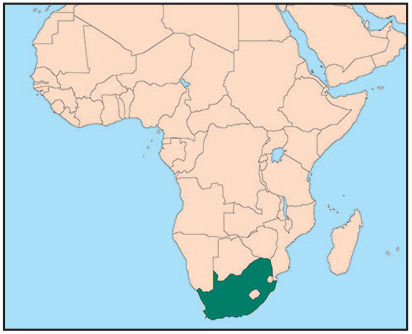
Durban, which is administered by the local government of eThekwini Municipality, became a 100RC city in 2013, when it was selected as part of the first cohort of 32 cities. As a leader in the fields of biodiversity conservation, climate change adaptation and water governance,(9) eThekwini Municipality’s initial interest in applying to 100RC was to use the programme to further integrate these fields of work into its city planning and development, using a resilience lens. The municipality wanted to create new opportunities for transformative action and to build on existing work in the field of urban resilience. The core resilience team believed this was essential to the city’s future, given increasing risk from rising inequality, declining natural habitats and growing evidence of climate change impacts. The team was deliberate about the way in which the resilience strategy was developed, adopting approaches that were reflective of the local context (including local political and institutional dynamics) and inclusive of local stakeholders’ conceptions of resilience. This was done to build relationships and trust, which would provide the foundations for longer-term institutionalization of resilience within the operations of the city. Importantly, the core resilience team recognized that building resilience needed to form part of a larger journey towards transformation, which would require a strengthening of some systems, but a fundamental breaking down of others, in order to bring about the necessary shifts towards a more sustainable and just society. This recognition aligns with Elmqvist et al’s.(10) arguments that resilience and sustainability should not be conflated, and that resilience can have both desired and undesired impacts.
EThekwini Municipality initiated its 100RC journey in December 2013, completed its Preliminary Resilience Assessment (PRA, Phase 1 of 100RC) in November 2015, and approved its resilience strategy in August 2017 (Phase 2 of 100RC). At the same time that work was beginning on plans to implement Durban’s resilience strategy, the municipal leadership, Durban’s core resilience team and the leadership of 100RC mutually agreed to a suspension of the relationship between Durban and the programme, following a previous eight month temporary pause in the relationship (August 2016-March 2017). This was due to a “deviation in the partnership values/philosophies”(11) and the areas of work each institution wanted to focus on. In the view of Durban’s core resilience team, there was a lack of flexibility and openness on the part of 100RC for Durban to develop its strategy in a way that was relevant to its city politics and context. Interestingly, the Urban Institute, in its 100RC review,(12) reported that Durban withdrew from 100RC, rather than stating that there was a mutual agreement by the two parties to suspend the programme.
As sustainability practitioners and researchers working in Durban, we argue that a dominant technocratic construction of urban resilience, framed by socio-ecological systems thinking, was implemented by 100RC. 100RC required a standardization of its resilience discourse and practices to ensure its global impact and success. The significant inflexibility resulting from this standardization is evident in this paper. An alternative framing of resilience emerged in Durban, shaped by its high levels of poverty, inequality and informality; a rural–urban continuum within the city’s boundaries; openness to participatory governance approaches; innovative and well-established programmes in climate adaptation, water and sanitation provision and biodiversity conservation; valuable ecosystem services, which support adaptation and transformation; and an interventionist local state, which shares 44 per cent of its municipal jurisdiction with traditional authorities.(13)
This paper reflects on Durban’s resilience journey and the conflict and contestations that emerged between eThekwini Municipality and 100RC, as both partners asserted themselves in the city’s resilience space. One assembled, and the other transferred, their conceptions of resilience in, and to, Durban respectively. It presents an insider perspective, acquired through a reflexive approach employed in developing Durban’s resilience strategy, supported by partnerships with multiple city stakeholders. Ethical considerations resulted in the authors focusing on Durban’s account of the journey, with some reference to engagements with 100RC. The paper contributes to debates on the meaning and value of resilience as a concept and approach in different urban contexts. It outlines the processes, knowledge and politics that emerged as Durban asserted itself in the global space of building urban resilience. It therefore responds to the call for empirical research that explores the ways in which urban resilience is implemented and practised on the ground, and how resilience practices are emerging in reality.(14) By analysing Durban’s 100RC journey and reflecting on why Durban’s approach to developing its resilience strategy led to the suspension of the city’s relationship with 100RC, the paper illuminates the power relations and struggles that emerged, emphasizing the importance of broadening the framing of resilience in different contexts.
II. Defining Resilience
The origins of the concept of resilience can be traced back to the field of ecology in the 1960s, where it was defined as “the magnitude of the disturbance that can be absorbed before the system changes its structure”.(15) From the perspective of ecological resilience, systems will sustain or reach a new equilibrium by bouncing back or forward after a shock or stress, revealing how much disturbance they can absorb, while remaining within critical thresholds.(16) Disaster risk management, which focuses on how risk is shaped by the nature of the hazard and social vulnerability, and body–society disciplines, namely psychology, which reflect on how humans respond to and cope with stress,(17) contributed to early resilience thinking and concepts. All three fields of knowledge focus on the ability of people and the environment to anticipate, respond to and cope with a hazard or shock.(18) According to Folke, in discussions of resilience, “persistence, adaptability, and transformability of complex adaptive social-ecological systems is the focus, clarifying the dynamic and forward-looking nature of the concept”.(19) It therefore requires transdisciplinary and interdisciplinary dialogue to ensure the capacity to sustain development in the face of surprises, shocks and stresses.
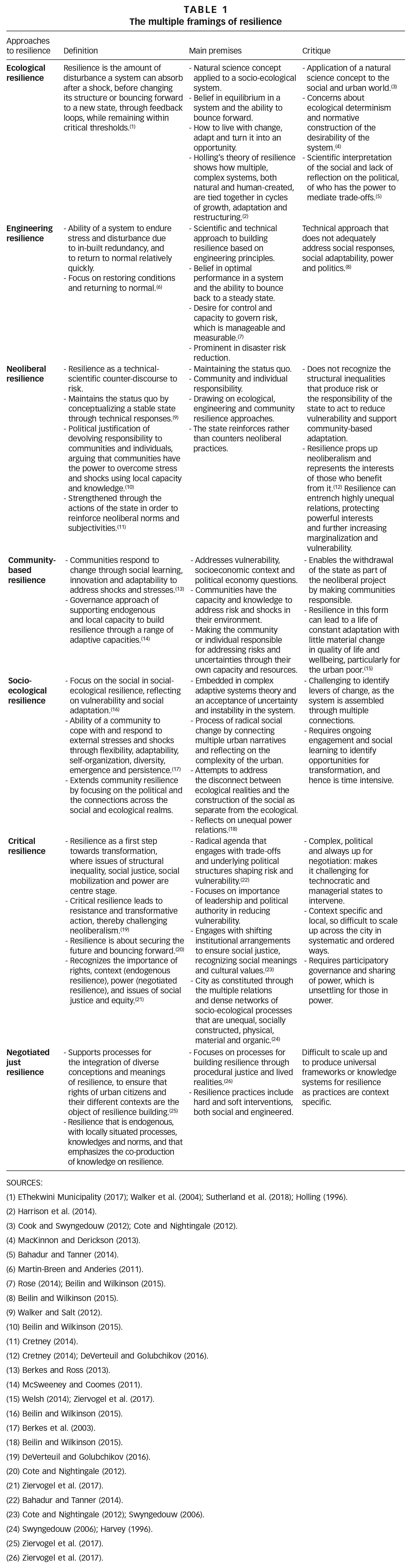
Natural science concepts of resilience are increasingly being applied to social systems as concerns about global environmental change, risk and climate change have increased. This has led to the expansion and application of the theory of resilience through multiple fields of knowledge, resulting in a continuum of ideas and approaches (Figure 1 and Table 1). These ideas have been applied to the urban condition, resulting in the concept and practice of urban resilience, which is being implemented through a range of international urban resilience programmes in cities across the world. Urban resilience is defined as “the ability of an urban system and all its constituent socio-ecological and socio-technical networks across temporal and spatial scales, to maintain or rapidly return to desired functions in the face of a disturbance, to adapt to change, and to quickly transform systems that limit current or future adaptive capacity”.(20) However, there are concerns that the application of concepts, from the natural sciences to the social and urban world, fails to address questions of politics and power. The critical questions of resilience for whom, by whom, to what, where, why and over what time scale, need to be answered.(21) Figure 1 and Table 1 present a continuum of the framings of resilience, as outlined in the literature, which are used to analyse the different approaches adopted by 100RC and Durban in defining and practicing urban resilience.
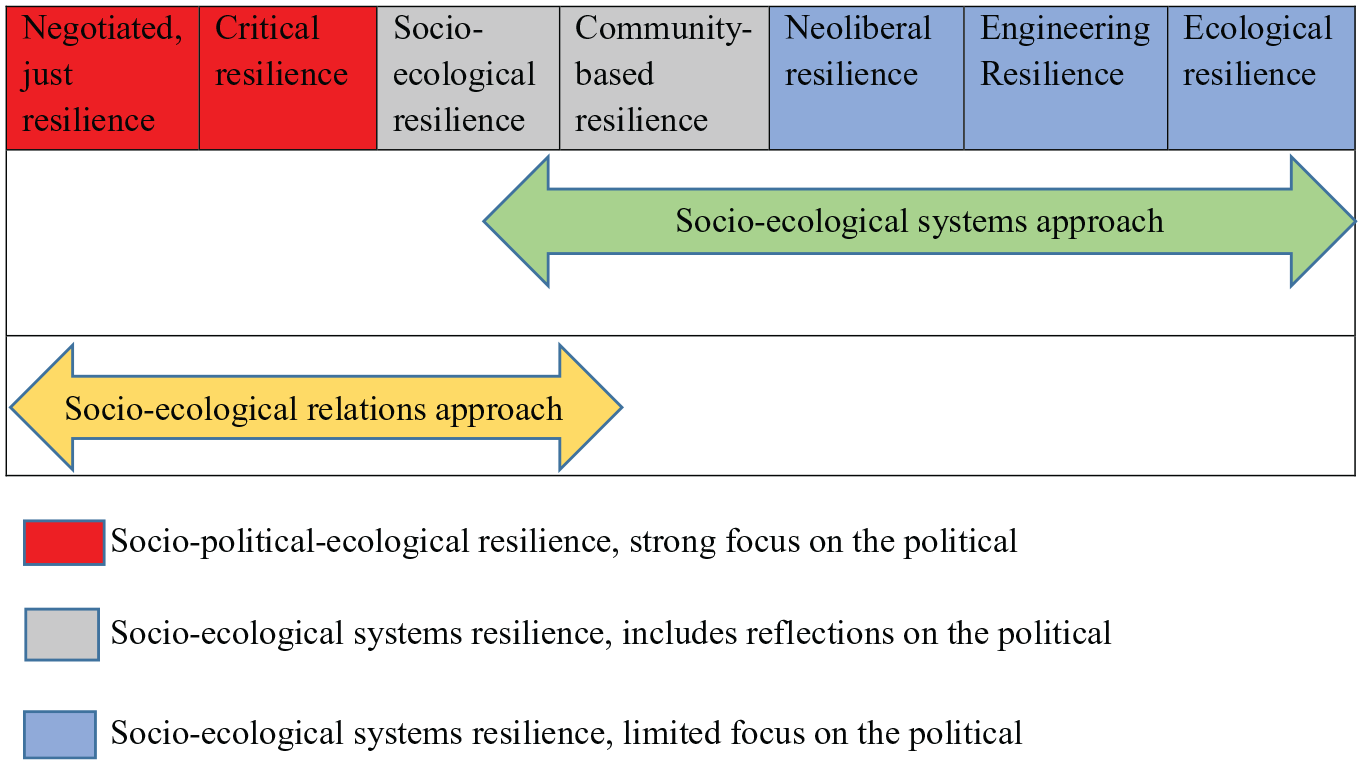
A typology (continuum) of resilience
The multiple framings of resilience
SOURCES:
(11) Cretney (2014).
(13) Berkes and Ross (2013).
(17) Berkes et al. (2003).
(21) Ziervogel et al. (2017).
(24) Swyngedouw (2006); Harvey (1996).
(25) Ziervogel et al. (2017).
(26) Ziervogel et al. (2017).
According to the Urban Institute,(22) the theoretical model adopted by 100RC emerged out of the organizational model of the 100RC programme. This meant that “counterfactual alternatives to 100RC”, based on alternative theoretical models, have therefore not emerged, as the theory was designed to fit the practice. 100RC’s ontological approach was framed by two reports commissioned by the Rockefeller Foundation, both of which are embedded in socio-ecological systems thinking: Martin-Breen and Anderies’ literature review on resilience(23) and Arup’s construction of the City Resilience Framework.(24) However, Ziervogel et al. and Sutherland et al.(25) call for greater political and critical engagement with the concept of resilience in the global South, through a socio-ecological relations approach. They state that resilience programmes should recognize and enable different conceptions of resilience, which are assembled through multiple relations and which are relevant and meaningful to different socio-political and economic contexts at different scales. This requires an imagining of “resilience in ways that do justice to on-the-ground realities in diverse urban contexts . . . taking into account locally situated processes, knowledges and norms”.(26) Definitions and practices of resilience therefore need to be both endogenous and negotiated, as the extent to which ecological challenges are elevated, and good resilience is built, is “a product of politicized, socio-cultural processes, emphasizing the subjectivities of the actors involved”; the laws, policies and institutions in place; and the actions of civil society organizations.(27) Wagenaar and Wilkinson(28) state that resilience is “organised improvisation” and a democratic, collective problem-solving process; hence it requires participatory governance processes. Elmqvist et al. propose “knowledge co-production with multiple urban actors as a process to invite, facilitate and enable locally informed and globally related meanings of urban resilience and sustainability”.(29) The framing of resilience in each context, and whether it is positive or negative for those at whom it is directed, is contingent upon who is governing for resilience and for what socio-economic and political purposes.(30)
III. Methodology
Action research undertaken by the authors, all of whom either led or were an integral part of Durban’s 100RC journey, as well as the detailed documentation of the process and outcomes of Durban’s resilience journey by the core resilience team, provide the data and evidence for this paper. Debra Roberts is Durban’s CRO, and Joanne Douwes its Deputy CRO. They were located in the Environmental Planning and Climate Protection Department at the time of producing Durban’s resilience strategy. Catherine Sutherland, an academic at the University of KwaZulu-Natal, was an advisor to the core resilience team. She and Vicky Sim, an environmental planning consultant, produced the second position paper (or non-paper) that foregrounded Durban’s resilience strategy, reflecting on the approach adopted from a theoretical perspective. The two non-papers (an idea borrowed from United Nations, programmes and projects, that allows the presentation of ideas that fall outside of a formal work programme or project agenda) provided a theoretical account of why and how the framing of resilience in Durban differed from that of 100RC. The non-papers were part of the core resilience team’s protest politics, as 100RC attempted to dominate the development of Durban’s resilience strategy.
As authors we recognize that our positionality in the 100RC journey fundamentally shapes the arguments presented in this paper, which reflects Durban’s account of the process, with no primary data contributions from 100RC. Throughout Durban’s 100RC journey, we deliberately documented and reflected critically on Durban’s resilience journey, drawing on the insights, knowledge and reflections of a range of key stakeholders, who engaged in the process of constructing Durban’s resilience strategy with the core resilience team. We did this in order to contribute to the body of empirical studies being produced on urban resilience globally. What we did not anticipate was that the municipality would suspend its relationship with 100RC, due to contestations over the framing of resilience. This has made these reflections even more important to document, particularly given the sudden disbanding of the 100RC programme, and the need to understand if and how programmes of global urban resilience can be built.
IV. The Rockefeller Foundation’s 100 Resilient Cities Programme
The Rockefeller Foundation initiated the 100RC programme as part of its centennial anniversary, to help cities “build resilience to the physical, social, and economic challenges that are a growing part of the 21st century”.(31) 100RC cities were provided with financial and logistical support to establish a Chief Resilience Officer position in city government to lead the city’s resilience efforts; expert support for the development of a resilience strategy; access to solutions, service providers and partners from the private, public and NGO sectors, who could help cities develop and implement their resilience strategies; and membership of a global network of cities that could learn from and help each other.(32) Beyond helping cities to become more resilient, 100RC saw its role as a facilitator in building a global practice of urban resilience among governments, NGOs, the private sector, and individual citizens.(33)
The Rockefeller Foundation’s aim was to define what makes a city resilient, so that cities could “understand, analyse and assess their own resilience”.(34) However, the foundation found that urban resilience was defined differently across different fields, such as disaster risk reduction, infrastructure resilience and climate change. To create a more uniform approach, Martin-Breen and Anderies’ literature review on resilience(35) and Arup’s construction of the City Resilience Framework (drawing on case studies on six geographically diverse cities that had recently experienced a major shock or were suffering chronic stresses) were used to produce “an accessible, evidence-based articulation of city resilience”.(36) 100RC defined urban resilience as: “the capacity of individuals, communities, institutions, businesses, and systems within a city to survive, adapt, and grow no matter what kinds of chronic stresses and acute shocks they experience”.(37)
The first step in a city’s resilience journey was the appointment of the CRO, who acted as a top-level advisor to city leadership; drew stakeholders together from silos of government and sectors of society; and accessed 100RC’s resilience-building tools, platform of partners and experts to develop a resilience strategy. 100RC recommended that the process for a city to develop a resilience strategy take six to nine months through engagement with a broad range of stakeholders, the identification of the city’s unique resilience priorities and the putting forward of implementable actions. The resilience strategy was conceived of as a living document that would continue to evolve as actions were implemented.
100RC intended that the process should build on what the city was already doing, using the additional resources offered by 100RC, such as the strategy partners(38) and platform of partners. 100RC enlisted the services of strategy partners, referred to as “the best global technical experts”,(39) to build resilience strategies in member cities (e.g. AECOM, HR&A, Dalberg, Accenture, Arup and ICLEI). Cities did not choose their strategy partners to suit their contexts, but rather were partnered with them as a result of decisions made by 100RC. As argued by 100RC,(40) “[b]ecause these firms have both local offices and global headquarters, 100RC can leverage their local capacity while using their global influence to maximize impact across regions, facilitate lessons sharing, and scale best practices”. Member cities were also given access to a suite of resilience-building tools and services provided by a platform of partners from the private, public, academic and nonprofit sectors, thereby facilitating a marketplace for resilience tools. However, most cities did not make significant use of the platform of partners and their resilience tools, rather focusing on implementing their strategies from within.(41)
For cities and their CROs, the main benefits of being part of the 100RC network were collective learning and problem solving and the opportunity to connect with other resilience experts in the process of developing a city’s resilience strategy. 100RC promoted CROs as global resilience ambassadors, who could play a role in facilitating a global practice of resilience building. A review of the resilience strategies published by member cities of 100RC reveals that the majority of cities applied the City Resilience Framework dimensions across their cities, elevating critical resilience issues in their cities in relation to these dimensions. They thereby developed resilience strategies that reflect and address local issues, but that are strongly aligned with the City Resilience Framework (Amman Resilience Strategy, 2017; Bristol City Council, 2017; City of Boulder Resilience Strategy, 2017; City of Norfolk, 2015; Resilient Glasgow Strategy, 2017). While this approach worked well for these cities, Durban’s core resilience team found that applying the City Resilience Framework and drawing on the expertise of the platform of partners would not address the particular resilience challenges in Durban. The core resilience team wanted to develop a resilience strategy that would be embedded in the city’s longer-term journey of achieving social, economic and environmental transformation. This led to Durban diverging from the global practice of resilience building as espoused by 100RC.
V. Durban’s Resilience Journey
Durban is South Africa’s third-largest city, and is situated in the province of KwaZulu-Natal on the east coast of South Africa. The city has a population of 3.64 million people.(42) Durban’s apartheid past has played a significant role in producing many of the challenges being experienced in the city.(43) These challenges are exacerbated by global drivers of change, including rapid urbanization, neoliberal economic systems and climate change. However, Durban is also located in a global “biodiversity hotspot”. Its natural environment plays a critical role in providing ecosystem services (such as water and soil provision, flood attenuation, etc.) that are foundational to the resilience and sustainable development of the city, and that provide important opportunities for ecosystem-based adaptation to climate change.(44)
The first public stakeholder workshop, Durban’s Resilience Agenda Setting Workshop, was held on 14 September 2014. This served as the launch of the 100RC programme in the city. It included a presentation by 100RC representatives of the City Resilience Framework and 100RC’s approach to building resilience across the 100 cities. The response of the stakeholders at the workshop, who represented a wide range of sectors and organizations from across the city, was unanimous: the framework and process to guide the development of Durban’s resilience strategy needed to take Durban’s local framing of resilience into account. Three critical principles emerged from this workshop: Durban’s 100RC process needed to be embedded in and recognize the institutional arrangements and politics of the city; multiple stakeholders from the municipality, traditional authorities, research institutions, the private sector and civil society needed to participate in the process; and the process needed to ensure that the technical knowledge/expertise provided and transferred by 100RC was shaped and framed within local knowledge.
a. Institutional structures for the development of Durban’s resilience strategy
100RC’s approach to coordination of the programme at a city level was centred around a CRO. However, the cross-sectoral municipal team in Durban, which had worked with the core resilience team on the application to 100RC, raised a number of concerns about bringing someone from outside the municipality into this strategic position. This included the time and energy required for a new person to familiarize him- or herself with city processes and to establish relationships and professional credibility. There was also potential for political and labour disputes over the appointment. As a result, the municipality nominated an internal local government official for the position of CRO, namely Debra Roberts. She has a direct line of communication with the city manager and relevant deputy city managers and has significant influence locally, nationally and internationally in the urban biodiversity, climate change adaptation and sustainability fields. Consequently, the municipality proposed that the funding equivalent of a CRO salary be used instead to appoint a local team to support the process of developing Durban’s resilience strategy. Urban Earth, a consultancy with extensive urban sustainability experience in Durban, was appointed to fulfil this role.
100RC offered member cities, as previously noted, the services of a strategy partner to provide assistance with various aspects of the programme. Dalberg, a global policy advisory firm based in New York and with an office in Johannesburg, was appointed as Durban’s strategy partner, to communicate the work being done at the global level in 100RC, and likewise communicate and introduce the local ideas emerging from the Durban experience to the international 100RC community. However, due to Dalberg’s lack of experience in Durban (which resulted in the core resilience team choosing to work with staff based in New York) and the limited time its consultants could spend in the city, Urban Earth provided the primary local support by contributing knowledge to the strategy, documenting the process and providing a secretariat function. They also locally outsourced additional specialist work required through the course of the programme to address specific needs that could not be fulfilled by a global 100RC strategy partner and platform of partners. The New York Dalberg office contributed to the development of the strategy at critical strategic points, but this was not the intense and close relationship envisaged by 100RC.(45) This pairing of global and local knowledge was used effectively in the process to ensure that the resilience strategy was grounded in the local reality. Urban Earth focused on Durban’s journey, while Dalberg’s role shifted to a focus on communication between the municipality’s core resilience team and 100RC. Dalberg also provided input into Durban’s Preliminary Resilience Assessment (PRA).
Considering the complexity of the programme, institutional resilience was further prioritized by the municipality, through the establishment of the core resilience team. EThekwini Municipality’s approach, of expanding the team directly responsible for building the resilience strategy to include a CRO and core resilience team, has been repeated in other cities, as the 100RC programme has evolved.(46) This approach created institutional redundancy by ensuring that the programme was not dependent on one individual. Rather, a focused and committed small group of individuals facilitated continuity of understanding and longer-term institutionalization of knowledge generated through the programme.
Taking into account Durban’s political context within a new democracy, the core resilience team also recognized that a single resilience steering committee (as originally conceptualized by 100RC) would not be representative of the wide range of stakeholders who needed to be engaged in Durban’s resilience journey. The team therefore introduced a number of different stakeholder interaction points for the strategy process, including a local government technical team (municipal officials who provide technical and cross-departmental input), a “critical thinkers” group (with representation from the business, local government, creative, environmental activist and inter-faith communities), and relevant city planning and leadership structures (Figure 2). These include the city’s Executive Management Team, chaired by the city manager and including his deputy city managers, and the Economic Development Committee, which was chaired at the time by the deputy mayor and comprised 30 councillors. Regular engagement with these high-level political and administrative structures ensured that the work undertaken was in line with the social and economic transformation goals of the municipality. While these stakeholders represented an elite group of experts, broader stakeholder engagement in the development of Durban’s resilience strategy was ensured through sector-specific stakeholder workshops in the preparation of the Preliminary Resilience Assessment and in broader public workshops, for ground-truthing the resilience-building outcomes and interventions in the production of the resilience strategy.
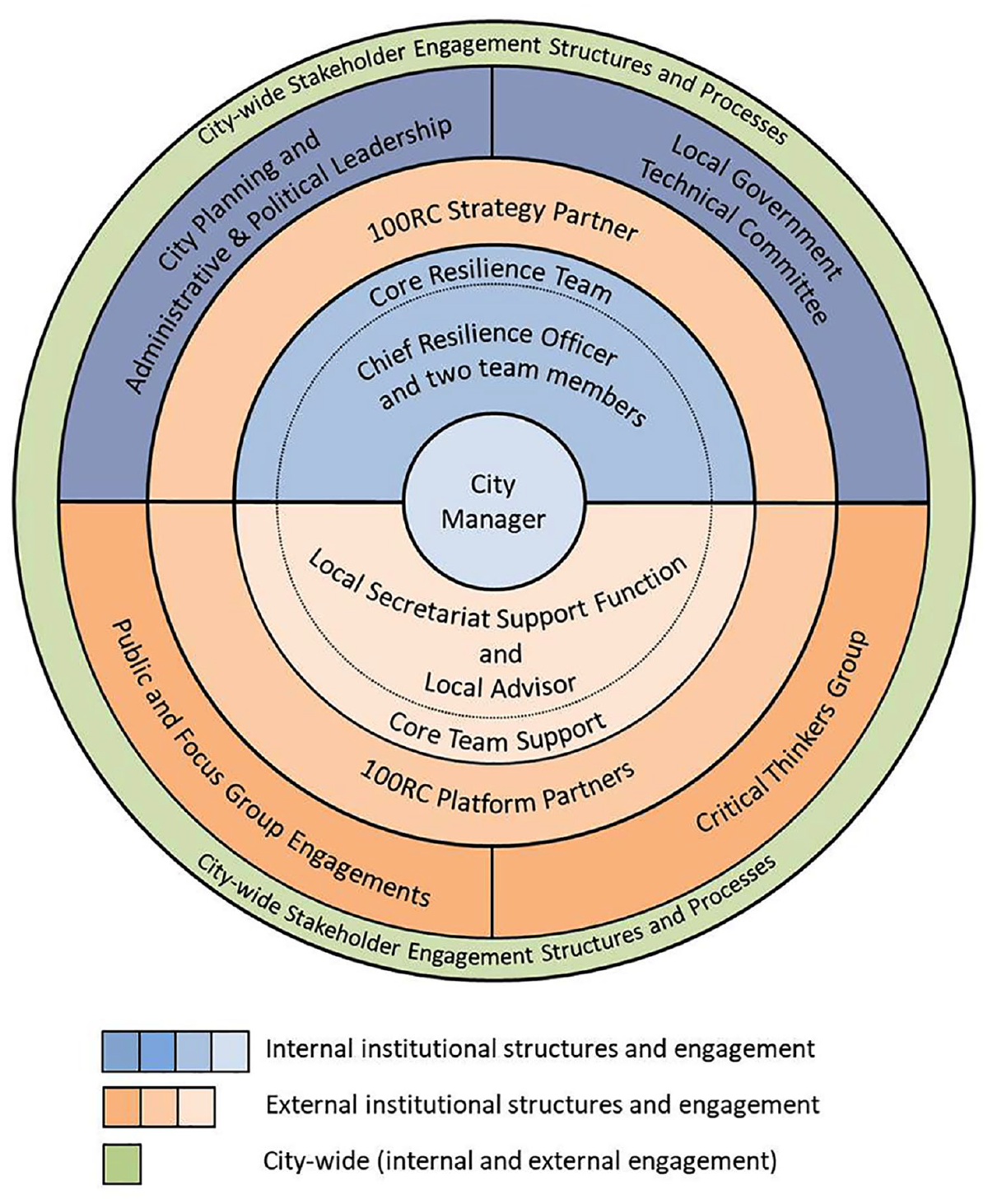
Durban’s institutional arrangements for its 100RC journey
Protracted and often conflictual engagements with 100RC were required to establish these institutional arrangements. 100RC did not initially support them as they deviated from their model. The Durban core resilience team sought a model that was reflective of the municipality’s institutional and stakeholder particularities, which would provide the right kind of support and foundation for the longer-term institutionalization of resilience discourses and practices. Durban also needed an approach that was sensitive to the particular politics of eThekwini Municipality, given that the African National Congress (ANC)-led municipality is strongly aligned with the imperatives and politics of the ANC national government,(47) with the city acting as a reflection of national policy. It therefore operates in a “hyperpolitical state”.
b. Negotiating resilience through Durban’s participatory approach
A hallmark of Durban’s resilience strategy process was its extensive participatory stakeholder engagement, which supported the co-production of knowledge. This marked a shift from other established strategy development processes in the municipality, which adopt a more managerial form of governance, or an “invited” form of participation.(48) The institutional structures established in Durban for the 100RC programme facilitated engagement with a wide range of stakeholders from within the municipality, as well as other key stakeholders from a range of sectors and the broader public. This process involved the integration of diverse conceptions of, and approaches to, resilience, resulting in a negotiated understanding of urban resilience that was contextually relevant and endogenous.(49)
However, extensive engagement is time consuming, and so the strategy development process took three years to complete, compared with 100RC’s recommended six to nine months. Apart from the breadth of stakeholders, the team’s long-term vision for institutionalization and systemic and transformative change meant moving slowly to build internal relationships and trust. The cross-cutting and cross-sectoral nature of the resilience priorities identified through the process also demanded a commitment to building linkages and relationships within the different sectors and departments of the municipality.
c. A local and theoretically informed approach
The first round of extensive stakeholder engagement in the PRA phase of Durban’s resilience journey was focused on developing an understanding of what resilience means in the local context. The core resilience team believed that there was “something missing” in the City Resilience Framework, particularly in terms of its transformative power, and so wanted to open up the debate on resilience to a wide range of stakeholders in the city. It became clear at this early stage that the resilience themes that emerged for Durban did not align neatly with the resilience dimensions and goals defined in the City Resilience Framework.(50) For example, the systemic challenge of inequality, not explicit in the City Resilience Framework, was considered central to urban resilience in a socio-institutional context like Durban, where there is a considerable development deficit and large disparities.
Another foundational element for enhancing Durban’s resilience, which is not explicit in the City Resilience Framework, is the natural environment, considered critical by the Environmental Planning and Climate Protection Department to the economic and social wellbeing of the city and its citizens. Although the natural environment appears as part of the thematic area “Infrastructure and ecosystems” in the City Resilience Framework, its combination with infrastructure meant that it was given a modernist framing, which reflects the values and practices of modern industrial life. While this approach resonates with Durban’s commitment to conserving its ecological infrastructure with its associated ecosystem services, it results in ecosystems forming one element of the infrastructure in the city, rather than being the critical asset base upon which the wellbeing of the city and its people depends. A number of resilience themes that emerged in Durban through its stakeholder engagement were cross-cutting – for example, building social cohesion and managing environmental assets more effectively – which did not fit well with the sectoral focus of the City Resilience Framework. Thus, while Durban completed the PRA phase using the prescribed 100RC tools, and adopting a socio-ecological systems approach, the fact that they were not locally nuanced limited their usefulness. A more tailored, critical and relational approach was needed to respond better to Durban’s particular context.
d. Adopting a systemic not sectoral approach
With these systemic and cross-sectoral considerations in mind, the core resilience team, in partnership with Dalberg New York, embarked on a systems analysis of the six resilience focus areas that emerged through the PRA (Bold and Participatory Governance, Knowledge-centred City, Innovative Place-making, Sustainable and Ecological City, Catalytic and Transformative Economy, and Equitable and Inclusive Society), with a view to identifying resilience interventions that would maximize benefits by addressing multiple resilience themes concurrently. The analysis, which included stakeholder engagement, provided an overview of outcomes for each focus area that would support a more resilient city and identified the main barriers to achieving these outcomes. A number of underlying and interlinked systemic challenges were identified that, through further stakeholder engagement, were prioritized to arrive at six cross-cutting levers for change that could enhance the city’s resilience in a systemic way (Figure 3). These levers for change replaced the City Resilience Framework as the resilience framework for Durban and guided the rest of the strategy development process. The value of the systems analysis was therefore the opportunity it provided for a more nuanced and systemic, rather than sectoral, understanding of Durban’s spectrum of resilience challenges, and how they were interconnected.
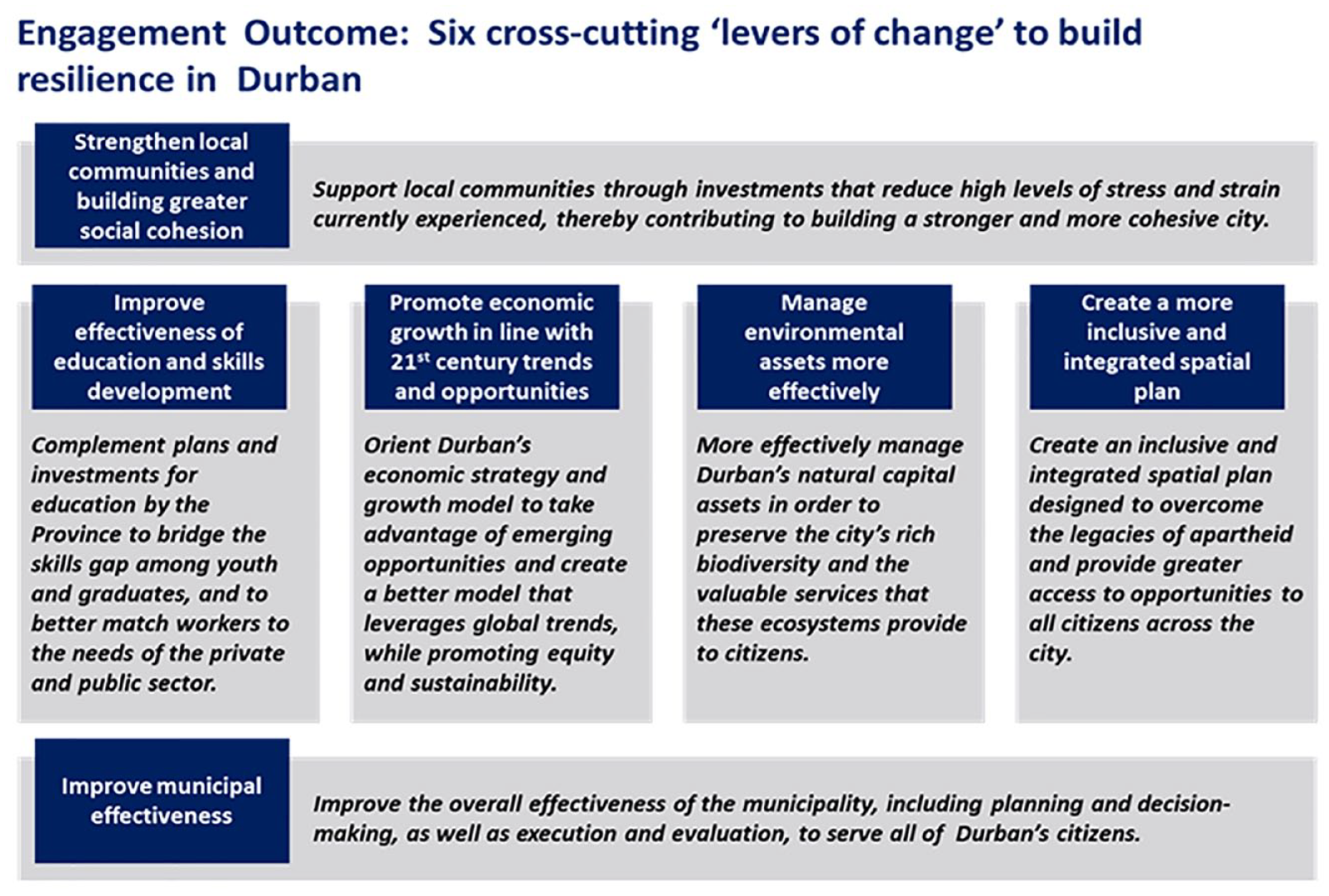
Six cross-cutting levers for change to build resilience in Durban
e. Drilling down rather than going wide
The high-level nature of the levers for change meant that they were too broad to facilitate practical implementation. As a result, the core resilience team led a further stakeholder engagement process in late April 2016 to identify more specific strategies that could address multiple levers for change simultaneously, be transformative in their impact, and be practically implemented. As a result, two pillars for building resilience (or Resilience Building Options [RBOs]) emerged: 1) collaborative informal settlement action and 2) integrated and innovative planning at the interface between municipal and traditional governance systems.(51) These pillars form the core of Durban’s resilience strategy, as they are centred on two critical spaces in the city, which fundamentally shape the city’s resilience and sustainability. The two RBOs can be viewed as strategic entry points for building urban resilience in Durban, providing an opportunity for a focused testing of what is required to address the six levers for change in a systemic and strategic way. They also contain, reproduce and have the potential to shift the multiple relations and socio-ecological trajectories that come together to shape resilience more broadly in the city.
RBO 1 and RBO 2 are seen by Durban’s stakeholders as proxies for developing an understanding of the city’s broader systemic challenges, such as: a lack of integrated data; the need for improved transversal management; poor institutional coordination; and exclusionary economic and social systems. Interventions in the spaces of informal settlements and traditional/municipal governance are intended to reduce systemic risk, but these spaces can be risky in themselves. Thus, focused action in these areas could produce important learnings that can be applied to broader resilience work in the city in the future (Figure 4). This approach is supported by Elmqvist et al.,(52) who argue for “directed transformations”, where elements of urban systems that are locked into path dependencies require shifts in values, meanings, power relations, resource flows, roles and routines to ensure shifts towards a more sustainable future.
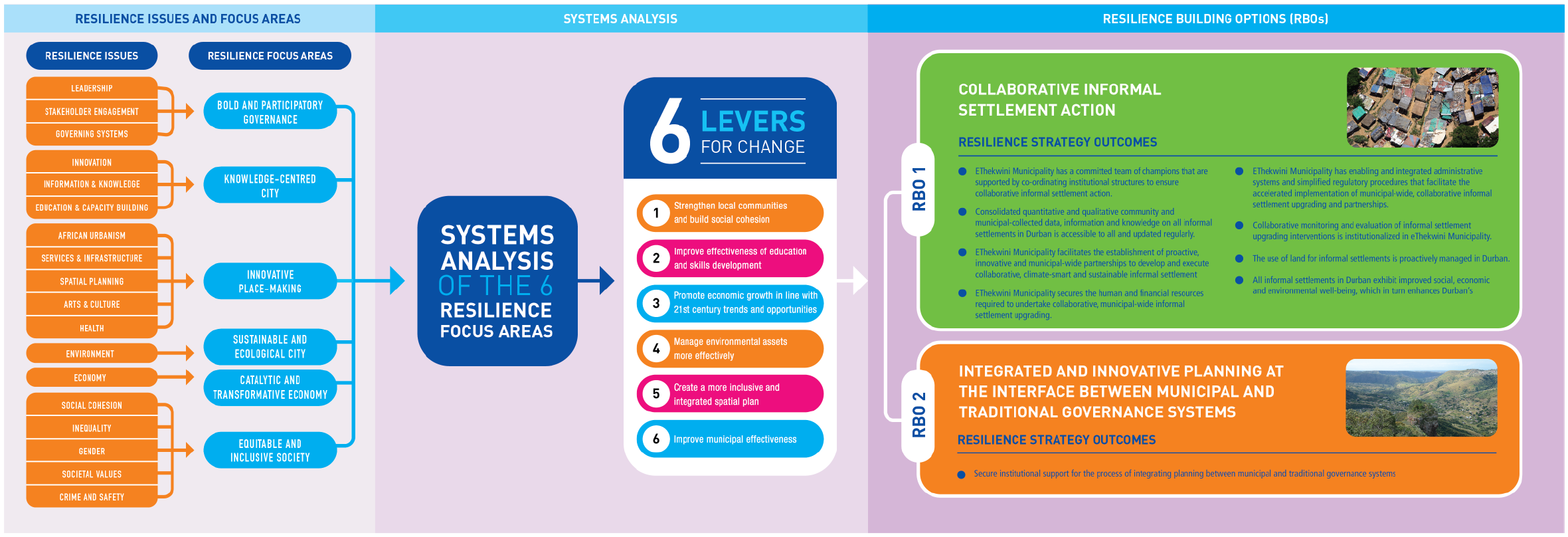
The process and outcomes of Durban’s resilience journey
Given the breadth of city challenges, limited institutional capacity and resources, and the already existing strategic framing of critical issues in the city, which are contained in Durban’s Integrated Development Plan, this deep approach promotes focused, rather than widespread and shallow, action for resilience. It suggests an alternative approach to building urban resilience, one of “drilling deep” into core barriers to resilience that, if overcome, could have far reaching resilience-enhancing consequences for Durban’s citizens. It also reflects a more integrative and relational governance approach to urban resilience that crosses sectoral silos and is based on multi-stakeholder collaboration and partnerships. This contrasts with the 100RC approach, which advocates for cities to address a broad range of resilience issues in a sectoral way.(53)
f. Theoretically informed resilience
From the outset of the 100RC process, it became apparent that there was very limited space to debate the approach for developing Durban’s resilience strategy in alternative ways with 100RC. There was never the opportunity to interrogate the fundamental elements of the programme. The Urban Institute’s review(54) states that the programme did become more flexible over time, perhaps through the social learning taking place, but it still focused on the application of the City Resilience Framework and a global model for building urban resilience.
We suggest that 100RC’s programme was framed, in terms of both its epistemology and ontology, through a socio-ecological systems approach,(55) and hence was produced using mainstream and less critical and political concepts of resilience (Figure 1 and Table 1). The core resilience team initially applied this approach, but realized very quickly that this framing of resilience was not appropriate to the city and its politics, and so shifted towards more critical and negotiated forms of resilience (Figure 1 and Table 1). This led to contestations between 100RC and the core resilience team, as Durban was deemed to be deviating significantly from the 100RC approach. As a result, the core resilience team decided to include a position paper (or non-paper) to foreground both the PRA and Resilience Strategy, to explain theoretically, and from Durban’s context, why the city was developing its Resilience Strategy in the way that it was. The core resilience team conceived the development of its resilience strategy as a social learning process, rather than the implementation of a global framework of resilience. It was the second non-paper that 100RC reacted against most strongly, as the CEO of 100RC stated that it indicated “too many various options” of what resilience might mean.(56) The second non-paper therefore became the critical element upon which Durban’s continuation in the 100RC programme was decided.
By the time Durban’s resilience strategy was submitted to 100RC for approval in April 2017, the fundamental differences that had emerged between Durban and 100RC during the resilience strategy process, in terms of the framing of urban resilience, the form and structure of the strategy, and the role of 100RC, became more apparent, leading to conflict and mistrust between the two teams. There was a fundamental conceptual difference in how resilience was conceived. Durban’s strategy focused on tackling the systemic and structural causes that undermine resilience and sustainability, given the unique challenges faced by the city and its citizens. However, the selection of the two RBOs was not considered by 100RC to be expansive enough to address the range of resilience dimensions identified in the City Resilience Framework, and in the PRA of Durban. 100RC required a more generalized and comprehensive coverage of all resilience issues, which the core resilience team believed would dilute the impact of the work done on the strategy thus far. The high-level nature of Durban’s strategy was also contested by 100RC, whereas the team felt it was important to get initial stakeholder buy-in around the ideas in the strategy, before developing detailed implementation plans.
There was also a difference in understanding of the role that a programme such as 100RC should have at the city level. The core resilience team saw it as providing support to the way a city works, while 100RC aimed to be more interventionist in shaping local governance processes through their global programme of resilience.
Lastly, the two parties differed in how they saw the intellectual development of the field. Durban’s core resilience team viewed the strategy development process as an opportunity for social learning and academic partnership to contribute to the local and global resilience debate, which is reflected in the inclusion of a non-paper in the PRA and Resilience Strategy, while 100RC viewed the strategy as a strategic and technical intervention, with intellectual critique and debate needing to happen elsewhere in the 100RC programme. In response to 100RC’s resistance to including critical debates about resilience in a city’s resilience strategy, the core resilience team produced two versions of its strategy: a short version that focused on the mainstream concepts and technical aspects of the strategy, and a long version that contained the non-paper and that raised more critical questions about the framing of resilience. The long version also provided a detailed account of the methodology used to develop Durban’s resilience strategy, with the intention of sharing ideas with cities that might be new to 100RC.
The core resilience team felt that “a diversity of opinion was valuable to the global resilience building project”(57) and was not willing to significantly adapt the strategy as per 100RC’s instructions, given that the city’s two resilience-building options did in fact provide comprehensive coverage of resilience issues, as they are products of resilience deficits. Unfortunately, despite efforts to resolve this impasse, the municipality and 100RC reached a mutual decision to suspend their relationship in October 2017, with Durban now working independently to pursue the implementation of its resilience strategy in a way that best responds to the city’s evolving needs and context. The core resilience team volunteered to continue to contribute the city’s learnings to the 100RC programme and the global resilience debate if needed. The municipality informed 100RC that it would release its council-approved resilience strategy into international networks, proceed to advance the resilience debate in the peer-reviewed literature, and re-engage with 100RC should a suitable opportunity present itself in the future.
The municipality has now entered Phase 3 of its resilience strategy process, the implementation phase, which is being led by the Sustainable and Resilient City Initiatives Unit under the instruction of city leadership. The team has re-engaged stakeholders to translate the high-level ideas in the strategy into specific actions and tasks, with suggested timelines, budgets and responsibilities. In the course of this work, it has become clear that the focused nature of Durban’s selected RBOs is extremely helpful in providing a clear entry point for action in order to challenge and address not only the RBOs, but also systemic city challenges. In the case of the “collaborative informal settlement action” RBO, for example, the development of the implementation plan is beginning to highlight both the opportunities and challenges related to the practical implementation of transversal management principles, in the context of an institution with entrenched structures and modes of operation. It has also highlighted that many of the issues identified by stakeholders in relation to the RBOs, for example the lack of accurate and integrated data and data management systems for informal settlements, are in fact indicative of a far more systemic data challenge in the city. Although the data work has started with a specific focus on informal settlements, opportunities are already emerging for these processes and learnings to influence systemic changes. This has served to re-emphasize the value of focused efforts, particularly in complex contexts where it is often difficult to know how to navigate complex spaces, and the need to build experience and demonstrate success to drive systemic and transformative change.
VI. Conclusions
Our particular, and insider-oriented, reflection on Durban’s resilience journey reveals two different ways of constructing urban resilience – one representing governing for resilience “from a distance” and one “from within”. Participating in the 100RC programme provided Durban with the opportunity to be innovative within its own city space, engaging with its politicians, officials and citizens around the concept of resilience, developing the strategy from below, learning from other cities, sharing and co-producing knowledge, challenging existing modes of thinking, and developing a pathway into the relatively new, untested and complex field of urban resilience. Durban’s resilience journey has revealed that locally contextualized, participatory, negotiated and endogenous forms of urban resilience need to be developed if the practice of resilience building is to be transformative in complex urban contexts (Table 1). This is applicable in terms of both what constitutes urban resilience and the process through which that resilience building needs to happen. This is important if we are serious about institutionalizing resilience in the long term. If cities and their stakeholders have not bought into the idea of urban resilience and the process through which this has been generated, they will not support resilience-building efforts. Sustainability of resilience efforts is linked to local agency. If this is undermined through the implementation of global programmes that are not “fit for purpose” and transferred to cities from a distance, this can undermine the transformation required.
Durban began its resilience journey drawing on the epistemology and ontology of a socio-ecological systems approach. However, as the municipality and the core resilience team learnt more about the “governing of resilience from within”, they shifted to a socio-ecological relations approach, which illuminates the systemic and relational nature of resilience and the need for it to be assembled from the historical and geographical context of the city and its particular issues and challenges. Durban reflects negotiated just resilience, critical resilience and socio-ecological resilience (to the left of Figure 1 and the bottom half of Table 1). 100RC’s approach is more strongly aligned with mainstream approaches to resilience (further to the right of Figure 1 or the top half of Table 1), which are less political, more technocratic and less cognizant of the structural relations that produce the need for resilience. It is perhaps these conceptual differences that resulted in Durban and 100RC parting ways. The 100RC programme did not have the space for different approaches, as this would undermine the rolling out of a global model of urban resilience upon which a market of resilience tools, instruments and practices could be built. Durban’s core resilience team was not willing to shift the resilience strategy to the level required by 100RC, to align with its hegemonic approach, as this would have undermined the particular quality of the resilience building required in a city with transformative social, environmental, economic and governance goals.
The paper has responded to the global call for empirical research that explores how the normative ideas of “governing for resilience” are implemented and practised on the ground, and how resilience practices are emerging in reality. What surprised the authors the most in reflecting on this journey was that there was no space within 100RC’s initiative for this debate or difference. When this dissent emerged, 100RC attempted to use its dominant global position to assert power over resilience building in Durban by trying to influence politics in the city. This is unfortunate, as we believe that both Durban and the 100RC lost an opportunity to work together and to develop innovative practices and knowledge for building transformative resilience in cities in the South, and more particularly in Africa.
Footnotes
Acknowledgements
The authors would like to acknowledge the six reviewers who provided valuable and insightful comments on the paper; the citizens of Durban (state, private sector and civil society) who played a critical role in the development of Durban’s resilience strategy; Urban Earth and Manisha Hassan from eThekwini Municipality who contributed to the strategy and the learnings presented here.
1.
Robinson, J (2017), “New geographies of theorising the urban: putting comparison to work for global urban studies”, in S Parnell and S Oldfield (editors), The Routledge Handbook on Cities in the Global South, Routledge, London.
2.
Folke, C (2016), “Resilience (republished)”, Ecology and Society Vol 21, No 4, Article 44; also Meerow, S, J P Newell and M Stults (2016), “Defining urban resilience: a review”, Landscape and Urban Planning Vol 147, pages 38–49; Bahadur, A V and T M Tanner (2014), “Transformational resilience thinking: putting people, power and politics at the heart of urban climate resilience”, Environment and Urbanization Vol 26, No 1, pages 200–214; and Welsh, M (2014), “Resilience and responsibility: governing uncertainty in a complex world”, The Geographical Journal Vol 180, No 1, pages 15–26.
4.
5.
Peck, J and N Theodore (2010), “Mobilizing policy: models, methods, and mutations”, Geoforum Vol 41, No 2, pages 169–174.
6.
The “core resilience team” refers to the three officials who led the 100RC application process and coordinated the development of Durban’s Resilience Strategy, with support from a local sustainability consultancy, Urban Earth. The three officials were Debra Roberts (Durban’s Chief Resilience Officer and Acting Head of the Sustainable and Resilient City Initiatives Unit in eThekwini Municipality) and Joanne Douwes (Environmental Planning and Climate Protection Department, eThekwini Municipality), both authors of this paper, and Manisha Hassan (Environmental Planning and Climate Protection Department, eThekwini Municipality).
7.
The advisory team, which included Catherine Sutherland and Vicky Sim, supported the core resilience team by providing theoretical insights on the conceptualization and practice of urban resilience.
8.
This paper is being followed by a second paper that explores resilience as a form of global and local governmentality. Roberts, D, J Douwes, V Sim and C Sutherland (forthcoming), “A local response to global governmentality: 100 Resilient Cities and Durban’s Resilience Strategy process”. The production of these papers was funded by eThekwini Municipality.
9.
Sutherland, C, D Scott, E Nel and A Nel (2018), “Conceptualising ‘the urban’ through the lens of Durban, South Africa”, Urban Forum Vol 29, No 4, pages 333–350.
10.
Elmqvist, T, E Andersson, N Frantzeskaki, T McPhearson, P Olsson, O Gaffney, K Takeuchi and C Folke (2019), “Sustainability and resilience for transformation in the urban century”, Nature Sustainability Vol 2, pages 267–273.
11.
Personal communication with a 100RC representative, 13 November 2017.
12.
See reference 4.
13.
The Ingonyama Trust (IT) was established in 1994, at the start of the democratic era in South Africa. Its sole trustee is the Zulu monarch, King Goodwill Zwelithini. Legally IT land is state land, which is held in trust for the use and benefit of the Zulu nation. [Sim, V, C Sutherland, S Buthelezi and D Khumalo (2018), “Possibilities for a hybrid approach to planning and governance at the interface of the administrative and traditional authority systems in Durban”, Urban Forum Vol 29, pages 351–368.] IT land is governed by both traditional councils and municipalities. Due to Durban’s apartheid history, 44 per cent of eThekwini Municipality is located on land governed both by the municipality and multiple traditional councils, creating a dual governance system. The traditional councils are responsible for allocating land, addressing social conflict and building social cohesion, while the municipality is mandated to provide services and administer and manage spatial planning and development in these areas.
14.
Pelling, M (2011), Adaptation to Climate Change: From Resilience to Transformation, Routledge, London and New York; also Beilin, R and R Wilkinson (2015), “Introduction: governing for urban resilience”, Urban Studies Vol 52, No 7, pages 1205–1217.
15.
Holling, C S (1996), “Engineering resilience versus ecological resilience”, in P E Schulze (editor), Engineering within Ecological Constraints, National Academy Press, Washington, DC, pages 31–43.
16.
Davoudi, S, E Brooks and A Mehmood (2013), “Evolutionary resilience and strategies for climate adaptation”, Planning Practice and Research Vol 28, No 3, pages 307–322.
17.
Rutter, M (1987), “Psychosocial resilience and protective mechanisms”, American Journal of Orthopsychiatry Vol 57, No 3, pages 316–331.
18.
Blaikie, P, T Cannon, I Davis and B Wisner (1994), At Risk: Natural Hazards, People Vulnerability and Disasters, 1st edition, Routledge, New York; also Cutter, S L, L Barnes, M Berry, C Burton, E Evans, E Tate and J Webb (2008), “A place-based model for understanding community resilience to natural disasters”, Global Environmental Change Vol 18, No 4, pages 598–606.
21.
See reference 2, Meerow et al. (2016); also see reference 2, Welsh (2014); and Ziervogel, G, M Pelling, A Cartwright, E Chu, D Teshpande, L Harris, K Hyams, J Kaunda, B Klaus, K Michael, L Pasquini, R Pharoah, L Rodina, D Scott and P Zweig (2017), “Inserting rights and justice into urban resilience: a focus on everyday risk”, Environment and Urbanization Vol 29, No 1, pages 123–138.
22.
See reference 4, page 94.
23.
Martin-Breen, P and J M Anderies (2011), Resilience: A Literature Review, Bellagio Initiative, Bellagio.
24.
25.
See reference 21, Ziervogel et al. (2017); also Sutherland, C, D Roberts and J Douwes (2019), “Constructing resilience at three different scales: the 100 Resilient Cities programme, Durban’s Resilience Journey and everyday resilience in the Palmiet Rehabilitation”, Human Geography Vol 12, No 1, pages 33–49.
27.
Cote, M and A J Nightingale (2012), “Resilience thinking meets social theory: situating social change in socio-ecological systems (SES) research”, Progress in Human Geography Vol 36, No 4, pages 475–489, page 481; also Satterthwaite, D (2013), “The political underpinnings of cities’ accumulated resilience to climate change”, Environment and Urbanization Vol 25, No 2, pages 381−391.
28.
Wagenaar, H and C Wilkinson (2013), “Enacting resilience: a performative account of governing for urban resilience”, Urban Studies Vol 52, No 7, pages 1265–1284.
29.
See reference 10, page 271.
30.
See reference 2, Bahadur and Tanner (2014); also see reference 14,  .
.
31.
Rockefeller Foundation (2018), 100 Resilient Cities, available at .
32.
See reference 31.
33.
See reference 31.
34.
Spaans, M and B Waterhout (2017), “Building up resilience in cities worldwide – Rotterdam as participant in the 100 Resilient Cities Programme”, Cities Vol 61, pages 109–116, page 110.
35.
See reference 23.
36.
See reference 24.
38.
Strategy partners were hired by 100RC to assist city governments in producing their resilience strategies at a local level. Global and regional platform partners were civil- and private-sector organizations with tools that could be used to implement the initiatives identified in the resilience strategy.
40.
See reference 39.
41.
See reference 4.
43.
See reference 9.
45.
See reference 4.
46.
See reference 4.
47.
See reference 9.
48.
See reference 9; also see Martel, P and C Sutherland (2018), “Durban’s Back of Port Project: a local spatial knowledge production process framed by urban entrepreneurialism”, Urban Forum Vol 29, No 4, pages 397–412; and Miraftab, F (2004), “Invited and invented spaces of participation: neoliberal citizenship and feminists’ expanded notion of politics”, Wagadu Vol 1, pages 1–7.
49.
See reference 21, Ziervogel et al. (2017); also see reference 25, .
51.
See reference 44.
52.
See reference 10.
53.
See reference 4.
54.
See reference 4.
55.
See reference 23; also see reference 31.
56.
Personal communication with Debra Roberts, 19 September 2017.
57.
Personal communication with Debra Roberts, 19 September 2017.