



Abstract
The debate on state institutions in the economic development of developing countries has been ongoing for the past three decades. In the 1980s, the debate was dominated by the importance of state-owned enterprises (SOEs) and transitioned to the privatisation of SOEs in the early1990s. The debate re-emerged in 2010 due to the increasing influence of Chinese SOEs in the global economy. While the corporatisation of SOEs led to financial results being the core measure of good governance and performance, balancing financial performance with societal socio-economic impact is necessary for developing nations as SOEs are established to stimulate social and economic development. This article uses secondary data to explore the social and economic impact of two South African SOEs—the Industrial Development Corporation (IDC) and the Development Bank of Southern Africa (DBSA)—to contribute to the ongoing debate on the importance of state institutions on the development of developing countries. The article demonstrates the criticalness of the IDC in stimulating the country’s industrial development capacity and structural transformation, whereas the DBSA provides infrastructure investment to enable structural transformation through an enabling development ecosystem. While contributing to the merits of the state and development, failures and areas of interventions are also discussed.
Keywords
Introduction
After many years of emerging and developing nations privatising state-owned enterprises (SOEs) at the command of the World Bank and the International Monetary Fund (IMF), the influence of SOEs is increasingly re-emerging. Data shows that from 2005 to 2014, the proportion of SOEs in the Fortune Global 500 increased from 9% to 23%, with China’s SOEs making up 15% of the total SOEs (PWC 2015). Despite this recent success of state institutions in the global economy, the emerging influence of SOEs is not accompanied by an upsurge in the number of SOEs. Two reasons can best explain the downward trend in state ownership. First, the privatisation of SOEs in developed countries after meeting their social and economic developmental role, that is, the capital recycling of SOEs in Europe and other developed nations in the twentieth century (Organisation for Economic Co-operation and Development 2015; PWC 2015). The second reason is related to the privatisation wave of SOEs in developing nations (Ritchken 2014, Stiglitz 2008), and the failure of developing countries, mainly in Africa, to resuscitate the role of the state.
For many emerging and developing nations, SOEs are strategically established to pursue specific social and economic developmental outcomes to improve socio-economic conditions (Richmond et al. 2018). This role is associated with the societal and public value bequeathed to SOEs in providing the physical infrastructure to enable industrialisation and the pursuit of structural transformation. Such a role was evident in the industrialisation journey of East Asian economies, where governments established various SOEs to put an impetus on industrial development (Thurbon 2020). While there is an acknowledgement that SOEs have an essential developmental role in developing nations, SOEs are criticised for the inefficient use of resources, labour and low productivity (Estrin and Pelletier 2015). After several decades of privatising SOEs in developing nations, privatisation has proven to be disastrous, disappointing and yielded more negative results than initially expected (Anuatti-Neto et al. 2003; Arnold 2019; Stiglitz 2008).
In the South African context, SOEs were established to provide the necessary infrastructure to stimulate inclusive economic development due to the country’s uneven development landscape (Department of Trade and Industry [DTI] 2018; National Planning Commission [NPC] 2012). However, in an era where SOEs are increasingly evaluated based on their financial results due to their global corporatisation, their strategic role and mission might be lost in the process. While it is necessary to evaluate SOEs based on their financial results linked to profit maximisation, the evaluation must include their social and economic contribution to society and the determined national goals. This underscores the need to explore SOEs’ contribution to ‘societal value creation, taking an integrated and holistic view of their impact’ (PWC 2015, 6). Using the South African context, this article explores the socio-economic impact and contribution of the Industrial Development Corporation (IDC) and the Development Bank of Southern Africa (DBSA) in supporting South Africa’s development landscape. Methodologically, the article is based on secondary data (content) analysis from the IDC and the DBSA’s annual reports and the existing work on state institutions in the development process.
The Role of SOEs in Social and Economic Development
SOEs are ‘known by many names – government corporations, government business enterprises, government-linked companies, parastatals, public enterprises, public sector units or enterprises and so on’ (PWC 2015, 8). SOEs are government-owned enterprises tasked with playing a social and commercial role in supporting the government’s bid to stimulate economic development and growth, shaped by social, political and economic considerations. SOEs are also defined as parastatals where the government is the main stakeholder and controls the entire enterprise (Richmond et al. 2018). While most of the literature tends to focus on SOEs owned by central governments, the various levels of government, provincial, regional and local governments can also own SOEs. In Germany, municipalities own 89% of SOEs with an estimated 62% of the overall SOE income. Comparatively, Sweden’s municipal-owned SOEs made up 74% of the country’s SOEs and contributed an estimated 34% of employees and 40% of total revenues in 2013 (PWC 2015). However, most SOEs in developing countries tend to be controlled by central governments because of the underdevelopment and incapacity of subnational governments.
The role of SOEs in the industrialisation process of East Asian nations demonstrates the most successful utilisation of SOEs to encourage economic development. Despite a weak industrial base, industrialisation in Japan was possible through SOEs and the financial activism that state-owned banks and other SOEs played in supporting industrialisation (Chang and Zach 2018). Such an approach led to the entire Asian region overtaking Europe in terms of industrialisation and manufacturing, as Asia contributes more than 35% of the global manufacturing value added (United Nations Conference on Trade and Development 2017). In Singapore, SOEs played a significant role in accelerating an industrialisation process that led to unprecedented economic growth and mass job creation. An essential objective of the SOEs in Singapore was to launch the country’s industrialisation through selected economic sectors by channelling capital and development finance, such as the petrochemicals industry, which became the drivers of industrial development in the country (Ramirez and Tan 2003; Shome 2009). An important observation in Singaporean SOEs is that they were established with a critical interface between the public and private sectors, thereby cementing reciprocal recognition in East Asian developmental states.
The past two decades have experienced an increase in SOEs engaged in international trade through explicit internationalisation policies (Kowalski et al. 2013). In emerging countries such as China and Brazil, SOEs are used as vehicles to pursue and strengthen the respective countries’ influence in the global economy through financing national development programmes and exploiting resources beyond national boundaries. Countries with higher SOE shares, such as BRICS countries (Brazil, Russia, India and China, Malaysia, Indonesia, Saudi Arabia and the United Arab Emirates), account for more than 20% of world trade (PWC 2015, Kowalski et al. 2013). Some of these countries are expected to be among the leading economies by 2030 (China) and 2050 (India), with countries such as Indonesia, Nigeria and Mexico expected to be in the top 10 economies (PWC 2017). These expected developments may change the course of the global political economy as these countries use a robust state-led model in their various economies, emphasising the role of SOEs in delivering social and economic developmental impact.
From 2005 to 2014, the proportion of SOEs in the Fortune Global 500 increased from 9% to 23% (PWC 2015). As evident in Figure 1, China dominates the share of SOEs, making up 15% of the total SOEs revenue.
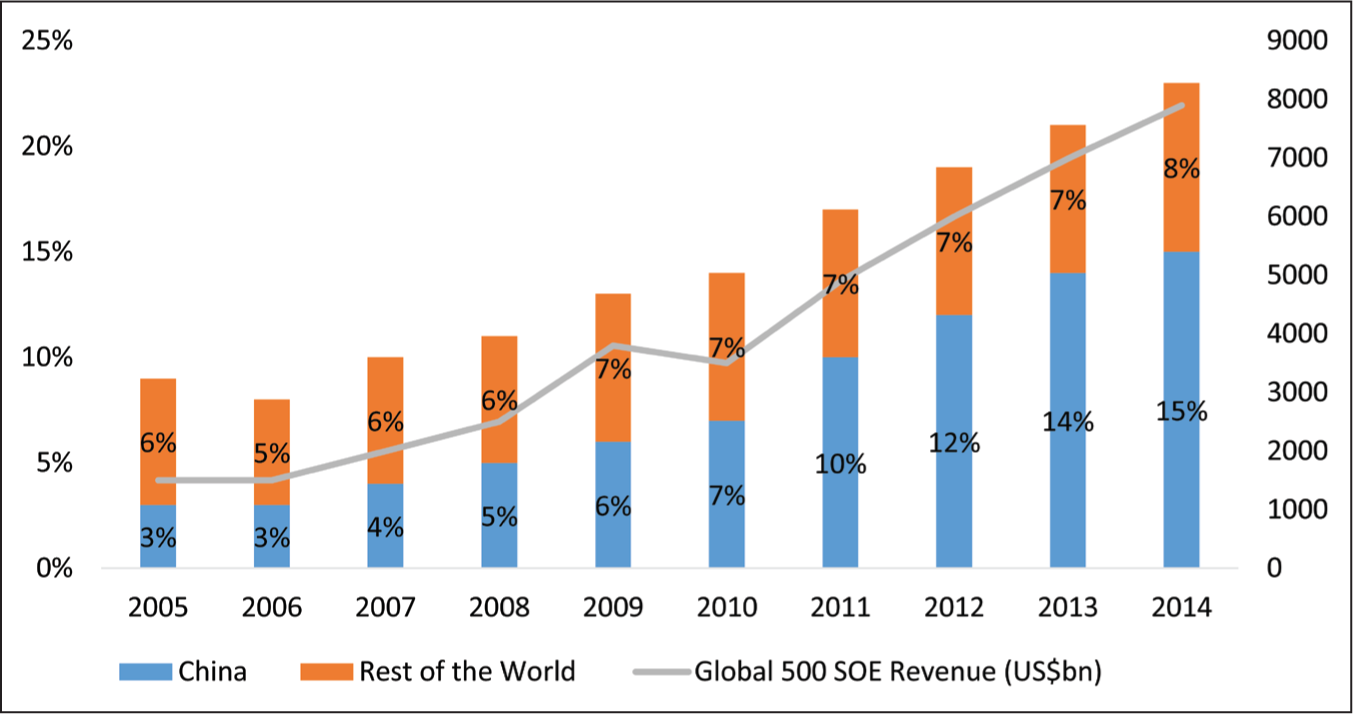
China experienced the largest share increase from 7% to 10% between 2010 and 2011 and reached 15% by 2014%. The rest of the world moved from 6% in 2005 to 8% by 2014. Figure 1 shows that China’s increasing shares in the Fortune Global 500 exceed the rest of the world. This is evident in that ‘three Chinese SOEs (Sinopec Group, China National Petroleum and State Grid) have consistently made the top ten since 2010 and contributed 16% of total revenues from the 114 SOEs on the list in 2014’ (PWC 2015, 9). Notably, the activities of these SOEs are in critical industries pursued on an international landscape, such as financial services, petroleum refining and utilities. The global financial crisis broadened the focus on financial services by forcing developing economies to rely on domestic financial resources to cushion against global economic volatilities. Further to this, unlisted companies contribute approximately 29% of the total value of all SOEs (Kowalski et al. 2013).
Linking the objective of SOEs with the required social and economic developmental outcomes is the primary function of governments. In a CEO Pulse survey, the PWC (2015) finds that private-sector CEOs encourage SOEs’ social and economic developmental role by providing the necessary infrastructure for development, advancing social outcomes and creating stability during the socio-economic crisis. As such, SOEs ‘should not be purely evaluated only based on financial results (the profit and loss account), but more widely on how they contribute to societal value creation, taking an integrated and holistic view of their impact’ (PWC 2015, 6). However, due to governance challenges that undermine SOEs’ social and economic impact, many countries have moved to the corporatisation of SOEs by applying private-sector instruments such as strict financial reporting and board management standards (Baum et al. 2019). This approach is adopted to improve SOEs’ corporate governance and accountability in the face of the weak interface between the government and the bureaucrats tasked with running SOEs, yet also limiting the socio-economic contribution of SOEs.
SOEs in South Africa’s Economic Development
With over 300 state companies, South Africa has one of the largest SOEs globally (Balbuena 2014). In the early 1900s, the country established a set of economically driven and recognisable SOEs linked to the mineral complex, especially iron steel, chemicals, electricity and steel, which would serve as the beacon of industrialisation. The social and economic objective of the industrialisation instituted by SOEs established by the government representing the white working class sought to promote the socio-economic position of poor whites and Afrikaners (Todes and Turok 2018). An important observation is that these SOEs were specifically designed to encourage industrialisation and make a significant social and economic contribution to the lives of the select racial groups, thereby cementing the developmental role of SOEs. Towards the end of the apartheid era, the National Party began a series of privatising SOEs, which also formed essential clauses in the negotiation period designed to disadvantage the role of the post-apartheid state in the economy (Gumede, Govender, and Motshidi 2016). This led to the privatisation of crucial SOEs such as the Iron and Steel Industrial Corporation (ISCOR) and petrochemical company Sasol, which later negatively affected the country’s steel industry.
The public value of SOEs can be destroyed if best practices and accountability are not promoted by the owning government (PWC 2015). While the National Development Plan or NDP (NPC 2012) highlights that SOEs have been weak and subject to questionable appointment processes and political interference, many South African SOEs have not improved, thus leading to the call for privatisation and restructuring. The leading criticism against SOEs is related to governance deficits and the high level of rent-seeking, which diverts resources from serving national developmental goals to serving individual and rent-seeking interests (Singh and Chen 2018). These governance challenges are evident in the widely documented state-captured debacle surrounding SOEs and government departments, where rent-seekers allegedly played a significant role in influencing board appointments to SOEs and the supply chain processes (Khambule 2021). In a cross-country analysis of the costs of corruption in SOEs, Baum et al. (2019) find that the performance of SOEs is equivalent to that of private firms when corruption is low.
Profitability is a determining factor in the performance of SOEs, and privatisation is encouraged for financially ailing SOEs (Estrin and Pelletier 2015; Richmond et al. 2018). However, some researchers argue that the social and economic impact of SOEs should be the main determining factor (Baum et al. 2019; PWC 2017, 2015). Improved governance should complement the social and economic impact of SOEs. However, most of the literature on SOEs in South Africa mainly focuses on governance deficiencies as the main reason to privatise SOEs, particularly without concentrating on the current social and economic impact of SOEs in the development landscape.
Another fundamental problem is the generalisation of the governance of SOEs, whereas only a few SOEs, such as Eskom, PRASA, Denel and the South African Airways, are thoroughly studied. While the country has over 300 SOEs, there is little to no information on the activities, contribution and socio-economic impact of the academically neglected SOEs. This led to the adoption of a principle that pins the considerations for recapitalisation of SOEs to be benchmarked on assessing the utilisation of bailout funds based on key performance indicators (National Treasury 2019). Thus, the fundamental problem is that SOEs that fail to manage their finances lead to further failures such as the inability to generate sufficient revenues for operational costs and capital investment, thereby leading to no public value and reduced social and economic impact. It becomes important to explore the social and economic impact of these SOEs to contribute to the knowledge on the socio-economic impact of SOEs.
The Case Study of the IDC
The IDC is one of South Africa’s most important social and economic development players due to its role in the economic development landscape. Established in 1940, the IDC was mainly a state-owned corporation focusing on development finance to promote industrial development. This aligns with the use of SOEs to finance the core public infrastructural services and industrial businesses capable of producing multiplier effects in the economy. According to the Trade and Industrial Policies Strategies/TIPS (2019), the main objective behind the establishment of the IDC was to avail finance for local enterprises due to the absence of capital investment to establish a secondary sector in the 1940s. The apartheid government extended the scope of the IDC from merely focusing on financing local enterprises to the development of domestic industrial capacity. The new IDC mandate ‘prioritised the development of large-scale strategic projects considered too big to be undertaken by the private sector in the chemicals and energy sectors, and probably not very profitable during their early years of operation’ (TIPS 2019, 10).
Because industrial policies emphasise innovation and the development of products capable of upscaling the industrial sector, the IDC played an essential role in establishing successful SOEs in chemicals and steel and coordinating industrial activities among different industries. The IDC utilised various incentives to support local enterprises and the industrial sector through interventionist programmes. These incentives included lower interest rates on their loans and subsidies to maximise social and economic development impact (Todes and Turk 2018). The IDC introduced various interventions, such as establishing manufacturing factories in the Bantustans to create job opportunities and discourage the movement of Africans to the city (Glaser 1987). In post-apartheid South Africa, the role of the IDC in industrial development has been treated as a catalyst for achieving structural transformation and building a globally competitive economy. The IDC is at the centre of realising the NDP’s vision and the Industrial Policies Action Plan’s (IPAP) targets due to its strategic role in identifying and coordinating high-impact projects (IDC 2020).
The Social and Economic Impact of the IDC’s Entrepreneurial Support
The IDC provides funding to many sectors linked to the industrial economy throughout the continent. While many African SOEs tend to focus on domestic investments, the IDC expanded its development finance role to the African continent by investing over $2 billion on 41 projects across Africa from 2001 to 2010 (Qobo and Soko 2015). The IDC made investments in critical sectors such as telecommunication, tourism, agriculture and manufacturing within the African continent to demonstrate its commitment to internationalisation.
With the large volume of development finance applications, reports show that the IDC received SOE-approved 1001 applications to the value of R68 billion between 2013 and 2017 (IDC 2020). This investment resulted in more than 344,006 direct and indirect jobs and an additional 32,155 jobs being created in rural areas. Table 1 reveals the breakdown of the funding disbursed to the various sectors.
IDC Finance to Industries 2013–2017.
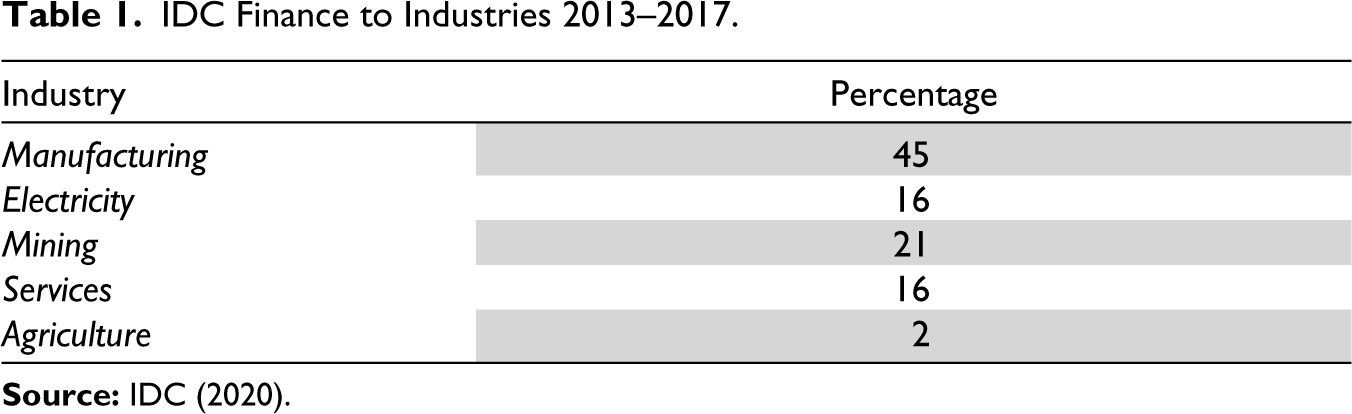
As evident from Table 1, most (45%) of the funding went into the manufacturing industry. The government identified manufacturing as the backbone for the millions of employment opportunities the country needs to create. The country’s manufacturing output was $43.2 in 2018, the lowest among its BRICS peers. As per the World Bank (2019), the manufacturing output within the BRICS countries is divided as follows: Brazil ($180.54), Russia ($203.99), China ($4,002.75) and India ($408.69). South Africa also had the lowest share of manufacturing output among its emerging and developing markets peers (Kaplan, 2019). The mining sector received the second-largest share (21%) of the funding, followed by the services and the energy sectors at 16%, respectively. The lowest share (2%) of the funding went to the agriculture sector. These funding statistics show that the country continues to enrol in massive financing for manufacturing because the manufacturing share of GDP has been on the decline.
The IDC’s commitment to supporting sustained economic growth and development in South Africa is reflected in the R6 billion invested in South Africa’s Framework Response to the Global Economic Crisis (TIPS 2019). This type of financial activism led to the cushioning of the country’s businesses during the 2007–2008 global financial crisis by financing distressed companies, thereby limiting economic shocks and employment loss (Khambule 2021). This is evident in the case of Quality Steel in Nelspruit, which received a R20 million windfall from the IDC amid the global financial crises. The funding from the IDC ensured the company could sustain its operations, procure computerised machines, build new offices and engage in bigger projects such as steel contracts worth R14 million (IDC 2020). The benefits of the new equipment made Quality Steel competitive and resulted in reducing labour costs by R4,000 per ton, doubling the output from 50–70 tons a month to 100–150 tons (IDC 2020). As such, the role played by the IDC in mitigating the financial crisis effect is underpinned using state ownership as a crisis response in a volatile global economic environment to save selected companies and jobs in key industries.
In the bid to facilitate the emergence of new industries over the past 20 years (2000–2020), the IDC spent over ‘R128 billion (R204 billion in 2013 prices) to firms, supporting the creation of 360 000 direct jobs over the period and saving an additional 43 000 jobs’ (TIPS 2019). In addition to the already visible social, economic and investment impact, the IDC funding expanded its development finance commitment to R100 billion per five-year cycle as part of the new IPAP to accelerate cross-societal development (DTI 2018). Societal impact is also demonstrable through the Black Industrialists Programme (BIP), which supports emerging black industrialists (DTI 2018; IDC 2020). The BIP was established to be at the epicentre of driving transformation in the ownership patterns of the economy and is listed in the IDC’s annual report. As an SOE, the IDC demonstrates a commitment to ensuring that its investment will materialise the required social and economic outcomes to address the triple challenges of unemployment, poverty and inequality.
The country’s SOEs have an ‘enabling role in supporting the general economic and industrial effort by providing competitive and efficient electricity, rail and port logistics’ (DTI 2018, 5). However, the performance of entities key to industrialisation, such as Eskom and PRASA, has been catastrophic for the country’s economy because of the rampant corruption and poor results. The energy challenge experienced by the country is a setback for the entire economy, particularly in the manufacturing industry. Without sustainable electricity, the economy cannot function to its full capacity, as evident in the load shedding that has engulfed the country. To fill this gap, the IDC funded the Kakamas Hydro Electric Power (KHEP) project in the Northern Cape to support the country’s green industries by using water to generate 10 megawatts (MW) of electricity. Despite the plant having a capacity of 12.75MW, it cannot produce it because of the Department of Energy regulations. The project is estimated to have a capital amount of R150 million and will form part of the country’s renewable energy initiatives with the potential to light up 5,000 homes in Nelspruit (IDC 2020). The project is further essential in building the country’s industrial capacity for renewable energy and contributing to addressing climate change problems.
To respond to the economic potential of underinvested regions to help lagging regions catch up economically, the IDC set up various support mechanisms, such as the establishment of regional economic development agencies (IDC 2008, 2020). Furthermore, the IDC targets the new Special Economic Zone (SEZ) policies to enable institutional and economic capabilities of manufacturing outputs and contribute to the country’s ailing manufacturing sector to put an impetus on the country’s export-oriented products. Two IDC-funded industrial projects to the value of R700 million started operations in the Coega Industrial Development Zone (IDZ; now functions under SEZs). These SEZs focus on renewable energy efforts and metals beneficiation cited as industrial priorities (DTI 2018). This demonstrates that IDC uses a development-oriented approach to coordinate industrial planning between regional and national industrialisation prospects. The Coega IDZ is a strategic zone to revive the manufacturing sector based on IDZ’s excellent infrastructure, investor-friendly environment and a large workforce with extensive experience in manufacturing (Kaplan 2019).
The Case Study of the DBSA
The DBSA is one of the largest state-owned contributors to economic development in South Africa, mainly through the capacity it brings to economic development. The apartheid government created the DBSA in 1983 to coordinate economic development, growth and regional integration through actively financing infrastructure development (DBSA 2015, 2019). The establishment of the DBSA coincided with the growing pressure that the apartheid government faced, which led to the government embarking on widespread infrastructure development to boost the ailing economy due to international sanctions. It also coincided with the growing revolt against the apartheid government by Africans, which led to a focus on infrastructure investment in the Bantustans to attenuate the ever-increasing social and economic unrest. The mission of the DBSA is aimed at maximising social and economic impact by improving the quality of life through providing social infrastructure and supporting economic growth by investing in economic infrastructure (DBSA 2019). This reflects the government’s commitment to using SOEs to deliver inclusive social and economic developmental impact.
The mandate of the DBSA is derived from the Development Bank of Southern Africa Act, No. 13 of 1997 (Amended Act No. 41 of 2014) (DBSA Act). In post-apartheid South Africa, the bank’s mandate expanded to delivering developmental infrastructure as it is in line with the country’s NDP. The DBSA’s strategy is informed and aligned with the African Union’s Agenda 2063, the United Nations’ Sustainable Development Goals (SDGs) and the Paris Agreement on Climate Change (DBSA 2019). Aligning with these strategic objectives confirms the DBSA is oriented towards playing a decisive role in promoting inclusive development. A fundamental role for the DBSA is to play a brokerage role in the economic development landscape by bridging the private–public divide by providing critical infrastructure to amplify the government’s social and economic impact. The capacity of the DBSA is acknowledged because of its experience in managing national projects such as the Infrastructure Investment Programme for South Africa (IIPSA), funded by the European Union (DBSA 2019).
The Social and Economic Impact of the DBSA’s Infrastructure Investment
Strategically, the DBSA performs the most important task of SOEs in developing nations, which is to create a conducive environment to attract investment and encourage economic development through the provision of the necessary infrastructure to unlock economic potential. In line with the developmental mandate of other key SOEs such as Transnet, PRASA, Eskom, among other things, the DBSA’s mission is to:
Improve the quality of life of people through the development of social infrastructure, Support economic growth through investment in economic infrastructure, Support regional integration and Promote sustainable use of scarce resources (DBSA 2020).
The provision of social and economic infrastructure is one of the most fundamental roles of the DBSA because investment in public infrastructure yields positive outcomes for the country’s economic growth and development. Various studies have pointed to the existence of an abundance of infrastructure as one of the main drivers of economic growth, development and mass employment between developed nations and developing nations and between cities and underdeveloped areas (Acemoglu and Robinson 2013; Todes and Turok 2018). For such reasons, the DBSA’s investment is spatially targeted at lagging regions to improve the quality of life for many people in rural areas by providing social and economic infrastructure. The DBSA does this by playing multiple roles, such as financing, advising, being a co-implementer, mobilising finance and using its expertise to accelerate development projects (Public Sector Manager 2011).
The DBSA plays an essential role in supporting investment shortfalls and extending its development finance support to the entire South African Development Community (Qobo and Soko 2015). In its mission to contribute to social and economic development, the DBSA worked with strategic partners such as the African Development Bank (ADB) to fund major infrastructural projects capable of accelerating industrialisation and structural transformation. Given the importance of domestic development finance SOEs, the DBSA plays an instrumental role in making up for the lack of local resources to finance and undertake the required infrastructural investment to unlock the country’s economic potential. The DBSA delivered infrastructure valued at R3.3 billion in 2018 and infrastructure improvement of 65 clinics to meet the country’s envisaged standards for the National Health Insurance scheme (DBSA 2019). This also includes the more than R3.2 billion spent on black-owned businesses to transform the country’s skewed ownership patterns of the economy, thereby signalling a string commitment towards radical economic transformation and redress.
A fundamental challenge for the African continent has been the inability to use investments for structural transformation because of the conditions that often-accompanied development finance to the continent. Domestic resources for development finance through SOEs such as the DBSA are ‘uniquely powerful form of finance for development because they can be spent at the discretion of Governments in the pursuit of national development strategies, and can be invested in efforts to combat poverty and achieve other development objectives without requiring a short-term financial return’ (UNECA 2017, 5). This underscores the continued commitment of the DBSA as its investment has led to half a million households benefiting from funds disbursed to municipalities. It has also built 8 new schools, more than 47,000 students benefiting from refurbished schools and the employment of 1,087 local small businesses and subcontractors in DBSA’s construction projects (DBSA 2015). Further to this, the DBSA is responsible for funding over 120,000 housing units for the poor and the continued support of building a rapid transit system in urban areas (DBSA 2016). These statistics indicate the social and economic impact of the DBSA in the development landscape, with a primary focus on social infrastructure to enable citizens to improve their capabilities.
The role of the DBSA as an institutional capacity enabler is evident in the SOE’s activities in strengthening the capacity of the local government sphere to plan and coordinate economic development policies. This is evident through the DBSA’s Local Economic Development Fund assisting municipalities with limited resources to tap into their economic potential and support the municipal infrastructure grant, such as R415million in 2015 (DBSA, 2015). Such an approach is instrumental in supporting under-capacitated municipalities to deliver quality and uninterrupted developmental services. Evidence of such initiatives is notable through projects, such as the Siyeza Manje and Vulindlea, designed to improve the governance capacity, infrastructure delivery and financial management of local government (Gumede, Govender, and Motshidi 2011). These strategic initiatives are important because South African municipalities are mired in incapacities and can barely manage their municipal entities compared to municipal SOEs in Sweden and Germany. In these two countries, municipal SOEs contribute the largest to economic development and employment in contrast to centrally owned SOEs (PWC 2015).
The DBSA delivered its highest recorded development impact in 2016 when it completed 70 infrastructure projects related to essential services such as water, electricity, sanitation and roads to under-resourced municipalities, with immediate benefits to more than 63,000 households (DBSA 2016). Essential services such as water, sanitation and electricity are among the leading drivers of multidimensional poverty in South Africa (Statistics South Africa, 2016). The role of the DBSA is to supplement the provision of these essential infrastructure services and demonstrate the commitment to improving the quality of life for many citizens. In a bid to support municipalities, R8.1 billion was disbursed to municipalities in the 2014–2015 financial year, with R1.2 billion approved for secondary municipalities, more than R600 million disbursed to secondary and under-capitated municipalities for the creation of 5,250 job opportunities, and 63,242 households are planned to benefit from ongoing projects (DBSA 2016). These strategic initiatives cannot be achieved without the interventionist role of the state through SOEs such as the DBSA, particularly with an emphasis on improving the social and economic infrastructure of poor areas where there is limited infrastructure investment.
South Africa ascribes to the SDGs because it faces common developmental challenges like any other emerging and developing nation. The developmental role of the DBSA is important because it is linked to national and international development goals such as the NDP and the SDGs. As evident from Table 2, the DBSA coordinates specific development projects in line with national objectives.
The DBSA’s Contribution to Meeting SDGs and NDP Outcomes.
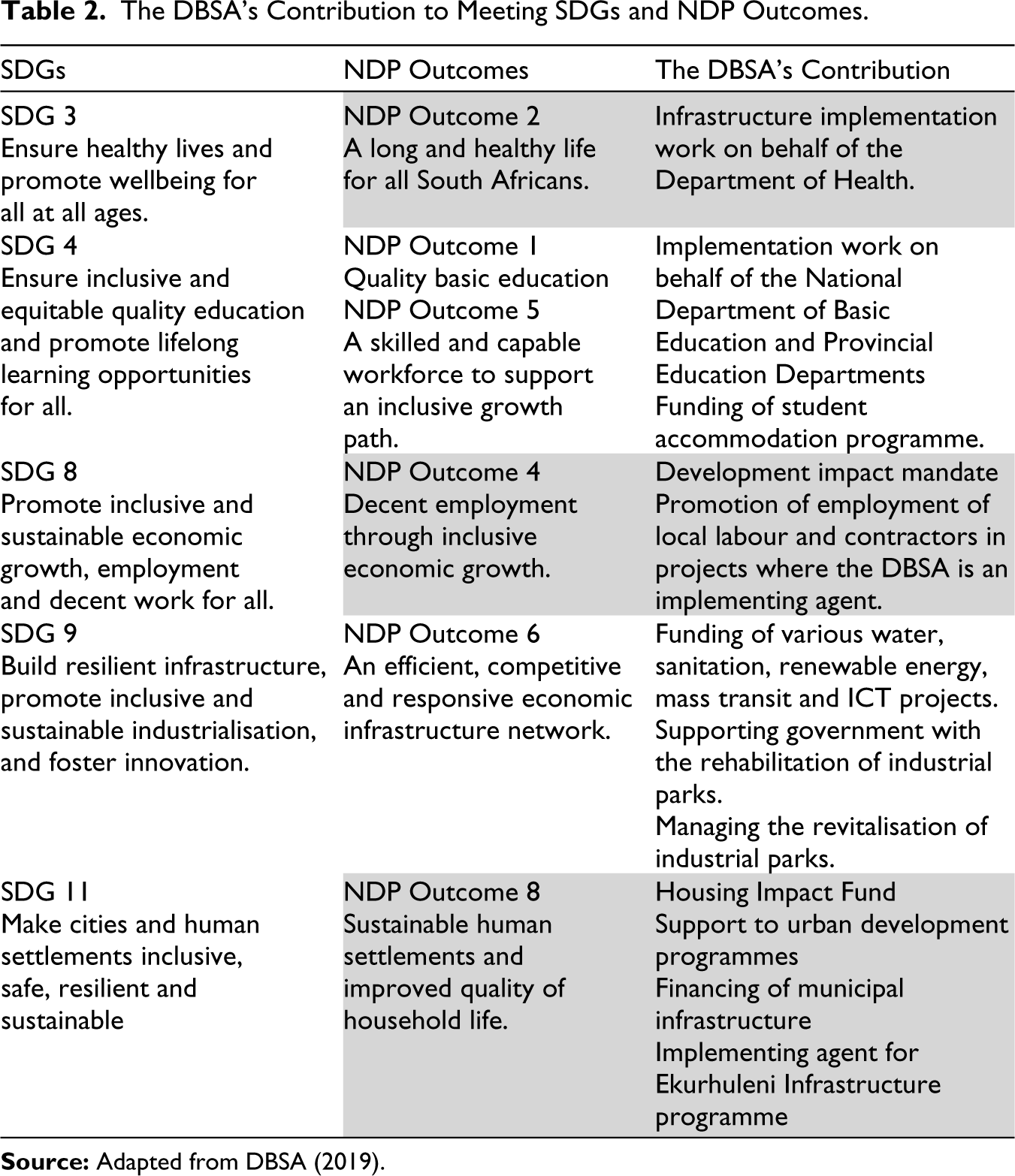
Because of its mandate as an SOE focused on development finance and infrastructure development, the DBSA plays an essential role in ensuring that the country meets its developmental ambitions. As evident from Table 2, the DBSA contributes to meeting goals such as providing resilient social and economic infrastructure through supporting various infrastructural projects with a particular focus on poor regions to ensure inclusive and sustainable development. The DBSA undertakes the promotion of sustainable human settlement pinned in the SDGs and NDP through the Housing Impact Fund, which has benefited more than 100,000 households (DBSA 2016, 2019). The provision of the DBSA as an SOE that promotes economic growth and development has yielded significant social and economic challenges for the country as evident in the impact of the DBSA on infrastructure delivery. As such, the impact of government SOEs on the development landscape cannot be understated despite the ongoing failure of other key SOEs.
Discussion
The IDC and the DBSA case studies demonstrate the importance of SOEs in driving national development and achieving societal goals. This is in line with the use of SOEs to unlock economies of scale by channelling capital into building industries where the start-up costs are high (PWC 2015). This is evident in establishing the IDC to build a secondary sector around the mineral complex to support the country’s industrialisation at the height of private sector financial risk aversion in the late 1930s. This approach was geared towards supporting and making a social and economic impact on the lives of the white and Afrikaner population (Todes and Turok 2018). This was also evident in the IDC’s investment in the Bantustans when most of the investment was directed towards cities, thereby establishing new regional economic nodes in rural areas designated for Africans. However, a significant contribution to this date is the continued support to lagging regions to address the country’s spatial inequalities through spatially targeted initiatives such as SEZs, LEDAs and IDZs addressed by both SOEs. These regional initiatives complement the country’s industrial decentralisation by spreading development to targeted regions supported by the IDC, as evident through the Coega IDZ (Kaplan 2019).
The use of SOEs to jumpstart industrialisation and accelerate economic development and structural transformation is one of the most notable successes of the state-led development model. This was evident in East Asian countries such as Singapore, Taiwan, Indonesia, South Korea and Japan, where SOEs were critical in stimulating economic development through mass investment in infrastructure and technologies (Chang and Zack 2018; Thurbon 2020; Wade 2018). The vital role of SOEs in these countries demonstrates the potential social and economic development impact derived from SOEs, instilling the focus on the broader societal value of SOEs rather than only focusing on financial results and the profit maximisation stance. The socio-economic benefit of the infrastructure support provided by the DBSA is that it contributes to delivering water, electricity, road and schooling infrastructure in support of under-performing municipalities (DBSA 2015, 2016, 2019). This impact is significant because a lack of essential services, such as water, electricity and schooling opportunities are some of the main drivers of South Africa’s multidimensional poverty and undermine the growth of businesses. The DBSA can be argued to be aimed at addressing drivers of multidimensional poverty by providing the infrastructure necessary for improving the quality of life
IDC case study reveals the importance of using government resources to coordinate industrial development for structural change, focusing on key industries to national development goals. Most of the IDC-related funding is towards the manufacturing industry in the bid to create low-skilled manufacturing jobs to address the country’s high unemployment rate (DTI 2018; Kaplan 2019). Further to this, the IDC demonstrates an innovative approach by diversifying to industries such as telecommunication in the age of digitalisation and petroleum, which have been a source of economic growth and development for countries such as Singapore, China and the United States. Another significant contribution of the IDC that cannot be ignored is the bailout of businesses during the 2008 financial crisis. This is in accordance with Calice’s (2013) ‘counter-cyclical’ role of SOEs and development finance institutions in times of economic crisis. This role had a positive impact on ensuring social and economic stability as South Africa is one of the few countries that managed to escape the global financial crisis with minimal job losses.
While the IDC and the DBSA perform financially better than almost all SOEs in South Africa, the use of financial results to evaluate the performance of these SOEs might result in neglecting the social and economic impact made by these entities. This argument is based on the observation that SOEs are not predominately driven by profits like private firms (PWC 2017; Stiglitz 2008). Evidence also shows that private firms do not offer substantial social and economic returns as they are driven by profit maximisation interests that result in employing fewer people and play a limited role in social development (Ritchken 2014; Stiglitz 2008). In Brazil, the privatisation of more than 119 state-owned firms (including minority stakes) brought little social and economic impact as it was accompanied by high profits and minimal employment opportunities (Anuatti-Neto et al. 2003). The case studies of the two SOEs demonstrate the importance of moving away from mainly evaluating the performance of SOEs based on their financial results without emphasising the social and economic impact. The focus on financial results is a reductionist approach that has adverse effects. It ignores the social and economic contribution of SOEs to the public because it uses corporate means of assessment (such as profit maximisation). Essentially, this requires a shift away from dealing with governance deficits from a corporate perspective to dealing with these deficits from a social cost perspective that considers the impact of corruption on societal needs. In Latin America, privatisation led to increased profits, but less social and economic impact as the welfare of workers declined. Privatisation also reduced wages and employment in Brazil (Arnold 2019). The default role of privatising SOEs that have not completed their social and economic mandate should be abandoned because the process has not resulted in improvement in citizens’ lives. However, the significance of sustainable results should also be emphasised because the financial standing of SOEs has an impact on the ability to deliver social and economic developmental outcomes.
The limitation of this article is that it uses pre-pandemic data. An important consideration emerging from this study is the need to consider the behaviour of state institutions during the COVID-19 pandemic in developing countries to determine their contribution to fighting the scourge of the pandemic. As such, further studies can explore that component as it impacts the state and development.
Conclusion
SOEs are essential engines of stimulating economic growth and development by providing the necessary infrastructure to attract investment and limit the cost of doing business across developing nations. Infrastructure investment is important because it enhances access to services for the citizens and businesses in the economic development process. Based on reviewing and analysing the social and economic activities of the IDC and the DBSA from the annual reports, it emerged that both SOEs play a fundamental role in building institutional and infrastructural readiness for stimulating economic development. The IDC plays an essential role in coordinating and supporting the country’s industrial development capacity by identifying and funding economically viable and high-impact projects that can facilitate the emergence of new industries to enhance the country’s diverse industrial economy.
The social and economic development impact of the DBSA can be considered the primary role of SOEs as it focuses mainly on investing in social and economic infrastructure that leads to improved quality of life and economic growth. As an institutional enabler, the DBSA makes valuable social and economic contributions evident in its wide-scale investment in transforming poor regions through infrastructural provisions. This is evident in the support the DBSA gives to under-capacitated municipalities and its role in funding critical infrastructure capable of improving people’s socio-economic conditions, such as water, electricity, roads, schools and health facilities. However, the role of the state and development can only be effective if all SOEs play their roles efficiently. It is important to build SOEs that can balance the social and economic impact delivery with improved financial results.
Footnotes
Declaration of Conflicting Interests
The author declared no potential conflicts of interest with respect to the research, authorship and/or publication of this article.
Funding
The author received no financial support for the research, authorship and/or publication of this article.